Why Arabian Traditional Dress Remains Important in Modern Society
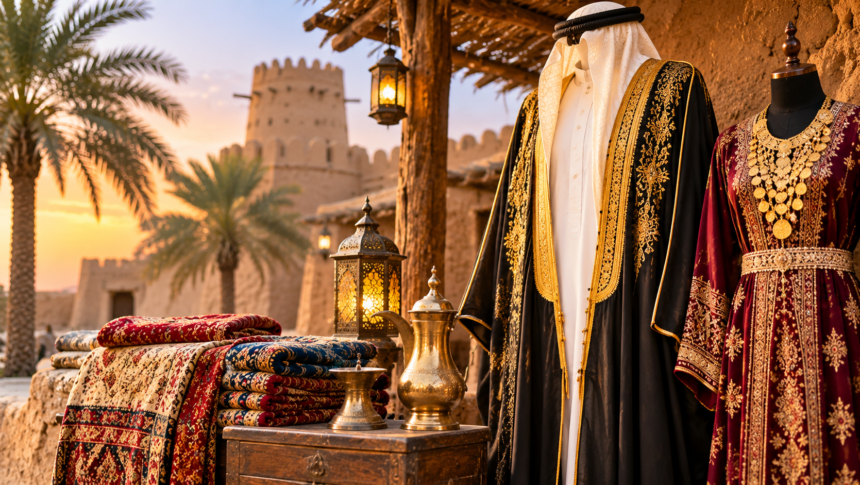
Traditional Arabian clothing is more than a way of dressing. It represents centuries of cultural heritage, regional identity, craftsmanship and adaptation to life in the Arabian Peninsula. From the flowing white kandura of the United Arab Emirates to the embroidered dresses of Saudi Arabia and the distinctive dishdasha of Oman, every garment has a story connected to the people who wear it.
- 1. How the Arabian Peninsula’s Climate Shaped Traditional Clothing
- 2. The History of the Thobe, Kandura and Dishdasha
- 3. How Traditional Arabian Women’s Clothing Developed Over Generations
- 4. The Cultural Meaning of the Ghutra, Shemagh, Agal and Traditional Headwear
- 5. How Trade Routes Influenced Arabian Fabrics, Colours and Embroidery
- 6. Why Traditional Arabian Clothing Became a Symbol of Cultural Identity
- 7. How Traditional Arabian Clothing Has Changed in the Modern Gulf
- 8. Why Preserving Traditional Arabian Clothing Matters for Future Generations
- Conclusion: Traditional Arabian Clothing Connects the Past With the Present
Today, traditional clothing remains an important part of daily life across the Gulf Cooperation Council (GCC). In countries such as Saudi Arabia, the UAE, Qatar, Kuwait, Bahrain and Oman, many people continue to wear garments that reflect their cultural identities while adapting to modern lifestyles.
However, Arabian clothing has never been completely uniform. Its styles developed differently among desert communities, coastal traders, mountain populations and urban families.
Climate played an important role in shaping these garments. Loose-fitting clothing helped people manage heat and sunlight, while different fabrics and layers provided comfort across changing seasons.
Trade also influenced fashion. The Arabian Peninsula’s connections with India, Persia, East Africa and other regions introduced new textiles, embroidery techniques and decorative styles.
Over time, clothing became a way to communicate local identity, social traditions, craftsmanship and the importance of particular occasions.
A historical feature published in Saudi Aramco World documents how the clothing traditions of the Arabian Peninsula developed through a combination of geography, history, local customs and influences from international trade. archive.aramcoworld.com
Today, the history of traditional Arabian clothing can be explored through museum collections, historical garments, family traditions and the work of contemporary designers.
Understanding this history reveals how clothing has connected generations while continuing to evolve with the modern Gulf.
1. How the Arabian Peninsula’s Climate Shaped Traditional Clothing
The climate of the Arabian Peninsula has influenced clothing for generations.
Much of the region experiences hot summers, strong sunlight and dry desert conditions. In coastal areas, humidity can create additional discomfort, while mountain regions and desert nights may become considerably cooler.
These different environments encouraged the development of garments that balanced protection, comfort and practicality.
Why loose-fitting garments became common
One of the most recognisable characteristics of traditional Arabian clothing is its loose shape.
Long garments provide coverage while allowing movement and leaving space between the fabric and the body.
Depending on the material, fit and surrounding conditions, this design can support comfort in warm weather.
Garments such as the thobe, kandura and dishdasha developed into familiar styles across much of the Arabian Peninsula.
However, the exact shape, neckline, sleeves and decorative details vary between communities.
The importance of fabric
Cotton became an important material for many everyday garments because of its comfort and practicality.
Other fabrics, including linen, wool and silk, have been used for different purposes and occasions.
The materials available to communities also depended on trade, income and local production.
For example, garments intended for everyday activities might use practical, relatively lightweight fabrics, while clothing for weddings or formal events could feature more elaborate materials.
Protection from sunlight and environmental conditions
Head coverings became important elements of traditional dress in many Arabian communities.
Cloth head coverings could help shield the head and neck from direct sunlight and blowing dust.
However, their cultural significance eventually extended beyond practical protection.
Different arrangements and styles became associated with local identity and customary dress.
Clothing for different environments
Traditional attire also reflected the distinction between desert, coastal and mountain life.
People living in mountainous areas sometimes required warmer clothing or additional layers.
Oman’s National Museum documents traditional garments from the Hajar Mountains, including cloaks made with wool or goat hair. nm.gov.om
These examples show why Arabian clothing cannot be explained through desert conditions alone.
| Environmental condition | Traditional clothing response |
|---|---|
| Strong sunlight | Long garments and head coverings |
| Hot weather | Loose-fitting clothing and suitable fabrics |
| Wind and dust | Adjustable head coverings and protective layers |
| Cooler desert nights | Additional outer garments |
| Mountain environments | Warmer fabrics and cloaks |
| Coastal communities | Clothing shaped by climate and trade connections |
Practical clothing choices gradually became established cultural traditions, but their forms continued to change across generations.
2. The History of the Thobe, Kandura and Dishdasha
The long garment worn by many Arabian men is among the region’s most recognisable forms of traditional clothing.
Depending on the country and local terminology, it may be called a thobe, thawb, kandura, kandora or dishdasha.
Although these garments share similarities, their tailoring details can distinguish one regional style from another.
The Saudi thobe
In Saudi Arabia, the thobe is a central element of men’s traditional dress.
It is generally a long, loose garment with sleeves, commonly worn in white, although other colours are also used.
Its design can vary in collar shape, front fastening and tailoring.
Saudi Arabia’s national encyclopaedia, Saudipedia, describes the thobe as a traditional garment with an important place in the country’s national identity. Saudipedia
The modern Saudi thobe is the product of continuing development rather than an unchanged garment from one particular ancient period.
The Emirati kandura
The UAE’s traditional men’s garment is commonly called the kandura.
It is typically long and loose, with styles that may include a distinctive neckline and front tassel.
The garment is frequently white, although people may choose other colours for seasonal or personal reasons.
Visit Dubai identifies the kandura, also known as the dishdasha, as a traditional garment worn by Emirati men. Visit Dubai
For many Emiratis, it remains ordinary daily attire rather than clothing reserved exclusively for ceremonies.
The Omani dishdasha
In Oman, the dishdasha has its own recognisable tailoring tradition.
The Omani national garment is generally ankle-length and collarless, with long sleeves.
A distinctive feature of many styles is the small decorative tassel at the neckline, commonly called the furakha.
The Sultanate of Oman’s Ministry of Information describes the dishdasha as a central element of the country’s national dress. Sultanate of Oman – EN
Why these garments remain important
Long robes are often associated with the wider Arab world, but their local variations communicate distinct identities.
A person familiar with Gulf clothing may recognise differences between Saudi, Emirati and Omani garments through details of the cut, collar, stitching and accessories.
| Country | Common garment name | Distinctive association |
|---|---|---|
| Saudi Arabia | Thobe | National men’s dress with different tailoring styles |
| UAE | Kandura or kandora | Emirati everyday and formal attire |
| Oman | Dishdasha | Recognisable collarless design and neckline details |
| Kuwait | Dishdasha or thobe | Local tailoring traditions |
| Bahrain | Thobe | Gulf dress with regional variations |
| Qatar | Thobe | Traditional men’s attire with locally preferred styles |
These differences reflect the history of local communities and tailoring rather than completely separate clothing traditions.
3. How Traditional Arabian Women’s Clothing Developed Over Generations
Women’s clothing across the Arabian Peninsula has a rich history involving layered garments, decorative embroidery, colourful fabrics and regional styles.
Although the black abaya is now one of the most recognisable forms of clothing in many Gulf countries, women’s traditional dress has never consisted of a single design.
Historical garments often featured bright colours, detailed stitching and carefully selected accessories.
The development of the abaya
The abaya is a loose outer garment worn by many women in the Arabian Peninsula.
Today, it is frequently associated with black fabric, although contemporary versions may use different colours, cuts and decorative elements.
Its history is more complex than the idea that all Arabian women have always worn the same black cloak.
Traditional clothing practices differed according to community, location and period.
Historical Emirati garments included layered dresses, embroidered trousers and head coverings, with outer clothing varying across generations. The Zay Initiative
The Emirati mukhawar
The mukhawar is a distinctive traditional Emirati women’s dress associated with decorative embroidery.
It may feature elaborate patterns around the neckline and sleeves.
The garment reflects the importance of textile craftsmanship in Emirati heritage.
It continues to appear during cultural occasions, family gatherings and celebrations.
Saudi Arabia’s regional women’s clothing
Saudi Arabia has a particularly diverse history of women’s traditional dress.
Different regions developed distinctive garments influenced by local customs, available materials and trade relationships.
Historical clothing from Najd, Hijaz, Asir and the Eastern Province includes variations in embroidery, colour, layering and headwear.
Saudipedia explains that the country’s regions have separate clothing traditions rather than one identical historical costume for all Saudi women. Saudipedia
The colourful thobe al-nashal
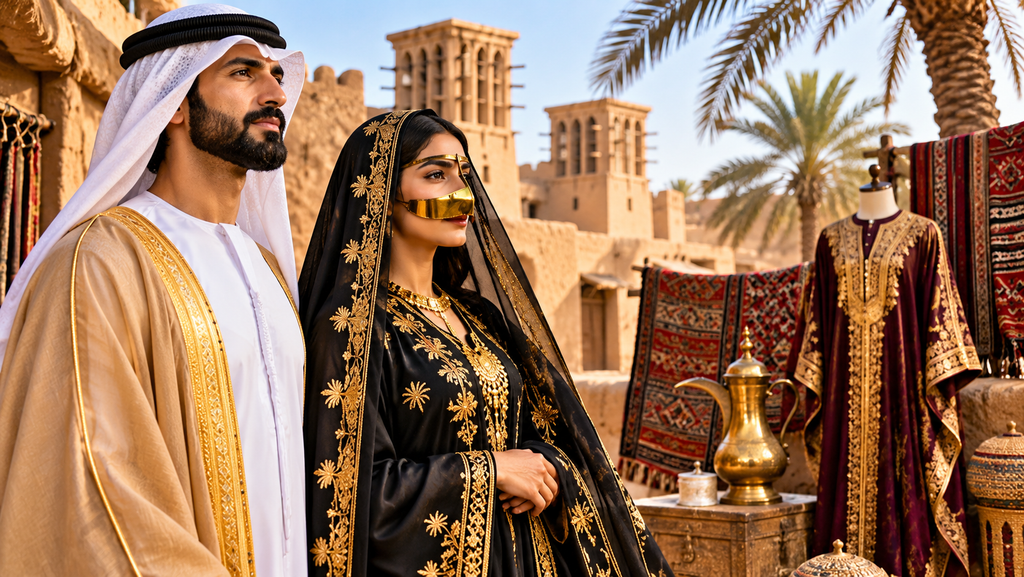
The thobe al-nashal is a traditional women’s garment associated with the Gulf, particularly Bahrain and neighbouring areas.
It is known for its flowing design and elaborate embroidery, often using gold-coloured threads.
Such garments are associated with celebrations and cultural heritage.
Historical textile research published in AramcoWorld describes the importance of embroidered women’s thobes across the Gulf, including variations in colour, layering and construction. aramcolife.com
Traditional women’s clothing across the Gulf
| Garment | Cultural association | Recognisable feature |
|---|---|---|
| Abaya | Widespread across Gulf countries | Loose outer garment |
| Mukhawar | UAE | Embroidered traditional dress |
| Thobe al-nashal | Bahrain and other Gulf communities | Flowing design with decorative embroidery |
| Sirwal | Several Arabian communities | Trousers worn beneath other garments |
| Shayla | UAE and neighbouring areas | Head covering or scarf |
| Regional Saudi dresses | Different Saudi provinces | Distinctive colours and local embroidery |
The history of Arabian women’s clothing reveals far more variety than the commonly recognised modern abaya alone.
4. The Cultural Meaning of the Ghutra, Shemagh, Agal and Traditional Headwear
Head coverings have long been an important element of traditional Arabian dress.
They serve practical purposes, but they also communicate cultural identity and reflect regional customs.
Different headwear styles developed across the peninsula, including the ghutra, shemagh, agal, kumma and mussar.
The ghutra
The ghutra is a square cloth commonly worn over the head by men in several Gulf countries.
White ghutras are widely seen in the UAE, Qatar, Kuwait, Bahrain and Saudi Arabia.
The cloth is typically folded and arranged according to local preferences.
It may be secured with an agal, although methods of wearing head coverings vary.
The shemagh
The shemagh is often associated with its red-and-white checked design.
It is particularly familiar in Saudi Arabia and other parts of the Arab world.
However, the history of patterned head coverings is linked to wider regional textile practices, and no single modern style represents every community.
Today, the shemagh can be worn in both ordinary and formal settings.
The agal
The agal, also spelled iqal or egal, is a cord traditionally worn around the head to secure a cloth head covering.
Black agals are especially common in modern Gulf dress.
Their size, construction and appearance may vary.
The ghutra, shemagh and agal together form a recognisable part of traditional men’s attire across several Gulf countries.
Saudi Arabia’s official heritage documentation describes regional variations in head coverings, including the ghutra, shemagh and agal. Saudipedia
Oman’s kumma and mussar
Omani men’s headwear is particularly distinctive.
The kumma is a close-fitting, often embroidered cap.
Its intricate geometric and decorative patterns make it an important example of Omani textile craftsmanship.
The mussar, also called massar, is a traditional wrapped head covering or turban.
Omani men may choose different headwear according to occasion, personal preference and local custom.
Oman’s Ministry of Information identifies the kumma and mussar as important elements of national dress. Sultanate of Oman – EN
Traditional women’s head coverings
Women’s head coverings also vary considerably.
Common terms include shayla and hijab, although these describe overlapping but not always identical practices.
Historical face coverings have differed by region.
For example, the traditional Emirati burqa is a shaped face mask, unlike the full-body covering commonly associated with the same word in some other countries.
Traditional Arabian headwear
| Head covering | Common association | Main characteristic |
|---|---|---|
| Ghutra | Several GCC countries | Usually plain head cloth |
| Shemagh | Saudi Arabia and wider region | Commonly red-and-white checked fabric |
| Agal | Gulf men’s headwear | Cord used to secure a head cloth |
| Kumma | Oman | Embroidered cap |
| Mussar | Oman | Wrapped head covering |
| Shayla | Gulf women’s clothing | Scarf or head covering |
| Emirati burqa | Traditional UAE women’s dress | Distinctive shaped face mask |
These garments demonstrate how even relatively small clothing details can preserve meaningful regional traditions.
5. How Trade Routes Influenced Arabian Fabrics, Colours and Embroidery
Traditional Arabian clothing developed through centuries of movement and exchange.
The Arabian Peninsula occupied an important position between the Indian Ocean, East Africa, Persia and the Mediterranean world.
Coastal trading communities encountered textiles, dyes and decorative practices from many regions.
These connections influenced the materials and styles available to local dressmakers.
The importance of imported textiles
Before modern industrial textile production became widespread, fabric availability often depended on trade networks.
Merchants transported cotton, silk and other materials through established regional markets.
Some garments incorporated imported fabrics that were valued for their texture, appearance or decorative qualities.
The use of particular textiles could also reflect household wealth or the importance of a special occasion.
Indian Ocean connections
Ports in Oman and the Arabian Gulf maintained longstanding commercial relationships with Indian Ocean communities.
These links shaped aspects of local material culture, including clothing.
Historical research published in Saudi Aramco World describes the influence of textiles and embroidery associated with India on women’s traditional dress in eastern Arabia. archive.aramcoworld.com
These exchanges demonstrate that Arabian fashion evolved through local creativity as well as contact with neighbouring cultures.
Embroidery as an expression of craftsmanship
Decorative embroidery remains one of the most distinctive features of many traditional Arabian garments.
Patterns may appear around necklines, sleeves, front panels and edges.
Depending on the garment, embroidery can include geometric shapes, floral designs and metallic-looking threads.
The techniques used vary between regions and craft traditions.
The role of colour
Modern images of Gulf clothing often emphasise white men’s garments and black women’s outerwear.
Historically, however, Arabian dress included a much broader range of colours.
Decorative women’s garments might feature red, green, purple, gold and other colours.
Different combinations could be associated with local styles, ceremonies or personal preference.
How clothing reflected economic and social life
| Historical influence | Effect on clothing |
|---|---|
| Regional trade | Greater variety of textiles |
| Indian Ocean connections | Exchange of designs and materials |
| Local craftsmanship | Distinctive tailoring and embroidery |
| Household resources | Differences in fabrics and decoration |
| Cultural celebrations | Demand for elaborate garments |
| Urban markets | Wider availability of clothing styles |
Traditional Arabian fashion developed through interaction rather than isolation.
This helps explain why neighbouring communities may share similar garment forms while preserving distinctive regional details.
6. Why Traditional Arabian Clothing Became a Symbol of Cultural Identity
Clothing is one of the most visible forms of cultural expression.
Across the Arabian Peninsula, traditional garments communicate connections to family history, local communities and national identity.
However, the meanings attached to clothing have changed over time.
From everyday practicality to national identity
Many traditional garments developed in response to local customs, environmental conditions and available resources.
As Gulf states developed modern national institutions, familiar clothing styles also became prominent expressions of national identity.
Today, garments such as the kandura, Saudi thobe and Omani dishdasha are associated with cultural continuity.
They remain part of everyday life for many people rather than being restricted to historical displays.
Clothing during celebrations
Traditional garments are especially visible during Eid, weddings, national celebrations and heritage events.
Formal occasions may involve more elaborate versions of familiar clothing.
For example, men may wear a bisht over a thobe or kandura during important ceremonies.
Women may choose embroidered dresses or specially designed abayas.
These practices vary by country, family and occasion.
The history of the bisht
The bisht is a traditional cloak worn over men’s clothing.
It is associated with formal occasions and can feature decorative borders or embroidery.
Different regions have developed their own techniques for making it.
Al-Ahsa in Saudi Arabia is particularly associated with bisht craftsmanship.
Saudi Arabia’s heritage documentation records the cultural importance of the bisht and efforts to preserve traditional production methods. Saudipedia
Heritage without uniformity
Traditional dress should not be interpreted as proof that every person in a country dresses identically.
The GCC contains diverse communities, generations and individual preferences.
Even among citizens who wear national dress, tailoring choices and accessories can vary.
Recognising these differences is important when discussing cultural heritage.
The relationship between dress and culture
| Cultural setting | Role of traditional clothing |
|---|---|
| Everyday life | Expression of personal and national identity |
| Weddings | Formal and decorative dress |
| Eid celebrations | Cultural and family traditions |
| National events | Visible connection to shared heritage |
| Museums | Preservation of historical designs |
| Craft workshops | Transmission of specialised skills |
Traditional clothing remains meaningful partly because it can connect the present with the past without remaining completely unchanged.
7. How Traditional Arabian Clothing Has Changed in the Modern Gulf
The transformation of Gulf societies during the twentieth and twenty-first centuries has influenced the way traditional clothing is produced, sold and worn.
Rapid urban development, international trade, industrial textile manufacturing and contemporary fashion have introduced new materials and design possibilities.
Yet traditional garments remain highly visible across the region.
Changes in fabrics and tailoring
Modern clothing production offers a wider selection of fabrics than many communities had access to in earlier periods.
Synthetic blends, modern cotton fabrics and new finishing techniques allow different textures and levels of comfort.
Tailoring practices have also evolved.
Garments may be made using traditional methods, modern machinery or a combination of both.
Customers can choose different cuts, colours and decorative details while maintaining recognisable regional styles.
The changing design of the abaya
The abaya has become an important part of contemporary Gulf fashion.
Designers now experiment with fabric, embroidery, sleeves and garment construction.
Some collections emphasise minimalism, while others incorporate elaborate decorative work.
However, the importance of modesty, cultural preferences and personal choice continues to shape many designs.
Traditional garments in modern workplaces
In several Gulf countries, national dress remains common in offices, government institutions and professional environments.
The kandura and thobe can therefore function as both traditional and modern everyday clothing.
Their continued use illustrates how cultural dress can remain practical within changing social and economic settings.
Fashion and cultural preservation
Modernisation also creates challenges.
Mass-produced clothing can make traditional garments more accessible, but it may reduce demand for certain specialised craft techniques.
Hand embroidery, traditional weaving and locally distinctive tailoring require experienced craftspeople.
Preserving these skills involves documentation, training and opportunities for artisans to continue practising their craft.
Oman has taken steps to protect elements of its national dress. Reports on government standards for traditional Omani garments describe efforts to preserve recognised features of the dishdasha and kumma. Oman Observer
Traditional and contemporary Arabian fashion
| Traditional element | Modern development |
|---|---|
| Handcrafted garments | Combination of handwork and machine production |
| Locally sourced and traded fabrics | Wider international material choices |
| Regional tailoring | Contemporary variations of established designs |
| Ceremonial embroidery | Traditional and modern decorative approaches |
| Local dressmaking | Specialist boutiques and fashion businesses |
| Family knowledge | Museums, heritage programmes and digital documentation |
The modern history of Arabian clothing is therefore not simply a story of old garments disappearing.
It is also a story of traditional designs finding new forms of expression.
8. Why Preserving Traditional Arabian Clothing Matters for Future Generations
Traditional clothing carries valuable information about the history of a society.
A garment can reveal details about materials, craftsmanship, trade connections, regional identity and daily life.
Preserving these objects and the knowledge required to make them helps future generations understand their cultural heritage.
The role of museums
Museums are important institutions for conserving historical clothing.
Garments may require careful storage because textiles can be damaged by light, humidity, handling and environmental conditions.
Museum collections also provide opportunities to study historical construction methods, embroidery and regional variation.
Oman’s National Museum maintains collections documenting traditional clothing and textile practices from different parts of the country. nm.gov.om
Similar preservation efforts across the Arabian Peninsula contribute to a broader understanding of the region’s material history.
Documenting traditional craftsmanship
Some clothing techniques are passed between generations through direct practice.
If fewer people learn a particular method, the knowledge may gradually disappear.
Recording garment patterns, identifying materials and documenting the experiences of artisans can help preserve traditional skills.
However, written records alone cannot fully replace practical craftsmanship.
Encouraging younger generations
Schools, universities, museums and cultural organisations can introduce young people to traditional dress through exhibitions and educational programmes.
These activities can explain the history of garments without presenting culture as something fixed or unchanging.
Young designers may also develop contemporary clothing inspired by traditional techniques while giving appropriate recognition to their origins.
Respecting regional diversity
One important part of heritage preservation is documenting differences rather than reducing every Arabian clothing tradition to a single costume.
The garments of coastal Oman, central Saudi Arabia, southern Arabia and the UAE reflect distinct histories.
Preservation efforts should recognise these regional identities.
A practical cultural preservation roadmap
- Document historical garments: Record names, designs, materials and regional associations.
- Support textile museums: Protect clothing collections through appropriate conservation.
- Train younger craftspeople: Encourage the transfer of tailoring and embroidery skills.
- Preserve local terminology: Record traditional names and their regional meanings.
- Support artisans: Create opportunities for skilled craftspeople to maintain their work.
- Encourage educational programmes: Explain the historical and cultural importance of clothing.
- Promote responsible contemporary design: Recognise heritage while allowing creativity.
- Involve communities: Ensure clothing traditions are documented with the people who practise them.
Conclusion: Traditional Arabian Clothing Connects the Past With the Present
The history of traditional Arabian clothing reflects centuries of adaptation, craftsmanship and cultural exchange.
From the practical garments developed for life in the desert to the decorated dresses shaped by regional trade, Arabian fashion has always been more varied than its most familiar modern images suggest.
The thobe, kandura and dishdasha remain recognisable symbols of national identity, while garments such as the abaya, mukhawar and thobe al-nashal illustrate the rich history of women’s clothing.
Head coverings, embroidery and formal cloaks provide further evidence of the cultural differences that developed across the Arabian Peninsula.
International trade introduced new materials and ideas, while local craftspeople transformed them into distinctive styles.
Today, traditional clothing continues to evolve through contemporary design, new fabrics and modern lifestyles.
However, its cultural importance remains closely connected to the people and communities that have preserved these traditions.
Protecting historical garments and traditional craftsmanship can help future generations understand the region’s social history and cultural diversity.
Ultimately, traditional Arabian clothing is more than fashion. It is a living expression of heritage, identity and creativity that continues to connect the Arabian Peninsula’s past with its present.
Do follow us on Instagram
Read More – The Fascinating History of Traditional Arabian Clothing