



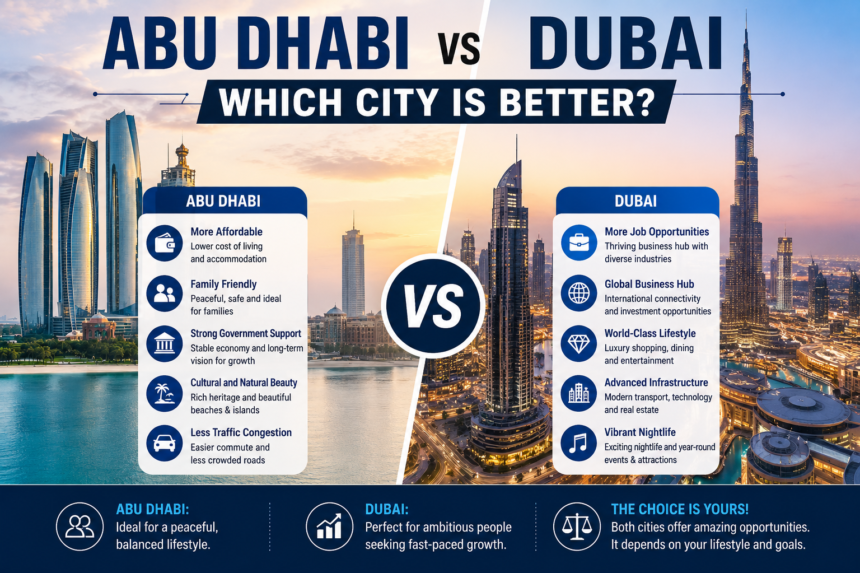
Which City Is Better Abu Dhabi vs Dubai?
Choosing between Abu Dhabi and Dubai is one of the most common questions for people planning to move to the UAE, start a business, find a job, invest in property, or simply enjoy a better lifestyle. Both cities offer excellent infrastructure, modern facilities, international communities, strong economies, and a high standard of living. However, they have noticeably different personalities.
- Abu Dhabi vs Dubai at a Glance
- Abu Dhabi vs Dubai: Cost of Living
- Abu Dhabi vs Dubai: Job Opportunities
- Abu Dhabi vs Dubai: Salaries
- Abu Dhabi vs Dubai: Business Environment
- Abu Dhabi vs Dubai: Lifestyle
- Abu Dhabi vs Dubai: Family Life
- Abu Dhabi vs Dubai: Housing
- Abu Dhabi vs Dubai: Public Transportation
- Abu Dhabi vs Dubai: Driving and Traffic
- Abu Dhabi vs Dubai: Tourism and Attractions
- Abu Dhabi vs Dubai: Shopping
- Abu Dhabi vs Dubai: Food and Dining
- Abu Dhabi vs Dubai: Nightlife
- Abu Dhabi vs Dubai: Culture and Heritage
- Abu Dhabi vs Dubai: Safety and Quality of Life
- Abu Dhabi vs Dubai: Education
- Abu Dhabi vs Dubai: Healthcare
- Abu Dhabi vs Dubai: Real Estate Investment
- Abu Dhabi vs Dubai for Families
- Abu Dhabi vs Dubai for Young Professionals
- Abu Dhabi vs Dubai for Entrepreneurs
- Abu Dhabi vs Dubai: Which City Is Better for Indians and Other Expats?
- Abu Dhabi vs Dubai: Which City Is Better in 2026?
- Abu Dhabi vs Dubai: Quick Winner Guide
Dubai is widely recognised for its fast-paced lifestyle, international business environment, tourism, entertainment, shopping, and large employment market. Abu Dhabi, the capital of the United Arab Emirates, is known for its spacious communities, government and energy sectors, cultural attractions, beaches, family-friendly environment, and relatively relaxed pace of life.
So, which city is better: Abu Dhabi or Dubai? The answer depends on your priorities. A young professional looking for career opportunities and entertainment may prefer Dubai, while a family seeking more space and a quieter environment may find Abu Dhabi more suitable.
This comprehensive Abu Dhabi vs Dubai comparison explores the differences in cost of living, jobs, salaries, business, lifestyle, housing, transportation, education, healthcare, tourism, entertainment, safety, and investment to help you decide which UAE city is right for you.
Abu Dhabi vs Dubai at a Glance
Before looking at each category in detail, here is a quick comparison:
| Category | Abu Dhabi | Dubai |
|---|---|---|
| Lifestyle | Relaxed and spacious | Fast-paced and dynamic |
| Cost of living | Generally lower | Generally higher |
| Housing | More space for the money | More variety but often higher rents |
| Jobs | Strong government, energy, finance and industry sectors | Very broad private-sector and international job market |
| Business | Strong government, energy, finance and investment ecosystem | Major international business and trade hub |
| Entertainment | Growing and family-oriented | Extensive entertainment and nightlife |
| Family life | Excellent | Excellent, but busier |
| Public transport | Strong bus and taxi network | Metro, tram, buses, taxis and marine transport |
| Culture | Strong cultural and national identity | Highly international and cosmopolitan |
| Tourism | Culture, beaches, islands and theme parks | Shopping, landmarks, entertainment and luxury |
| Real estate | Attractive for long-term residents and investors | Highly diverse and internationally active |
| Best for | Families, professionals seeking balance and long-term living | Entrepreneurs, young professionals and lifestyle seekers |
Abu Dhabi vs Dubai: Cost of Living
Cost of living is one of the most important factors when comparing Abu Dhabi and Dubai. While both cities can be expensive compared with many other destinations, the actual cost depends heavily on your accommodation, neighbourhood, lifestyle, family size and spending habits.
Current 2026 crowdsourced comparisons generally place Dubai above Abu Dhabi in overall living costs, particularly for housing. Expatistan’s July 2026 comparison estimates Dubai to be about 14% more expensive overall, although it warns that its figures are based on a relatively small number of user-submitted prices. Its data also shows housing in Dubai costing more than in Abu Dhabi.
Housing is usually the biggest difference. Premium areas in Dubai, such as Downtown Dubai, Dubai Marina, Palm Jumeirah and Jumeirah, can command significant rental premiums. Abu Dhabi also has premium areas such as Saadiyat Island and Al Raha Beach, but many residential districts can offer more space at a comparatively lower cost.
This does not mean that Abu Dhabi is always cheap. Luxury apartments, villas, international schools, restaurants and premium services can be expensive in both cities.
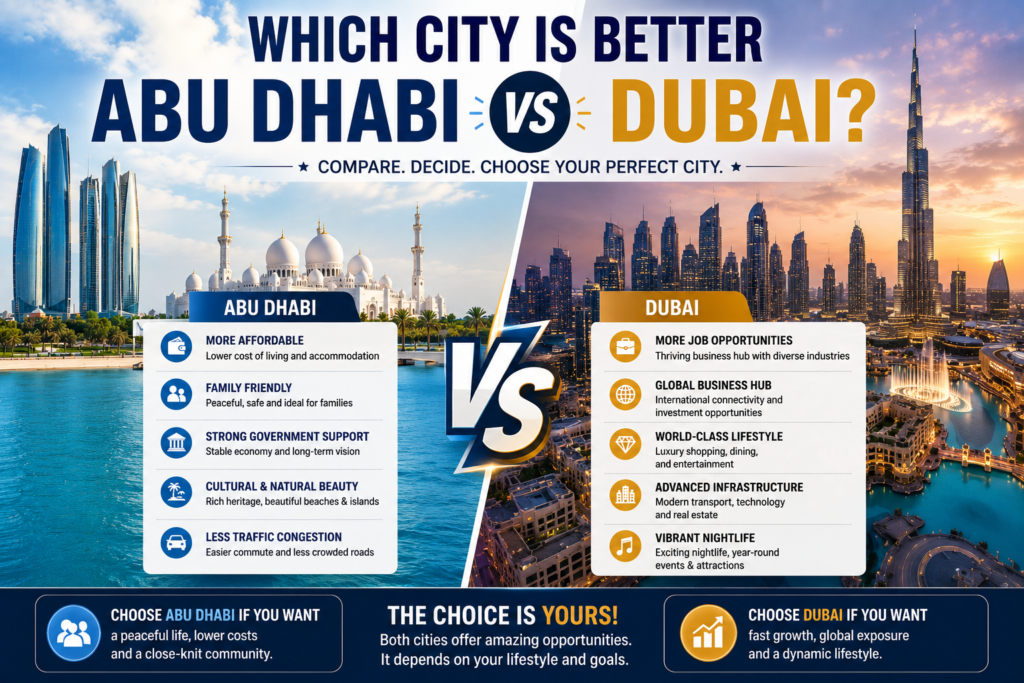
Abu Dhabi may be better if you want:
- Lower housing costs in many neighbourhoods.
- Larger residential spaces.
- A more relaxed lifestyle.
- Family-oriented communities.
- Better value from some residential areas.
Dubai may be better if:
- You have a higher salary that offsets housing costs.
- You prioritise location and convenience.
- You want access to a larger selection of premium properties.
- You prefer living close to major entertainment and business districts.
Winner for affordability: Abu Dhabi, for many residents, although your actual costs depend on your neighbourhood and lifestyle.
Abu Dhabi vs Dubai: Job Opportunities
The job market is another major difference.
Dubai has developed into one of the UAE’s most internationally connected commercial centres. It has a broad economy covering tourism, hospitality, real estate, technology, finance, logistics, retail, media, professional services, aviation and entrepreneurship.
For professionals who want to move between industries or work for international companies, Dubai can provide a particularly diverse employment environment.
Abu Dhabi has a strong economy built around government, energy, finance, investment, healthcare, aviation, construction, infrastructure and major industrial projects. Its role as the UAE capital also means that government-related organisations and large institutions have a significant presence.
Dubai can be attractive for careers in:
- Technology and startups
- Tourism and hospitality
- Real estate
- Retail
- Marketing and media
- Finance
- Aviation
- Logistics
- E-commerce
- International business
- Professional services
Abu Dhabi can be attractive for careers in:
- Energy
- Government
- Finance and investment
- Engineering
- Construction
- Healthcare
- Education
- Infrastructure
- Aviation
- Industry
Dubai generally has the edge when it comes to breadth and variety of private-sector opportunities, while Abu Dhabi can be especially attractive for professionals targeting government, energy, investment and large institutional employers.
Winner for overall job variety: Dubai
Abu Dhabi vs Dubai: Salaries
Salary comparisons between Abu Dhabi and Dubai are difficult because compensation varies by industry, experience, employer and position.
A higher salary in Dubai does not necessarily mean greater disposable income if your rent and lifestyle expenses are also substantially higher. Similarly, a slightly lower salary in Abu Dhabi can potentially provide a better financial outcome if accommodation and everyday expenses are lower.
When comparing job offers, look beyond the basic salary.
Consider:
- Basic salary.
- Housing allowance.
- Transportation allowance.
- Health insurance.
- Annual air tickets.
- School allowance.
- Performance bonuses.
- End-of-service benefits.
- Working hours.
- Commute time.
- Location of accommodation.
For example, a job offering AED 20,000 per month in Dubai may not necessarily be financially better than an AED 18,000 package in Abu Dhabi if the latter includes better housing benefits and lower commuting expenses.
Best city for salary potential: Depends on industry and role.
Abu Dhabi vs Dubai: Business Environment
Both cities are excellent locations for starting and expanding a business, but their economic ecosystems have different strengths.
Dubai is strongly associated with international trade, tourism, real estate, logistics, technology, retail, finance and entrepreneurship. Its global connectivity makes it particularly attractive to companies that want international clients and a large expatriate customer base.
Abu Dhabi has a powerful institutional economy supported by government investment, energy, finance, infrastructure, industry and major development initiatives. It can be particularly attractive for companies involved in engineering, energy, technology, financial services, construction and industrial sectors.
Entrepreneurs should also consider the specific free zones and licensing authorities available in each emirate.
Dubai may be better for:
- Startups.
- International trading.
- Tourism businesses.
- E-commerce.
- Retail.
- Digital businesses.
- Real estate.
- Hospitality.
- International services.
Abu Dhabi may be better for:
- Energy-related businesses.
- Industrial companies.
- Government-linked projects.
- Financial services.
- Engineering.
- Infrastructure.
- Large institutional businesses.
Winner for international entrepreneurial visibility: Dubai.
Winner for institutional and strategic industries: Abu Dhabi.
Abu Dhabi vs Dubai: Lifestyle
Lifestyle is where the difference between the two cities becomes particularly noticeable.
Dubai is energetic, busy and highly cosmopolitan. There is always something happening, from exhibitions and concerts to restaurant openings, sporting events, shopping festivals and nightlife.
Abu Dhabi generally offers a calmer environment. It still has high-end restaurants, cultural attractions, beaches, events and entertainment, but the overall pace can feel less intense.
If you enjoy meeting people from different countries, exploring new restaurants, attending events and having a busy social calendar, Dubai may be more appealing.
If you prefer quieter evenings, beaches, parks, spacious neighbourhoods and a slower pace, Abu Dhabi may suit you better.
Winner for vibrant lifestyle: Dubai.
Winner for relaxed lifestyle: Abu Dhabi.
Abu Dhabi vs Dubai: Family Life
Both cities are excellent choices for families, offering international schools, hospitals, shopping centres, parks, recreational facilities and family attractions.
Abu Dhabi’s spacious residential communities and relatively relaxed atmosphere can make it particularly attractive to families with children.
The emirate offers beaches, parks, cultural attractions and major family destinations. Experience Abu Dhabi highlights attractions across the emirate including Sheikh Zayed Grand Mosque, Yas Island, Saadiyat Island and Al Ain.
Dubai also offers an enormous range of family attractions, international schools, residential communities and entertainment options.
Families who want access to a very wide range of restaurants, malls, theme parks, indoor entertainment and international activities may prefer Dubai.
Winner for a peaceful family lifestyle: Abu Dhabi.
Winner for family entertainment: Dubai.
Abu Dhabi vs Dubai: Housing
Housing is another major consideration.
Dubai offers an enormous selection of apartments, villas and residential communities. You can choose from high-rise living in Downtown Dubai or Dubai Marina to suburban communities such as Mirdif, Jumeirah Village Circle, Dubai Hills Estate and others.
Abu Dhabi also offers apartments and villas across areas such as Al Reem Island, Al Raha, Khalifa City, Mohammed Bin Zayed City, Saadiyat Island and Yas Island.
Current 2026 cost comparisons generally show housing costs higher in Dubai, although the difference varies considerably by location and property type.
Choose Abu Dhabi for:
- Spacious family communities.
- A quieter residential environment.
- Potentially lower rent in comparable segments.
- Island and suburban living.
Choose Dubai for:
- High-rise city living.
- Waterfront communities.
- Large choice of neighbourhoods.
- Luxury apartments.
- Easy access to major commercial and entertainment districts.
Winner for value-oriented housing: Abu Dhabi.
Winner for housing variety: Dubai.
Abu Dhabi vs Dubai: Public Transportation
Dubai has one of the UAE’s most developed urban public transport systems. Its network includes metro, tram, buses, taxis and marine transport. The Dubai Metro’s Red and Green lines cover many major populated areas, while the tram connects important parts of the Dubai Marina and Jumeirah Beach Road areas.
This makes Dubai particularly convenient for residents who live and work near Metro stations.
Abu Dhabi also has an extensive bus and taxi network. Abu Dhabi Mobility provides public bus services throughout Abu Dhabi city and its suburbs, as well as other parts of the emirate.
Abu Dhabi also offers on-demand transport through Abu Dhabi Link in selected areas and inter-emirate bus connections to Dubai and other destinations.
For residents without a car, Dubai generally has the advantage because of its Metro network.
Winner for public transportation: Dubai.
Abu Dhabi vs Dubai: Driving and Traffic
Both cities have modern road networks, but commuting experiences depend heavily on where you live and work.
Dubai’s larger commercial activity and dense population can mean heavier traffic on major routes during peak periods.
Abu Dhabi’s central island and surrounding communities can also experience congestion, particularly during busy periods, but many residents appreciate its comparatively spacious road layout and residential planning.
Your daily commute should therefore be considered before choosing a home.
A simple rule is:
The best city is often the one that puts your home closer to your workplace.
Saving an hour of commuting every day can have a greater impact on quality of life than choosing between two cities based purely on rent.
Abu Dhabi vs Dubai: Tourism and Attractions
Dubai is one of the world’s most recognisable tourism destinations.
Its attractions include:
- Burj Khalifa.
- Dubai Mall.
- Palm Jumeirah.
- Dubai Marina.
- Museum of the Future.
- Desert experiences.
- Beaches.
- Luxury hotels.
- Theme parks.
- Shopping and entertainment venues.
The Burj Khalifa is officially described by Visit Dubai as the world’s tallest building and one of Dubai’s leading attractions.
Dubai Mall is another major attraction, combining shopping, entertainment and leisure on a massive scale.
Abu Dhabi offers a different tourism experience, with a stronger emphasis on culture, heritage, beaches, islands, museums and family attractions.
Major highlights include:
- Sheikh Zayed Grand Mosque.
- Louvre Abu Dhabi.
- Qasr Al Watan.
- Yas Island.
- Ferrari World Abu Dhabi.
- Saadiyat Island.
- Mangrove experiences.
- Abu Dhabi Corniche.
- Al Ain Oasis.
- Desert landscapes.
Experience Abu Dhabi describes the emirate as a destination with diverse landscapes, cultural attractions, beaches and islands, including Saadiyat Island and Yas Island.
Winner for iconic attractions and entertainment: Dubai
Winner for culture, heritage and a relaxed tourism experience: Abu Dhabi
Abu Dhabi vs Dubai: Shopping
Dubai is arguably the stronger choice if shopping is one of your major priorities.
The city has enormous shopping destinations, luxury boutiques, traditional markets and a wide range of international brands.
Dubai Mall alone offers more than 1,200 retail stores along with restaurants and entertainment attractions, according to Visit Dubai.
Abu Dhabi also has excellent shopping centres, including Yas Mall, The Galleria Al Maryah Island and Marina Mall.
However, Dubai’s scale, variety and shopping-focused tourism ecosystem give it the advantage.
Winner for shopping: Dubai
Abu Dhabi vs Dubai: Food and Dining
Both cities have exceptional food scenes because of their highly international populations.
In Dubai, you can find restaurants representing cuisines from around the world, from affordable street food to luxury dining experiences.
Abu Dhabi also has an impressive dining scene, with restaurants ranging from traditional Emirati cuisine to international fine dining.
Dubai may have a larger overall selection, particularly for nightlife-oriented restaurants, celebrity chef venues and high-end dining.
Abu Dhabi can appeal to people who prefer a slightly quieter dining environment.
Winner for restaurant variety: Dubai.
Abu Dhabi vs Dubai: Nightlife
Dubai has a clear advantage if nightlife is important.
The city offers:
- Nightclubs.
- Rooftop lounges.
- Beach clubs.
- Live music.
- Late-night restaurants.
- Entertainment venues.
- International events.
Abu Dhabi also has bars, lounges, restaurants and entertainment venues, but its nightlife environment is generally less extensive than Dubai’s.
For young professionals and visitors who want a highly active social scene, Dubai is usually the stronger option.
Winner for nightlife: Dubai
Abu Dhabi vs Dubai: Culture and Heritage
Abu Dhabi has a strong advantage in cultural tourism and national heritage.
As the UAE’s capital, it has a close connection with the country’s political and cultural identity. The emirate combines modern architecture with mosques, museums, heritage sites, desert landscapes and traditional communities.
The Saadiyat Cultural District is becoming an increasingly important cultural destination, while the Sheikh Zayed Grand Mosque remains one of the country’s most recognisable landmarks.
Dubai also has a rich history, particularly around areas such as Al Fahidi, Deira, Bur Dubai and Dubai Creek. However, the city is more strongly associated internationally with modern architecture, commerce and tourism.
Winner for culture and heritage: Abu Dhabi
Abu Dhabi vs Dubai: Safety and Quality of Life
Both Abu Dhabi and Dubai offer a high standard of living and modern infrastructure. Safety is an important attraction for residents, families and international visitors.
The UAE does not levy personal income tax on individuals, although residents and businesses may still encounter VAT, corporate tax and other applicable taxes and fees.
Quality of life depends on several factors, including income, housing, commute, access to healthcare, education and social activities.
Abu Dhabi’s quieter environment can be appealing to families, while Dubai’s international lifestyle can be particularly attractive to young professionals.
Winner: Both cities
Abu Dhabi vs Dubai: Education
Both cities have a large selection of schools offering international curricula.
Families can find schools following British, American, Indian, IB and other educational systems.
Dubai’s larger expatriate population and enormous private-school sector give parents a wide range of choices.
Abu Dhabi also offers numerous international schools and universities, making it a strong option for families and students.
When comparing schools, parents should look beyond tuition fees and consider:
- Curriculum.
- School ratings.
- Location.
- Transport.
- Class sizes.
- Extracurricular activities.
- University preparation.
- Distance from home.
Winner: Dubai for variety; Abu Dhabi for a potentially calmer family environment.
Abu Dhabi vs Dubai: Healthcare
Both cities have modern hospitals, clinics and specialist medical facilities.
Dubai’s large private healthcare market offers numerous hospitals and clinics across different neighbourhoods.
Abu Dhabi also has a strong healthcare sector, including major hospitals and specialist facilities.
For residents, employer-provided health insurance is an important factor. Always check which hospitals and clinics are included in your insurance network before selecting an employer or neighbourhood.
Winner: Both cities
Abu Dhabi vs Dubai: Real Estate Investment
Both Abu Dhabi and Dubai offer opportunities for property investors, but the markets have different characteristics.
Dubai is highly active internationally and has a broad range of apartments, villas, branded residences, waterfront properties and investment developments. Its strong tourism and expatriate market can support rental demand in many areas.
Abu Dhabi also offers attractive property opportunities, particularly in locations such as Saadiyat Island, Yas Island, Al Reem Island and other emerging communities.
Recent market analysis describes Dubai as having strong liquidity and transaction activity, while Abu Dhabi offers attractive options for longer-term residents and investors seeking spacious communities and competitive yields in selected locations.
Real estate investors should analyse:
- Purchase price.
- Rental yield.
- Service charges.
- Financing costs.
- Vacancy risk.
- Capital appreciation potential.
- Location.
- Developer reputation.
- Freehold ownership eligibility.
- Exit liquidity.
Winner: Dubai for market scale and liquidity; Abu Dhabi for selected long-term opportunities.
Abu Dhabi vs Dubai for Families
If you are moving to the UAE with children, Abu Dhabi deserves serious consideration.
Its combination of residential space, beaches, schools, cultural attractions and a relatively relaxed atmosphere can make it attractive for families.
Dubai is equally strong but provides a busier lifestyle and an enormous entertainment ecosystem.
Abu Dhabi may suit families who want:
- More space.
- A quieter environment.
- Cultural experiences.
- Beaches and outdoor activities.
- Family-oriented communities.
- A potentially lower housing budget.
Dubai may suit families who want:
- More entertainment options.
- Extensive shopping.
- International communities.
- Large school choices.
- Convenient public transport in Metro-connected areas.
- A very active social environment.
Family winner: Abu Dhabi for tranquillity; Dubai for entertainment and convenience.
Abu Dhabi vs Dubai for Young Professionals
For young professionals, Dubai often has the edge.
The city’s large private-sector economy, international companies, nightlife, restaurants, networking events and social activities make it especially attractive to people at the early and middle stages of their careers.
Abu Dhabi can be a better option for professionals working in sectors such as energy, government, finance, engineering and healthcare who prefer a quieter lifestyle.
Winner for young professionals: Dubai
Abu Dhabi vs Dubai for Entrepreneurs
Entrepreneurs should select a city based on the type of business they want to build.
Dubai can be particularly attractive for startups, tourism, retail, e-commerce, technology, real estate, professional services and international trading.
Abu Dhabi can be especially attractive for companies connected to energy, industry, investment, technology, government and large institutional projects.
There is no universal winner. Your customers, suppliers, employees and business partners matter more than the city name.
Winner: Depends on the business model
Abu Dhabi vs Dubai: Which City Is Better for Indians and Other Expats?
Both cities have large international communities, making it relatively easy for expatriates to find restaurants, schools, cultural activities and social networks connected with their home countries.
Dubai is particularly international and highly diverse, with communities from across Asia, Europe, Africa and the Americas.
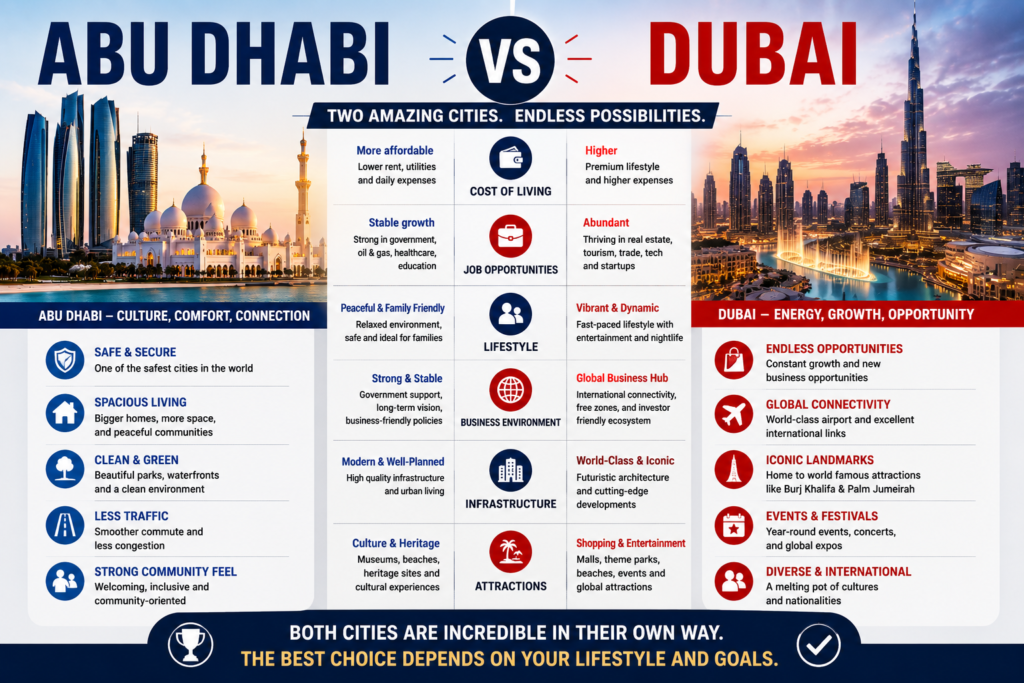
Abu Dhabi is also highly multicultural and offers a strong expatriate community while maintaining a somewhat calmer atmosphere.
For Indian professionals, entrepreneurs and families, both cities offer extensive opportunities. The deciding factors should include employment location, salary, housing budget, school requirements and community preferences.
Abu Dhabi vs Dubai: Which City Is Better in 2026?
There is no single winner because the two cities excel in different areas.
Choose Abu Dhabi if you want:
- A calmer lifestyle.
- More spacious residential options.
- Potentially lower living costs.
- Strong family environment.
- Cultural attractions.
- Beaches and islands.
- Careers in energy, government, finance and large institutions.
- A more relaxed pace of life.
Choose Dubai if you want:
- More job opportunities across diverse industries.
- A highly international business environment.
- Vibrant nightlife.
- Extensive shopping.
- Global networking opportunities.
- World-famous attractions.
- Strong tourism and hospitality industries.
- Extensive public transportation.
- A fast-paced and ambitious lifestyle.
Abu Dhabi vs Dubai: Quick Winner Guide
- Lower overall living costs: Abu Dhabi
- Job variety: Dubai
- International business: Dubai
- Government and energy careers: Abu Dhabi
- Family lifestyle: Abu Dhabi
- Nightlife: Dubai
- Shopping: Dubai
- Culture and heritage: Abu Dhabi
- Public transportation: Dubai
- Relaxed lifestyle: Abu Dhabi
- Tourist attractions: Dubai
- Beaches and islands: Abu Dhabi
- Global connectivity: Dubai
- Long-term family living: Abu Dhabi
- Fast-paced career and social life: Dubai
Ultimately, neither city is universally better. Abu Dhabi and Dubai represent two different versions of life in the UAE. Dubai offers speed, scale and international energy, while Abu Dhabi offers space, stability and a more relaxed experience.
Before moving, working or investing, compare your expected salary, rent, commute, school costs, healthcare, business requirements and lifestyle priorities. By matching the city to your personal or professional goals, you can make a much more informed decision.
Final Verdict: Abu Dhabi or Dubai?
So, which city is better: Abu Dhabi or Dubai?
The answer depends on what you want from life in the UAE.
Dubai is better for people who prioritise career variety, entrepreneurship, international business, entertainment, nightlife, shopping and a fast-paced lifestyle.
Abu Dhabi is better for people who prioritise space, family life, culture, beaches, institutional careers and a calmer environment.
For many people, the decision ultimately comes down to where they work and how much they value lifestyle over cost. A slightly cheaper apartment is not necessarily worthwhile if it creates a long daily commute. Likewise, living in the centre of Dubai may not be the best choice if your priorities are peace, space and family time.
The good news is that the two cities are relatively close. Experience Abu Dhabi notes that Dubai is roughly a 60-minute drive away, making it possible to experience both destinations.
Do follow us on Instagram
Read More – Dubai vs Abu Dhabi Which City Is Better for Expats?