How Extreme Heat and Evaporation Affect River Formation
The Arabian Peninsula is home to some of the world’s most extraordinary landscapes. From the vast sand dunes of Saudi Arabia’s Empty Quarter to the rocky mountains of Oman and Yemen, the region contains deserts, valleys, coastal plains and ancient geological formations.
- 1. The Arabian Peninsula Receives Too Little Rainfall to Sustain Most Rivers
- 2. Extreme Heat and Evaporation Cause Surface Water to Disappear Quickly
- 3. What Are Wadis and Why Do They Flow Only After Heavy Rain?
- 4. How Desert Geography and Underground Rock Formations Affect River Development
- 5. Arabia Once Had Ancient Rivers, Lakes and Wetter Landscapes
- 6. Why Groundwater and Oases Are More Important Than Rivers in Many Parts of Arabia
- 7. How the Lack of Permanent Rivers Has Shaped Arabian Civilisation
- 8. How Arabian Countries Manage Water Without Major River Systems Today
However, one geographical feature is surprisingly rare: permanent rivers.
Unlike regions where large rivers flow continuously through cities, farmland and forests, much of Arabia has no natural river systems that carry water throughout the year.
Instead, the landscape is crossed by dry valleys known as wadis. These channels may remain dry for months or even years before suddenly filling with water after heavy rainfall.
This unusual geography raises an interesting question: Why does the Arabian Peninsula have so few permanent rivers despite its enormous size?
The answer involves several connected environmental factors, including limited rainfall, intense evaporation, desert climate systems, mountain geography and underground water movement.
Most of the peninsula lies within an arid climate zone where rainfall is too limited and irregular to maintain continuous river flow.
High temperatures increase water loss, while dry soils and underground rock formations influence what happens to rainfall after it reaches the ground.
Yet Arabia has not always been as dry as it is today.
Scientific evidence suggests that parts of the peninsula experienced wetter conditions during earlier periods, supporting rivers, lakes and grassland environments that have since disappeared.
A 2025 study published in Scientific Reports documented ancient drainage channels in Saudi Arabia using satellite imagery and geological observations, providing further evidence of watercourses associated with wetter conditions in the region’s past. Nature
Today, the scarcity of permanent rivers has influenced settlement patterns, agriculture, water management and economic development across the Arabian Peninsula.
Understanding this geography helps explain why groundwater, traditional irrigation systems, dams and seawater desalination are so important to modern Arabian societies.
1. The Arabian Peninsula Receives Too Little Rainfall to Sustain Most Rivers
The main reason the Arabian Peninsula has so few permanent rivers is its limited rainfall.
A river usually needs a continuing supply of water from rainfall, snowmelt, springs or groundwater to maintain its flow throughout the year.
In many parts of Arabia, there is insufficient reliable precipitation to provide that supply.
Saudi Arabia occupies most of the peninsula and contains enormous desert areas where rainfall is both scarce and unpredictable.
Some regions may experience long dry periods interrupted by occasional storms.
In contrast, mountainous areas of southwestern Saudi Arabia, Yemen and Oman can receive considerably more rainfall.
This uneven distribution is important because the Arabian Peninsula is not one uniform desert.
Some locations support seasonal streams, springs and more extensive vegetation, while other areas receive very little precipitation.
A United Nations regional water-resources study describes typical annual rainfall across much of the peninsula as approximately 70–130 millimetres, with substantially higher amounts possible in certain mountain ranges. Digital Library
These figures are broad regional estimates rather than rainfall values for every location or year.
Why rainfall frequency matters
The amount of rain is only one part of the explanation.
For a river to remain active, it must receive water consistently enough to replace what it loses.
Rainfall concentrated into a small number of storms can produce sudden runoff without sustaining long-term flow.
For example, a desert valley may receive intense rainfall during a thunderstorm.
Water can rush through the channel for several hours, but the flow may disappear soon afterwards.
The same valley might remain dry until another significant weather event occurs.
The absence of widespread snowmelt
Many major rivers around the world receive water from mountain snowpacks or glaciers.
Seasonal melting provides an additional water source even when rainfall is limited.
The Arabian Peninsula does not possess extensive permanent snowfields or glaciers capable of supplying large river systems.
Although temporary snowfall can occur in certain highland areas, it does not provide the sustained meltwater contribution found in many major mountain-fed river basins.
Rainfall differences across Arabia
| Region | General rainfall characteristics | Effect on surface water |
|---|---|---|
| Central Saudi Arabia | Low and irregular rainfall | Mostly dry drainage channels |
| Empty Quarter | Extremely arid conditions | Very limited surface runoff |
| Southwestern Saudi highlands | Relatively greater rainfall | Seasonal streams and some spring-fed flows |
| Yemeni highlands | More rainfall in suitable seasons | Mountain runoff and local watercourses |
| Northern Oman | Variable rainfall, often associated with storms | Wadis and local springs |
| Southern Oman | Seasonal monsoon influence in parts of Dhofar | More seasonal vegetation and local water availability |
The scarcity of reliable rainfall makes it difficult for large, permanent river systems to develop across most of the peninsula.
2. Extreme Heat and Evaporation Cause Surface Water to Disappear Quickly
Even when rain falls in the Arabian Desert, much of the resulting surface water does not remain available for long.
High temperatures, dry air and strong sunlight create conditions that favour evaporation.
Evaporation occurs when liquid water changes into water vapour and enters the atmosphere.
In hot, dry environments, this process can remove water from exposed surfaces rapidly.
The Arabian Peninsula experiences some of the world’s most demanding summer conditions, particularly in its inland deserts.
These conditions create a substantial difference between the amount of water supplied by rainfall and the amount that could potentially be lost through evaporation.
A scientific review of Saudi Arabian water resources identifies high potential evaporation, low precipitation and the absence of permanent surface water bodies as fundamental features of the country’s climate. MDPI
Why evaporation matters for rivers
A river needs enough incoming water to compensate for losses along its course.
Water can disappear through evaporation, infiltration into the ground and use by vegetation.
In regions with frequent rainfall, these losses may be replaced continuously.
In an arid environment, however, new water may not arrive for weeks or months.
Consequently, temporary streams often stop flowing once the runoff from a particular storm has passed.
The role of dry air
Warm air can support substantial amounts of water vapour.
When the surrounding air is dry, evaporation from exposed water can be especially effective.
This helps explain why shallow pools left after rainfall may disappear quickly.
However, local humidity, wind speed and water temperature also influence evaporation rates.
Coastal regions may experience different conditions from inland deserts.
High temperatures do not tell the whole story
The Arabian Peninsula’s lack of rivers cannot be explained by heat alone.
Some hot tropical regions receive abundant rainfall and have enormous rivers.
The crucial issue is the balance between water arriving and water being lost.
In Arabia, low rainfall combines with high potential evaporation to create persistent water scarcity.
| Environmental factor | Effect on river flow |
|---|---|
| Strong solar radiation | Increases energy available for evaporation |
| High air temperatures | Supports rapid water loss under suitable conditions |
| Dry atmospheric conditions | Encourages evaporation |
| Irregular rainfall | Prevents consistent replenishment |
| Shallow temporary pools | Can disappear relatively quickly |
| Limited vegetation in dry areas | Influences runoff, infiltration and soil conditions |
This combination helps explain why even heavy rainfall does not necessarily create a permanent river.
3. What Are Wadis and Why Do They Flow Only After Heavy Rain?
One of the most distinctive features of Arabian geography is the widespread presence of wadis.
A wadi is a valley or drainage channel commonly associated with water flowing during or after rainfall.
Some wadis have broad, sandy channels, while others pass through narrow rocky valleys.
They are found throughout Saudi Arabia, Oman, the UAE, Yemen and other parts of the peninsula.
The European Space Agency describes how Saudi Arabia’s normally dry valleys can fill with water following heavy rain, despite the country’s lack of permanent rivers. ESA
How a wadi becomes a temporary river
When rain falls on a hillside or drainage basin, some water enters the soil.
If rainfall is intense enough, or the ground cannot absorb water quickly enough, runoff begins moving downhill.
Small streams may join together, producing a stronger flow through the main valley.
In mountainous terrain, this process can happen rapidly.
Water may travel toward lower ground, carrying sediment, rocks and other materials.
However, once the storm runoff declines, the channel may become dry again.
Why flash floods occur
Dry valleys can experience dangerous flash floods.
A storm in an upstream mountain area may send water into a channel even when the location farther downstream has received little or no rain.
The steep terrain of some Arabian mountain ranges can increase the speed of runoff.
This is why people should avoid entering wadis during heavy rainfall or when flood warnings are in effect.
A dry channel is not necessarily a safe location during unsettled weather.
Famous examples
Wadi systems occur across the peninsula, including Wadi Al-Rummah in Saudi Arabia, Wadi Hanifah near Riyadh, and Wadi Bani Khalid in Oman.
However, these locations should not all be described as permanently flowing rivers.
Some contain managed water features, springs or pools in certain sections.
Others experience only episodic natural flow.
Permanent, seasonal and temporary flow
| Watercourse type | Main characteristic | Arabian relevance |
|---|---|---|
| Perennial river | Flows throughout a normal year | Rare at the peninsula-wide scale |
| Seasonal stream | Flows during predictable wetter periods | Occurs in some highland catchments |
| Ephemeral stream | Flows mainly in response to rainfall | Common in desert wadis |
| Spring-fed channel | Receives water from groundwater discharge | Found in selected locations |
| Artificial water channel | Carries managed or diverted water | Used in irrigation systems |
Understanding wadis is essential because the Arabian Peninsula has extensive drainage networks even though most channels lack continuous surface water.
4. How Desert Geography and Underground Rock Formations Affect River Development
The Arabian Peninsula’s geology also influences the movement of water.
A landscape may receive rainfall, but whether that water forms a river depends partly on the rocks, soils, slopes and drainage networks beneath and around it.
Different geological formations allow water to behave in different ways.
Some surfaces produce substantial runoff during intense storms.
Others allow water to infiltrate into the ground.
In sandy environments, water may pass through surface sediments rather than travelling a long distance as a visible stream.
However, infiltration depends on the properties of the sediment, its moisture content and the intensity of rainfall.
Not all desert sands absorb water equally, and compacted soils or rocky surfaces can produce rapid runoff.
The role of large desert basins
The Arabian Peninsula contains extensive sedimentary basins, including the Rub’ al Khali basin.
These geological regions include layers of rock and sediment that formed over long periods.
Some layers are capable of storing groundwater.
Others restrict water movement.
Water entering the ground may therefore become part of underground storage systems instead of remaining at the surface.
Research examining aquifers in the Rub’ al Khali describes the importance of geological structures and groundwater resources in an environment lacking perennial rivers and lakes. ScienceDirect
Why mountains do not always create permanent rivers
Mountains can help generate rainfall by forcing moist air upward.
They also provide slopes that channel runoff toward valleys.
However, mountains do not guarantee permanent flow.
A river also needs a sufficient and sustained water source.
In Oman and southwestern Saudi Arabia, some mountain regions receive more precipitation than nearby deserts.
This can support springs and temporary watercourses.
Nevertheless, water availability may decline sharply during dry seasons.
Internal drainage and disappearing channels
Some Arabian drainage systems terminate in desert depressions, sandy plains or inland basins.
Water can spread across these low-lying areas, evaporate or infiltrate into sediments.
It may not reach the sea through a continuously flowing channel.
Ancient drainage networks can also become buried by sediment or sand dunes.
As a result, a valley’s shape may remain visible long after regular water flow has disappeared.
How geology influences surface water
| Geological feature | Possible influence |
|---|---|
| Permeable sediments | Allow water to infiltrate |
| Impermeable rock surfaces | Encourage runoff during storms |
| Mountain slopes | Channel water into valleys |
| Sedimentary basins | Can contain groundwater reservoirs |
| Desert depressions | Collect temporary surface water |
| Sand dunes | May cover or redirect older drainage systems |
The shortage of permanent rivers is therefore caused by the interaction between climate and landscape rather than rainfall alone.
5. Arabia Once Had Ancient Rivers, Lakes and Wetter Landscapes
One of the most fascinating discoveries about the Arabian Peninsula is that its present-day climate does not represent every period of its past.
Geological and archaeological evidence indicates that parts of Arabia experienced significantly wetter conditions during certain prehistoric intervals.
These periods supported lakes, rivers, wetlands and vegetation in areas that are now desert.
Scientists have reconstructed these environments through sediment analysis, ancient river deposits, fossil evidence and satellite observations.
The influence of earlier climate changes
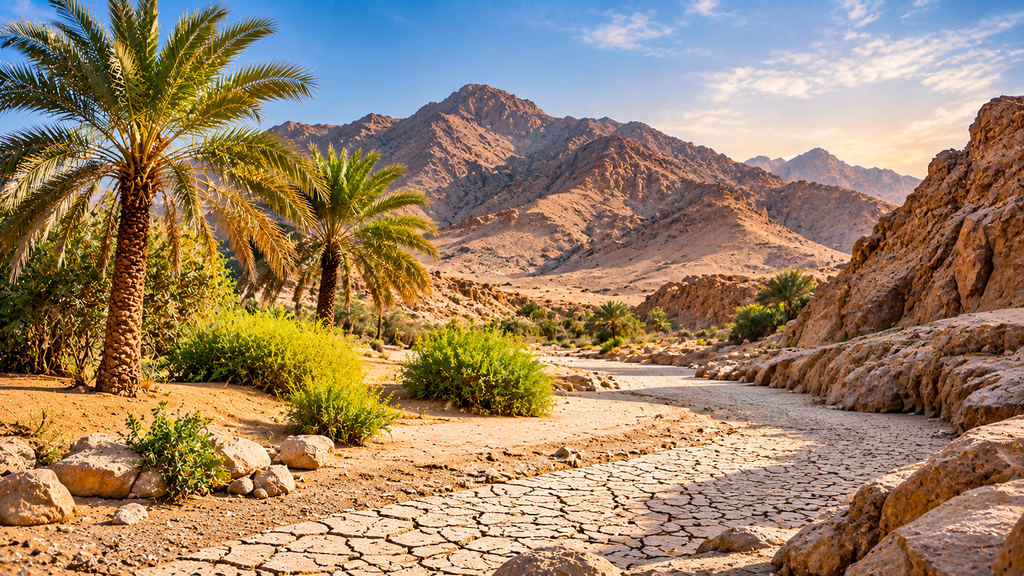
Over thousands of years, changes in Earth’s climate and monsoon systems altered rainfall patterns across parts of Arabia.
During favourable periods, stronger or differently positioned monsoon rainfall reached regions that are now much drier.
This allowed some drainage systems to carry water more regularly.
However, wetter conditions did not occur uniformly across the entire peninsula or remain constant for thousands of years.
Different locations experienced different climatic histories.
Ancient drainage beneath the desert
A 2025 study published in Scientific Reports examined ancient drainage features in Saudi Arabia using satellite observations and field investigations.
Researchers identified buried channels and geological evidence associated with previous water movement.
These features are known as paleodrainages or palaeochannels.
They help scientists reconstruct earlier river systems that are no longer active. PubMed Central (PMC)
The history of Wadi ad-Dawasir
Wadi ad-Dawasir provides another important example.
Research published in Geomorphology examined the reactivation of a much older river system during a humid phase of the Holocene.
The study investigated sediment deposits and evidence of former water flow across parts of Saudi Arabia.
These findings demonstrate that certain drainage systems were more active under earlier environmental conditions. ScienceDirect
What happened to the ancient rivers?
As climatic conditions became drier, rainfall declined in many areas.
Rivers that had depended on wetter conditions lost their reliable water supply.
Some channels became seasonal or ephemeral.
Others were gradually filled or covered by sediments.
The physical evidence of earlier flow remained in the landscape even after the rivers disappeared.
Why this history matters
Ancient waterways provide clues about environmental change and prehistoric human settlement.
Reliable freshwater could support vegetation, animals and communities in places that are now extremely dry.
Studying these earlier environments helps researchers understand how Arabian landscapes responded to changes in climate over time.
It also demonstrates that deserts are dynamic environments with long and complex histories.
6. Why Groundwater and Oases Are More Important Than Rivers in Many Parts of Arabia
Although much of the peninsula lacks continuously flowing rivers, substantial quantities of water exist beneath the ground.
Groundwater is stored in the spaces and fractures of suitable rock and sediment.
A geological formation capable of storing and transmitting useful amounts of groundwater is called an aquifer.
Aquifers are particularly important in arid environments where surface water is scarce.
Where does groundwater come from?
Groundwater can originate when rainfall infiltrates into the soil and moves downward.
In some areas, water also enters underground systems through mountain runoff and stream channels.
However, not all groundwater was deposited recently.
Parts of Arabia contain ancient groundwater that accumulated during wetter climatic periods.
This is often called fossil groundwater.
Because its replacement can be extremely slow, heavy extraction may reduce reserves over time.
NASA has documented groundwater depletion associated with agricultural irrigation in Saudi Arabia, highlighting the risks of relying on ancient aquifers for sustained high-volume water use. NASA Science
The importance of oases
Oases are locations where water availability supports vegetation and human settlement within otherwise dry environments.
Water may come from groundwater, springs or other local sources.
Historically, oases helped sustain agriculture, trading activities and permanent communities.
Date palms became particularly important in many settlements because they were suited to the local agricultural environment.
Oases also provided stopping points for travellers crossing long desert routes.
Oman’s traditional aflaj systems
One of the most remarkable examples of Arabian water management is the aflaj irrigation tradition of Oman.
A falaj is a water-channel system that can carry water from groundwater, springs or surface sources to areas requiring irrigation or domestic supply.
The plural form is aflaj.
These systems use gravity to distribute water through carefully designed channels.
Five representative systems were inscribed on the UNESCO World Heritage List in 2006.
UNESCO describes how the networks supported settlements and agricultural activity in areas where rainfall was limited. UNESCO World Heritage Centre
The existence of flowing water in a falaj does not mean the surrounding landscape contains a large natural permanent river.
The channels are engineered systems designed to collect and distribute available water.
Surface water and groundwater compared
| Water source | Main characteristic | Arabian importance |
|---|---|---|
| Rainfall | Irregular natural water input | Supplies runoff and groundwater recharge |
| Wadi runoff | Often temporary | Can support recharge and local storage |
| Springs | Groundwater reaching the surface | Supports selected communities and habitats |
| Fossil groundwater | Ancient stored water | Important but potentially non-renewable resource |
| Oases | Locations with accessible water | Historically supported settlement and farming |
| Aflaj | Managed water distribution channels | Traditional irrigation and community water supply |
These resources helped Arabian societies adapt to the absence of extensive permanent river systems.
7. How the Lack of Permanent Rivers Has Shaped Arabian Civilisation
Water scarcity has influenced the development of Arabian communities for thousands of years.
Where water was available, settlements could support agriculture, trade and permanent habitation.
In areas with extremely limited water, communities often depended more heavily on mobility, livestock keeping and commercial relationships.
However, Arabian history cannot be reduced to a single pattern.
Coastal towns, mountain villages, agricultural oases and desert communities followed different ways of life.
The importance of settlement location
Permanent settlements often developed near reliable sources of water.
Oases, springs and accessible groundwater made agriculture possible in otherwise dry landscapes.
Communities developed methods for managing and sharing these resources.
In some places, water distribution involved established customs governing when different households or farms could receive irrigation.
Oman’s aflaj provide a well-documented example of water-sharing practices embedded in local social organisation.
Agriculture without major rivers
In countries with large perennial river systems, agriculture can depend on regular river withdrawals and floodplain irrigation.
In much of Arabia, farmers historically relied instead on wells, springs, seasonal runoff and managed irrigation systems.
Date cultivation became important in many agricultural settlements.
Other crops were grown where climate, soil and water conditions allowed.
The absence of major rivers also encouraged careful management of limited water supplies.
However, traditional agriculture was not always sustainable under every circumstance, and modern groundwater extraction has introduced additional pressures.
The role of trade and transportation
Because water resources were scattered, trade routes often linked settlements with different agricultural and commercial strengths.
Oases offered opportunities for travellers to obtain supplies.
Coastal settlements connected inland communities with wider maritime networks.
These relationships encouraged cooperation and exchange between different parts of the peninsula.
Why modern cities no longer depend entirely on nearby natural water
Industrial development and technological change have altered the relationship between settlements and local freshwater sources.
Modern water infrastructure allows large populations to live in coastal and inland cities without relying on a nearby natural river.
Water may be produced through desalination, stored in reservoirs and transported through extensive distribution systems.
This development has helped support urban expansion but has also created new requirements for energy, infrastructure and financial investment.
How water scarcity influenced Arabian development
| Area of life | Historical or modern response |
|---|---|
| Settlement patterns | Concentration near accessible water |
| Agriculture | Wells, springs and irrigation channels |
| Desert travel | Use of established routes and water stops |
| Community organisation | Water-sharing arrangements |
| Urban development | Investment in modern supply networks |
| Economic activity | Adaptation to available natural resources |
The scarcity of rivers helped shape the region’s history, while modern engineering has changed how communities respond to that scarcity.
8. How Arabian Countries Manage Water Without Major River Systems Today
The lack of permanent rivers remains an important challenge for modern water management.
Across the Arabian Peninsula, population growth, urban development and economic activity have increased demand for reliable freshwater supplies.
Countries have responded by combining groundwater extraction, desalination, water storage, wastewater treatment and conservation measures.
Each approach offers benefits but also has limitations.
Seawater desalination
Desalination is especially important in several Gulf countries.
The process removes salts and other impurities from seawater to produce water suitable for designated uses after appropriate treatment.
It allows coastal cities to obtain freshwater even when natural rivers and rainfall are insufficient.
However, desalination requires energy, infrastructure and careful management of concentrated brine discharges.
A scientific analysis of Saudi Arabian water resources identifies desalination as a major contributor to municipal freshwater supply. Nature
Groundwater management
Aquifers remain important sources of water for agriculture and other activities.
However, extraction can exceed natural replenishment in arid environments.
Excessive pumping may lower groundwater levels and increase costs.
In some coastal locations, falling groundwater levels can also contribute to saltwater intrusion.
Long-term management therefore requires monitoring withdrawals and understanding how quickly different aquifers recharge.
Dams and rainfall harvesting
Saudi Arabia, Oman and other countries have developed dams to capture certain types of runoff, reduce flood risks or support groundwater recharge.
However, these structures cannot create water when rainfall is absent.
Their effectiveness depends on local climate, catchment conditions and maintenance.
Some dams are primarily designed for flood management rather than continuous freshwater supply.
Treated wastewater
Treated wastewater can provide an additional resource for irrigation, landscaping and selected industrial uses.
Reusing water for suitable purposes can reduce pressure on freshwater supplies.
However, treatment standards must match the intended application.
Water reuse also requires public confidence, monitoring and appropriate infrastructure.
Conservation and efficiency
Water conservation is important because increasing supply alone may not address long-term demand.
Leakage reduction, efficient irrigation and responsible consumption can improve the use of available resources.
Scientific research also helps identify how changing rainfall patterns and temperatures may influence future water availability.
Modern water-management approaches
| Approach | Main benefit | Important limitation |
|---|---|---|
| Desalination | Produces freshwater from seawater | Energy use and brine management |
| Groundwater extraction | Provides accessible stored water | Risk of depletion |
| Dams | Capture runoff or manage floods | Depend on rainfall |
| Treated wastewater | Supports reuse for suitable purposes | Requires appropriate treatment |
| Rainwater harvesting | Uses rainfall when available | Limited by precipitation |
| Efficient irrigation | Reduces agricultural water demand | Requires investment and management |
| Leakage detection | Reduces distribution losses | Requires monitoring and maintenance |
Priorities for the future
- Protect aquifers from excessive extraction and contamination.
- Improve water-use efficiency in agriculture and urban systems.
- Expand treated wastewater reuse where appropriate.
- Reduce avoidable losses in water distribution networks.
- Manage desalination energy requirements and environmental impacts.
- Maintain natural wadi drainage pathways and flood-risk planning.
- Protect springs, freshwater wetlands and sensitive mountain habitats.
- Strengthen regional research into drought and climate variability.
The Arabian Peninsula’s future water security will depend on combining reliable infrastructure with careful management of limited natural resources.
Conclusion
The Arabian Peninsula has very few permanent rivers because most of its landscape receives insufficient regular rainfall to sustain continuous surface water flow.
High evaporation, arid atmospheric conditions and the movement of water into underground geological formations further reduce the availability of lasting streams.
Although many parts of Arabia contain extensive drainage channels, these usually function as wadis that carry water during or after rainfall.
Mountain regions in Yemen, Oman and southwestern Saudi Arabia provide important exceptions, including springs and some locally persistent flows. However, these do not form an extensive network of large, year-round rivers across the peninsula.
Scientific research also reveals that Arabia was not always so dry.
Ancient drainage channels, former lake deposits and evidence of wetter prehistoric environments show that water once moved through parts of the landscape under very different climatic conditions.
Today, groundwater and traditional irrigation systems remain important features of the region’s environmental and cultural history.
Modern desalination, water recycling and distribution networks have made it possible for large cities to develop despite the shortage of natural freshwater rivers.
However, water scarcity continues to require careful long-term planning.
Ultimately, the Arabian Peninsula’s lack of permanent rivers is the result of its climate, geography and geological history. Understanding these factors helps explain both the extraordinary character of its deserts and the importance of sustainable water management for future generations.
Do follow us on Instagram
Read More – The History of Oil Discovery and How It Changed the Arabian Peninsula