





The Future of Arabic Speech Recognition and Multilingual AI
Artificial intelligence is changing how people interact with technology through voice assistants, automated customer service, live subtitles, digital transcription, and speech-controlled applications. Across the Middle East, businesses and government organisations are exploring these technologies to make digital services more accessible and efficient. However, developing systems that accurately understand spoken Arabic remains a complex technical challenge.
- 1. Why Arabic Dialect Diversity Creates Major Speech Recognition Challenges
- 2. How Arabic Pronunciation and Word Formation Complicate AI Models
- 3. Why Code-Switching and Multilingual Conversations Remain Difficult
- 4. The Shortage of Arabic Speech Datasets and Reliable Transcriptions
- 5. How Background Noise and Real-World Conditions Affect Arabic Recognition
- 6. How AI and Modern Speech Models Are Addressing Arabic Recognition Challenges
- 7. The Future of Arabic-Language Speech Recognition in the Gulf and Beyond
Arabic-language speech recognition has advanced significantly with the development of machine learning, neural networks, and multilingual artificial intelligence models. These technologies can convert spoken words into written text and support applications ranging from media production to banking and healthcare. Yet recognising Arabic speech reliably across different countries, dialects, and communication environments remains difficult.
One of the greatest challenges is the enormous diversity of spoken Arabic. While Modern Standard Arabic is widely used in formal communication, everyday conversations often involve regional dialects that differ in pronunciation, vocabulary, grammar, and sentence structure. A model trained primarily on formal Arabic may struggle to recognise spontaneous conversations in Gulf, Egyptian, Levantine, Iraqi, or North African dialects.
Arabic also presents linguistic complexities involving word formation, pronunciation, written representation, and frequent switching between languages. These challenges become more demanding when speech recordings contain background noise, overlapping speakers, unfamiliar accents, or technical terminology.
For countries such as the United Arab Emirates, Saudi Arabia, Qatar, Kuwait, Bahrain, and Oman, improving Arabic speech recognition could support more inclusive digital services and create opportunities for regional technology development.
Understanding the difficulties behind Arabic speech recognition reveals why building effective voice-based artificial intelligence requires more than simply translating existing English-language systems.
1. Why Arabic Dialect Diversity Creates Major Speech Recognition Challenges
Arabic is spoken across a large geographical area, but everyday speech is far from uniform. Different communities use regional varieties that have developed distinctive vocabulary, grammatical structures, and pronunciation patterns.
This diversity creates one of the most important technical challenges for automatic speech recognition, commonly known as ASR.
Modern Standard Arabic Versus Everyday Speech
Modern Standard Arabic, or MSA, is commonly used in formal news broadcasts, official communication, education, and written publications.
However, ordinary conversations frequently take place in regional dialects.
A speaker may use formal Arabic during a presentation and then switch to a local dialect when speaking with friends or colleagues.
This linguistic situation is known as diglossia, where different varieties of a language serve different social and communication purposes.
Speech-recognition models trained on formal news recordings may therefore perform differently when processing informal conversation.
The Diversity of Regional Dialects
Arabic dialects differ across several major geographical regions.
These include Gulf Arabic, Egyptian Arabic, Levantine Arabic, Iraqi Arabic, and Maghrebi Arabic.
Even within these broad categories, substantial local variation exists.
For example, Saudi Arabia includes distinct regional varieties associated with Najd, Hijaz, the Eastern Province, and other areas.
Similarly, Gulf Arabic is not identical across the UAE, Kuwait, Bahrain, Qatar, Oman, and Saudi Arabia.
A model that performs well on one variety may not achieve comparable accuracy on another.
Major Arabic Speech Varieties
| Arabic Variety | Broad Geographic Association | Recognition Challenge |
|---|---|---|
| Modern Standard Arabic | Formal communication across Arabic-speaking countries | Differences between formal and spontaneous speech |
| Gulf Arabic | GCC countries and nearby regions | Regional pronunciation and vocabulary variation |
| Egyptian Arabic | Egypt | Differences from formal Arabic and other dialects |
| Levantine Arabic | Lebanon, Syria, Jordan, Palestine | Local lexical and pronunciation differences |
| Iraqi Arabic | Iraq | Distinct phonological and grammatical patterns |
| Maghrebi Arabic | North Africa | Substantial variation and contact with other languages |
These categories are broad linguistic groupings rather than completely separate or internally uniform systems.
Why Dialect Diversity Affects AI Accuracy
Speech-recognition models learn relationships between acoustic signals and written language.
When a model encounters unfamiliar pronunciations or expressions, it may substitute more familiar words.
For example, a system trained primarily on MSA could transcribe a dialectal expression incorrectly or replace it with a formal equivalent.
These errors may alter the speaker’s intended meaning.
A 2025 study presented at the Association for Computational Linguistics conference examined dialectal coverage across Arabic speech-recognition systems.
The researchers introduced models covering speech from 17 Arabic-speaking countries and demonstrated the importance of broader dialect representation.
The research highlights why improving recognition requires models that understand Arabic as a linguistically diverse language rather than treating one formal variety as representative of all speakers.
2. How Arabic Pronunciation and Word Formation Complicate AI Models
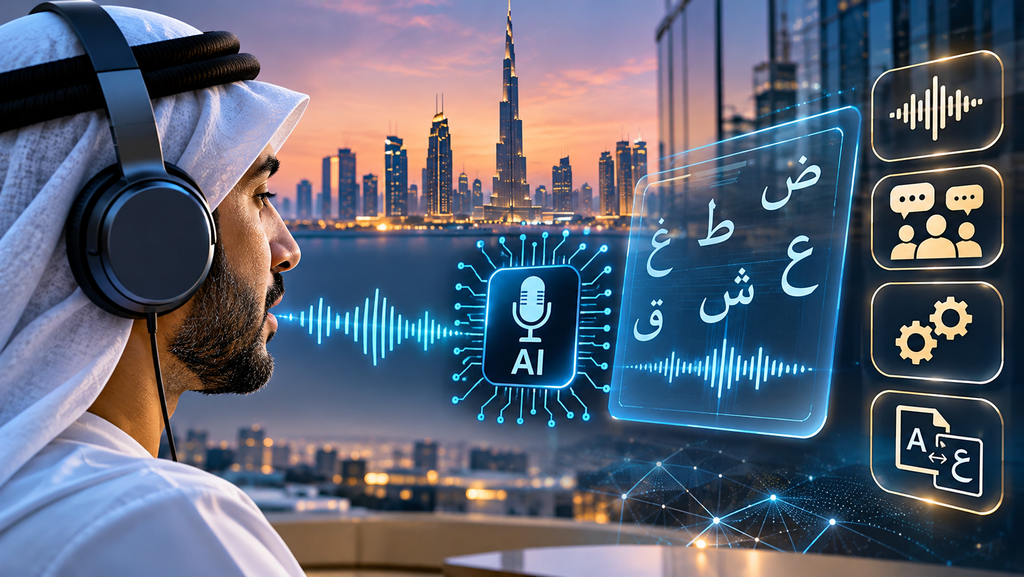
Arabic presents several linguistic features that make speech processing technically demanding.
These include consonant distinctions, vowel patterns, complex word formation, and differences between written and spoken language.
Although other languages also contain similar challenges, their combination creates specific difficulties for Arabic speech-recognition development.
The Importance of Arabic Sounds
Arabic contains consonants that may be unfamiliar to speakers of many other languages.
Some involve articulation in the throat or emphatic pronunciation patterns.
In addition, certain consonants have different pronunciations across dialects.
For example, the Arabic letter ق may be pronounced differently depending on the region and speaker.
A recognition model must learn that distinct acoustic forms can correspond to related words or written representations.
This becomes more complicated when pronunciation varies within the same conversation.
Arabic Morphology and Word Structure
Arabic is a morphologically rich language.
Many words are formed through combinations of roots, patterns, prefixes, and suffixes.
A single written word may include elements expressing grammatical relationships that would require multiple words in English.
This creates numerous possible word forms.
For a speech-recognition system, morphological complexity can make it difficult to identify the correct written output when training data contains limited examples of particular forms.
The Challenge of Missing Short Vowels
Arabic writing commonly omits short-vowel diacritics in ordinary text.
These marks can help indicate pronunciation and distinguish between words sharing the same consonantal structure.
Their absence can create ambiguity during language processing.
Speech contains pronunciation information, but a transcription system still needs to decide how the recognised words should be represented in writing.
For certain applications, restoring diacritics may require an additional processing stage.
Linguistic Challenges Compared
| Linguistic Feature | Technical Difficulty |
|---|---|
| Regional Pronunciation | Multiple acoustic forms for related words |
| Rich Morphology | Large numbers of possible word forms |
| Omitted Short Vowels | Ambiguity in written representation |
| Connected Speech | Difficulty identifying boundaries between words |
| Dialectal Grammar | Sentence patterns absent from formal training text |
| Variable Word Stress | Differences in acoustic patterns |
Why Context Matters
Recognising sounds is only one part of speech transcription.
AI systems must also interpret context to select plausible words.
For example, two similar-sounding expressions may have different meanings depending on the subject of the conversation.
Modern neural speech-recognition models can use contextual information to improve predictions.
However, contextual prediction also creates a risk of producing plausible text that does not accurately reflect what the speaker said.
For high-stakes applications, preserving the actual spoken content is essential.
3. Why Code-Switching and Multilingual Conversations Remain Difficult
Many Arabic speakers use more than one language during ordinary conversation.
In business, education, technology, healthcare, and professional settings, speakers may combine Arabic with English, French, or other languages.
This practice, known as code-switching, creates significant challenges for speech-recognition systems.
Understanding Code-Switching
Code-switching occurs when speakers alternate between languages or linguistic varieties during a conversation.
A person in Dubai might discuss a business project in Arabic while using English expressions for software, marketing, or technical processes.
A speaker in North Africa may incorporate French terms into Arabic conversation.
Switching can occur between sentences or within a single sentence.
This presents difficulties for systems designed to recognise only one language at a time.
Why Multilingual Speech Confuses Recognition Models
A monolingual system may interpret unfamiliar foreign words as similar-sounding Arabic expressions.
Alternatively, a multilingual model may recognise the foreign word but struggle to determine its correct written representation.
Technical terminology can create additional problems when speakers pronounce English words according to local Arabic phonological patterns.
For example, software-related words may be pronounced differently from their original English forms.
A recognition system must connect the acoustic signal to the intended expression without unnecessarily changing the speaker’s language choice.
Arabic and English in Gulf Workplaces
Multilingual communication is particularly relevant to GCC workplaces.
Teams may include speakers from several national and linguistic backgrounds.
A meeting conducted primarily in Arabic could include English business terminology and regional expressions.
For transcription systems used in such environments, reliable code-switching recognition can be important.
However, performance depends on the languages, accents, and specialised vocabulary represented in the model’s training data.
Challenges in Multilingual Speech Processing
| Conversation Type | Potential Recognition Problem |
|---|---|
| Arabic with English Business Terms | Incorrect rendering of foreign terminology |
| Arabic with French Expressions | Confusion between languages |
| MSA Mixed With Dialect | Inconsistent recognition and normalisation |
| Multiple Arabic Dialects | Difficulty identifying changing pronunciation patterns |
| Technical Conversations | Unfamiliar vocabulary |
| Multilingual Group Meetings | Combined speaker and language identification challenges |
The Role of Multilingual AI Models
Modern multilingual speech models can process several languages using shared neural architectures.
These systems may learn common acoustic features across languages and benefit from larger training datasets.
However, broad multilingual support does not guarantee equal performance across all language combinations.
Research published at ACL 2025 specifically examined Arabic code-switching and dialectal speech recognition.
The findings support the need for training approaches that account for language mixing rather than treating it as an unusual exception.
4. The Shortage of Arabic Speech Datasets and Reliable Transcriptions
One of the most persistent barriers to Arabic speech recognition is the availability of suitable training data.
Machine learning systems require substantial quantities of recorded speech paired with accurate written transcriptions.
The quality, diversity, and representativeness of these datasets strongly influence model performance.
Why Training Data Matters
A speech-recognition model learns by examining examples of audio and the words spoken within them.
When training data includes different speakers, accents, recording environments, and communication styles, the model can develop broader recognition capabilities.
However, if the dataset contains mostly formal news broadcasts, the system may struggle with spontaneous conversations.
Similarly, a model trained predominantly on one regional dialect may perform poorly on less-represented dialects.
The Problem of Unequal Dialect Representation
Arabic speech datasets have historically provided greater coverage of Modern Standard Arabic and certain widely studied dialects.
Smaller dialect communities and regional varieties may have fewer publicly accessible recordings.
This imbalance can influence which speakers benefit most from speech technology.
A recognition system may work effectively for one population while producing substantially more errors for another.
The Difficulty of Collecting Conversational Speech
Collecting authentic conversational audio can be challenging.
Researchers must obtain appropriate consent, protect participant information, and produce accurate transcriptions.
Informal speech contains interruptions, repeated words, overlapping speakers, and incomplete sentences.
Different transcribers may also write dialectal expressions differently because some spoken varieties lack universally accepted spelling conventions.
This can make dataset preparation labour-intensive.
Recent Arabic Speech Dataset Developments
In August 2026, researchers introduced BULBUL, a multi-dialect Arabic speech-recognition dataset.
The dataset includes speech from 275 speakers across 11 Arab countries.
Its design incorporates dialect and sub-dialect coverage, together with recordings of formal Arabic spoken using different regional accents.
Mozilla Common Voice also provides publicly accessible Arabic speech data.
Its September 2026 Arabic release reported approximately 158 hours of recorded audio, including about 93 hours of validated speech from the complete dataset.
These resources can support research, although a dataset’s total duration does not establish that every dialect or recording condition is equally represented.
What Makes a Useful Speech Dataset?
- Recordings from speakers with different regional accents.
- Representation across age groups and speaking styles.
- Clear documentation of dialect and language varieties.
- Both formal and spontaneous conversations.
- Appropriate variation in recording environments.
- Accurate transcription and quality review.
- Transparent licensing and consent arrangements.
- Consistent evaluation procedures.
Better datasets are essential for improving the reliability of Arabic-language speech technology.
5. How Background Noise and Real-World Conditions Affect Arabic Recognition
Speech-recognition systems may perform well when processing clear audio recorded in controlled environments.
However, everyday conversations often take place in offices, vehicles, public spaces, homes, and busy commercial environments.
These settings introduce acoustic challenges that can reduce transcription accuracy.
Noise and Recording Quality
Background noise can interfere with important speech information.
Common sources include traffic, ventilation equipment, crowd conversations, music, and electronic interference.
The effect depends on noise intensity, microphone quality, distance from the speaker, and the model’s ability to separate speech from other sounds.
For example, a customer speaking to a banking voice assistant from a crowded shopping centre may produce audio that differs substantially from the recordings used during model training.
Overlapping Speakers
Meetings and interviews often involve several people speaking close together.
Sometimes participants interrupt one another or speak simultaneously.
A recognition system may struggle to identify which words belong to which person.
Speaker diarisation, a related technology, attempts to determine when different individuals are speaking.
However, separating speakers accurately remains challenging when audio overlaps.
Accents and Speaking Speed
Speech varies according to individual pronunciation, speaking speed, emotional state, and communication style.
A person may speak rapidly, reduce certain sounds, or pause unexpectedly.
Recognition models must accommodate these differences without assuming that every speaker follows a standard pronunciation pattern.
Real-World Recognition Challenges
| Recording Condition | Likely Technical Difficulty |
|---|---|
| Busy Street | Traffic and environmental noise |
| Customer Service Call | Audio compression and variable microphone quality |
| Group Meeting | Multiple speakers and interruptions |
| Video Interview | Inconsistent microphones and background sounds |
| Vehicle Cabin | Road and engine noise |
| Public Event | Reverberation and crowd noise |
Why Testing Conditions Matter
A model evaluated only on clean recordings may not perform equally well in ordinary commercial applications.
Developers should test systems using representative audio from actual intended environments.
A call-centre transcription model, for example, should be evaluated on realistic call recordings rather than only studio-quality speech.
Researchers reviewing Saudi Arabic ASR studies in 2026 identified domain mismatch and performance degradation on spontaneous or noisy speech as continuing problems.
This illustrates why real-world evaluation is an essential part of building reliable systems.
6. How AI and Modern Speech Models Are Addressing Arabic Recognition Challenges
Recent improvements in artificial intelligence have introduced new methods for recognising speech across different languages and dialects.
Deep learning, transformer architectures, self-supervised training, and multilingual models have expanded what speech-recognition systems can achieve.
However, these developments have not eliminated Arabic-specific difficulties.
The Shift Toward Neural Speech Recognition
Earlier speech-recognition systems commonly relied on separate acoustic models, pronunciation dictionaries, and language models.
Modern systems increasingly use neural architectures that can learn complex relationships between speech signals and textual output.
These approaches may improve recognition when sufficient training data and computing resources are available.
However, their performance still depends on evaluation conditions and the speech varieties represented during training.
Transfer Learning and Fine-Tuning
Transfer learning allows developers to adapt a model trained on broader data to a more specific task.
A multilingual model may be fine-tuned using recordings from a particular Arabic dialect.
This can help improve performance when developing an entirely new model would require excessive data or computing resources.
A 2025 Interspeech study examined fine-tuning Whisper across Gulf, Levantine, Iraqi, Egyptian, and Maghrebi Arabic.
The researchers found that appropriately balanced pooled dialectal training data could produce performance comparable to dialect-specific models in their experimental setting.
The findings demonstrate promising ways to address limited training data, although results should not be assumed to generalise to every model or deployment environment.
Self-Supervised Learning
Self-supervised learning allows models to learn useful patterns from audio without requiring complete manual transcriptions for every recording.
This can reduce dependence on large quantities of fully annotated training material.
However, evaluation still requires reliable reference data.
Self-supervised learning also does not automatically correct gaps in dialect representation.
Improving Evaluation Standards
Researchers commonly assess speech recognition using word error rate, or WER.
WER measures the number of substitutions, deletions, and insertions relative to the words in a reference transcription.
A lower WER generally indicates better performance under a given evaluation method.
However, comparing WER across Arabic dialects can be difficult when spelling and transcription conventions differ.
AI Approaches and Their Limitations
| Technical Approach | Potential Advantage | Remaining Limitation |
|---|---|---|
| Multilingual Models | Shared learning across languages | Unequal dialect coverage |
| Dialect Fine-Tuning | Better adaptation to local speech | Requires representative recordings |
| Self-Supervised Learning | Uses unlabelled audio | Still needs reliable evaluation |
| Data Augmentation | Creates varied training examples | Synthetic variation may be unrealistic |
| Noise-Robust Training | Better performance in selected environments | Cannot eliminate all acoustic errors |
| Contextual Recognition | Improves vocabulary interpretation | May produce plausible but incorrect words |
The Importance of Consistent Benchmarking
The NADI 2025 shared task introduced evaluations involving dialect identification, automatic speech recognition, and diacritic restoration.
The best-performing ASR systems reported an average word error rate of 35.68% on the designated speech-recognition task.
This is a benchmark-specific result, not a universal error rate for Arabic speech-recognition technology.
It nevertheless demonstrates that substantial challenges remain even for systems evaluated in organised research competitions.
7. The Future of Arabic-Language Speech Recognition in the Gulf and Beyond
The future of Arabic-language speech recognition will depend on technical progress combined with sustained investment in linguistic resources, responsible data collection, and real-world evaluation.
For Gulf countries, improved Arabic voice technology could support digital accessibility, public services, education, business communication, and media production.
However, its effectiveness will require systems designed for the way Arabic is actually spoken.
Opportunities for Government Services
Voice interfaces could make selected government services easier to access for people who prefer speaking instead of typing.
Users may be able to ask questions, navigate services, or request information using spoken Arabic.
However, public-service applications must handle recognition errors carefully.
Systems should provide clear confirmation for important information and offer alternative assistance when recognition fails.
Applications in Banking and Customer Service
Financial institutions and customer service providers could use Arabic speech recognition to support call transcription, automated assistance, and quality monitoring.
However, errors involving personal details, account information, or financial instructions can have significant consequences.
High-risk processes require appropriate verification, secure data handling, and human intervention.
Supporting Media and Creative Industries
Media organisations can benefit from accurate Arabic transcription.
Journalists, broadcasters, and video producers may use speech recognition to prepare subtitles, search recorded interviews, or organise content archives.
However, dialectal speech and code-switching can create errors that affect quotations and meaning.
Human review remains especially important before publishing news transcripts or subtitles.
Arabic Speech Recognition Development Checklist
- Identify the Arabic dialects relevant to the intended users.
- Collect representative recordings with appropriate consent.
- Establish consistent transcription guidelines.
- Include multilingual and code-switched speech where relevant.
- Test models under realistic acoustic conditions.
- Evaluate performance across speaker groups and dialects.
- Measure word error rates and critical meaning-related errors.
- Protect personal and sensitive voice information.
- Include human review for high-impact applications.
- Update models and evaluation datasets as language use evolves.
The Importance of Regional Research Collaboration
Universities, technology companies, and public institutions can contribute to Arabic speech-recognition development.
Research partnerships may support dataset creation, dialect documentation, model evaluation, and shared technical resources.
Initiatives involving researchers at the Mohamed bin Zayed University of Artificial Intelligence and Saudi telecommunications specialists demonstrate the potential of regional collaboration.
However, wider access to research resources must be balanced with consent, privacy, and appropriate data governance.
Why Linguistic Inclusion Matters
Speech technology should not work effectively only for speakers using formal Arabic or widely represented regional dialects.
Smaller dialect communities, older speakers, and users with different speech characteristics also need consideration.
Models that perform well on average may still produce consistently higher error rates for particular populations.
Developers should therefore examine performance differences rather than relying only on aggregate accuracy figures.
Conclusion
Arabic-language speech recognition has made important progress through advances in artificial intelligence, multilingual models, and improved training methods.
However, the language continues to present distinct technical challenges involving dialect diversity, pronunciation, morphology, code-switching, inconsistent spelling conventions, and limited representative speech data.
Real-world conditions such as background noise, overlapping speakers, and unfamiliar accents introduce additional difficulties.
Research published in 2025 and 2026 demonstrates both the progress being made and the challenges that remain, particularly in recognising spontaneous dialectal speech reliably.
For Gulf businesses and public institutions, improving speech recognition could support more accessible digital services, efficient customer communication, and stronger Arabic-language technology capabilities.
Yet meaningful progress will depend on developing systems that accurately represent the linguistic diversity of Arabic-speaking communities.
The future of Arabic speech recognition is therefore not simply about making AI models larger or faster. It is about building technology that understands the different ways people speak, preserves their intended meaning, and performs reliably across real-world situations.
As regional investment in artificial intelligence continues, addressing these challenges could help make Arabic-language voice technology more inclusive, practical, and effective.
Do follow us on Instagram
Read More – The Future of Digital Product Passports in Middle Eastern Retail Markets