



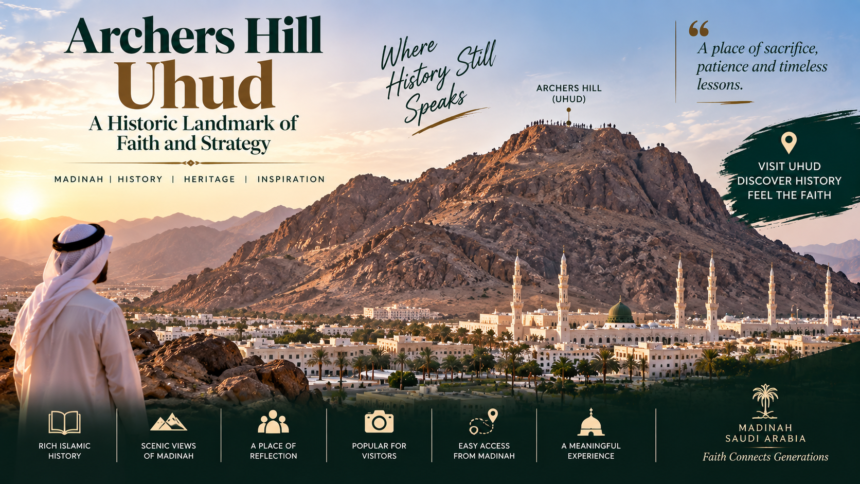
Archers Hill Uhud Jabal al-Rumah historic landmark in Madinah Saudi Arabia
A small rocky hill north of central Madinah carries a story far greater than its physical size. Archers Hill Uhud, known in Arabic as Jabal al-Rumah and historically also called Jabal Aynayn, stands beside Mount Uhud at the landscape associated with one of the most significant events in early Islamic history, the Battle of Uhud.
- Archers Hill Uhud at a Glance
- Why Is It Called Archers Hill?
- Understanding the Battle of Uhud
- Why Archers Hill Was Strategically Important
- What Happened When Many Archers Left Their Position?
- What Does Archers Hill Look Like Today?
- Mount Uhud and the Bigger Historical Landscape
- Uhud Martyrs Square Adds Another Layer to the Visit
- What Archers Hill Can Teach Modern Visitors
- Best Time to Visit Archers Hill Uhud
- How Much Time Do You Need at Archers Hill?
- Visiting Archers Hill Respectfully
- Nearby Historic Places to Combine With Archers Hill
- A Simple Archers Hill Uhud Visitor Plan
- Practical Tips Before Visiting
- Frequently Asked Questions About Archers Hill Uhud
- Why Archers Hill Uhud Remains One of Madinah’s Most Meaningful Historic Sites
Unlike Mount Uhud, which dominates the horizon with its long mountain ridge, Archers Hill is relatively modest. Saudi Press Agency describes Jabal al-Rumah as extending for about 180 metres, yet its position on the historic battlefield made it strategically important. Visitors continue to climb the hill to understand where the archers were stationed and how the geography shaped what happened during the battle.
Today, the site attracts pilgrims, residents and history-focused travelers from around the world. Some come because they have read about the Battle of Uhud since childhood, while others discover the significance of the location only after arriving in Madinah. Standing here connects historical accounts with a real landscape: Mount Uhud rises ahead, the battlefield spreads below, and the Martyrs of Uhud area lies nearby.
This guide explores Archers Hill Uhud through its history, geography, strategic importance and modern visitor experience. It also explains how to visit respectfully, what else to see around the Uhud battlefield and why this small hill remains one of Madinah’s most thought-provoking historic landmarks.
Archers Hill Uhud at a Glance
The first thing to understand is that Archers Hill and Mount Uhud are not the same geographical feature. Jabal al-Rumah is a much smaller hill located close to the southwestern side of the much larger Mount Uhud landscape.
Saudipedia identifies Jabal al-Rumah as an Islamic and historical landmark north of the Prophet’s Mosque and notes that it is also known as Jabal Aynayn. The surrounding ground level has changed over centuries because of accumulated sediment from floods flowing through Wadi Qana, which has contributed to the hill appearing lower today than it would have historically.
| Quick Fact | Archers Hill Uhud |
|---|---|
| Arabic Name | Jabal al-Rumah |
| Historical Name | Jabal Aynayn |
| Location | North of central Madinah, beside Mount Uhud |
| Approximate Length | Around 180 metres |
| Main Historical Connection | Battle of Uhud |
| Battle Period | Third year after the Hijrah |
| Archers Stationed Here | 50 according to SPA historical reporting |
| Nearby Landmark | Mount Uhud |
| Nearby Memorial Area | Uhud Martyrs Square |
| Modern Experience | Historical visit, reflection and battlefield viewing |
| Ticket | The wider Uhud historic area is generally visited without conventional attraction tickets |
The hill’s significance does not come from its height or geological size. Its importance comes from the role it played in protecting the Muslim army’s rear position during the Battle of Uhud.
Understanding that purpose transforms a visit. Instead of seeing only a rocky mound, visitors begin to see why the position mattered and how decisions made on this small piece of ground affected events across the battlefield.
Why Is It Called Archers Hill?
The name Jabal al-Rumah translates approximately as the Mountain or Hill of the Archers. The name became closely associated with the Battle of Uhud because Prophet Muhammad stationed archers there before the fighting began.
Saudi Press Agency historical reporting states that 50 archers were ordered to take position on the hill. Their role was to protect the Muslim forces from an attack around the rear or side of the battlefield.
That defensive purpose explains the geography. From an elevated position, archers could observe movement across the open battlefield and help prevent cavalry from using the space behind the Muslim lines.
The hill therefore functioned as more than a place from which arrows could be fired. It was effectively a strategic defensive position controlling an important route through the battlefield.
| Name | Meaning or Context |
|---|---|
| Jabal al-Rumah | Hill or Mountain of the Archers |
| Archers Hill | Common English description |
| Jabal Aynayn | Older historical name |
| Uhud | Name of the larger mountain and battlefield area |
Visitors may encounter all three names online, on tours or in historical material. They generally refer to the same small hill associated with the archers during the Battle of Uhud.
Understanding the Battle of Uhud
To understand why Archers Hill Uhud matters, it is necessary to understand the wider conflict surrounding it.
The Battle of Uhud took place in the third year after the Hijrah, commonly dated to 625 CE. It followed the earlier Battle of Badr and involved the Muslim community of Madinah facing a much larger Makkan force near Mount Uhud. Saudipedia records that the battle unfolded in the area between the southwestern base of Mount Uhud and Jabal al-Rumah.
The Muslim forces positioned themselves with Mount Uhud providing natural protection in one direction. Jabal al-Rumah then became important because cavalry could potentially move through another part of the battlefield and attack from behind.
The archers were therefore instructed to remain on the hill and guard that position. The instruction was central to the battle plan rather than a secondary detail.
A simplified battlefield structure helps explain the strategy:
| Battlefield Element | Strategic Role |
|---|---|
| Mount Uhud | Large natural barrier behind part of the Muslim position |
| Jabal al-Rumah | Elevated defensive position |
| Archers | Protected the rear approach |
| Open battlefield | Main area of confrontation |
| Cavalry movement | Major tactical threat |
| Martyrs area | Location associated with those killed in the battle |
Looking at the landscape today helps make these relationships much easier to understand than simply reading them on a page.
Visitors standing on or near Archers Hill can see how close the different sections of the battlefield are to each other. The geography explains why maintaining control of the position was so important.
Why Archers Hill Was Strategically Important
Archers Hill demonstrates a basic principle of battlefield strategy: a relatively small piece of elevated ground can become extremely important if it controls movement through a larger area.
The archers’ position overlooked the route that enemy cavalry could potentially use to reach the Muslims from behind. From the hill, they could watch this space and respond if mounted troops attempted to move around the main battle line.
Saudi Press Agency describes the archers as having been positioned there specifically to protect the rear flank of the Muslim forces.
That makes Jabal al-Rumah one of the clearest places in Madinah where landscape and historical narrative can be studied together.
| Strategic Advantage | Why It Mattered |
|---|---|
| Elevated ground | Better visibility across surrounding terrain |
| Position near battlefield | Allowed rapid defensive response |
| Control of rear approach | Reduced risk of cavalry attack |
| Connection with Mount Uhud | Helped complete the defensive formation |
| Small concentrated position | Could be held by a limited number of archers |
Modern visitors often climb the hill and look outward across the same general area. Although the surrounding cityscape has naturally changed dramatically over more than fourteen centuries, the relationship between Archers Hill and Mount Uhud remains visible.
This is one reason visiting with someone who knows the battlefield history can make the experience significantly more meaningful. A guide can point out directions and explain troop positions rather than leaving visitors to interpret the landscape by themselves.
What Happened When Many Archers Left Their Position?
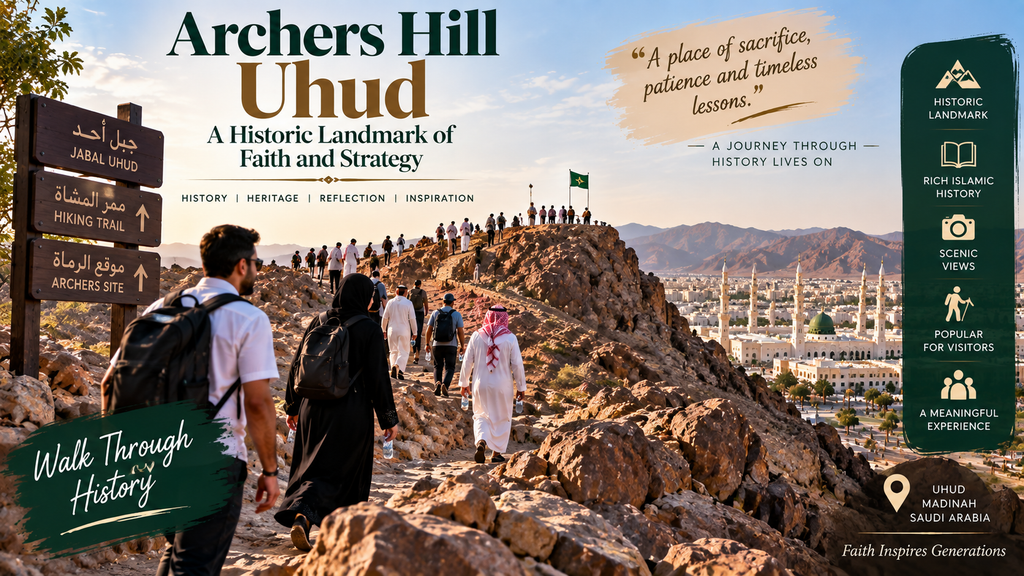
The most famous part of the story of Archers Hill concerns what happened after the battle initially appeared to be moving in favour of the Muslims.
According to Saudipedia’s account of Jabal al-Rumah, many archers believed victory had been achieved and descended from the hill despite instructions to maintain their position. Their commander called for them to remain, but much of the defensive force left the strategic location.
That created an opening.
The Makkan cavalry, led at the time by Khalid ibn al-Walid before his later conversion to Islam, maneuvered around the hill and attacked the remaining defenders before striking the Muslim forces from behind. The unexpected attack dramatically changed the course of the battle.
The fighting became intense and Muslim ranks were disrupted. Around 70 companions were martyred, including Hamzah ibn Abdul-Muttalib, the uncle of Prophet Muhammad. The martyrs were buried close to the battlefield at the foot of Mount Uhud.
| Stage | What Happened |
|---|---|
| Initial position | Archers guarded the rear approach |
| Early fighting | Muslim forces gained an advantage |
| Decision point | Many archers left their position |
| Tactical opening | Rear defensive route became vulnerable |
| Cavalry movement | Enemy cavalry moved around the hill |
| Counterattack | Muslim forces were attacked from behind |
| Final impact | Heavy losses and around 70 Muslim martyrs |
For many Muslim visitors, the story is remembered not simply as military history but as a lesson concerning discipline, obedience, patience and the consequences of abandoning an assigned responsibility.
That meaning explains why visitors often spend time quietly reflecting here rather than treating Archers Hill as an ordinary viewpoint.
What Does Archers Hill Look Like Today?
Visitors expecting a large mountain may initially be surprised. Jabal al-Rumah is relatively small, particularly when compared with the massive ridge of Mount Uhud rising nearby.
SPA reported in February 2026 that the hill extends approximately 180 metres and has prepared routes that help visitors access the site. During Ramadan and Hajj periods, the agency has documented large numbers of international pilgrims climbing the hill, listening to explanations about the Battle of Uhud and looking across the historic landscape.
The terrain remains rocky and uneven. Although the climb is short for many physically able visitors, it should not be treated like a paved staircase or indoor attraction.
Footwear makes a noticeable difference. Visitors wearing footwear designed only for smooth mosque floors may find loose rocks and irregular surfaces less comfortable.
What you can expect during a visit:
- Rocky, uneven ground on and around the hill
- Large numbers of visitors during busy pilgrimage seasons
- Views toward Mount Uhud and the battlefield area
- Guides explaining the Battle of Uhud
- Nearby pedestrian areas and visitor infrastructure
- Strong sun during much of the year
- A visit that can be physically short but historically meaningful
The physical visit may take less than an hour, but spending slightly longer to understand the site usually creates a better experience.
Mount Uhud and the Bigger Historical Landscape
Archers Hill should not be viewed separately from Mount Uhud. The two landmarks form part of the same historical battlefield.
Mount Uhud lies north of Madinah and approximately four kilometres from the Prophet’s Mosque according to Saudipedia. The mountain rises above 1,000 metres above sea level and remains one of the city’s best-known geographical landmarks.
Its long rocky formation provided a natural element in the defensive geography of the battle. Today, it also gives the entire Uhud area its dramatic visual character.
Islamic tradition gives Mount Uhud additional spiritual importance. Historical and religious sources record the Prophet Muhammad expressing affection for the mountain, contributing to the special place it holds in Muslim memory.
| Archers Hill | Mount Uhud |
|---|---|
| Small hill | Large mountain massif |
| Around 180 metres long | Extensive mountain range |
| Position of the archers | Major natural backdrop to battlefield |
| Also called Jabal Aynayn | Known as Jabal Uhud |
| Short climb | Much larger mountain landscape |
| Main importance is tactical | Historical, geographical and religious significance |
Seeing both together is important. A photograph of Archers Hill alone does not fully communicate why the location mattered.
Once visitors see the hill in relation to Mount Uhud and the open ground between them, the tactical logic becomes much clearer.
Uhud Martyrs Square Adds Another Layer to the Visit
Close to Archers Hill is Uhud Martyrs Square, one of the most visited historical areas around Mount Uhud.
Visit Saudi describes the site as a landmark associated with the martyrs of the Battle of Uhud and places it around five kilometres north of the Prophet’s Mosque. The visitor area includes pedestrian infrastructure and a large mosque developed as part of improvements around the historic site.
Among those associated with the cemetery is Hamzah ibn Abdul-Muttalib, one of the best-known figures who was martyred during the battle.
The atmosphere here is different from climbing Archers Hill. The hill encourages visitors to understand strategy and geography, while the martyrs area naturally carries a more solemn character.
Current Visit Saudi information lists Uhud Martyrs Square as a freely accessible site and notes accessibility infrastructure in the wider developed visitor area.
A good visit should therefore allow time for both places rather than arriving only to photograph the hill and leave.
What Archers Hill Can Teach Modern Visitors
Historic landmarks become more meaningful when travelers understand the human decisions connected with them.
At Archers Hill, the central story concerns responsibility. Fifty archers were given a specific position because holding that ground protected a much larger force. When many left, the consequences extended far beyond the hill itself.
For Muslim visitors, that story is frequently discussed in the context of obedience to the Prophet, patience and remaining committed to an instruction even when circumstances appear to have changed.
For students of history and military strategy, the same event illustrates the importance of terrain, command structure, disciplined positioning and maintaining defensive control.
| Perspective | Key Takeaway |
|---|---|
| Islamic history | Important episode from the Prophet’s biography |
| Faith and reflection | Discipline, patience and responsibility |
| Military history | Importance of controlling strategic terrain |
| Leadership | Instructions can remain critical even when circumstances shift |
| Geography | Small landforms can influence much larger events |
| Cultural travel | Physical places make historical narratives easier to understand |
This ability to be understood from several perspectives is part of what makes the site so important.
Visitors do not need a long museum exhibition to grasp the central story. The hill itself becomes part of the explanation.
Best Time to Visit Archers Hill Uhud
Madinah can become extremely hot, so the time of day has a major effect on the comfort of an outdoor historical visit.
Early morning is usually one of the easiest periods for walking around the battlefield, particularly during warmer months. Late afternoon can also be attractive because the light becomes softer and the temperature gradually decreases.
SPA documented visitors gathering and climbing Jabal al-Rumah before Maghrib during Ramadan 2026, demonstrating how active the area can become around late afternoon during major religious seasons.
| Time | Advantages | Considerations |
|---|---|---|
| Early morning | Cooler and often easier for walking | Requires earlier start |
| Late morning | Good visibility | Heat can increase quickly |
| Midday | Bright battlefield views | Often the hottest period |
| Late afternoon | Softer light and cooler conditions | Can become crowded |
| Evening | Pleasant surrounding atmosphere | Less daylight for battlefield interpretation |
During Hajj, Ramadan and busy Umrah periods, larger visitor numbers should be expected. SPA reported substantial pilgrim traffic at Jabal al-Rumah during the 1447 AH Hajj season.
Weather, personal mobility and crowd levels should therefore determine your timing rather than simply choosing whatever hour fits between other sightseeing stops.
How Much Time Do You Need at Archers Hill?
A rushed visitor could physically see Archers Hill in 20 or 30 minutes, but that would miss much of the value of the site.
Allowing approximately 60 to 90 minutes for the wider battlefield area gives enough time to look at Jabal al-Rumah, understand its relationship with Mount Uhud and spend time around the martyrs area.
Visitors taking an organised historical tour may spend longer. Visit Saudi currently lists a guided electric-bike experience around the Uhud area lasting approximately two hours and covering Jabal al-Rumah, Sayyid al-Shuhada Cemetery and Al-Fasah Mosque.
| Available Time | Suggested Experience |
|---|---|
| 30 minutes | View Archers Hill and battlefield |
| 60 minutes | Hill plus historical explanation |
| 90 minutes | Add Uhud Martyrs Square |
| 2 hours | Guided historical circuit |
| Half day | Combine several Madinah Islamic heritage sites |
For a first visit, 60 to 90 minutes is a comfortable middle ground.
The goal should not be to remain on the summit as long as possible. The strongest understanding often comes from moving around the battlefield and viewing the hill from different positions.
Visiting Archers Hill Respectfully
Although Archers Hill is an outdoor historic site, its connection with the Prophet’s biography and the martyrs of Uhud makes respectful behaviour especially important.
Wear modest clothing suitable for Madinah, keep noise controlled around areas of reflection and avoid blocking paths while taking photographs. Visitors should also follow local barriers, signs and instructions rather than attempting to access restricted areas.
The rocky terrain itself deserves consideration. Avoid climbing unstable sections simply to reach a better photograph, particularly when the site is crowded.
Respect for other visitors is equally important. People may be engaging with the site emotionally or spiritually, so it should not be treated like an entertainment attraction.
When visiting the martyrs area, maintain a particularly calm atmosphere. Historical curiosity and photography can coexist with respect when visitors remain aware of the significance the location holds for others.
Nearby Historic Places to Combine With Archers Hill
The biggest advantage of visiting Jabal al-Rumah is that several related historical landmarks are concentrated around the same part of Madinah.
Mount Uhud should naturally be viewed as part of the same visit. Its location helps explain why the battlefield developed where it did and gives visitors the larger geographical context for Archers Hill. Saudipedia describes it as one of Madinah’s most famous historical and geographical landmarks.
Uhud Martyrs Square is equally important because it connects the battlefield with the human cost of the Battle of Uhud. Visitors commonly include the hill and martyrs area in the same historical tour.
Al-Fasah Mosque is another historical site associated with Mount Uhud. Saudipedia records it among remnants around the mountain linked with the Prophetic period, while current Visit Saudi experiences include it on guided Uhud historical routes.
| Nearby Site | Why Visit |
|---|---|
| Mount Uhud | Understand the battlefield’s natural geography |
| Uhud Martyrs Square | Reflect on those martyred in the battle |
| Al-Fasah Mosque | Explore another site linked to Uhud history |
| Jabal al-Rumah | Understand the archers’ strategic position |
Combining these stops produces a far stronger historical experience than visiting each as an isolated attraction.
A Simple Archers Hill Uhud Visitor Plan
Begin by viewing the hill from ground level rather than climbing immediately. Look toward Mount Uhud and identify the open space between the two landmarks so the geography starts to make sense.
Next, climb only as far as you feel comfortable on the rocky terrain. From the elevated position, consider why archers stationed there could watch movement across the battlefield.
After descending, continue toward Uhud Martyrs Square. This transition from strategy to remembrance gives the visit a natural structure and prevents it from becoming only a sightseeing stop.
If you have additional time, add Al-Fasah Mosque or take a guided Uhud tour. Visitors interested in history may find that a knowledgeable guide adds substantially more value here than at many conventional tourist attractions.
Practical Tips Before Visiting
Archers Hill is simple to visit, but a little preparation makes the experience more comfortable.
- Wear comfortable shoes with reasonable grip because the hill is rocky.
- Carry drinking water, especially outside winter.
- Use sunscreen and head protection during daytime visits.
- Avoid the hottest hours during warmer months when possible.
- Give older visitors the option to observe from ground level rather than climbing.
- Keep children close because the terrain is uneven.
- Allow more time during Ramadan, Hajj and busy Umrah periods.
- Consider a guide if you want to understand troop movements and battlefield geography.
- Respect the Martyrs of Uhud area as a place of historical and religious significance.
The most important practical point is that climbing the hill is not essential to appreciating the history. Visitors with mobility limitations can still see Jabal al-Rumah, Mount Uhud and much of the surrounding landscape from ground level.
Frequently Asked Questions About Archers Hill Uhud
What is Archers Hill Uhud?
Archers Hill is a small historic hill beside Mount Uhud in Madinah. Known as Jabal al-Rumah or Jabal Aynayn, it is associated with the Battle of Uhud because Prophet Muhammad positioned archers there to protect the Muslim forces’ rear flank.
Why is Jabal al-Rumah important?
Its importance comes from its strategic role during the Battle of Uhud. The archers positioned there controlled an approach that enemy cavalry could potentially use to reach the Muslim army from behind.
How many archers were stationed there?
Saudi Press Agency historical reporting states that 50 archers were positioned on Jabal al-Rumah before the Battle of Uhud.
Is Archers Hill the same as Mount Uhud?
No. Archers Hill is the smaller Jabal al-Rumah located beside the much larger Mount Uhud. The battlefield lies around and between these geographical features.
How large is Archers Hill?
SPA describes Jabal al-Rumah as extending approximately 180 metres in length. The surrounding ground level has changed over centuries, and Saudipedia notes that accumulated flood sediments have contributed to a reduction in its apparent height.
Can visitors climb Archers Hill?
Yes, visitors are regularly documented climbing the hill, and SPA says prepared routes provide access. The terrain remains rocky and uneven, however, so appropriate footwear and caution are important.
How far is Archers Hill from the Prophet’s Mosque?
Sources give slightly different measurements depending on the precise reference point. SPA places Jabal al-Rumah about four kilometres from the Prophet’s Mosque, while Saudipedia describes it as approximately three kilometres away. It is located north of the central mosque area beside Mount Uhud.
What happened after the archers left the hill?
Saudipedia records that many archers descended after believing victory had been achieved. The opposing cavalry then maneuvered around the position and attacked the remaining archers before striking the Muslim forces from behind, changing the course of the battle.
Who is buried near Mount Uhud?
Companions martyred during the Battle of Uhud were buried near the battlefield. Among the best known is Hamzah ibn Abdul-Muttalib, the Prophet Muhammad’s uncle.
Do you need much time to visit?
Around an hour is sufficient for the hill and basic battlefield context, while 90 minutes to two hours allows time for Uhud Martyrs Square and a more complete historical explanation.
Why Archers Hill Uhud Remains One of Madinah’s Most Meaningful Historic Sites
The power of Archers Hill Uhud comes from contrast. Physically, it is small enough that many visitors can climb it within minutes. Historically, however, decisions made around this hill influenced the course of one of the defining battles of early Islamic history.
Its location explains why. Jabal al-Rumah stood beside the battlefield as a defensive position protecting the rear of the Muslim forces. The archers stationed there were given a precise responsibility, and what followed after many left their position became one of the most remembered lessons associated with the Battle of Uhud.
The surrounding landscape makes that history unusually tangible. Mount Uhud rises behind the battlefield, the martyrs area lies close by, and visitors can physically observe the relationship between these locations rather than imagining them only through maps or written descriptions.
For Muslim travelers, the visit can carry an additional spiritual dimension. The landscape is closely connected with the Prophet’s biography, his companions and events that have been studied and remembered for centuries. For other history-focused visitors, it remains an extraordinary example of how geography, military positioning and individual decisions can shape an event.
A visit does not need elaborate entertainment or a long checklist. Walk around the battlefield, look carefully at the relative positions of the mountains, spend time near the martyrs area and understand why the archers were asked to remain where they were.
That is what makes Archers Hill Uhud different from an ordinary viewpoint. More than fourteen centuries after the Battle of Uhud, this modest rocky hill continues to turn a historical account into a visible landscape and remains one of Madinah’s most significant places for understanding faith, responsibility and strategy.
Do follow us on Instagram
Read More – Guesto Indian Restaurant Madinah: 7 Things to Know