How Solar Panel Recycling Works Step by Step
A solar farm in Dubai may continue producing electricity for decades, quietly converting sunlight into power for homes and businesses. However, the equipment will not operate indefinitely. As panels age, their electricity output may decline, individual components can fail and operators may eventually decide to replace the installation with newer technology. This raises an important environmental question: what happens to thousands of solar panels when they are no longer needed?
- What Happens When Solar Panels Reach the End of Their Life?
- 7 Valuable Materials That Can Be Recovered From Old Solar Panels
- How Solar Panel Recycling Works Step by Step
- UAE and Gulf Solar Projects: Preparing for Future Panel Waste
- Can Old Solar Panels Be Repaired or Reused?
- The Economics of Solar Panel Recycling and Material Recovery
- Environmental Risks, Recycling Rules and Industry Challenges
- The Future of Solar Panel Recycling in the Gulf and FAQs
Solar Panel Recycling is becoming an increasingly important consideration for the renewable energy industry as more photovoltaic installations approach replacement or retirement.
Solar panels are widely associated with clean electricity generation, but manufacturing them requires materials including glass, aluminium, silicon, copper and small quantities of valuable metals.
These materials do not automatically lose their usefulness when a panel stops generating electricity.
Depending on its condition, a retired panel may remain suitable for continued use, repair, refurbishment or recycling. When appropriate recovery technologies are available, some of its components can become inputs for new products.
However, not every panel is recyclable through the same process, and the costs of collecting, dismantling and processing the equipment can be substantial.
For Gulf countries, this issue is particularly relevant because solar power capacity has expanded through major infrastructure investments.
Dubai’s Mohammed bin Rashid Al Maktoum Solar Park is one example. In October 2026, Dubai Electricity and Water Authority reported that its installed generation capacity had reached 4,660 megawatts, combining photovoltaic and concentrated solar power technologies.
The solar park is expected to exceed 8,000 megawatts by 2030, making long-term asset management and eventual decommissioning important planning considerations.
The challenge is not limited to large solar farms. Rooftop installations, commercial solar systems and smaller renewable energy projects will also require responsible treatment when equipment reaches the end of its useful life.
According to the International Energy Agency’s Photovoltaic Power Systems Programme, recent advances are improving the recovery of materials from retired panels. Nevertheless, the industry still faces economic, technical and logistical barriers.
A 2026 IEA-PVPS study also highlights the potential to repair or reuse selected panels rather than immediately recycling them.
These developments suggest that the future of solar energy will depend not only on producing clean electricity but also on managing equipment responsibly throughout its entire lifecycle.
What Happens When Solar Panels Reach the End of Their Life?
Solar photovoltaic panels convert sunlight into electricity through semiconductor materials.
Most commercially installed panels are designed to operate for many years, but their performance changes over time.
The US Department of Energy reports that the average operational lifespan of solar panels has increased substantially, with industry estimates reaching approximately 25–35 years by 2025.
However, lifespan is not a fixed expiration date.
Some panels may continue producing useful electricity beyond their expected service period, while others require earlier replacement because of physical damage, defects or economic considerations.
Why Solar Panels Lose Performance
Solar modules experience gradual degradation as their materials are exposed to environmental conditions.
Potential causes of reduced performance include changes in electrical connections, degradation of encapsulating materials and deterioration of other components.
Damage may also result from transportation, installation errors or extreme weather.
In Gulf environments, high temperatures, dust accumulation and demanding operating conditions make maintenance and performance monitoring important.
However, the actual degradation rate depends on module design, installation quality and site conditions.
Does a 25-Year Warranty Mean the Panel Stops Working?
No. A performance warranty is not an automatic expiry date.
A panel may continue functioning after the warranty period, although its output could be lower than when it was new.
The decision to replace equipment should consider its measured performance, safety, maintenance requirements and the economic value of continued operation.
Four Possible End-of-Life Pathways
| Option | What Happens | Main Requirement |
|---|---|---|
| Continued Operation | Existing panels remain in service | Safe, adequate performance |
| Repair or Refurbishment | Suitable defects are addressed | Technical evaluation |
| Second-Life Use | Panels are tested for another application | Reliability and compliance |
| Recycling | Components and materials are recovered | Suitable processing facilities |
Disposal may still be necessary for certain materials that cannot be safely recovered, but it should not automatically be considered the preferred pathway.
Why Early Replacement Happens
Some solar farms may retire functioning panels before their technical end of life.
Newer modules may offer higher output or better commercial performance, encouraging operators to upgrade existing installations.
This is known as repowering.
However, replacing working equipment also creates new manufacturing demand and waste-management obligations.
The environmental and financial advantages must therefore be assessed across the full lifecycle.
7 Valuable Materials That Can Be Recovered From Old Solar Panels
Solar panels contain several materials that may retain commercial value after the equipment is retired.
Their composition varies according to the technology and manufacturer.
Most conventional crystalline-silicon modules contain substantial amounts of glass and aluminium, alongside polymers, silicon and metal conductors.
1. Glass
Glass generally accounts for the largest proportion of a conventional photovoltaic module’s weight.
It protects the solar cells from weather and mechanical damage.
During recycling, suitable processes can recover glass for potential use in other industrial applications.
However, contamination and quality requirements may limit whether recovered glass can be used to manufacture new solar panels.
2. Aluminium
Aluminium is commonly used in panel frames.
It can often be separated during dismantling and supplied to metal recycling processes.
Recovering aluminium may reduce demand for newly produced material, depending on the recycling route and resulting product.
3. Silicon
Crystalline silicon forms the electricity-generating cells in many solar panels.
Recovering silicon at a useful purity can be technically challenging because the cells are bonded into laminated structures.
Advanced processing technologies may improve recovery, but producing material suitable for new solar cells requires demanding specifications.
4. Copper
Copper is used in electrical connections, cables and other components.
It has established recycling markets, making it a potentially valuable recovered material.
However, separation and processing costs still need to be considered.
5. Silver
Some photovoltaic cells contain small quantities of silver.
Although silver represents a small fraction of total module weight, its value can make it an important target for specialised recycling.
IEA-PVPS research published in September 2026 identifies recovered silver as a potentially important future secondary material source.
6. Steel and Mounting Components
Solar installations also contain mounting structures and other equipment that may be manufactured from steel or aluminium.
These are not always part of the panel itself, but they contribute to the material recovery opportunity when a system is decommissioned.
7. Electronic Components
Junction boxes, wiring and certain other electrical components may contain recoverable materials.
Inverters are separate system components that also require appropriate end-of-life management.
However, electronic equipment must be processed according to its composition and applicable waste requirements.
Material Recovery Compared
| Material | Main Location | Recovery Opportunity |
|---|---|---|
| Glass | Front surface | Bulk material recycling |
| Aluminium | Panel frame | Metal recycling |
| Silicon | Photovoltaic cells | Specialised recovery |
| Copper | Wiring and connections | Metal recovery |
| Silver | Cell contacts | High-value metal recovery |
| Steel | Mounting structures | Conventional scrap recycling |
| Electronics | Junction boxes and inverters | Specialist processing |
Recovering a large percentage of a panel’s weight does not necessarily mean recovering an equally high percentage of its economic value.
Glass dominates the mass of many modules, while smaller quantities of valuable metals can account for an important portion of the potential recycling revenue.
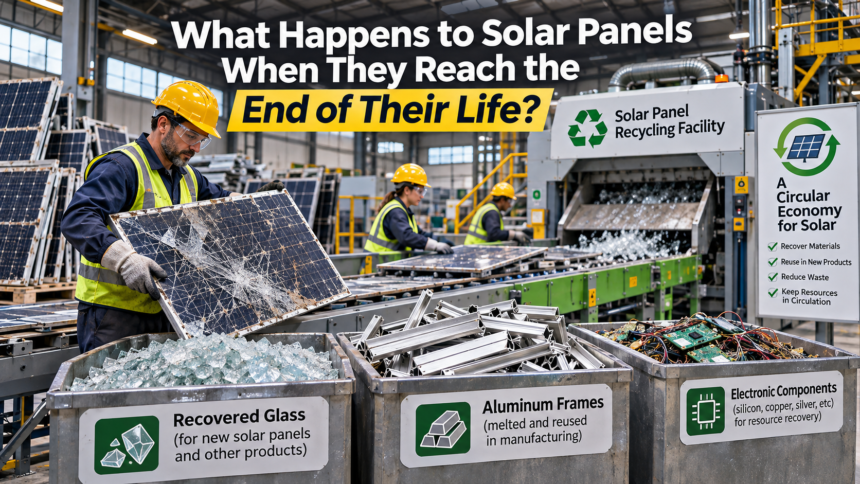
How Solar Panel Recycling Works Step by Step
The recycling process begins when a solar panel is removed from service.
Before dismantling, operators need to establish whether the panel remains safe and whether repair or reuse is possible.
Damaged equipment should be handled by trained personnel because photovoltaic modules can present electrical and physical hazards.
Collection and Inspection
Retired panels are collected from rooftops, commercial installations or utility-scale solar farms.
Operators may examine their condition, identify the module technology and separate equipment suitable for further testing.
The original manufacturer’s information can help determine the appropriate treatment method.
Removing Frames and Electrical Components
Aluminium frames, junction boxes and accessible wiring may be removed during initial processing.
These components can sometimes enter established metal or electronic recycling streams.
Removing them also prepares the remaining laminated structure for further treatment.
Separating the Glass and Solar Cells
One of the most difficult parts of photovoltaic recycling is separating the layers bonded together inside the panel.
The glass, polymer encapsulants and solar cells form a durable structure designed to survive decades outdoors.
This durability benefits electricity generation but complicates recycling.
Mechanical Processing
Mechanical recycling commonly involves cutting, crushing, shredding and separating different materials.
It is one of the most established commercial approaches for crystalline-silicon modules.
However, some recovered materials may contain impurities, limiting their potential uses.
Thermal and Chemical Treatment
Advanced processes may use controlled heat or chemical methods to separate layers and recover selected materials.
These approaches can improve the purity of recovered silicon or precious metals.
However, they may involve greater energy consumption, specialised equipment and additional environmental controls.
The IEA-PVPS recycling report published in April 2026 identifies progress in both material recovery and output purity, while emphasising continuing gaps in performance data.
Quality Testing and Final Processing
Recovered glass, metals and semiconductor materials may require testing before entering commercial markets.
The quality needed for new photovoltaic manufacturing is different from the quality required for many other industrial applications.
A recycling facility must also manage residues that cannot be recovered safely or economically.
The Recycling Process
| Stage | Main Activity | Purpose |
|---|---|---|
| Collection | Retrieve retired panels | Controlled handling |
| Inspection | Assess condition and technology | Decide treatment route |
| Dismantling | Remove frames and wiring | Recover accessible components |
| Separation | Break down laminated layers | Access internal materials |
| Recovery | Extract glass, metals and silicon | Produce secondary materials |
| Testing | Verify quality and purity | Identify suitable applications |
| Residue Management | Handle unrecovered materials | Reduce environmental risks |
A successful recycling operation needs both efficient processing and reliable markets for its recovered products.
UAE and Gulf Solar Projects: Preparing for Future Panel Waste
The Gulf’s growing solar industry creates an important opportunity to plan for end-of-life equipment before large volumes of panels require replacement.
However, solar expansion figures should not be confused with present-day waste volumes.
Most newly installed modules are expected to operate for many years, and the timing of retirement will depend on maintenance, performance and commercial decisions.
Dubai’s Solar Infrastructure
The Mohammed bin Rashid Al Maktoum Solar Park is one of the UAE’s most important renewable energy developments.
Dubai Electricity and Water Authority reported installed generation capacity of 4,660 megawatts in October 2026, including both photovoltaic and concentrated solar power technologies.
The planned seventh phase includes 2,000 megawatts of additional photovoltaic capacity and a battery energy storage system.
However, the entire solar park capacity cannot be treated as photovoltaic panel capacity because its fourth phase includes concentrated solar power.
Likewise, a battery storage system has different end-of-life requirements from photovoltaic modules.
DEWA’s Decommissioning Guidance
DEWA’s published environmental safety guidance for solar photovoltaic installations identifies several important stages in decommissioning.
These include correct electrical disconnection, dismantling, separation of recyclable components, appropriate disposal and restoration of the installation site.
The guidance also emphasises the importance of planning the financial arrangements for decommissioning in advance.
This is an important example of end-of-life management being considered during the system’s operating lifecycle.
However, the existence of such guidance does not establish that all UAE panels are currently recycled domestically.
Abu Dhabi and Other Gulf Markets
Major solar investments across the UAE and Saudi Arabia are expanding the region’s installed renewable electricity infrastructure.
As these projects mature, operators will need to assess the condition of their panels, plan replacements and arrange appropriate material handling.
The timing and scale of future recycling demand will vary according to the installation year, equipment type and actual retirement decisions.
There is not yet a comprehensive, independently verified public dataset establishing how many photovoltaic panels are recycled annually across all six GCC countries.
Why Early Planning Matters
Large solar projects may involve millions of individual modules over their operating lives.
Collecting and transporting retired equipment can become a major logistical task.
Developers can reduce future uncertainty by maintaining accurate equipment records and establishing decommissioning responsibilities before the installation reaches retirement.
Regional Planning Priorities
| Priority | Why It Matters |
|---|---|
| Equipment Records | Identify age and type of panels |
| Performance Monitoring | Avoid unnecessary replacement |
| Repair and Reuse Assessment | Extend useful service where safe |
| Recycling Arrangements | Establish responsible treatment |
| Contractor Verification | Confirm technical capability |
| Financial Planning | Budget for removal and processing |
| Reporting | Track recovered and discarded materials |
The Gulf has an opportunity to develop more systematic solar waste management as its renewable energy assets age.
Can Old Solar Panels Be Repaired or Reused?
A retired solar panel is not necessarily a failed panel.
Some modules are removed because an installation is being redesigned or upgraded rather than because they have completely stopped generating electricity.
This distinction is important for environmental and financial planning.
The Second-Life Solar Market
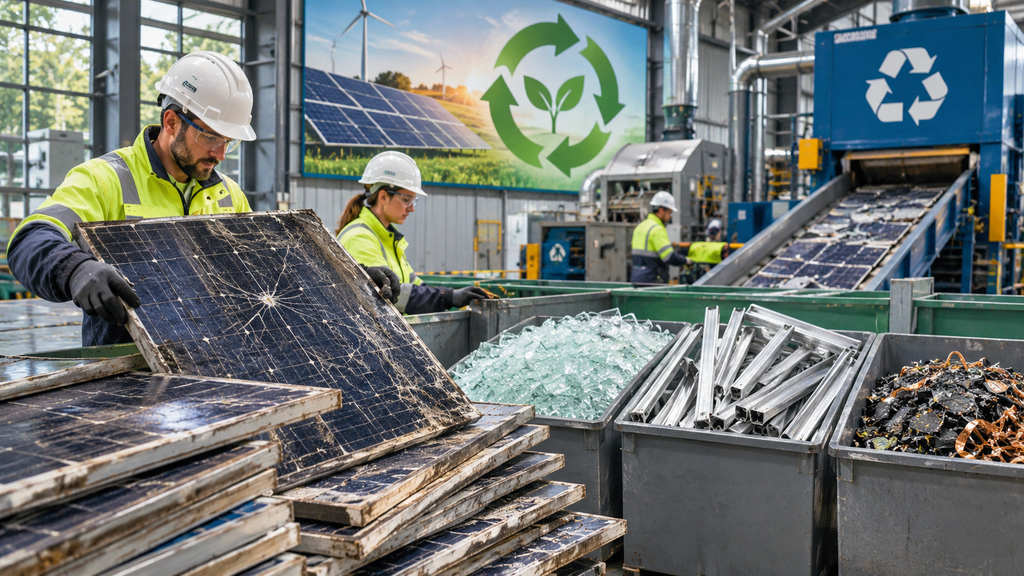
Second-life panels are modules that have completed their original installation period but may still be useful elsewhere.
They could potentially support small-scale electricity applications where their condition and performance meet relevant requirements.
However, moving equipment to another installation should not be considered safe without appropriate testing.
What the Latest Research Shows
In February 2026, IEA-PVPS published research examining the performance and reliability of second-life photovoltaic modules.
The report found that repair is technically feasible for several defect types.
However, repair may be labour-intensive and expensive, making it difficult to scale commercially.
The report identified testing and sorting as particularly important for establishing whether second-life modules are reliable.
Which Defects Can Be Repaired?
Certain problems involving electrical connections, junction boxes and other components may be repairable under suitable conditions.
Other problems can make reuse impractical or unsafe.
Damaged insulation, compromised structural integrity or serious deterioration may justify removing a panel from service.
The correct decision depends on professional inspection.
When Recycling Makes More Sense
Recycling may be preferable when a module is unsafe, its output is inadequate or repair would require disproportionate resources.
However, an economic decision to replace a working panel with a newer one does not automatically mean that recycling is environmentally preferable to continued operation.
Lifecycle assessment is important because manufacturing replacement panels also consumes materials and energy.
Reuse vs Recycling
| Factor | Repair or Reuse | Recycling |
|---|---|---|
| Main Goal | Extend productive service | Recover materials |
| Suitable Equipment | Functional or repairable modules | Retired or unsuitable modules |
| Required Assessment | Safety and electrical testing | Material identification |
| Main Challenge | Reliability and warranty | Separation and processing costs |
| Potential Benefit | Delays waste generation | Supplies secondary materials |
The most sustainable pathway may vary according to the condition of the panel and the additional electricity it can produce.
The Economics of Solar Panel Recycling and Material Recovery
Solar panel recycling offers the possibility of recovering valuable materials, but commercial success depends on several factors.
Recycling facilities must cover collection, transportation, labour, equipment, energy, waste treatment and quality testing.
The revenue generated from recovered materials may not be sufficient to cover those expenses.
Why Recycling Can Be Expensive
Solar modules are designed to withstand harsh outdoor conditions.
Their glass, cells and protective polymers are strongly bonded together.
Separating these layers without damaging valuable materials can require specialised equipment and substantial processing.
The IEA-PVPS 2025 report on recycling practices identifies relatively low waste volumes, logistics challenges and undeveloped markets for recovered materials as major barriers.
The Difference Between Material Weight and Value
Glass contributes most of the weight of many conventional panels, but it generally has a relatively low market value.
Silver, copper and other metals can be more valuable, even though they represent much smaller quantities.
A recycler that recovers mostly glass may therefore achieve a high recovery rate by weight without generating substantial revenue.
Hypothetical Recycling Economics
Consider a fictional recycling facility processing 1,000 tonnes of retired solar panels.
| Financial Measure | Illustrative Amount |
|---|---|
| Incoming Solar Panel Waste | 1,000 tonnes |
| Assumed Recoverable Material | 850 tonnes |
| Average Sales Revenue per Recovered Tonne | AED 500 |
| Material Sales Revenue | AED 425,000 |
| Processing and Labour | AED 300,000 |
| Collection and Transportation | AED 120,000 |
| Testing and Residue Management | AED 80,000 |
| Illustrative Operating Result | AED -75,000 |
These figures are hypothetical and do not represent actual Gulf recycling costs or recovered-material prices.
They exclude facility investment, financing and any waste acceptance fees.
The example demonstrates that a high material recovery rate does not necessarily make a recycling business profitable.
How Commercial Viability Could Improve
Larger volumes of retired panels may help recycling facilities distribute fixed costs across more material.
More efficient separation methods and higher-value recovered products could also improve financial performance.
In September 2026, IEA-PVPS reported that silver recovered from future retired photovoltaic systems could potentially become a significant secondary supply source under its modelled scenarios.
However, projected material availability does not guarantee profitable recovery or immediate industrial demand.
Environmental Risks, Recycling Rules and Industry Challenges
Solar energy provides electricity without the direct combustion emissions associated with fossil-fuel power generation.
However, photovoltaic equipment still has environmental impacts from manufacturing, transportation, maintenance and disposal.
Responsible end-of-life management is therefore an important part of assessing solar technology’s full environmental performance.
Are Old Solar Panels Hazardous?
Not every retired solar panel should be classified as hazardous waste.
Conventional crystalline-silicon panels primarily contain glass, aluminium, polymers and silicon, along with smaller amounts of metals.
Some module types may contain substances that require special handling.
For example, cadmium telluride thin-film panels contain a different semiconductor material from conventional silicon modules.
Whether a particular waste panel is legally hazardous depends on its composition, condition, relevant testing and the applicable jurisdiction.
Why Improper Disposal Matters
Dumping or breaking panels without appropriate controls may create physical hazards and prevent recovery of valuable materials.
Improper treatment can also complicate management of metals or other potentially harmful substances.
Specialist recycling helps separate recoverable materials while managing residues appropriately.
Lessons From the European Union
The European Union includes photovoltaic panels within its Waste Electrical and Electronic Equipment regulatory framework.
The framework establishes requirements concerning collection and environmentally appropriate treatment, alongside responsibilities for relevant producers.
However, these obligations should not be presented as universally applicable in the UAE or Saudi Arabia.
Gulf businesses must follow the requirements of their own jurisdictions and the authorities responsible for waste management.
Designing Panels for Easier Recycling
Manufacturers can improve end-of-life outcomes by developing modules that are more durable, repairable and easier to separate into their component materials.
Better documentation can also help recyclers identify different technologies and select appropriate treatment methods.
The US Department of Energy identifies design improvements, longer product lifetimes and more efficient recycling as important strategies for reducing future solar waste.
Challenges and Solutions
| Challenge | Potential Impact | Possible Response |
|---|---|---|
| High Processing Costs | Limited Profitability | Improved Recovery Technology |
| Mixed Panel Types | Complex Treatment | Product Identification |
| Limited Waste Volumes | Underused Facilities | Regional Collection Planning |
| Difficult Material Separation | Lower Recovery Value | Advanced Processing |
| Hazardous Components | Environmental and Safety Risks | Specialist Handling |
| Weak Secondary Markets | Limited Material Sales | Product Quality Standards |
| Unclear Responsibilities | Improper Disposal | Decommissioning Contracts |
Reducing solar waste requires coordination between manufacturers, project developers, regulators, recyclers and equipment owners.
The Future of Solar Panel Recycling in the Gulf and FAQs
The next major challenge for the solar industry is to ensure that renewable electricity generation is supported by responsible material management.
As the Gulf’s solar installations mature, more panels will eventually require repair, replacement or recycling.
However, the future volume of retired equipment cannot be determined simply from today’s installed generating capacity.
Accurate estimates require information about module types, installation dates, operating conditions and actual retirement behaviour.
How Large Could Global Solar Waste Become?
A widely cited 2016 study by the International Renewable Energy Agency and IEA-PVPS projected cumulative global solar panel waste of 60–78 million tonnes by 2050.
These are historical scenario estimates, not measurements of current waste.
More recent energy-transition scenarios have produced higher potential figures because expected photovoltaic deployment has expanded.
For example, the 2023 global SDG7 report, using IRENA’s 1.5°C-compatible pathway, described cumulative photovoltaic waste exceeding 212 million tonnes by 2050.
The difference illustrates how forecasts depend on deployment assumptions and modelling methods.
The figures should not be combined into one supposedly definitive estimate.
Circular Solar Manufacturing
A circular solar industry would seek to keep functioning equipment in use, recover valuable materials and reduce dependence on newly extracted resources.
Advanced recycling may eventually help return more recovered silicon and metals to manufacturing supply chains.
However, achieving this will require suitable material purity, competitive costs and dependable industrial demand.
The Gulf’s Opportunity
Gulf countries can begin preparing through decommissioning plans, equipment tracking, technical training and partnerships with appropriately licensed recycling businesses.
Solar project owners may also consider how future recovery responsibilities should be allocated in contracts.
The goal should be to develop reliable systems before large retirement volumes accumulate.
Solar Panel End-of-Life Checklist
- Identify the manufacturer, age and technology of the panels.
- Check actual electrical performance.
- Determine whether safe continued operation is possible.
- Obtain professional assessments before repair or reuse.
- Plan safe electrical disconnection and removal.
- Review local waste management requirements.
- Use appropriately authorised collection and processing providers.
- Separate mounting structures and other recyclable components.
- Obtain documentation of material recovery and final treatment.
- Include end-of-life costs in future project budgets.
Frequently Asked Questions
How long do solar panels last?
Many modern panels have expected operational lifetimes of approximately 25–35 years, although actual service life depends on the technology and operating conditions.
Do solar panels stop working after 25 years?
No. Some continue generating electricity beyond that period, usually at reduced performance.
Can old solar panels be recycled?
Yes. Appropriate facilities can recover materials such as glass, aluminium, copper and, through more advanced methods, selected semiconductor materials and valuable metals.
What percentage of a solar panel can be recycled?
More than 85% of a typical module’s mass consists of commonly recyclable materials, according to the US Department of Energy. However, that does not mean every recycling facility recovers 85% or more at useful purity.
Can recycled solar materials be used to manufacture new panels?
Potentially. Certain recovered materials may be suitable after specialised processing, but the quality requirements can be demanding.
Are old solar panels dangerous?
Their risks depend on their condition and composition. Damaged electrical equipment and certain materials require careful handling.
Can solar panels be reused instead of recycled?
Yes, if suitable inspection and testing demonstrate that they remain safe and functional for the intended application.
Does the UAE have rules for solar panel disposal?
Relevant waste-management requirements apply, and DEWA has published guidance concerning photovoltaic decommissioning and recycling. Specific requirements depend on the location, equipment and competent authority.
Is solar panel recycling profitable?
It can be commercially viable in certain circumstances, but processing costs, transportation and recovered-material prices create significant challenges.
Will the Gulf face large amounts of solar waste?
As installations age and are replaced, the region will need increasing end-of-life management capacity. The exact volumes and timing require region-specific analysis.
Final Thoughts
Solar panels are an important part of the transition towards lower-emission electricity generation, but their environmental responsibilities do not end when they stop producing power.
As installations age, owners must decide whether equipment should remain in service, be repaired, reused or recycled.
Recovered glass, aluminium, silicon, copper and other materials could eventually contribute to a more circular renewable energy supply chain.
However, commercial recycling remains technically and financially challenging, particularly when sophisticated processes are required to separate valuable materials.
For the UAE and wider Gulf, the expansion of solar power presents an opportunity to establish responsible end-of-life practices before large volumes of equipment reach retirement.
DEWA’s decommissioning guidance and international research from IEA-PVPS demonstrate the importance of planning, testing and material recovery.
Ultimately, Solar Panel Recycling will become increasingly important as renewable energy infrastructure matures.
The future of sustainable solar power depends not only on how efficiently panels generate electricity, but also on how responsibly their materials are managed when their useful life comes to an end.
Do follow us on Instagram
Read More – Smart Irrigation in Desert Cities: 7 Powerful Ways to Transform Public Landscaping