

Best Industries in the UAE: Which Industries Are Driving the Country’s Economy?
The United Arab Emirates (UAE) has developed into one of the most diversified and internationally connected economies in the Middle East. While oil and gas remain important to the country’s economy, the UAE has invested heavily in tourism, real estate, finance, manufacturing, technology, logistics, healthcare, renewable energy, and other non-oil sectors. These industries have helped create new business opportunities and strengthen the country’s position as a global commercial hub.
- What Are the Best Industries in the UAE?
- Why Is the UAE Developing a Diversified Economy?
- Is Oil and Gas Still an Important Industry in the UAE?
- Why Is Manufacturing One of the Important Industries in the UAE?
- What Types of Manufacturing Industries Are Growing in the UAE?
- How Important Are Real Estate and Construction in the UAE?
- Why Is Tourism One of the Best-Known Industries in the UAE?
- How Is the Hospitality Industry Growing in the UAE?
- Why Is the Financial Services Industry Important in the UAE?
- What Is Fintech and Why Is It Growing in the UAE?
- Why Is Technology One of the Most Promising Industries in the UAE?
- What Role Does Artificial Intelligence Play in the UAE Economy?
- Why Is Logistics a Major Industry in the UAE?
- How Does E-Commerce Support the UAE Economy?
- Why Is Healthcare an Important Industry in the UAE?
- What Is the Future of Pharmaceuticals and Medical Technology in the UAE?
- Why Is Renewable Energy Becoming an Important UAE Industry?
- Is Food and Agriculture an Important Industry in the UAE?
- Why Is Aerospace and Space Technology Important in the UAE?
- What Is the Role of Maritime Industries in the UAE?
- Why Is the Aluminum and Metals Industry Important in the UAE?
- Is Education a Growing Industry in the UAE?
- What Role Does Retail Play in the UAE Economy?
- Which Industries Are Considered Future Industries in the UAE?
- How Is Advanced Manufacturing Changing UAE Industries?
- Why Is the UAE Attractive for International Businesses?
- Which Industries Are Important for Dubai?
- Which Industries Are Important for Abu Dhabi?
- What Are the Main Benefits of Industry Diversification in the UAE?
- What Challenges Do UAE Industries Face?
- Which Industries Could Shape the UAE’s Economic Future?
- What Are the Best Industries in the UAE for Business Opportunities?
- How Can Businesses Benefit from the UAE’s Growing Industries?
- What Should Entrepreneurs Consider Before Entering a UAE Industry?
- What Is the Future of the Best Industries in the UAE?
But what are the best industries in the UAE, and which sectors are shaping the country’s economic future? From established industries such as energy and construction to emerging fields such as artificial intelligence, space technology, fintech, renewable energy, and advanced manufacturing, the UAE offers a broad industrial and business landscape.
The UAE Ministry of Economy identifies sectors including fintech, e-commerce, agritech, healthcare, education, tourism, space, logistics, information and communications technology, manufacturing, and medical tourism as promising foreign-investment sectors.
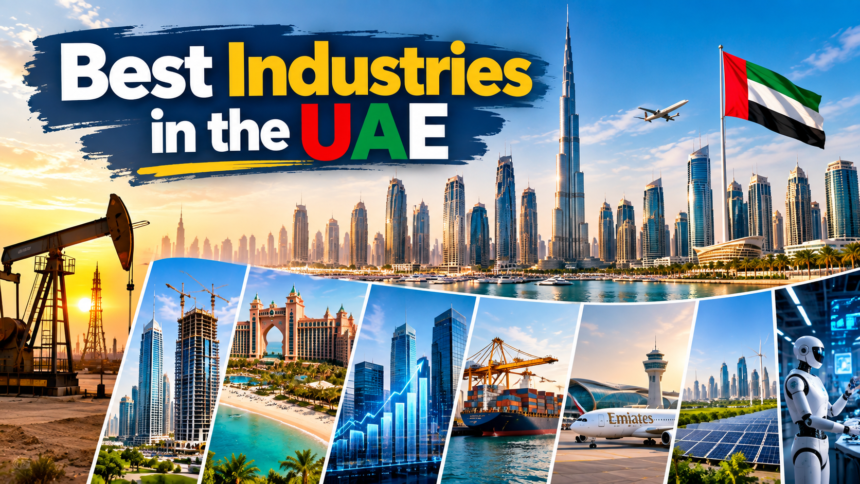
What Are the Best Industries in the UAE?
The UAE has a diverse range of industries supporting economic activity, employment, trade, investment, and innovation.
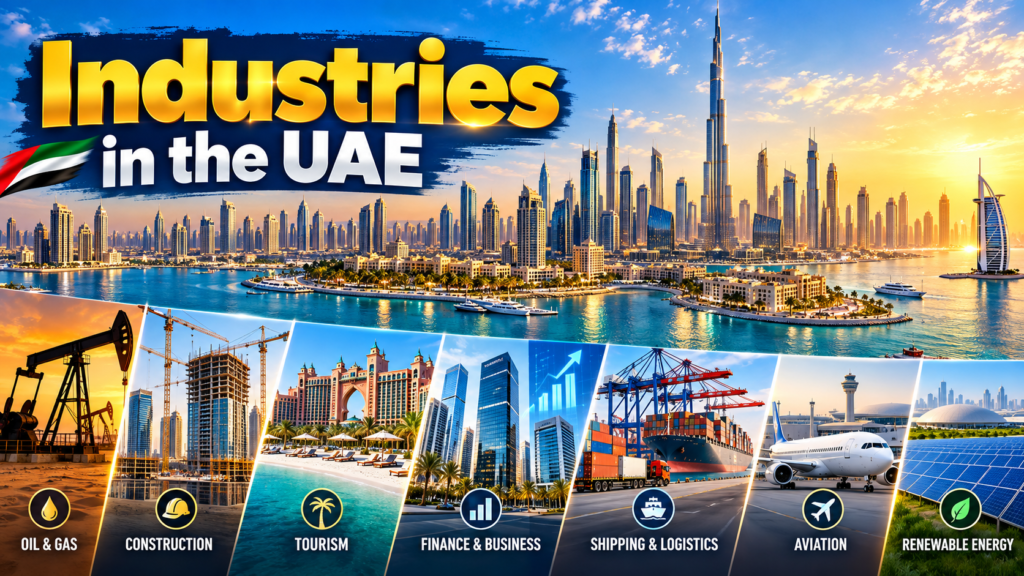
Some of the country’s most significant and promising best industries in the UAE include:
- Oil and gas and energy
- Manufacturing
- Real estate and construction
- Tourism and hospitality
- Financial services and fintech
- Technology and information technology
- Logistics and transportation
- Healthcare and pharmaceuticals
- Retail and e-commerce
- Renewable energy and clean technology
- Food and agriculture
- Aerospace and space technology
- Education
- Media and entertainment
- Maritime industries
The importance of each industry varies depending on factors such as government strategy, investment, technology adoption, international demand, and individual emirate. The UAE’s official Investor Navigator currently covers sectors ranging from healthcare and agritech to ICT, logistics, fintech, tourism, renewables, manufacturing, space, and the creative economy.
Why Is the UAE Developing a Diversified Economy?
Why has economic diversification become such an important priority for the UAE? One major reason is the country’s long-term objective of developing an economy that is supported by a wide range of industries rather than relying on a single source of economic activity.
The UAE has therefore invested in infrastructure, technology, international trade, tourism, manufacturing, financial services, healthcare, and other sectors. Government strategies also encourage innovation and the development of industries that can contribute to future economic growth.
The country’s industrial strategy, known as Operation 300bn, aims to increase the contribution of the industrial sector to GDP to AED 300 billion by 2031. The strategy focuses on industrial development, advanced technology, investment, innovation, and sustainable production.
Is Oil and Gas Still an Important Industry in the UAE?
Yes. Oil and gas remain important components of the UAE’s energy sector and have played a major role in the country’s economic development. The energy industry has supported infrastructure development, international trade, government revenues, and the growth of related industries.
At the same time, the UAE is expanding its energy portfolio. Investment and development are also taking place in renewable energy, clean technologies, hydrogen, and other areas associated with the energy transition.
This means that the UAE’s energy industry increasingly includes both traditional energy activities and newer technologies focused on efficiency and lower-carbon energy systems.
The energy sector also supports other industries, including petrochemicals, manufacturing, transportation, construction, and logistics.
Why Is Manufacturing One of the Important Industries in the UAE?
Manufacturing is a major focus of the UAE’s economic diversification strategy. The country has developed industrial zones, ports, logistics infrastructure, and business facilities designed to support manufacturers serving both domestic and international markets.
The UAE’s National Strategy for Industry and Advanced Technology identifies 11 priority industrial sectors. These include food, beverages and agri-tech; pharmaceuticals and medical equipment; electrical equipment and electronics; advanced manufacturing; chemicals; rubber and plastics; machinery and equipment; heavy industries; hydrogen; medical technology; and space technology.
Manufacturing also connects several parts of the economy. Raw materials can be processed locally, products can be manufactured and packaged, and finished goods can then be distributed through the UAE’s logistics and transportation networks.
The government’s industrial strategy is also designed to encourage the adoption of advanced technologies and Fourth Industrial Revolution solutions in manufacturing.
What Types of Manufacturing Industries Are Growing in the UAE?
The UAE’s manufacturing landscape includes both traditional and advanced industries. Some important areas include:
- Food and beverage manufacturing
- Pharmaceuticals
- Medical equipment
- Chemicals and petrochemicals
- Plastics and rubber
- Machinery and equipment
- Electrical equipment
- Electronics
- Metal products
- Advanced manufacturing
- Renewable energy equipment
The government’s industrial priorities demonstrate the broad scope of manufacturing being developed in the country. Rather than focusing exclusively on conventional manufacturing, the UAE is also encouraging technology-intensive and future-oriented production.
How Important Are Real Estate and Construction in the UAE?
Real estate and construction are among the most visible industries in the UAE. Cities such as Dubai and Abu Dhabi have experienced extensive development in residential, commercial, hospitality, retail, and infrastructure projects.
The construction industry supports a wide network of businesses, including architecture, engineering, building materials, project management, interior design, property management, facilities management, and real estate services.
Dubai’s international reputation as a business and tourism destination has also supported demand for hotels, residential developments, offices, shopping destinations, and mixed-use communities.
The industry is closely connected with other sectors, including tourism, finance, retail, logistics, and professional services.
Why Is Tourism One of the Best-Known Industries in the UAE?
Tourism has become one of the UAE’s most internationally recognized industries. Dubai and Abu Dhabi attract visitors for leisure, business, shopping, entertainment, cultural experiences, sporting events, and major international exhibitions.
The country’s tourism industry includes much more than hotels. It supports:
- Airlines and airports
- Hotels and resorts
- Restaurants
- Travel agencies
- Tour operators
- Attractions and theme parks
- Shopping destinations
- Events and exhibitions
- Transportation services
- Entertainment businesses
The UAE Ministry of Economy lists tourism among sectors with strong potential for foreign investment.
Tourism also creates demand across other industries, making it an important part of the broader service economy.
How Is the Hospitality Industry Growing in the UAE?
Hospitality is closely connected with tourism and business travel. The UAE has developed a large hospitality market ranging from luxury resorts and international hotel brands to serviced apartments and budget accommodation.
Dubai’s position as an international tourism and business destination has created demand for different types of hospitality services. Abu Dhabi also has a significant hotel and events industry, while other emirates offer beach, cultural, nature, and adventure tourism experiences.
The hospitality sector creates opportunities for businesses involved in accommodation, food and beverages, event management, housekeeping, transportation, entertainment, and customer services.
Why Is the Financial Services Industry Important in the UAE?
Financial services are another major component of the UAE economy. The country has established itself as a regional financial centre with banking, investment, insurance, asset management, wealth management, and other financial services.
Dubai International Financial Centre and Abu Dhabi Global Market are examples of financial ecosystems that support international financial businesses and professional services.
The financial industry also supports other sectors by providing financing, investment services, payment solutions, insurance, and corporate financial services.
What Is Fintech and Why Is It Growing in the UAE?
Fintech refers to the use of technology to provide or improve financial services. The UAE has developed an increasingly active fintech ecosystem covering digital payments, financial platforms, banking technology, investment services, insurance technology, and other digital financial products.
The UAE Ministry of Economy specifically identifies fintech as a promising sector for foreign investment.
Fintech development is closely connected with the country’s broader digital transformation. As consumers and businesses increasingly use online financial services, demand for secure and convenient digital solutions continues to shape the financial sector.
Why Is Technology One of the Most Promising Industries in the UAE?
Technology has become an important part of the UAE’s long-term economic development plans. Businesses across banking, retail, healthcare, logistics, manufacturing, government services, and real estate are increasingly adopting digital technologies.
Technology-related industries include:
- Artificial intelligence
- Cloud computing
- Cybersecurity
- Software development
- Data analytics
- Internet of Things
- Robotics
- Digital payments
- E-commerce technology
- Smart-city solutions
- Enterprise technology
The UAE government has also identified ICT as a promising investment sector.
Technology is not only an industry by itself; it is also transforming other industries by improving productivity, automation, customer service, and operational efficiency.
What Role Does Artificial Intelligence Play in the UAE Economy?
Artificial intelligence is becoming increasingly relevant across many areas of the UAE economy. Businesses can use AI for data analysis, automation, customer service, cybersecurity, marketing, logistics, manufacturing, healthcare, and financial services.
AI can also support smart-city development and improve the way businesses interact with customers.
For technology companies, the UAE’s combination of digital infrastructure, international business connections, investment activity, and government interest in advanced technologies has helped create an environment for technology development.
AI should therefore be viewed not only as a standalone industry but also as a technology that can influence manufacturing, healthcare, finance, transportation, retail, and other sectors.
Why Is Logistics a Major Industry in the UAE?
The UAE’s geographical position between major markets in Asia, Europe, Africa, and the Middle East has helped it develop into an important logistics and transportation centre.
The country has invested heavily in airports, seaports, roads, free zones, warehouses, distribution facilities, and supply-chain infrastructure.
The logistics industry supports:
- Freight transportation
- Warehousing
- Supply-chain management
- Air cargo
- Maritime shipping
- E-commerce fulfillment
- Distribution
- Customs and trade services
- Last-mile delivery
The UAE Ministry of Economy identifies logistics services as one of the country’s promising investment sectors.
How Does E-Commerce Support the UAE Economy?
E-commerce has changed the way consumers shop and businesses sell products. The UAE has a highly connected population and a strong retail market, providing a foundation for online shopping and digital commerce.
E-commerce businesses depend on several supporting industries, including technology, payments, logistics, warehousing, marketing, and delivery services.
The sector covers everything from online marketplaces and direct-to-consumer brands to digital payment systems and specialized fulfillment services.
The UAE government also includes retail and e-commerce among the sectors monitored through its Investor Navigator.
Why Is Healthcare an Important Industry in the UAE?
Healthcare has become an important part of the UAE’s economic and social development. The country has invested in hospitals, clinics, medical centres, specialist healthcare facilities, pharmaceuticals, medical equipment, and healthcare technology.
The healthcare industry creates opportunities across a broad range of services, including:
- Hospitals
- Clinics
- Pharmaceuticals
- Medical equipment
- Biotechnology
- Diagnostic services
- Digital health
- Medical tourism
- Healthcare technology
Healthcare is also identified by the UAE government as a promising investment sector.
What Is the Future of Pharmaceuticals and Medical Technology in the UAE?
Pharmaceuticals and medical technology are among the industries receiving attention under the UAE’s industrial strategy. The government has identified medicine, medical equipment and supplies as priority industrial areas.
Developing local capabilities in these areas can support domestic demand while also creating opportunities for manufacturing, research, technology development, and exports.
Medical technology can include diagnostic devices, healthcare equipment, digital systems, laboratory technologies, and other products used by healthcare providers.
Why Is Renewable Energy Becoming an Important UAE Industry?
Renewable energy has become increasingly important as the UAE works to develop cleaner energy solutions and diversify its energy portfolio.
Solar power is particularly relevant because of the country’s climate and large-scale investment in renewable-energy infrastructure. Clean energy development can also create opportunities in engineering, construction, technology, equipment manufacturing, research, and energy management.
Hydrogen is another future-focused area identified within the UAE’s industrial priorities. The Ministry of Industry and Advanced Technology lists hydrogen among the country’s priority industries of the future.
Is Food and Agriculture an Important Industry in the UAE?
Food production and agricultural technology have strategic importance because of the country’s focus on food security. The UAE’s climate and limited arable land create particular challenges for conventional agriculture, encouraging interest in technologies that can improve productivity and resource efficiency.
Agritech can include:
- Controlled-environment agriculture
- Smart irrigation
- Hydroponics
- Agricultural automation
- Food technology
- Alternative production methods
- Supply-chain technology
Food, beverage, and agricultural technology are included among the UAE’s priority industrial sectors.
Why Is Aerospace and Space Technology Important in the UAE?
The UAE has developed an active space sector and has invested in satellite technology, scientific research, space exploration, and related capabilities.
Space technology is also specifically included among the UAE’s future-focused industrial priorities.
The industry can create opportunities in areas such as:
- Satellite technology
- Earth observation
- Space research
- Communications
- Data analysis
- Aerospace engineering
- Advanced materials
- Scientific research
The development of space technology also supports the UAE’s broader objective of developing a knowledge-based economy.
What Is the Role of Maritime Industries in the UAE?
The maritime industry benefits from the UAE’s extensive coastline, major ports, shipping infrastructure, and position as a regional trade hub.
Maritime activities include shipping, port operations, shipbuilding, marine services, logistics, offshore activities, and related engineering services.
Dubai’s Industrial Strategy 2030 specifically identifies the maritime sector as one of its priority manufacturing sub-sectors, alongside aerospace, aluminum and fabricated metals, pharmaceuticals and medical equipment, food and beverages, and machinery and equipment.
Why Is the Aluminum and Metals Industry Important in the UAE?
The UAE has developed significant capabilities in aluminum production and metal-related manufacturing. These industries supply materials for construction, transportation, engineering, manufacturing, and international markets.
Metal production also supports downstream manufacturing, where raw materials are converted into finished or semi-finished products.
Dubai’s Industrial Strategy 2030 identifies aluminum and fabricated metals as one of its priority industrial sub-sectors.
Is Education a Growing Industry in the UAE?
Education is an important service sector and has expanded alongside population growth, international business activity, and the UAE’s ambition to develop a knowledge-based economy.
The education industry includes schools, universities, vocational institutions, professional training, online education, educational technology, and research.
The UAE Ministry of Economy identifies education as one of the promising investment sectors.
Education also supports other industries by developing the skilled workforce required for technology, healthcare, engineering, finance, manufacturing, and business services.
What Role Does Retail Play in the UAE Economy?
Retail is a major part of the UAE’s consumer economy. The country is known for large shopping centres, international brands, specialty stores, supermarkets, luxury retail, and increasingly digital commerce.
Dubai’s tourism industry further supports retail because international visitors often combine sightseeing with shopping and dining.
Modern retail is also increasingly connected with e-commerce, digital payments, logistics, customer data, and technology.
Which Industries Are Considered Future Industries in the UAE?
The UAE is actively developing industries associated with advanced technology, sustainability, and innovation. The country’s industrial strategy specifically highlights hydrogen, medical technology, and space technology as future-oriented sectors.
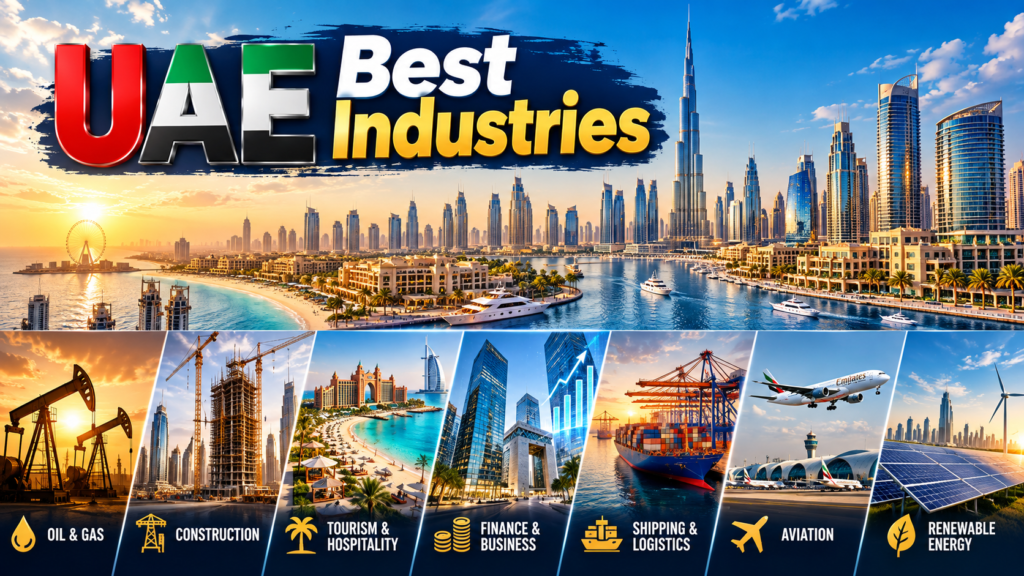
Other areas being monitored or developed include:
- Artificial intelligence
- Renewable energy
- Fintech
- Smart cities
- Autonomous transportation
- Agritech
- Biotechnology
- Advanced manufacturing
- E-commerce
- Gaming
- Creative industries
The government’s Investor Navigator includes many of these sectors and provides information about growth opportunities, projects, trends, and relevant government stakeholders.
How Is Advanced Manufacturing Changing UAE Industries?
Advanced manufacturing uses automation, data, robotics, artificial intelligence, and other modern technologies to improve production processes.
The UAE’s industrial strategy encourages manufacturers to adopt Fourth Industrial Revolution technologies to improve productivity and efficiency.
This approach can change traditional manufacturing by making production more automated, connected, data-driven, and adaptable.
For businesses, advanced manufacturing can create opportunities in both the production of goods and the development of technologies used in factories.
Why Is the UAE Attractive for International Businesses?
The UAE’s location, infrastructure, international connectivity, business environment, and diversified economy have contributed to its appeal as a regional business hub.
International businesses can access markets across the Middle East, Africa, Asia, and other regions from the UAE. The country’s airports, seaports, free zones, financial centres, and digital infrastructure also support international commercial activity.
The UAE government has also introduced initiatives aimed at attracting foreign investment into technology-intensive and other promising sectors.
Which Industries Are Important for Dubai?
Dubai has a particularly diverse economy with strong activity across tourism, real estate, construction, financial services, retail, logistics, technology, hospitality, manufacturing, aviation, and maritime industries.
Dubai Industrial Strategy 2030 focuses on developing a knowledge-based, sustainable, and innovation-focused industrial economy. Its identified priority sub-sectors include aerospace, maritime, aluminum and fabricated metals, pharmaceuticals and medical equipment, food and beverages, and machinery and equipment.
This industrial focus complements Dubai’s broader strengths in tourism, trade, finance, logistics, and services.
Which Industries Are Important for Abu Dhabi?
Abu Dhabi has a strong energy and industrial base while also developing sectors such as manufacturing, technology, healthcare, finance, tourism, aerospace, and renewable energy.
The emirate’s industrial development is supported by infrastructure, investment initiatives, industrial zones, and access to energy and transportation networks.
Abu Dhabi also plays an important role in the UAE’s broader efforts to expand advanced manufacturing and diversify economic activity beyond traditional energy.
What Are the Main Benefits of Industry Diversification in the UAE?
Economic diversification can create multiple sources of economic activity and reduce dependence on individual sectors. It can also support employment, innovation, exports, entrepreneurship, and investment.
For the UAE, industrial diversification is linked to the development of advanced technologies, local manufacturing capabilities, supply chains, and knowledge-intensive industries.
The government’s Operation 300bn strategy specifically seeks to strengthen national industries, attract local and international investment, encourage innovation, and increase industrial competitiveness.
What Challenges Do UAE Industries Face?
Although the UAE has developed a broad industrial and business ecosystem, businesses still operate in a competitive global environment.
Companies may face challenges involving international competition, changing technology, supply-chain disruptions, workforce requirements, sustainability expectations, market demand, and regulatory compliance.
For industries such as manufacturing and energy, businesses must also adapt to technological changes and global sustainability trends.
For investors and entrepreneurs, understanding the specific regulations, licensing requirements, market conditions, and operating costs of an industry is therefore important before starting a business.
Which Industries Could Shape the UAE’s Economic Future?
The UAE’s economic future is likely to involve a combination of established industries and emerging sectors. Traditional areas such as energy, construction, real estate, finance, tourism, and logistics remain important, while technology, advanced manufacturing, healthcare, renewable energy, space, fintech, and agritech are receiving increasing attention.
Government strategies provide a useful indication of the sectors being developed. The National Strategy for Industry and Advanced Technology focuses on 11 priority industrial sectors, while the Ministry of Economy’s Investor Navigator tracks a wider range of promising sectors.
This combination suggests that the UAE’s industrial development is not limited to one particular sector. Instead, the country is building an interconnected economy in which technology can support manufacturing, logistics, healthcare, finance, energy, retail, and other industries.
What Are the Best Industries in the UAE for Business Opportunities?
The answer depends on the type of business, available capital, expertise, target market, regulations, and long-term objectives. There is no single industry that suits every entrepreneur or investor.
However, industries receiving significant strategic attention include:
- Technology and ICT
- Fintech
- Manufacturing
- Healthcare
- Tourism
- Logistics
- Renewable energy
- Agritech
- E-commerce
- Space technology
- Advanced manufacturing
- Medical technology
The UAE government’s official investment information identifies many of these sectors as promising, while its industrial strategy provides a more specific focus on priority manufacturing and technology areas.
How Can Businesses Benefit from the UAE’s Growing Industries?
Businesses can benefit by identifying areas where market demand, technology, government priorities, and private-sector investment overlap. Entrepreneurs can also explore opportunities within the supply chains of major industries rather than focusing only on large companies or major projects.
For example, the growth of tourism can create opportunities in hospitality technology, transportation, food services, events, and travel services. Similarly, manufacturing can create demand for equipment suppliers, logistics providers, technology companies, maintenance services, and professional consultants.
This interconnected nature of the UAE economy means that smaller businesses can participate in larger industry ecosystems.
What Should Entrepreneurs Consider Before Entering a UAE Industry?
Anyone considering entering an industry in the UAE should research the market carefully before making an investment. Industry attractiveness can vary considerably depending on the emirate, business model, customer segment, licensing requirements, competition, and available resources.
Important considerations include:
- Market demand
- Business licensing requirements
- Required capital
- Competition
- Location
- Target customers
- Workforce requirements
- Technology requirements
- Import and export considerations
- Regulatory obligations
- Long-term industry trends
Official UAE government resources should be checked for the latest rules and requirements before establishing a business.
What Is the Future of the Best Industries in the UAE?
The UAE is continuing to move toward a more diversified, technology-driven, and knowledge-based economy. Manufacturing remains an important part of this transformation, while technology, healthcare, logistics, tourism, finance, renewable energy, and future industries are creating additional opportunities.
The country’s industrial strategy aims to raise industrial GDP contribution to AED 300 billion by 2031, while promoting advanced technologies, investment, innovation, and sustainable industrial development.
At the same time, the Ministry of Economy continues to identify sectors such as fintech, healthcare, tourism, logistics, ICT, manufacturing, space, agritech, and e-commerce as promising areas for investment.
Conclusion: What Are the Best Industries in the UAE?
The best industries in the UAE span both established economic sectors and emerging fields. Energy, real estate, construction, tourism, finance, logistics, retail, and manufacturing remain important pillars, while technology, fintech, healthcare, renewable energy, agritech, advanced manufacturing, space technology, and medical technology are helping shape the next phase of economic development.
The UAE’s approach is increasingly focused on diversification, innovation, advanced technology, local manufacturing, international investment, and sustainable development. Its industrial strategy and investment initiatives demonstrate a broad focus on building industries capable of serving domestic demand while also competing in international markets.
For entrepreneurs, investors, professionals, and businesses researching the UAE market, understanding these industries can provide a useful starting point for identifying opportunities. However, industry conditions can change, so current government regulations, market data, licensing requirements, and sector-specific information should always be reviewed before making business or investment decisions.
Do follow us on Instagram
Read More – Best Business Opportunities in Dubai