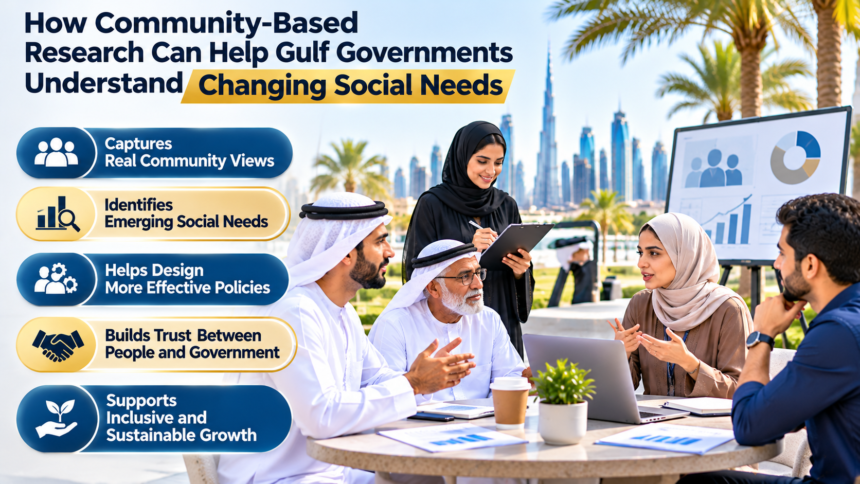
How Local Voices Could Shape the Future of GCC Public Services
Across the Arabian Gulf, societies are experiencing important changes as urban development, economic diversification, digital technology, and evolving family structures influence everyday life. From Dubai and Abu Dhabi to Riyadh, Doha, Muscat, Manama, and Kuwait City, governments are investing in housing, healthcare, education, employment, and community services to respond to changing population needs.
- 1. Why Community-Based Research in the Gulf Is Becoming More Important
- 2. What Abu Dhabi’s Quality of Life Research Reveals About Community Needs
- 3. How Qatar and Saudi Arabia Are Using Social Research for Public Planning
- 4. How Community Research Could Improve Healthcare, Housing, and Education
- 5. Why Participatory Research and Digital Tools Could Strengthen Community Engagement
- 6. The Ethical and Methodological Challenges of Community-Based Research
- 7. The Future of Community-Based Research in Gulf Social Development
However, understanding what communities actually require is not always straightforward.
Economic indicators can reveal trends in employment and household income, while administrative records provide information about service utilisation. Yet these measurements do not always explain the experiences behind the numbers.
A neighbourhood may have access to healthcare facilities but still face difficulties with appointment availability, transport, language, or accessibility. Similarly, a city may expand public transport while some residents continue experiencing problems reaching workplaces or essential services.
This is why community-based research in the Gulf could become increasingly valuable for public planning and social development.
Community-based research involves gathering knowledge from people affected by particular social issues. Depending on the approach, residents may participate in surveys, interviews, focus groups, community discussions, or the design and interpretation of research itself.
These methods can help authorities better understand how public services are experienced and where improvements may be needed.
Across the GCC, institutions are already developing approaches to social research and community engagement.
Abu Dhabi conducts recurring Quality of Life Surveys, Qatar University operates a dedicated Social and Economic Survey Research Institute, and Saudi Arabia’s General Authority for Statistics measures quality-of-life perceptions through national statistical activities.
However, collecting more data does not automatically lead to better policies. Effective research requires representative participation, professional methodology, appropriate privacy protections, and a clear process for translating findings into decisions.
Understanding these principles reveals how Gulf governments could use community-based research to develop more responsive, evidence-informed public services.
1. Why Community-Based Research in the Gulf Is Becoming More Important
Government planning often depends on economic, demographic, and administrative information.
These datasets can help authorities understand population growth, labour-market conditions, infrastructure demand, and public spending.
However, they may not fully capture how residents experience everyday challenges.
Understanding Community-Based Research
Community-based research focuses on issues affecting a particular population, neighbourhood, or social group.
Researchers may investigate access to services, family wellbeing, transport difficulties, educational opportunities, or the needs of people with disabilities.
In conventional community surveys, residents mainly provide information.
In community-based participatory research, community members may also help define research questions, shape methods, interpret findings, and develop possible solutions.
The distinction matters because not every survey is genuinely participatory.
Why Population Averages Can Be Misleading
A citywide indicator may show strong overall satisfaction with a service.
However, experiences can differ considerably between neighbourhoods, age groups, income levels, and people with different accessibility needs.
For example, an average public transport satisfaction score may conceal difficulties experienced by residents living far from major routes.
Detailed research can help identify these differences when sample sizes and methods are appropriate.
Understanding Changing Social Expectations
Residents’ needs may evolve as cities expand and employment patterns change.
Families may require different childcare arrangements, while older adults may need additional accessible transport or community services.
Young professionals may prioritise affordable housing and career development.
These are potential areas of inquiry rather than assumptions about what all members of a group want.
Research Methods Compared
| Method | Information Collected | Main Limitation |
|---|---|---|
| Household Surveys | Broad patterns and reported experiences | Response bias |
| Interviews | Detailed individual experiences | Limited generalisability |
| Focus Groups | Perspectives and group discussions | Dominant participants may influence discussion |
| Community Workshops | Problems and proposed solutions | May exclude less vocal groups |
| Administrative Data | Actual service activity | Limited explanation of personal experiences |
| Participatory Mapping | Location-specific challenges | Depends on participation and accurate mapping |
| Longitudinal Surveys | Changes over time | Cost and participant retention |
Why Multiple Methods Are Useful
A survey might reveal that residents are dissatisfied with a particular service.
Interviews can help researchers understand why.
Administrative records can then show whether the reported problem corresponds with appointment delays, staffing levels, or other operational conditions.
Combining evidence can produce a more useful picture than relying on one data source.
2. What Abu Dhabi’s Quality of Life Research Reveals About Community Needs
Abu Dhabi provides an important regional example of recurring research designed to understand residents’ wellbeing and support social planning.
Its Department of Community Development conducts Quality of Life Surveys covering multiple aspects of daily life.
A Long-Term Approach to Social Measurement
The survey examines areas including family life, social relationships, housing, safety, wellbeing, and work-life balance.
Its purpose is to understand residents’ experiences and identify issues relevant to policies and services.
Because the survey is repeated, it can also provide information about changes over time.
However, comparisons must account for survey design, population characteristics, and differences in participation.
Results From the 2025 Survey
In March 2026, Abu Dhabi’s Department of Community Development published findings from its sixth Quality of Life Survey, conducted in 2025.
Participation increased from 51,413 respondents in 2018 to 115,801 in 2025.
The department reported that satisfaction with family life reached 78.4%, compared with 70.9% in the previous cycle.
Satisfaction with work-life balance increased from 46.8% to 51.1%.
Housing satisfaction reached 71.5%.
These figures describe reported perceptions among survey respondents.
They should not be treated as independent measurements of every household’s circumstances.
Moving From Research to Policy
The department states that survey findings have contributed to the development of social strategies and programmes.
This illustrates the potential connection between collecting community perspectives and designing public initiatives.
However, evaluating policy effectiveness requires additional evidence about implementation and outcomes.
An improvement in survey satisfaction does not necessarily prove that one particular programme caused the change.
Why Repeated Surveys Matter
An individual survey offers information about a particular period.
Repeated surveys can help identify emerging trends.
For example, if work-life balance becomes a growing concern over several cycles, policymakers may investigate workplace conditions, transport time, family responsibilities, or other contributing factors.
Researchers should avoid assuming a cause before collecting relevant evidence.
Abu Dhabi’s Research Indicators
| Indicator | Reported 2025 Result | Potential Policy Relevance |
|---|---|---|
| Survey Participation | 115,801 respondents | Community engagement |
| Family Life Satisfaction | 78.4% | Family and social services |
| Work-Life Balance Satisfaction | 51.1% | Employment and wellbeing |
| Housing Satisfaction | 71.5% | Residential planning |
| Average Happiness Score | 7.88 out of 10 | Broader wellbeing monitoring |
What Other Gulf Cities Can Learn
The main lesson is not that every city should use identical questions.
Rather, regular community research can help authorities examine social conditions alongside traditional economic indicators.
To be useful, findings must be analysed carefully and connected to specific policy decisions.
3. How Qatar and Saudi Arabia Are Using Social Research for Public Planning
Research institutions in Qatar and Saudi Arabia offer additional examples of how social needs can be examined through structured evidence.
Their approaches demonstrate the role of universities, statistical agencies, and policy specialists.
Qatar University’s Social Research Institute
Qatar University’s Social and Economic Survey Research Institute, known as SESRI, was established in 2008.
Its mission includes producing reliable data to support policy formulation, priority-setting, and evidence-based planning.
The institute researches employment, education, health, family structure, social values, and media use.
These subjects are relevant to understanding how changing economic and social conditions affect residents.
Connecting Research With Policymaking

SESRI established a Policy Department in 2014.
The department works on policy analysis, research reports, briefs, and engagement with governmental and nongovernmental institutions.
Its social development work focuses on using survey research to inform discussions about social policy.
This provides an example of how academic research can contribute to public decision-making.
However, research recommendations and government adoption are different outcomes.
Saudi Arabia’s Quality of Personal Life Survey
Saudi Arabia’s General Authority for Statistics conducts a Quality of Personal Life survey.
It examines how citizens and residents aged 15 and above assess their wellbeing and satisfaction with different aspects of life.
The survey uses field visits and telephone interviews.
Its indicators can support understanding of personal wellbeing across demographic groups.
However, national indicators may still need to be complemented by more detailed local research.
Why Research Institutions Matter
Universities and statistical agencies can contribute methodological expertise.
This includes survey design, sampling, data analysis, confidentiality safeguards, and the interpretation of findings.
Independent academic analysis can also help identify limitations in administrative data.
Regional Research Approaches
| Institution | Country | Main Contribution |
|---|---|---|
| Department of Community Development | UAE | Recurring quality-of-life research |
| Qatar University SESRI | Qatar | Social and economic survey research |
| SESRI Policy Department | Qatar | Policy analysis and research communication |
| General Authority for Statistics | Saudi Arabia | Official quality-of-life statistics |
| University Research Centres | Across GCC | Specialist social research and evaluation |
The Importance of Local Research
National data can reveal broad patterns, but municipalities may require more detailed evidence.
For example, housing needs in a rapidly growing urban district may differ from those in a smaller community.
Local research can investigate these differences without assuming that one national average describes every resident.
4. How Community Research Could Improve Healthcare, Housing, and Education
The practical value of community-based research lies in helping authorities understand where services meet residents’ needs and where difficulties remain.
Several public service sectors could benefit from this approach.
Understanding Healthcare Access
Healthcare utilisation records show how many people use clinics, hospitals, and specialist services.
However, these records may provide limited information about people who are unable to access care.
Community research can investigate transport barriers, appointment availability, language needs, affordability, and patient experiences.
For example, interviews may reveal that a local clinic’s opening hours are difficult for shift workers.
Such findings could support a pilot programme testing alternative appointment schedules.
However, the pilot would still need evaluation to establish whether it improves access.
Planning Housing Around Household Needs
Housing research can explore the experiences of families, single-person households, older adults, and people with disabilities.
It may investigate affordability, accessibility, proximity to employment, and satisfaction with neighbourhood facilities.
This information can complement property market data and population forecasts.
However, preferences gathered through voluntary online surveys may not represent people who lack reliable internet access.
Improving Education and Youth Services
Students, parents, teachers, and employers may provide different perspectives on educational needs.
Community-based research can help identify barriers involving transport, digital access, extracurricular opportunities, and career preparation.
Young people can also participate directly in appropriate research activities.
However, studies involving minors require additional ethical safeguards and suitable consent procedures.
Supporting Older Adults
Research involving older adults may identify difficulties with transport, digital services, healthcare access, or social participation.
Accessible interview methods may be important for residents who do not regularly use online platforms.
The purpose should be to understand individual experiences rather than assume that all older people share the same needs.
Potential Public Service Applications
| Sector | Research Question | Possible Policy Application |
|---|---|---|
| Healthcare | What prevents residents from accessing care? | Service scheduling or outreach |
| Housing | Which housing features are most important? | Residential planning |
| Education | What barriers affect student participation? | Support services |
| Transport | Where do residents encounter travel difficulties? | Route and accessibility reviews |
| Social Services | Which groups face unmet needs? | Targeted assistance |
| Public Spaces | How are parks and facilities used? | Facility design |
| Digital Government | Who struggles with online services? | Accessible service channels |
Why Residents Should Help Define Problems
Government agencies may begin with a particular policy question.
However, residents may identify related issues that were not initially considered.
For example, a study about public transport satisfaction may reveal that pedestrian access to stops is a more important problem than the frequency of vehicles.
Listening before selecting solutions can help avoid poorly targeted investments.
5. Why Participatory Research and Digital Tools Could Strengthen Community Engagement
Technology is expanding the ways governments can communicate with residents and collect feedback.
Online surveys, digital mapping, mobile applications, and service portals can make participation more convenient.
However, digital methods must be designed carefully to avoid excluding people.
Online Community Surveys
Digital questionnaires can reach large numbers of participants and simplify data collection.
They may be suitable for gathering views on neighbourhood services or public facilities.
However, voluntary surveys are vulnerable to self-selection bias.
People who respond may have unusually positive or negative experiences.
Researchers should avoid treating a large number of responses as proof of representativeness.
Participatory Mapping
Participatory mapping allows residents to identify relevant locations on a map.
Participants might highlight difficult road crossings, poorly accessible facilities, or areas requiring improved public amenities.
This can help planners understand how infrastructure is experienced at street level.
However, public maps should not expose sensitive personal information or vulnerable individuals.
Community Workshops
Workshops can bring residents, service providers, and researchers together to discuss a defined problem.
Participants may contribute ideas and compare possible solutions.
The OECD’s citizen participation guidance identifies public consultations, workshops, civic monitoring, open innovation, and representative deliberative processes among methods that can support public decisions.
Different methods suit different objectives.
Co-Designing Public Services
Co-design involves relevant service users participating in the development of solutions.
For example, residents with disabilities may help assess the accessibility of a proposed public service.
Their involvement can identify practical issues that technical assessments alone might overlook.
However, meaningful participation requires clear expectations about which decisions participants can influence.
Digital and Offline Methods Compared
| Method | Main Advantage | Main Risk |
|---|---|---|
| Online Survey | Convenient broad participation | Digital exclusion |
| Mobile Feedback | Timely user observations | Unequal smartphone access |
| Interactive Mapping | Location-specific information | Privacy concerns |
| In-Person Interviews | Detailed context | Higher time and staffing costs |
| Community Workshops | Collaborative discussion | Unequal participation |
| Telephone Interviews | Access beyond internet users | Nonresponse and coverage limits |
Why Hybrid Research Can Be Better
Combining digital and offline methods may help researchers reach more diverse participants.
For example, an online survey might be supplemented by telephone interviews or appropriately planned field visits.
However, combining methods also requires careful analysis because different collection methods can influence how people respond.
6. The Ethical and Methodological Challenges of Community-Based Research
Community research can improve understanding of social needs, but poorly designed studies may produce misleading findings.
Researchers must consider who participates, how information is collected, and what happens to the data afterward.
The Problem of Representation
A survey receiving tens of thousands of responses may appear comprehensive.
However, sample size alone does not establish whether the results reflect the wider population.
If certain groups are underrepresented, the findings may provide an incomplete picture.
Researchers should consider sampling methods, nonresponse, language accessibility, and relevant demographic differences.
Protecting Personal Information
Social research may involve sensitive information about health, family circumstances, employment, income, or living conditions.
Participants should understand why information is being collected and how it will be used.
Data collection and sharing must follow applicable privacy laws, ethical standards, and institutional procedures.
Publishing detailed individual records can create risks even when names have been removed.
Avoiding Consultation Without Influence
Community members may become discouraged if they repeatedly provide feedback without learning whether it affected decisions.
The OECD recommends that public participation processes clearly define their objectives and explain how contributions will be considered.
Authorities should communicate which suggestions were adopted, which were not, and the reasons where appropriate.
Distinguishing Perceptions From Measured Conditions
Satisfaction surveys measure reported experiences and opinions.
Administrative records measure service activities.
Neither should automatically replace the other.
For example, high satisfaction with healthcare does not prove that every resident can obtain timely treatment.
Similarly, a low satisfaction score may reflect expectations as well as actual service quality.
Common Research Challenges
| Challenge | Potential Consequence | Appropriate Response |
|---|---|---|
| Unrepresentative Sampling | Misleading conclusions | Robust sampling design |
| Language Barriers | Excluded participants | Multilingual materials |
| Digital Exclusion | Missing community perspectives | Offline participation |
| Privacy Risks | Loss of confidentiality | Secure data governance |
| Leading Questions | Biased responses | Neutral survey design |
| Consultation Fatigue | Reduced participation | Clear and purposeful engagement |
| Limited Policy Follow-Up | Low practical impact | Transparent reporting |
| Inconsistent Methods | Difficult comparisons | Standardised measurement |
Why Independent Review Matters
Research should be evaluated for methodological quality before major policy decisions rely on its findings.
Universities, statistical professionals, and independent evaluators can help review evidence.
However, independence should be accompanied by clear accountability and appropriate professional standards.
7. The Future of Community-Based Research in Gulf Social Development
As GCC societies continue changing, governments may increasingly combine administrative data with social surveys, local consultations, and research partnerships.
This could create a more detailed understanding of how public services affect different communities.
However, effective systems require more than collecting information.
They need clear processes for translating evidence into action.
Creating Long-Term Community Research Programmes
One-off research can identify an immediate issue.
Repeated studies may provide a stronger understanding of how needs evolve.
For example, governments could examine changes in transport accessibility, public service satisfaction, or neighbourhood wellbeing over several years.
However, indicators and methodologies should remain sufficiently consistent to support meaningful comparisons.
Connecting Research With Policy Evaluation
Community perspectives should be considered before, during, and after the introduction of a public programme.
A government might first identify a service-access problem through interviews.
It could then introduce a limited pilot programme.
Follow-up research would help determine whether residents experienced improvements.
This process connects community research with practical policy evaluation.
A Community-Based Research Checklist
- Define a clear social or public service question.
- Identify the communities affected.
- Select appropriate quantitative and qualitative methods.
- Include groups that may be difficult to reach.
- Provide accessible language and participation options.
- Obtain required ethical approvals and informed consent.
- Protect confidential and sensitive information.
- Compare community findings with relevant administrative data.
- Explain uncertainty and methodological limitations.
- Communicate findings to participants.
- Establish responsibility for policy follow-up.
- Repeat research when changes need to be monitored.
Measuring Whether Community Research Makes a Difference
Authorities should evaluate research quality and its contribution to decisions.
Useful indicators include representativeness, participation accessibility, policy use, and the results of subsequent interventions.
However, a research programme should not claim responsibility for improvements that may have occurred for unrelated reasons.
Suggested Performance Indicators
| Indicator | What It Measures |
|---|---|
| Sample Representativeness | Coverage of the intended population |
| Participation Accessibility | Ability of different groups to contribute |
| Research Quality | Reliability of methods and analysis |
| Policy Uptake | Use of findings in decisions |
| Public Reporting | Transparency of results |
| Participant Feedback | Experience of the research process |
| Follow-Up Completion | Implementation of agreed actions |
| Service Outcomes | Changes following interventions |
The Role of Universities and Research Organisations
Universities can contribute expertise in sampling, sociology, economics, behavioural research, and programme evaluation.
Community organisations may help researchers understand local conditions and reach participants who are otherwise overlooked.
Government agencies can connect findings with public service decisions.
However, these partnerships should define responsibilities, data access, and research independence.
Moving Beyond General Satisfaction Scores
Overall happiness or satisfaction indicators can provide useful information.
However, social needs often require more detailed analysis.
For example, policymakers may need to know whether dissatisfaction is associated with service delays, cost, accessibility, or communication difficulties.
The next generation of community research should aim to explain problems clearly enough to support realistic solutions.
Conclusion
Community-based research could become an increasingly important tool for Gulf governments seeking to understand changing social needs and improve public services.
As populations, economies, and urban environments evolve, traditional administrative statistics alone may not capture every challenge faced by residents.
Surveys, interviews, community workshops, participatory mapping, and research partnerships can provide additional information about how people experience healthcare, housing, education, transport, and social services.
Existing initiatives in Abu Dhabi, Qatar, and Saudi Arabia demonstrate that social research already contributes to regional public planning.
However, collecting large amounts of data does not automatically produce effective policies.
Research must be representative, ethically managed, methodologically reliable, and connected to clearly defined decisions.
For governments, the opportunity lies in treating community perspectives as an important source of evidence rather than merely a public relations exercise.
For universities and researchers, it involves developing methods that reflect different experiences and communicate findings clearly.
For residents, meaningful participation can create opportunities to explain practical challenges and contribute to the design of services that affect their everyday lives.
Ultimately, understanding social change requires looking beyond national averages and listening to how people experience their communities.
By connecting reliable research with transparent decision-making and ongoing evaluation, Gulf governments could develop public services that are more responsive, inclusive, and better prepared for future needs.
Do follow us on Instagram
Read More – Why Media Literacy Is Becoming an Essential Skill for Young People in the GCC