How Media Literacy Could Transform Digital Education in the Gulf
Across the Gulf Cooperation Council, digital technology is changing how young people learn, communicate, discover information, and participate in society. Social media platforms, online videos, messaging applications, digital news outlets, and artificial intelligence tools have become important parts of the information environment.
- 1. Why Media Literacy in the GCC Matters More Than Ever
- 2. How Social Media Algorithms Influence What Young People See
- 3. Why Artificial Intelligence Is Changing Media Literacy Education
- 4. What UAE and Qatar Initiatives Reveal About Digital Citizenship
- 5. How Saudi Arabia, Bahrain, and Oman Are Supporting Digital Awareness
- 6. Why Media Literacy Supports Education, Employment, and Personal Safety
- 7. The Future of Media Literacy Education for GCC Youth
For many students and young professionals, news and educational content now arrive through the same platforms used for entertainment and social interaction. A short video may contain useful information, a personal opinion, a paid advertisement, or a misleading claim presented as fact.
Distinguishing between these different forms of content is becoming an important life skill.
Media literacy in the GCC is gaining attention as educational institutions, governments, and international organisations examine how young people can navigate increasingly complex digital environments.
Media literacy involves more than knowing how to operate a smartphone or use an application. It includes evaluating information sources, understanding how media messages are created, recognising commercial influences, identifying misleading content, and communicating responsibly.
These skills are becoming especially relevant as artificial intelligence makes it easier to produce convincing images, voices, videos, and written content.
Across the United Arab Emirates, Saudi Arabia, Qatar, Bahrain, Oman, and Kuwait, digital education and responsible online participation are receiving greater institutional attention.
UNESCO has launched a 2026–2027 initiative supporting media and information literacy policies and digital activities across the GCC and Yemen.
Qatar has introduced digital citizenship materials for school students, while the UAE has highlighted children’s right to digital knowledge as a national awareness priority.
However, media literacy education should not teach young people to distrust everything they encounter online. Its purpose is to build the ability to evaluate evidence, recognise uncertainty, understand different perspectives, and make informed decisions.
As the Gulf’s digital economy continues developing, these capabilities could become increasingly valuable for education, employment, personal wellbeing, and responsible participation in public life.
1. Why Media Literacy in the GCC Matters More Than Ever
Media literacy refers to the ability to access, understand, critically evaluate, create, and communicate information across different media.
UNESCO uses the broader term media and information literacy, often abbreviated as MIL, to include knowledge about information sources, media systems, digital platforms, and the ethical use of information.
This approach recognises that understanding media involves both technical and critical-thinking skills.
The Difference Between Digital Skills and Media Literacy
Digital skills may help a student create a presentation, edit a video, or use an online research platform.
Media literacy helps that student decide whether information is reliable, whether an image has been manipulated, and whether an online claim is supported by evidence.
Both capabilities are important, but they serve different purposes.
A person may be technically proficient with social media while remaining vulnerable to misleading information.
Why Online Information Requires Evaluation
Digital platforms allow information to spread quickly across geographical boundaries.
This creates opportunities for education, creativity, and communication.
However, the same speed can enable unverified claims to reach large audiences before reliable information becomes available.
Young people may encounter misleading health advice, false scholarship announcements, inaccurate financial information, or manipulated videos.
The consequences depend on the content and how it is used.
Misinformation and Disinformation
Misinformation generally refers to false or misleading information shared without necessarily intending to deceive.
Disinformation involves false or misleading information deliberately created or distributed to mislead.
Recognising this distinction is useful, although the intentions behind a particular post may be difficult to establish.
A student should focus first on checking the accuracy of the information rather than assuming why another person shared it.
Core Media Literacy Skills
| Skill | Main Purpose | Practical Example |
|---|---|---|
| Source Evaluation | Assess credibility | Identify the original publisher |
| Fact-Checking | Verify factual claims | Compare independent sources |
| Context Analysis | Understand surrounding circumstances | Check when a video was recorded |
| Advertising Awareness | Recognise commercial influence | Identify sponsored recommendations |
| AI Literacy | Evaluate synthetic content | Verify a suspicious audio clip |
| Digital Citizenship | Communicate responsibly | Avoid sharing unverified accusations |
| Privacy Awareness | Protect personal information | Review application permissions |
Developing these skills can help young people become more confident information users rather than passive consumers of online content.
2. How Social Media Algorithms Influence What Young People See
Social media platforms do not present every available post to every user.
Instead, recommendation systems help determine which videos, photographs, advertisements, and updates appear in individual feeds.
These systems may use signals such as viewing history, interactions, language preferences, and other information.
Understanding this process is an important part of modern media literacy.
Why Personalised Feeds Matter
Two students using the same platform may encounter very different content.
One may receive technology tutorials, while another regularly sees celebrity news or financial commentary.
Personalisation can make online experiences more relevant.
However, a personalised feed does not necessarily provide a balanced or complete picture of an issue.
Young people should understand that popularity within their feed is not the same as general public agreement.
Engagement Does Not Prove Accuracy
A video with millions of views may still contain inaccurate information.
Likes, reposts, comments, and follower counts primarily indicate forms of audience engagement.
They do not independently establish whether a claim is true.
Likewise, a reliable specialist source may have a relatively small audience.
Students should therefore evaluate the underlying evidence rather than judging credibility through popularity alone.
Understanding Emotional Content
Posts designed to provoke surprise, anger, fear, or excitement can attract attention.
However, emotionally engaging material is not automatically inaccurate.
The important question is whether its claims are supported by evidence.
Media literacy encourages users to recognise their reactions without allowing those reactions to replace verification.
Questions to Ask Before Sharing
A practical evaluation process can begin with several questions.
Who created the content? What evidence is provided? When was it published? Does the headline accurately represent the full story? Can another credible source confirm the information?
These questions are useful for news stories, promotional videos, and social media discussions.
Platform Features and Their Limitations
| Feature | What It Indicates | What It Does Not Prove |
|---|---|---|
| View Count | Number of recorded views | Factual accuracy |
| Likes | Audience engagement | Expert agreement |
| Verification Badge | Platform-specific account status | Truthfulness of every post |
| Trending Label | Increased platform activity | Public importance |
| Sponsored Label | Advertising relationship | Product reliability |
| AI Disclosure | Information about synthetic content | Complete accuracy of the content |
Why Students Need Multiple Sources
Seeking information from different credible sources can reveal important details missing from a single account.
However, finding several websites repeating the same claim is not sufficient if they all rely on one unverified original post.
Independent evidence matters more than repetition.
3. Why Artificial Intelligence Is Changing Media Literacy Education
Generative artificial intelligence can create text, images, audio, and video using digital models.
These technologies have valuable applications in education, accessibility, translation, and creative work.
However, they also complicate the process of identifying whether information is authentic and accurate.
The Challenge of AI-Generated Images
Modern image-generation systems can produce realistic-looking scenes that did not occur.
An image may depict a fictional event, an imaginary location, or a person in a situation that never happened.
Visual quality is therefore no longer reliable evidence that a photograph documents a real event.
Students should examine the image’s original source, publication context, and corroborating evidence.
Deepfake Audio and Video
AI tools can imitate aspects of human voices and appearances.
This may enable deceptive audio messages or fabricated videos.
However, not every altered video is malicious. Synthetic media also has legitimate applications in entertainment, education, and accessibility.
Media literacy should help young people distinguish appropriate creative uses from content falsely presented as authentic evidence.
AI-Generated Written Information
AI systems can produce fluent explanations, summaries, and answers.
However, confidently written content can still contain factual errors, unsupported claims, or invented references.
Students should verify important information through appropriate primary sources, particularly when it concerns healthcare, financial decisions, legal obligations, or academic research.
UNESCO’s Updated Educational Approach

In November 2026, UNESCO introduced AI Answers. You Decide., a companion guide to its media and information literacy curriculum.
The guide provides learning activities addressing AI-generated information, algorithmic influence, reliability, bias, and privacy.
It is designed primarily for learners aged 13 to 15, although activities can be adapted for other age groups.
This reflects the growing need to combine AI literacy with broader information-evaluation skills.
Practical Ways to Evaluate Suspicious Content
| Content Type | Verification Approach |
|---|---|
| AI-Looking Photograph | Search for original publication and independent reporting |
| Suspicious Audio | Confirm through the purported speaker’s official channels |
| Viral News Video | Check date, location and original footage |
| AI-Generated Answer | Verify claims against reliable references |
| Unusual Screenshot | Locate the original document or webpage |
| Misleading Statistic | Identify the dataset, year and population |
Why AI Detection Tools Are Not Enough
Automated detectors can make mistakes.
A detector may incorrectly classify authentic material as synthetic or fail to identify generated content.
Verification should therefore combine source tracing, contextual evidence, and appropriate technical tools.
No single detector should be treated as definitive.
4. What UAE and Qatar Initiatives Reveal About Digital Citizenship
Gulf education systems are increasingly discussing responsible digital participation, critical thinking, and information verification.
The UAE and Qatar provide concrete examples of how these themes are appearing in public initiatives.
The UAE’s Right to Digital Knowledge
Emirati Children’s Day 2026 adopted the theme The Right to Digital Knowledge.
The initiative highlights children’s ability to use technology responsibly while protecting their privacy, dignity, and opportunities for learning.
Its priorities include understanding digital content and algorithms, verifying information, developing critical thinking, and practising responsible digital citizenship.
This approach recognises that protecting children online involves education and empowerment as well as safety measures.
However, a national awareness campaign should not be treated as evidence that all children have received comprehensive media literacy training.
The UAE’s Digital Life Policy
The UAE’s National Policy for Quality of Digital Life includes initiatives addressing digital behaviour, online safety, communication, and public awareness.
Its Digital Life Quality Approach Initiative aims to integrate digital citizenship issues across school subjects from nursery through Grade 12.
The policy illustrates a wider approach connecting education with safe technology use.
Qatar’s National Media Literacy Consultation
In April 2024, UNESCO’s regional office worked with Qatar’s Ministry of Education and Higher Education, the Qatar National Committee for UNESCO, and Al Jazeera Media Institute on a national consultation in Doha.
Approximately 75 participants attended the initial day, representing education, media, government, and other sectors.
The consultation examined media literacy, online misinformation, and opportunities for educational development.
Qatar’s 2026 Digital Citizenship Curriculum
In June 2026, Qatar’s Ministry of Education and Higher Education launched digital citizenship learning materials for fifth-grade primary and eighth-grade preparatory students.
The materials focus on digital awareness and responsible online behaviour.
They draw on resources developed with Qatar’s National Cyber Security Agency and Ministry of Communications and Information Technology.
This represents a targeted educational initiative rather than a complete media literacy curriculum for every school grade.
Qatar’s SafeSpace Programme
Qatar’s Ministry of Communications and Information Technology also operates SafeSpace.
The programme provides digital safety information and resources for students, parents, teachers, and the wider public.
Its focus includes online safety, cyberbullying awareness, and responsible internet use.
Regional Initiatives Compared
| Initiative | Location | Main Focus |
|---|---|---|
| Right to Digital Knowledge 2026 | UAE | Children’s digital awareness and rights |
| National Policy for Quality of Digital Life | UAE | Digital citizenship and responsible participation |
| National MIL Consultation | Qatar | Media literacy planning |
| Digital Citizenship Curriculum 2026 | Qatar | School-level digital awareness |
| SafeSpace | Qatar | Online safety education |
These programmes demonstrate different approaches to digital learning, with varying scopes and objectives.
5. How Saudi Arabia, Bahrain, and Oman Are Supporting Digital Awareness
Media literacy and digital citizenship are also relevant to educational initiatives elsewhere in the GCC.
However, programmes focused on cybersecurity or safe internet use should not automatically be described as comprehensive media literacy education.
The subjects overlap but are not identical.
Saudi Arabia’s E-Learning Standards
Saudi Arabia’s National eLearning Center includes digital citizenship and safe behaviour within its e-learning standards.
The requirements address critical thinking, evaluating information, verifying sources, mitigating misinformation, and responsible AI use.
They also encourage awareness of digital risks and appropriate online participation.
These standards demonstrate how digital safety and information evaluation can be incorporated into educational quality frameworks.
Bahrain’s Safe Use of Technology Programme
Bahrain’s Ministry of Education operates a Safe Use of Technology initiative.
It aims to help students, parents, teachers, and administrators understand responsible digital behaviour.
The programme addresses digital citizenship, online safety, and ethical technology use.
Bahrain’s National Cyber Security Center has also developed a cybersecurity awareness curriculum for schools in collaboration with the Ma’an programme.
This includes age-appropriate activities covering privacy, communication, responsible behaviour, and digital citizenship.
Oman’s Youth Media Training
In July 2026, Oman’s Ministry of Information concluded four specialised training programmes designed to encourage responsible social media use among young people.
The initiative formed part of a wider effort to strengthen positive digital behaviour and develop responsible content creators.
In October 2026, Muscat Governorate also reported the launch of an awareness campaign at Sultan Qaboos University addressing digital identity, online values, and responsible technology use.
UNESCO’s Regional Programme
UNESCO’s 2026–2027 project on media and information literacy covers GCC countries and Yemen.
It proposes policy support, capacity-building activities, educational resources, and partnerships involving youth organisations and educators.
Its work includes addressing misinformation, disinformation, and AI-related challenges.
However, planned programme activities should not be confused with independently evaluated improvements in students’ skills.
Digital Education Approaches
| Country | Verified Initiative | Main Emphasis |
|---|---|---|
| Saudi Arabia | National eLearning Center standards | Source verification and responsible AI |
| Bahrain | Safe Use of Technology | Digital citizenship and safety |
| Bahrain | School cybersecurity curriculum | Privacy and online risks |
| Oman | Youth media training programmes | Responsible content creation |
| Oman | Digital identity awareness campaign | Responsible participation |
| GCC Region | UNESCO 2026–2027 MIL programme | Media literacy and educational development |
Why Regional Cooperation Matters
GCC countries share certain digital education challenges, including multilingual information environments and widespread access to international online platforms.
Regional cooperation could help educators exchange teaching materials and effective approaches.
However, programmes should remain adaptable to local education systems, languages, and student needs.
6. Why Media Literacy Supports Education, Employment, and Personal Safety
Media literacy is not only a tool for understanding news.
It can also support academic learning, professional development, consumer decisions, and safe digital behaviour.
These benefits make it relevant beyond classrooms.
Improving Academic Research
Students often use search engines, online articles, social media, and AI tools when preparing assignments.
Media literacy helps them identify suitable academic sources and distinguish original evidence from commentary.
It also encourages appropriate citation and recognition of uncertainty.
However, evaluating a research source requires more than checking whether a webpage appears professional.
Students should consider authorship, publication standards, methodology, and relevance.
Preparing for Digital Careers
Employers increasingly rely on digital communication and information systems.
Professionals may need to interpret data, review online claims, communicate with customers, and assess AI-generated content.
These capabilities are relevant to journalism, marketing, finance, healthcare, education, and business administration.
For example, a marketing professional should understand how sponsored content differs from independent recommendations.
Recognising Online Financial Risks
Young people may encounter investment promotions, shopping offers, job advertisements, and financial advice through digital platforms.
Some claims may exaggerate potential returns or conceal important conditions.
Media literacy can help individuals verify businesses and question unrealistic promises.
However, information evaluation should complement appropriate financial education and fraud-prevention practices.
Health Information and Online Claims
Health-related content is widely shared online.
A video may recommend a treatment without presenting clinical evidence.
Young people should understand that popularity or personal testimonials do not establish medical effectiveness.
Important health decisions should rely on appropriate qualified professionals and trustworthy medical sources.
Media Literacy Across Everyday Life
| Situation | Useful Skill |
|---|---|
| School Assignment | Check source credibility and citations |
| Internship Application | Verify employer and job listing |
| Health Video | Look for appropriate medical evidence |
| Online Shopping | Identify advertising and misleading claims |
| Financial Promotion | Check regulatory and business information |
| Viral Public Notice | Locate the original official announcement |
| Social Media Discussion | Separate facts, interpretations and opinions |
The Role of Families
Families can support media literacy through open conversations about online experiences.
UNESCO encourages approaches that emphasise critical engagement rather than relying solely on restrictions.
Young people may be more willing to discuss suspicious content when adults respond constructively.
However, digital safety arrangements should remain appropriate to a child’s age and circumstances.
7. The Future of Media Literacy Education for GCC Youth
As digital technologies continue developing, media literacy education will need to evolve.
The challenge is not simply teaching students how to identify one kind of misleading post.
It is helping them develop transferable habits for evaluating unfamiliar information and changing technology.
Integrating Media Literacy Across Subjects
Media literacy can be included in language, science, history, technology, and social studies lessons.
Students might compare reporting on the same event, examine the evidence behind a scientific claim, or evaluate whether an advertisement uses misleading statistics.
These exercises can connect critical thinking with existing academic subjects.
However, teachers require suitable resources and professional development.
Supporting Student-Led Learning
Young people can help design educational activities that reflect the platforms and information formats they actually use.
Student media clubs, fact-checking projects, and supervised digital storytelling activities may encourage active learning.
UNESCO’s Journey through the MILtiverse toolkit provides resources for youth organisations developing media and information literacy programmes.
Avoiding an Overly Restrictive Approach
Effective media literacy should encourage questioning and independent judgement.
It should not teach students that disagreement automatically indicates misinformation or that all unofficial sources are unreliable.
Credible evidence can emerge from researchers, journalists, community organisations, independent specialists, and official institutions.
The reliability of a claim depends on its evidence and context.
A Practical Media Literacy Checklist for Young People
- Identify the original source before sharing information.
- Check when and where the content was created.
- Distinguish factual claims from opinions.
- Look for independent supporting evidence.
- Examine statistics in their original context.
- Recognise advertisements and promotional relationships.
- Question suspicious AI-generated content.
- Protect personal and account information.
- Avoid spreading unverified accusations.
- Correct mistakes when reliable new evidence becomes available.
- Respect other people’s privacy and rights.
- Ask for help when online content creates a serious safety concern.
Measuring Educational Progress
Schools should evaluate more than attendance at digital awareness workshops.
Students can be assessed through realistic exercises involving source comparison, evidence evaluation, and responsible communication.
However, one successful classroom activity does not guarantee that a learner will identify every misleading claim in daily life.
Media Literacy Performance Indicators
| Indicator | What It Measures |
|---|---|
| Source Verification | Ability to identify reliable evidence |
| Context Recognition | Understanding dates and original meaning |
| Advertising Awareness | Recognition of promotional content |
| AI Literacy | Ability to assess synthetic information |
| Privacy Knowledge | Understanding of personal data protection |
| Responsible Sharing | Appropriate information-handling decisions |
| Critical Reasoning | Ability to explain conclusions |
| Learning Retention | Continued application of skills |
Opportunities for Gulf Education and Media Organisations
The growing interest in media literacy may create opportunities for schools, universities, journalism organisations, educational technology providers, and youth groups.
These organisations could develop interactive lessons, Arabic-language resources, teacher training, and practical verification workshops.
However, educational materials should be evaluated for accuracy, accessibility, and genuine learning outcomes.
Conclusion
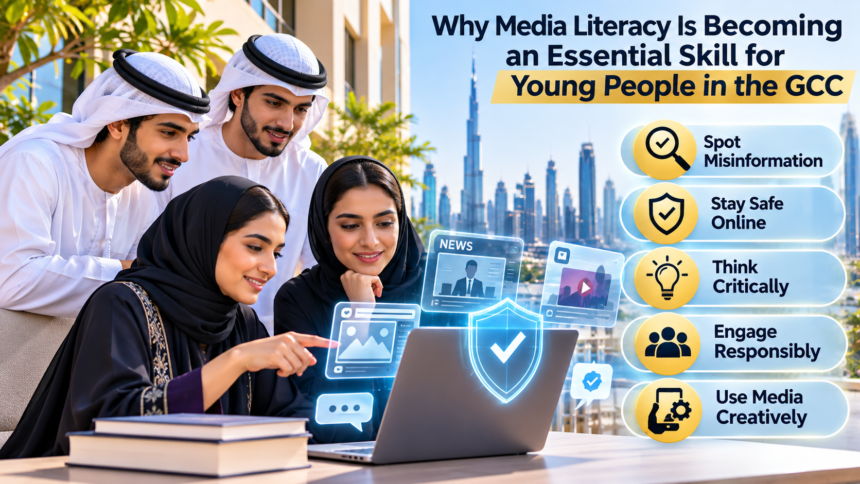
Media literacy is becoming an essential skill for young people in the GCC as social media, digital services, and artificial intelligence increasingly shape how information is created and consumed.
Students need more than technical familiarity with applications and devices.
They must understand how to evaluate sources, identify misleading claims, recognise commercial influences, and use digital platforms responsibly.
Initiatives in the UAE, Qatar, Saudi Arabia, Bahrain, and Oman show that digital citizenship and information awareness are receiving growing regional attention.
UNESCO’s GCC-focused media and information literacy programme also illustrates the importance of coordinated educational development.
However, media literacy should not be reduced to memorising a list of suspicious websites or detecting artificial intelligence through visual clues.
Its foundation is critical thinking, curiosity, respect for evidence, and the willingness to reconsider conclusions when better information becomes available.
For schools, the priority is to make these skills part of meaningful everyday learning.
For parents, it involves constructive conversations and age-appropriate guidance.
For businesses and media organisations, it means supporting transparent communication and credible information practices.
Ultimately, the future of the Gulf’s digital economy will depend not only on how effectively young people use technology, but also on how thoughtfully they interpret and share the information that technology delivers.
A generation equipped with strong media literacy skills may be better prepared to learn independently, make informed decisions, participate responsibly online, and navigate the uncertainties of an increasingly AI-driven world.
Do follow us on Instagram
Read More – The Growing Importance of Rehabilitation Services in the Middle East’s Healthcare Economy