



Dubai’s Digital Boom Is Creating New Cybersecurity Career Opportunities
Dubai’s economy is becoming increasingly digital. Banks process millions of electronic transactions, government services operate online, businesses store information in the cloud, hospitals manage sensitive patient data and companies are rapidly adopting artificial intelligence. Every new digital connection creates convenience, but it can also create a new security risk.
- Why Cybersecurity Careers in Dubai Are Becoming More Important
- Dubai’s Digital Economy Is Expanding the Need for Security
- What Does a Cybersecurity Professional Actually Do?
- Security Operations Centre Careers Are a Common Entry Point
- Cybersecurity Analyst Jobs in Dubai
- Ethical Hacking and Penetration Testing
- Cloud Security Could Be One of Dubai’s Strongest Career Areas
- Application Security Is Becoming More Important
- Cyber Threat Intelligence Careers
- Governance, Risk and Compliance Careers
- Digital Forensics and Incident Response
- Cybersecurity Jobs Exist Across Almost Every Dubai Industry
- Dubai’s Cyber Security Strategy Strengthens the Career Outlook
- Skills Needed for Cybersecurity Careers in Dubai
- Soft Skills Matter More Than Many Beginners Expect
- Do You Need a Degree for Cybersecurity Jobs in Dubai?
- Which Cybersecurity Certifications Can Help?
- How Beginners Can Build Cybersecurity Experience
- A Practical Cybersecurity Career Path
- AI Is Changing Cybersecurity Careers
- Cloud, AI and Cybersecurity Skills Could Become a Powerful Combination
- Cybersecurity Career Progression in Dubai
- Can International Professionals Build Cybersecurity Careers in Dubai?
- Cybersecurity Is Also Becoming a Government and Education Priority
- Biggest Opportunities in Cybersecurity Careers in Dubai
- Common Mistakes People Make When Entering Cybersecurity
- FAQs About Cybersecurity Careers in Dubai
- Conclusion
That is why Cybersecurity Careers in Dubai are becoming increasingly relevant for technology professionals, students and people considering a career change.
Cybersecurity is no longer limited to antivirus software or an IT employee protecting office computers. Modern security professionals protect cloud infrastructure, investigate digital attacks, secure applications, monitor networks, manage data privacy and help companies understand business risks.
Dubai is also treating cybersecurity as a strategic priority. The second cycle of the Dubai Cyber Security Strategy was launched in 2023 to strengthen the emirate’s digital infrastructure and establish a safe and secure cyberspace.
For professionals, this creates an important opportunity. As Dubai’s digital economy expands, companies need people capable of protecting the systems supporting that growth.
Why Cybersecurity Careers in Dubai Are Becoming More Important
Modern Dubai depends heavily on digital technology.
Government services, aviation, banking, logistics, retail, hospitality, healthcare, real estate and energy all rely on connected systems.
The more these industries digitalize, the larger their cybersecurity responsibilities become.
A cyberattack against an ordinary website may cause inconvenience.
An attack affecting a bank, airport, hospital or government system can create much more serious consequences.
Cybersecurity professionals therefore protect much more than computers. They can help protect:
- financial transactions,
- customer information,
- cloud infrastructure,
- business operations,
- intellectual property,
- government systems,
- healthcare information,
- and critical infrastructure.
Dubai’s Cyber Security Strategy reflects this wider perspective. The Dubai Electronic Security Center says the strategy provides a framework for managing cyber risks and helps government entities respond proactively to rapid changes in the digital world.
This means cybersecurity is increasingly becoming part of business resilience, not simply an IT function.
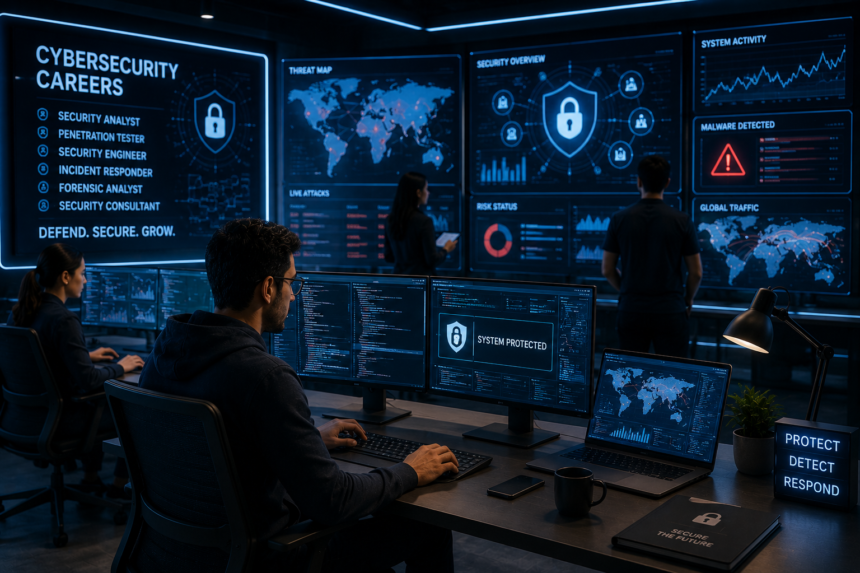
Suggested image placement: Cybersecurity operations team overlooking a futuristic Dubai skyline.
Dubai’s Digital Economy Is Expanding the Need for Security
Cybersecurity demand does not grow independently.
It grows because almost every other technology sector is expanding.
Dubai is investing in:
- artificial intelligence,
- cloud computing,
- FinTech,
- digital payments,
- e-commerce,
- smart-city infrastructure,
- blockchain,
- Internet of Things,
- and data-driven government services.
Dubai Future Foundation has identified technologies including AI, cloud computing, IoT, data analytics and cybersecurity as important elements of the city’s emerging digital economy.
Every one of those technologies creates cybersecurity requirements.
Consider cloud computing.
A company moving its data from physical servers into a cloud environment may gain flexibility and scalability. But it also needs professionals who understand identity management, cloud configurations, encryption and access controls.
The same applies to AI.
Businesses adopting generative AI need to consider confidential data, model security, access permissions and potential misuse.
As Dubai becomes more technologically advanced, cybersecurity becomes the layer protecting everything underneath.
What Does a Cybersecurity Professional Actually Do?
The term cybersecurity covers many different careers.
A person working in cybersecurity might spend the day analysing suspicious network activity.
Another might ethically attempt to break into a company’s systems to find vulnerabilities.
Someone else may design cloud security architecture.
Another professional might investigate a cyberattack after it occurs.
There are also cybersecurity professionals who spend far more time working with policies, regulations, audits and business teams than writing code.
Common areas include:
| Cybersecurity Area | Main Responsibility |
|---|---|
| Security Operations | Monitor and respond to threats |
| Penetration Testing | Identify vulnerabilities through authorized testing |
| Cloud Security | Protect cloud systems and applications |
| Incident Response | Investigate and contain cyber incidents |
| Security Engineering | Build and maintain security controls |
| Threat Intelligence | Analyse attackers and emerging threats |
| GRC | Governance, risk and compliance |
| Application Security | Find and prevent software vulnerabilities |
| Digital Forensics | Investigate digital evidence |
| Security Architecture | Design secure technology environments |
Understanding these differences is important before choosing a career path.
There is no single “cybersecurity job.”
There are dozens of specializations.
Security Operations Centre Careers Are a Common Entry Point
One of the most recognizable cybersecurity career paths is working in a Security Operations Centre, commonly called a SOC.
SOC teams continuously monitor an organization’s technology environment for suspicious activity.
A SOC analyst may investigate:
- unusual login attempts,
- malware alerts,
- suspicious network traffic,
- compromised accounts,
- phishing attempts,
- abnormal user behavior,
- and potential data breaches.
Entry-level professionals may begin as junior or Tier 1 SOC analysts.
With experience, they can progress into more advanced incident response, threat hunting, security engineering or management roles.
SOC work can be demanding because cybersecurity threats do not necessarily follow office hours.
Large organizations may operate security teams around the clock.
However, the experience can provide an excellent foundation because analysts encounter real security incidents and learn how different systems interact.
Cybersecurity Analyst Jobs in Dubai
Cybersecurity analyst is another broad role appearing across the UAE employment market.
Current job listings in the UAE include positions such as security analyst, cybersecurity engineer, cyber threat intelligence analyst, information security specialist and network security officer, including several based in Dubai.
A cybersecurity analyst may be responsible for:
- analysing security alerts,
- checking vulnerabilities,
- monitoring security tools,
- investigating suspicious activity,
- writing incident reports,
- supporting security audits,
- and improving organizational defenses.
The exact responsibilities depend heavily on the employer.
A cybersecurity analyst working at a bank will encounter different systems and regulations from someone working at a hotel group or technology company.
That is why candidates should read job descriptions carefully rather than focusing only on job titles.
Ethical Hacking and Penetration Testing
Ethical hacking is one of the most popular areas among people entering cybersecurity.
The basic idea is simple.
Organizations hire authorized professionals to try to find security weaknesses before criminals discover them.
This process is commonly known as penetration testing.
Penetration testers may assess:
- websites,
- mobile applications,
- networks,
- cloud environments,
- APIs,
- wireless systems,
- and employee security awareness.
The word “ethical” is crucial.
Cybersecurity professionals must have authorization before attempting to access or test systems.
Skills useful in penetration testing include networking, Linux, web technologies, scripting and understanding how applications operate.
Popular tools can be learned relatively quickly.
Understanding why vulnerabilities exist and how systems actually work takes much longer.
That deeper knowledge is what separates skilled security professionals from people who simply know how to run security software.
Cloud Security Could Be One of Dubai’s Strongest Career Areas
Cloud computing has transformed enterprise technology.
Businesses increasingly use platforms such as Amazon Web Services, Microsoft Azure and Google Cloud to host applications and data.
This creates significant demand for cloud security expertise.
Cloud security professionals help protect:
- cloud servers,
- databases,
- user identities,
- applications,
- storage,
- APIs,
- and infrastructure configurations.
One of the biggest cloud security problems is often not an advanced hacker.
It is a simple configuration mistake.
A database may accidentally become publicly accessible.
An employee may receive more permissions than necessary.
An exposed credential may allow unauthorized access.
Cloud security professionals therefore need to understand both cybersecurity and cloud architecture.
This combination can be particularly valuable in a market like Dubai, where companies are rapidly modernizing digital infrastructure.
Application Security Is Becoming More Important
Modern companies constantly develop websites, applications and digital platforms.
Every new application creates a potential attack surface.
Application security professionals work with developers to identify vulnerabilities before software reaches customers.
Common issues may include:
- insecure authentication,
- weak access controls,
- vulnerable APIs,
- exposed secrets,
- insecure code,
- and software dependencies with known vulnerabilities.
Application security specialists need to understand how software is built.
This makes programming knowledge especially valuable.
Professionals who understand both development and cybersecurity can work closely with engineering teams and integrate security throughout the software-development process.
This approach is often associated with DevSecOps, where security becomes part of development rather than something checked only at the end.
Cyber Threat Intelligence Careers
Cybersecurity is partly a technical problem and partly an intelligence problem.
Organizations need to understand who may attack them, why and how.
Cyber threat intelligence professionals analyse information about:
- criminal groups,
- malware,
- ransomware,
- attack methods,
- geopolitical threats,
- known vulnerabilities,
- and emerging campaigns.
Their job is not simply collecting information.
They need to determine what matters to their organization.
A vulnerability affecting an obscure system a company does not use may be irrelevant.
A vulnerability affecting critical software used across the company may require immediate action.
Strong intelligence professionals therefore combine technical understanding with research and analytical skills.
Current UAE job listings include threat intelligence roles in Dubai, demonstrating that this specialization exists within the local market.
Governance, Risk and Compliance Careers
Not every cybersecurity professional spends the day analysing code.
Governance, Risk and Compliance, commonly called GRC, is an important non-offensive security career path.
These professionals help organizations understand whether security systems, processes and policies meet relevant requirements.
Their responsibilities can involve:
- risk assessments,
- security policies,
- compliance audits,
- regulatory requirements,
- third-party risk,
- information-security standards,
- and business continuity.
Communication skills are extremely important.
A GRC professional may need to explain technical risks to senior managers who do not have engineering backgrounds.
This is particularly valuable in regulated industries such as finance, healthcare and government.
People with backgrounds in auditing, risk, law, compliance or business may find GRC an accessible route into cybersecurity.
Digital Forensics and Incident Response
When an organization suffers a serious cyber incident, someone needs to determine what happened.
That is where digital forensics and incident-response professionals become important.
They may investigate questions such as:
How did the attacker enter?
Which systems were affected?
Was information stolen?
How long was the attacker present?
How can the attack be contained?
What evidence needs to be preserved?
Incident response can be high-pressure work.
During a major breach, companies may face financial, operational, regulatory and reputational consequences simultaneously.
Professionals therefore need strong technical abilities combined with calm decision-making and communication.
Current UAE listings also demonstrate demand for security engineering and incident-related expertise across the wider market.
Cybersecurity Jobs Exist Across Almost Every Dubai Industry

One advantage of cybersecurity is that professionals are not limited to working for cybersecurity companies.
Almost every large digital organization needs security expertise.
In Dubai, opportunities can exist across:
- banking and financial services,
- aviation,
- government,
- technology,
- telecom,
- healthcare,
- hospitality,
- logistics,
- e-commerce,
- consulting,
- real estate,
- and energy.
Financial institutions need professionals to protect transactions.
Airlines need to protect complex operational systems.
Hotels hold payment information and customer data.
Healthcare organizations store sensitive patient records.
E-commerce businesses need to protect accounts and payments.
Consulting firms provide cybersecurity expertise to clients that cannot build every capability internally.
This gives cybersecurity professionals the flexibility to build both technical expertise and industry specialization.
Dubai’s Cyber Security Strategy Strengthens the Career Outlook
Government strategy matters because it influences how seriously cybersecurity is treated across the wider economy.
Dubai launched the second cycle of its Cyber Security Strategy in July 2023.
According to the Dubai Electronic Security Center, the strategy aims to establish a safe and secure cyberspace while strengthening the city’s digital infrastructure.
DESC also describes its role as supporting Dubai’s goal of becoming a global leader in innovation, safety and security.
That matters for careers because stronger security requirements can encourage organizations to invest in:
- cybersecurity teams,
- security technologies,
- audits,
- risk management,
- incident-response capabilities,
- and professional training.
Government strategy does not guarantee a job for every candidate.
It does, however, demonstrate that cybersecurity is being treated as long-term infrastructure rather than a temporary technology trend.
Skills Needed for Cybersecurity Careers in Dubai
People often focus immediately on certifications.
Technical foundations matter first.
Important cybersecurity skills include:
Networking
You should understand IP addresses, ports, protocols, DNS, routing and how devices communicate.
Operating systems
Linux and Windows knowledge is extremely useful.
Cloud computing
Understanding major cloud environments is becoming increasingly valuable.
Security fundamentals
Learn authentication, encryption, vulnerabilities, firewalls, access control and risk concepts.
Scripting
Python, PowerShell or Bash can help automate tasks and analyse information.
Web technologies
HTML, HTTP, APIs, databases and authentication are important for application security.
Security tools
SIEM systems, vulnerability scanners and endpoint-security platforms appear frequently in real environments.
But technical knowledge alone is not enough.
Soft Skills Matter More Than Many Beginners Expect
A cybersecurity professional can discover the most serious vulnerability in a company.
If they cannot explain why it matters, the business may still fail to fix it.
Communication is therefore essential.
Professionals need to translate technical findings into business language.
Other valuable skills include:
- critical thinking,
- problem solving,
- report writing,
- research,
- teamwork,
- attention to detail,
- curiosity,
- and decision-making under pressure.
These become even more important as professionals advance.
A Chief Information Security Officer does not spend every day running technical tools.
Senior security leaders communicate with executives, regulators, legal teams, auditors and boards.
The higher someone progresses, the more valuable the combination of technical expertise and business understanding becomes.
Do You Need a Degree for Cybersecurity Jobs in Dubai?
A computer science, cybersecurity or information-technology degree can certainly help.
But cybersecurity also has multiple entry routes.
Some professionals enter after studying:
- computer science,
- networking,
- software engineering,
- information systems,
- mathematics,
- engineering,
- or business-related disciplines.
Others move into cybersecurity from IT support, network administration, software development, auditing or cloud engineering.
What employers ultimately evaluate depends on the role.
Technical positions may place significant emphasis on practical ability.
Candidates can strengthen their profiles through:
- home labs,
- cybersecurity projects,
- capture-the-flag challenges,
- GitHub projects,
- internships,
- certifications,
- and documented security research.
For beginners, proof that you can actually work with systems can be extremely valuable.
Which Cybersecurity Certifications Can Help?
Certifications can support a cybersecurity career, but there is no single certificate that guarantees employment.
Different certifications suit different stages.
| Career Stage | Certification Areas to Explore |
|---|---|
| Beginner | Cybersecurity fundamentals and networking |
| SOC / Blue Team | Security operations and incident analysis |
| Penetration Testing | Offensive security and ethical hacking |
| Cloud Security | AWS, Azure or Google Cloud security |
| Experienced Professional | CISSP-style security management |
| GRC / Risk | Security governance and audit |
| Security Management | Enterprise security and leadership |
Candidates should choose certifications based on the job they actually want.
Collecting ten unrelated certificates can be less useful than earning two relevant ones and demonstrating practical experience.
Employers increasingly want evidence that candidates understand how security works outside exam questions.
How Beginners Can Build Cybersecurity Experience
The classic problem is familiar:
You need experience to get a job, but you need a job to get experience.
Fortunately, cybersecurity allows candidates to build practical experience independently.
You can create a home lab using virtual machines and practice:
- configuring networks,
- analyzing logs,
- hardening operating systems,
- running vulnerability scans,
- investigating simulated incidents,
- and securing cloud environments.
Platforms offering cybersecurity labs and capture-the-flag competitions can also provide structured practice.
Candidates can build portfolios showing:
- security reports,
- lab documentation,
- scripts,
- incident-analysis exercises,
- cloud security projects,
- and responsible vulnerability research.
A portfolio makes an important difference.
Instead of telling an employer, “I am interested in cybersecurity,” you can show what you have already done.
A Practical Cybersecurity Career Path
A beginner does not need to know everything.
A structured path is more effective.
- Learn computer and networking fundamentals.
Understand how systems communicate before learning how to attack or defend them.
- Learn Linux and Windows.
Both appear throughout enterprise environments.
- Understand cybersecurity fundamentals.
Study vulnerabilities, authentication, encryption and common attacks.
- Choose a specialization.
SOC, cloud security, penetration testing and GRC require different skill sets.
- Build practical projects.
Create evidence of your abilities.
- Earn relevant certifications.
Use certifications to support skills, not replace them.
- Apply for entry-level technology and security roles.
Do not ignore IT support, networking or cloud roles that can provide useful foundations.
- Keep specializing.
Cybersecurity rewards continuous learning.
AI Is Changing Cybersecurity Careers
Artificial intelligence is influencing both sides of cybersecurity.
Attackers can use AI to improve phishing messages, automate research and create convincing social-engineering content.
Defenders can use AI to analyse huge volumes of security data, investigate alerts and identify suspicious patterns.
Dubai Future Foundation has specifically highlighted that the growth of the digital economy can increase exposure to cybersecurity risks associated with generative AI.
This means cybersecurity professionals increasingly need to understand AI security.
Future roles may involve:
- protecting AI systems,
- detecting AI-assisted attacks,
- securing training data,
- preventing model misuse,
- monitoring AI agents,
- and testing large language models for vulnerabilities.
AI is unlikely to eliminate the need for cybersecurity professionals.
Instead, it is changing the threats they need to understand.
Cloud, AI and Cybersecurity Skills Could Become a Powerful Combination
One of the best ways to differentiate yourself is to combine cybersecurity with another high-demand technology area.
Useful combinations include:
Cybersecurity + Cloud
Ideal for protecting modern enterprise infrastructure.
Cybersecurity + AI
Useful for AI security, automated defense and emerging threats.
Cybersecurity + Software Development
Strong foundation for application security and DevSecOps.
Cybersecurity + Finance
Valuable in banking, FinTech and payment security.
Cybersecurity + Risk
Important for regulated organizations.
Cybersecurity + IoT
Relevant to smart cities, industrial systems and connected devices.
This combination approach can make candidates more valuable because companies increasingly need people who understand security within a specific technological or business context.
Cybersecurity Career Progression in Dubai
A possible career path could look like:
| Level | Example Roles |
|---|---|
| Entry Level | Junior SOC Analyst, Security Support |
| Early Career | Cybersecurity Analyst, Security Engineer |
| Specialist | Penetration Tester, Cloud Security Engineer |
| Senior Specialist | Incident Responder, Security Architect |
| Management | Security Manager, SOC Manager |
| Leadership | Head of Information Security |
| Executive | Chief Information Security Officer |
Current UAE job listings demonstrate this range, from analyst and engineer positions through security architects, directors and Chief Information Security Officer roles.
Progression usually depends on more than years of experience.
Professionals need evidence that they can handle increasingly complex risks and responsibilities.
Can International Professionals Build Cybersecurity Careers in Dubai?
Dubai’s wider technology industry has long attracted international professionals.
Cybersecurity is similarly international because security skills are often transferable across markets.
However, candidates should not assume that technical skills alone guarantee employment.
Employers may look for:
- relevant experience,
- recognized certifications,
- industry-specific expertise,
- communication ability,
- knowledge of security frameworks,
- and understanding of regional requirements.
Competition can also be significant.
Dubai attracts professionals from many countries, meaning candidates often compete with people who already have several years of practical experience.
A strong profile should therefore demonstrate results, not simply list tools.
For example, saying:
“Used SIEM software”
is less persuasive than explaining how you used security monitoring to investigate and resolve actual incidents.
Cybersecurity Is Also Becoming a Government and Education Priority
Cybersecurity talent cannot be developed only by employers.
Education matters.
Dubai Electronic Security Center has worked with local universities to support education and development in cybersecurity, artificial intelligence, IoT and technology.
This kind of collaboration is important because the talent pipeline needs to start before professionals enter the workforce.
Students need exposure to:
- secure coding,
- network security,
- digital ethics,
- cloud technology,
- threat analysis,
- and practical cybersecurity exercises.
Employers can then build on those foundations through internships and specialized training.
For Dubai’s long-term cybersecurity ambitions, developing talent locally will be just as important as attracting experienced specialists internationally.
Biggest Opportunities in Cybersecurity Careers in Dubai
Some career areas appear particularly relevant as Dubai’s technology ecosystem develops.
| Career Area | Why It Matters |
|---|---|
| Cloud Security | Businesses are moving infrastructure to cloud platforms |
| SOC Operations | Organizations need continuous threat monitoring |
| Application Security | More services are delivered through apps and websites |
| AI Security | AI creates new security risks and defensive opportunities |
| GRC | Regulation and risk management remain critical |
| Penetration Testing | Companies need vulnerabilities identified proactively |
| Incident Response | Organizations need preparation for cyber incidents |
| Identity Security | Digital services require strong access control |
| Cyber Threat Intelligence | Threats are increasingly sophisticated |
| Security Architecture | Large digital systems need secure design |
The strongest career path depends on the individual’s interests.
Someone who enjoys coding may prefer application security.
Someone who enjoys investigation may prefer incident response.
Someone interested in business and regulation may prefer GRC.
Cybersecurity is broad enough to accommodate all three.
Common Mistakes People Make When Entering Cybersecurity
Beginners often approach cybersecurity in the wrong order.
One mistake is learning hacking tools without understanding networking.
Another is collecting certifications without building practical skills.
Candidates also sometimes apply immediately for advanced penetration-testing positions despite having no professional IT foundation.
Avoid these mistakes:
- chasing certifications only,
- ignoring networking fundamentals,
- learning tools without understanding concepts,
- applying for every cybersecurity job regardless of specialization,
- neglecting communication skills,
- exaggerating technical experience,
- and failing to build practical projects.
Cybersecurity rewards patience.
Strong careers are usually built layer by layer.
FAQs About Cybersecurity Careers in Dubai
Are cybersecurity careers in Dubai in demand?
Cybersecurity is an important part of Dubai’s digital economy and government security strategy. Current UAE job listings include roles ranging from analysts and security engineers to threat intelligence specialists, architects and CISOs.
What cybersecurity jobs are available in Dubai?
Common roles include SOC analyst, cybersecurity analyst, security engineer, cloud security engineer, penetration tester, threat intelligence analyst, information security specialist, security architect and cybersecurity manager.
Can beginners get cybersecurity jobs in Dubai?
Entry-level opportunities exist, but candidates often improve their chances by developing IT fundamentals, practical labs, relevant certifications and internship or technology experience before applying.
Which skills are most important for cybersecurity careers in Dubai?
Networking, Linux, Windows, cloud computing, security fundamentals, scripting and strong communication skills are valuable. The exact skill set depends on the specialization.
Do cybersecurity professionals need programming skills?
Not every cybersecurity role requires advanced programming. However, scripting and understanding code can be valuable, particularly in penetration testing, application security, automation and security engineering.
Is ethical hacking a good career in Dubai?
Penetration testing and ethical hacking can be valuable specializations, particularly for professionals with strong networking, web-application and operating-system knowledge. Testing must always be performed with explicit authorization.
Which cybersecurity field has the best future?
Cloud security, AI security, application security, identity security, incident response and security architecture are likely to remain important as businesses continue digitalizing. There is no single best field; the right choice depends on individual skills and interests.
Does Dubai have an official cybersecurity strategy?
Yes. Dubai launched the second cycle of the Dubai Cyber Security Strategy in 2023 to strengthen digital infrastructure and establish a safe and secure cyberspace.
Conclusion
Cybersecurity Careers in Dubai are becoming increasingly important because the city’s economic future depends heavily on technology.
Digital banking needs security.
Artificial intelligence needs security.
Cloud computing needs security.
E-commerce needs security.
Government digital services need security.
Smart-city infrastructure needs security.
That is why Dubai’s cybersecurity ambitions extend far beyond protecting individual computers. The Dubai Cyber Security Strategy focuses on strengthening the emirate’s wider digital infrastructure and creating a secure cyberspace capable of supporting continued technological development.
For professionals, the opportunity is broad.
Cybersecurity careers can lead into security operations, ethical hacking, cloud security, threat intelligence, application security, digital forensics, GRC, architecture and eventually leadership roles such as Chief Information Security Officer.
But entering the industry requires more than completing a short course.
The strongest candidates build solid technology fundamentals, develop practical skills, choose a specialization and learn how to explain security risks in language businesses understand.
As Dubai becomes more dependent on AI, cloud platforms, digital finance and connected infrastructure, cybersecurity will become increasingly embedded into the city’s economy.
And for people who can protect those systems, that creates something valuable: a career built around a problem that becomes more important as technology advances.
follow us on Instagram
Read More – Tech Startups in Dubai: Why the City Is Becoming a Global Innovation Hub