The Future of Climate-Resilient Farming in Desert Environments
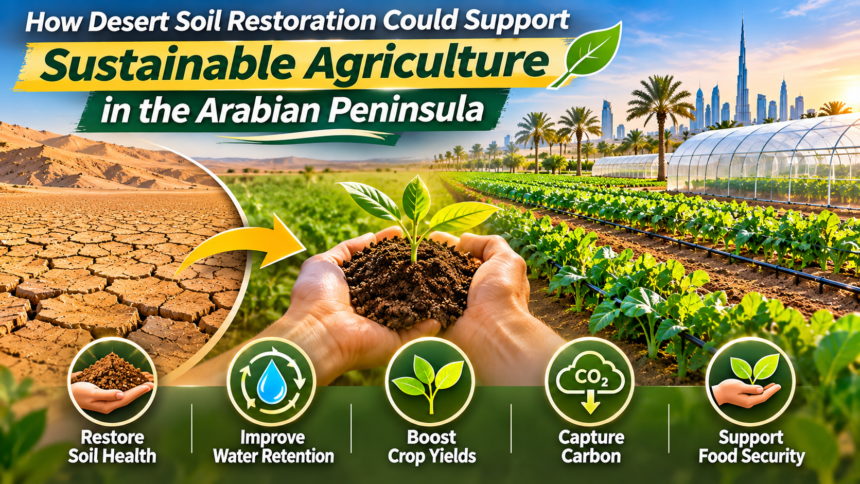
The Arabian Peninsula is known for its vast deserts, high temperatures, limited rainfall, and challenging agricultural conditions. Yet farming has remained part of the region’s economic and cultural history for centuries. From date palm cultivation in traditional oases to modern greenhouses and advanced irrigation systems, communities have developed different ways to produce food in environments where water and fertile soil are scarce.
- 1. Why Desert Soil Restoration Is Important for Arabian Peninsula Agriculture
- 2. How Organic Matter, Compost, and Soil Biology Could Improve Fertility
- 3. How Water Conservation and Salinity Management Support Restored Soils
- 4. How Saudi Arabia and the UAE Are Advancing Land Restoration and Desert Agriculture
- 5. How Salt-Tolerant Crops and Climate-Smart Farming Could Expand Opportunities
- 6. The Environmental and Economic Challenges of Desert Soil Restoration
- 7. The Future of Desert Soil Restoration and Sustainable Agriculture in the Arabian Peninsula
- Measuring Restoration Success
- Opportunities for Agricultural Businesses
- Conclusion
Today, desert soil restoration is attracting greater attention as governments, researchers, and agricultural businesses search for more sustainable ways to manage land and strengthen food security.
Healthy soil performs several important functions. It supports plant roots, stores nutrients, regulates water movement, and provides a habitat for microorganisms. When soil becomes degraded through erosion, salinity, inappropriate irrigation, or the loss of organic matter, its ability to support productive agriculture can decline.
These challenges are particularly relevant to Saudi Arabia, the United Arab Emirates, Oman, Yemen, Qatar, Bahrain, and Kuwait. Although their landscapes and agricultural systems differ, many areas experience significant pressure from heat, water scarcity, and fragile soil conditions.
Restoring soil could help selected farms improve water retention, protect existing agricultural land, support suitable crops, and reduce further environmental degradation.
However, restoration does not mean transforming every desert into farmland. Many desert ecosystems are naturally valuable and should be protected rather than converted.
The opportunity lies in identifying degraded agricultural land, improving its condition, and using resources responsibly.
As the Arabian Peninsula continues developing its environmental and food-security strategies, desert soil restoration could become an important part of more resilient agriculture.
1. Why Desert Soil Restoration Is Important for Arabian Peninsula Agriculture
Soil is the foundation of most conventional agriculture.
It supplies physical support for plants, helps regulate access to water, and influences nutrient availability.
In desert environments, maintaining these functions can be difficult because of harsh climatic conditions and the characteristics of local soils.
Understanding Desert Soil Conditions
Desert soils vary considerably.
Some are sandy, while others contain more clay, gravel, or naturally accumulated salts. Certain soils are shallow, and others may develop hard layers that restrict root growth or water movement.
The FAO identifies low soil organic matter, weak soil structure, and salinity as important challenges across the Near East and North Africa.
Low organic matter can reduce a soil’s ability to retain nutrients and maintain suitable structure.
However, sandy soil is not necessarily degraded simply because it contains little organic material. Desert ecosystems naturally function differently from fertile agricultural regions.
What Causes Agricultural Soil Degradation?
Land degradation can occur through several processes.
Wind erosion may remove exposed surface material, while unsustainable irrigation can cause salts to accumulate around plant roots.
Excessive cultivation, inappropriate land management, and the loss of protective vegetation may also reduce soil quality.
In some areas, overgrazing can damage vegetation and leave land vulnerable to erosion.
These problems often interact, requiring coordinated solutions.
Why Food Security Matters
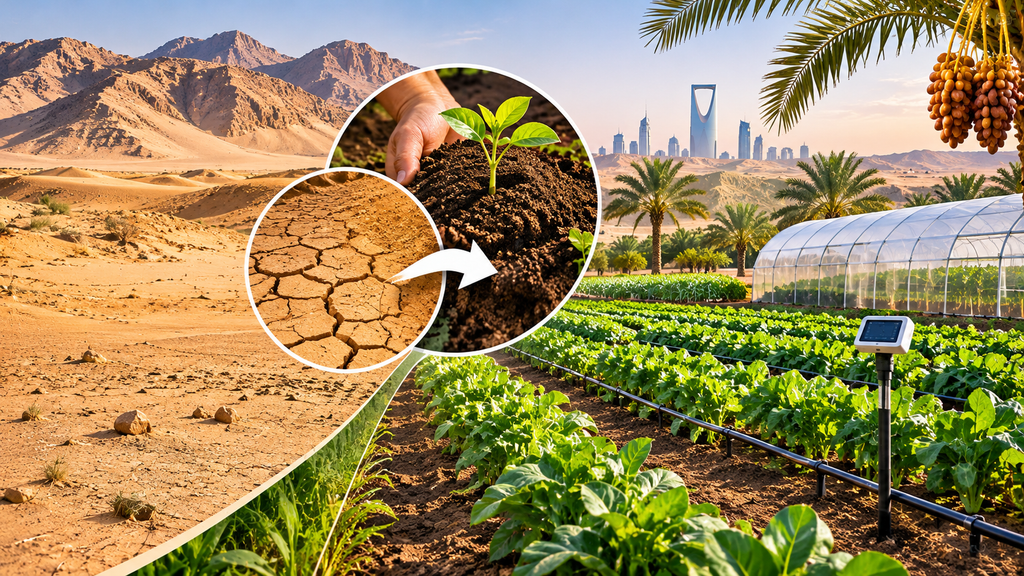
The Arabian Peninsula faces limitations on agricultural production because of water scarcity and climatic conditions.
Improving existing farmland may help preserve local production and reduce avoidable losses.
However, soil restoration alone cannot eliminate dependence on imported food.
Crop suitability, water availability, energy requirements, supply chains, and economic competitiveness remain important.
Common Soil Challenges
| Challenge | Agricultural Consequence |
|---|---|
| Low Organic Matter | Reduced nutrient retention and weaker structure |
| High Salinity | Difficulty absorbing water and nutrients |
| Wind Erosion | Loss of exposed surface material |
| Soil Compaction | Restricted infiltration and root growth |
| Poor Drainage | Waterlogging and salt accumulation |
| Unsuitable Irrigation | Increased water use and secondary salinisation |
| Limited Vegetation | Greater exposure to erosion |
The most effective restoration method depends on identifying the actual problem rather than treating all desert soils alike.
2. How Organic Matter, Compost, and Soil Biology Could Improve Fertility
One approach to improving degraded agricultural soils involves restoring organic matter.
Organic materials can support soil structure, nutrient cycling, and biological activity when appropriately selected and applied.
However, amendments must be tested because their composition and effects vary.
The Importance of Organic Matter
Soil organic matter includes decomposing plant material, microbial residues, and other carbon-containing substances.
In suitable conditions, it helps soil particles form aggregates and can improve the soil’s ability to hold water and nutrients.
In sandy agricultural soils, this may be especially useful because water can drain rapidly through coarse particles.
However, extremely hot conditions and intensive cultivation can accelerate the decomposition of some organic materials.
This means soil improvement often requires continuing management rather than a single application.
Compost as a Soil Amendment
Mature compost can introduce organic material and selected nutrients.
It may improve the structure of some agricultural soils and support microbial activity.
However, poorly processed compost may contain unsuitable salts, contaminants, viable weed seeds, or pathogens.
Farmers should therefore use appropriate quality standards and examine the amendment’s characteristics before applying it.
Biochar and Soil Restoration
Biochar is a carbon-rich material produced by heating suitable biomass under conditions with limited oxygen.
Researchers are investigating its use as a soil amendment because certain forms may influence nutrient retention, water movement, and carbon storage.
However, biochar performance varies according to feedstock, processing temperature, soil characteristics, and application rate.
Not every biochar product improves crop growth, and inappropriate applications can create additional problems.
Microorganisms and Soil Health
Soil contains bacteria, fungi, and other organisms involved in nutrient cycling and plant interactions.
Some agricultural research examines microbial treatments that may improve crop tolerance to environmental stresses.
However, laboratory results should not be assumed to translate directly into field performance under extreme desert conditions.
Soil Improvement Methods Compared
| Method | Potential Benefit | Important Limitation |
|---|---|---|
| Mature Compost | Organic matter and nutrient supply | Quality and salinity must be checked |
| Crop Residues | Surface protection and organic inputs | Requires suitable residue management |
| Biochar | Possible improvements in selected soil properties | Results depend on product and soil |
| Mulching | Reduced surface evaporation and erosion | Material and maintenance requirements |
| Cover Crops | Root activity and soil protection | Require water and suitable growing conditions |
| Microbial Products | Possible support for plant processes | Need locally validated evidence |
Why Testing Is Essential
Farmers should assess soil texture, organic carbon, pH, salinity, and nutrient levels before investing in amendments.
A product suitable for one field may be ineffective or inappropriate in another.
3. How Water Conservation and Salinity Management Support Restored Soils
Water availability is one of the most important limitations on agriculture in the Arabian Peninsula.
Improving soil quality has limited value if a farm cannot access sufficient water of appropriate quality.
Soil and water management must therefore be planned together.
The Problem of Salt Accumulation
Irrigation water naturally contains dissolved minerals.
When water evaporates or is taken up by plants, some salts may remain in the soil.
Without appropriate drainage, these salts can accumulate in the root zone.
Excessive salinity can make it harder for crops to absorb water and may reduce productivity.
The FAO identifies salinisation as a major regional soil threat, alongside erosion.
Why Drainage Matters
Managing saline agricultural soils may require removing excess salts from the root zone.
This can involve controlled leaching, where sufficient water passes through the soil and carries salts away.
However, leaching requires appropriate drainage.
Otherwise, salts may move into groundwater or surrounding areas, creating additional environmental problems.
Leaching can also consume substantial water, making it unsuitable where water availability is insufficient.
Efficient Irrigation
Drip irrigation can deliver water near plant roots and reduce some unnecessary surface wetting.
However, irrigation systems still require correct scheduling and maintenance.
Drip irrigation does not automatically prevent salinity, especially when water quality is poor or drainage is inadequate.
Rainwater Harvesting
Rainfall in desert regions is often irregular, but selected landscapes can benefit from harvesting seasonal runoff.
Appropriate structures may slow water movement, support infiltration, and reduce erosion.
However, designs must account for local flood risks, soil characteristics, and environmental effects.
Integrated Water and Soil Management
| Practice | Potential Benefit | Main Consideration |
|---|---|---|
| Drip Irrigation | More targeted water delivery | Maintenance and scheduling |
| Soil Moisture Monitoring | Better irrigation decisions | Sensor accuracy |
| Mulching | Lower surface evaporation | Material suitability |
| Controlled Leaching | Reduction of root-zone salts | Water demand and safe drainage |
| Rainwater Harvesting | Capture of suitable seasonal runoff | Site-specific design |
| Reclaimed-Water Irrigation | Alternative water source | Quality, safety and salinity controls |
The Importance of Water Quality
Reclaimed water may support selected agricultural uses when it meets applicable standards.
However, salts, pathogens, and chemical contaminants require careful monitoring.
Using an alternative water source without appropriate treatment and controls can damage soils or create health risks.
4. How Saudi Arabia and the UAE Are Advancing Land Restoration and Desert Agriculture
Government initiatives and research institutions across the region are examining approaches to degraded land, vegetation recovery, and agriculture in harsh environments.
Saudi Arabia and the UAE provide particularly relevant examples.
Saudi Arabia’s Land Rehabilitation Progress
In March 2026, Saudi Arabia’s Ministry of Environment, Water and Agriculture reported the rehabilitation of one million hectares of degraded land.
The announcement also identified the planting of more than 159 million trees under national greening efforts.
The Saudi Green Initiative includes longer-term ambitions involving vegetation cover and the rehabilitation of degraded land.
However, restored rangeland, natural habitat, and agricultural soil are not interchangeable categories.
The reported million-hectare milestone should not be interpreted as farmland created for crop production.
Restoring Natural Rangelands
Saudi Arabia’s National Center for Vegetation Cover Development and Combating Desertification works on rehabilitating natural environments through measures including native vegetation, seed dispersal, and rainwater harvesting.
In November 2026, an initiative was announced covering 313 hectares within two royal reserves.
Such projects can support vegetation and ecosystems while potentially reducing erosion.
However, their primary purpose is ecological restoration rather than converting protected land into intensive farmland.
The UAE’s Biosaline Agriculture Research
The International Center for Biosaline Agriculture, based in Dubai, conducts research into farming with saline water and crops adapted to difficult growing conditions.
One project examines integrated agricultural systems using aquaculture effluents and salt-tolerant plants.
Research has also explored coastal environments in Umm Al Quwain.
These projects seek to identify productive uses for marginal water resources.
However, pilot systems require careful economic and environmental evaluation before large-scale expansion.
Regional Initiatives Compared
| Initiative | Main Focus | Relevance to Agriculture |
|---|---|---|
| Saudi Green Initiative | Land rehabilitation and vegetation recovery | Protecting landscapes and ecosystem functions |
| Saudi Rangeland Restoration | Native vegetation and rainwater management | Erosion control and natural land productivity |
| ICBA Research in UAE | Saline agriculture and adapted crops | Potential farming options under difficult conditions |
| Middle East Green Initiative | Regional cooperation on land rehabilitation | Knowledge sharing and environmental resilience |
| FAO Regional Soil Partnership | Sustainable soil management | Research, data and technical guidance |
The Importance of Regional Cooperation
In July 2026, the Middle East Green Initiative and the UN Convention to Combat Desertification signed a memorandum of understanding focused on land rehabilitation and vegetation development.
Such cooperation can support shared expertise and technical capacity.
However, agreements and restoration targets should be distinguished from independently verified improvements in agricultural production.
5. How Salt-Tolerant Crops and Climate-Smart Farming Could Expand Opportunities
Restoring soils is not always about making them suitable for conventional crops.
In some locations, it may be more practical to select plants adapted to local conditions.
This approach can reduce pressure to impose unsuitable farming systems on fragile landscapes.
Understanding Salt-Tolerant Crops
Some plants tolerate higher soil or water salinity than others.
These include certain forage crops and halophytes, which are naturally adapted to salty environments.
Researchers are examining how such species can be integrated into agricultural systems.
However, salt tolerance varies significantly between species and even between varieties of the same crop.
A plant described as salt-tolerant still has limits.
The Role of Date Palms
Date palms are an established part of agriculture and oasis landscapes in the Arabian Peninsula.
They can perform under hot conditions and tolerate some environmental stresses.
However, productive cultivation still requires appropriate water, nutrients, and soil management.
Traditional agricultural knowledge can therefore be combined with modern monitoring and irrigation practices.
Protected Agriculture
Greenhouses and controlled-environment systems can provide alternative approaches for producing selected crops.
They may reduce some exposure to harsh weather and improve control over growing conditions.
However, cooling and energy demands can be substantial in hot climates.
Hydroponic systems can also reduce dependence on conventional soil, but they do not restore agricultural soil itself.
Choosing the Right Farming Approach
| Farming Approach | Potential Use | Main Limitation |
|---|---|---|
| Restored Open-Field Soil | Suitable crops on rehabilitated land | Water and climate constraints |
| Salt-Tolerant Crop Production | Selected saline environments | Crop-specific tolerance |
| Date Palm Cultivation | Suitable oasis and agricultural settings | Irrigation and long-term management |
| Protected Agriculture | Controlled crop production | Energy and capital costs |
| Hydroponics | Soil-independent growing | Technology, energy and nutrient management |
| Integrated Biosaline Farming | Productive use of selected saline resources | Technical complexity and site suitability |
Why Agricultural Diversity Matters
Food security benefits from diverse production systems rather than dependence on one technology.
Restored farmland, protected agriculture, imported food, and resilient supply chains may all play complementary roles.
No single system can meet every agricultural requirement in the Arabian Peninsula.
6. The Environmental and Economic Challenges of Desert Soil Restoration
Desert soil restoration offers potential benefits, but projects can be expensive and technically difficult.
Success depends on local environmental conditions, long-term maintenance, and whether improvements justify the resources required.
High Restoration Costs
Restoration may involve soil testing, organic amendments, erosion controls, irrigation infrastructure, and specialised expertise.
Some degraded soils require extensive treatment before agricultural production becomes viable.
Farmers and policymakers must compare expected benefits with long-term costs.
Water Scarcity Remains a Major Constraint
Improved soil does not create new freshwater resources.
A field may become more productive after restoration while still requiring substantial irrigation.
Consequently, expanding agriculture into unsuitable desert areas can increase pressure on groundwater.
Restoration should prioritise efficient use of available resources.
Protecting Natural Desert Ecosystems
Not all desert landscapes need to be planted or cultivated.
Natural desert habitats support specialised plants, wildlife, and ecological processes.
Converting these habitats into farmland may create biodiversity losses.
Restoration should distinguish degraded agricultural land from naturally functioning desert ecosystems.
Avoiding Harmful Amendments
Inappropriate compost, contaminated soil conditioners, or excessive fertiliser can damage soil quality.
Some amendments may introduce salts or unwanted substances.
Projects should use quality-controlled materials and appropriate testing.
Challenges and Practical Responses
| Challenge | Potential Risk | Appropriate Response |
|---|---|---|
| Limited Water | Unsustainable irrigation demand | Water budgeting and efficient practices |
| Salinity | Reduced crop productivity | Soil testing and drainage planning |
| High Costs | Poor financial viability | Pilot projects and lifecycle analysis |
| Soil Erosion | Loss of restored material | Protective vegetation and erosion controls |
| Inappropriate Crops | Low yields | Locally adapted crop selection |
| Weak Monitoring | Unverified restoration claims | Long-term soil and vegetation measurements |
| Habitat Conversion | Biodiversity damage | Protect intact natural ecosystems |
The Need for Long-Term Monitoring
Restoration cannot be evaluated through photographs of newly planted fields alone.
Soil properties, vegetation survival, water use, and agricultural productivity must be assessed over time.
A short-term increase in plant growth may not represent lasting improvement.
7. The Future of Desert Soil Restoration and Sustainable Agriculture in the Arabian Peninsula
The future of desert soil restoration will likely involve combining established agricultural knowledge with soil science, water management, and carefully selected technologies.
The objective should be to maintain productive land without placing unsustainable pressure on scarce resources.
Digital Soil Monitoring
Sensors and laboratory analysis can help farmers monitor soil moisture, salinity, and nutrient conditions.
Satellite imagery and geographic information systems may support broader landscape assessment.
These tools can help identify changing conditions and guide interventions.
However, remote measurements require calibration and field verification.
Restoration Through Local Partnerships
Farmers, researchers, environmental authorities, and agricultural businesses can contribute different forms of expertise.
Local farmers understand seasonal conditions and practical cultivation challenges.
Research institutions can test soil treatments and crop performance.
Government agencies may support information sharing, training, and suitable infrastructure.
A Practical Desert Soil Restoration Checklist
- Identify whether the land is degraded farmland or intact natural habitat.
- Test soil texture, salinity, pH, and nutrient conditions.
- Assess the quantity and quality of available irrigation water.
- Identify the main causes of degradation.
- Select amendments according to laboratory results.
- Evaluate drainage before attempting salt removal.
- Choose crops suitable for local conditions.
- Protect the soil from erosion and unnecessary disturbance.
- Monitor water consumption and crop performance.
- Review results over multiple growing seasons.
Measuring Restoration Success
Projects should use consistent indicators to evaluate environmental and agricultural outcomes.
Useful measures include soil organic carbon, salinity, water infiltration, vegetation cover, crop productivity, and water consumption.
However, indicators must be interpreted together.
For example, higher crop yields may not represent sustainable progress if they require excessive groundwater extraction.
Key Performance Indicators
| Indicator | What It Helps Evaluate |
|---|---|
| Soil Organic Carbon | Changes in soil carbon status |
| Soil Electrical Conductivity | Salinity conditions |
| Water Infiltration | Movement of water into soil |
| Vegetation Cover | Surface protection and plant recovery |
| Crop Yield | Agricultural productivity |
| Water Productivity | Output relative to water use |
| Groundwater Conditions | Resource sustainability |
| Biodiversity | Wider ecological effects |
Opportunities for Agricultural Businesses
Soil restoration could create opportunities for environmental consulting firms, laboratories, irrigation specialists, compost producers, agricultural technology companies, and research organisations.
Businesses may develop services involving soil analysis, water monitoring, erosion control, and sustainable farm management.
However, commercial products should be supported by evidence from relevant field conditions.
A treatment that performs well in laboratory trials may require significant adjustment before becoming useful on working farms.
The Importance of Realistic Expectations
Restoration does not mean that every desert can become productive agricultural land.
Some areas lack sufficient water, while others have soil or environmental constraints that make cultivation impractical.
In such locations, protecting natural vegetation or restoring ecological functions may be more responsible than attempting intensive agriculture.
The strongest strategies will focus on improving the land that can be managed sustainably.
Conclusion
Desert soil restoration could support sustainable agriculture in the Arabian Peninsula by improving soil health, protecting existing farmland, supporting suitable crops, and reducing some forms of land degradation.
The region faces significant challenges involving water scarcity, salinity, high temperatures, and fragile ecosystems.
Approaches such as organic matter management, efficient irrigation, appropriate drainage, erosion control, and salt-tolerant crops offer potential ways to address selected agricultural problems.
Saudi Arabia’s land rehabilitation programmes and the UAE’s biosaline agriculture research demonstrate growing regional interest in restoring landscapes and developing climate-adapted agricultural systems.
However, land rehabilitation and agricultural expansion are not the same.
Restoration must be assessed according to local soil conditions, water availability, biodiversity, economic feasibility, and long-term results.
For farmers, healthier soil may support more resilient production when combined with responsible water management.
For governments, restoration can contribute to environmental protection and food-security planning.
Ultimately, sustainable agriculture in the Arabian Peninsula will depend not on turning every desert green, but on recognising where agricultural improvement is practical and protecting the natural systems on which the region depends.
By combining scientific research, local knowledge, and careful resource management, desert soil restoration could become an important part of a more resilient agricultural future.
Do follow us on Instagram
Read More – Could District Cooling Become a Model for Energy-Efficient Cities Beyond the Gulf?