


Engineering Jobs in Dubai Offering Exciting Career Growth
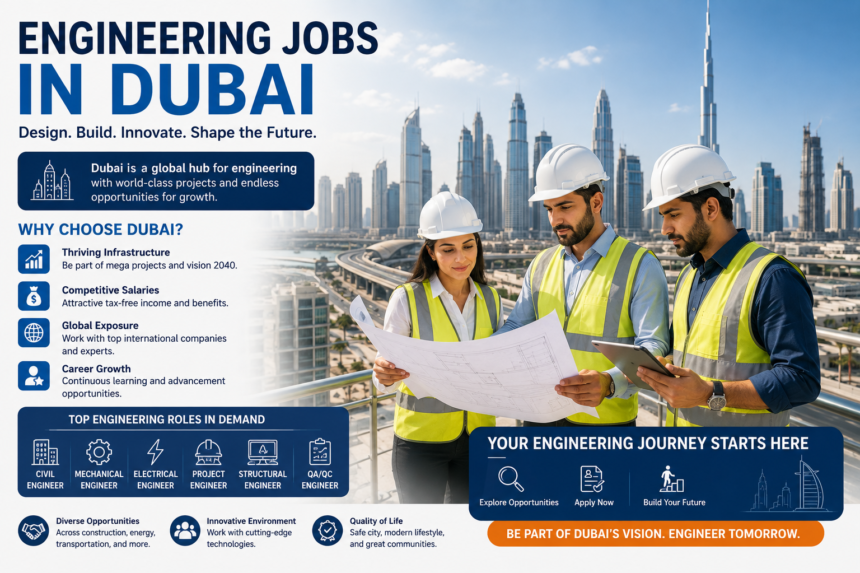
Dubai is known for ambitious construction, advanced infrastructure and rapid urban development, but the city’s engineering story is becoming much wider. Civil and mechanical engineering remain important, while new opportunities are also developing around sustainability, digital infrastructure, energy systems, automation and smart buildings.
- Why Engineering Jobs in Dubai Continue to Grow
- 1. Civil Engineers
- 2. Structural Engineers
- 3. Mechanical Engineers
- 4. Electrical Engineers
- 5. MEP Engineers
- 6. Project Engineers
- 7. Construction Project Managers
- 8. BIM Engineers and Coordinators
- 9. Sustainability Engineers
- 10. Renewable Energy Engineers
- 11. Data Centre Engineers
- 12. Automation and Controls Engineers
- Engineering Jobs in Dubai at a Glance
- Engineering Qualification and Licensing in Dubai
- Society of Engineers Membership Can Matter
- Engineering Salaries in Dubai
- Experience Often Matters More Than Degree Name
- GCC Experience Can Improve Employability
- Software Skills Can Strengthen Your Engineering Profile
- Engineering Careers Are Becoming More Digital
- Fresh Graduates Need a Different Strategy
- Experienced Engineers Should Target Specialisation
- Where to Find Engineering Jobs in Dubai
- How to Build a Strong Dubai Engineering CV
- Common Engineering Job Mistakes
- How to Avoid Engineering Job Scams
- The Future of Engineering Jobs in Dubai
- Frequently Asked Questions
- Conclusion
For professionals researching Engineering Jobs in Dubai, 2026 presents an interesting market. Dubai’s construction sector grew 8.2 percent year on year in the first quarter of 2026 and contributed around AED 18.7 billion in gross value added, representing 8.1 percent of the emirate’s economy. Real estate activity also expanded during the same period.
That economic momentum supports demand for professionals who can design, build, operate and maintain increasingly complex projects.
But getting an engineering job in Dubai is not only about having a degree. Experience, technical specialisation, software skills, project exposure and, for certain construction and consultancy roles, professional qualification or accreditation requirements can all matter.
Dubai Municipality currently operates the Dubai Engineering Qualification system for engineers, consultants, contractors and related technical professionals. The system includes services for engineer registration and professional practice permits.
Here are some of the engineering careers worth watching.
Why Engineering Jobs in Dubai Continue to Grow
Dubai’s development model depends heavily on engineering.
Every new residential community, hotel, data centre, road, warehouse, energy system or industrial facility requires engineers at different stages.
Demand is influenced by:
- Construction growth
- Real estate development
- Transport infrastructure
- Data centres
- Utilities
- Manufacturing
- Sustainability
- Smart city projects
- Logistics infrastructure
The important change is that engineering is becoming increasingly connected with technology.
A modern building project may involve civil engineers, mechanical engineers, electrical engineers, sustainability specialists, BIM professionals, automation teams and data specialists.
This makes the sector more multidisciplinary than it was in the past.
1. Civil Engineers
Civil engineering remains one of the most obvious career paths in Dubai.
Civil engineers can work across:
- Buildings
- Roads
- Bridges
- Infrastructure
- Drainage
- Utilities
- Urban developments
The construction sector’s 8.2 percent growth in Q1 2026 underlines the continuing importance of physical development to Dubai’s economy.
Civil engineers may work for:
- Contractors
- Consultants
- Developers
- Government entities
- Project management companies
Experience matters significantly.
A graduate civil engineer supporting site supervision has a very different market position from a professional managing major structural or infrastructure projects.
2. Structural Engineers
Structural engineers focus on the strength and stability of buildings and other structures.
Dubai’s skyline creates obvious demand for professionals who understand complex building systems.
Responsibilities can include:
- Structural analysis
- Design calculations
- Foundation systems
- Steel structures
- Concrete structures
- Technical review
Certain engineering consultancy and contracting activities in Dubai are regulated through Dubai Municipality standards, which include requirements for engineer experience and technical qualifications.
For experienced structural engineers, knowledge of UAE design requirements and local project processes can significantly strengthen employability.
3. Mechanical Engineers
Mechanical engineers are needed across much more than factories.
Dubai buildings depend on mechanical systems for:
- Air conditioning
- Ventilation
- Water systems
- Fire protection
- Building services
In construction, mechanical engineers often work as part of MEP teams.
MEP means mechanical, electrical and plumbing.
These systems can represent a major portion of a modern building project.
Mechanical engineers may also work in:
- Manufacturing
- Facilities management
- Energy
- Maintenance
- Industrial operations
Professionals familiar with large commercial buildings, hospitals, hotels and data centres can be particularly valuable.
4. Electrical Engineers
Electrical engineers support the systems that keep modern Dubai functioning.
Possible areas include:
- Building power distribution
- Lighting
- Substations
- Renewable energy
- Industrial electrical systems
- Control systems
Dubai’s utilities sector also recorded strong growth in Q1 2026, with electricity, gas, water supply and waste management activity expanding 8.4 percent year on year.
That broader infrastructure growth supports career opportunities beyond traditional building construction.
Electrical engineers with experience in power systems, renewable energy or mission critical facilities may find particularly interesting roles.
5. MEP Engineers
MEP engineers play a central role in Dubai construction.
A building can look impressive externally, but it becomes usable only when mechanical, electrical and plumbing systems work properly.
MEP engineers coordinate these systems and may work across:
- HVAC
- Electrical distribution
- Plumbing
- Fire systems
- Building controls
Dubai’s climate makes HVAC engineering particularly important.
Large commercial buildings need efficient cooling while sustainability requirements increasingly encourage reduced energy consumption.
Professionals who can combine building services engineering with energy efficiency knowledge can therefore add additional value.
6. Project Engineers
Project engineers sit between technical engineering and project management.
They may coordinate:
- Contractors
- Consultants
- Procurement
- Technical submissions
- Schedules
- Site activities
This career can be particularly useful for engineers who want eventually to move toward project management.
Dubai projects often involve multiple international companies and subcontractors.
That means project engineers need strong communication alongside technical ability.
Knowing how to solve technical problems is important.
Knowing how to explain the solution to several stakeholders is equally valuable.
7. Construction Project Managers
Experienced project managers can become some of the most valuable professionals in Dubai’s engineering and construction market.
Their responsibilities can include:
- Budget
- Schedule
- Quality
- Contractors
- Consultants
- Risk
- Delivery
Large projects create major financial consequences when delays occur.
This means employers value managers who can maintain control across complex developments.
Engineers who want to reach project leadership roles should develop more than technical knowledge.
Useful skills include:
- Cost awareness
- Contract knowledge
- Leadership
- Reporting
- Risk management
Certifications such as PMP can support a profile, but employers usually place strong value on proven project delivery experience.
8. BIM Engineers and Coordinators
Building Information Modelling has changed the way construction projects are designed and coordinated.
BIM creates digital models that allow teams to identify problems before they appear on site.
Roles can include:
- BIM engineer
- BIM coordinator
- BIM manager
- Revit specialist
BIM can reduce clashes between architectural, structural and MEP systems.
This makes it increasingly useful on large or technically complex projects.
Engineers with strong BIM skills may therefore have an advantage, especially when they also understand the physical engineering discipline behind the software.
Software knowledge without engineering judgement is limited.
The combination is more valuable.
9. Sustainability Engineers
Dubai’s engineering future increasingly includes sustainability.
Buildings need to use energy and water more efficiently.
Engineers may work across:
- Energy modelling
- Green buildings
- Sustainable materials
- Carbon reduction
- Environmental performance
Dubai Municipality maintains the Al Sa’fat Dubai Green Building System among its planning and construction regulations.
This creates demand for engineers who understand sustainability requirements alongside conventional design.
Professionals with credentials connected with green building, energy efficiency or environmental engineering can strengthen their career prospects.
10. Renewable Energy Engineers
Renewable energy is another growing field.
Engineering opportunities can involve:
- Solar systems
- Energy storage
- Electrical integration
- Energy efficiency
- Smart grids
Dubai’s energy infrastructure is gradually becoming more diverse.
Electrical and mechanical engineers who develop renewable energy expertise can transition into these newer career areas.
The important advantage is transferable knowledge.
An electrical engineer already understands power systems.
Adding solar or storage knowledge creates an additional layer of specialisation.
11. Data Centre Engineers
Data centres are becoming one of the most interesting engineering environments globally.
These facilities need:
- Reliable electricity
- Advanced cooling
- Backup power
- Fire protection
- Security
- Building automation
That creates opportunities for mechanical, electrical and controls engineers.
Data centre projects are different from normal commercial buildings because downtime can be extremely expensive.
Reliability becomes the central engineering objective.
Professionals with mission critical facility experience may therefore command strong demand.
As AI and cloud computing expand, data infrastructure could remain an important long term career area.
12. Automation and Controls Engineers
Dubai’s smart building and industrial environments create another opportunity.
Automation engineers can work with:
- Building management systems
- Industrial control systems
- Sensors
- PLCs
- Smart infrastructure
Buildings are becoming more connected.
Air conditioning, lighting, access control and energy use can increasingly be monitored and adjusted digitally.
This creates a bridge between traditional engineering and software.
Engineers who understand both physical systems and automation can become particularly valuable.
Engineering Jobs in Dubai at a Glance
| Career | Strongest Area |
|---|---|
| Civil Engineer | Buildings and infrastructure |
| Structural Engineer | Structural design |
| Mechanical Engineer | HVAC and building systems |
| Electrical Engineer | Power and electrical systems |
| MEP Engineer | Building services |
| Project Engineer | Coordination and delivery |
| Project Manager | Large project leadership |
| BIM Engineer | Digital construction |
| Sustainability Engineer | Green buildings |
| Renewable Energy Engineer | Clean energy |
| Data Centre Engineer | Mission critical infrastructure |
| Automation Engineer | Smart systems |
Engineering Qualification and Licensing in Dubai
This is an important area that international engineers should understand.
Dubai Municipality regulates the practice of engineering consultancy and contracting through established standards.
Its current system covers areas including:
- Engineering consultancy
- Contracting activities
- Qualification of technical staff
- Practice permits
- Professional accreditation
The Dubai Engineering Qualification system provides services for engineers and engineering companies, including registration and professional practice permits.
Dubai Municipality also states that engineers working for qualifying engineering consultancies and contracting companies can be subject to registration and technical qualification requirements.
For some construction activities, engineers must also pass relevant technical proficiency examinations and satisfy experience standards.
This does not mean every engineering job requires exactly the same process.
Requirements depend on:
- Employer
- Activity
- Engineering discipline
- Level of responsibility
Candidates should verify requirements for the specific position.
Society of Engineers Membership Can Matter

Dubai Municipality’s published building contracting standards state that engineers within certain regulated contracting categories must obtain membership in the UAE Society of Engineers and pass applicable technical proficiency tests.
In January 2026, Dubai Municipality and the Society of Engineers also signed a cooperation agreement designed to strengthen evaluation, qualification and licensing of engineering professionals.
The agreement includes cooperation around professional examinations and engineering classification.
This shows that professional accreditation is becoming more structured.
Engineering Salaries in Dubai
There is no single Dubai engineering salary.
Pay varies significantly according to:
- Discipline
- Experience
- Employer
- Project size
- Responsibility
- Technical skills
A site engineer and project director cannot be compared directly.
Entry level engineers may find salaries much more competitive than expected because Dubai attracts international applicants.
Senior professionals can access significantly stronger packages when they bring rare expertise or leadership experience.
The most important rule is to compare roles by responsibility rather than title alone.
Experience Often Matters More Than Degree Name
A degree opens the door.
Experience often decides how far the door opens.
Employers may ask:
What projects have you delivered?
What systems have you designed?
What budgets have you managed?
What software do you know?
Have you worked in the GCC before?
This is why engineers should build CVs around achievements.
Instead of writing:
Worked on residential construction.
write:
Managed site coordination across a multi tower residential project and supported delivery across structural and MEP interfaces.
Specific experience is easier for employers to understand.
GCC Experience Can Improve Employability
Dubai employers often value UAE or GCC project experience.
This is because local experience suggests familiarity with:
- Regulations
- Consultants
- Contractors
- Client expectations
- Climate conditions
- Construction processes
But newcomers should not assume Gulf experience is mandatory for every role.
Strong international project experience can still be valuable.
The key is explaining how that experience transfers into Dubai.
Software Skills Can Strengthen Your Engineering Profile
Depending on the discipline, useful software can include:
- AutoCAD
- Revit
- Civil 3D
- ETABS
- SAP2000
- Primavera P6
- MS Project
- Navisworks
- BIM platforms
Do not simply list every software name you have ever opened.
Employers care about actual proficiency.
If you used Primavera P6 to manage a real construction schedule, that carries more value than completing one short online tutorial.
Engineering Careers Are Becoming More Digital
One of the biggest changes in the sector is digital integration.
Engineering teams increasingly work with:
- BIM
- Digital twins
- Sensors
- Automation
- Data analytics
- AI assisted design
This does not mean traditional engineering knowledge is becoming less important.
It means engineers need to combine that knowledge with new tools.
A structural engineer still needs to understand loads.
A mechanical engineer still needs to understand heat transfer.
Technology improves the process.
It does not replace engineering judgement.
Fresh Graduates Need a Different Strategy
Dubai can be difficult for inexperienced engineers because competition is strong.
Fresh graduates should focus on:
- Strong technical fundamentals
- Internship experience
- Software skills
- Professional communication
- Entry level project exposure
Do not wait only for the perfect title.
A junior technical role can provide valuable local experience.
Once you understand Dubai project processes, your market position can improve.
Experienced Engineers Should Target Specialisation
Senior professionals should avoid presenting themselves too broadly.
Instead of:
Mechanical Engineer with 15 years experience.
consider:
Senior Mechanical Engineer with 15 years of experience delivering HVAC systems for hospitals, hotels and high rise developments across GCC markets.
The second statement is much stronger.
Specialisation makes it easier for recruiters and employers to understand your value.
Where to Find Engineering Jobs in Dubai
Useful channels include:
- Developer career pages
- Engineering consultancy websites
- Contractor websites
- Specialist recruiters
- Professional networks
Companies often recruit through several channels at once.
Do not rely only on job portals.
Networking can become particularly important for experienced engineering professionals.
Industry events and professional organisations can also help.
How to Build a Strong Dubai Engineering CV
A good engineering CV should include:
Professional summary
State your discipline, experience and specialist strengths.
Projects
Mention significant developments.
Responsibilities
Explain what you personally handled.
Achievements
Show measurable results where possible.
Software
List tools you genuinely know.
Certifications
Include relevant professional credentials.
Keep the CV clear.
Engineers sometimes overload resumes with technical detail.
The goal is helping the employer quickly understand why you fit the role.
Common Engineering Job Mistakes
Avoid these:
- Applying for every engineering discipline
- Sending generic CVs
- Ignoring Dubai accreditation requirements
- Listing software without real proficiency
- Focusing only on salary
- Ignoring project experience
- Trusting fake recruiters
- Paying for guaranteed job offers
- Ignoring communication skills
- Failing to research the employer
How to Avoid Engineering Job Scams
Be careful when applying internationally.
Warning signs include:
- Guaranteed jobs
- Huge salaries without interviews
- Requests for upfront visa payments
- Personal email accounts claiming to represent major companies
- Pressure to send money immediately
Always verify vacancies through the employer’s official website.
Recruitment agencies normally receive their fees from employers rather than candidates for genuine professional recruitment.
The Future of Engineering Jobs in Dubai
Dubai’s engineering future is likely to become more technical and more sustainable.
Traditional construction will remain important.
But future growth can also create opportunities around:
- Smart infrastructure
- Data centres
- Renewable energy
- Sustainable buildings
- Automation
- Advanced manufacturing
The construction sector’s strong 8.2 percent growth in Q1 2026 suggests that physical development remains a major part of Dubai’s economic momentum.
At the same time, Dubai Municipality is strengthening professional qualification systems for engineers.
That combination means the future market may increasingly reward both experience and formal professional competency.
Frequently Asked Questions
Are Engineering Jobs in Dubai in demand in 2026?
Dubai’s construction sector grew 8.2 percent year on year in Q1 2026, while utilities also recorded strong growth. This supports continued demand across construction and infrastructure related engineering.
Which engineering jobs are best in Dubai?
Civil, structural, mechanical, electrical, MEP, BIM, project engineering, data centre engineering and sustainability related careers can all provide opportunities depending on experience.
Do engineers need Dubai Municipality approval?
Some regulated consultancy and contracting activities require engineers to meet Dubai Municipality qualification, accreditation or technical examination requirements. The exact requirement depends on the engineering activity and role.
What is the Dubai Engineering Qualification system?
It is Dubai Municipality’s system providing engineering qualification services, including registration and professional practice permits for engineers and related industry participants.
Do engineers need Society of Engineers membership?
Dubai Municipality’s published standards require Society of Engineers membership for engineers within certain regulated building contracting categories.
Are BIM skills useful in Dubai?
Yes. BIM is increasingly important for coordination and digital construction, especially on complex projects.
Can fresh graduate engineers find jobs in Dubai?
Yes, but competition can be strong. Internships, software skills and practical project exposure can significantly improve employability.
Conclusion
Engineering Jobs in Dubai remain closely connected to the emirate’s continuing development.
Civil, structural, mechanical and electrical engineering remain essential because Dubai continues building new communities, infrastructure and commercial developments.
The construction sector grew 8.2 percent year on year during the first quarter of 2026, contributing around AED 18.7 billion to Dubai’s economy.
But the engineering market is also changing.
BIM is making construction more digital.
Sustainability is influencing building design.
Data centres are creating new demand for mechanical and electrical specialists.
Automation is connecting engineering with software and controls.
Professional regulation is also becoming more structured through Dubai Municipality’s engineering qualification system and its strengthened cooperation with the Society of Engineers.
For job seekers, this creates both opportunity and competition.
A degree alone will not guarantee success.
The strongest candidates will combine technical knowledge, practical project experience, relevant software skills, professional accreditation where required and strong communication.
Dubai will continue building.
The engineers with the best chance of building careers alongside it will be those prepared to keep learning as quickly as the city itself changes.
follow us on Instagram
Read More – Healthcare Careers in Dubai: 12 Amazing Jobs for 2026