How Modern Urban Planning Is Transforming Gulf Public Spaces
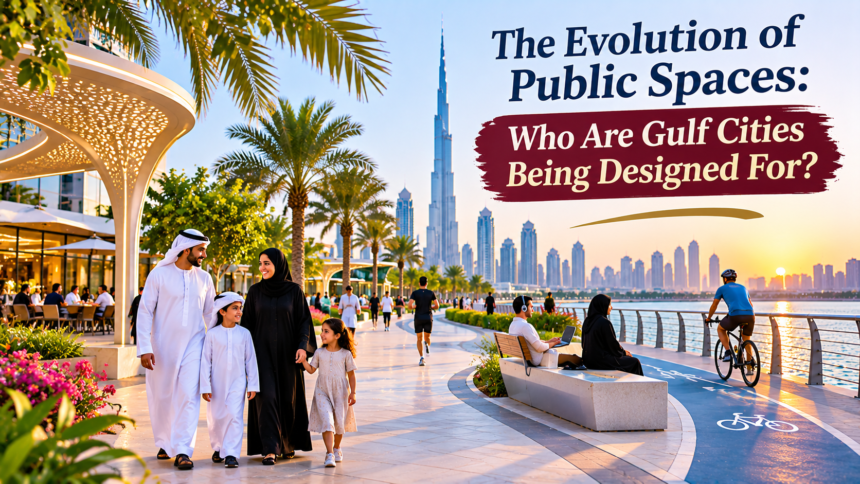
The skyline of the Arabian Gulf has become a symbol of extraordinary urban transformation. From Dubai’s skyscrapers and Doha’s waterfront developments to Riyadh’s expanding green infrastructure and Muscat’s evolving urban landscape, Gulf cities have invested heavily in modern infrastructure, architecture, and public amenities. Yet beyond the buildings and major developments, an important question is emerging: who are these cities actually being designed for?
- 1. How Public Spaces in Gulf Cities Have Evolved Over Time
- 2. Who Benefits From Modern Public Space Development in the GCC?
- 3. How Gulf Cities Are Redesigning Parks, Streets, and Waterfronts
- 4. Why Walkability, Climate Comfort, and Accessibility Matter
- 5. The Role of Public Spaces in Social Inclusion and Cultural Identity
- 6. Challenges Facing Inclusive Public Space Development Across the Gulf
- 7. The Future of Public Spaces in Gulf Cities: Designing for Everyone
- Conclusion
Public spaces in Gulf cities are increasingly becoming central to conversations about urban development, sustainability, social inclusion, and quality of life. Parks, pedestrian streets, waterfronts, public squares, and community facilities influence how residents interact with their surroundings and with one another.
Historically, public life in the Gulf was shaped by traditional markets, neighbourhood gathering spaces, coastal settlements, and social institutions such as the majlis. Rapid urbanisation introduced highways, commercial districts, and large-scale developments that transformed how people moved through cities.
Today, urban planners are placing greater emphasis on walkability, accessibility, environmental comfort, and shared community experiences. However, the success of these initiatives depends on whether public spaces serve the needs of diverse residents rather than primarily supporting tourism, commercial activity, or prestigious architectural projects.
Understanding this transformation reveals how Gulf cities can balance international ambitions with the everyday needs of the people who live and work within them.
1. How Public Spaces in Gulf Cities Have Evolved Over Time
Public spaces have always played an important role in Gulf societies, although their forms and functions have changed considerably.
Before large-scale urban development, traditional neighbourhoods often featured compact streets, markets, courtyards, and gathering areas shaped by local climate and social customs.
These environments supported commerce, informal interaction, and community relationships.
The Role of Traditional Gulf Urban Design
Traditional Gulf settlements frequently reflected the need to manage intense sunlight, high temperatures, and limited natural resources.
Narrow streets, shaded pathways, courtyards, and closely arranged buildings could help provide shelter from heat while encouraging movement between homes, markets, and gathering places.
Souqs served as commercial centres and informal social spaces where residents exchanged information and maintained relationships.
The majlis also played an important role in social interaction, although its accessibility and function differed according to community traditions and circumstances.
These features demonstrate that public life was historically connected to everyday activities rather than separated into dedicated recreational districts.
The Transformation During Rapid Urbanisation
Economic expansion during the twentieth century changed the physical structure of many Gulf cities.
Road networks, modern housing developments, shopping centres, office districts, and large infrastructure projects accommodated growing populations and economic activities.
In some areas, road-oriented development increased distances between residential neighbourhoods, workplaces, and essential services.
This made private vehicles important for everyday travel.
At the same time, modernisation created new public amenities, including landscaped parks, waterfront promenades, sports facilities, and cultural destinations.
The Shift Toward People-Centred Planning
Contemporary planning increasingly recognises that attractive buildings alone do not create comfortable urban environments.
Residents also need accessible places to walk, exercise, meet neighbours, and participate in community activities.
This has encouraged greater attention to pedestrian infrastructure, public transportation, green spaces, and neighbourhood facilities.
Traditional and Contemporary Public Spaces
| Urban Feature | Traditional Gulf Settlements | Contemporary Gulf Developments |
|---|---|---|
| Main Gathering Areas | Souqs, neighbourhood spaces, and majlis | Parks, waterfronts, plazas, and community centres |
| Street Design | Often compact, with shaded routes | Wider roads alongside emerging pedestrian networks |
| Climate Response | Passive shading and traditional building methods | Landscaping, engineered shade, and modern cooling strategies |
| Community Interaction | Strong neighbourhood-based relationships | Planned recreational and social facilities |
| Commercial Activity | Traditional markets and local businesses | Shopping districts, mixed-use developments, and retail destinations |
| Mobility | Walking and animal transport | Private vehicles, public transit, and active mobility |
Neither urban model is universally appropriate for every contemporary neighbourhood.
However, studying traditional design can offer useful lessons about climate adaptation, human-scale development, and community interaction.
2. Who Benefits From Modern Public Space Development in the GCC?
Public space is often described as an essential component of inclusive cities.
However, not all public spaces are equally accessible, and different residents may experience them in different ways.
A landscaped waterfront may attract tourists and visitors, while a small neighbourhood park may be more important to families living nearby.
Understanding who benefits from urban investment requires examining everyday needs rather than relying exclusively on visual appeal.
Residents Versus Visitors
Gulf cities increasingly compete as international destinations for tourism, investment, entertainment, and business.
Well-designed public spaces can support these objectives by making urban environments attractive and memorable.
However, spaces designed primarily around visitor experiences may not always meet the needs of local residents.
For example, a waterfront destination dominated by restaurants and commercial attractions might offer limited opportunities for people who simply want to sit, walk, or spend time outdoors without purchasing anything.
Public spaces should therefore provide meaningful options for both visitors and permanent residents.
The Needs of Different Age Groups
Children, teenagers, working adults, and older residents use public environments differently.
Families may prioritise playgrounds, accessible toilets, seating, and safe walking routes.
Young adults might value sports areas, cultural events, and places for informal gatherings.
Older residents may need shaded pathways, comfortable benches, accessible surfaces, and nearby public transport.
Designing spaces that support multiple age groups can encourage interaction while improving daily usability.
Accessibility for People With Disabilities
Inclusive public space must also consider people with mobility, sensory, and other accessibility requirements.
Ramps, tactile guidance, accessible toilets, appropriate crossings, and clear signage can improve independence.
However, accessibility should involve the complete journey.
A park may provide wheelchair-friendly pathways but remain difficult to reach if nearby streets lack safe crossings or accessible transport connections.
Who Needs What From Public Spaces?
| Community Group | Common Public Space Needs |
|---|---|
| Children | Safe playgrounds and supervised activity spaces |
| Teenagers | Sports facilities and affordable gathering areas |
| Working Adults | Convenient parks, walking routes, and recreational facilities |
| Older Residents | Shade, seating, accessible pathways, and nearby services |
| People With Disabilities | Universal design and barrier-free connections |
| Families | Toilets, seating, play areas, and safe environments |
| Lower-Income Residents | Free or affordable recreation and reliable transport access |
| Tourists | Clear navigation, cultural attractions, and welcoming facilities |
These groups overlap, and individual preferences vary.
The central principle is that publicly accessible urban environments should accommodate diverse needs rather than assuming every visitor uses space in the same way.
3. How Gulf Cities Are Redesigning Parks, Streets, and Waterfronts
Several GCC cities have adopted urban development strategies that place greater emphasis on public space, walkability, and recreational infrastructure.
These initiatives demonstrate changing planning priorities, although many projects remain at different stages of implementation.
Dubai’s 2040 Urban Master Plan
Dubai’s 2040 Urban Master Plan, launched in 2021, outlines a long-term approach to improving urban development and quality of life.
Its objectives include increasing green and recreational spaces, enhancing accessibility, protecting heritage areas, and supporting more sustainable transportation.
The plan aims to double green and recreational space by 2040 and improve connections between residential communities, public facilities, and employment centres.
It also incorporates the concept of a 20-minute city, which seeks to make many daily amenities accessible within a convenient walking or cycling journey.
These objectives reflect a shift toward integrating community services more closely with urban planning.
Riyadh’s Expanding Green Infrastructure
Saudi Arabia’s Green Riyadh programme aims to expand urban greenery and improve environmental conditions across the capital.
The initiative targets the planting of more than 7.5 million trees by 2030 and substantial increases in green space availability.
Projects include major parks, landscaped corridors, and pedestrian-oriented environments.
Riyadh’s wider development agenda also includes the Sports Boulevard, King Salman Park, and public art initiatives.
These projects aim to create more opportunities for recreation, cultural participation, and active lifestyles.
Abu Dhabi’s People-Focused Urban Planning
Abu Dhabi has developed standards and planning approaches intended to improve public space quality and accessibility.
In August 2026, the Department of Municipalities and Transport introduced its Livability by Design Framework for major new and updated master plans accommodating more than 2,000 people.
The framework places emphasis on walkable neighbourhoods, connected mobility, public spaces, and universal accessibility.
It reflects growing recognition that quality of life should be considered during the early stages of development.
Doha and Muscat’s Urban Priorities
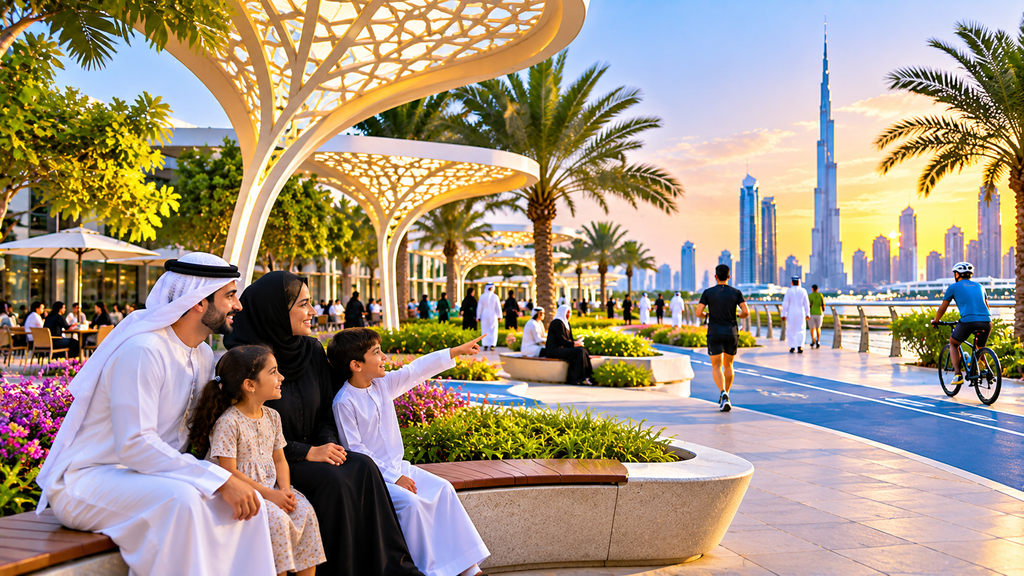
Qatar’s Urban Design Compendium identifies climate-responsive design, sustainable urbanism, and transit-oriented development as important planning principles.
These approaches can influence the quality of streets, public spaces, and neighbourhood environments.
In Oman, the Greater Muscat Structure Plan includes objectives involving parks, tree-lined walkways, and the use of wadis and beaches as natural public spaces.
Such strategies demonstrate that the evolution of Gulf public space extends beyond major international business centres.
4. Why Walkability, Climate Comfort, and Accessibility Matter
Walkability is becoming an important measure of urban quality.
However, creating walkable Gulf cities involves challenges that differ from those experienced in cooler climates.
High temperatures, strong sunlight, wide roads, and the distances between destinations can make walking uncomfortable or impractical during parts of the year.
Urban planners must therefore consider climate and connectivity together.
The Challenge of Extreme Heat
A pedestrian route may appear attractive but become difficult to use if it lacks sufficient shade.
Trees, building canopies, sheltered walkways, and appropriately designed rest areas can improve outdoor comfort.
Materials and landscape design also influence how surfaces absorb and release heat.
However, the effectiveness of individual cooling measures depends on local conditions, maintenance, and design.
Water features and cooling technologies may provide benefits in certain environments but can also introduce energy and water demands.
Designing for Everyday Mobility
Walkability involves more than constructing pavements.
People need safe, convenient routes connecting homes with schools, shops, healthcare facilities, parks, and public transport.
A pedestrian network interrupted by major roads or inaccessible intersections may discourage walking even when individual pathways are well maintained.
Important design priorities include:
- Continuous and obstacle-free pedestrian routes.
- Safe crossings with sufficient crossing time.
- Shade along frequently used walking corridors.
- Seating and drinking water where appropriate.
- Clear directional signs and accessible navigation.
- Connections with buses, metro stations, and cycling infrastructure.
- Lighting that supports safe evening use.
The Relationship Between Public Spaces and Public Transport
Accessible public transport can expand the number of residents able to use parks, cultural destinations, and recreational facilities.
Without reliable transport connections, attractive public spaces may remain difficult to reach for people who do not drive.
Transit-oriented development can help by placing services and public amenities near transport stations.
However, station access must also be comfortable and safe.
The final part of a journey, sometimes called last-mile connectivity, can determine whether residents choose public transport or private vehicles.
Climate-Responsive Design Strategies
| Design Challenge | Potential Response | Expected Benefit |
|---|---|---|
| Strong Sunlight | Trees, canopies, and shaded structures | Improved pedestrian comfort |
| High Surface Temperatures | Appropriate paving and vegetation | Reduced local heat exposure |
| Long Walking Distances | Connected neighbourhood services | More convenient daily journeys |
| Traffic Barriers | Safe crossings and continuous pathways | Improved pedestrian access |
| Limited Rest Areas | Seating, shelters, and public facilities | Greater usability for diverse ages |
| Water Constraints | Efficient irrigation and climate-suited planting | More sustainable landscape maintenance |
Climate-responsive public spaces require ongoing maintenance and careful resource management.
A development may perform well immediately after completion but become less comfortable if vegetation, shade structures, or public amenities are poorly maintained.
5. The Role of Public Spaces in Social Inclusion and Cultural Identity
Public spaces influence more than physical movement and recreation.
They also shape social relationships, cultural participation, and residents’ experiences of belonging.
Across multicultural Gulf cities, parks, markets, libraries, waterfronts, and community venues can provide opportunities for interaction between people from different backgrounds.
Creating Opportunities for Everyday Social Interaction
Neighbourhood parks allow people to spend time near others without requiring formal appointments or organised activities.
Children may interact through play, while adults encounter neighbours during walks, exercise, or community events.
These ordinary experiences can contribute to social familiarity and a sense of shared place.
However, opportunities for interaction depend on whether spaces feel welcoming and accessible.
A well-maintained park located far from public transport may be less useful to certain communities than a modest recreational area within walking distance.
Preserving Gulf Cultural Heritage
Modern public spaces can incorporate historical and cultural references without simply reproducing traditional architecture.
Heritage districts, markets, public art, and cultural programmes can help residents understand the history of their cities.
Traditional design features such as shaded courtyards and narrow pedestrian routes may also inform contemporary climate-responsive planning.
However, heritage preservation should involve careful historical research.
Using decorative elements without explaining their meaning may create an attractive setting without strengthening cultural understanding.
Public Spaces and Migrant Communities
Migrant communities form substantial parts of the resident population in several Gulf countries.
Their experiences should be considered when evaluating the inclusiveness of public environments.
Affordable recreation, multilingual information, transport connections, and accessible community facilities can make public spaces more useful to a wider range of residents.
Cultural events can also introduce audiences to different artistic traditions and encourage exchange.
The Difference Between Public and Commercial Space
Not every destination that welcomes visitors functions as an equally open public space.
Some privately managed developments permit general access but operate under commercial rules, opening hours, or event restrictions.
Shopping centres and entertainment complexes provide valuable amenities, but they may encourage spending as part of the visitor experience.
Publicly accessible parks and squares can offer alternatives where participation does not necessarily depend on purchasing goods or services.
Cities benefit from a variety of spaces with different functions.
The important issue is ensuring that free or affordable options remain available alongside commercial destinations.
6. Challenges Facing Inclusive Public Space Development Across the Gulf
Although contemporary urban plans increasingly emphasise sustainability and liveability, implementing these objectives involves practical challenges.
Rapid development, land values, climate conditions, maintenance costs, and different community needs can influence whether public spaces achieve their intended purposes.
Unequal Distribution of Urban Amenities
Major projects may attract attention because of their architectural scale and visibility.
However, neighbourhood-level access is equally important.
A city might develop a large destination park while residents in other districts continue to lack nearby recreational facilities.
Evaluating public space requires examining geographic distribution rather than counting only the total area of parks.
The Cost of Developing and Maintaining Public Spaces
Landscaping, lighting, accessibility features, irrigation, cleaning, and security all require continued investment.
In arid environments, maintaining vegetation can involve substantial water and operational requirements.
Design choices should therefore consider long-term environmental and financial sustainability.
Using appropriate plant species and efficient irrigation systems may reduce some maintenance demands.
Balancing Security With Openness
Public spaces require reasonable safety measures.
However, excessive restrictions can limit opportunities for informal gatherings, cultural activities, and everyday participation.
Planners and operators must balance safety requirements with the goal of creating welcoming public environments.
Rules should be communicated clearly and applied consistently.
Common Urban Planning Challenges
| Challenge | Potential Consequence | Planning Consideration |
|---|---|---|
| Unequal Park Distribution | Limited access in some neighbourhoods | Geographic accessibility assessments |
| Extreme Weather | Reduced outdoor use | Climate-responsive design |
| High Maintenance Costs | Deteriorating facilities | Long-term operational planning |
| Commercialisation | Reduced free recreational options | Publicly accessible non-commercial spaces |
| Car Dependency | Difficult access without vehicles | Transit and pedestrian integration |
| Limited Community Consultation | Facilities may not reflect actual needs | Resident participation |
| Accessibility Barriers | Exclusion of some users | Universal design standards |
Why Community Consultation Matters
Urban planning decisions are often influenced by technical studies, investment priorities, and design requirements.
However, residents possess practical knowledge about how their neighbourhoods function.
Families may identify unsafe crossings, while older residents may highlight the absence of seating or shade.
Community feedback can help planners understand needs that are not always visible through architectural drawings.
Consultation should include residents from different age groups, income levels, and accessibility backgrounds.
It should also continue after public spaces open so operators can respond to changing patterns of use.
7. The Future of Public Spaces in Gulf Cities: Designing for Everyone
The future of Gulf public spaces will depend on whether cities successfully connect ambitious urban development with everyday human needs.
Smart infrastructure, environmental technology, and new architectural concepts may improve urban environments.
However, a successful public space must remain usable, accessible, and meaningful to its community.
Moving Toward Human-Centred Urban Development
Human-centred design begins by examining how people experience streets, parks, and public facilities.
Instead of focusing only on visual appearance, planners consider movement, comfort, safety, accessibility, and social interaction.
This approach can help cities develop spaces that support different activities throughout the day.
A neighbourhood park, for example, may serve children in the afternoon, walkers in the evening, and community gatherings during suitable weather.
The Potential of Smart Urban Technology
Digital tools may help cities monitor environmental conditions, manage lighting, and understand patterns of public space usage.
Sensors could provide information about temperature, irrigation performance, or facility maintenance.
Digital mapping can help residents locate accessible routes and public amenities.
However, data collection should respect privacy and remain proportionate to its purpose.
Technology should support urban planning decisions rather than replace direct engagement with communities.
Measuring Public Space Success
The quality of public spaces cannot be assessed solely through architectural awards, visitor numbers, or construction budgets.
Useful indicators may include:
- The proportion of residents living within a convenient journey of public green space.
- Availability of safe pedestrian and cycling routes.
- Accessibility for people with disabilities.
- Thermal comfort during different seasons.
- Availability of free recreational facilities.
- Visitor satisfaction across different community groups.
- Environmental performance and maintenance quality.
- Participation in cultural and community activities.
These measures can help identify whether urban investments produce practical benefits.
A Checklist for More Inclusive Public Spaces
- Design for children, adults, older residents, and people with disabilities.
- Provide shaded walking routes and comfortable seating.
- Connect public amenities with reliable transport.
- Preserve meaningful elements of local cultural identity.
- Offer free or affordable opportunities for recreation.
- Use climate-appropriate landscaping and efficient irrigation.
- Provide clear information and accessible signage.
- Consult diverse community groups during planning.
- Establish long-term maintenance responsibilities.
- Evaluate actual usage and resident satisfaction.
The Importance of Neighbourhood-Level Investment
Large destination projects can contribute to tourism, economic activity, and international recognition.
However, everyday liveability often depends on smaller improvements.
A shaded pedestrian crossing, a safe local playground, or a public bench near a transport stop may significantly improve someone’s daily experience.
These changes are less visually dramatic than major architectural developments, but they can make urban environments more accessible and practical.
Conclusion
The evolution of public spaces across the Arabian Gulf reflects a wider shift in urban development priorities.
Cities once strongly associated with rapid construction and large-scale infrastructure are increasingly exploring walkability, green spaces, public transportation, and community-focused planning.
Initiatives in Dubai, Riyadh, Abu Dhabi, Doha, and Muscat illustrate different approaches to improving urban environments.
However, the success of public space development cannot be measured only through the scale of investment or the appearance of completed projects.
It must also consider whether children can play safely, older residents can walk comfortably, workers can access recreation, and people from diverse backgrounds can participate in public life.
Climate conditions, accessibility, affordability, and community engagement will remain essential considerations.
Ultimately, the question of who Gulf cities are being designed for should remain central to future urban planning.
Public spaces achieve their greatest value when they serve not only visitors, investors, or particular residential communities, but the wider population that depends on them.
A truly people-centred Gulf city is one where public life is not simply an architectural attraction, but an accessible and meaningful part of everyday experience.
Do follow us on Instagram
Read More – Can Local Language Technology Help Preserve Regional Arabic Dialects?