


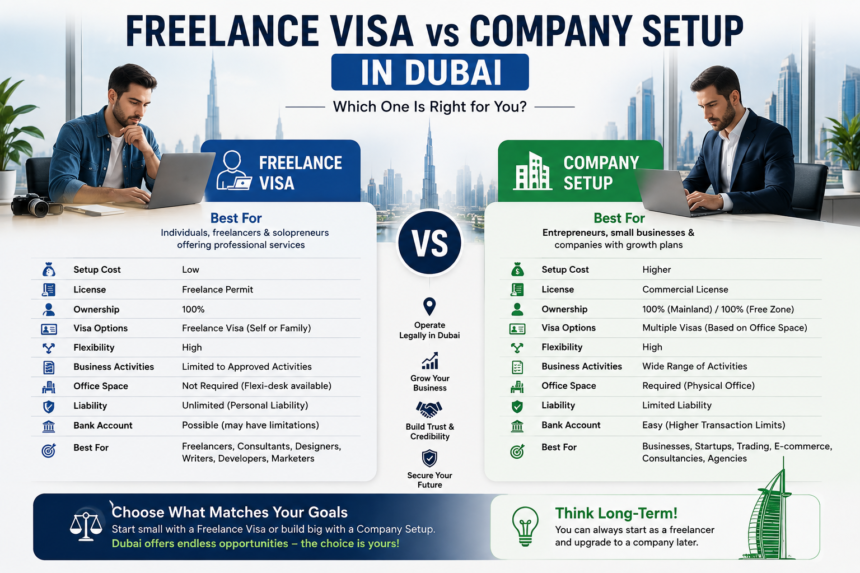
Freelance Visa vs Company Setup in Dubai: Which Option Is Right for You?
Dubai has become one of the world’s most attractive destinations for freelancers, entrepreneurs, startups, investors, and international businesses. With a strong digital economy, modern infrastructure, global connectivity, and access to international markets, the city offers several ways for professionals to legally establish themselves and work independently.
- Freelance Visa vs Company Setup in Dubai: Quick Comparison
- What Is a Freelance Visa in Dubai?
- Who Is a Dubai Freelance Visa Best For?
- What Is Company Setup in Dubai?
- Freelance Visa vs Company Setup in Dubai: Cost
- Freelance Costs
- Company Setup Costs
- Freelance Visa vs Company Setup: Business Activities
- Ownership: Freelance Visa vs Company Setup
- Visa Options
- Office Requirements
- Freelance Visa vs Company Setup for Bank Accounts
- Liability and Legal Structure
- Tax Considerations for Freelancers and Companies in Dubai
- Freelance Visa vs Company Setup: Advantages of Freelancing
- Disadvantages of a Freelance Visa
- Advantages of Company Setup in Dubai
- Disadvantages of Company Setup
- Which Is Better: Freelance Visa or Company Setup in Dubai?
- Choose a Freelance Route If:
- Choose Company Setup If:
- Freelance Visa vs Company Setup: What Should Startups Choose?
- Can You Move From Freelance to a Company Later?
- How to Decide Between Freelancing and Company Formation
- Final Checklist
- Frequently Asked Questions
For many people planning to move to Dubai, one important question comes up: Should I get a freelance visa or set up a company in Dubai?
The answer depends on your profession, business model, budget, long-term plans, need for employees or visas, and the type of clients you want to serve. A freelance route can be suitable for an individual professional who wants to provide services independently, while a company setup may be more appropriate for entrepreneurs who plan to build a larger business, hire employees, operate under a company name, or expand into multiple activities.
It is also important to understand that a “freelance visa” and a “company setup” are not exactly the same type of legal arrangement. A freelance route can involve a freelance permit or licence together with an appropriate residence status, while a company setup involves establishing a legal business entity and obtaining the relevant commercial, professional, or other licence.
This guide explains the Freelance Visa vs Company Setup in Dubai, including costs, ownership, visas, business activities, office requirements, banking, taxation, advantages, disadvantages, and which option may be better for different types of professionals and entrepreneurs.
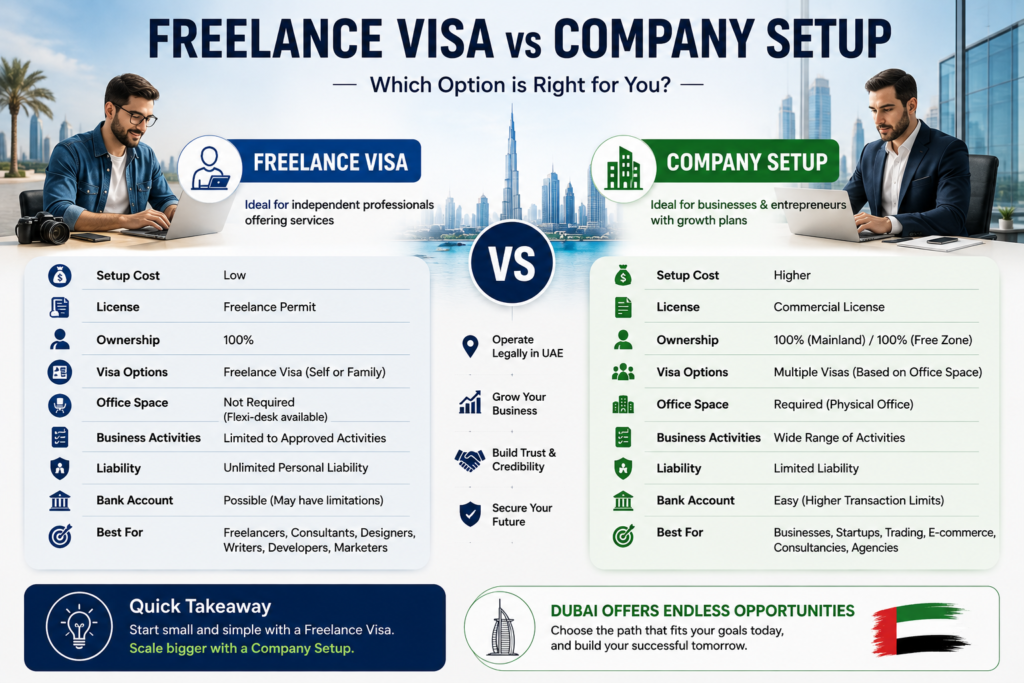
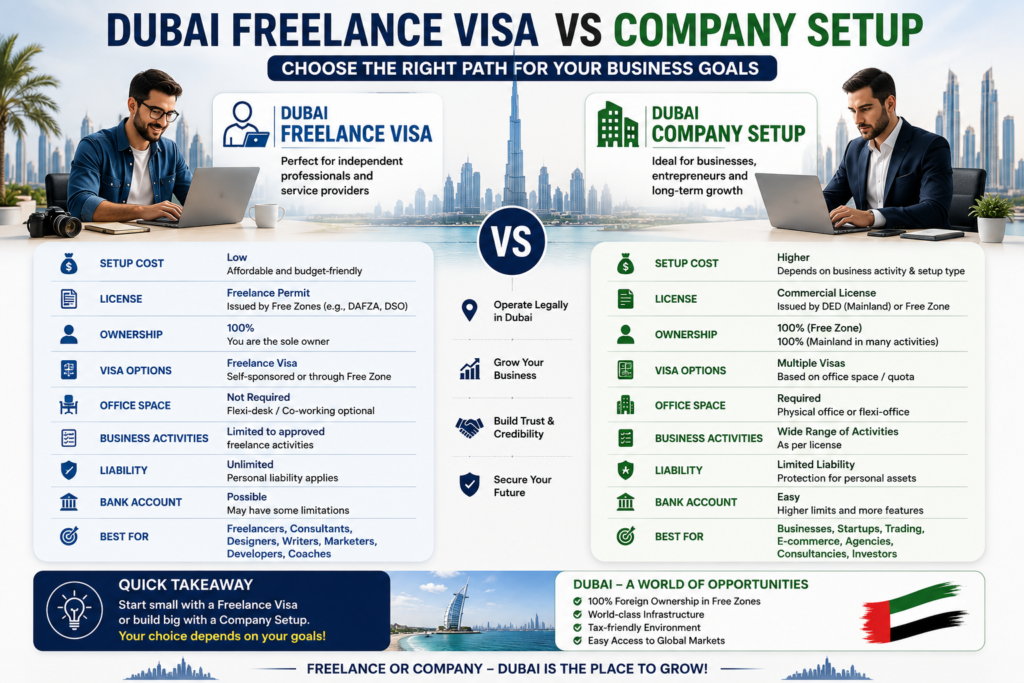
Freelance Visa vs Company Setup in Dubai: Quick Comparison
Before looking at the details, the following comparison provides a quick overview.
| Factor | Freelance Route | Company Setup |
|---|---|---|
| Best for | Independent professionals | Entrepreneurs and growing businesses |
| Setup complexity | Generally simpler | More structured |
| Business activities | Limited to approved freelance activities | Depends on the selected licence |
| Ownership | Individual | Company/shareholder structure |
| Employees | Generally not designed for building a workforce | Can support employee visas subject to rules |
| Office | May be possible with flexible workspace options depending on authority | Requirements vary by jurisdiction and activity |
| Banking | Business banking options depend on provider and profile | Corporate banking generally available |
| Scalability | Suitable for solo work | Better suited to expansion |
| Liability | Depends on the legal structure/permit | May provide limited liability where the chosen entity does |
| Branding | Personal/professional | Separate company identity |
| Long-term business growth | Suitable for individual services | Better for larger operations |
The exact rules, fees, visa quotas, and workspace requirements vary by free zone, mainland authority, business activity, and immigration route.
What Is a Freelance Visa in Dubai?
A Dubai freelance visa generally refers to a residence arrangement associated with a freelancer or self-employed professional, often supported by a freelance permit or licence issued through an authorised jurisdiction.
The important distinction is that the permit and residence status are separate concepts. A freelance permit authorises the individual to perform permitted freelance activities, while the residence visa allows the individual to legally reside in the UAE under the applicable immigration framework.
The UAE government also provides a Green Residence route for certain freelancers and self-employed people. The Green Residence is a renewable five-year residence option for eligible categories, including freelancers and self-employed individuals, subject to the applicable requirements.
The UAE’s labour regulations also recognise a freelance work permit for individuals who wish to undertake freelance work independently without being sponsored by an employer in the UAE and without an active employment contract.
Because there are different freelance and residence routes, applicants should check the exact requirements of the authority issuing their permit rather than assuming every “freelance visa” has identical conditions.
Who Is a Dubai Freelance Visa Best For?
A freelance route can be attractive for people who sell their own professional expertise rather than operating a large company.
Typical users may include:
- Graphic designers
- Writers and editors
- Photographers
- Digital marketers
- Social media professionals
- Web developers
- Software specialists
- Consultants
- Trainers
- Coaches
- Content creators
- Videographers
- Creative professionals
- Technology specialists
- Independent business professionals
For these individuals, a freelance structure may provide a relatively straightforward way to establish a professional presence without creating a larger corporate structure than necessary.
What Is Company Setup in Dubai?
Company setup in Dubai means establishing a legal business entity and obtaining a business licence that permits the company to conduct its approved activities.
Entrepreneurs can consider different routes, including mainland and free zone structures. The appropriate option depends on the nature of the business, target market, ownership, office requirements, regulatory approvals, and expansion plans.
The UAE government states that company formation generally begins with selecting the business activity and jurisdiction, determining the legal form and licence type, completing the required approvals, paying applicable fees, and receiving the business licence.
Dubai businesses may operate through structures suitable for:
- Trading
- Professional services
- Consultancy
- Technology
- E-commerce
- Marketing
- Manufacturing
- Import and export
- Logistics
- Education
- Hospitality
- Real estate-related activities
- Other approved commercial activities
Some activities require additional approvals from relevant government or regulatory authorities.
Freelance Visa vs Company Setup in Dubai: Cost
Cost is one of the biggest factors when comparing a freelance visa with a company setup.
There is no single fixed price for either option because the total cost depends on the authority, business activity, visa requirements, establishment fees, office or flexi-desk requirements, number of visas, and other services.
Freelance Costs
A freelance route may involve costs for:
- Freelance permit or licence
- Residence visa, where applicable
- Emirates ID
- Medical examination
- Health insurance
- Establishment or immigration-related charges
- Workspace or flexi-desk, where required
- Renewal fees
Because packages differ considerably, applicants should compare the complete package rather than looking only at the headline permit price.
Company Setup Costs
A company setup may involve:
- Trade or professional licence
- Initial approval
- Trade name registration
- Incorporation documents
- Memorandum of Association, where applicable
- Office or workspace
- Establishment card
- Residence visas
- Emirates ID
- Medical testing
- Immigration fees
- Additional activity approvals
- Accounting and compliance costs
- Banking-related expenses
A company can therefore have a higher initial and ongoing cost than a simple freelance arrangement, particularly if the business needs office space and multiple employee visas.
However, a higher setup cost does not necessarily mean a company is the wrong choice. If the business is expected to generate significant revenue, employ staff, sign larger contracts, or expand internationally, the additional structure may be worthwhile.
Freelance Visa vs Company Setup: Business Activities
Business activity is one of the most important differences.
A freelancer is generally limited to activities approved under the relevant freelance permit or licence. This works well if your business revolves around your own professional skills.
For example, a freelance digital marketer may provide marketing services to clients, while a freelance designer may provide graphic design services.
A company can potentially operate a broader business model depending on the licence and approved activities.
For example, a company may be structured for:
- Consulting
- Software development
- E-commerce
- Trading
- Marketing services
- Recruitment
- Professional services
- Import and export
- Manufacturing
- Agency activities
The exact activities allowed depend on the issuing authority and the relevant regulations.
Therefore, if you expect your business to expand beyond your personal professional service, company setup in Dubai may provide greater flexibility.
Ownership: Freelance Visa vs Company Setup
Ownership is another major consideration.
Under a freelance arrangement, the individual generally operates personally under the relevant permit.
With a company, ownership is structured through the legal entity. The UAE has significantly expanded foreign ownership opportunities. The UAE government states that foreign investors can own 100% of many mainland businesses, although strategic activities and certain regulated sectors can have specific requirements or restrictions.
Free zones also offer foreign ownership structures, subject to the rules of the relevant free zone and business activity.
This means entrepreneurs should not automatically assume that setting up a UAE company requires a local majority partner. The actual ownership rules should be checked for the specific activity and jurisdiction.
Visa Options
Visa requirements can differ substantially between freelancers and company owners.
A freelancer may obtain residence through an eligible freelance/self-employed route. The UAE’s Green Residence framework includes freelancers and self-employed individuals among eligible categories, subject to conditions.
A company owner or investor may obtain residence through an applicable investor, partner, or other residence route, depending on the company structure and immigration rules.
One major advantage of company formation is the potential to support residence applications for employees, partners, and dependents, subject to the company’s immigration quota, workspace requirements, and applicable regulations.
For a solo professional, one residence visa may be sufficient. For an entrepreneur planning to build a team, company formation can become more practical.
Office Requirements
Office requirements vary and should not be treated as identical across every Dubai business setup.
Some freelance or free zone packages may offer flexible workspace or flexi-desk solutions. Depending on the activity and authority, a freelancer may not need a traditional private office.
Companies can also have flexible workspace solutions in certain jurisdictions, while other activities or structures may require physical premises.
Office requirements can affect:
- Licence eligibility
- Number of employee visas
- Operating costs
- Business address
- Regulatory approvals
- Customer perception
Before choosing a setup, determine whether you need a private office, shared workspace, flexi-desk, warehouse, retail location, or another type of commercial premises.
Freelance Visa vs Company Setup for Bank Accounts
Opening a UAE bank account is another consideration.
Freelancers may be able to open suitable personal or business banking arrangements depending on their permit, residence status, bank policy, income profile, and documentation.
A company generally operates through a corporate bank account in the company’s name.
Corporate banking can be particularly useful for businesses that need:
- Multiple authorised users
- International transfers
- Supplier payments
- Payroll
- Merchant services
- Corporate cards
- Trade finance
- Larger transaction volumes
- Separate business accounting
Banks conduct their own compliance and KYC assessments, so having a company licence does not automatically guarantee corporate-account approval.
Liability and Legal Structure
Liability is an important issue that is sometimes overlooked when comparing a freelance route with company formation.
A freelancer operating personally may have a different liability position from an incorporated company. The protection available through a company depends on the legal entity and applicable law.
A properly structured company can provide a degree of separation between the business and its owners, particularly where a limited-liability structure applies.
However, limited liability is not an absolute shield. Personal guarantees, professional negligence, fraud, regulatory violations, or other circumstances can create personal exposure.
Anyone operating a high-risk business should obtain professional legal advice before choosing a structure.
Tax Considerations for Freelancers and Companies in Dubai
The UAE’s tax environment has changed significantly with the introduction of Corporate Tax.
The UAE Corporate Tax regime applies to businesses and certain individuals conducting business activities. The standard Corporate Tax rate is 0% on taxable income up to AED 375,000 and 9% on taxable income above AED 375,000, subject to the applicable rules.
Freelancers should not assume that having a freelance permit means they are automatically outside the Corporate Tax system.
The Federal Tax Authority states that a natural person conducting business in the UAE is generally required to register for Corporate Tax if revenue from business or business activities exceeds AED 1 million in a Gregorian calendar year, subject to the applicable rules.
Companies and other juridical persons have their own Corporate Tax registration and compliance obligations.
VAT may also become relevant. The UAE government states that mandatory VAT registration generally applies when taxable supplies and imports exceed AED 375,000, while voluntary registration may be available above AED 187,500, subject to the applicable conditions.
Tax treatment depends on individual circumstances, so freelancers and business owners should obtain professional tax advice where necessary.
Freelance Visa vs Company Setup: Advantages of Freelancing
A freelance route can offer several advantages to independent professionals.
Lower complexity: A freelancer may have fewer structural requirements than an entrepreneur establishing a full company.
Suitable for solo professionals: If you personally deliver the services and do not need employees, freelancing can be a practical model.
Flexible working model: Many freelance professionals can work remotely or from flexible workspaces, depending on their permit and activity.
Lower overhead: A freelancer may avoid some of the costs associated with larger offices, employee visas, and corporate infrastructure.
Faster start: The process can be simpler when compared with establishing a more complex business entity, although processing times vary by authority.
Personal brand development: Freelancing allows professionals to build a reputation around their own name and expertise.
Disadvantages of a Freelance Visa
Freelancing is not ideal for everyone.
Potential limitations include:
- Restricted business activities
- Less suitable for employing a large team
- Potential banking limitations depending on profile
- Less separation between individual and business
- Possible restrictions on business expansion
- Permit renewal requirements
- Dependence on personal professional capacity
- Less suitable for businesses that need multiple shareholders
If your goal is to create a scalable agency, trading business, technology company, or larger enterprise, these limitations may become increasingly important.
Advantages of Company Setup in Dubai
Company formation provides several benefits for entrepreneurs.
Scalability: A company structure is generally better suited to growing revenue, staff, operations, and market reach.
Multiple employees: Companies can potentially sponsor employees subject to immigration quotas and applicable requirements.
Broader business activities: A company can select appropriate licensed activities based on its business model.
Corporate identity: Operating under a company name can create a stronger commercial identity for certain types of businesses.
Business banking: Corporate structures can be suitable for companies requiring dedicated business banking and financial services.
Investment opportunities: A company structure may be more appropriate if you plan to bring in partners, investors, or shareholders.
Long-term expansion: Entrepreneurs planning to establish an agency, trading company, e-commerce operation, technology business, or other scalable enterprise may find company formation more suitable.
Disadvantages of Company Setup
Company formation also comes with additional responsibilities.
These can include:
- Higher initial setup costs
- Annual licence renewal
- Accounting requirements
- Corporate compliance
- Office or workspace costs
- Employee administration
- Visa costs
- Tax compliance
- Corporate banking requirements
- Additional regulatory approvals for certain activities
For someone who only needs to provide professional services independently, these additional responsibilities may not be necessary.
Which Is Better: Freelance Visa or Company Setup in Dubai?
There is no universal answer.
The right choice depends on your goals.
Choose a Freelance Route If:
A freelance arrangement may be suitable if:
- You work independently
- You sell professional services
- You do not need many employees
- Your business activity fits an approved freelance category
- You want to keep overhead relatively low
- You value flexibility
- You are building a personal brand
- You do not require a complex corporate structure
Freelancing can be an excellent starting point for designers, writers, consultants, developers, marketers, photographers, coaches, and other independent professionals.
Choose Company Setup If:
A company structure may be better if:
- You plan to hire employees
- You want to build an agency
- You need multiple business activities
- You plan to sell products
- You operate e-commerce
- You require corporate banking
- You want to bring in business partners
- You expect significant business growth
- You need a separate corporate identity
- You want to build a long-term company
Freelance Visa vs Company Setup: What Should Startups Choose?
Startups should consider their expected business model rather than simply selecting the cheapest option.
For example, imagine a software developer who wants to work independently with five clients. A freelance structure may provide everything needed.
Now consider an entrepreneur launching a software company with ten employees, outside investors, multiple customers, and plans to expand across the GCC. A company setup is likely to be more appropriate.
Similarly, a marketing professional starting alone may begin with freelancing and later establish a company when the business develops employees, larger contracts, and additional services.
The important point is that your initial structure should match your current needs while leaving room for future growth.
Can You Move From Freelance to a Company Later?
In many situations, entrepreneurs can transition from an individual freelance arrangement to a company structure when their business grows, subject to the applicable authority and immigration requirements.
A common growth path can look like this:
Stage 1: Start as an independent freelancer.
Stage 2: Build a customer base and establish recurring revenue.
Stage 3: Expand your service offering.
Stage 4: Establish a company when additional employees, partners, activities, or corporate infrastructure become necessary.
This approach can allow a professional to avoid paying for a larger business structure before it is actually needed.
However, the correct transition process depends on the authority, existing permit, company structure, and immigration status.
How to Decide Between Freelancing and Company Formation
Before making a decision, ask yourself these questions:
1. What exactly will I sell?
If you are selling your personal skills, freelancing may be suitable. If you are building a broader commercial operation, consider a company.
2. Will I hire employees?
If you plan to employ several people, company formation may be more practical.
3. Do I need investors or partners?
If yes, a formal company structure may be more appropriate.
4. Do I need a corporate bank account?
If your business will have substantial business transactions, supplier payments, payroll, or international operations, corporate banking may be important.
5. What is my expected revenue?
A small solo consultancy and a high-growth company have very different structural requirements.
6. Will my business activity expand?
If you expect to add products, services, trading activities, or other operations, check whether a freelance permit can accommodate those activities.
7. Where are my customers?
If you plan to serve customers across Dubai, the UAE, and international markets, consider how the chosen structure supports your contracts, payments, licensing, and operations.
Final Checklist
Before choosing between a Dubai freelance visa and company setup, consider:
- Business activity
- Freelance permit eligibility
- Company licence requirements
- Mainland or free zone
- Initial setup cost
- Annual renewal cost
- Residence visa requirements
- Family sponsorship needs
- Employee visa requirements
- Office requirements
- Business banking
- Liability
- Tax obligations
- VAT requirements
- Future expansion
- Investors or business partners
- International transactions
- Required regulatory approvals
Frequently Asked Questions
Q1. Is a freelance visa cheaper than company setup in Dubai?
Ans: A freelance route is often designed for individuals and may have lower overall overhead than a full company setup, but the actual cost depends on the issuing authority, permit, residence status, insurance, workspace, and other fees. Company setup costs vary according to jurisdiction, activity, office requirements, visas, and other services.
Q2. Can freelancers legally work in Dubai?
Ans: Individuals must use an appropriate legal route that authorises their freelance activity and residence/work status. The UAE recognises a freelance work permit for individuals who wish to undertake freelance work independently under the applicable conditions.
Q3. Can a freelancer sponsor family members?
Ans: Family sponsorship depends on the individual’s residence status, income, housing, and other applicable conditions. Certain long-term residence routes, including the Green Residence, provide eligible holders with the ability to sponsor family members subject to the rules.
Q4. Is 100% foreign ownership available in Dubai?
Ans: Foreign investors can own 100% of many UAE mainland businesses, although strategic activities and certain regulated sectors may have specific restrictions or approval requirements.
Q5. Does a company need an office in Dubai?
Ans: Office requirements depend on the jurisdiction, business activity, and licence type. Some structures may offer flexible workspace options, while other activities require dedicated premises.
Q6. Do freelancers pay Corporate Tax in the UAE?
Ans: Potentially. The UAE Corporate Tax rules can apply to natural persons conducting business when the relevant conditions are met. The FTA states that a natural person conducting business generally needs to register when business revenue exceeds AED 1 million in a calendar year, subject to the applicable rules.
Q7. Is company setup better for long-term business growth?
Ans: For entrepreneurs planning to hire employees, add partners, expand activities, operate under a corporate identity, or build a larger business, company setup is often more suitable. However, the best structure depends on the business model and licensing requirements.
Conclusion
The decision between a Freelance Visa vs Company Setup in Dubai ultimately comes down to the type of professional or business you want to build.
If you are an independent designer, consultant, developer, writer, marketer, photographer, coach, or other professional who primarily sells your own expertise, a freelance route can offer flexibility and a simpler operating model.
If you are planning to build an agency, hire employees, bring in partners, sell products, operate an e-commerce business, or create a scalable enterprise, a company setup may provide a stronger long-term foundation.
Dubai offers multiple business structures, and the right choice should be based on your business activity, budget, visa requirements, customer base, office needs, banking requirements, and growth plans. The UAE also permits 100% foreign ownership for many businesses, while freelancers and self-employed professionals have dedicated residence and work routes under applicable conditions.
Most importantly, do not choose a structure solely because it appears cheaper. A low-cost freelance setup may be ideal for a solo professional but unsuitable for a business that needs employees, investors, corporate banking, or multiple activities. Likewise, establishing a full company may create unnecessary costs for someone who only needs to provide a limited professional service independently.
The best approach is to start with your business model, identify the activities you need to perform legally, compare the available Dubai and UAE licensing options, and then select the structure that supports both your current needs and your future growth.
Do follow us on Instagram
Read More – Business Setup Cost in Dubai