


Why Electric Vehicles Are Growing Across the Gulf
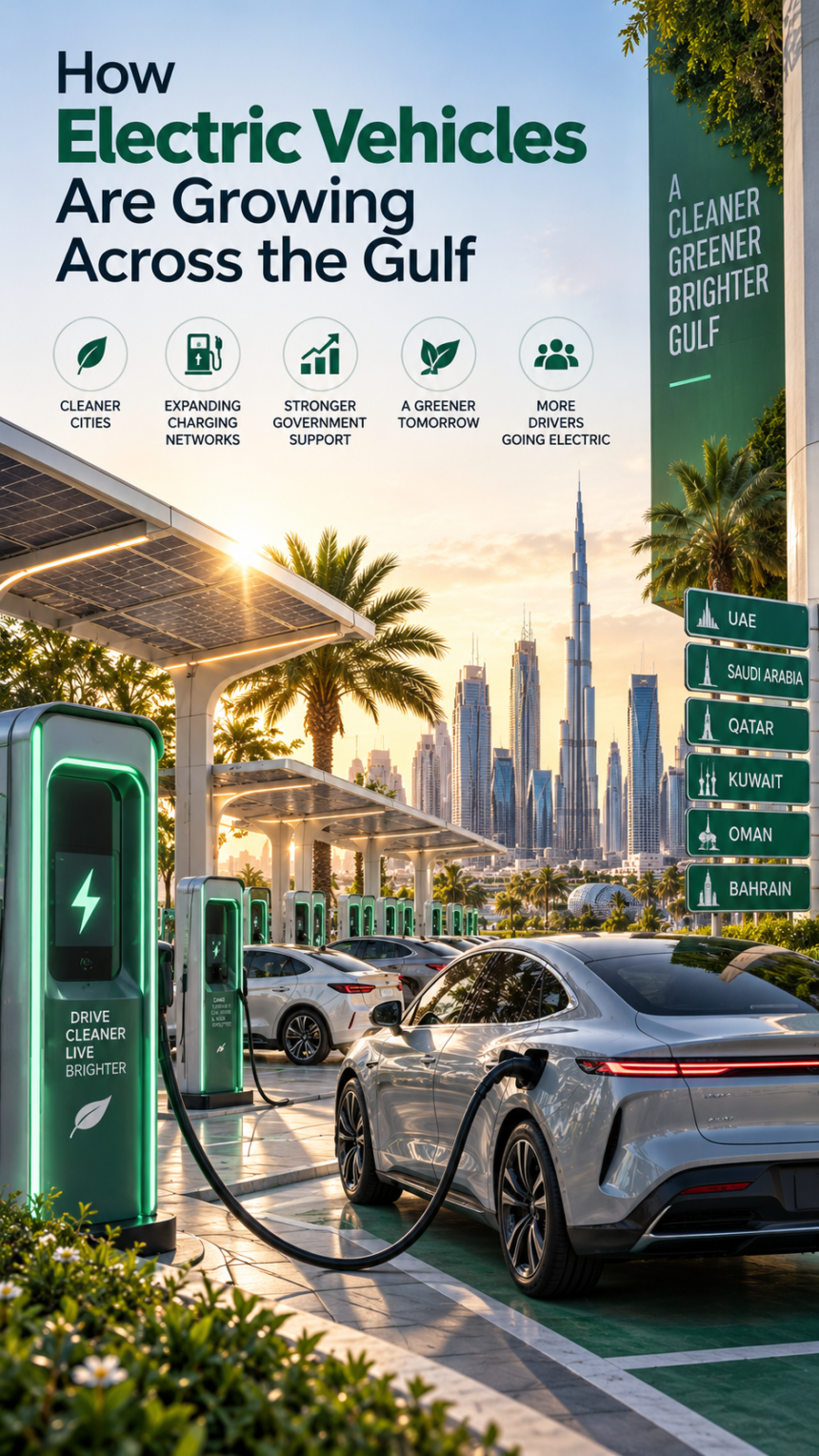
Electric vehicles across the Gulf are moving from a relatively small market into an increasingly important part of the region’s transportation future. New charging networks, wider vehicle choice, government policies and investment in clean mobility are making electric cars more practical for drivers in the UAE, Saudi Arabia, Qatar, Oman, Bahrain and Kuwait.
- Why Electric Vehicles Are Growing Across the Gulf
- The UAE Is Leading Gulf EV Adoption
- Dubai’s Charging Network Is Expanding Rapidly
- A Nationwide UAE Charging Network Is Emerging
- Saudi Arabia Is Building an Entire EV Industry
- Saudi Arabia Is Expanding Fast-Charging Infrastructure
- Qatar Is Electrifying Public Transport
- Oman Is Seeing Rapid EV Growth
- Bahrain Is Making EV Charging Easier to Find
- Kuwait Is Developing the Foundations for EV Growth
- More EV Brands Are Increasing Consumer Choice
- Chinese EV Brands Are Changing the Gulf Market
- Gulf Weather Creates a Unique EV Challenge
- Charging at Home Could Determine EV Convenience
- Electric Taxis and Commercial Fleets Could Accelerate Adoption
- EVs Could Become Part of the Gulf’s Smart Energy System
- What Is Still Slowing EV Adoption?
- How EV Growth Could Change Gulf Economies
- How the Six GCC Countries Compare
- What the Next Stage of Gulf EV Growth Could Look Like
- Electric Vehicles Across the Gulf Are Moving Into the Mainstream
The change is particularly visible in major Gulf cities. Electric cars are becoming more common on the roads, chargers are appearing at shopping centres, offices, residential developments and service stations, while governments are increasingly electrifying buses and other public fleets.
The UAE has developed one of the region’s most mature EV markets. Saudi Arabia is combining electric vehicle adoption with plans to build a domestic automotive manufacturing industry. Qatar is focusing heavily on electrifying public transportation, while Oman has recorded rapid growth in registered electric vehicles. Bahrain and Kuwait are also developing regulations and charging infrastructure that could support wider adoption.
This does not mean petrol-powered vehicles will disappear quickly. Fuel remains relatively affordable in several Gulf markets, driving distances can be long and charging availability still differs significantly between countries. However, the direction of travel is becoming clearer.
Electric mobility is becoming part of a much larger transformation in the way the Gulf thinks about transportation, energy and industrial development.
Why Electric Vehicles Are Growing Across the Gulf
Several factors are driving the expansion of electric mobility across GCC countries.
The first is sustainability. Every GCC economy is exploring ways to reduce emissions while developing new industries and technologies. Transportation is an important part of that transition because road vehicles have traditionally depended heavily on petrol and diesel.
The second factor is consumer choice. Gulf buyers now have access to significantly more electric vehicles than they did only a few years ago. Luxury EVs were among the first to receive attention, but the market is expanding to include family SUVs, sedans, commercial vehicles and more affordable models.
Charging infrastructure is developing at the same time.
| Growth Driver | Why It Matters |
|---|---|
| More EV models | Drivers have more choices across different price ranges |
| Fast charging | Longer journeys become more practical |
| Government policies | Regulations and targets provide long-term direction |
| Electric public transport | EV technology becomes visible in everyday life |
| Local manufacturing | Creates jobs and develops automotive industries |
| Smart city projects | EVs can connect with wider digital transport systems |
| Renewable energy growth | Cleaner electricity can increase the environmental benefits of EVs |
| Private investment | More companies can build and operate charging networks |
Electric mobility therefore extends beyond replacing a petrol engine with a battery. It is creating new opportunities in charging, energy management, software, battery services, manufacturing and logistics.
The UAE Is Leading Gulf EV Adoption
The UAE has developed one of the clearest examples of rapid EV growth in the region.
In May 2026, the UAE Ministry of Energy and Infrastructure said the country ranked first in the Middle East for electric vehicle sales for the second consecutive year. According to the ministry, citing the International Energy Agency’s Global EV Outlook 2026, the UAE accounted for nearly half of EV sales across the region.
This growth is supported by the UAE’s National Electric Vehicles Policy, which aims to expand EV use, develop charging infrastructure and create consistent standards across the country. The government’s longer-term objective is for electric vehicles to represent 50 percent of vehicles on UAE roads by 2050.
Dubai provides an especially clear picture of how quickly the market is developing. DEWA reported that the number of electric vehicles registered in Dubai reached 47,944 by the end of 2025, compared with 37,486 a year earlier. That represented annual growth of almost 28 percent.
Growth at this pace creates another requirement: charging infrastructure must expand just as quickly.
Dubai’s Charging Network Is Expanding Rapidly
One of the biggest concerns for potential EV owners is whether charging will be available when and where they need it.
Dubai has spent more than a decade developing its charging network through DEWA’s EV Green Charger initiative. The programme began in 2014 and has expanded alongside the city’s electric vehicle population.
By the first quarter of 2026, Dubai had reached 2,223 EV charging points, according to DEWA.
The pace of expansion shows how infrastructure is beginning to catch up with demand.
EV chargers are increasingly being installed not only by electricity authorities but also through partnerships with private companies, fuel station operators, car park operators, property developers and fleet businesses.
DEWA has also created a regulatory framework allowing independent charge point operators to participate in the market. This can help turn charging into a competitive infrastructure industry rather than something provided entirely by government entities.
For drivers, greater competition could eventually mean more charging locations, improved reliability and a wider range of charging speeds.
A Nationwide UAE Charging Network Is Emerging
EV development in the UAE is not limited to Dubai.
The federal government created UAEV as a joint venture between the Ministry of Energy and Infrastructure and Etihad Water and Electricity to develop accessible fast-charging infrastructure across the country.
The objective is important because EV ownership becomes much more useful when drivers can confidently travel between emirates.
Urban charging is only one piece of the puzzle. Long-distance routes need fast chargers located at suitable intervals so drivers can travel between Abu Dhabi, Dubai, Sharjah, Ras Al Khaimah, Fujairah and other areas without worrying about battery range.
A national charging network can also create greater consistency in technical standards, pricing and user experience.
For residents living in apartments, public charging will remain particularly important because installing a private charger may not always be possible.
The next stage of UAE EV growth is therefore likely to involve not simply adding more chargers but improving their location, charging speed, reliability and integration with digital payment systems.
Saudi Arabia Is Building an Entire EV Industry
Saudi Arabia’s electric vehicle strategy is different from simply encouraging people to buy imported electric cars.
The Kingdom is developing a domestic automotive ecosystem that includes vehicle production, charging infrastructure, technology, suppliers and manufacturing.
One of the centrepieces is Ceer, Saudi Arabia’s first national electric vehicle brand. The company is a joint venture involving the Public Investment Fund and Foxconn and uses licensed component technology from BMW. Ceer plans to design and manufacture electric vehicles for Saudi Arabia and the wider GCC market.
Saudi Arabia has also invested heavily in Lucid Motors.
Lucid opened its first international manufacturing facility in King Abdullah Economic City in 2023. Saudi Arabia’s wider automotive strategy also includes suppliers and manufacturing projects intended to establish a larger local industry rather than simply an EV sales market.
This gives the Kingdom an additional reason to encourage electric mobility.
EV adoption can support industrial diversification, technology transfer, local employment and manufacturing alongside environmental goals.
Saudi Arabia Is Expanding Fast-Charging Infrastructure
Manufacturing electric vehicles is only useful if drivers have reliable places to charge them.
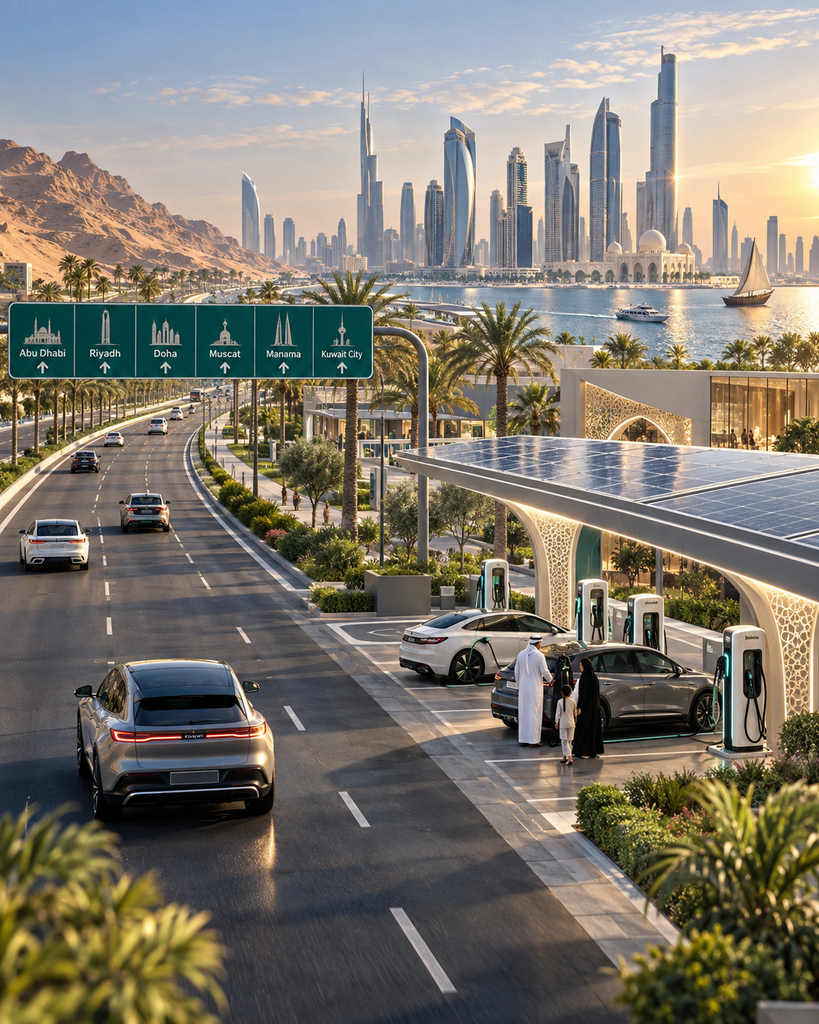
Saudi Arabia is addressing this through EVIQ, the Electric Vehicle Infrastructure Company established as a joint venture between the Public Investment Fund and Saudi Electricity Company.
EVIQ plans to deploy more than 5,000 fast chargers in more than 1,000 locations across the Kingdom by 2030.
Its current network continues to expand across Saudi cities, with EVIQ reporting operations across multiple cities and dozens of charging locations.
This infrastructure is particularly important because Saudi Arabia is geographically much larger than many other GCC countries.
An EV used only for urban commuting in Riyadh or Jeddah may be easy to charge. Long-distance travel between cities requires something different: reliable fast chargers positioned along highways and major transport corridors.
Building that network is therefore essential if electric vehicles are eventually expected to become a practical choice beyond major metropolitan areas.
Qatar Is Electrifying Public Transport
Qatar’s transition provides an interesting contrast to markets where private passenger EVs receive most of the attention.
The country has concentrated heavily on electric public transport.
Qatar’s Ministry of Transport reported in its 2025-2030 strategy that 73 percent of the country’s public buses were already electric, with a target to reach 100 percent electrification by 2030.
The country began testing electric buses years earlier and significantly expanded the fleet around the 2022 FIFA World Cup. Qatar’s Electric Bus Transition Plan includes the gradual conversion of public and school buses, supported by electric bus depots and charging infrastructure.
This approach matters because electrifying one bus can potentially replace far more fossil-fuel kilometres than replacing one privately owned vehicle.
Public transportation vehicles often operate for many hours every day and follow predictable routes. That can make charging requirements easier to plan.
Electric buses also introduce thousands of passengers to electric mobility without requiring them to own an electric car themselves.
Oman Is Seeing Rapid EV Growth
Oman’s electric vehicle market remains smaller than some neighbouring markets, but recent figures show rapid development.
The Ministry of Transport, Communications and Information Technology said the number of EVs in Oman exceeded 5,800 by the end of the first quarter of 2026. The ministry also announced plans to install 350 electric charging points by 2027.
The pace becomes clearer when compared with earlier data. Oman reported more than 1,500 registered electric vehicles and over 150 chargers by the end of 2024.
This means the country’s EV ecosystem has moved quickly from an early-adoption stage toward a more visible market.
Oman’s green mobility plans are connected with its goal of achieving net-zero emissions by 2050. The strategy includes support for electric and hydrogen vehicles, charging infrastructure and lower-emission transport systems.
Oman also presents an interesting test for electric mobility because drivers often travel significant distances between cities and regions.
Developing highway charging corridors will therefore be just as important as providing chargers in Muscat and other urban centres.
Bahrain Is Making EV Charging Easier to Find
Bahrain’s smaller geographic size creates a different environment for electric vehicles.
Distances between major population centres are relatively short, which can reduce some of the range concerns found in much larger countries.
The government has been gradually developing charging infrastructure while also making it easier for users to locate available chargers.
Bahrain’s National Portal now provides access to an EV Charging Station Locator in partnership with goEV.bh. The platform is designed to provide information including station locations, charger availability and connector details.
The Electricity and Water Authority has also supported fast-charging development, including projects to install high-speed charging stations across the Kingdom.
Digital services can play an important role in increasing EV confidence. Drivers need to know not only that chargers exist but whether they are operational, compatible with their vehicle and available before they arrive.
As EV adoption increases, real-time charger information could become just as important as the number of chargers themselves.
Kuwait Is Developing the Foundations for EV Growth
Kuwait’s EV transition has progressed more gradually, but important building blocks are appearing.
The Ministry of Electricity, Water and Renewable Energy provides formal services for EV charger approvals and applications to increase electrical connections for charging equipment.
Kuwait has also established technical requirements covering electric vehicles through national standards.
These regulations may sound less visible than opening hundreds of charging stations, but they are an important part of preparing the market.
Before a charging ecosystem can expand rapidly, authorities need rules for electrical capacity, charger installation, safety and technical compatibility.
Private-sector charging investment is also beginning to grow, suggesting that Kuwait’s EV infrastructure could expand more noticeably as commercial demand increases.
One of Kuwait’s challenges will be convincing drivers to switch when conventional fuel remains relatively affordable. This means factors such as vehicle technology, performance, convenience and ownership experience may be as important as fuel savings.
More EV Brands Are Increasing Consumer Choice
One major reason EV adoption is becoming easier across the Gulf is the rapidly expanding variety of vehicles.
Earlier electric vehicle markets were concentrated around a relatively small number of premium models. Today, buyers can choose from a much broader selection.
European, American, Korean and increasingly Chinese manufacturers are introducing electric vehicles across GCC markets.
This competition matters because Gulf buyers do not all want the same type of vehicle.
Large SUVs remain extremely popular. Families need spacious vehicles capable of handling highways and long journeys. Business users may prioritise cost and reliability, while premium buyers may focus on performance and technology.
As manufacturers introduce more body styles and price categories, electric mobility becomes relevant to a wider customer base.
Competition can also encourage better battery range, faster charging, improved warranties and more attractive prices.
Chinese EV Brands Are Changing the Gulf Market
The rise of Chinese automotive companies is particularly important for the next stage of EV adoption.
China has developed one of the world’s largest EV industries, and several Chinese manufacturers are expanding rapidly into Gulf markets.
Their presence is increasing competition in areas including battery range, vehicle software, interior technology and price.
For Gulf consumers, this creates more choice between established global manufacturers and newer brands.
However, buyers are also likely to pay close attention to after-sales service, spare parts availability, resale value and long-term battery support.
These considerations could become increasingly important as the market matures.
Selling an EV is only the beginning. Manufacturers that build strong service networks and provide clear battery warranties may be better positioned to develop long-term customer confidence.
Gulf Weather Creates a Unique EV Challenge
Electric vehicles in the GCC must operate in some of the world’s most demanding climatic conditions.
Summer temperatures can exceed 45°C in parts of the region. Air-conditioning may run continuously, while batteries and charging equipment must operate under intense heat.
Modern EVs use thermal management systems designed to maintain battery temperature, but extreme heat can still affect efficiency and charging behaviour.
This makes Gulf-specific testing particularly important.
Charging stations also need to withstand high temperatures, dust and prolonged outdoor exposure.
Saudi Arabia’s EVIQ has established an R&D facility for testing chargers and related software, including suitability for operating conditions in the Kingdom.
As the market expands, manufacturers that can demonstrate reliable performance under Gulf conditions may gain an advantage.
Consumers will increasingly want real-world information about summer range rather than relying only on laboratory estimates.
Charging at Home Could Determine EV Convenience
Public fast chargers receive much of the attention, but home charging may be even more important for everyday EV ownership.
A driver who can plug a vehicle in overnight may rarely need to visit a public charging station during normal commuting.
For villa residents, installing a charger can be relatively straightforward where electrical capacity and local regulations allow it.
Apartment living creates a more complicated challenge.
Buildings need designated parking spaces, electricity connections, metering systems and management approval. Older residential buildings may not have been designed for multiple vehicles charging simultaneously.
This means property developers could become an important part of the EV transition.
New residential projects may increasingly treat EV charging in the same way they already treat parking, security and other essential infrastructure.
Office buildings, hotels, shopping centres and mixed-use developments could follow the same direction.
Electric Taxis and Commercial Fleets Could Accelerate Adoption
Private cars are only one part of electric mobility.
Taxis, delivery vehicles, corporate fleets and government vehicles could have an even larger effect on total electric kilometres travelled.
Fleet vehicles are well suited to electrification because their daily routes and operating patterns can often be predicted.
A company can install chargers at a depot, schedule charging during quieter periods and monitor energy consumption centrally.
Dubai’s charging expansion already includes partnerships involving taxi operations and ultra-fast charging infrastructure. DEWA has announced plans with Dubai Taxi Company for 208 ultra-fast charge points over the duration of their agreement.
Delivery companies are another potential area of growth.
Electric motorcycles and small commercial EVs can be particularly suitable for short-distance urban deliveries where vehicles return regularly to central facilities.
Oman has already supported pilot projects involving electric motorcycles for delivery services.
EVs Could Become Part of the Gulf’s Smart Energy System
The relationship between electric vehicles and the electricity grid is likely to become more sophisticated.
At the simplest level, millions of EVs would create additional electricity demand. If thousands of cars begin fast charging at the same time, utilities need enough generation and grid capacity to handle the load.
Smart charging can help solve this problem.
Vehicles could be encouraged to charge during periods when electricity demand is lower. Charging speeds could also adjust automatically based on grid conditions.
An even more advanced development is vehicle-to-grid technology.
Compatible EVs can theoretically store electricity and later return some of that energy to the grid. DEWA has highlighted vehicle-to-grid technology as an emerging part of the future charging ecosystem.
In this model, an electric car becomes more than a vehicle. Its battery can become a small mobile energy storage system.
The technology is still developing, but it could become increasingly relevant as Gulf countries add more renewable electricity.
What Is Still Slowing EV Adoption?
Despite rapid progress, several barriers remain.
Charging availability: Infrastructure is growing quickly, but coverage remains uneven between countries and between major cities and remote areas.
Apartment charging: Residents without private parking or dedicated chargers may find EV ownership less convenient.
Purchase price: Some electric models still cost more initially than comparable petrol vehicles, although the difference varies significantly by brand.
Resale value: Buyers are still learning how battery age and technology changes affect second-hand EV prices.
Heat performance: Gulf drivers want confidence that batteries, air-conditioning and charging systems will perform reliably during extreme summers.
Repair networks: EVs require technicians trained in high-voltage electrical systems and battery technology.
Long-distance travel: Drivers need reliable fast-charging stations along highways, not only inside cities.
These barriers are important, but many are infrastructure and market-development problems rather than permanent technical limitations.
As adoption increases, businesses have stronger incentives to solve them.
How EV Growth Could Change Gulf Economies
The economic impact of electric vehicles goes beyond car dealerships.
EV growth creates demand for electricians, software developers, charger manufacturers, technicians, battery specialists, energy companies and automotive engineers.
Saudi Arabia is pursuing perhaps the clearest example by connecting EV development directly with industrial policy.
Ceer, Lucid and the wider King Salman Automotive Cluster are intended to contribute to domestic manufacturing and supply-chain development.
Other Gulf markets could develop specialised industries around charging, battery recycling, fleet management and smart energy systems.
The UAE, for example, is working on battery recycling as part of its broader green mobility plans.
As millions of vehicles eventually move toward electrification, these supporting industries could become substantial markets of their own.
How the Six GCC Countries Compare
The electric mobility transition is occurring at different speeds across the Gulf.
| GCC Country | Current EV Direction |
|---|---|
| UAE | Strong private EV adoption, national charging expansion and clear long-term targets |
| Saudi Arabia | EV manufacturing, nationwide fast charging and automotive industry development |
| Qatar | Strong focus on electric buses and public transport |
| Oman | Rapid rise in registered EVs and expanding charging infrastructure |
| Bahrain | Growing fast-charging network and digital charger-location services |
| Kuwait | Developing technical regulations, charging approvals and private infrastructure |
No single model is being followed across the GCC.
Some countries are prioritising private electric cars. Others are focusing more heavily on buses or industrial development.
Together, these approaches are gradually creating a regional electric mobility ecosystem.
What the Next Stage of Gulf EV Growth Could Look Like
The next few years could look very different from the early phase of EV adoption.
Charging stations are likely to become much more common at fuel stations, shopping malls, hotels, workplaces and residential buildings. Fast charging should make intercity EV journeys increasingly convenient.
More affordable vehicles may bring electric mobility to a wider group of consumers.
Government and corporate fleets can create steady demand, while electric taxis and delivery vehicles could dramatically increase the number of kilometres travelled without petrol.
Local manufacturing may also become more important.
Saudi Arabia is already building an automotive industry around future mobility, while Qatar’s transport strategy includes domestic electric bus capabilities.
Digital services will develop alongside physical infrastructure. Drivers will increasingly expect mobile applications that identify available chargers, show prices, process payments and recommend charging stops automatically.
Eventually, choosing an EV may require much less lifestyle adjustment than it does today.
Electric Vehicles Across the Gulf Are Moving Into the Mainstream
The growth of electric vehicles across the Gulf is no longer based only on environmental ambition or futuristic concepts.
Real infrastructure is being built. More vehicles are being registered. Public bus fleets are becoming electric. Charging companies are expanding, and automotive manufacturing is emerging as a new Gulf industry.
The UAE has become a major regional EV market, with Dubai alone approaching 48,000 electric vehicles by the end of 2025 and continuing to expand its charging network. Saudi Arabia is building thousands of planned fast chargers while developing domestic EV manufacturing. Qatar aims to make its public bus fleet fully electric by 2030, and Oman has already recorded rapid growth in its EV population.
Bahrain and Kuwait are building the regulatory and infrastructure foundations needed for wider adoption.
Challenges remain, particularly around charging access, extreme temperatures, resale value and long-distance travel. But these are increasingly becoming problems for governments and businesses to solve rather than reasons for the transition to stop.
The Gulf’s transport system was built during the age of oil-powered mobility. The next stage is likely to be much more diverse.
Petrol vehicles will remain part of Gulf roads for years, but electric cars, buses, taxis and commercial fleets are becoming a larger part of everyday transportation.
The important question is therefore changing. It is becoming less about whether electric vehicles will grow across the Gulf and more about how quickly charging networks, consumers, manufacturers and cities can adapt to that growth.
Do follow us on Instagram
Read More – Future of GCC Transportation: How Mobility Is Changing Across the Gulf