



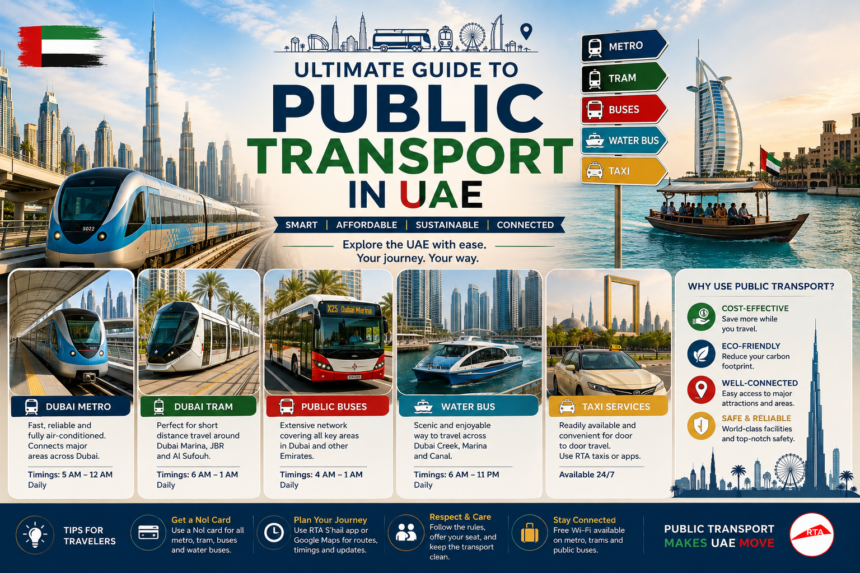
Complete Travel Guide to Public Transport in UAE
Public transport in the UAE is one of the easiest and most practical ways to travel between major cities, business districts, residential communities, tourist attractions, shopping destinations, airports, and other important locations. With modern infrastructure, clean vehicles, well-connected routes, and multiple transportation choices, the UAE offers convenient mobility for residents, tourists, students, and business travellers. Dubai and Abu Dhabi have particularly developed public transportation networks, while other emirates also provide buses, taxis, and intercity services.
- Public Transport in UAE: An Overview
- Dubai Metro
- Dubai Tram
- Public Buses in the UAE
- Why choose public buses?
- Public Transport in Abu Dhabi
- Intercity Buses in the UAE
- Taxis in the UAE
- Water Transport in the UAE
- Nol Card and Public Transport Payments in Dubai
- Public Transport Payment in Abu Dhabi
- Public Transport Fares in the UAE
- Public Transport for Tourists in the UAE
- Public Transport from UAE Airports
- Public Transport for Daily Commuters
- Public Transport for Students
- Public Transport Etiquette in the UAE
- Safety on Public Transportation
- Accessibility on UAE Public Transport
- Public Transport Apps and Journey Planning
- Public Transport vs Taxi in the UAE
- Tips for Using Public Transport in the UAE
- Advantages of Public Transport in the UAE
- Challenges of Public Transportation
- Future of Public Transportation in the UAE
- Frequently Asked Questions About Public Transport in UAE
Whether you are visiting the UAE for the first time, moving to the country, or simply looking for affordable ways to travel, understanding the available public transport options can help you save time and money. This Guide to Public Transport in UAE explains the major transportation systems, payment methods, fares, travel tips, and differences between transport options across the country.
Public Transport in UAE: An Overview
The UAE has invested heavily in transportation infrastructure as part of its wider development and smart-city initiatives. Public transportation includes metro systems, buses, trams, taxis, water transport, and intercity buses. Dubai has the country’s most extensive integrated public transport network, while Abu Dhabi operates an extensive bus system and other transport services.
Public transportation is particularly useful for people who want to avoid driving in busy areas, parking fees, and traffic congestion. It is also an important option for tourists who want to explore the UAE without renting a car.
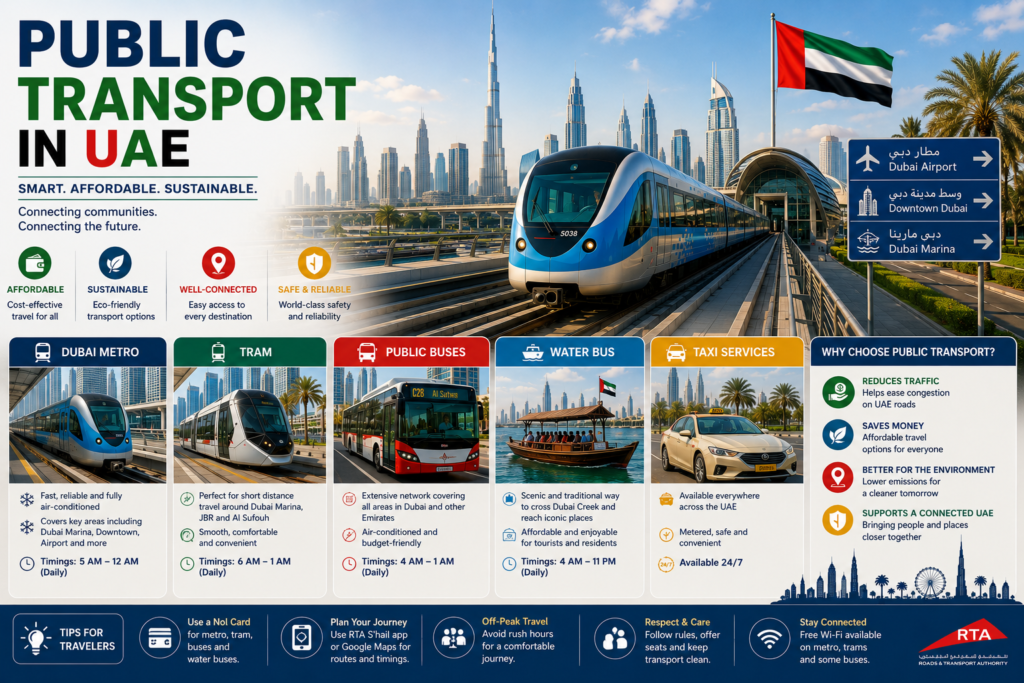
The main public transportation options in the UAE include:
- Metro
- Public buses
- Trams
- Taxis
- Intercity buses
- Water buses and ferries
- Monorails and specialized transport systems
- Ride-hailing services
Different emirates have different transport authorities, payment systems, routes, and fare structures. Therefore, travelers should check the latest information from the relevant transport authority before starting a journey.
Dubai Metro
The Dubai Metro is one of the most recognizable forms of public transport in the UAE. It provides fast and convenient transportation across many important parts of Dubai and connects residential, commercial, shopping, and tourist areas.
The Dubai Metro consists primarily of the Red Line and Green Line. The Red Line serves major destinations along the city’s main corridor, while the Green Line connects several historic and residential areas.
The metro is particularly useful for travelers visiting areas such as Downtown Dubai, Business Bay, Dubai Marina, Jumeirah Lakes Towers, Deira, Bur Dubai, and other connected neighborhoods.
One of the biggest advantages of the Dubai Metro is that it avoids road traffic. During busy periods, traveling by metro can be significantly more predictable than driving.
Key benefits of Dubai Metro
- Fast transportation across major parts of Dubai
- Air-conditioned stations and trains
- Connections with other public transport services
- Convenient access to major tourist and business areas
- Separate carriage areas and dedicated facilities
- Cashless travel through the appropriate transport card system
Passengers should check the current operating hours, station information, fares, and service updates before traveling because schedules can change during holidays, special events, maintenance periods, or other circumstances.
Dubai Tram
The Dubai Tram is another important component of the city’s public transportation network. It primarily serves areas around Dubai Marina, Jumeirah Beach Residence, Al Sufouh, and surrounding communities.
The tram can be especially useful for tourists staying near Dubai Marina or JBR because it provides connections between residential areas, hotels, attractions, and metro stations.
The tram also connects with the Dubai Metro network, making it possible to combine different forms of public transportation during a single journey.
For visitors exploring Dubai’s coastal districts, the tram can be a convenient alternative to taxis, particularly during periods of heavy road traffic.
Public Buses in the UAE
Buses are an essential part of public transportation throughout the UAE. They serve areas that are not directly connected by metro or tram and provide affordable transportation for both short and long-distance journeys.
Dubai operates a large network of buses that connects metro stations with residential neighborhoods, commercial districts, shopping centers, and other destinations. Abu Dhabi also has an extensive bus network serving the city and surrounding areas.
Other emirates, including Sharjah, Ajman, Ras Al Khaimah, Fujairah, and Umm Al Quwain, also have public and intercity bus services.
Why choose public buses?
Public buses can be useful when:
- Your destination is far from a metro station.
- You are traveling within residential neighborhoods.
- You want an affordable transportation option.
- You are connecting between different transport modes.
- You are traveling between selected emirates.
Modern buses generally offer air conditioning, comfortable seating, and accessibility features. Some routes operate frequently, while others may have longer intervals between services.
Public Transport in Abu Dhabi
Abu Dhabi has developed a reliable public transportation system centered around buses and taxis, along with other specialized transportation services.
The city’s bus network serves residential communities, commercial areas, government districts, shopping destinations, and major attractions. Public buses are particularly useful for people living or working in Abu Dhabi who regularly travel around the city.
Abu Dhabi also offers intercity transportation options connecting the capital with other emirates. Travelers heading between Abu Dhabi and Dubai, for example, can choose from several transportation alternatives depending on their destination, schedule, and budget.
For visitors, buses can be an economical way to explore Abu Dhabi without renting a car.
Intercity Buses in the UAE
The UAE’s emirates are connected through roads and intercity bus services, making it possible to travel between major cities without driving.
Intercity buses can connect destinations such as:
- Dubai and Abu Dhabi
- Dubai and Sharjah
- Dubai and Ajman
- Abu Dhabi and Al Ain
- Other major communities and emirates
The availability, route numbers, fares, and schedules vary by service and emirate. Travelers should always verify the latest timetable before making an intercity journey.
Intercity buses are often attractive to budget-conscious travelers because they can cost less than taxis or private transfers.
Taxis in the UAE
Taxis remain one of the most convenient transportation options in the UAE. They are widely available in major cities and can take passengers directly to their destination without requiring transfers.
Taxis are especially useful when:
- Traveling with luggage
- Traveling with children or elderly passengers
- Reaching areas without convenient public transport
- Traveling late at night
- Traveling with several people
- Going directly from an airport to a hotel
Taxi fares vary according to the emirate, vehicle type, distance, time, and other applicable factors. Airport taxis may also have different fare structures.
Although taxis are generally more expensive than buses or metro services, they offer greater convenience and door-to-door transportation.
Water Transport in the UAE
Water transportation is another interesting part of the UAE’s transport network, particularly in Dubai and Abu Dhabi.
Dubai offers several forms of marine transportation, including abras, water buses, ferries, and other water-based services. Traditional abras are particularly associated with Dubai Creek and provide an affordable and scenic way to travel between certain areas.
Water transport can be more than simply a way to get from one location to another. For tourists, it can also provide an opportunity to experience the UAE’s waterways and enjoy views of the surrounding city.
Popular water transport options include:
- Traditional abras
- Water buses
- Ferries
- Water taxis
- Other marine transport services
Routes and operating schedules vary, so passengers should check current information before traveling.
Nol Card and Public Transport Payments in Dubai
One of the most important things to understand when using public transportation in Dubai is the Nol Card. It is used for various forms of transportation within Dubai’s integrated public transport network.
Depending on the type of Nol product and the service being used, passengers can use it for transportation such as:
- Metro
- Buses
- Trams
- Some marine transport
- Other eligible services
Passengers should ensure that their card has sufficient balance before starting a journey. Different card types may be designed for different users and travel requirements.
Visitors who plan to use public transportation frequently should understand the available card options and choose one that suits their travel plans.
Public Transport Payment in Abu Dhabi
Abu Dhabi uses its own public transport payment system. Travelers using buses should obtain and use the appropriate transport card according to current regulations.
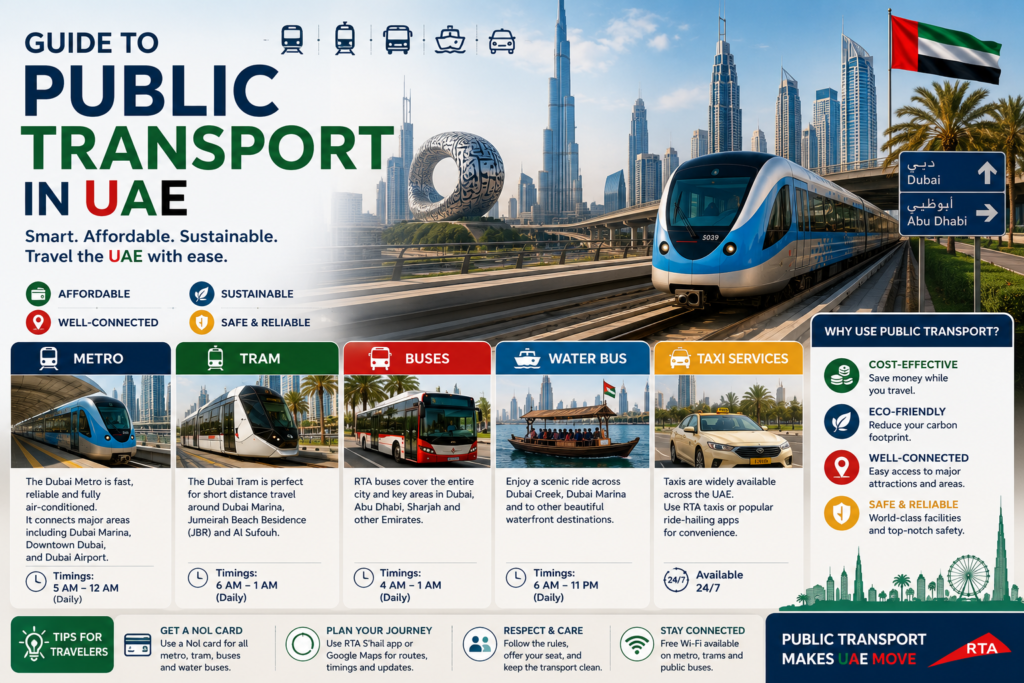
Because transport payment systems can be updated over time, visitors should check official Abu Dhabi transport information for current card availability, fares, recharge options, and usage rules.
Public Transport Fares in the UAE
Public transport fares vary depending on the emirate, transportation mode, journey distance, passenger category, and payment method.
Metro and bus travel can generally be much more affordable than taking a taxi for the same journey. However, travelers should not assume that the same fare structure applies throughout the UAE.
Before traveling, check:
- Current fare
- Travel zones
- Card requirements
- Transfer rules
- Discount eligibility
- Minimum card balance requirements
- Peak and off-peak conditions, if applicable
Transport authorities occasionally update fares, routes, and policies, so current official information should always take priority over older travel guides.
Public Transport for Tourists in the UAE
Tourists can use public transportation to explore many popular destinations in the UAE. Dubai is particularly convenient for visitors because the metro, tram, buses, taxis, and marine transport services can be combined.
A tourist staying near a metro station can often use the metro for major parts of a trip and then take a short taxi or bus ride to reach the final destination.
Public transport can be useful for visiting:
- Dubai Mall and Downtown Dubai
- Burj Khalifa area
- Dubai Marina
- JBR
- Deira
- Bur Dubai
- Dubai Creek
- Major shopping destinations
- Business districts
- Abu Dhabi city attractions
- Selected cultural and heritage destinations
However, not every tourist attraction is directly accessible by metro. Checking the complete route before leaving your hotel can prevent unnecessary walking or transfers.
Public Transport from UAE Airports
Airports in the UAE are major transportation hubs, and travelers have several options for reaching their hotels or destinations.
Dubai International Airport has connections with the Dubai Metro network, while taxis and private transport services are also widely available.
Abu Dhabi’s airport is served by road-based transportation options, including taxis and bus services, depending on the current network.
When arriving with heavy luggage, families may find taxis more convenient. Solo travelers and budget-conscious visitors may prefer public buses or metro services where available.
Public Transport for Daily Commuters
For residents, public transport can be an economical alternative to owning and operating a private vehicle. Daily commuters can combine metro, bus, tram, and walking depending on their location and workplace.
Public transportation can reduce expenses associated with:
- Fuel
- Parking
- Vehicle maintenance
- Insurance
- Road tolls
- Vehicle depreciation
The most convenient option depends heavily on where you live and work. People living close to a metro station may find rail transportation particularly efficient, while residents in areas without rail access may rely more heavily on buses or taxis.
Public Transport for Students
Students can also benefit from public transportation in the UAE. Affordable transportation can make it easier to travel between homes, educational institutions, libraries, shopping areas, and social destinations.
Students should check whether their local transport authority offers any special fares, concessions, or travel products. Eligibility requirements can vary.
Planning journeys in advance is especially useful for students who have fixed class schedules and need reliable transportation every day.
Public Transport Etiquette in the UAE
Following public transport rules and showing consideration toward other passengers helps make journeys comfortable for everyone.
Important etiquette includes:
- Queue properly when boarding.
- Allow passengers to exit before entering.
- Keep noise levels reasonable.
- Avoid blocking doors.
- Give priority seats to passengers who need them.
- Keep vehicles and stations clean.
- Follow designated seating rules.
- Do not eat or drink where prohibited.
- Keep personal belongings under control.
- Follow instructions from transport staff.
The UAE has strict rules regarding behavior in public places, and passengers should familiarize themselves with transport regulations.
Safety on Public Transportation
Public transportation in the UAE is generally designed with passenger safety in mind. Stations, vehicles, and major transport hubs commonly use security systems, surveillance, signage, and trained staff.
Passengers should nevertheless follow normal travel precautions.
Keep valuable belongings secure, especially in crowded stations or busy areas. Parents traveling with children should supervise them closely around platforms, escalators, roads, and boarding areas.
Always stand behind safety lines where provided and follow instructions displayed at stations.
Accessibility on UAE Public Transport
Many public transportation facilities in the UAE include accessibility features designed to assist passengers with disabilities, elderly travelers, and people with mobility challenges.
These can include:
- Accessible entrances
- Elevators
- Dedicated spaces
- Priority seating
- Accessible buses
- Station assistance
- Clear signage
Travelers requiring specific assistance should check with the relevant transport authority before traveling to understand available services and procedures.
Public Transport Apps and Journey Planning
Technology makes using public transportation in the UAE easier. Transport authorities and mapping services provide route information, schedules, station locations, and journey-planning tools.
Before leaving, travelers should check:
- Starting location
- Destination
- Nearest station or bus stop
- Route number
- Transfer points
- Estimated travel time
- Fare
- Operating hours
Checking the route before starting a journey is particularly important when using public transport for the first time.
Public Transport vs Taxi in the UAE
Choosing between public transportation and a taxi depends on your budget, destination, travel time, and personal preferences.
Public transport is usually better when:
- You want to save money.
- You are traveling along a major metro or bus route.
- Traffic congestion is heavy.
- You are traveling alone.
- Your destination is near a station.
A taxi may be better when:
- You need door-to-door transportation.
- You have heavy luggage.
- You are traveling with several people.
- Your destination is far from public transport.
- You need a faster direct journey.
Many travelers use a combination of both. For example, you might take the metro for most of the journey and then use a taxi for the final few kilometers.
Tips for Using Public Transport in the UAE
If you are new to public transportation in the UAE, a few simple habits can make your journeys easier.
Plan your route: Check your route before leaving. Identify stations, bus stops, transfers, and walking distances.
Keep your transport card ready: If your journey requires a transport card, make sure it has sufficient balance before entering the system.
Travel outside busy periods when possible: Peak commuting hours can result in crowded stations, buses, and trains. If your schedule is flexible, traveling outside the busiest periods can make the journey more comfortable.
Carry essential items: Keep your phone, identification documents, wallet, and other important belongings secure.
Check service updates: Maintenance, road works, public events, weather conditions, and special occasions can affect transportation services.
Wear comfortable footwear: Some public transport journeys involve walking between stations, bus stops, and destinations. Comfortable shoes can make a significant difference.
Advantages of Public Transport in the UAE
Public transportation provides several benefits for residents and visitors.
Affordable travel: Buses and metro services can be considerably cheaper than private transportation for regular journeys.
Reduced traffic: Greater use of public transportation can help reduce the number of private vehicles on roads.
Convenience: Integrated transportation networks allow passengers to combine different modes during one journey.
Environmental benefits: Public transportation can help reduce fuel consumption and emissions by transporting many passengers using shared vehicles.
Access to major destinations: Metro and bus networks connect many residential, commercial, shopping, and tourist locations.
Challenges of Public Transportation
Despite its many advantages, public transportation may not be ideal for every journey.
Some residential communities are located far from metro stations, making buses or taxis necessary. Transfers can also increase journey times. During peak hours, public transport can become crowded.
Other challenges can include:
- Limited direct routes to some destinations
- Walking between stops and final destinations
- Waiting times
- Crowded services during peak periods
- Different payment systems between emirates
For these reasons, travelers should choose transportation based on the specific journey rather than assuming one option is always best.
Future of Public Transportation in the UAE
The UAE continues to focus on smart mobility, sustainable transportation, and advanced infrastructure. Future transportation development is expected to emphasize technology, connectivity, efficiency, and environmentally friendly mobility.
Dubai and Abu Dhabi have both explored innovative transportation solutions as part of their broader smart-city strategies. These developments can include intelligent traffic management, electric mobility, autonomous transportation technologies, and improved integration between different transport modes.
As cities continue to grow, public transportation will remain an important part of the UAE’s urban development.
Frequently Asked Questions About Public Transport in UAE
Q1. What is the best public transport in the UAE?
Ans: There is no single best option for every journey. Dubai Metro is particularly convenient for traveling along major corridors in Dubai, while buses are useful for areas without metro access. Taxis provide convenient door-to-door transportation.
Q2. Is public transport cheap in the UAE?
Ans: Public transportation can be an affordable way to travel, especially compared with taxis or private vehicles. Exact costs depend on the emirate, transport mode, route, and applicable fare structure.
Q3. Can tourists use public transport in the UAE?
Ans: Yes. Tourists can use metro, buses, trams, taxis, and other public transportation services, depending on the emirate and destination. Visitors should obtain the required transportation card where applicable.
Q4. Which UAE city has the best public transport?
Ans: Dubai has one of the UAE’s most extensive and integrated public transportation networks, including metro, tram, buses, taxis, and marine transport. Abu Dhabi also has a substantial bus and taxi network.
Q5. Can I travel between Dubai and Abu Dhabi by public transport?
Ans: Yes. Intercity bus services provide a practical option for traveling between Dubai and Abu Dhabi. Routes, terminals, fares, and schedules can change, so travelers should verify current information before departure.
Q6. Do all emirates use the same transport card?
Ans: No. Different emirates generally operate their own transportation systems and payment arrangements. A card used for public transport in one emirate may not necessarily work across all other emirates.
Final Thoughts
Public transport in the UAE provides residents and visitors with a practical alternative to private cars. From the extensive Dubai Metro and tram network to public buses, taxis, intercity services, and water transportation, there are many ways to move around the country.
For tourists, public transportation can make exploring major destinations more affordable. For residents and commuters, it can reduce the costs associated with driving, parking, fuel, and vehicle maintenance. The key to a smooth journey is understanding the transport system in your emirate, selecting the right payment method, checking routes in advance, and staying informed about current schedules and regulations.
As the UAE continues to develop its cities and invest in smart and sustainable mobility, public transportation is likely to become an even more important part of everyday life. Whether you are commuting to work, visiting attractions, traveling between emirates, or exploring a new neighbourhood, understanding your transportation options can help you travel around the UAE more efficiently and confidently.
Do follow us on Instagram
Read More – Public Transport in Dubai