How Walkability Influences Health, Happiness and Community Life
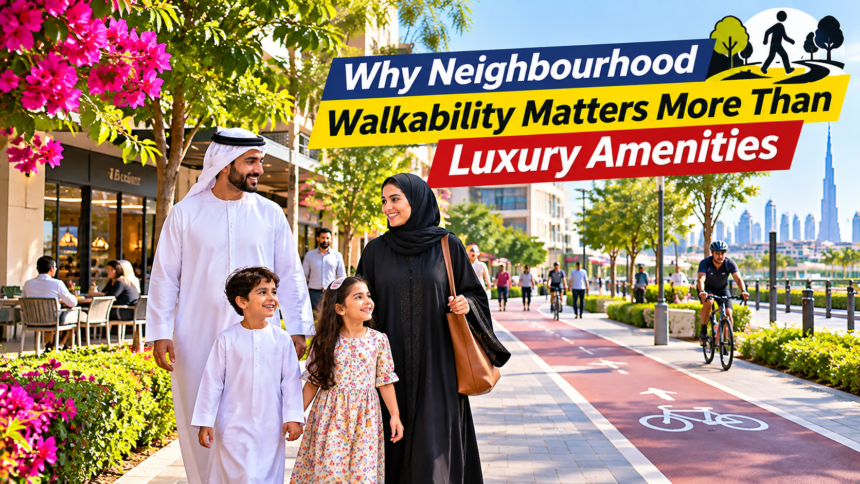
A residential development in Dubai may advertise an infinity pool, private cinema, landscaped gardens and a fully equipped gym. Yet residents could still find themselves driving ten minutes to buy groceries, collect a prescription or visit a nearby café. Another neighbourhood may offer fewer luxury facilities but provide shaded sidewalks, accessible shops, public parks and transportation connections within walking distance.
- What Is Neighbourhood Walkability and Why Does It Matter?
- 7 Powerful Benefits of Neighbourhood Walkability
- Dubai, Abu Dhabi and Riyadh: The Shift Towards Walkable Cities
- How Walkability Influences Health, Happiness and Community Life
- The Hidden Economics of Walkability vs Luxury Amenities
- Why Climate, Safety and Accessibility Matter in Gulf Walkability
- How to Evaluate Walkability Before Renting or Buying a Home
- The Future of Walkable Gulf Neighbourhoods and FAQs
The comparison reveals an important consideration in modern urban living: neighbourhood walkability can influence everyday quality of life more consistently than premium amenities that residents may use only occasionally.
Across the Gulf, residential developments frequently compete through attractive facilities, architectural design and exclusive services. Swimming pools, rooftop lounges and wellness centres can make properties appealing to buyers and tenants.
However, these features do not necessarily solve the practical challenges of daily life.
A family may still spend considerable time travelling between home, school, shopping facilities and other essential destinations. A professional living in a luxury tower may need a car for even the shortest errands if the surrounding streets are unsuitable for pedestrians.
Walkability offers a different way to assess residential value.
A walkable neighbourhood provides convenient access to everyday destinations through safe, connected and comfortable pedestrian routes. It considers not only what exists inside a residential development but also how residents interact with the surrounding community.
This approach is receiving greater attention in Gulf urban planning.
Dubai’s Walk Master Plan aims to create an extensive pedestrian network across 160 areas, while Abu Dhabi’s Livability by Design Framework places walkable neighbourhoods and connected mobility at the centre of major urban developments.
Riyadh is also investing in large pedestrian, cycling and recreational networks through projects including the Sports Boulevard.
These initiatives reflect a growing recognition that attractive buildings alone cannot create convenient residential environments.
Nevertheless, walkability in Gulf cities involves particular challenges, especially extreme summer temperatures, wide roads and development patterns historically designed around private vehicles.
Understanding why walkability matters requires examining its effects on health, household finances, mobility, social interaction and long-term residential satisfaction.
What Is Neighbourhood Walkability and Why Does It Matter?
Neighbourhood walkability describes how easily and comfortably people can reach everyday destinations on foot.
A walkable area generally combines useful nearby services with connected sidewalks, safe crossings, accessible public spaces and suitable pedestrian infrastructure.
It is not simply a neighbourhood containing a walking track.
A residential compound may offer a beautiful internal jogging path while remaining disconnected from nearby shops or transport stations.
Conversely, a modest urban neighbourhood may support everyday walking because essential services are located along connected streets.
The Main Elements of Walkability
Urban planners commonly assess walkability through several characteristics.
These include the distance between homes and destinations, street connectivity, pedestrian safety and the quality of the walking environment.
In hot climates, shade and thermal comfort are also important.
Walkability vs Luxury Amenities
| Feature | Walkable Neighbourhood | Luxury-Amenity Development |
|---|---|---|
| Main Priority | Everyday Accessibility | On-Site Lifestyle Facilities |
| Grocery Access | Potentially Within Walking Distance | May Require Driving |
| Physical Activity | Integrated Into Daily Travel | Often Through Dedicated Facilities |
| Public Transport | Connected Pedestrian Routes | Depends on Location |
| Social Interaction | Shops, Parks and Public Spaces | Shared Residential Facilities |
| Main Limitation | Climate and Street Conditions | Cost and External Connectivity |
A development can offer both luxury amenities and good walkability. The distinction is therefore about priorities rather than mutually exclusive choices.
Why Daily Convenience Matters
Consider two residents.
One walks to a nearby shop, pharmacy and café several times each week. The other drives to these destinations despite having access to a premium residential gym.
The first resident may experience greater everyday convenience even if the property itself offers fewer facilities.
This illustrates why neighbourhood quality cannot be evaluated solely through building features.
7 Powerful Benefits of Neighbourhood Walkability
Walkable environments can support daily life in several ways, although the benefits depend on actual infrastructure, climate and individual circumstances.
1. More Physical Activity Without Additional Planning

Walking to shops, parks or public transport can introduce movement into everyday routines.
The World Health Organization recommends that adults undertake 150–300 minutes of moderate-intensity aerobic physical activity each week.
Brisk walking can contribute to this recommendation.
However, a walkable neighbourhood does not guarantee that residents will become more physically active.
2. Less Dependence on Private Cars
When everyday destinations are within convenient walking distance, some journeys may no longer require driving.
This can reduce the inconvenience of parking, short trips and vehicle use.
However, many Gulf households still require cars for employment, longer journeys and activities during extreme weather.
3. Greater Convenience for Families
Parents may appreciate neighbourhoods where playgrounds, grocery shops and everyday services can be reached without lengthy drives.
Children may also benefit from suitable spaces for supervised outdoor activity.
Safe crossings and appropriate street design remain essential.
4. Better Access for Older Residents
Walkable communities can make routine activities more convenient for older adults.
Accessible sidewalks, seating and nearby services may support independent daily movement.
However, mobility requirements vary, and some residents need additional assistance or transport.
5. More Opportunities for Social Interaction
Walking through a neighbourhood creates opportunities to encounter neighbours, shopkeepers and other residents.
Local parks and cafés may become informal meeting places.
These interactions can contribute to community familiarity, although physical proximity alone does not guarantee strong social relationships.
6. Potential Household Savings
Reducing unnecessary car journeys may lower certain fuel, parking and vehicle-related expenses.
However, these savings depend on how much driving is actually avoided.
A walkable location may also command higher housing costs, so the overall financial benefit is not automatic.
7. More Useful Public Spaces
Walkable neighbourhoods encourage attention to sidewalks, lighting, crossings, greenery and public seating.
These features can benefit residents even when they do not walk long distances.
The result may be a more convenient and accessible public environment.
Seven Benefits Compared
| Benefit | Everyday Example | Main Consideration |
|---|---|---|
| Physical Activity | Walking to Shops | Weather and Ability |
| Reduced Car Use | Short Errands on Foot | Actual Transport Needs |
| Family Convenience | Nearby Playground | Pedestrian Safety |
| Accessibility | Local Services for Older Residents | Suitable Pathways |
| Social Interaction | Neighbourhood Encounters | Welcoming Public Spaces |
| Financial Flexibility | Fewer Short Car Trips | Housing and Vehicle Costs |
| Public Realm Quality | Connected Parks and Sidewalks | Maintenance |
The greatest advantage is that walkability makes ordinary activities more convenient rather than requiring residents to schedule separate recreational experiences.
Dubai, Abu Dhabi and Riyadh: The Shift Towards Walkable Cities
Several Gulf authorities are incorporating pedestrian accessibility into broader urban development strategies.
However, their programmes differ in scale, implementation and geographical coverage.
Dubai Walk Master Plan
Dubai approved its Walk Master Plan in December 2024.
The original announcement described an approximately 6,500-kilometre pedestrian network covering 160 areas, including planned construction, upgrades and longer-term routes extending beyond 2040.
In 2026, Dubai’s Roads and Transport Authority described the programme as delivering and enhancing more than 6,000 kilometres of walkways by 2040.
The updated project information also identifies 110 pedestrian bridges and underpasses.
Its stated objective is to increase walking and soft mobility’s share of trips to 25% by 2040.
These figures describe planned infrastructure and targets, not a completed network.
The 20-Minute City Concept
Dubai’s wider urban strategy includes a 20-Minute City concept intended to make essential services more accessible.
The planning goal is for 80% of residents to access essential services within a 20-minute journey.
This includes sustainable transport and should not be interpreted as a promise that every service will be reachable through a 20-minute walk alone.
The concept places greater emphasis on proximity, connectivity and reducing unnecessary travel.
Abu Dhabi’s Livability by Design Framework
In August 2026, Abu Dhabi’s Department of Municipalities and Transport introduced its Livability by Design Framework.
It applies to new and updated master plans accommodating more than 2,000 people, including relevant mixed-use and tourism developments.
The framework incorporates walkable neighbourhoods, connected mobility, accessible public spaces and universal accessibility.
Abu Dhabi also launched the second phase of its Liveability Strategy in September 2026, placing greater emphasis on the operational quality and everyday usefulness of community facilities.
Earlier programme results included nearly 120 kilometres of walking paths and 283 kilometres of cycling tracks.
Riyadh’s Sports Boulevard
Riyadh’s Sports Boulevard is a major project designed to improve recreational mobility and public space.
The approximately 135-kilometre corridor connects western and eastern parts of the city.
It incorporates walking, cycling and other recreational facilities, alongside green spaces and cultural destinations.
However, recreational walking infrastructure is not identical to neighbourhood walkability.
Residents also need connected access to grocery shops, schools, healthcare facilities and other everyday services.
Gulf Initiatives Compared
| City | Initiative | Main Focus |
|---|---|---|
| Dubai | Dubai Walk Master Plan | Connected Pedestrian Infrastructure |
| Dubai | Dubai 2040 Urban Master Plan | Proximity and Sustainable Mobility |
| Abu Dhabi | Livability by Design Framework | People-Centred Residential Planning |
| Abu Dhabi | Liveability Strategy | Community Facilities and Accessibility |
| Riyadh | Sports Boulevard | Walking, Cycling and Recreation |
These programmes demonstrate planning priorities, but their practical impact will depend on implementation and the experience of residents in individual neighbourhoods.
How Walkability Influences Health, Happiness and Community Life
Walkability can affect daily well-being by making physical activity and community interaction easier.
However, its health effects should be evaluated through research rather than assumptions about particular neighbourhoods.
Walking as Everyday Exercise
The WHO identifies regular physical activity as beneficial for cardiovascular health, mental well-being and the prevention and management of several noncommunicable diseases.
When a neighbourhood makes walking convenient, residents may have more opportunities for routine movement.
For example, walking to a nearby shop can contribute to overall activity without requiring a dedicated exercise session.
What Research Shows
A systematic review published in 2023 examined health impact assessments involving walkability and urban built environments.
Most included assessments identified beneficial health impacts from improvements to walking conditions.
However, the authors also noted limitations in evidence concerning how benefits and disadvantages are distributed among different population groups.
Another review of built-environment research found associations between connected, compact neighbourhoods and positive outcomes involving physical activity and social engagement.
These findings do not prove that every walkable development causes identical health improvements.
Social Interaction and Neighbourhood Familiarity
Public spaces become more useful when residents can access them easily.
A nearby park may attract regular visitors, while shops along pedestrian-friendly streets can provide opportunities for everyday interaction.
However, community belonging also depends on safety, affordability and whether people feel welcome.
Children and Independent Mobility
Safe pedestrian routes can make neighbourhood activities more accessible to families.
Children may have opportunities to walk with caregivers or, when appropriate for their age and circumstances, travel more independently.
Street crossings, traffic speeds and supervision remain essential considerations.
Accessibility for Different Abilities
A neighbourhood cannot be described as genuinely walkable if it excludes people using wheelchairs or mobility aids.
Ramps, even surfaces, suitable crossings and accessible routes should be considered fundamental rather than optional luxury features.
The Importance of Environmental Quality
Walkability should also account for exposure to traffic pollution, excessive noise and heat.
An area with nearby destinations may still provide an unpleasant pedestrian experience if routes run directly beside heavily trafficked roads.
The objective is not simply to encourage more walking, but to make walking safe and practical.
The Hidden Economics of Walkability vs Luxury Amenities
Residential developments often market features that are easy to photograph and promote.
A private cinema, rooftop pool or premium gym can create an immediate impression of exclusivity.
However, everyday convenience may have financial value that is less visible in property advertisements.
The Cost of Short Car Journeys
Residents may use private vehicles for small errands because the surrounding infrastructure makes walking inconvenient.
These journeys involve fuel, parking, vehicle wear and time.
The costs vary considerably according to location and driving habits.
Walkability and Housing Prices
A desirable pedestrian-friendly neighbourhood may carry higher rental or purchase costs.
Therefore, the financial benefit of walking should not be assumed to exceed the additional housing expense.
Households should compare total residential and transportation commitments.
Illustrative Household Comparison
Consider two fictional Dubai households living in different neighbourhood types.
| Monthly Expense | Amenity-Focused Location | Walkable Location |
|---|---|---|
| Rent | AED 9,000 | AED 9,800 |
| Fuel and Vehicle Use | AED 1,300 | AED 750 |
| Parking and Short-Trip Transport | AED 400 | AED 150 |
| Additional Recreation Spending | AED 350 | AED 200 |
| Total | AED 11,050 | AED 10,900 |
Under these hypothetical assumptions, the walkable location costs AED 150 less monthly despite higher rent.
However, the difference depends entirely on the chosen figures.
If rent were substantially higher, the financial outcome could be reversed.
The comparison is illustrative, not a statement about real rental prices or typical transport savings in Dubai.
The Value of Time
Walkability may also reduce the time required for simple errands.
A five-minute walk to a convenience store may be easier than driving to a shopping centre, finding parking and returning home.
However, a convenient walking route is not always the fastest option during extreme heat or for residents with mobility limitations.
Do Luxury Amenities Deliver Value?
Premium amenities can be useful.
A resident who swims frequently may value an on-site pool, while someone with a demanding schedule may appreciate a building gym.
The question is whether the household actually uses the facilities enough to justify their cost.
Amenity Value vs Daily Accessibility
| Feature | Frequency of Potential Use | Main Value |
|---|---|---|
| Nearby Grocery Store | Several Times Weekly | Daily Convenience |
| Safe Sidewalks | Potentially Daily | Mobility |
| Public Transport Access | Regularly for Some Residents | Connectivity |
| Private Cinema | Occasional | Entertainment |
| Rooftop Pool | Varies | Recreation |
| Luxury Lounge | Occasional | Social Space |
| Nearby Pharmacy | As Needed | Essential Access |
A useful property evaluation considers how frequently each feature contributes to daily life.
Why Climate, Safety and Accessibility Matter in Gulf Walkability
Walking in Gulf cities presents environmental challenges that differ from many temperate-climate urban environments.
High temperatures, strong sunlight and seasonal humidity can make pedestrian journeys uncomfortable or unsafe.
Therefore, measuring only the distance between destinations is insufficient.
Shade and Thermal Comfort
Trees, covered walkways, building overhangs and suitably designed shelters can improve the pedestrian experience.
Dubai Walk’s official design proposals include shaded areas, greenery, rest areas and selected cooling features.
However, cooling measures vary in effectiveness and resource requirements.
Summer Heat
Outdoor walking can become physically demanding during hot weather.
Residents should consider temperature, humidity, hydration and their personal health circumstances.
Not every walking journey is appropriate during periods of extreme heat.
Safe Road Crossings
A destination located only 400 metres away may still be difficult to reach if a major road separates it from the neighbourhood.
Pedestrian crossings, signals, traffic speeds and accessible infrastructure can influence whether the route is genuinely usable.
Distance alone does not establish safety.
Connected Sidewalks
A sidewalk that ends unexpectedly or forces pedestrians into a vehicle lane reduces accessibility.
An effective pedestrian network needs continuous routes, suitable surfaces and connections between destinations.
Lighting and Public Comfort
Well-designed lighting can make evening walking more practical.
Seating and clear signage may also improve the experience, particularly for older residents.
However, public-space improvements need maintenance to remain useful.
Climate-Responsive Walkability
| Challenge | Useful Design Response |
|---|---|
| Strong Sunlight | Trees and Shaded Routes |
| High Temperatures | Climate-Sensitive Planning |
| Wide Roads | Safe Pedestrian Crossings |
| Disconnected Sidewalks | Continuous Pedestrian Networks |
| Limited Accessibility | Ramps and Suitable Surfaces |
| Long Distances | Nearby Mixed-Use Services |
| Evening Travel | Lighting and Clear Signage |
For the Gulf, a walkable neighbourhood should be evaluated by how reliably its routes can be used throughout the year, not simply by their appearance during cooler months.
How to Evaluate Walkability Before Renting or Buying a Home
Property buyers and tenants can assess walkability through practical observations.
A development brochure may highlight nearby attractions, but it does not necessarily explain whether those destinations are comfortable to reach on foot.
Check Everyday Destinations
Start with the places household members visit regularly.
These might include a grocery shop, pharmacy, park, school, public transport station or café.
A neighbourhood can be convenient for one household and unsuitable for another.
Test the Actual Walking Route
Map distance and practical walking distance are not always identical.
A destination may look close but require a long detour because of fencing, roads or restricted access.
Where possible, walk the route yourself.
Observe Crossings and Sidewalks
Look for continuous pedestrian paths, suitable ramps and clearly marked crossings.
Check whether parked vehicles or other obstructions make sidewalks difficult to use.
Visit at Different Times
A route that feels pleasant in the morning may be poorly lit at night.
Similarly, a walking distance that seems comfortable during winter may feel very different in summer.
Seasonal conditions should be considered before making a long-term housing decision.
Compare Total Living Costs
Rent is only one part of household expenditure.
Consider transport, parking, fuel and the frequency of car journeys.
A more expensive apartment in a convenient location may be worthwhile for some households, while others may prefer lower rent and accept greater reliance on driving.
Neighbourhood Walkability Checklist
- Grocery shops are conveniently accessible.
- A pharmacy or healthcare service is reasonably nearby.
- Sidewalks are continuous and maintained.
- Road crossings are safe and accessible.
- Walking routes include suitable shade where possible.
- Public transport is accessible if needed.
- Parks or open spaces can be reached conveniently.
- Streets have appropriate lighting.
- Routes accommodate wheelchairs and mobility aids.
- Walking remains practical for the household’s needs and the local climate.
A Simple Neighbourhood Comparison
| Question | Neighbourhood A | Neighbourhood B |
|---|---|---|
| Grocery Store Within Easy Walking Distance | Yes | No |
| Continuous Sidewalks | Yes | Limited |
| Convenient Public Transport | Yes | No |
| Shaded Routes | Partial | Limited |
| Luxury Swimming Pool | No | Yes |
| Private Cinema | No | Yes |
| Frequent Driving Required | Less Often | More Often |
This fictional comparison illustrates how practical neighbourhood characteristics can outweigh premium facilities for some residents.
It is not a ranking of actual developments.
The Future of Walkable Gulf Neighbourhoods and FAQs
Walkability is becoming an important component of urban planning strategies across the Gulf.
However, building attractive pedestrian infrastructure is only one part of the challenge.
Cities must also ensure that housing, services and public transport are connected in ways that support residents’ daily routines.
Moving Beyond Isolated Developments
A residential community may provide excellent internal facilities but remain difficult to reach from neighbouring districts.
Urban planners increasingly emphasise connectivity between communities rather than treating each development as a separate destination.
Dubai’s pedestrian network proposals and Abu Dhabi’s planning frameworks reflect this wider approach.
More Attention to Quality of Life
In September 2026, Abu Dhabi’s Department of Municipalities and Transport announced the second phase of its Liveability Strategy.
The updated programme places greater emphasis on how well community facilities operate and how effectively they serve residents.
This is an important distinction.
A park, sidewalk or public facility creates limited benefit if it is inaccessible, poorly maintained or unsuitable for everyday use.
What Developers Should Consider
Residential developers can evaluate the surrounding neighbourhood alongside the features inside their buildings.
Useful questions include whether residents can reach essential services, use nearby public spaces and travel safely without a private car.
However, walkability should not be marketed as a substitute for suitable housing quality, reliable services or affordability.
Frequently Asked Questions
What is neighbourhood walkability?
Neighbourhood walkability describes how easily and safely residents can reach everyday destinations on foot.
Why does walkability matter more than luxury amenities?
For some households, walkability affects routine activities more frequently than facilities such as private cinemas or rooftop lounges.
Is Dubai becoming more walkable?
Dubai has approved a major pedestrian infrastructure plan covering 160 areas, with implementation planned in stages through 2040.
What is Dubai’s 20-Minute City concept?
It is a planning objective intended to improve access to essential services within a 20-minute journey using appropriate transport connections.
Is Riyadh investing in walkable infrastructure?
Yes. The Sports Boulevard and other public-realm projects include pedestrian and cycling facilities.
Can walking improve health?
Regular physical activity, including suitable brisk walking, contributes to physical and mental health. Outcomes depend on individual circumstances and activity levels.
Does walkability reduce transportation costs?
It may reduce some vehicle journeys, but actual savings depend on household transport patterns and housing expenses.
Are luxury amenities unnecessary?
No. Premium facilities can provide meaningful benefits when residents use them regularly. Their value depends on individual preferences.
What makes a neighbourhood walkable in hot climates?
Connected sidewalks, safe crossings, shade, accessible destinations and climate-responsive infrastructure are important.
Can a neighbourhood be walkable without public transport?
It may support local walking, but reliable public transport can improve access to destinations beyond the immediate area.
How can homebuyers assess walkability?
They can examine nearby services, test actual walking routes, evaluate crossings and shade, and consider transport requirements.
Will all Gulf cities become fully walkable?
There is no basis to assume that every district will become equally walkable. Progress depends on planning, investment, climate and existing urban structures.
Final Thoughts
Neighbourhood walkability is becoming an increasingly important consideration in how residents evaluate modern urban living.
Luxury amenities can make a residential development attractive, but they do not necessarily provide convenient access to the services people need every day.
Safe sidewalks, nearby shops, public transport connections and comfortable public spaces can influence how residents travel, exercise and interact with their communities.
For Gulf cities, this approach is particularly relevant because heat, road design and historically car-oriented development patterns create additional challenges.
Dubai’s Walk Master Plan, Abu Dhabi’s liveability frameworks and Riyadh’s Sports Boulevard illustrate growing institutional attention to pedestrian-friendly environments.
However, the success of these initiatives will depend on completed infrastructure and measurable improvements in everyday accessibility.
For residents, the most useful question may not be how many amenities a development advertises, but how easily they can meet their ordinary needs after moving in.
Ultimately, neighbourhood walkability represents an important dimension of residential quality.
A home may offer impressive architecture and premium facilities, but its surrounding streets, services and connections often determine how convenient everyday life actually feels.
Do follow us on Instagram
Read More – Middle Eastern Family Homes: 7 Powerful Changes Shaping Domestic Life