The Economics of Turning Construction Waste Into Valuable Products
Every new tower, highway and residential development creates a less visible challenge: what happens to the concrete, bricks, metal, timber and other materials left behind during construction or demolition? Across the Gulf, where large-scale infrastructure development continues to shape expanding cities, these discarded materials represent both an environmental problem and a potential economic resource.
- Why Gulf Construction Waste Recycling Matters
- 7 Valuable Building Materials That Can Come From Construction Waste
- UAE and Saudi Arabia: Recycling Projects Already Changing Construction
- How Construction Debris Becomes Safe, Usable Building Materials
- The Economics of Turning Construction Waste Into Valuable Products
- Environmental Benefits and Technical Challenges
- The Future of Gulf Construction Waste Recycling and FAQs
Gulf Construction Waste Recycling is attracting greater attention as governments, developers and recycling companies explore ways to transform construction and demolition debris into useful products.
Instead of sending damaged concrete, old bricks and other recoverable materials to landfills, specialised facilities can sort, crush, clean and process selected waste into materials for future construction projects.
Some outputs can be used in road foundations, parking areas and earthworks. Others may support the manufacture of paving blocks, bricks or suitable concrete products, provided they meet relevant technical requirements.
The opportunity is particularly important in the UAE and Saudi Arabia, where urban expansion creates continuing demand for aggregates and infrastructure materials.
In Abu Dhabi, waste management operations have already produced millions of tonnes of recycled aggregate. Saudi Arabia has also developed dedicated construction waste recycling facilities and tested recycled materials in road construction.
In January 2025, Saudi Arabia’s Roads General Authority announced the use of recycled construction and demolition waste in asphalt paving layers in Al-Ahsa. Riyadh Municipality subsequently reported a similar application in neighbourhood roads in July 2025.
Dubai has introduced requirements for separating construction and demolition waste, while its 2026 waste management regulations provide a framework for determining the use of recycled materials in appropriate projects.
These developments show that converting demolition debris into construction products is not merely a theoretical possibility.
However, recycling does not automatically make every material suitable for reuse.
Structural performance, contamination, processing costs, transportation distances and regulatory approval all influence whether recycled materials can safely replace virgin resources.
The Gulf’s opportunity lies in developing a reliable market where construction waste is treated as a recoverable resource rather than an unavoidable disposal expense.
Why Gulf Construction Waste Recycling Matters
Construction and demolition activities generate large volumes of materials throughout a building’s lifecycle.
Waste can originate during site preparation, building construction, renovation, road maintenance and demolition.
Some materials remain suitable for direct reuse. Others require substantial processing before they can become useful products.
The Scale of the Environmental Challenge
The United Nations Environment Programme’s Global Status Report for Buildings and Construction 2025–2026 identifies buildings and construction as a major contributor to global environmental pressures.
The report attributes approximately 37% of global emissions and nearly half of global material extraction to the sector, using its broader lifecycle and sectoral accounting framework.
These are global construction-sector figures, not measurements of Gulf construction waste.
Nevertheless, they demonstrate why material efficiency is an important issue.
Extracting new stone, manufacturing building products and transporting heavy materials all require resources.
Why Landfill Disposal Is Not the Only Option
Concrete rubble may contain recoverable aggregates, while steel and aluminium can enter established metal recycling systems.
Certain timber products, bricks and other materials may also be reused or processed.
However, mixed waste containing hazardous substances or unsuitable contaminants may not be appropriate for ordinary recycling.
What the Circular Economy Means for Construction
A circular construction system seeks to keep materials useful for longer through repair, reuse, recycling and better design.
For example, a demolished concrete wall could be processed into aggregate suitable for selected infrastructure applications.
A reused structural component may deliver different environmental benefits from material that must be crushed and reprocessed.
The appropriate pathway depends on technical feasibility and lifecycle impacts.
Traditional vs Circular Construction
| Conventional Approach | Circular Construction Approach |
|---|---|
| Demolition debris sent to disposal | Recoverable materials separated |
| Heavy dependence on virgin aggregates | Suitable recycled aggregates used |
| Limited material tracking | Documented material characteristics |
| Waste treated mainly as a cost | Waste evaluated as a resource |
| Disposal after demolition | Planning for reuse and recycling |
The most effective approach begins during project planning, not only when demolition is complete.
7 Valuable Building Materials That Can Come From Construction Waste
Not every waste stream can be transformed into the same product.
Processing requirements and end uses depend on material composition, quality and applicable standards.
1. Recycled Concrete Aggregates
Concrete from demolition can be crushed and screened to produce recycled aggregates.
These materials may be suitable for road sub-base layers, certain earthworks and other approved infrastructure applications.
Some recycled aggregates can also be incorporated into concrete products under appropriate specifications.
However, water absorption, grading and residual cement paste can affect performance.
2. Recycled Bricks and Masonry Products
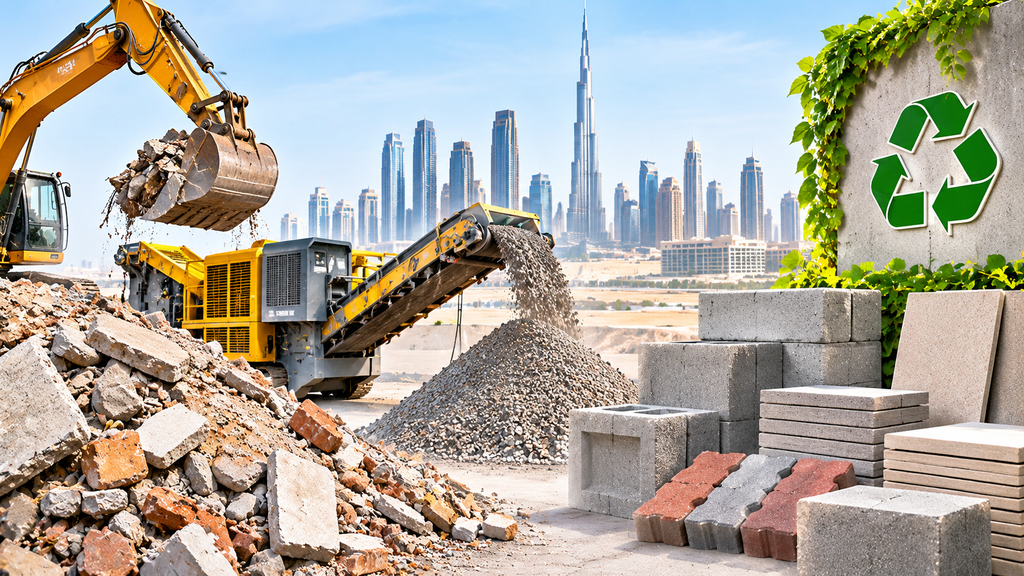
Selected crushed masonry materials can be processed for use in certain construction applications.
Manufacturers may also incorporate suitable recycled aggregates into new bricks or blocks.
Saudi Investment Recycling Company’s sustainability reporting describes green bricks made using 40% recycled aggregates or processed industrial waste.
That figure relates to the reported product formulation, not a universal requirement for every recycled brick.
3. Road Base and Sub-Base Materials
Road construction creates opportunities to use appropriately processed recycled aggregates.
These materials can sometimes replace selected virgin aggregates in layers beneath the road surface.
Their suitability depends on strength, grading, compaction and environmental requirements.
4. Recycled Asphalt Materials
Old asphalt and certain appropriately processed demolition materials may be incorporated into road construction.
Saudi Arabia has demonstrated applications involving construction waste in asphalt mixtures.
However, recycled asphalt pavement and crushed building demolition debris are distinct material streams and require different mix-design assessments.
5. Recovered Steel and Metals
Steel reinforcement, aluminium and other metals can be separated from construction waste.
These materials may be supplied to appropriate recycling facilities for processing into new metal products.
Their environmental and financial value depends on purity, recovery efficiency and market conditions.
6. Reclaimed Timber and Wood Products
Selected wood from construction or demolition may be suitable for direct reuse or further processing.
Potential applications include non-structural products and other approved uses.
However, treated, painted or contaminated timber may require specialised handling.
7. Paving Blocks and Precast Products
Suitable recycled materials may be incorporated into paving products and selected precast components.
These applications can create demand for recycled aggregate products close to the recycling facility.
However, each product requires appropriate quality testing, particularly where structural strength or durability matters.
Seven Material Opportunities Compared
| Recovered Material | Potential New Product | Main Quality Requirement |
|---|---|---|
| Crushed Concrete | Recycled Aggregate | Grading and Strength |
| Masonry Debris | Bricks or Blocks | Composition and Durability |
| Mixed Mineral Rubble | Road Sub-Base | Compaction Performance |
| Reclaimed Asphalt | Suitable Pavement Mixes | Mix Design |
| Steel and Aluminium | Recycled Metal Products | Separation and Purity |
| Recoverable Timber | Reused Wood Products | Contamination Screening |
| Processed Aggregates | Pavers and Precast Products | Product Standards |
These are potential applications, not permission to use every waste-derived material in every construction project.
UAE and Saudi Arabia: Recycling Projects Already Changing Construction
The strongest evidence of progress comes from actual recycling operations and infrastructure projects.
The UAE and Saudi Arabia have moved beyond general sustainability commitments by developing facilities, regulatory measures and practical applications for recovered construction materials.
Abu Dhabi’s Recycled Aggregate Production
Abu Dhabi has been processing construction and demolition waste through dedicated facilities for several years.
The Abu Dhabi Government Media Office reported that Tadweer produced approximately 2.7 million tonnes of recycled aggregate from construction and demolition waste during 2021.
This is a historical production figure, not the amount produced in 2026.
Tadweer’s published sustainability policy also identifies recycled concrete aggregates as an example of converting waste into economic value.
Its approach treats selected discarded materials as potential resources for construction and infrastructure projects.
Dubai’s Construction Waste Separation Requirements
Dubai Municipality issued Circular No. 12-10-1 of 2023, requiring construction and demolition contractors to separate and sort relevant waste streams.
The guidance identifies materials including concrete, reinforcing steel, timber, tiles and plastics.
Separating these materials before transportation can make subsequent recovery more practical.
When mineral debris becomes mixed with unsuitable waste, processing can become more expensive and the quality of recycled products may decline.
Dubai’s Updated Waste Management Framework
Administrative Resolution No. 34 of 2026 implements provisions of Dubai’s Waste Management Law No. 18 of 2024.
Article 13 provides for minimum recycled-material percentages to be determined through subsequent decisions, taking into account market availability, technical standards, transport feasibility and the type of project.
The regulation does not establish one universal mandatory recycled-content percentage for all Dubai buildings.
It provides a mechanism for defining requirements according to relevant conditions.
Saudi Arabia’s Riyadh Recycling Facility
The Saudi Investment Recycling Company developed a construction and demolition waste recycling facility in Riyadh’s Al Khair district.
Its published project description identifies a design processing capacity of approximately 600 tonnes per hour and production of several sizes of recycled aggregates.
The original facility announcement also described an intended recycling rate above 90% for material processed at the facility.
These are project-design and operational objectives, not evidence that every incoming waste stream is recycled at that rate.
Recycled Construction Materials on Saudi Roads
On January 3, 2025, Saudi Arabia’s Roads General Authority reported the first road project using construction and demolition waste in asphalt mixtures in Al-Ahsa.
The project involved research into suitable asphalt and aggregate-layer performance.
In July 2025, Riyadh Municipality also announced the use of demolition-derived materials in asphalt mixtures for roads in several neighbourhoods.
These applications show that recycled construction waste can enter real infrastructure projects when the materials meet the required technical specifications.
Regional Examples
| Location | Project or Measure | Significance |
|---|---|---|
| Abu Dhabi | Recycled aggregate production | Established material recovery |
| Dubai | Construction waste sorting circular | Improved waste separation |
| Dubai | 2026 waste management regulations | Framework for recycled-material use |
| Riyadh | Dedicated recycling facility | Industrial-scale processing |
| Al-Ahsa | Recycled demolition material in roads | Practical infrastructure application |
| Riyadh Roads | Recovered material in asphalt works | Expansion of road-use applications |
These examples demonstrate commercial and regulatory development, although they do not establish that construction waste recycling is equally advanced across every GCC market.
How Construction Debris Becomes Safe, Usable Building Materials
Turning rubble into construction products involves more than crushing concrete into smaller pieces.
Recycling facilities need to control the quality of incoming waste, separate unwanted materials and verify the characteristics of their finished products.
Collection and Source Separation
The process begins at a construction or demolition site.
Contractors can identify different materials and place them in suitable collection areas or containers.
Concrete, steel, timber and other waste streams should be handled according to the relevant requirements.
Separating materials at source reduces the likelihood of contamination.
Initial Inspection
When waste arrives at a recycling facility, operators may examine its composition and suitability.
Hazardous or unsuitable materials need to be identified and managed appropriately.
Not all demolition debris can enter an ordinary recycled aggregate production line.
Crushing and Screening
Suitable mineral debris is processed through crushing machinery.
Screening equipment then separates particles into different sizes.
The required grading depends on the intended construction application.
For example, aggregates used in road foundations may require a different size distribution from those used in certain precast products.
Metal Separation
Reinforcing steel and other metals can be removed during processing.
Recovered metals may then be supplied to appropriate recycling operators.
Efficient separation also helps improve the quality of the remaining mineral material.
Quality Testing
The finished material must be checked against relevant specifications.
Depending on the application, testing may examine particle size, density, water absorption, strength, contamination and durability.
Structural applications require particular care because material failure could affect building safety.
The Recycling Process
| Stage | Main Activity | Purpose |
|---|---|---|
| 1. Collection | Recover demolition materials | Capture useful waste |
| 2. Sorting | Separate material types | Reduce contamination |
| 3. Inspection | Identify unsuitable substances | Support safe processing |
| 4. Crushing | Reduce mineral debris size | Produce aggregate |
| 5. Screening | Classify particle sizes | Match intended use |
| 6. Testing | Check technical characteristics | Confirm suitability |
| 7. Distribution | Supply approved materials | Support construction projects |
Why Standards Matter
The UAE’s Ministerial Resolution No. 21 of 2019 addresses the use of recycled aggregates in road construction and infrastructure projects.
The resolution establishes environmental and quality conditions and permits qualifying contractors to meet up to 40% of relevant material requirements through recycled aggregates under its framework.
That figure should not be interpreted as a universal safe mix percentage for concrete or permission to use recycled material in every structural component.
Material specifications, intended uses and applicable project approvals remain essential.
The Economics of Turning Construction Waste Into Valuable Products
Construction waste recycling becomes commercially attractive when the value of recovered materials and avoided disposal costs can justify collection, transportation, processing and quality assurance.
However, recycled products are not automatically cheaper than virgin materials.
Heavy construction materials are particularly sensitive to transportation costs.
A recycling facility located close to demolition and infrastructure projects may have an advantage over one requiring long-distance deliveries.
Where Recycling Companies Generate Revenue
Recycling businesses may earn income from accepting waste, selling recovered aggregates and supplying other recyclable materials.
Metals recovered during processing can create additional value.
However, revenue arrangements depend on commercial agreements, local disposal rules and market prices.
Why Location Matters
Aggregates are relatively heavy products.
Transporting them over long distances can reduce potential cost advantages and increase fuel consumption.
A recycling operation may therefore benefit from being located near major construction activity or infrastructure demand.
Illustrative Recycling Economics
Consider a hypothetical facility processing 10,000 tonnes of suitable construction debris.
| Financial Measure | Hypothetical Amount |
|---|---|
| Incoming Waste | 10,000 tonnes |
| Recoverable Material Yield | 80% |
| Recovered Material | 8,000 tonnes |
| Average Selling Price | AED 35 per tonne |
| Aggregate Sales Revenue | AED 280,000 |
| Processing and Operating Costs | AED 190,000 |
| Transport and Quality Testing | AED 55,000 |
| Illustrative Operating Margin | AED 35,000 |
The model is fictional and excludes financing, capital expenditure, land costs, taxes, revenue from recovered metals and potential waste acceptance fees.
The assumed recovery rate and prices are not actual Gulf market benchmarks.
Its purpose is to illustrate how recycling profitability depends on multiple variables.
Potential Benefits for Developers
Developers may reduce disposal costs and acquire suitable secondary materials, depending on local market conditions.
Some projects may also benefit from demonstrating compliance with sustainability requirements.
However, environmental certification or procurement benefits must be assessed under the relevant programme’s actual rules.
Why Commercial Demand Is Essential
A recycling facility can produce technically suitable aggregates but struggle financially if contractors do not purchase them.
Reliable demand, appropriate specifications and competitive delivered prices are therefore essential.
Long-term supply agreements and approved infrastructure uses may help recycling operators plan production.
Environmental Benefits and Technical Challenges
Recycling construction waste can reduce disposal volumes and demand for certain virgin resources.
However, environmental benefits depend on how materials are recovered, processed and transported.
A recycled product should be evaluated through its actual lifecycle rather than assumed to be environmentally preferable in every situation.
Reducing Landfill Pressure
Recovering useful materials can reduce the amount of construction debris requiring disposal.
This may conserve landfill capacity and reduce some associated environmental impacts.
The effect depends on the quantity of material diverted and whether unsuitable residues are managed responsibly.
Conserving Natural Aggregates
Recycled aggregates can replace selected virgin materials in appropriate applications.
This may reduce demand for quarrying and raw material extraction.
However, substitution is not necessarily one-for-one in every product.
The performance requirements of the final application must remain the priority.
Understanding Carbon Savings
Crushing, screening and transporting recycled materials consume energy.
A recycled aggregate may offer environmental advantages when it replaces suitable virgin material, particularly if processing and transport are efficient.
But the actual carbon benefit requires a lifecycle assessment using relevant data.
It would be misleading to claim that every tonne of recycled construction waste saves a fixed amount of carbon emissions.
Contamination Risks
Demolition waste can contain materials that require specialised handling.
Examples include certain coatings, chemicals and other potentially hazardous substances.
These must be managed according to applicable environmental and occupational safety rules.
Mixing unsuitable waste with otherwise recoverable concrete can affect the quality and safety of the finished material.
Material Quality and Confidence
Contractors may hesitate to use recycled aggregates if they lack reliable information about performance.
Testing, certification and consistent product specifications can help address these concerns.
Dubai Municipality’s Building Materials Passport Platform, showcased at WETEX 2026, is intended to support the traceability of construction material information throughout its lifecycle.
Better information could make it easier to identify materials suitable for future recovery and reuse.
Challenges and Possible Responses
| Challenge | Potential Impact | Practical Response |
|---|---|---|
| Mixed Waste | Lower recovery quality | On-site sorting |
| Contamination | Safety concerns | Inspection and specialist handling |
| Variable Aggregate Quality | Inconsistent performance | Laboratory testing |
| Long Transport Distances | Higher costs and emissions | Regional processing facilities |
| Limited Buyer Confidence | Weak demand | Approved specifications |
| Processing Energy | Environmental impacts | Efficient equipment |
| Poor Material Records | Difficult future reuse | Digital material documentation |
The objective should be to produce materials that are safe, technically suitable and economically viable, not simply to maximise the quantity of waste labelled as recycled.
The Future of Gulf Construction Waste Recycling and FAQs
Construction waste recycling offers Gulf countries an opportunity to connect infrastructure development with resource efficiency.
The UAE has established rules for sorting and using selected recycled aggregates, while Saudi Arabia is developing large-scale recovery operations and incorporating suitable materials into road projects.
Future growth will depend on consistent standards, reliable demand and investments in collection and processing.
From Waste Disposal to Material Recovery
Developers may increasingly consider how materials can be recovered before demolition begins.
Identifying useful components, separating waste and maintaining material records can improve recovery opportunities.
However, not every material is suitable for reuse, and projects must prioritise safety.
The Role of Digital Material Passports
Digital records can provide information about the composition, origin and technical characteristics of building materials.
Such information may make future reuse and recycling decisions easier.
However, the usefulness of these systems depends on accurate records and widespread adoption.
Opportunities for the Private Sector
Potential business activities include construction waste collection, material sorting, aggregate processing, quality testing and distribution.
Companies may also develop technology for tracking materials or improving recycling efficiency.
However, commercial viability depends on local regulations, infrastructure demand and operating costs.
A Practical Checklist for Contractors
- Identify recoverable materials before construction or demolition.
- Review local waste separation requirements.
- Use authorised collection and processing providers.
- Separate concrete, metals and other relevant materials.
- Identify hazardous or unsuitable waste.
- Request technical specifications for recycled products.
- Verify compliance with project requirements.
- Compare delivered costs with virgin alternatives.
- Document quantities recovered and reused.
- Assess actual environmental performance.
Frequently Asked Questions
Can construction waste be turned into new building materials?
Yes. Suitable concrete, masonry, metals and other recoverable materials can be reused or processed into products such as recycled aggregates, bricks, paving materials and metal products.
What is recycled concrete aggregate?
It is aggregate produced by processing suitable recovered concrete, generally through crushing, screening and quality control.
Can recycled aggregates be used in UAE construction projects?
Yes, in approved applications that meet relevant technical and regulatory requirements. UAE Ministerial Resolution No. 21 of 2019 addresses their use in roads and infrastructure.
Does Dubai require construction waste sorting?
Dubai Municipality has issued requirements for contractors to separate and sort relevant construction and demolition waste streams.
Is Saudi Arabia recycling construction waste?
Yes. Saudi Arabia has developed dedicated recycling facilities and demonstrated recycled construction material use in road projects.
Can recycled concrete replace ordinary concrete?
Recycled concrete aggregate may replace certain virgin aggregates in suitable mixes, but the permitted proportions and applications depend on technical specifications and testing.
Is recycled building material always cheaper?
No. Prices depend on processing, transportation, testing, supply and market demand.
Does recycling construction waste reduce emissions?
It can reduce certain environmental impacts, but actual emissions savings depend on the materials, processes and transportation involved.
Can demolition waste be used in structural buildings?
Certain recovered materials may be suitable for structural applications only when they meet the applicable engineering standards and project specifications.
What is the biggest challenge for the Gulf?
There is no single challenge across all markets. Common obstacles include material quality, waste separation, transport economics, technical approval and dependable demand.
Final Thoughts
Construction and demolition waste represents a significant resource recovery opportunity for the Gulf’s building industry.
Materials that were once treated mainly as disposal problems can, under suitable conditions, become useful inputs for roads, paving products, bricks and other infrastructure applications.
Abu Dhabi’s recycled aggregate production, Dubai’s waste management requirements and Saudi Arabia’s road construction projects demonstrate that this transformation is already taking place.
However, recycling must be supported by reliable sorting, technical testing and appropriate regulations.
For developers, recycled materials may offer opportunities to reduce disposal requirements and diversify material sourcing. For recycling companies, they can create commercial opportunities in processing and distribution.
The environmental benefits will depend on whether recycled products genuinely reduce resource consumption and lifecycle impacts.
Ultimately, Gulf Construction Waste Recycling could become an important part of the region’s transition towards more circular building practices.
The long-term opportunity is not merely to turn waste into a product, but to create a construction economy in which useful materials retain their value across multiple building lifecycles.
Do follow us on Instagram
Read More – Neighbourhood Walkability: 7 Powerful Benefits Beyond Luxury Amenities