



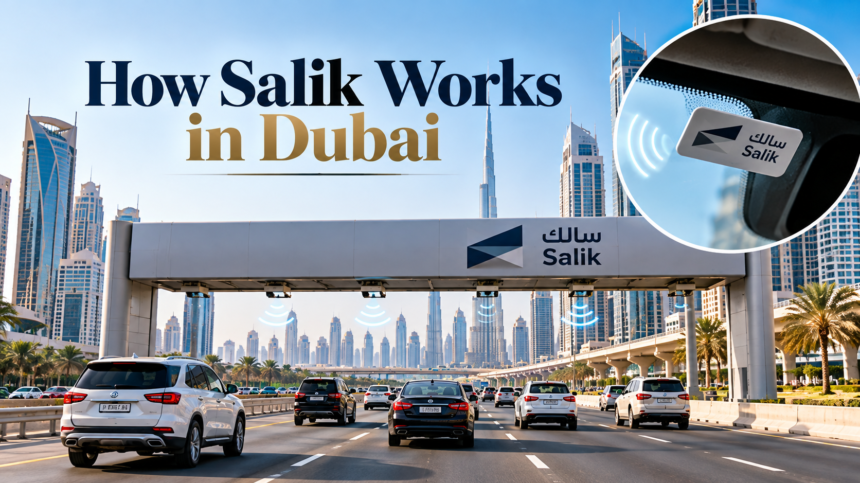
How Salik Works in Dubai When You Pass a Toll Gate
Understanding how Salik works in Dubai is essential if you plan to drive your own car, use a rental vehicle or regularly travel on major roads such as Sheikh Zayed Road and Al Khail Road.
- How Salik Works in Dubai When You Pass a Toll Gate
- How Much Does Salik Cost in Dubai?
- Where Are the Salik Toll Gates in Dubai?
- How the Al Safa and Al Mamzar Double-Gate Rules Work
- How to Get and Activate a Salik Tag
- What Happens if Your Salik Balance Is Too Low?
- What Happens if You Drive Through Salik Without Registering the Vehicle?
- How Salik Works With Rental Cars in Dubai
- Which Vehicles Can Receive Salik Exemptions?
- How Salik Variable Pricing Affects Daily Commuters
- How to Reduce Salik Costs Without Making Your Journey Difficult
- Common Salik Mistakes Dubai Drivers Should Avoid
- How Salik Works in Dubai: Quick Driver Checklist
Salik is Dubai’s electronic road-toll system. It is completely barrier-free, which means drivers do not stop at a toll booth or hand over cash. A vehicle simply passes beneath a Salik gate at normal road speed, and the applicable toll is automatically charged to the vehicle’s Salik account.
The system uses RFID technology to identify an activated Salik tag attached to the vehicle, while automatic number-plate recognition provides additional vehicle identification. Dubai currently has 10 Salik toll gates, including Al Barsha, Al Safa North, Al Safa South, Business Bay Crossing, Al Garhoud Bridge, Al Maktoum Bridge, Al Mamzar North, Al Mamzar South, Airport Tunnel and Jebel Ali.
One of the biggest changes visitors and residents need to understand is variable toll pricing. Since January 31, 2025, the amount charged can depend on the time and day rather than every passage costing the same amount.
That makes route timing much more important than it used to be.
How Salik Works in Dubai When You Pass a Toll Gate
Salik has been designed so that drivers barely notice the tolling process while travelling.
There are no barriers, payment windows or toll plazas. You continue driving normally while the system processes the transaction electronically.
The basic process works like this:
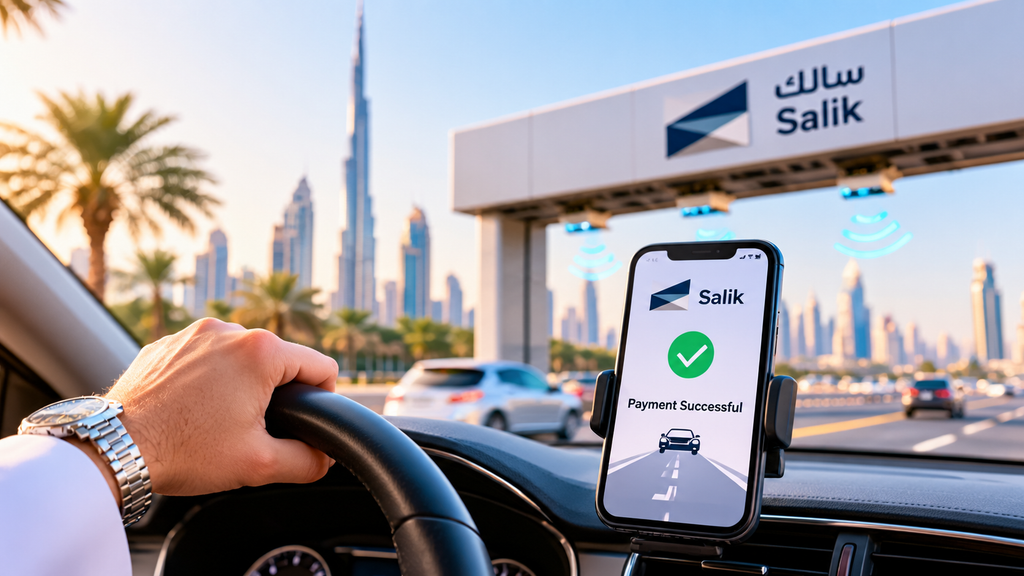
- Your vehicle approaches a Salik toll gate.
- The gate identifies the activated Salik RFID tag associated with the vehicle.
- Vehicle identification systems can also read the number plate.
- The applicable toll is deducted from the prepaid Salik account.
- The driver continues without stopping.
This free-flow model is particularly useful on Dubai’s busiest highways because stopping thousands of vehicles to collect tolls would create significant congestion.
Salik says its ten gates are positioned on major corridors including Sheikh Zayed Road and Al Khail Road, helping manage traffic on routes connecting key Dubai districts as well as journeys towards Abu Dhabi and the Northern Emirates.
You do not pay cash at the gate
Drivers do not need cash or a bank card ready when approaching Salik.
The payment comes from the Salik account linked to the vehicle.
That means the important thing is not preparing to pay while driving. It is making sure the correct vehicle is registered and the account contains sufficient balance.
How Much Does Salik Cost in Dubai?
Dubai now uses variable toll pricing.
Salik introduced the current system on January 31, 2025 to encourage drivers to travel outside the busiest periods and help redistribute traffic across the road network.
For regular weekdays, the current structure is:
| Time | Salik Charge |
|---|---|
| 6:00am–10:00am | AED 6 |
| 10:00am–4:00pm | AED 4 |
| 4:00pm–8:00pm | AED 6 |
| 8:00pm–1:00am | AED 4 |
| 1:00am–6:00am | AED 0 |
On Sundays, the standard toll is AED 4 throughout the chargeable daytime and evening periods, while travel between 1:00am and 6:00am remains free. The Sunday arrangement does not necessarily apply in the same way on public holidays or during certain events.
Peak hours cost more
The morning period from 6:00am to 10:00am and the afternoon-evening period from 4:00pm to 8:00pm are treated as weekday peak periods.
A passage through a Salik gate during these periods costs AED 6.
Off-peak travel costs AED 4
Travelling between 10:00am and 4:00pm or between 8:00pm and 1:00am on a normal weekday costs AED 4 per chargeable passage.
Past midnight can be free
The current system charges zero toll between 1:00am and 6:00am.
For drivers with flexible schedules, shifting a regular trip away from peak periods can therefore reduce Salik spending.
Where Are the Salik Toll Gates in Dubai?
Dubai currently operates ten Salik toll gates.
They are:
| Salik Gate | Main Road or Location |
|---|---|
| Al Safa North | Sheikh Zayed Road |
| Al Safa South | Sheikh Zayed Road |
| Al Barsha | Sheikh Zayed Road |
| Jebel Ali | Sheikh Zayed Road |
| Business Bay Crossing | Al Khail Road |
| Al Garhoud Bridge | Sheikh Rashid Road |
| Al Maktoum Bridge | Umm Hurair Road |
| Al Mamzar North | Al Ittihad Road |
| Al Mamzar South | Al Ittihad Road |
| Airport Tunnel | Beirut Street |
Salik confirms these ten locations in its current system information.
The two newest gates are Business Bay Crossing on Al Khail Road and Al Safa South on Sheikh Zayed Road. Both became operational on November 24, 2024.
Drivers should not assume Salik exists only on Sheikh Zayed Road.
The network now affects several important routes, including Al Khail Road, airport-related routes and major crossings.
Navigation apps can usually help drivers recognise toll roads, but anyone travelling regularly should become familiar with the gates on their normal commute.
How the Al Safa and Al Mamzar Double-Gate Rules Work
Not every passage beneath two nearby gates results in two separate charges.
Dubai applies special rules in certain locations.
Al Safa North and Al Safa South
If a vehicle passes through both Al Safa North and Al Safa South in the same direction within one hour, only one toll charge applies.
This arrangement became particularly important after the introduction of the Al Safa South gate.
It prevents drivers following the same corridor from automatically being charged twice simply because they crossed both closely related gates during one continuous journey.
Al Mamzar North and Al Mamzar South
A similar principle applies to the Al Mamzar North and South gates.
When a vehicle passes both in the same direction within one hour, only one toll is charged.
The important conditions are the same direction and the one-hour period.
Drivers should not assume every pair of Salik gates across Dubai qualifies for this arrangement.
How to Get and Activate a Salik Tag
A privately owned vehicle using Dubai’s Salik system should have its own activated Salik tag.
Salik states that drivers should purchase and activate the tag and attach it to the vehicle’s windscreen.
The tag contains vehicle-linked information that allows the tolling system to process charges automatically.
Each vehicle needs its own tag
Salik’s terms state that tags cannot be moved from one vehicle to another or transferred between users.
If you own two vehicles, you should therefore not treat one physical Salik tag as something you can move between both cars depending on which one you are driving.
Register the correct vehicle details
When activating the tag, make sure the licence-plate information and vehicle details are correct.
Incorrect registration can create toll-payment problems and potentially lead to violations.
Use digital services to manage the account
The Smart Salik app allows users to:
- Create or manage an account
- Recharge the balance
- Check usage
- Review transactions
- Settle violations
- Provide feedback
Salik also integrates with other digital platforms, including RTA services.
The most important habit after activation is simply maintaining enough money in the account.
What Happens if Your Salik Balance Is Too Low?
Salik is prepaid, so drivers are expected to maintain sufficient balance for their toll passages.
If the account does not contain enough money when the vehicle passes a gate, the driver receives a grace period to correct the situation.
Salik documentation states that an insufficient-balance violation can result in a AED 50 fine if the shortfall is not resolved within five working days.
That means a temporarily low balance does not necessarily produce an immediate fine.
However, it should still be corrected quickly.
Check your balance regularly
This is especially important if you:
- Commute daily through Salik gates
- Have several vehicles on the account
- Travel frequently during peak hours
- Use automatic parking payments linked to Salik
Variable pricing means regular commuters may use balance more quickly during peak periods than under the old flat toll system.
Consider automatic recharge options
If available through your banking or Salik setup, automatic recharging can reduce the risk of accidentally allowing the balance to fall too low.
Regular account notifications are also useful.
What Happens if You Drive Through Salik Without Registering the Vehicle?
Dubai’s system can recognise a vehicle even if there is no valid tag because cameras can identify the number plate.
However, driving without properly registering the vehicle does not mean the toll disappears.
Salik’s terms require users to complete registration and tag activation within 10 working days from the trip.
If the vehicle remains unregistered after the grace period, violations can become considerably more expensive than the original toll.
Salik documentation describes the unregistered-vehicle fines as:
- AED 100 for the first violation
- AED 200 for the second violation
- AED 400 from the third violation onward
A maximum of one such violation per day per vehicle applies under the cited rules.
For a newly purchased vehicle, therefore, delaying Salik registration is not a good way to avoid tolls.
The unpaid tolls and possible penalties can quickly exceed the cost of simply registering the car correctly.
How Salik Works With Rental Cars in Dubai
Tourists driving rental cars usually do not need to purchase their own Salik tag.
Rental vehicles are normally already registered within the tolling system, and the rental company tracks each Salik passage associated with the car.
However, this does not mean Salik is included free of charge.
The rental company may charge:
- The actual toll
- An administration fee
- A processing fee
- Another contractually specified Salik charge
The amount depends on the rental agreement.
Read the Salik section before driving
Do not assume a rental company charges exactly the same amount as the raw toll.
For example, a gate passage may produce an AED 4 or AED 6 toll, but your rental contract could include an additional service fee.
Ask the rental company how Salik is calculated before accepting the vehicle.
Do not remove the tag
The car’s toll setup belongs to the rental vehicle.
There is no need to attach your personal tag or interfere with the rental company’s system.
Track your journeys
If you expect to drive frequently on Sheikh Zayed Road, include Salik in your holiday transport budget.
Several gate passages each day can add up, particularly during AED 6 peak periods.
Which Vehicles Can Receive Salik Exemptions?
Not every vehicle passing a Salik gate is necessarily charged.
Salik reports toll exemptions for several categories of vehicles serving community or public-service functions.
These can include vehicles associated with:
- Charities
- Schools
- People of Determination
- Ambulance services
- Certain public services
Eligibility depends on applicable rules and registration requirements.
Drivers should not assume that simply belonging to an eligible category makes every vehicle automatically exempt.
The relevant exemption normally needs to be recognised within the official system.
For ordinary private vehicles and most rental cars, normal toll charges apply.
How Salik Variable Pricing Affects Daily Commuters
Variable pricing has changed the way regular commuters should think about Salik.
Under the current model, a weekday commuter passing one chargeable gate during morning peak and another during evening peak could pay AED 12 per working day just for those two passages.
Over approximately 22 working days, that would amount to about AED 264 for that pattern alone.
A driver making the same two trips during AED 4 off-peak periods would spend about AED 176 over 22 days.
The difference is AED 88 in that simplified example.
Actual spending depends on:
- Number of gates crossed
- Route
- Travel times
- Working days
- One-hour linked-gate rules
- Sundays
- Public holidays
- Other exemptions
The variable system is designed partly to encourage people who have flexibility to shift journeys away from the busiest hours. Salik says the change was introduced to improve transportation efficiency and redistribute travel between peak and off-peak periods.
For commuters, checking whether leaving 30 to 60 minutes earlier or later changes both congestion and toll cost may therefore be worthwhile.
How to Reduce Salik Costs Without Making Your Journey Difficult
The cheapest route is not always the best route.
Avoiding a AED 4 toll by adding 25 minutes of driving and using significantly more fuel may not be a real saving.
Instead, compare the complete journey.
Travel outside peak hours
When your schedule allows, avoiding the AED 6 weekday peak periods immediately reduces the toll per chargeable crossing to AED 4.
Travelling between 1:00am and 6:00am is currently toll-free, although that time will obviously not suit most journeys.
Use toll-free routes carefully
Navigation apps may offer an “avoid tolls” option.
This can be useful, but compare:
- Extra kilometres
- Additional travel time
- Traffic congestion
- Fuel consumption
before automatically choosing it.
Use public transport for suitable commutes
For journeys along areas served well by Dubai Metro, public transport can remove Salik costs as well as parking and fuel expenses.
This can be particularly useful for regular journeys along the Sheikh Zayed Road corridor.
Understand linked gates
Knowing the Al Safa and Al Mamzar rules prevents unnecessary confusion when reviewing account transactions.
Plan several errands together
Instead of crossing a toll gate repeatedly throughout the day, group activities by area where practical.
Good route planning can save both tolls and time.
Common Salik Mistakes Dubai Drivers Should Avoid
One common mistake is still believing that every Salik passage costs AED 4.
That was the older flat-price structure. Since January 31, 2025, weekday peak passages cost AED 6, off-peak passages cost AED 4 and the 1:00am–6:00am period is currently free.
Another mistake is assuming that driving through a gate without a tag means the system cannot identify the vehicle. Number-plate recognition can still identify unregistered vehicles, and failure to register within the permitted period can result in substantial fines.
Drivers should also avoid allowing the account balance to remain insufficient. A short grace period exists, but leaving the problem unresolved can lead to a AED 50 violation.
Rental-car users sometimes forget that Salik can appear later on the rental invoice. The car may pass the toll gate without any obvious alert to the driver, but the transaction is still recorded.
Another mistake is assuming every Salik gate charges independently. Al Safa North and South, as well as Al Mamzar North and South, have special same-direction one-hour charging arrangements.
Finally, drivers should avoid taking long and congested detours merely to save a small toll. Time, fuel and stress also have a cost.
How Salik Works in Dubai: Quick Driver Checklist
The system becomes simple once drivers understand the basic rules.
| Question | What Drivers Should Know |
|---|---|
| What is Salik? | Dubai’s barrier-free road toll system |
| Do you stop at gates? | No |
| Number of toll gates | 10 |
| Weekday peak price | AED 6 |
| Weekday off-peak price | AED 4 |
| 1am–6am charge | AED 0 |
| Sunday standard charge | AED 4 outside free hours, subject to exceptions |
| Tag required for private vehicle? | Yes, with correct activation and registration |
| Low-balance grace period | Five working days before qualifying fine |
| Unregistered vehicle grace period | 10 working days |
| Rental cars | Rental company normally manages the Salik setup |
| Can one tag move between cars? | No |
Understanding how Salik works in Dubai is ultimately straightforward once you know that the system operates automatically.
A vehicle passes beneath one of Dubai’s ten Salik gates, the system identifies it and the appropriate toll is deducted electronically. There are no physical toll booths and no need to slow down specifically to make a payment.
The most important recent change is variable pricing. Normal weekday peak travel from 6:00am to 10:00am and 4:00pm to 8:00pm costs AED 6 per chargeable crossing, while off-peak periods cost AED 4 and travel from 1:00am to 6:00am is currently free.
Drivers should keep their vehicles properly registered, maintain sufficient account balance and understand which toll gates they cross during their normal journeys.
Rental-car users should check how their rental company bills Salik, while regular commuters can potentially reduce costs by shifting travel away from peak periods or using public transport where practical.
Salik is designed to make toll payment almost invisible while driving.
For the driver, the main responsibility happens before and after the journey: register correctly, keep the account funded and understand when and where the charges apply.
Do follow us on Instagram
Read More – Dates in Gulf Hospitality: Why This Tradition Still Matters