



Choosing an International School in the GCC
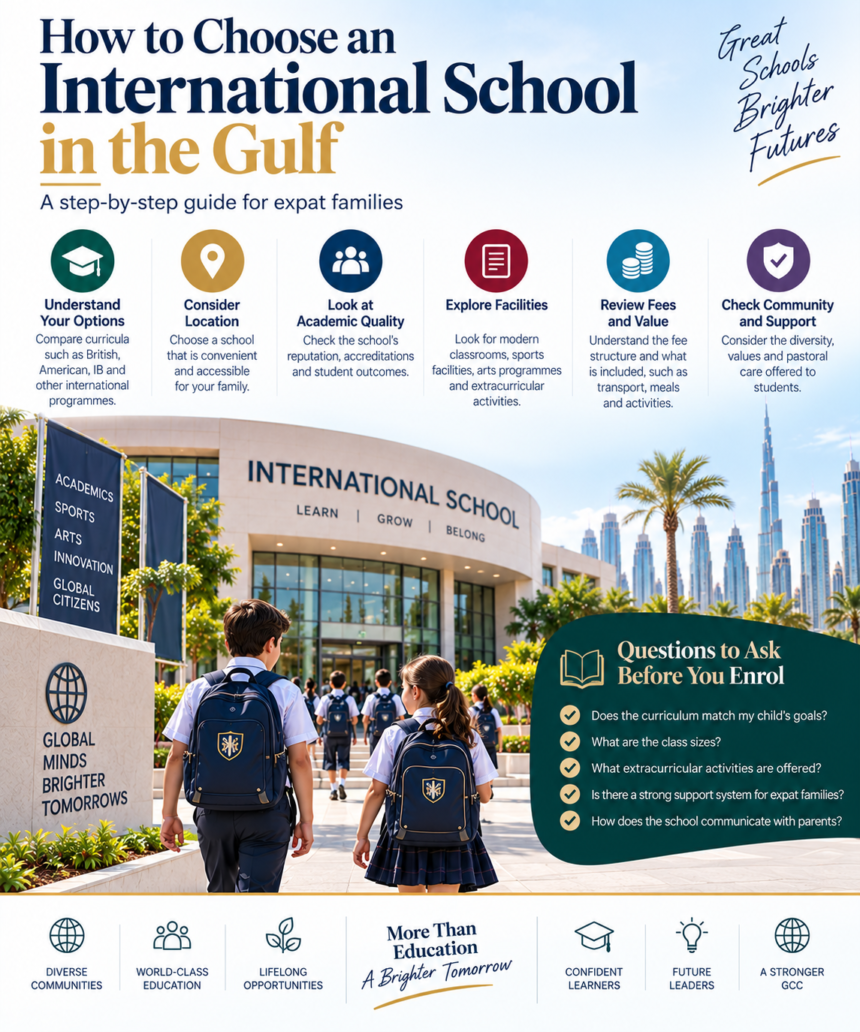
How to Choose an International School in the Gulf is one of the most important questions facing expatriate parents relocating to the UAE, Saudi Arabia, Qatar, Kuwait, Bahrain or Oman. The Gulf has developed a large international education sector offering British, American, International Baccalaureate, Indian and other national curricula, giving families far more choice than they may initially expect.
- Choosing an International School in the GCC
- 1. Selecting the Right Curriculum
- 2. Checking School Licensing and Accreditation
- 3. Reviewing School Inspections and Academic Quality
- 4. Comparing Teaching Quality and Staff Stability
- 5. Understanding School Fees and Additional Costs
- 6. Evaluating Class Sizes and Learning Support
- 7. Reviewing Student Wellbeing and Safeguarding
- 8. Considering Location and Daily Commute
- 9. Comparing Facilities and Extracurricular Activities
- 10. Planning for Secondary Education and University
- 11. Understanding Admissions and Waiting Lists
- 12. Visiting the School Before Enrolment
- Choosing Schools for Younger Children
- Choosing Schools for Teenagers
- International School Choices Across the GCC
- British, American, IB and Other Curriculum Options
- Special Educational Needs and Inclusive Education
- School Transport and Family Housing Decisions
- Preparing Documents for International School Admission
- Changing International Schools Within the Gulf
- Common Mistakes Parents Make When Choosing Schools
- Practical International School Comparison Checklist
- Final Thoughts on Choosing an International School in the Gulf
More choice, however, does not necessarily make the decision easier.
Two schools following the same curriculum can provide very different educational experiences. One may have excellent academic results but a long daily commute. Another may offer impressive sports facilities but limited subject choices for older students. A premium school may charge considerably more without necessarily being the best environment for a particular child.
Parents therefore need to look beyond school reputation, social media photographs and impressive campuses.
The right international school should provide a strong combination of academic quality, appropriate curriculum, student wellbeing, qualified teachers, realistic fees, manageable travel and a clear pathway into the next stage of education.
For internationally mobile families, another factor matters: continuity. A child may begin school in Dubai, move to Riyadh several years later and eventually apply to university in Europe, North America, Asia or elsewhere. The education decisions made today can influence how easily those transitions happen later.
Choosing an International School in the GCC
International education is firmly established across the Gulf.
Dubai provides one of the clearest examples of the scale of choice. KHDA’s current private-school directory lists 232 schools and allows parents to compare them using criteria including curriculum, fee range, location and performance. The directory also displays information relating to wellbeing and inclusion for inspected schools.
The same principle exists elsewhere in the GCC, although regulatory systems differ.
Abu Dhabi’s ADEK maintains policies covering school licensing, curriculum, assessment, inclusion, safeguarding, wellbeing, transportation and quality assurance.
Saudi Arabia’s Ministry of Education regulates private and international schools, including areas such as staffing, school schedules, tuition and educational quality.
Qatar requires private schools to be licensed by the Ministry of Education and Higher Education under the country’s private-school regulatory framework.
Oman distinguishes between monolingual, bilingual and international private schools, with international institutions offering recognised international programmes and qualifications.
For parents, this means the first step is not finding the school with the most attractive website. It is identifying officially recognised schools that match the family’s educational priorities.
1. Selecting the Right Curriculum
Curriculum should be one of the first filters when comparing schools.
The most common international options in major GCC cities include:
- British curriculum
- American curriculum
- International Baccalaureate
- Indian CBSE or other Indian programmes
- French curriculum
- Canadian programmes
- Australian programmes
- Other national or international systems
The right choice depends partly on where the child studied previously and where the family expects them to continue their education.
A child already studying the British curriculum may benefit from continuing through the same structure, particularly when approaching GCSEs or A Levels.
A student following an American programme may be better served by remaining within a compatible credit-based system.
Internationally mobile families may consider IB because its programmes are specifically designed around international education, although individual schools may offer different subjects.
Curriculum changes become more difficult as children get older.
Moving between educational systems during early primary school can often be managed relatively easily. Changing curriculum immediately before major secondary qualifications can create complications with credits, examination content or university prerequisites.
Parents should therefore think beyond the next academic year.
2. Checking School Licensing and Accreditation
Every international school should be appropriately licensed by the education regulator in the country or emirate where it operates.
This should be considered essential rather than optional.
Saudi Arabia’s Ministry of Education specifically regulates private and international schools and establishes requirements for staffing, leadership, facilities and educational operations.
Qatar’s Ministry of Education and Higher Education similarly licenses private schools under Law No. 23 of 2015 and associated regulations.
In Oman, international schools are defined as schools offering recognised international programmes and qualifications under appropriate international supervision and recognition.
Parents should also examine curriculum-specific accreditation.
For an American school, find out which recognised organisation accredits the institution.
For a British school, investigate whether it has recognised international or British-school accreditation in addition to local licensing where applicable.
For an IB school, confirm whether the school is formally authorised to offer the specific IB programme advertised.
Local licensing proves the school is permitted to operate. International accreditation can provide additional information about whether it meets the standards associated with its claimed educational model.
3. Reviewing School Inspections and Academic Quality
Parents should use independent evidence whenever it is available.
Dubai’s KHDA directory is particularly useful because parents can see regulatory performance ratings alongside curriculum, grade range, fees and location.
Inspection information can reveal much more than examination results.
Depending on the regulator, reports may cover:
- Teaching quality
- Student achievement
- School leadership
- Curriculum quality
- Inclusion
- Student wellbeing
- Safeguarding
- Areas requiring improvement
Abu Dhabi’s education framework also requires schools to maintain quality-assurance processes, including evaluation of teaching standards and the use of inspection results to support improvement.
Bahrain offers another useful example. The Ministry of Education advises parents to verify that a private school is officially licensed and to examine independent school reports produced by the Education and Training Quality Authority.
Bahrain’s BQA currently publishes searchable review reports, including recent 2026 school evaluations.
Inspection ratings should not decide the choice by themselves, but they can help parents distinguish evidence from marketing.
4. Comparing Teaching Quality and Staff Stability
Teachers influence a child’s experience more directly than the size of the swimming pool or appearance of the school entrance.
Parents should therefore ask about:
- Teacher qualifications
- Average teaching experience
- Staff turnover
- Professional development
- Classroom support
- Subject-specialist teachers
- Leadership stability
High staff turnover can disrupt continuity.
This is especially important for children in examination years or students requiring additional learning support.
During a school visit, ask how long teachers typically stay and how new staff are recruited and supported.
Parents can also observe the atmosphere.
Do teachers appear comfortable interacting with students? Are children confident speaking to adults? Are classrooms calm and organised?
These observations can reveal aspects of school culture that cannot be captured in a brochure.
Saudi Arabia’s international-school regulations, for example, require schools to maintain sufficient educational personnel according to their curricula, student numbers and educational levels.
Strong staffing is not simply a luxury. It is part of delivering the curriculum effectively.
5. Understanding School Fees and Additional Costs
International school fees can become one of the largest expenses in an expatriate family’s household budget.
Parents should never compare schools using tuition alone.
Additional costs can include:
- Application fees
- Registration deposits
- Books
- Uniforms
- School buses
- Laptops or tablets
- Examination charges
- Lunches
- School trips
- Extracurricular programmes
- Learning support
Dubai has introduced a particularly transparent system through its School Fees Fact Sheet.
KHDA states that every Dubai private school must provide a fact sheet showing mandatory and optional fees for the academic year. These documents are available through the official school directory.
Saudi Arabia also provides an official electronic service allowing parents to review tuition fees for private and international schools.
Families should calculate the total annual cost per child and then multiply it across the number of children and expected years of schooling.
A small annual difference becomes substantial over ten years.
Parents receiving a company education allowance should also check whether it covers tuition only or additional charges.
6. Evaluating Class Sizes and Learning Support
A school’s total number of students tells parents relatively little about the actual classroom experience.
Ask specifically about class sizes.
The ideal number depends on age, teaching style and the needs of individual students, but parents should understand how much adult support is available.
For younger children, ask whether classrooms have teaching assistants.
For older students, investigate how schools support children who fall behind and how they challenge high-performing students.
Questions worth asking include:
- How quickly are learning difficulties identified?
- Are intervention programmes available?
- Are students grouped by ability?
- What happens when a child struggles with mathematics or reading?
- How are gifted students supported?
- Are language-support programmes available for students learning English?
A school should be able to explain these processes clearly.
7. Reviewing Student Wellbeing and Safeguarding
Academic performance is important, but children spend a significant part of their lives at school.
Parents should therefore examine the environment in which those results are achieved.
Abu Dhabi’s current regulatory framework contains dedicated policies covering student mental health, safeguarding, student protection, behaviour and broader wellbeing.
When comparing schools, ask about:
- Anti-bullying procedures
- Counsellors
- Student protection
- Online safety
- Behaviour management
- Mental health support
- Pastoral care
- Communication with parents
Observe students during the visit.
Children who appear relaxed, engaged and comfortable speaking with teachers can provide clues about school culture.
Parents should also understand the school’s complaint procedure. Problems can arise even at excellent schools. What matters is whether the institution responds fairly and effectively when they do.
8. Considering Location and Daily Commute
Families sometimes find a school they love and only later realise that reaching it requires an exhausting daily journey.
This is particularly important in large Gulf cities such as Dubai and Riyadh.
A journey shown as 20 minutes on a map late in the evening might take considerably longer during school traffic.
Visit the route at approximately the same time the child will travel.
Calculate:
Morning journey + afternoon journey × five school days.
A one-hour journey each direction means a child could spend ten hours every week travelling.
That affects sleep, extracurricular activities, homework and family time.
The school with the slightly lower rating but a 15-minute commute may provide a better overall quality of life than another requiring 70 minutes each way.
Location should therefore be treated as part of education quality rather than merely a housing issue.
9. Comparing Facilities and Extracurricular Activities
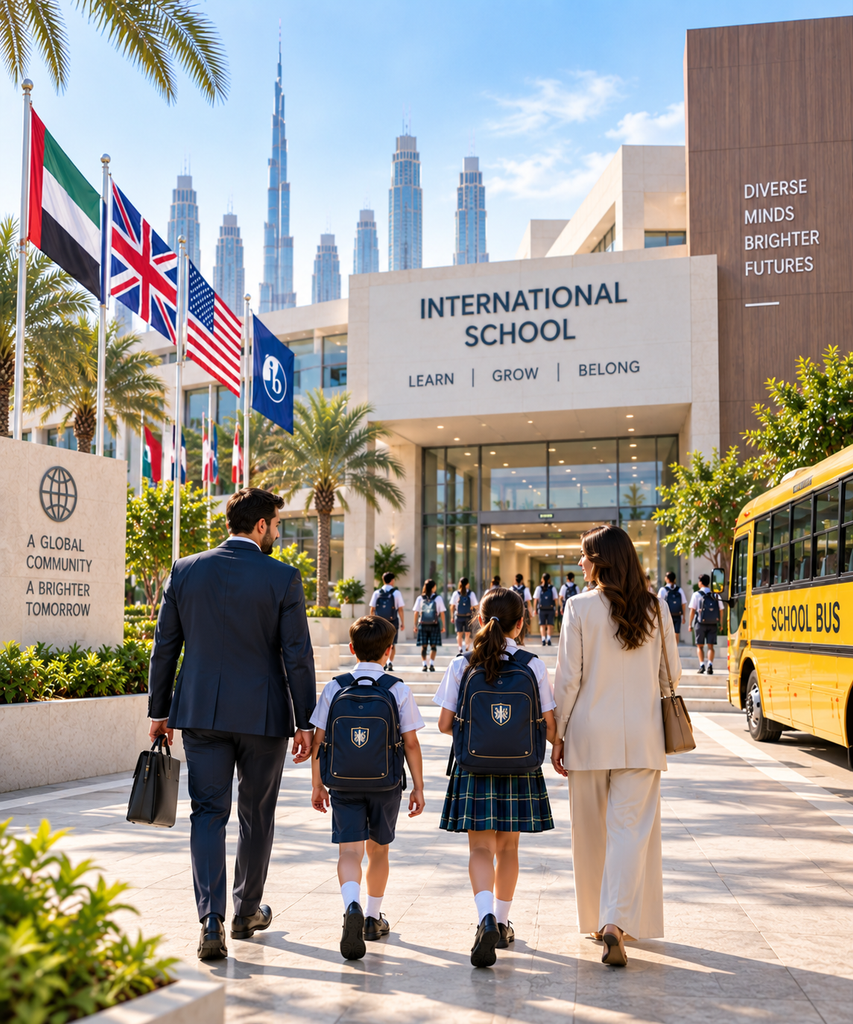
Modern Gulf international schools can have extremely impressive campuses.
Facilities may include:
- Swimming pools
- Football pitches
- Sports halls
- Science laboratories
- Auditoriums
- Music studios
- Art rooms
- Design laboratories
- Robotics facilities
- Libraries
These features can improve education, but only when students actually use them.
Ask how often ordinary students access each facility.
A large theatre has limited value if your child never participates in performing arts.
Extracurricular programmes deserve similar scrutiny.
Activities may include sports, coding, robotics, debating, Model United Nations, music, drama, art, language clubs and community service.
Check whether they are included in tuition or carry additional charges.
The goal is not to find the campus with the longest list of facilities. It is to identify opportunities that match your child’s interests.
10. Planning for Secondary Education and University
Parents of younger children often focus almost entirely on primary education.
However, it is worth understanding where the school ultimately leads.
Find out which qualifications students can complete.
These may include:
- GCSE or IGCSE
- A Levels
- International Baccalaureate Diploma
- American High School Diploma
- Advanced Placement
- CBSE examinations
- Other national qualifications
Then investigate the school’s university guidance.
Abu Dhabi’s regulatory framework, for example, specifically includes career and university guidance requirements designed to help students transition successfully into post-secondary education.
For older children, ask for recent information about university destinations.
More importantly, confirm whether the school offers the subjects required for the child’s possible degree.
A student interested in engineering may need advanced mathematics and physics. Medicine can require specific sciences. Other degrees may have different prerequisites.
Do not wait until Grade 12 or Year 13 to discover that a required subject was unavailable.
11. Understanding Admissions and Waiting Lists
Popular international schools can have limited places in specific year groups.
Parents relocating to the Gulf should therefore begin applications early.
Admissions procedures can involve:
- Previous school reports
- Entrance assessments
- English-language testing
- Mathematics testing
- Interviews
- Special educational needs assessments
- Registration deposits
Qatar’s current system illustrates how structured the process can be. Parents applying to private schools through the compulsory education platform can review information including fees and curriculum before submitting an application, after which schools may interview or assess the student according to their own policies.
Seat availability can also affect the options shown to families.
Do not assume that an application guarantees admission.
Families moving because of employment should consider applying to several suitable schools rather than relying entirely on one preferred option.
12. Visiting the School Before Enrolment
A school visit can answer questions that websites cannot.
Try to visit during an ordinary school day rather than only attending a highly polished promotional event.
Observe:
- Student behaviour
- Classroom atmosphere
- Teacher interactions
- Cleanliness
- Security
- Libraries
- Sports areas
- Toilets
- Canteens
- Outdoor spaces
- Learning displays
Speak with the admissions team, but also ask to meet teachers or academic leaders where possible.
Bahrain’s Ministry of Education specifically advises parents to visit schools, explore the learning environment and speak with teachers, parents and students before choosing.
Prepare questions in advance.
You should leave understanding not only what the school offers, but how the school actually operates.
Choosing Schools for Younger Children
For children in nursery, kindergarten or early primary education, the school environment can matter more than university results.
Look closely at:
- Teacher warmth
- Play opportunities
- Language development
- Reading
- Numeracy
- Outdoor activity
- Classroom routines
- Parent communication
Young children also benefit enormously from short commutes.
A highly prestigious school requiring a lengthy bus journey may not always be the best choice for a four-year-old.
At this stage, parents should prioritise a safe, positive learning environment where children develop confidence and enjoy attending school.
Choosing Schools for Teenagers
Secondary students require a very different evaluation.
Subject choice becomes critical.
Check the exact GCSEs, A Levels, AP courses or IB Higher Level subjects available.
Ask whether courses sometimes disappear because too few students select them.
Look at university counselling and examination results, but also consider student workload.
Changing schools during senior secondary education can be particularly disruptive.
Families expecting relocation should discuss possible transfer scenarios with the school before enrolling.
International School Choices Across the GCC
International-school availability varies significantly across the Gulf.
United Arab Emirates
Dubai and Abu Dhabi offer some of the widest choices. Dubai’s KHDA directory currently lists 232 private schools and provides performance, curriculum, fee and location information.
Saudi Arabia
Saudi Arabia has an extensive private and international education sector supervised by the Ministry of Education. The government also provides official services for checking tuition fees.
Qatar
Qatar’s Ministry of Education and Higher Education licenses private schools and maintains digital registration processes for resident families.
Bahrain
Parents can verify licensed private schools through the Ministry of Education and examine independent performance reports from the BQA.
Oman
Oman recognises several forms of private education, including international schools offering recognised international programmes and qualifications.
Kuwait
Kuwait also has a long-established international education market. Families should verify current licensing, curricula, fees and admission conditions through the school and relevant Ministry of Education services before enrolling.
British, American, IB and Other Curriculum Options
Curriculum labels are useful, but they should never replace investigation of the individual school.
A British school may follow a structured pathway towards GCSEs and A Levels.
An American school may use a broader credit-based model leading to a High School Diploma and potentially AP courses.
An IB school may offer the Primary Years Programme, Middle Years Programme or Diploma Programme.
Indian families may prefer CBSE because it can provide continuity when returning to India.
Other families may deliberately choose French, Canadian or another national programme because they expect to return to that system later.
The best curriculum is one that fits both the child and the family’s likely future.
Special Educational Needs and Inclusive Education
Parents of children requiring additional support should investigate inclusion before paying a deposit.
Ask the school for specific examples of how it supports children with similar needs.
Check:
- Learning support teachers
- Individual education plans
- Specialist services
- Classroom assistants
- Speech and language support
- Occupational therapy arrangements
- Additional costs
Abu Dhabi’s current policies explicitly cover inclusive education and in-school specialist services, including referral processes for students needing additional support.
The word “inclusive” in marketing material is not enough.
Parents should understand what support will actually be available every day.
School Transport and Family Housing Decisions
Families relocating internationally often rent a home before finalising a school.
In some Gulf cities, it can make sense to reverse that process.
Shortlist schools first, then examine residential communities that create manageable journeys to both school and work.
School transport may help, but parents should check:
- Bus journey length
- Pick-up time
- Drop-off time
- Safety arrangements
- Transport fees
- Adult supervision
Abu Dhabi’s education framework, for example, includes specific requirements for safe and efficient school transport.
A child’s daily routine should be considered alongside academic quality.
Preparing Documents for International School Admission
Parents moving between countries should maintain an organised education file for each child.
Common documents can include:
- Passport
- Residence identification
- Birth certificate
- Previous school reports
- Transfer certificate
- Academic transcript
- Vaccination or health records
- Special educational needs assessments
- Examination results
Requirements vary between GCC countries and individual schools.
Qatar, for example, requires officially approved academic certificates in certain international private-school registration situations for students arriving from outside the country.
Ask the school for its current document checklist before relocating.
Missing documents can delay admission even after the child has been academically accepted.
Changing International Schools Within the Gulf
Families frequently move between GCC countries because of career changes.
A transfer from Dubai to Doha or Riyadh may seem easier than moving to another part of the world, but academically it is still an international transfer.
Try to remain within the same curriculum where possible.
For older children, provide the receiving school with detailed transcripts and current subject information before accepting the place.
Check examination boards, graduation credits and subject availability.
Qatar’s current rules, for example, distinguish between transfers within the same curriculum and transfers between different curricula during the academic year.
Timing matters more as students approach graduation.
Common Mistakes Parents Make When Choosing Schools
Choosing only by reputation
A famous school may still be wrong for your child.
Ignoring the commute
Daily travel affects sleep, family time and extracurricular activities.
Looking only at tuition
Transport, uniforms, devices and activities can significantly increase costs.
Choosing curriculum without thinking long term
Future relocation and university plans matter.
Focusing excessively on facilities
Excellent buildings do not guarantee excellent teaching.
Ignoring staff turnover
Teacher continuity can significantly affect children.
Applying too late
Popular year groups may have waiting lists.
Not checking official inspection information
Use regulator reports where available.
Assuming every school within one curriculum is identical
Individual schools can differ significantly in subjects, teaching and qualifications.
Practical International School Comparison Checklist
| Factor | Information to compare |
|---|---|
| Curriculum | British, American, IB, Indian or another system |
| Licensing | Officially recognised by local regulator |
| Accreditation | Relevant external recognition |
| Inspection | Latest available regulator report |
| Teaching | Qualifications and staff stability |
| Class size | Students and classroom support |
| Fees | Tuition plus all additional costs |
| Location | Peak-time travel |
| Admissions | Tests, interviews and availability |
| Inclusion | Learning and specialist support |
| Wellbeing | Counselling, safeguarding and pastoral care |
| Facilities | Relevant to the child’s interests |
| Activities | Sport, arts, technology and clubs |
| Qualifications | GCSE, A Level, IB, AP, CBSE or others |
| University guidance | Subject planning and applications |
| Parent communication | Reports, meetings and digital systems |
No school will necessarily be strongest in every category.
The purpose is to identify which factors matter most for your child.
Final Thoughts on Choosing an International School in the Gulf
Learning how to choose an international school in the Gulf requires parents to look beyond rankings, tuition fees and campus photographs.
Begin with the child.
Consider how they learn, what support they need and which curriculum fits their previous education and future plans.
Then verify the school.
Check local licensing, curriculum accreditation and official inspection information where available.
Examine teacher quality and staff stability. Understand the complete annual cost. Test the commute during peak hours and investigate student wellbeing as carefully as academic results.
For younger children, a nurturing classroom, strong foundational teaching and short journey may matter most.
For teenagers, subject availability, examination pathways and university guidance become critical.
Families expecting to move again should consider curriculum portability from the beginning.
Across the UAE, Saudi Arabia, Qatar, Bahrain, Oman and Kuwait, international education provides families with an impressive range of options. The challenge is not finding a school with a good reputation. It is identifying the school that works best for one particular child.
The strongest school choice balances academic quality, wellbeing, curriculum, affordability, location and long-term continuity.
That combination is far more valuable than choosing a school simply because it is the most expensive, most famous or most visually impressive.
Do follow us on Instagram
Read More – British vs American vs IB Schools in the GCC: 10 Essential Differences