

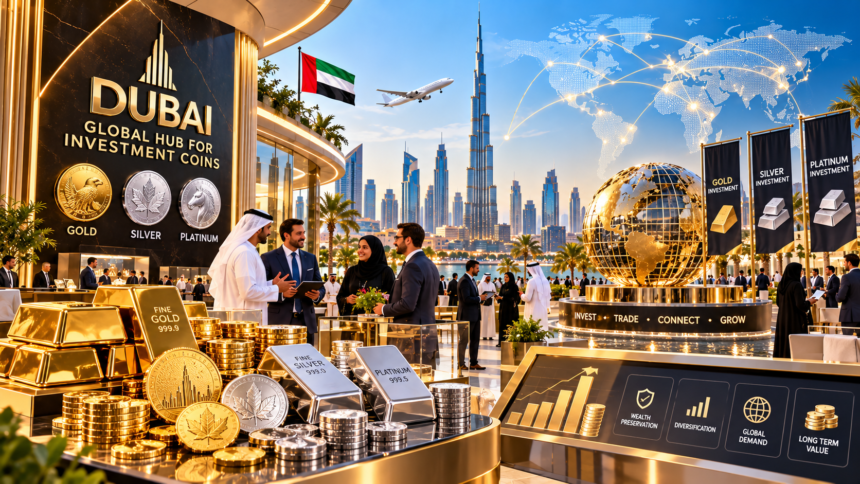
Investment Coins in Dubai: Why Gold, Silver and Platinum Are Gaining Global Attention
Investment coins in Dubai are becoming part of a much larger precious-metals story. The emirate has long been associated with gold jewellery and the traditional Gold Souk, but today its market stretches far beyond jewellery into bullion, investment-grade coins, refining, secure storage, commodities trading and digital precious-metal infrastructure.
- Investment Coins in Dubai: Why the Market Is Growing
- Dubai Already Has the Infrastructure of a Major Gold Hub
- The UAE Offers 0% VAT on Qualifying Investment Precious Metals
- Why the VAT Rule Is Especially Important for Silver and Platinum
- Gold, Silver or Platinum: They Do Not Behave the Same Way
- Dubai Even Has Its Own UAE Bullion Coins
- Coins Can Offer More Flexibility Than Large Bullion Bars
- Understanding the Premium Over the Metal Price
- Dubai’s Market Is Becoming More Transparent and Regulated
- The UAE Good Delivery Standard Adds Another Layer to the Market
- Secure Storage Is Already Part of Dubai’s Precious-Metal Ecosystem
- Dubai’s Gold Market Is Moving Beyond Traditional Physical Trading
- Why Dubai’s Location Matters to International Coin Buyers
- Authenticity Matters More as the Market Expands
- Bullion Coins and Collectible Coins Are Not the Same Investment
- What to Check Before Buying Investment Coins in Dubai
- Price Movements Still Matter
- Why Dubai Could Become Even More Important for Silver and Platinum
- Frequently Asked Questions About Investment Coins in Dubai
- Why Dubai Is Becoming a Global Hub for Investment Coins
Dubai already sits at the centre of substantial global gold flows. DMCC says the emirate accounts for around 15% of worldwide gold trade, while more than 1,500 companies operate across its gold and precious-metals ecosystem. DMCC also reported that UAE precious-metals trade exceeded US$186 billion in 2024, highlighting the scale of the wider market supporting investors and traders.
For people interested in physical gold, silver or platinum, Dubai also has another important advantage. Under UAE VAT rules, qualifying investment precious metals can be supplied or imported at a 0% VAT rate, provided they meet specific purity and global tradability requirements.
That combination of taxation, international trade links, established bullion businesses, professional storage and regulation is helping make Dubai increasingly relevant to buyers of investment coins.
Investment Coins in Dubai: Why the Market Is Growing
An investment coin is different from an ordinary commemorative or collectible coin.
Its value is primarily connected to the precious metal it contains, although mint reputation, rarity, condition and demand can also influence the price. Investors commonly look at weight, purity and the premium charged over the underlying metal value.
Dubai is particularly well positioned for this market because investment coins do not exist in isolation. They sit inside a much larger precious-metals ecosystem that includes refiners, wholesalers, logistics companies, vault operators, dealers, exchanges and international trading businesses.
DMCC describes its ecosystem as covering refining, trading, finance, logistics, storage and manufacturing, with more than 1,500 companies operating across gold and precious metals.
For the individual buyer, this means Dubai is not simply a destination where coins happen to be sold. It is part of an international supply chain through which precious metals are refined, traded, stored and redistributed.
Dubai Already Has the Infrastructure of a Major Gold Hub
Perhaps the strongest reason Dubai can develop into a major investment-coin centre is that much of the required infrastructure already exists.
DMCC operates a dedicated gold ecosystem that includes trading companies, refineries, jewellery manufacturers, financial infrastructure and high-security storage. It describes Dubai as accounting for approximately 15% of global gold trade, with much of that activity passing through the DMCC ecosystem.
The UAE’s geographic position also helps.
Dubai sits between major precious-metal producing and consuming markets across Africa, Asia, the Middle East and Europe. This allows metal to move through the emirate as part of international refining, wholesale and retail supply chains.
That matters to investment-coin buyers because a large trading ecosystem can support greater product availability, specialist expertise and opportunities for resale.
A developed market does not guarantee that every coin will always be easy to sell, but internationally recognised bullion products generally benefit from being traded within an active precious-metals environment.
The UAE Offers 0% VAT on Qualifying Investment Precious Metals
Tax treatment is one of Dubai’s most important advantages, particularly when comparing physical precious-metal ownership across different jurisdictions.
Article 36 of the UAE VAT Executive Regulations states that the supply or importation of investment precious metals is zero-rated.
To qualify, the metal must meet two conditions:
- It must have a purity of at least 99%.
- It must be in a form that is tradable in global bullion markets.
The rule covers gold, silver and platinum.
This distinction is important because it means a qualifying investment coin can potentially receive 0% VAT treatment regardless of whether the underlying metal is gold, silver or platinum.
The Federal Tax Authority also specifically includes qualifying investment-grade precious metals among supplies eligible for the zero VAT rate.
However, buyers should understand the wording carefully.
Zero-rated does not mean that every gold, silver or platinum object sold in Dubai automatically carries no VAT. A piece must satisfy the legal definition of an investment precious metal.
A decorative coin, jewellery item, lower-purity product or collectible that does not meet the relevant conditions may receive different VAT treatment.
Why the VAT Rule Is Especially Important for Silver and Platinum
Gold often receives preferential investment-tax treatment in international markets, but silver and platinum can face different tax rules in some countries.
The UAE framework is notable because Article 36 applies the same basic investment-precious-metal test to all three metals: gold, silver and platinum.
For an investor comparing physical metals, taxes can significantly affect the starting cost of a position.
Imagine that two coins contain the same market value of metal but one jurisdiction adds a substantial consumption tax before the buyer even takes possession. The metal price would need to rise enough to recover that tax cost before other expenses such as dealer premiums and resale spreads are considered.
The UAE’s 0% treatment for qualifying products can therefore make Dubai attractive to people considering physical silver and platinum alongside gold.
It is still essential to confirm the VAT status of the specific coin before purchase rather than assuming that every bullion-looking product qualifies.
Gold, Silver or Platinum: They Do Not Behave the Same Way
Although all three are precious metals, investors should not treat them as interchangeable.
| Metal | Typical Investment Characteristics | Important Considerations |
|---|---|---|
| Gold | Deep international market, widely recognised bullion products and long history as a store-of-value asset | Price can still fall, and premiums vary between products |
| Silver | Lower price per ounce can make physical ownership accessible in smaller monetary amounts | Larger physical volume is required for the same investment value |
| Platinum | Smaller and more specialised market with significant industrial demand | Liquidity and dealer spreads can differ from gold |
| Mixed holding | Provides exposure to more than one precious-metal market | Creates additional storage, pricing and resale considerations |
Gold tends to dominate the conversation in Dubai because the city already has a highly developed gold market.
Silver, however, is receiving increasing attention within Dubai’s commodities infrastructure. DGCX already operates a Shariah-compliant spot silver product, and DMCC has also been developing silver-related digital commodity initiatives.
Platinum remains a more specialised physical investment market, but qualifying platinum products are explicitly included in the UAE’s investment precious-metals VAT rules.
Dubai Even Has Its Own UAE Bullion Coins
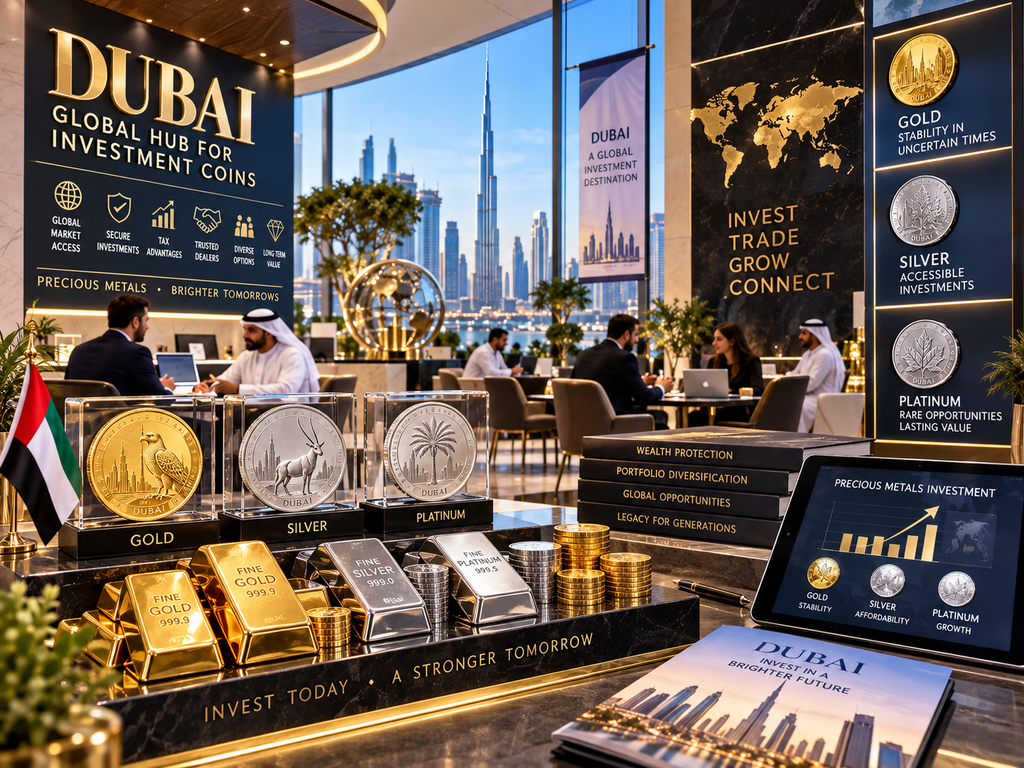
Dubai’s precious-metals ecosystem extends into officially produced UAE-themed bullion coins.
DMCC markets UAE bullion coins in both gold and silver. Its gold coins include products with 9999 fineness, while its silver bullion products use 999-fine silver.
The gold collections have featured UAE landmarks and leaders, including designs connected with Burj Khalifa, Palm Jumeirah and Louvre Abu Dhabi.
For example, DMCC’s one-ounce first-edition gold bullion coin is listed with a gross weight of approximately 31.103 grams and 9999 fineness. DMCC also sells smaller denominations, including half-ounce, quarter-ounce and one-tenth-ounce versions.
That range demonstrates an important feature of investment coins.
An investor does not necessarily need to buy an entire kilogram bar to own physical precious metal. Coins allow precious-metal holdings to be divided into smaller units that may be easier to store, gift or sell separately.
Prices fluctuate with the metal market and dealer premiums, so displayed retail prices should always be checked at the time of purchase.
Coins Can Offer More Flexibility Than Large Bullion Bars
Both coins and bars can provide physical exposure to precious metals, but their practical characteristics differ.
| Investment Coins | Larger Bullion Bars |
|---|---|
| Available in smaller units | Efficient for larger quantities of metal |
| Individual pieces can be sold separately | Fewer pieces to store |
| Often highly recognisable | Premium per ounce can sometimes be lower |
| Can combine bullion and collectible appeal | Primarily focused on metal value |
| Easy to divide among multiple transactions | Selling part of one large bar is not possible |
| Premium can be higher | Authentication of high-value bars remains important |
Suppose someone owns ten one-ounce coins and later wants to sell only 20% of the position.
Two coins could potentially be sold while the remaining eight are retained.
Someone holding the equivalent amount in a single indivisible bar does not have the same flexibility.
The trade-off is that smaller products often carry higher manufacturing and distribution costs relative to the quantity of metal they contain. Buyers therefore need to compare the premium over spot price, not simply the headline retail price.
Understanding the Premium Over the Metal Price
A one-ounce gold coin rarely sells for exactly the international spot value of one ounce of gold.
The difference is known as the premium.
That premium can reflect minting costs, distribution, dealer margins, scarcity, branding, packaging and market demand.
The same principle applies to silver and platinum.
A useful comparison is therefore:
Retail coin price − underlying metal value = approximate purchase premium
Investors should also look at the other side of the transaction.
Ask what the dealer would pay to buy the same product back.
The difference between the buying price and resale price is the spread. A coin with an attractive purchase price but a weak resale market could ultimately be more expensive to own than a slightly more expensive but widely recognised product.
Dubai’s Market Is Becoming More Transparent and Regulated
Dubai’s precious-metals expansion is happening alongside stronger regulatory and responsible-sourcing requirements.
The UAE Ministry of Economy and Tourism supervises dealers in precious metals and precious stones as part of the Designated Non-Financial Businesses and Professions framework for anti-money laundering and counter-terrorist financing obligations.
In May 2026, the Ministry conducted an inspection tour of Dubai’s Gold Souk focused specifically on compliance with AML, counter-terrorist financing and counter-proliferation financing rules.
The UAE has also introduced responsible-sourcing requirements for gold refiners based around a five-step due-diligence framework that includes supply-chain risk assessment, mitigation, independent review and reporting.
This does not mean every investment product is risk-free or automatically authenticated by the government.
Buyers must still choose reputable sellers, verify products and retain documentation.
However, the broader regulatory framework is becoming an increasingly important part of Dubai’s development as an international precious-metals centre.
The UAE Good Delivery Standard Adds Another Layer to the Market
Quality standards matter in precious metals because a bar or coin is only useful as an investment if buyers have confidence in what it contains.
The UAE has developed the UAE Good Delivery Standard as part of its wider gold-sector framework.
The Ministry of Economy has previously described the standard as a mechanism designed to strengthen quality and reliable technical specifications in refining and gold production. UAE Good Delivery-standard gold has also been accepted in cross-border bullion trade, including shipments to India’s International Bullion Exchange.
For retail coin buyers, the practical lesson is to look beyond appearance.
Purity, mint or refiner reputation, documentation and market recognition all matter more than a coin simply looking impressive inside attractive packaging.
Secure Storage Is Already Part of Dubai’s Precious-Metal Ecosystem
Buying physical metal creates a question that does not arise with many digital investments:
Where will you keep it?
Small holdings may be stored personally, but larger precious-metal portfolios can require professional custody.
DMCC operates a high-security vault at Almas Tower that stores high-value assets including gold and silver bullion, precious stones and other valuable goods. The facility is operated by Brink’s Global Services and offers insured storage and secure logistics services.
This kind of infrastructure is important because becoming an international bullion hub requires more than buying and selling.
The market also needs secure transport, custody, insurance and verification.
Investors evaluating professional storage should still compare fees, insurance terms, withdrawal procedures, ownership structure and whether their specific metal or product is accepted.
Dubai’s Gold Market Is Moving Beyond Traditional Physical Trading
Dubai is also connecting traditional bullion with newer financial and digital infrastructure.
The Dubai Gold and Commodities Exchange already provides gold-market products for professional market participants. In June 2026, DGCX launched a new Spot Gold T0 contract settled in UAE dirhams, with subsequent notices covering physical settlement arrangements.
DMCC has also expanded work around tokenised commodities.
In 2026, it announced the first tokenised commodity asset developed under its framework with Dubai’s Virtual Assets Regulatory Authority, using a 1,971kg silver bar held through professional custody infrastructure.
These products are very different from walking into a dealer and buying a physical one-ounce coin.
However, they demonstrate how Dubai’s precious-metal ecosystem is becoming broader. Physical bullion, derivatives, secure custody, financing and tokenisation are increasingly existing within the same commercial centre.
Why Dubai’s Location Matters to International Coin Buyers
Dubai’s position between Asia, Africa and Europe has always played an important part in its trading economy.
That geographic advantage is particularly relevant to precious metals.
Gold can originate in one part of the world, be refined or traded through the UAE and eventually reach consumers or institutions in another.
Dubai’s air connectivity, logistics networks and international business community strengthen that role.
DMCC describes the emirate’s connectivity to producing and consuming nations as one of the main factors supporting its gold-trading position.
For investment coins, international connectivity can support greater interaction between global mints, refiners, distributors and buyers.
It also means Dubai’s bullion market is influenced by global rather than purely local demand.
Authenticity Matters More as the Market Expands
A growing precious-metal market inevitably makes authentication more important.
Two coins can appear almost identical while having very different value if one is genuine and the other is counterfeit.
Professional verification can involve checking dimensions, weight, magnetic properties, conductivity, surface features and, when appropriate, specialised testing equipment.
Collectors may also use recognised third-party grading or certification services for certain products.
Buyers should keep invoices, certificates and original packaging where relevant.
Breaking sealed packaging unnecessarily can sometimes affect resale convenience, particularly for products where buyers expect the original assay or certification packaging.
The objective is not simply to prove that a coin is attractive.
It is to make the eventual resale process as straightforward as possible.
Bullion Coins and Collectible Coins Are Not the Same Investment
This distinction is particularly important for new buyers.
A bullion coin is primarily valued according to the precious metal it contains plus a market premium.
A collectible or numismatic coin can trade far above its underlying metal value because of rarity, age, condition or collector demand.
Consider two one-ounce gold coins containing similar quantities of gold.
One may trade close to the gold price because it is produced mainly for bullion investors. Another may cost several times more because collectors consider it rare.
If the gold price rises 10%, that does not necessarily mean the collectible coin will also rise 10%.
Its price could rise faster, remain unchanged or fall depending on collector demand.
Buyers therefore need to decide whether they are investing primarily in precious metal or in numismatic rarity.
What to Check Before Buying Investment Coins in Dubai
A disciplined purchase starts before money changes hands.
The most useful buyer checklist is:
- Confirm the exact metal, weight and purity, check whether the product qualifies as an investment precious metal under UAE VAT rules, compare the dealer’s premium with the underlying metal value, ask about the dealer’s buyback price, verify the mint or refiner, request an invoice, examine certification and packaging, understand storage costs, and confirm any customs or tax rules that could apply if the coin will later be taken into another country.
The final point is particularly important for international visitors.
A product receiving 0% VAT treatment in the UAE does not mean it can automatically be carried or imported into another country without tax, declaration or customs consequences.
The rules of the destination country still apply.
Price Movements Still Matter
Dubai’s infrastructure and tax environment can make precious-metal ownership efficient, but they do not remove investment risk.
Gold, silver and platinum prices can all rise and fall.
They also react differently to economic conditions.
Gold demand can be influenced by investment flows, central-bank activity, interest rates, currencies and geopolitical uncertainty. Silver has both investment and substantial industrial demand, while platinum’s market is also closely connected with industrial uses.
Physical coins introduce additional factors.
Investors must consider premiums, buyback spreads, storage, insurance and potentially transportation costs.
This means a coin purchased today cannot be assumed to generate a profit simply because it contains precious metal.
Why Dubai Could Become Even More Important for Silver and Platinum
Dubai’s reputation has traditionally centred on gold.
The next phase could be broader.
The UAE VAT framework explicitly recognises qualifying silver and platinum, along with gold, as investment precious metals.
Dubai’s commodities infrastructure is also expanding beyond gold. DGCX has introduced silver-market products, while DMCC’s recent tokenisation work has used physical silver as the underlying commodity.
That does not mean silver and platinum currently have the same depth of retail market as gold.
Gold remains the city’s dominant precious-metal identity.
But the regulatory and commercial foundations are already capable of supporting a wider physical investment market, giving dealers and investors room to diversify beyond a single metal.
Frequently Asked Questions About Investment Coins in Dubai
Are investment coins VAT-free in Dubai?
Qualifying investment precious metals are subject to 0% UAE VAT, rather than the standard VAT rate. The metal must be gold, silver or platinum with purity of at least 99% and must be in a form tradable in global bullion markets.
Does every gold coin qualify for 0% VAT?
No. The legal conditions relate to purity and whether the metal is in a globally tradable bullion form. Collectible, decorative or lower-purity products should not automatically be assumed to qualify.
Can you buy UAE bullion coins in Dubai?
Yes. DMCC has produced UAE bullion coins in gold and silver, including gold coins in several weights such as one ounce, half ounce, quarter ounce and one-tenth ounce.
Is gold better than silver or platinum?
They have different market characteristics, so there is no universal answer. Gold generally has a deeper global bullion market, while silver and platinum have different industrial-demand and liquidity characteristics. Buyers should compare their own objectives, costs and risk tolerance.
Are investment coins the same as gold jewellery?
No. Jewellery includes design and manufacturing value and may have different purity and VAT treatment. Investment bullion coins are primarily intended to provide exposure to their precious-metal content.
Can tourists buy investment coins in Dubai?
Availability depends on individual dealers and their identification or compliance requirements. International buyers should also check the customs, declaration and tax rules that apply when taking precious metals into their destination country.
Where can precious metals be stored in Dubai?
Dubai has professional secure-custody infrastructure. DMCC’s vault at Almas Tower, for example, is operated by Brink’s and provides secure storage services for high-value assets including gold and silver bullion.
Why Dubai Is Becoming a Global Hub for Investment Coins
Dubai’s rise in the investment-coin market is not being driven by a single advantage.
It is the combination of several factors.
The city already sits inside one of the world’s largest gold-trading ecosystems. DMCC says Dubai handles around 15% of worldwide gold trade, while more than 1,500 businesses participate in its gold and precious-metals ecosystem.
Qualifying gold, silver and platinum investment products can receive 0% VAT treatment under UAE law. Professional storage, international logistics, refining infrastructure, regulated dealers and modern commodities markets add further depth.
At the same time, Dubai is moving beyond its traditional image as simply the “City of Gold.” New silver products, digital commodities, tokenisation projects and AED-based gold trading infrastructure show how the market is evolving.
For buyers, the attraction of investment coins in Dubai ultimately comes down to access. Investors can participate in a sophisticated precious-metals marketplace while choosing physical products that range from smaller bullion coins to much larger holdings.
The advantages are significant, but careful purchasing still matters. Purity, premiums, authenticity, dealer reputation, storage, resale spreads and destination-country rules should all be checked before buying.
Dubai’s greatest strength is therefore not that precious metals suddenly become risk-free. It is that the city has developed many of the trading, regulatory, taxation and infrastructure components needed for a mature international bullion market.
Do follow us on Instagram
Read More – Fujairah Autumn Festival 2026: Free Family Fun and Shopping