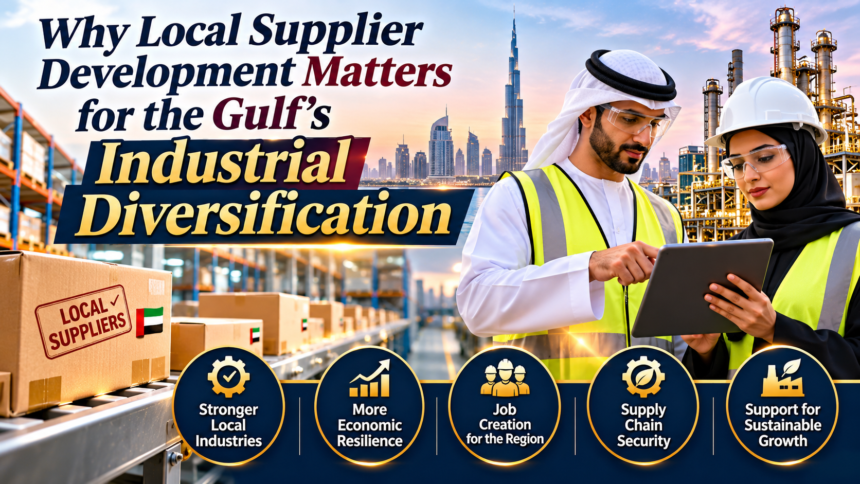
Why Developing Local Suppliers Matters for Gulf Manufacturing
Across the Gulf Cooperation Council, economic diversification is creating new opportunities for businesses involved in manufacturing, engineering, technology, logistics, and industrial services. As governments invest in industries beyond traditional hydrocarbon production, attention is increasingly shifting toward the companies that supply the materials, components, equipment, and expertise required for these sectors to operate.
- 1. Why Local Supplier Development in the Gulf Is Essential for Industrial Diversification
- 2. How the UAE’s In-Country Value Programme Supports Local Industries
- 3. What Saudi Arabia’s iktva Programme Reveals About Supplier Development
- 4. How Qatar and Oman Are Building Local Supplier Ecosystems
- 5. How Local Supplier Development Could Strengthen SMEs and Industrial Innovation
- 6. The Challenges of Developing Competitive Local Supply Chains
- 7. The Future of Local Supplier Development in GCC Industrial Diversification
Large industrial projects often attract the most public attention. However, their long-term economic impact also depends on the businesses supporting them behind the scenes.
A new manufacturing plant may need electrical components, packaging materials, industrial machinery, maintenance services, software systems, and specialised technical expertise. When these products and services are sourced from capable domestic suppliers, a greater proportion of industrial spending can support activity within the local economy.
This is why local supplier development in the Gulf is becoming an important part of the region’s industrial diversification strategies.
Supplier development involves helping businesses improve their capabilities so they can meet the commercial, technical, quality, and delivery requirements of larger customers. It may include training, certification, technology upgrades, financing support, and opportunities to participate in major procurement contracts.
Across the UAE, Saudi Arabia, Qatar, and Oman, governments and major industrial companies have introduced initiatives intended to increase local participation in supply chains.
The UAE’s National In-Country Value programme encourages domestic economic contributions through procurement. Saudi Aramco’s iktva programme focuses on strengthening Saudi supply chains, while QatarEnergy’s Tawteen initiative supports supplier development and new investment opportunities in Qatar.
Oman has also introduced programmes focused on local content, industrial procurement, and manufacturing capabilities.
However, developing local suppliers involves more than encouraging businesses to purchase locally. Domestic firms must be able to deliver appropriate quality, competitive pricing, reliable service, and consistent compliance with industrial standards.
Understanding these requirements reveals how local supplier development could help Gulf economies build stronger industrial ecosystems and create new opportunities for small and medium-sized enterprises.
1. Why Local Supplier Development in the Gulf Is Essential for Industrial Diversification
Industrial diversification aims to develop economic activity across a wider range of sectors.
For GCC countries, this includes expanding industries such as advanced manufacturing, renewable energy equipment, pharmaceuticals, food processing, construction materials, and industrial technology.
However, attracting large manufacturers does not automatically create a broad domestic industrial base.
The Importance of Industrial Supply Chains
A factory is rarely an independent operation.
It depends on suppliers for raw materials, components, packaging, equipment, transport, maintenance, and technical services.
Some supplies are purchased frequently, while others are required for expansion or major maintenance projects.
If most inputs must be imported, the economic opportunities associated with local manufacturing may remain concentrated in a relatively small number of activities.
Developing domestic suppliers can help additional businesses participate in industrial value creation.
What Supplier Development Actually Means
Supplier development is a structured effort to improve the capabilities of companies that provide products or services to larger organisations.
It may involve technical training, quality improvement, production planning, financial support, or better access to procurement opportunities.
The objective is not simply to register more suppliers.
It is to help qualified businesses become capable of meeting commercial requirements consistently.
Local Content and Local Ownership Are Different
A locally registered company is not necessarily manufacturing its products domestically.
Similarly, a foreign-owned manufacturer operating a factory in a GCC country may contribute to local employment, production, and skills development.
Local content programmes may consider several types of domestic economic contribution.
Their definitions differ by programme and jurisdiction.
How Supplier Development Supports Diversification
| Development Area | Potential Economic Contribution |
|---|---|
| Local Manufacturing | Additional domestic production |
| Industrial Services | Greater technical service capacity |
| SME Participation | Opportunities for smaller enterprises |
| Workforce Training | Development of specialised skills |
| Technology Adoption | Improved production capabilities |
| Supplier Networks | Stronger industrial relationships |
| Export Readiness | Potential access to international customers |
Why Economic Value Matters More Than Supplier Numbers
A programme may register hundreds of suppliers without necessarily increasing industrial productivity.
Meaningful progress requires measuring what suppliers actually produce, how their capabilities improve, and whether they can compete over time.
The quality of supplier participation is therefore as important as its scale.
2. How the UAE’s In-Country Value Programme Supports Local Industries
The UAE provides an important example of how procurement policy can be connected with industrial development.
Its National In-Country Value programme encourages companies to increase their contributions to the domestic economy through purchasing, investment, and related activities.
Understanding the National ICV Programme
The UAE’s National In-Country Value programme is overseen by the Ministry of Industry and Advanced Technology.
It builds on the In-Country Value initiative originally introduced by ADNOC in 2018 and expanded nationally in 2021.
The programme encourages participating organisations to consider suppliers’ domestic economic contributions as part of procurement evaluation.
Depending on the applicable framework, relevant considerations may include domestic spending, investment, and workforce development.
However, an ICV certificate does not automatically guarantee the award of a contract.
Connecting Procurement With Industrial Opportunities
Large industrial companies purchase substantial quantities of materials and services.
Their procurement requirements can create demand for local manufacturers.
For example, a company producing industrial cables or mechanical components may find opportunities if its products meet the technical requirements of major buyers.
However, domestic sourcing still requires appropriate commercial and operational performance.
Reported Programme Activity
At the 2025 Make it in the Emirates event, the Ministry of Industry and Advanced Technology reported industrial procurement under the National ICV programme reaching AED 168 billion, compared with AED 143 billion in the previous edition.
These are figures reported by the ministry for the programme’s industrial procurement activity.
They should not be interpreted as a direct measure of net GDP growth or the profits generated by local suppliers.
ADNOC’s Industrial Resilience Programme
In 2026, ADNOC announced an Industrial Resilience Programme intended to strengthen domestic manufacturing capacity and critical supply chains.
The programme included measures encouraging contractors to source from approved national manufacturers in selected product categories, provided suppliers are technically qualified and commercially competitive.
It also introduced initiatives intended to improve demand visibility for manufacturers considering local investment.
This demonstrates how supplier development may combine procurement incentives with clearer information about future industrial demand.
UAE Supplier Development Approaches
| Initiative | Main Focus | Potential Benefit |
|---|---|---|
| National ICV Programme | Domestic economic contribution | Increased local procurement opportunities |
| ADNOC ICV | Supplier participation in industrial supply chains | Stronger domestic capabilities |
| Make it in the Emirates | Industrial investment and procurement connections | Buyer-supplier engagement |
| ADNOC Industrial Resilience Programme | Critical production and sourcing | Supply-chain development |
| Supplier Qualification Systems | Technical and commercial requirements | Better procurement readiness |
Why Demand Visibility Matters
A manufacturer may hesitate to invest in new equipment without sufficient confidence that customers will purchase its products.
Information about future procurement needs can support planning.
However, forecasts and expressions of interest are different from binding purchase commitments.
Businesses should verify commercial arrangements before making major capital investments.
3. What Saudi Arabia’s iktva Programme Reveals About Supplier Development
Saudi Arabia has placed local content development at the centre of several industrial and procurement initiatives.
Saudi Aramco’s In-Kingdom Total Value Add programme, known as iktva, provides an established example.
Understanding iktva
Aramco launched iktva in 2015 to increase the domestic economic contribution of its supply chain.
The programme seeks to develop local manufacturing, expand supplier capabilities, support workforce development, and encourage research and innovation.
Its approach extends beyond purchasing products from local distributors.
It also focuses on strengthening industrial activities taking place within Saudi Arabia.
Aramco’s 70% Local Content Milestone
On February 11, 2026, Aramco announced that iktva had reached its initial target of 70% local content.
The company subsequently identified a new objective of 75% by 2030.
This is a reported achievement and target within Aramco’s own procurement and local content measurement framework.
It should not be interpreted as 70% local content across the entire Saudi economy.
Supplier Training and Industrial Investment
Aramco’s programme includes supplier development, industrial collaboration, and initiatives intended to encourage investment in Saudi manufacturing.
The company has also established relationships with training institutions to support relevant technical capabilities.
These activities illustrate that localisation involves building skills and production capacity rather than relying only on procurement preferences.
Saudi Arabia’s Local Content Authority
Saudi Arabia’s Local Content and Government Procurement Authority develops policies and mechanisms intended to increase domestic economic participation.
The authority works with government entities and businesses on local content requirements, measurement, and procurement practices.
In April 2026, the authority reported that local content in government procurement had increased from a 28% baseline in 2018 to more than 51% by the end of 2025.
These figures describe the measure reported by the authority.
They are not directly comparable to Aramco’s iktva percentage because the two systems cover different procurement activity and measurement scopes.
Developments in Procurement Requirements
In February 2026, the authority introduced minimum local content requirements for businesses seeking to benefit from specified mandatory national-product list arrangements.
The requirements apply under defined conditions.
This approach illustrates how local content policies may increasingly depend on verifiable supplier contributions rather than company registration alone.
Saudi Supplier Development Measures
| Programme or Measure | Main Purpose |
|---|---|
| Aramco iktva | Develop domestic industrial supply chains |
| Supplier Development Initiatives | Improve technical and commercial capabilities |
| Industrial Investment Partnerships | Establish additional local production |
| Local Content Authority | Develop and coordinate localisation policies |
| Government Procurement Mechanisms | Encourage eligible domestic economic contribution |
Why Industrial Capability Is the Real Objective
A supplier may initially depend on imported components or specialised foreign expertise.
Over time, training, local investment, and technology partnerships may help it undertake more activities domestically.
However, genuine capability development should be measured through production, skills, technology, and competitiveness rather than company nationality alone.
4. How Qatar and Oman Are Building Local Supplier Ecosystems
Qatar and Oman provide additional examples of how industrial diversification can be connected with local procurement and supplier capability development.
Their programmes demonstrate the role of sector-specific initiatives and industrial policy.
QatarEnergy’s Tawteen Programme
Tawteen is QatarEnergy’s supply-chain localisation programme for the energy sector.
It operates with the participation of other companies active in the sector.
The programme has three principal elements: new investment opportunities, supplier development, and an In-Country Value policy.
Its objectives include increasing the ability of domestic companies to meet energy-sector requirements.
Supplier Development Through Tawteen
Tawteen provides support intended to help local suppliers improve technical and business capabilities.
It also identifies industrial investment opportunities associated with the needs of Qatar’s energy sector.
This approach can help businesses understand where market demand may exist.
However, identifying an investment opportunity does not mean that every new supplier will obtain contracts or operate profitably.
Qatar’s ICV Approach
Tawteen includes an In-Country Value system designed to recognise domestic economic contributions.
The framework encourages companies to examine the contribution of suppliers to Qatar’s economy.
However, participation requirements and evaluation methods must be reviewed through the relevant programme documents.
Oman’s Taseen Initiative
In November 2024, Oman launched the Taseen plan to encourage greater use of locally manufactured products and reduce dependence on imports.
The initiative includes three major programmes: enhancing local content in industry, empowering manufacturers and suppliers, and promoting Omani products.
It also connects with broader workforce development and industrial skills initiatives.
Oman’s Industrial Strategy
Oman’s industrial development efforts form part of its wider economic diversification objectives.
Industrial estates, domestic procurement programmes, and supplier training can support the creation of manufacturing capabilities.
However, the effectiveness of these measures depends on market demand, competitiveness, and implementation.
Qatar and Oman Compared
| Country | Programme | Main Focus |
|---|---|---|
| Qatar | Tawteen | Energy-sector supply-chain localisation |
| Qatar | Supplier Development Programme | Technical and business capability building |
| Qatar | ICV Policy | Recognition of domestic economic contribution |
| Oman | Taseen | Local industrial content and import substitution |
| Oman | Manufacturer and Supplier Empowerment | Business capability development |
| Oman | Industrial Skills Initiatives | Workforce preparation |
Why Sector-Specific Programmes Can Be Useful
Different industries require different supplier capabilities.
Energy companies may need specialised safety-certified equipment, while food manufacturers may need packaging, refrigeration, and hygiene-compliant logistics.
Supplier development is more effective when support reflects the requirements of the industry being served.
5. How Local Supplier Development Could Strengthen SMEs and Industrial Innovation
Small and medium-sized enterprises are important participants in industrial supply chains.
They may provide machinery components, specialist maintenance, software, packaging, testing services, or other products needed by larger manufacturers.
However, winning major industrial contracts can be difficult for smaller businesses.
The Challenge of Supplier Qualification
Large buyers often require suppliers to demonstrate financial stability, quality assurance, technical competence, and reliable delivery.
An SME may offer a suitable product but lack the documentation or systems required to complete supplier qualification.
Development programmes can help businesses identify and address these gaps.
However, certification should reflect actual performance rather than become a formality.
Access to Quality Standards
Industrial buyers may require quality management systems, product testing, or sector-specific certifications.
These requirements can create costs for smaller firms.
Technical assistance and shared testing infrastructure may help suitable businesses improve compliance.
However, the necessary standards differ by product and industry.
Technology Transfer and Skills Development
Supplier development may involve partnerships between domestic firms and international manufacturers.
Such arrangements can provide opportunities to learn new production techniques and improve workforce skills.
However, successful technology transfer requires appropriate agreements, training, and the ability to apply knowledge locally.
Buying advanced machinery alone does not guarantee higher productivity.
The Importance of Finance
Manufacturers often need working capital to purchase materials before receiving customer payments.
They may also require financing for machinery, testing, or factory expansion.
Banks and development institutions can play a role in supporting viable businesses.
However, a prospective supply contract does not automatically establish creditworthiness.
Potential SME Benefits
| Opportunity | Possible Benefit | Main Requirement |
|---|---|---|
| Major Buyer Contracts | More stable commercial demand | Supplier qualification |
| Technical Training | Improved production capability | Relevant skills |
| Quality Certification | Access to regulated markets | Compliance investment |
| Industrial Partnerships | Technology and knowledge transfer | Effective agreements |
| Financing Support | Increased production capacity | Financial sustainability |
| Digital Procurement | Better visibility of opportunities | Digital readiness |
| Export Development | Access to wider markets | International competitiveness |
Why Innovation Matters
Supplier development should not focus solely on replacing imported products with identical domestic alternatives.
Local businesses can also develop improved components, reduce material waste, or introduce more efficient production methods.
Innovation creates opportunities to strengthen competitiveness beyond local procurement preferences.
6. The Challenges of Developing Competitive Local Supply Chains
Local supplier development can produce economic benefits, but poorly designed programmes may create inefficiencies.
Encouraging domestic production does not automatically make it commercially competitive or technically suitable.
Policy design must balance industrial development with quality, cost, reliability, and competition.
The Risk of Higher Production Costs
A locally manufactured component may initially cost more than an imported alternative.
This can reflect smaller production volumes, higher equipment costs, or limited specialist capacity.
Temporary support may help a developing industry achieve scale.
However, long-term competitiveness requires continuous improvement rather than permanent dependence on purchasing preferences.
Quality and Safety Requirements
Industrial suppliers may provide products used in energy facilities, transport infrastructure, healthcare, or electrical systems.
Failures can create serious operational and safety consequences.
Buyers should therefore maintain appropriate testing and qualification standards.
Local sourcing objectives must not override essential safety requirements.
Supplier Concentration
Replacing several international suppliers with one domestic provider may create a new form of supply-chain concentration.
Businesses should monitor supplier capacity and maintain suitable contingency options.
A resilient supply chain is not necessarily one in which every product is purchased locally.
Import Dependencies Within Domestic Production
A product assembled in a GCC country may still rely on imported raw materials, machinery, software, or components.
This does not mean local production has no value.
However, policymakers should understand which parts of the value chain are genuinely domestic.
Accurate measurement helps identify where further capability development may be useful.
Potential Risks and Responses
| Challenge | Potential Consequence | Practical Response |
|---|---|---|
| High Production Costs | Reduced competitiveness | Productivity improvement |
| Limited Technical Expertise | Quality or delivery problems | Training and partnerships |
| Weak Supplier Financing | Production constraints | Suitable financial support |
| Overdependence on Major Buyers | Revenue concentration | Customer diversification |
| Inadequate Certification | Procurement exclusion | Technical assistance |
| Limited Competition | Higher prices and weaker innovation | Competitive procurement |
| Imported Critical Inputs | Continued external exposure | Supply-chain mapping |
| Unclear Local Content Measures | Misleading performance claims | Transparent measurement |
Why International Trade Still Matters
Industrial diversification does not require eliminating imports.
Specialised international suppliers can remain important for advanced technology, rare materials, and products that are not economical to manufacture locally.
The objective is to build domestic capabilities where they provide sustainable value while maintaining effective access to global supply chains.
7. The Future of Local Supplier Development in GCC Industrial Diversification
The next stage of supplier development could involve closer cooperation between industrial buyers, SMEs, universities, financial institutions, and manufacturing technology providers.
However, the strongest programmes will need to demonstrate lasting improvements in productivity and competitiveness.
Using Procurement Forecasts to Support Investment
Large industrial companies often have information about their future equipment and service requirements.
Appropriately sharing procurement forecasts can help potential suppliers evaluate investment opportunities.
For example, a manufacturer considering a new production line may benefit from understanding expected demand for a particular component.
However, forecast demand is not equivalent to a binding contract.
Connecting Supplier Development With Research
Universities and applied research centres can help businesses solve technical problems.
Manufacturers may collaborate on materials testing, industrial automation, product design, or production efficiency.
These partnerships can support capability development when projects address genuine commercial needs.
Building Export-Ready Suppliers
Localisation should not be viewed as the final stage of industrial growth.
A supplier that becomes competitive domestically may seek customers in other GCC countries or international markets.
However, export expansion requires suitable certification, logistics, finance, market research, and customer relationships.
A Practical Local Supplier Development Checklist
- Identify products and services with credible domestic demand.
- Assess existing local supplier capabilities.
- Define transparent procurement and qualification requirements.
- Provide appropriate technical training.
- Support access to recognised testing and certification.
- Improve financing opportunities for viable SMEs.
- Encourage relevant technology partnerships.
- Share realistic procurement forecasts where appropriate.
- Maintain fair competition and safety standards.
- Monitor local content using consistent definitions.
- Measure productivity, quality, and delivery performance.
- Help competitive suppliers explore export opportunities.
How Should GCC Supplier Programmes Measure Success?
The number of suppliers registered in a programme is one useful administrative indicator.
However, it does not show whether suppliers have become more capable or commercially sustainable.
Governments and major buyers should examine purchasing outcomes, domestic production, productivity, innovation, and workforce development.
Suggested Supplier Development Indicators
| Indicator | What It Measures |
|---|---|
| Domestic Value Added | Economic activity created locally |
| Qualified Supplier Numbers | Businesses meeting procurement requirements |
| Local Procurement Spending | Purchasing activity within programme definitions |
| On-Time Delivery | Supplier reliability |
| Product Acceptance Rate | Quality and compliance |
| Workforce Development | Training and relevant skills |
| Productivity Growth | Efficiency improvements |
| Supplier Diversification | Breadth of qualified supply base |
| Export Sales | Competitiveness beyond domestic demand |
| Research Collaboration | Applied industrial innovation |
The Role of Large Industrial Buyers
Large companies can influence supplier development because their purchasing requirements create opportunities for investment.
They may provide technical specifications, supplier development programmes, or long-term commercial visibility.
However, suppliers should avoid becoming dependent on a single customer.
Building diversified commercial relationships can support long-term stability.
Why Localisation Should Lead to Competitiveness
The strongest industrial outcome is not simply replacing an imported component with a domestically manufactured one.
It is developing a supplier capable of providing quality, reliable delivery, competitive costs, and ongoing innovation.
That supplier may eventually compete for business beyond its original domestic customer.
Conclusion
Local supplier development is becoming an important part of the Gulf’s industrial diversification efforts because it connects large industrial investments with wider economic opportunities.
Factories and infrastructure projects create demand for materials, components, services, and specialised expertise.
When domestic businesses can meet these requirements competitively, industrial spending may support additional manufacturing activity, skilled employment, and technological development.
Initiatives such as the UAE’s National In-Country Value programme, Saudi Arabia’s iktva, Qatar’s Tawteen, and Oman’s Taseen demonstrate different approaches to strengthening local supplier ecosystems.
However, the success of localisation cannot be measured only by procurement spending or the number of businesses receiving certificates.
Long-term value depends on productivity, quality, innovation, financial sustainability, and the ability of suppliers to compete beyond protected or preferred markets.
For governments, the priority is to develop transparent policies that encourage meaningful domestic capability building.
For large industrial companies, supplier development offers a way to strengthen procurement relationships and potentially improve supply-chain resilience.
For small and medium-sized businesses, the opportunity lies in improving technical capabilities, meeting professional standards, and building relationships with demanding customers.
Ultimately, industrial diversification requires more than attracting major investments.
It also requires developing the network of capable businesses that allows industries to operate, expand, innovate, and compete.
By building stronger local suppliers alongside internationally connected supply chains, Gulf economies can work toward more diversified, productive, and resilient industrial sectors.
Do follow us on Instagram
Read More – The Rise of Specialist Consulting Services for Family Wealth Management in the Middle East