



Why Middle Eastern Families Need Specialist Wealth Advisers
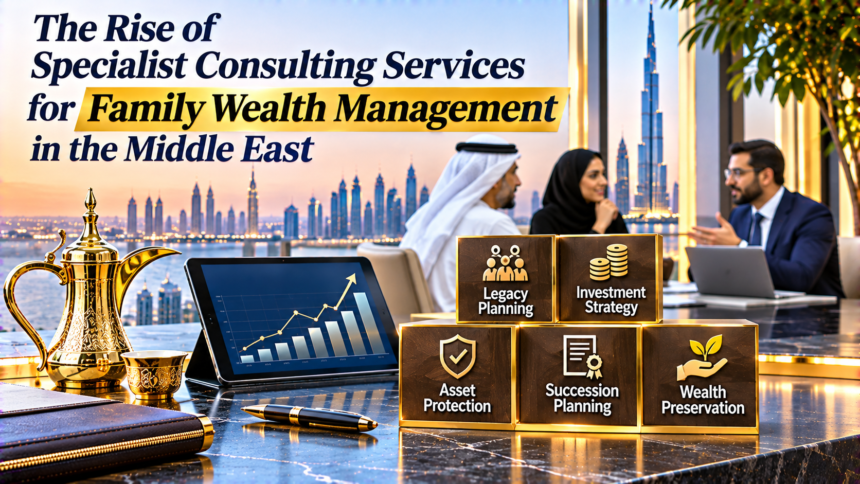
Across the Middle East, family-owned businesses, entrepreneurs, and high-net-worth individuals are reconsidering how they manage their financial assets and prepare for the future. As regional economies diversify and investment opportunities become more complex, preserving family wealth increasingly involves decisions that extend beyond conventional banking and portfolio management.
- 1. Why Family Wealth Management in the Middle East Is Becoming More Complex
- 2. How Family Offices Are Changing the Specialist Consulting Market
- 3. What Dubai and Abu Dhabi Reveal About Family Wealth Advisory Services
- 4. Why Succession Planning and Family Governance Are Driving Consulting Demand
- 5. How Cross-Border Investments and Tax Rules Are Increasing Advisory Complexity
- 6. The Risks of Specialist Family Wealth Consulting and How Families Can Evaluate Advisers
- 7. The Future of Specialist Family Wealth Management in the Middle East
- Conclusion
Many families hold assets across several categories, including operating businesses, commercial property, financial investments, and international holdings. Managing these assets can involve different legal systems, ownership arrangements, taxation rules, and family expectations.
At the same time, generational transitions are creating new questions about succession, governance, and the responsibilities of future family leaders.
These developments are contributing to the growing importance of family wealth management in the Middle East, particularly specialist consulting services that address the financial, legal, operational, and personal dimensions of long-term wealth.
Traditional private banking remains important, but some families require a wider range of expertise. They may need advisers to develop ownership structures, coordinate tax and legal specialists, establish family governance arrangements, or prepare younger relatives for leadership responsibilities.
Family offices, independent advisory firms, professional trustees, governance consultants, and succession specialists are becoming part of this broader ecosystem.
Dubai International Financial Centre has expanded its Family Wealth Centre, while Abu Dhabi Global Market offers legal structures and a business environment relevant to family offices, foundations, and wealth planning.
Saudi Arabia is also strengthening the governance framework for family-owned businesses through corporate law provisions and dedicated institutional support.
Research from wealth management firms suggests growing interest in professional advice. A 2025 Lombard Odier survey involving 300 high-net-worth individuals across five GCC countries found that family offices were already established among a substantial proportion of respondents.
However, sophisticated advisory services do not automatically guarantee higher investment returns, fewer family disagreements, or successful succession.
Their value depends on independence, professional competence, clear responsibilities, and the family’s willingness to address difficult decisions.
Understanding these developments helps explain why specialist wealth consulting could play an increasingly important role in the region’s financial and business landscape.
1. Why Family Wealth Management in the Middle East Is Becoming More Complex
Family wealth may begin with one successful company, but it can become much more complicated as the business expands and ownership passes between generations.
A founder may personally oversee most financial decisions. Later, several family members might hold interests in different companies, properties, and investments.
These changes create administrative and strategic challenges.
Moving Beyond Traditional Wealth Management
Conventional wealth management often focuses on investment portfolios, savings, asset allocation, and financial objectives.
Family wealth management may also involve business ownership, inheritance arrangements, family relationships, philanthropic activities, and long-term governance.
For example, a family may need to decide how its operating company will be managed when some heirs work in the business and others do not.
A portfolio manager cannot necessarily resolve those questions.
Why Different Assets Require Different Expertise
A family might own a construction company in Saudi Arabia, investment property in Dubai, and financial assets held through international institutions.
Each asset can involve different regulations, reporting obligations, and risks.
A coordinated approach can help the family understand how these holdings fit into its overall financial position.
However, a single adviser should not be assumed to have expertise in every jurisdiction or discipline.
The Growing Role of Professional Coordination
Specialist consultants can assist families in identifying the areas where additional advice is needed.
They may coordinate lawyers, accountants, investment managers, trustees, and corporate governance professionals.
This is particularly relevant when the family’s interests are spread across several legal entities.
Different Family Wealth Services
| Service | Main Purpose | Typical Specialist |
|---|---|---|
| Investment Advisory | Evaluate financial assets and risk | Licensed investment adviser |
| Succession Planning | Prepare for ownership transitions | Legal and succession specialist |
| Family Governance | Establish decision-making arrangements | Governance consultant |
| Tax Planning | Understand applicable tax obligations | Qualified tax adviser |
| Estate Planning | Arrange wealth transfers | Estate lawyer |
| Family Office Administration | Coordinate records and services | Family office professional |
| Philanthropic Planning | Organise charitable activities | Legal and philanthropic adviser |
Why Families Need Clear Objectives
Before hiring consultants, families should determine what they want to achieve.
Some may prioritise succession planning, while others need better financial reporting or investment oversight.
Defining objectives helps avoid paying for services that do not address the family’s actual requirements.
2. How Family Offices Are Changing the Specialist Consulting Market
Family offices are among the most visible developments in the region’s private wealth ecosystem.
A family office is an arrangement through which a family organises the management or administration of its wealth and related affairs.
However, different family offices perform different functions.
Understanding Single-Family Offices
A single-family office generally serves one family and its associated interests.
Its responsibilities may include investment coordination, financial reporting, estate planning support, philanthropy, and administration.
Some operate with substantial internal teams, while others outsource specialised work.
The appropriate structure depends on the family’s needs and the applicable regulatory framework.
Multi-Family Offices
A multi-family office generally serves several unrelated families.
Sharing advisory and administrative infrastructure may reduce certain costs compared with establishing an independent organisation.
However, clients should understand how confidentiality, conflicts of interest, investment decisions, and fees are managed.
Why Outsourced Services Are Important
Not every wealthy family needs a large dedicated office.
Some may benefit from an outsourced family office model involving independent advisers and external service providers.
This approach may offer access to specialist expertise without employing a full internal team.
However, outsourcing introduces coordination and oversight responsibilities.
Evidence of Growing Regional Interest
Lombard Odier’s 2025 survey covered 300 high-net-worth individuals residing in the UAE, Saudi Arabia, Qatar, Kuwait, and Bahrain.
Among respondents, 55% reported having a family office, while another 11% were considering establishing one.
The findings indicate significant interest within the surveyed population.
However, the sample should not be interpreted as representative of every wealthy family in the GCC.
Family Office Models Compared
| Model | Main Characteristic | Important Consideration |
|---|---|---|
| Single-Family Office | Dedicated to one family | Operating costs |
| Multi-Family Office | Serves several families | Conflicts and confidentiality |
| Outsourced Family Office | External specialists coordinate services | Provider oversight |
| Hybrid Family Office | Internal leadership plus external advisers | Clear responsibilities |
| Private Banking Relationship | Banking and financial services | May not cover wider governance needs |
Why Professionalisation Matters
As family offices become more complex, they may require experienced investment professionals, legal specialists, financial controllers, and risk managers.
Deloitte’s research on Middle Eastern family offices highlights growing attention to professional talent and institutional approaches to wealth management.
However, professionalisation should not remove the family’s ability to set objectives and oversee advisers.
3. What Dubai and Abu Dhabi Reveal About Family Wealth Advisory Services
The UAE has developed an increasingly visible ecosystem for family wealth management.
Dubai International Financial Centre and Abu Dhabi Global Market offer different legal, business, and professional frameworks relevant to family offices and related entities.
DIFC Family Wealth Centre
The DIFC Family Wealth Centre was launched in 2023.
It provides an ecosystem for family businesses and high-net-worth individuals, with activities involving education, networking, thought leadership, and business support.
The centre also connects families with relevant professional expertise.
This illustrates how wealth management is expanding beyond investment products toward coordinated services involving governance and succession.
DIFC Family Arrangements Regulations

The DIFC introduced Family Arrangements Regulations in 2023.
The framework addresses arrangements relevant to family businesses, family entities, and family wealth structures.
It forms part of the centre’s broader approach to supporting continuity and governance.
However, the regulations should not be interpreted as providing universal asset protection or tax benefits.
The suitability of any structure depends on the family’s circumstances and applicable laws.
The 2026 Expert Advisory Council
In January 2026, DIFC announced an Expert Advisory Council for its Family Wealth Centre.
Its intended focus includes governance, succession planning, wealth preservation, specialist advisory access, and training.
The initiative demonstrates institutional attention to the non-investment aspects of managing family wealth.
Growth in the DIFC Ecosystem
DIFC reported 1,408 family business-related entities during the first half of 2026, alongside 1,409 foundations.
The family business-related category includes several types of entities, not exclusively single-family offices.
These figures should therefore not be described as 1,408 individual family offices.
Abu Dhabi Global Market
ADGM provides legal structures relevant to family wealth arrangements, including foundations and trusts.
Its framework also accommodates family office structures subject to applicable conditions.
A foundation can hold assets under a distinct legal structure, while a trust operates according to its governing rules and the relevant law.
These structures differ in legal personality, governance, responsibilities, and beneficiary rights.
DIFC and ADGM Compared
| Financial Centre | Relevant Offering | Planning Consideration |
|---|---|---|
| DIFC | Family Wealth Centre | Education and advisory ecosystem |
| DIFC | Family Arrangements Regulations | Family business structuring |
| DIFC | Trusts and Foundations | Succession and ownership arrangements |
| ADGM | Family Office Framework | Family wealth administration |
| ADGM | Foundations | Ownership and succession structures |
| ADGM | Trust Framework | Trustee and beneficiary arrangements |
Why Legal Structures Need Careful Assessment
A foundation or trust may help organise assets, but establishing one is not a substitute for proper legal, tax, and regulatory analysis.
Families should clarify the purpose of a proposed structure before proceeding.
4. Why Succession Planning and Family Governance Are Driving Consulting Demand
Succession is one of the most sensitive issues in family wealth management.
The transfer of ownership and leadership can affect businesses, family relationships, and the financial security of several generations.
Professional advisers may help families establish clear processes before a transition becomes urgent.
The Difference Between Ownership and Leadership Succession
Ownership succession concerns who will hold the family’s assets or shares.
Leadership succession concerns who will manage the business.
These responsibilities do not necessarily pass to the same people.
For example, several heirs may inherit ownership interests while one professionally qualified family member becomes chief executive.
A clear structure can help distinguish these roles.
Family Constitutions and Charters
A family constitution or charter may describe shared values, governance principles, employment policies, decision-making procedures, and approaches to resolving disagreements.
The document’s legal effect depends on its structure and the relevant jurisdiction.
Families should distinguish voluntary statements of intent from enforceable legal agreements.
Saudi Arabia’s Family Charter Framework
Saudi Arabia’s Companies Law permits shareholders or partners in relevant family businesses to conclude a family charter.
The Ministry of Commerce explains that such arrangements may address family ownership, governance, management, employment, dividends, share transfers, and dispute resolution.
This creates a framework in which specialised governance consultants and legal advisers may assist families.
However, the effectiveness of a family charter depends on appropriate drafting and implementation.
The Saudi National Center for Family Businesses
Saudi Arabia has established the National Center for Family Businesses to support the sustainability and development of family enterprises.
Its work includes promoting governance and supporting continuity.
Research published by INSEAD in November 2025 examined succession challenges among Saudi family businesses and the importance of mediation and governance arrangements.
Preparing the Next Generation
Successful succession also requires future leaders to understand the responsibilities associated with family ownership.
In July 2026, the DIFC Family Wealth Centre announced that the inaugural cohort of its NextGen Leadership Programme had graduated.
The programme focuses on leadership development and the challenges of managing family enterprises.
However, completing a training programme does not guarantee that a future succession process will succeed.
Common Succession Planning Challenges
| Challenge | Potential Response |
|---|---|
| Unclear Ownership Transfer | Estate and legal planning |
| Disagreement Over Leadership | Governance and selection procedures |
| Unequal Involvement in Business | Ownership and employment policies |
| Lack of Prepared Successors | Education and mentoring |
| Complex Asset Structures | Coordinated legal and financial advice |
| Family Disputes | Agreed mediation procedures |
Why Early Planning Matters
Succession decisions made during a crisis may face greater pressure.
Discussing ownership, leadership, and family expectations in advance can create opportunities to identify disagreements and establish suitable arrangements.
5. How Cross-Border Investments and Tax Rules Are Increasing Advisory Complexity
Family wealth often extends beyond a single country.
International property, financial portfolios, holding companies, and business investments can create obligations under multiple legal systems.
This makes specialist cross-border advice increasingly relevant.
Understanding Cross-Border Ownership
A family may hold investments through companies, partnerships, trusts, or foundations in different jurisdictions.
Each arrangement can have distinct ownership, reporting, and governance requirements.
Consultants can help map these structures and identify where further legal or tax advice is needed.
However, the existence of an international structure does not automatically produce financial or tax advantages.
Tax Residence and Reporting
Tax treatment may depend on factors such as residence, entity classification, source of income, and applicable treaties.
A family member’s personal residence and the location of an investment may influence reporting obligations.
These rules differ between jurisdictions and can change.
Families should therefore obtain qualified advice relevant to their actual circumstances.
Investment Diversification
Specialist investment consultants may help families assess exposure across asset classes and markets.
Diversification can reduce some concentration risks.
However, it does not eliminate losses or guarantee returns.
Families that hold a substantial proportion of wealth in one operating company may require a different strategy from those primarily holding financial assets.
Private Investments and Alternative Assets
Some wealthy families invest in private equity, venture capital, private credit, real estate, or other alternative assets.
These investments may involve limited liquidity and complex valuation methods.
Advisers should explain capital commitments, fees, potential losses, and the ability to exit.
Why Independent Oversight Matters
When several advisers manage different parts of a family’s wealth, consolidated reporting becomes important.
A family should be able to understand its total assets, liabilities, commitments, and significant risks.
This requires reliable information from banks, investment managers, corporate entities, and advisers.
Major Cross-Border Advisory Needs
| Area | Main Question |
|---|---|
| Legal Ownership | Who legally controls each asset? |
| Tax Compliance | Which jurisdictions impose obligations? |
| Investment Risk | How concentrated is family wealth? |
| Currency Exposure | How could exchange rates affect value? |
| Estate Planning | What happens after a family member’s death? |
| Reporting | Can the family see its consolidated position? |
| Regulatory Compliance | Are service providers appropriately authorised? |
Why Coordination Is Not the Same as Regulation
A consultant who coordinates professional services is not automatically authorised to provide regulated financial advice.
Families should verify that investment recommendations and other regulated activities are performed by suitably licensed professionals.
6. The Risks of Specialist Family Wealth Consulting and How Families Can Evaluate Advisers
As demand for wealth-related services increases, families may encounter a wide range of consultants, advisers, financial institutions, and corporate service providers.
The quality and regulatory status of these services can vary.
Choosing an adviser therefore requires careful evaluation.
Understanding Conflicts of Interest
An adviser may receive fees directly from a family or compensation from financial products and service providers.
These arrangements can create different incentives.
Clients should understand who pays the adviser, how fees are calculated, and whether recommendations involve third-party compensation.
Disclosure of a conflict does not always eliminate its effect.
The Difference Between Consulting and Investment Advice
A family governance consultant may help design decision-making processes.
An estate lawyer may advise on inheritance arrangements.
A licensed investment adviser may recommend particular financial products or strategies.
These services involve different qualifications, professional obligations, and regulatory requirements.
Families should not assume that one consultant can legally perform every function.
Protecting Confidential Information
Wealth advisers may handle sensitive information involving family relationships, business ownership, financial records, and estate plans.
Appropriate cybersecurity, confidentiality agreements, data access controls, and privacy procedures are therefore important.
Families should understand how information is stored and who can access it.
Managing Advisory Costs
Specialist consulting can involve significant fees.
Some providers charge fixed project amounts, hourly rates, recurring retainers, or asset-based fees.
Families should understand the full cost of services and any additional expenses associated with implementing recommendations.
A complicated structure may not be appropriate merely because it is available.
Questions to Ask Before Engaging an Adviser
| Question | Why It Matters |
|---|---|
| What services are you authorised to provide? | Regulatory suitability |
| What experience do you have with similar families? | Relevant expertise |
| How are you compensated? | Fee transparency |
| Do you receive third-party payments? | Conflicts of interest |
| Who will perform the work? | Professional accountability |
| How will information be protected? | Confidentiality |
| What deliverables will we receive? | Clear expectations |
| How will outcomes be reviewed? | Service quality |
Why Family Participation Remains Essential
Consultants can explain options and recommend processes, but families must make informed decisions about their objectives.
A technically sophisticated plan may fail if relevant family members do not understand or support it.
Meaningful consultation and clear communication are therefore important.
7. The Future of Specialist Family Wealth Management in the Middle East
The specialist family wealth consulting market could continue developing as regional families seek more coordinated professional services.
Future demand may involve governance, investment oversight, succession, philanthropy, technology, and family education.
However, growth should not be understood solely through the number of new family offices.
The quality and suitability of services matter just as much.
Greater Integration of Professional Services
Families may increasingly expect advisers to coordinate legal, investment, tax, and governance matters.
This could encourage multidisciplinary advisory teams.
However, each specialist must operate within applicable professional and regulatory boundaries.
Digital Reporting and Wealth Technology
Consolidated reporting systems can help families monitor investments held through different institutions.
Technology may support financial dashboards, document management, and administrative processes.
However, data accuracy, privacy, and cybersecurity remain essential.
Artificial intelligence tools may assist with organising information, but they should not replace professional judgement on complex legal or financial matters.
Leadership Development and Family Education
The next generation may require education about investment risks, governance responsibilities, business strategy, and philanthropy.
DIFC’s leadership programmes demonstrate institutional interest in this area.
Families may also develop internal educational initiatives appropriate to their circumstances.
A Practical Family Wealth Advisory Checklist
- Define long-term family and financial objectives.
- Prepare an accurate inventory of assets and liabilities.
- Identify ownership and decision-making responsibilities.
- Review existing succession arrangements.
- Assess the need for a family charter or constitution.
- Consider relevant trust, foundation, or holding structures.
- Obtain qualified advice on cross-border tax and legal matters.
- Verify the licensing and qualifications of advisers.
- Review conflicts of interest and advisory fees.
- Establish appropriate reporting and cybersecurity controls.
- Prepare younger family members for future responsibilities.
- Review governance and wealth plans periodically.
How Families Should Measure Advisory Value
A family’s investment returns are not sufficient to evaluate every aspect of wealth consulting.
Governance advisers may be helping address risks that do not appear immediately in financial performance.
Families can assess whether services produce clear decisions, reliable information, appropriate structures, and better preparedness.
Suggested Performance Indicators
| Indicator | What It Measures |
|---|---|
| Succession Readiness | Progress toward documented transition plans |
| Financial Reporting | Accuracy and completeness of consolidated information |
| Governance Effectiveness | Clarity of responsibilities |
| Investment Risk Monitoring | Visibility of major exposures |
| Compliance | Fulfilment of relevant obligations |
| Advisory Costs | Fees relative to agreed services |
| Family Participation | Engagement in governance processes |
| Next-Generation Preparation | Development of relevant skills |
Opportunities for Middle Eastern Advisory Businesses
The development of family wealth services may create opportunities for corporate governance consultants, specialist lawyers, tax professionals, investment advisers, accountants, technology providers, and professional educators.
Smaller independent firms may serve families seeking expertise in a particular area rather than a fully integrated family office.
However, providers should avoid making unsupported promises about preserving wealth or preventing disputes.
Conclusion
Specialist consulting services are becoming increasingly relevant to family wealth management in the Middle East as wealth structures, investment activities, and generational responsibilities grow more complex.
Family businesses that were once managed primarily by their founders may now require coordinated approaches to ownership, governance, succession, and financial oversight.
Developments in the UAE, including the DIFC Family Wealth Centre and ADGM’s legal frameworks, demonstrate expanding institutional support for family wealth planning.
Saudi Arabia’s family charter provisions and the work of its National Center for Family Businesses also highlight the importance of business continuity and governance.
However, establishing a family office or engaging expensive consultants does not automatically protect wealth.
Families must understand the risks, costs, legal implications, and limitations of each service.
For advisers, the opportunity lies in providing professional expertise that supports informed decisions and long-term accountability.
For families, the priority should be developing clear objectives, appropriate governance, and effective coordination between qualified specialists.
Ultimately, successful family wealth management is not only about growing financial assets.
It also involves preparing future generations, preserving useful business knowledge, managing uncertainty, and making responsible decisions about how wealth should serve a family over time.
Do follow us on Instagram
Read More – How Small Businesses in the Gulf Can Benefit from Shared Manufacturing Facilities