


Mainland vs Free Zone: 2026 Overview
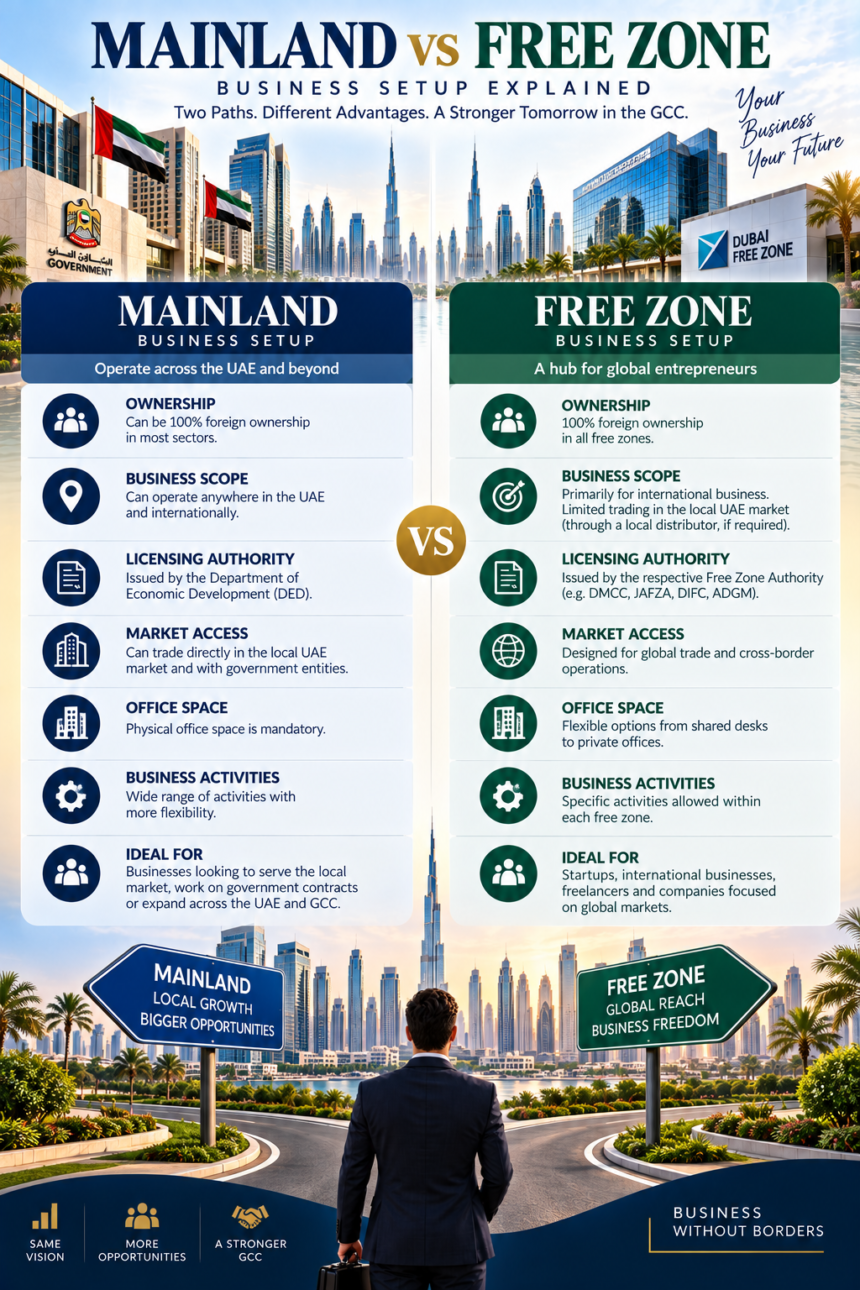
Mainland vs Free Zone is one of the first comparisons entrepreneurs face when starting a company in the UAE. Both structures can offer 100% foreign ownership for many activities, both can support residence visas and corporate banking, and both can provide access to one of the Gulf’s most important business markets. However, the way a company trades, obtains licences, rents office space and handles tax can differ considerably.
- Mainland vs Free Zone: 2026 Overview
- Understanding Mainland Business Setup
- Understanding Free Zone Business Setup
- 1. Business Ownership
- 2. UAE Market Access
- 3. Business Activities and Licensing
- 4. Company Setup Costs
- 5. Office and Workspace Requirements
- 6. Employee Visas
- 7. Corporate Tax Treatment
- 8. VAT and Tax Registration
- 9. Government and Local Contracts
- 10. Import, Export and International Trade
- 11. Company Expansion and Branches
- 12. Business Renewal and Compliance
- Mainland Setup for Consultants and Service Businesses
- Free Zone Setup for Consultants and Startups
- Mainland Setup for Trading Companies
- Free Zone Setup for International Trading
- E-Commerce Business Setup
- Mainland vs Free Zone for First-Time Entrepreneurs
- Mainland vs Free Zone Cost Comparison
- Choosing the Right Business Setup
- Common UAE Business Setup Mistakes
- UAE Business Setup Checklist
- Final Thoughts on Mainland vs Free Zone
The old explanation that a free zone is for foreigners while a mainland company requires an Emirati shareholder is no longer accurate for most businesses.
Dubai’s official investment platform states that foreign investors have been able to enjoy 100% ownership in many mainland sectors since 2020. Mainland companies licensed by Dubai’s Department of Economy and Tourism can generally operate within Dubai, across the UAE and internationally.
Free zones also continue to provide 100% foreign ownership and specialised business environments, but their rules are determined by the individual free-zone authority.
Market access is one of the biggest distinctions. Dubai’s official investment guidance notes that a free-zone company cannot simply trade within the UAE mainland without the appropriate mainland licensing arrangement.
Tax treatment is another major area where outdated information causes confusion. A free-zone company is not automatically a “zero-tax company.” Under UAE Corporate Tax rules, only a Qualifying Free Zone Person meeting the required conditions can obtain a 0% rate on qualifying income. Other taxable income can be subject to 9%.
Understanding these differences before incorporation can prevent an entrepreneur from choosing a cheap licence that later restricts how the company actually needs to operate.
Mainland vs Free Zone: 2026 Overview
The basic differences can be summarised as follows:
| Feature | Mainland Company | Free Zone Company |
|---|---|---|
| Foreign ownership | Up to 100% for many activities | Generally 100% |
| Licensing authority | Emirate’s economic authority | Individual free-zone authority |
| UAE mainland access | Direct, subject to licence | May require additional mainland arrangement |
| International trading | Yes | Yes |
| Business activities | Broad selection | Depends on free zone |
| Office requirement | Depends on activity and emirate | Often flexible packages available |
| Visas | Based on business and establishment | Often linked to package/workspace |
| Corporate Tax | Standard UAE CT rules | Special QFZP regime may apply |
| Government contracts | Generally easier structurally | Depends on tender and licensing |
| Setup simplicity | Varies | Often highly streamlined |
| Ideal for | UAE-focused businesses | International, specialised or startup businesses |
This table provides a starting point rather than a universal rule.
Dubai alone has more than 20 free zones serving sectors such as technology, finance, commodities, media and trade.
Each can have different:
- Licence fees
- Activities
- Visa allocations
- Office requirements
- Shareholder rules
- Renewal fees
The best structure therefore depends on what the company actually plans to do.
Understanding Mainland Business Setup
A mainland company is incorporated under the commercial regulations of the relevant emirate rather than under an individual free-zone authority.
In Dubai, mainland registration and licensing are handled by the Department of Economy and Tourism.
Dubai’s official investment platform defines mainland as areas outside the emirate’s free zones and confirms that mainland companies can operate within and outside the UAE, including in free zones and across the wider GCC.
Common mainland licence categories include:
- Commercial licences
- Professional licences
- Industrial licences
- E-commerce-related activities
- Other specialised activities
A mainland company can be particularly useful when the business needs to serve customers throughout the UAE directly.
Examples include:
- Restaurants
- Retail stores
- Construction businesses
- Local consultancies
- Maintenance companies
- UAE-focused e-commerce operations
- Professional service firms
The legal structure can include an LLC, sole establishment, civil company, branch or other permitted form depending on the activity.
Understanding Free Zone Business Setup
A free zone is a designated business jurisdiction with its own licensing authority.
Free zones are often created around particular industries.
Examples include zones specialising in:
- Technology
- Media
- Financial services
- Logistics
- Commodities
- Manufacturing
- Healthcare
- Aviation
- International trade
The UAE Government describes free zones as providing streamlined administrative procedures, specialised infrastructure and business environments for investors.
Free zones are particularly attractive to entrepreneurs who want:
- Full foreign ownership
- Relatively simple setup
- Flexible office packages
- International business
- Industry-specific ecosystems
However, a free-zone licence should not be selected simply because the initial incorporation package appears cheaper.
The entrepreneur needs to check whether that licence permits the business model planned for the next several years.
1. Business Ownership
Foreign ownership used to be one of the biggest differences between mainland and free-zone companies.
That distinction has reduced significantly.
Historically, many UAE mainland companies were required to have a UAE national holding at least 51% of the shares.
Changes to federal company law removed that general requirement for many activities.
Dubai’s official investment platform confirms that foreigners can now enjoy 100% ownership in many mainland sectors.
Free zones have traditionally allowed full foreign ownership and continue to do so.
Therefore, someone asking:
“Which option gives me 100% ownership?”
may find that both do.
The better question is:
“Which structure allows my business to serve its customers most efficiently?”
Certain strategic or regulated business activities can still have additional ownership or approval requirements, so entrepreneurs should always verify the specific activity before registration.
2. UAE Market Access
This is one of the most important differences.
A mainland business can generally conduct its licensed activities throughout the UAE.
This is particularly useful for businesses selling directly to UAE customers.
Dubai’s official investment platform states that mainland companies can operate within Dubai, across the UAE, internationally and within the wider GCC.
Free-zone companies operate under their respective free-zone licences.
Their ability to conduct business directly in the mainland market depends on the activity and applicable licensing arrangements.
Dubai’s official guidance specifically notes that free-zone businesses cannot trade within the UAE mainland without an appropriate mainland licence.
In practice, different mechanisms may be available depending on the free zone and business, including:
- Mainland branches
- Dual licences
- Distributors
- Local commercial arrangements
- Additional permits
This makes customer location extremely important when choosing the structure.
If most customers are businesses or consumers inside Dubai, a mainland licence may provide greater simplicity.
If the business serves international clients, a free zone may work perfectly.
3. Business Activities and Licensing

Both structures require the company to select approved business activities.
Your licence determines what the business is legally permitted to do.
A company licensed for management consultancy cannot automatically begin importing electronics.
Likewise, a trading company cannot automatically begin operating a restaurant.
Mainland authorities generally provide access to a broad range of business activities.
Dubai’s current business setup system includes licence categories covering commercial, industrial and professional activities.
Free zones may offer narrower but highly specialised lists.
A media zone might focus on:
- Advertising
- Content creation
- Publishing
- Digital media
A commodities zone may focus on:
- Trading
- Import/export
- Commodities
- Logistics
This specialisation can be useful because the free zone may already understand the needs of companies in that sector.
However, the entrepreneur should confirm every planned activity before incorporation.
Adding activities later can create amendment fees or even require another licence.
4. Company Setup Costs
There is no universal answer to whether mainland or free zone is cheaper.
Free-zone packages are often marketed with attractive starting prices.
These may include:
- Licence
- Registration
- Shared workspace
- Establishment card
But the advertised price may exclude:
- Residence visa
- Medical examination
- Emirates ID
- Immigration fees
- Office upgrades
- Additional activities
- Additional shareholders
- Employee visas
- Banking assistance
- Annual renewal
Mainland setup costs also vary substantially according to:
- Licence type
- Activity
- Legal structure
- Office rent
- Municipality requirements
- Regulatory approval
Therefore, compare the full first-year cost and annual renewal cost, not the promotional setup fee.
A AED 12,000 licence that later requires AED 20,000 of additional expenses may be more expensive than a AED 25,000 package that already includes the necessary facilities and approvals.
5. Office and Workspace Requirements
Physical-office requirements vary by business activity.
Mainland companies carrying out customer-facing, industrial or operational activities may need appropriate commercial premises.
The office must normally match the licensed activity and local planning requirements.
Free zones often provide more flexible options for small businesses.
These can include:
- Flexi desks
- Co-working spaces
- Dedicated desks
- Private offices
- Warehouses
- Industrial facilities
This makes free zones particularly attractive for consultants and small companies that do not initially need a full office.
However, workspace can also affect visa allocation.
A low-cost flexi-desk package may support only a small number of employee visas.
A company planning to hire 15 people should therefore investigate future office and immigration requirements before selecting the cheapest package.
6. Employee Visas
Both mainland and free-zone companies can generally sponsor eligible employees, subject to immigration and labour rules.
The practical process differs.
For mainland companies, employee capacity can depend partly on:
- Business activity
- Office size
- Labour requirements
- Establishment status
Free-zone visa packages often specify how many visas are included or permitted.
For example, a package may offer:
- Zero visa
- One visa
- Three visas
- Five visas
More employees may require a larger office or upgraded licence package.
For a solo entrepreneur, this can make a free-zone package attractive.
For a fast-growing company expecting dozens of employees, mainland establishment may provide more flexibility depending on the activity.
Business owners should plan staffing requirements at least two to three years ahead.
7. Corporate Tax Treatment
Corporate Tax is one of the most misunderstood parts of the comparison.
A free-zone company does not automatically pay 0% Corporate Tax.
For ordinary taxable persons under the UAE Corporate Tax regime, the current general rates are:
- 0% on taxable income up to AED 375,000
- 9% on taxable income above AED 375,000
The Federal Tax Authority confirms these rates.
Free-zone businesses can receive different treatment if they qualify as a Qualifying Free Zone Person.
The FTA states that a Qualifying Free Zone Person can receive:
- 0% Corporate Tax on Qualifying Income
- 9% on taxable income that does not meet the Qualifying Income definition
Qualification is subject to conditions.
These include matters such as:
- Qualifying income
- Adequate economic substance
- Transfer pricing compliance
- Permitted activities
- De minimis requirements for non-qualifying revenue
The FTA also issued additional compliance procedures for Qualifying Free Zone Persons in 2026, demonstrating that the special regime remains an actively regulated tax framework rather than a blanket exemption.
Tax should therefore not be the only reason to choose a free zone.
Get professional tax advice if the QFZP regime materially affects the business model.
8. VAT and Tax Registration
Mainland and free-zone companies can both have UAE tax obligations.
Corporate Tax registration and VAT are separate systems.
The FTA specifically notes that VAT and Corporate Tax continue to operate independently.
Free-zone status does not automatically remove VAT obligations either.
VAT treatment can depend on:
- Business activity
- Supplies
- Customer location
- Designated zone status
- Goods versus services
A company should therefore determine:
- Whether VAT registration is required
- Whether Corporate Tax registration is required
- How invoices should be prepared
- What accounting records must be maintained
Tax planning should begin before the first invoice is issued rather than at the end of the financial year.
9. Government and Local Contracts
Mainland companies are generally positioned more directly for business within the domestic UAE market.
This can be useful for companies targeting:
- Government contracts
- Large local corporations
- Construction projects
- Facility management
- UAE retail customers
Tender requirements still vary significantly.
A government entity may specify:
- Particular licence
- Local registration
- Industry certification
- Previous experience
- Financial guarantees
A free-zone company may still be eligible for many opportunities, but some contracts can require additional local licensing or a mainland presence.
Companies planning to depend heavily on UAE government or semi-government work should review tender requirements before selecting the incorporation jurisdiction.
10. Import, Export and International Trade
Free zones can be particularly attractive for international trading businesses.
Many were specifically designed around logistics and global commerce.
Advantages may include access to:
- Ports
- Airports
- Warehouses
- Customs infrastructure
- International shipping
- Re-export operations
However, goods entering the UAE mainland from a free zone can involve customs and import procedures.
A mainland trading company can sell directly into the UAE market under its licence, subject to customs and product requirements.
The correct structure therefore depends on where goods are ultimately sold.
Main target: UAE consumers
Mainland may be simpler.
Main target: international customers or re-export
A specialised free zone may be highly attractive.
Trading companies should calculate logistics and customs costs before selecting the jurisdiction.
11. Company Expansion and Branches
Entrepreneurs should not build only for the first year.
Consider what happens when the company grows.
A business may eventually need:
- More employees
- Larger office
- Warehouse
- Retail outlet
- New business activities
- Government contracts
- Additional branches
Dubai’s licensing system recognises several branch structures, including branches of foreign companies and branches of free-zone companies for qualifying activities. Current Invest in Dubai activity records specifically identify a “Branch of a Free Zone Company” among available legal forms for certain professional activities.
This can provide expansion options.
However, restructuring later still costs money.
Choosing the correct setup initially can reduce:
- Amendment fees
- Licence changes
- Banking disruption
- Contract transfers
- New lease costs
Ask where the company should be in three years, not only how cheaply it can open today.
12. Business Renewal and Compliance
Both mainland and free-zone licences need ongoing maintenance.
Typical obligations can include:
- Licence renewal
- Office or workspace renewal
- Corporate Tax filings
- VAT filings where applicable
- Accounting
- Beneficial ownership records
- Employee compliance
- Immigration renewals
- Industry permits
Free zones may package several administrative services together.
Mainland businesses may deal with several government authorities depending on the business.
Neither structure eliminates compliance.
Entrepreneurs should therefore budget for annual professional and government costs.
A business licence should be treated as an ongoing operating expense rather than a one-time purchase.
Mainland Setup for Consultants and Service Businesses
Consultancies are among the businesses that can work under either structure.
A mainland consultancy can be attractive when clients are predominantly within the UAE.
For example, a company serving:
- Dubai restaurants
- UAE property developers
- Local retailers
- Government organisations
may benefit from direct mainland access.
A consultant serving international businesses remotely may not need the same local-market flexibility.
In that case, a suitable free zone may provide a simpler and more economical structure.
The decision should follow the clients.
Free Zone Setup for Consultants and Startups
Free zones can work particularly well for:
- Freelancers
- Consultants
- Digital agencies
- Technology startups
- International service companies
Reasons include:
- 100% foreign ownership
- Flexible workplaces
- Streamlined incorporation
- Industry ecosystems
- Smaller initial office requirements
A startup with two founders and no employees may not need a conventional commercial office immediately.
A free-zone workspace can therefore reduce overhead.
However, founders should check whether the licence permits the exact services they intend to offer in the UAE mainland.
Mainland Setup for Trading Companies
A mainland licence can be useful for trading companies focused strongly on UAE customers.
The company may sell goods through:
- Shops
- Distributors
- E-commerce
- Wholesale
- Corporate customers
Direct domestic market access can reduce structural complexity.
However, traders should also review:
- Customs registration
- Product approvals
- Warehousing
- VAT
- Import licences
Some regulated products may require additional permission regardless of whether the company is mainland or free zone.
Free Zone Setup for International Trading
Free zones can be particularly effective when the main business involves international trade.
A company might import goods into a free zone and later re-export them to:
- Saudi Arabia
- India
- Africa
- Europe
- Asia
Zones near airports or ports can provide important logistical advantages.
For this type of company, proximity to logistics infrastructure may be more important than direct access to UAE consumers.
Choose the free zone based on actual supply-chain needs rather than reputation alone.
E-Commerce Business Setup
E-commerce businesses can operate under either structure depending on the business model.
A UAE-focused online store selling directly to consumers may find mainland licensing practical.
A digital marketplace serving customers internationally may be well suited to a free zone.
Important questions include:
- Where are customers?
- Where is inventory stored?
- Who imports the products?
- Who collects payment?
- Are products regulated?
- Is a warehouse required?
Do not assume “online business” means physical location no longer matters.
Product movement, customs, VAT and customer location still influence the appropriate business structure.
Mainland vs Free Zone for First-Time Entrepreneurs
First-time entrepreneurs often prefer free zones because the setup process can feel simpler.
A single authority may handle:
- Registration
- Licence
- Workspace
- Immigration services
This convenience has real value.
However, entrepreneurs expecting substantial local UAE business should also compare mainland options.
Foreign ownership is no longer a reason by itself to avoid the mainland.
A founder may discover that a mainland company provides greater flexibility for only a modest difference in annual cost.
The best structure is the one that fits the business model.
Mainland vs Free Zone Cost Comparison
There is no fixed winner because costs depend heavily on activity and jurisdiction.
| Cost Area | Mainland | Free Zone |
|---|---|---|
| Licence | Activity dependent | Package dependent |
| Workspace | Often commercial premises | Flexi-desk options common |
| Visa | Separate government costs | Often packaged |
| Additional activities | Fees may apply | Fees may apply |
| Tax registration | Required where applicable | Required where applicable |
| Banking | Separate process | Separate process |
| Annual renewal | Required | Required |
| Expansion | Flexible depending on licence | May require package upgrade |
Instead of asking which is cheaper, request a complete estimate including:
Setup + visas + office + tax compliance + renewal + banking-related documents + planned employees.
Then compare the first three years.
That produces a far more realistic number.
Choosing the Right Business Setup
Choose mainland when the business needs:
- Direct UAE market access
- Physical retail presence
- Broad local contracting
- Larger local operations
- Greater domestic expansion flexibility
Consider a free zone when the business prioritises:
- International trade
- Remote consulting
- Technology
- Export
- Industry-specific ecosystems
- Flexible workspace
- Streamlined startup packages
Some businesses can operate successfully through either structure.
In those cases, compare total cost, customer access and tax implications.
Common UAE Business Setup Mistakes
Choosing solely by the cheapest licence
The licence may not support the real business model.
Believing free zones automatically mean 0% tax
Only qualifying income of a Qualifying Free Zone Person receives the special 0% Corporate Tax treatment.
Believing mainland companies always need Emirati shareholders
100% foreign ownership is now available for many mainland activities.
Ignoring UAE market access
A free-zone company may require additional arrangements for direct mainland trade.
Ignoring visa requirements
The cheapest package may not provide enough employee visas.
Choosing the wrong business activity
Changing later can create cost and delays.
Ignoring renewal costs
Compare annual costs, not only setup fees.
Assuming a business licence guarantees banking
Banks conduct independent compliance and KYC checks.
Ignoring Corporate Tax
Both mainland and free-zone companies can have Corporate Tax obligations.
UAE Business Setup Checklist
Before deciding between mainland and free zone:
- Define the exact business activity
- Identify your target customers
- Decide whether direct mainland trading is required
- Confirm foreign ownership eligibility
- Compare available legal forms
- Check regulated-sector approvals
- Compare complete first-year costs
- Compare annual renewal fees
- Review office requirements
- Estimate employee visas
- Check free-zone mainland access rules
- Review Corporate Tax treatment
- Check VAT requirements
- Understand customs requirements
- Consider future staff growth
- Review branch options
- Compare banking documentation
- Plan accounting and compliance
- Obtain written fee schedules
- Verify licence details through official government sources
Final Thoughts on Mainland vs Free Zone
The Mainland vs Free Zone decision has changed considerably as the UAE’s business laws have become more flexible.
Foreign ownership is no longer the defining difference.
Dubai allows 100% foreign ownership across many mainland sectors, while free zones continue to offer full foreign ownership through specialised jurisdictions.
The more important difference is how and where the company plans to operate.
A mainland company can be particularly attractive for businesses serving customers throughout the UAE, opening physical locations, competing for local contracts or building substantial domestic operations.
A free-zone company can work extremely well for startups, consultants, international traders and specialised companies that benefit from flexible workspace and industry-focused ecosystems.
Corporate Tax also needs careful consideration.
Ordinary taxable persons generally face 0% Corporate Tax on taxable income up to AED 375,000 and 9% above that threshold.
A Qualifying Free Zone Person can instead obtain 0% on qualifying income, while income outside the qualifying definition can be taxed at 9%.
This means free-zone status by itself does not create an automatic tax exemption.
For a first-time entrepreneur, the best approach is to start with customers rather than licences.
Determine where your customers are, which activity you need, how many employees you expect, whether you need physical premises and how the business may expand over the next three years.
Then compare mainland and free-zone options.
The cheapest licence today can become an expensive structure to change tomorrow.
The strongest UAE business setup is therefore the one that gives the company the ownership, market access, licence flexibility, tax position and operating capacity it actually needs to grow.
Do follow us on Instagram
Read More – GCC Business Ownership: 12 Essential Rules for Foreign Investors in 2026