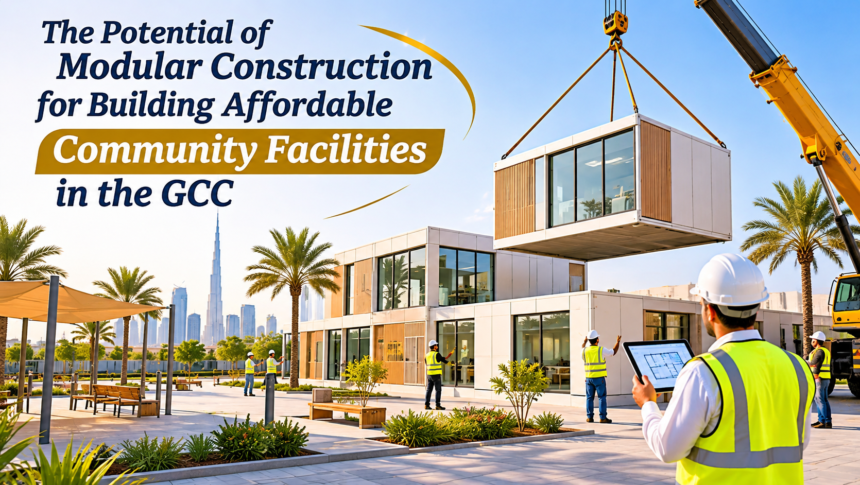
The Economic and Environmental Benefits of Modular Construction in the Gulf
Rapid urban development across the Gulf Cooperation Council (GCC) is creating new opportunities and challenges for infrastructure planning. Countries such as the United Arab Emirates, Saudi Arabia, Qatar, Kuwait, Oman and Bahrain continue investing in housing, transport networks, education, healthcare and public services. As residential communities expand and new urban districts emerge, the demand for accessible and affordable community facilities is becoming increasingly important.
- 1. Understanding Modular Construction and Its Role in Community Infrastructure
- 2. Why Affordable Community Facilities Matter for Growing GCC Cities
- 3. How Modular Construction Could Reduce Project Costs and Delivery Times
- 4. Where Modular Construction Could Improve Community Services Across the GCC
- 5. The Sustainability Benefits of Factory-Built Community Facilities
- 6. What Challenges Could Limit Modular Construction in the Gulf?
- 7. How Governments and Developers Can Make Modular Facilities More Affordable
- 8. The Future of Modular Community Construction in the GCC
- Conclusion: Modular Construction Could Strengthen Community Development Across the GCC
Schools, healthcare centres, libraries, recreational spaces and community halls play a central role in improving quality of life. However, developing these facilities through conventional construction methods can involve significant financial investment, lengthy project timelines and complex coordination between contractors, designers and government authorities.
This is where modular construction in the GCC could offer a practical alternative.
Modular construction involves manufacturing building components or complete sections in controlled factory environments before transporting them to construction sites for installation. By shifting substantial portions of the building process away from the construction site, developers may improve production efficiency, reduce certain forms of waste and deliver suitable facilities more quickly.
The approach is particularly interesting for community infrastructure because many public buildings require similar functional spaces. Classrooms, consultation rooms, administrative offices and multipurpose halls can often be designed around repeatable layouts while still allowing adaptations for local requirements.
Research by McKinsey suggests that modular construction can accelerate project schedules by approximately 20% to 50% in suitable circumstances. Potential construction cost savings can reach around 20% when projects are designed and delivered effectively, although these outcomes are not guaranteed.
Across the Gulf, construction authorities and private developers are already exploring advanced building systems. In June 2026, Dubai Municipality announced its approval of DuBox’s modular construction system, demonstrating growing institutional support for modern construction methods. Dubai Municipality
For the GCC, modular construction could become an important tool for delivering affordable, adaptable and sustainable community facilities. Its long-term value will depend on proper engineering, realistic financial planning, suitable building regulations and careful consideration of community needs.
1. Understanding Modular Construction and Its Role in Community Infrastructure
Modular construction is a building method in which substantial parts of a structure are manufactured away from the final construction location.
These components are transported to the site and assembled into a complete building.
Unlike conventional construction, where most structural and finishing activities take place directly on-site, modular construction transfers many activities into a factory environment.
This can allow site preparation and module manufacturing to progress simultaneously.
For example, while workers prepare foundations and utility connections at a future community centre, another team can manufacture the building’s classrooms, offices or service rooms at an off-site facility.
Once the modules are completed, they can be transported and installed according to an approved construction plan.
Different forms of modular construction
Modular construction includes several approaches, each suited to different project requirements.
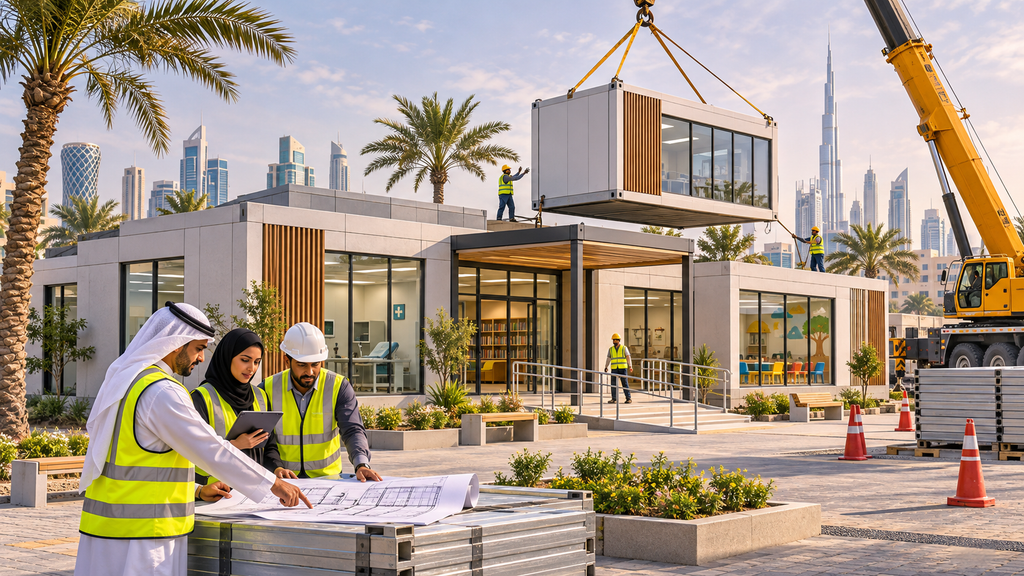
Volumetric modular construction uses three-dimensional units that may contain finished walls, floors, ceilings and internal services.
Panelised construction involves manufacturing flat building elements such as wall panels, floor sections and roof components.
Hybrid construction combines conventional building techniques with prefabricated elements.
Not all prefabricated buildings are fully modular, and the terms should not be used interchangeably.
The appropriate method depends on the size, structural requirements, location and intended use of the building.
Why community facilities are suitable candidates
Many community buildings contain repeatable spaces that can be standardised without eliminating design flexibility.
A primary healthcare centre, for example, may require consultation rooms, waiting areas, washrooms and administrative facilities.
Similarly, a school may need classrooms, staff offices, storage rooms and shared activity areas.
These recurring spatial requirements can make modular design particularly useful.
However, specialised facilities such as operating theatres, advanced laboratories or buildings with unusually complex structural requirements may demand additional engineering or conventional construction elements.
Potential community applications
- Primary schools and educational annexes.
- Local healthcare centres and medical consultation facilities.
- Community libraries and learning spaces.
- Youth clubs and recreational centres.
- Municipal offices and public service centres.
- Multipurpose community halls.
- Cultural and creative activity spaces.
- Public sanitation and support facilities.
The opportunity is not simply to construct buildings faster, but to create facilities that remain functional, safe and adaptable throughout their intended service lives.
2. Why Affordable Community Facilities Matter for Growing GCC Cities
Community facilities support everyday life by giving residents access to essential services close to where they live.
As cities expand into new residential districts, public infrastructure must develop alongside housing and commercial projects.
A neighbourhood containing thousands of homes may require schools, healthcare facilities, recreational areas and community gathering spaces.
If these services are delayed, residents may need to travel considerable distances for basic activities.
This can increase transportation demand and reduce the convenience of daily life.
The importance of accessible public services
Affordable community infrastructure helps ensure that essential facilities are available to a broad range of residents.
A local healthcare centre can improve access to routine medical services, while a public library can support education and lifelong learning.
Community halls can provide spaces for cultural programmes, workshops and neighbourhood activities.
These facilities contribute to social development, not merely physical urban expansion.
Balancing investment and public needs
Municipal authorities and developers must consider several competing financial priorities.
Transportation, drainage, electricity, water networks and public buildings all require investment.
Reducing the cost of delivering suitable community facilities could allow available budgets to support a greater number of projects.
However, affordability should not be confused with choosing the cheapest construction method.
A low initial building cost may become less attractive if the facility experiences high maintenance expenses, poor energy efficiency or limited durability.
The appropriate measure is the total cost of providing a safe, useful building throughout its expected life.
Supporting new residential communities
Planned neighbourhoods often develop over several phases.
A permanent community facility may not be required at its full eventual capacity during the earliest development stage.
Modular buildings could allow developers to construct an initial facility and consider expansion as the community grows.
For example, a small educational centre might begin with several classrooms and later add additional learning spaces if the original structure and site are designed for expansion.
This flexibility can help align infrastructure investment with actual demand.
The role of urban planning standards
Dubai Municipality’s planning standards guide addresses different categories of community facilities, including education, healthcare, social, cultural and recreational services.
The guidance reflects the importance of providing facilities according to population needs and neighbourhood development. Dubai Municipality
Modular construction could support these planning objectives where it meets the relevant technical, safety and operational standards.
3. How Modular Construction Could Reduce Project Costs and Delivery Times
One of the main arguments for modular construction is its potential to improve project delivery efficiency.
Conventional construction projects involve sequential activities that may be affected by weather, labour availability, site access and coordination between different contractors.
Modular construction can change the sequence of work by transferring selected activities to a factory.
This allows certain construction stages to take place simultaneously rather than consecutively.
Parallel manufacturing and site preparation
In conventional construction, substantial progress on a building may depend on the completion of earlier on-site activities.
In modular projects, foundations and underground services can be prepared while building modules are manufactured.
This overlapping schedule may reduce overall delivery time.
However, efficient coordination is essential. If site preparation falls behind, completed modules may require storage, creating additional costs.
Factory-based quality control
Controlled factory environments can provide more consistent conditions for manufacturing.
Components can be produced using repeatable processes and checked before leaving the facility.
This may reduce some forms of construction error and rework.
For community buildings, standardised components could also simplify maintenance planning and replacement-part management.
Quality still depends on the manufacturer’s capability, inspection procedures and installation standards.
Reducing labour-intensive site activities
Modular construction may reduce the amount of work performed at the final building location.
This can be useful in congested urban environments or areas where construction access is limited.
However, skilled workers are still needed for manufacturing, transport, installation, inspection and final commissioning.
The method changes the distribution of construction work rather than eliminating the need for professional labour.
Understanding cost savings realistically
Construction cost comparisons must include more than the price of factory-produced modules.
A realistic budget should consider foundations, transport, crane operations, connections, permits, site development and finishing work.
Savings may emerge from standardisation, reduced construction time and improved productivity.
However, projects with highly customised designs or expensive transport requirements may not achieve those savings.
Traditional versus modular construction
| Factor | Conventional construction | Modular construction |
|---|---|---|
| Main construction location | Primarily on-site | Factory and construction site |
| Project sequence | More activities performed sequentially | Some activities can overlap |
| Design flexibility | High, including late-stage changes | High when planned early; late changes can be costly |
| Quality management | Site-based inspections | Factory and site inspections |
| Labour requirements | Extensive on-site workforce | Greater factory-based participation |
| Waste management | Depends on site practices | Potential for controlled material use |
| Transport requirements | Materials and equipment | Materials, large modules and lifting equipment |
| Potential schedule | Depends on site conditions and project complexity | Can be shorter for suitable projects |
| Expansion opportunities | Possible, subject to design | Can be planned around additional modules |
The strongest financial case may emerge when several community facilities share similar designs, enabling manufacturers to produce components repeatedly.
A one-off building with extensive customisation may offer fewer advantages.
4. Where Modular Construction Could Improve Community Services Across the GCC
Different Gulf countries have different development priorities, but all six GCC members require reliable community infrastructure.
Modular construction could serve these needs through locally appropriate projects rather than a single building model applied across the entire region.
Saudi Arabia: Supporting expanding residential districts
Saudi Arabia’s urban development initiatives create opportunities for alternative construction technologies.
New residential communities require schools, health services, community centres and other public facilities to support growing populations.
In November 2025, Saudi Arabia’s Ministry of Municipalities and Housing signed a memorandum of understanding with Samsung C&T Saudi Arabia covering cooperation in advanced construction, including modular and prefabricated building technologies. Ministry of
Such cooperation indicates interest in industrialised construction methods, although it does not establish that modular construction is already being used across all public facility programmes.
For new residential areas, standardised community buildings could provide a way to coordinate service delivery with phased housing development.
United Arab Emirates: Encouraging advanced building systems
The UAE has developed a construction industry that increasingly incorporates digital design, prefabrication and advanced engineering practices.
Dubai Municipality’s June 2026 approval of a modular building system provides a concrete example of regulatory engagement with these technologies.
The approved DuBox system is manufactured through facilities associated with AMANA Group in Dubai Industrial City. Dubai Municipality
Ramboll has also reported supporting the approval process for a multistorey volumetric modular building system in Dubai, highlighting the technical and regulatory coordination required to introduce new construction methods. Ramboll
These developments may help create a stronger foundation for modular community facilities, provided individual projects satisfy the relevant planning and safety requirements.
Qatar: Opportunities for neighbourhood services
Qatar’s urban infrastructure and hospitality development create potential applications for modular construction.
Suitable projects might include neighbourhood learning facilities, public service offices, recreational spaces and selected healthcare buildings.
Modular systems may be especially useful where projects share similar layouts or need to be delivered in phases.
However, feasibility must be evaluated against local planning requirements, site access and lifecycle costs.
Oman: Serving geographically dispersed communities
Oman’s settlements vary from urban centres to smaller communities separated by significant distances.
In suitable cases, modular buildings could help provide education, healthcare or administrative facilities outside major cities.
Transport logistics would remain a major consideration, particularly in mountainous areas or locations with limited road access.
Smaller prefabricated components may sometimes be more practical than transporting large complete modules.
Kuwait and Bahrain: Urban renewal and public facilities
Kuwait and Bahrain could investigate modular construction for suitable community buildings, particularly where construction schedules or site limitations create challenges.
Potential applications include recreational centres, educational annexes and municipal service facilities.
However, limited site space and dense existing development may complicate transport and lifting operations.
Potential GCC applications
| Country | Potential community applications | Key planning consideration |
|---|---|---|
| Saudi Arabia | Schools, clinics, community centres | Scale, standardisation and distribution |
| UAE | Educational, healthcare and municipal facilities | Regulatory approvals and urban integration |
| Qatar | Neighbourhood and recreational facilities | Planning standards and site suitability |
| Oman | Rural service centres and smaller public buildings | Transportation and terrain |
| Kuwait | Community halls and public service annexes | Infrastructure connections and site access |
| Bahrain | Educational extensions and community facilities | Land availability and construction logistics |
These examples represent potential applications, not confirmed projects in every country.
The best approach will depend on local demand, engineering requirements and the availability of experienced contractors.
5. The Sustainability Benefits of Factory-Built Community Facilities
Modular construction can contribute to sustainable development when it improves material efficiency, reduces avoidable waste and supports durable, energy-efficient buildings.
However, the environmental benefits should be measured rather than assumed.
Factory manufacturing can generate savings in some areas while introducing additional impacts through transport, lifting operations and material choices.
Reducing construction waste
Conventional construction sites can generate substantial waste from inaccurate cutting, damaged materials, packaging and rework.
Factory production may offer better opportunities to control material quantities and reuse offcuts.
Standardised manufacturing can also support improved inventory management.
For example, a manufacturer producing identical classroom modules may be able to optimise material dimensions across multiple units.
This may reduce waste compared with building each classroom independently.
Efficient material management
Controlled production allows manufacturers to plan material quantities more consistently.
Digital design tools can help identify potential clashes between structural systems, electrical installations and plumbing before manufacturing begins.
Preventing these problems can reduce the need for corrective work.
However, manufacturers must still manage defective products, packaging and waste generated during production.
Reducing some on-site environmental impacts
Off-site manufacturing may reduce certain activities at the final construction location.
Potential benefits include lower levels of site-generated waste, fewer extended construction activities and reduced disruption to surrounding communities.
This could be useful when constructing facilities near occupied residential areas, schools or healthcare buildings.
Nevertheless, large modules require transportation, and cranes may be necessary for installation.
These activities can generate emissions and temporary disruption.
Designing for Gulf temperatures
Energy performance is particularly important in GCC buildings because cooling demand can be substantial.
Modular facilities should incorporate suitable insulation, glazing, airtightness and efficient mechanical systems.
Poorly designed modules could result in high electricity consumption regardless of how quickly they were manufactured.
For schools and healthcare centres, thermal comfort must also support health and safety.
Potential for future adaptation
Some modular buildings can be designed for expansion, reconfiguration or relocation.
This flexibility may reduce the need for complete demolition when community requirements change.
However, relocation is not automatically simple or economical.
It depends on module connections, structural condition, transport routes, the original foundation design and the availability of a suitable new site.
Environmental performance comparison
| Sustainability factor | Potential modular advantage | Important qualification |
|---|---|---|
| Material waste | Repeatable manufacturing may improve material use | Factory waste still requires management |
| Construction disruption | Less work may be needed on-site | Transport and installation remain necessary |
| Energy efficiency | Building envelopes can be standardised | Performance depends on actual design |
| Resource planning | More predictable material quantities | Poor forecasting can still create waste |
| Building adaptability | Some modules can be expanded or relocated | Not every system is reusable |
| Carbon emissions | Potential reductions through efficient production | Transport and material emissions must be assessed |
| Maintenance | Repeatable systems may simplify repairs | Manufacturer support and spare parts matter |
The environmental value of modular construction should be assessed through a full lifecycle approach covering manufacturing, transport, operation, maintenance and eventual replacement or disposal.
6. What Challenges Could Limit Modular Construction in the Gulf?
Despite its potential advantages, modular construction is not suitable for every building or development.
Its success depends on early planning, manufacturing capacity, structural engineering and the ability to move large components safely.
Several challenges are particularly relevant to the Gulf.
Transportation and installation constraints
Completed modules may be large and heavy.
Transporting them requires suitable roads, vehicles, permits and site access.
Urban locations with narrow roads, overhead utilities or limited crane space may present difficulties.
For remote developments, long transportation distances can increase costs.
These factors should be evaluated before selecting a modular system.
High temperatures and environmental exposure
Gulf buildings must withstand demanding environmental conditions.
High temperatures, strong sunlight, dust, humidity and coastal salinity can influence material performance.
Appropriate corrosion protection, insulation, waterproofing and ventilation are essential.
Factory manufacturing does not eliminate the need for climate-specific engineering.
Building regulations and safety
Permanent modular buildings must comply with applicable building codes and approval requirements.
These may include structural safety, fire protection, accessibility, electrical systems, ventilation and emergency evacuation.
In Dubai, the Dubai Building Code provides a regulatory framework for building design and construction, while specific modular systems may require additional technical assessments. dlp.dubai.gov.ae+1
Requirements vary across GCC countries and sometimes between local authorities.
Limited standardisation
One of modular construction’s biggest advantages is repeatability.
If every public facility requires a completely different design, manufacturers may struggle to achieve production efficiencies.
However, excessive standardisation can create buildings that fail to meet local cultural, environmental or operational needs.
The challenge is to establish repeatable designs while preserving necessary flexibility.
Supply-chain and manufacturing capacity
Modular projects depend on reliable manufacturers, transportation providers and installation contractors.
Production delays at one factory may affect several projects simultaneously.
A limited supplier market can also reduce procurement competition.
Public authorities should therefore evaluate supplier capacity and contingency arrangements.
Financing and contractual arrangements
Modular construction often requires early design decisions and manufacturing commitments.
Payment schedules may differ from conventional construction because significant work occurs before modules reach the site.
This can create challenges for financing, insurance, inspection and contract management.
Developers must establish clear responsibilities for quality control, defects and acceptance testing.
Public perceptions of modular buildings
Some people associate modular construction with temporary structures or basic portable cabins.
However, modern permanent modular buildings can be designed to meet demanding architectural and engineering standards.
Community acceptance depends on the actual quality, appearance, durability and functionality of the finished facility.
Providing attractive, well-maintained public buildings can help demonstrate that modular construction is a method of production rather than a limitation on design quality.
Challenges and practical solutions
| Challenge | Potential response |
|---|---|
| Large module transportation | Assess routes and lifting requirements early |
| Local climate exposure | Specify suitable materials and envelope systems |
| Regulatory approval | Engage authorities during initial design |
| Limited production scale | Group suitable projects into repeatable programmes |
| Supplier dependence | Evaluate manufacturing capacity and contingency plans |
| High initial investment | Compare full lifecycle costs |
| Late design changes | Finalise critical requirements before manufacturing |
| Public concerns about quality | Demonstrate compliance, durability and design standards |
These considerations show why modular construction should be selected through project-specific analysis rather than treated as a universal solution.
7. How Governments and Developers Can Make Modular Facilities More Affordable
Modular construction is most likely to deliver value when authorities and developers consider it during the earliest stages of project planning.
Introducing modular construction after completing a design intended for conventional building methods may reduce its potential benefits.
A more effective strategy is to coordinate design, manufacturing, procurement and installation from the beginning.
Developing standardised facility designs
Government departments and property developers could establish approved design templates for common community facilities.
For example, a standard primary healthcare centre might include consultation rooms, reception areas, accessible washrooms and administrative spaces.
The same basic design could be adapted to different locations while maintaining core structural and service requirements.
This approach may reduce repeated design work and improve construction predictability.
Grouping similar projects
Constructing several facilities through a coordinated programme may improve manufacturing efficiency.
For example, an authority planning multiple neighbourhood libraries could use repeatable components across the projects.
Manufacturers would then have a more predictable production schedule.
This approach could also strengthen procurement negotiations and improve material planning.
However, grouped procurement should still encourage fair competition and avoid creating unnecessary dependence on a single supplier.
Using building information modelling
Building Information Modelling, commonly called BIM, enables project teams to coordinate digital representations of buildings and their components.
For modular construction, BIM can help integrate architectural design, structural systems and mechanical, electrical and plumbing services.
It can also support manufacturing plans and identify potential clashes before production begins.
Digital coordination is particularly valuable because late changes to completed modules can be expensive.
Considering lifecycle costs
Public authorities should evaluate the full cost of a facility rather than focusing only on initial construction expenses.
Important considerations include:
- Design and approval costs.
- Manufacturing and material expenses.
- Transportation and installation.
- Site preparation and foundation work.
- Electricity and cooling requirements.
- Regular maintenance and repairs.
- Expected operational life.
- Potential future expansion.
- Replacement and end-of-life costs.
A building with a slightly higher initial cost may represent better long-term value if it is durable, energy-efficient and easier to maintain.
Encouraging local manufacturing
Regional manufacturing facilities could help reduce reliance on long-distance transportation while supporting industrial development.
Local production may also create opportunities for engineers, technicians, designers and construction specialists.
However, domestic manufacturing should be evaluated according to market demand and economic efficiency.
Establishing expensive factories without sufficient project volume can increase rather than reduce construction costs.
Supporting public-private cooperation
Governments, developers, construction companies and manufacturers can collaborate on demonstration projects.
Public authorities may establish performance requirements while private companies contribute design and manufacturing expertise.
Pilot projects can help evaluate whether modular community facilities meet actual service needs.
This evidence can support future procurement decisions.
A practical procurement framework
| Project stage | Recommended action | Intended outcome |
|---|---|---|
| Community assessment | Identify service demand and facility requirements | Avoid unnecessary construction |
| Concept design | Evaluate modular and conventional alternatives | Select suitable construction method |
| Financial planning | Assess capital and lifecycle costs | Establish realistic affordability |
| Supplier evaluation | Review manufacturing capacity and experience | Reduce delivery risks |
| Regulatory approval | Confirm code and permitting requirements | Support compliant construction |
| Manufacturing | Implement inspection and quality controls | Improve reliability |
| Installation | Coordinate transport, foundations and connections | Reduce delays |
| Operation | Monitor maintenance and user experience | Support long-term performance |
The objective is not to use modular construction for every public building, but to identify where it can deliver suitable facilities at a reasonable long-term cost.
8. The Future of Modular Community Construction in the GCC
The future of modular construction in the GCC will depend on how successfully governments and private companies integrate advanced manufacturing with urban planning.
As residential developments expand and public service requirements evolve, demand for adaptable community infrastructure may create opportunities for standardised building systems.
However, technology alone will not determine the success of these projects.
Long-term outcomes will depend on construction quality, financial planning, community acceptance and regulatory compliance.
Expanding access to essential facilities
Modular construction could help governments provide community services in developing neighbourhoods.
Schools, clinics, libraries and recreational facilities may benefit from designs that can be manufactured efficiently and adapted to local needs.
This may be particularly relevant where similar facilities are required across several locations.
Supporting national industrial development
A stronger regional modular construction industry could create opportunities for manufacturing businesses, engineering companies and technology providers.
Factory production requires expertise in digital design, materials engineering, quality management and logistics.
Developing these capabilities may support workforce skills and industrial diversification.
Saudi Arabia’s interest in advanced construction systems and Dubai’s recent modular building approvals indicate that the region is exploring this direction.
However, future investment should remain connected to realistic project demand and demonstrated performance.
Creating adaptable community infrastructure
Community requirements can change as populations grow.
A neighbourhood that initially requires a small community centre may later need additional classrooms, activity rooms or administrative facilities.
Modular systems designed for expansion could help developers respond to these changes.
This flexibility is particularly valuable when planning facilities across multiple phases of urban development.
However, expansion must be anticipated in the original design, including structural capacity, foundations, fire safety and utility connections.
Encouraging innovation without compromising quality
Modern construction techniques should be assessed against the same essential expectations as conventional buildings.
Community facilities must be safe, accessible, comfortable and durable.
A school built through modular construction should provide an appropriate educational environment.
Similarly, a healthcare centre must meet applicable hygiene, ventilation, safety and clinical requirements.
Construction speed cannot replace these standards.
A roadmap for implementation
- Identify suitable facilities: Prioritise repeatable building types with clearly defined community needs.
- Develop performance standards: Establish requirements for safety, durability, accessibility, energy efficiency and maintenance.
- Conduct pilot projects: Test modular systems in selected GCC environments and document actual results.
- Compare lifecycle costs: Evaluate manufacturing, transport, installation and long-term operation against conventional alternatives.
- Strengthen local expertise: Support training in modular design, manufacturing and installation.
- Improve regulatory coordination: Work with approval authorities early in the project lifecycle.
- Expand proven solutions: Apply successful designs to additional locations when results justify wider investment.
Conclusion: Modular Construction Could Strengthen Community Development Across the GCC
Modular construction offers a promising approach to developing affordable community facilities across the Gulf Cooperation Council.
By transferring substantial construction activities into controlled manufacturing environments, developers may reduce project timelines, improve production consistency and make better use of materials.
These advantages could be particularly useful for schools, healthcare centres, libraries, public service buildings and recreational facilities.
The potential extends beyond construction efficiency. Modular systems could support phased development, local manufacturing, workforce development and more sustainable resource management.
Nevertheless, affordability must be evaluated through realistic project costs and long-term building performance.
Transportation, climate conditions, regulatory approvals and manufacturing capacity can significantly influence whether modular construction is suitable for a particular project.
For GCC governments and developers, the most effective strategy will be to combine careful planning with standardised designs, reliable suppliers and evidence from regional pilot projects.
Ultimately, modular construction could help Gulf communities gain access to essential public facilities more efficiently, while supporting the development of resilient, adaptable and sustainable infrastructure.
Do follow us on Instagram
Read More – Why Water Leakage Detection Is Becoming Essential for Sustainable Gulf Infrastructure