What Is a UAE Smart Home? Everything You Need to Know About the Future of Smart Living
Imagine arriving home after a long day in Dubai’s busy streets. Before you enter your property, your air conditioning has already adjusted to a comfortable temperature, the lights have switched on, and your favourite music is playing. Your security system has recognised your arrival, while smart curtains have automatically adjusted to the evening light. Everything happens with minimal effort.
- 1. What Is a UAE Smart Home?
- 2. How Does Smart Home Technology Work?
- 3. What Are the Main Features of a UAE Smart Home?
- 4. What Technologies Are Used in UAE Smart Homes?
- 5. Why Are Smart Homes Becoming Popular in the UAE?
- 6. What Are the Benefits of Living in a Smart Home in the UAE?
- 7. How Much Does It Cost to Build a Smart Home in the UAE?
- 8. Which Are the Best Smart Home Devices for UAE Homes?
- 9. Are Smart Homes in Dubai Different from Traditional Homes?
- 10. How Does Smart Home Automation Help Save Energy in the UAE?
- 11. Are UAE Smart Homes Safe and Secure?
- 12. Can Smart Homes Work Without an Internet Connection?
- 13. What Should You Consider Before Installing a Smart Home System in the UAE?
- 14. Are Smart Homes Suitable for Apartments and Villas in the UAE?
- 15. How Are Real Estate Developers Using Smart Home Technology in the UAE?
- 16. What Is the Role of Artificial Intelligence in UAE Smart Homes?
- 17. What Are the Challenges of Smart Home Technology in the UAE?
- 18. What Is the Future of Smart Homes in the UAE?
- 19. Is Investing in a UAE Smart Home Worth It?
- 20. How Can You Start Building a Smart Home in the UAE?
- Frequently Asked Questions About UAE Smart Homes
This is no longer a futuristic dream. It is becoming a reality for homeowners across the United Arab Emirates (UAE), where technology, innovation, and modern lifestyles are increasingly coming together.
Smart homes are changing how people live, manage their properties, and interact with everyday household appliances. From luxury villas in Dubai and Abu Dhabi to modern apartments in Sharjah and other Emirates, smart home technology is creating opportunities for more convenient, connected, secure, and energy-efficient living.
But what exactly is a UAE smart home? How does it work? What technologies make a property intelligent, and why are homeowners increasingly interested in home automation?
Let’s explore everything you need to know about smart homes in the UAE, including their features, benefits, costs, challenges, and future possibilities.
1. What Is a UAE Smart Home?
A UAE smart home is a residential property equipped with connected devices, automated systems, sensors, and intelligent technologies that allow homeowners to control and monitor different household functions.
These functions may include lighting, air conditioning, security cameras, door locks, curtains, entertainment systems, kitchen appliances, and energy consumption.
Unlike traditional homes, where residents operate most appliances manually, smart homes use internet-connected devices and automation systems to perform certain activities automatically or through remote commands.
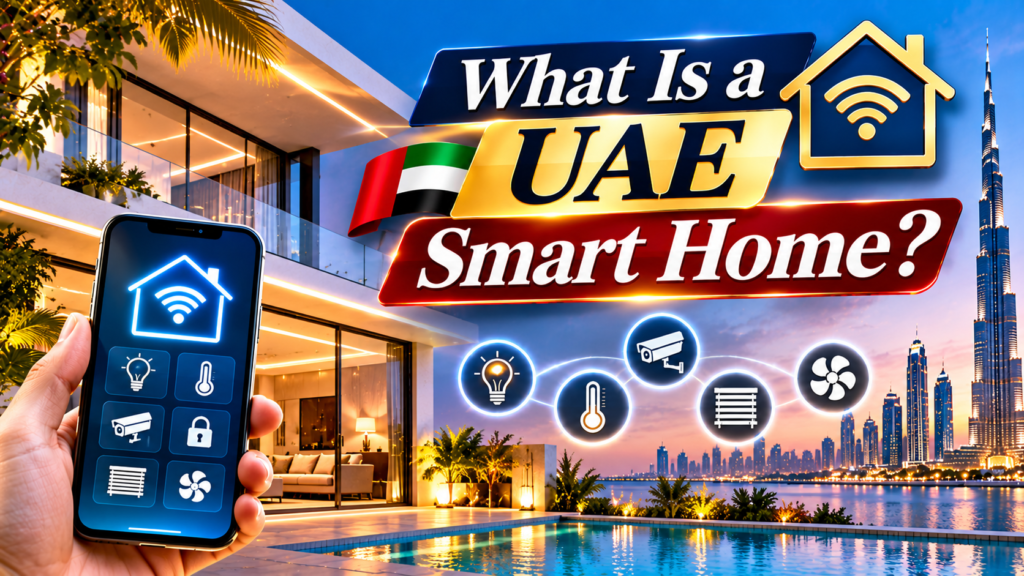
For example, homeowners can use a smartphone application or voice assistant to:
- Switch lights on or off.
- Adjust indoor temperatures.
- Lock and unlock smart doors.
- Monitor security cameras.
- Control curtains and blinds.
- Manage entertainment systems.
- Receive alerts about unusual activities.
- Monitor electricity consumption.
In the UAE, smart home technology is particularly relevant because of the country’s growing focus on digital transformation, sustainable development, energy efficiency, and advanced residential infrastructure.
A smart apartment in Dubai or a connected villa in Abu Dhabi can combine multiple technologies into one integrated system, making everyday household management easier.
2. How Does Smart Home Technology Work?
Smart home technology works through a combination of internet connectivity, sensors, controllers, software applications, and connected devices.
These components communicate with one another to perform specific tasks according to user commands, schedules, or automatically programmed conditions.
For example, a smart thermostat can detect indoor temperature levels and adjust the air conditioning system according to the homeowner’s preferred settings.
Similarly, a motion sensor can detect movement and automatically switch on hallway lighting.
Most smart home systems operate through the following process:
Step 1: Devices collect information
Sensors and connected devices collect information about the home environment. This may include temperature, humidity, movement, light levels, and door activity.
Step 2: Information is communicated
The devices send information to a central hub, controller, smartphone application, or cloud-based platform.
Step 3: The system processes instructions
The smart home system processes the information according to programmed rules, user preferences, and automation settings.
Step 4: Actions are performed
The connected devices perform the required tasks, such as switching on lights, adjusting air conditioning, or sending a security notification.
Step 5: Homeowners monitor and control everything
Residents can check the system through mobile applications, control panels, or voice assistants.
For example, if a homeowner sets a rule that the air conditioning should switch off when everyone leaves the property, the system can use location-based settings or presence sensors to trigger that action.
This combination of connected technology and automation makes a home more responsive to residents’ daily routines.
3. What Are the Main Features of a UAE Smart Home?
Modern smart homes offer several features designed to improve comfort, convenience, security, and efficiency.
Here are some of the most popular smart home features available in the UAE.
A. Smart Lighting Systems
Smart lighting is one of the most common elements of home automation.
These systems allow residents to control lights using smartphones, voice commands, motion sensors, or automated schedules.
For example, homeowners can programme bedroom lights to switch off automatically at bedtime or create different lighting settings for watching movies, reading, or entertaining guests.
Some smart lighting systems also adjust brightness according to natural daylight.
Key benefits include:
- Convenient remote lighting control.
- Reduced unnecessary electricity consumption.
- Customisable lighting schedules.
- Motion-activated lighting.
- Improved comfort and atmosphere.
B. Smart Air Conditioning and Climate Control
Why is smart climate control important in the UAE?
The UAE experiences extremely hot summers, making air conditioning an essential part of everyday life.
Smart thermostats and connected air conditioning systems allow homeowners to control indoor temperatures more efficiently.
Residents can adjust cooling settings through mobile applications, establish temperature schedules, and monitor their systems remotely.
Some advanced systems use occupancy sensors to adjust cooling based on whether people are present in a room.
For example, a smart air conditioning system can:
- Reduce cooling in unused rooms.
- Maintain comfortable temperatures throughout the day.
- Allow remote temperature adjustments.
- Create customised cooling schedules.
- Help reduce unnecessary energy consumption.
Since cooling can represent a significant portion of household electricity use in hot climates, intelligent climate management can be particularly valuable for UAE residents.
However, actual savings depend on the property, equipment, insulation, usage patterns, and electricity tariffs.
C. Smart Home Security Systems
Home security is another important reason why residents invest in smart home technology.
Smart security systems combine connected cameras, digital door locks, motion detectors, alarm systems, and video doorbells to help homeowners monitor their properties.
These devices can send real-time notifications when unusual activity is detected.
For example, if someone approaches the entrance of a property, a smart video doorbell can notify the homeowner and allow them to view the visitor through a mobile application.
Popular smart security features include:
- Video surveillance cameras.
- Smart doorbells.
- Fingerprint-enabled digital locks.
- Motion detection sensors.
- Remote door monitoring.
- Smart alarms.
- Automated security notifications.
Some systems also allow homeowners to create temporary access codes for visitors, domestic staff, or authorised service providers.
However, smart security devices should complement appropriate physical security measures rather than replace them.
D. Smart Curtains and Blinds
Smart curtains and blinds allow residents to control natural light through automated systems.
They can be operated using a smartphone, remote control, voice assistant, or scheduled automation.
For example, curtains can open automatically in the morning and close during the hottest hours of the afternoon.
This feature can be particularly useful in UAE villas and apartments with large glass windows.
Automated window coverings can help:
- Control sunlight entering the property.
- Improve indoor comfort.
- Reduce glare.
- Support privacy.
- Work alongside climate control systems.
E. Smart Kitchen Appliances
Smart kitchens are becoming an important part of modern residential design.
Connected refrigerators, ovens, dishwashers, coffee machines, and other appliances can make household activities more convenient.
Depending on the product, smart kitchen appliances may offer remote monitoring, maintenance notifications, programmable settings, and energy usage information.
For example, a smart oven may allow residents to preheat it remotely, while a connected refrigerator may send an alert if its door remains open.
These features can make everyday cooking and kitchen management more organised.
F. Smart Entertainment Systems
Smart entertainment systems connect televisions, speakers, streaming devices, and other audiovisual equipment.
Homeowners can use voice commands or mobile applications to control entertainment throughout the property.
Some advanced systems support multi-room audio, allowing residents to play music in different rooms.
Home theatre automation may also coordinate lighting, curtains, speakers, and television settings with a single command.
4. What Technologies Are Used in UAE Smart Homes?
A smart home does not depend on a single technology. It uses different communication protocols, sensors, platforms, and connected devices to create an integrated residential environment.
The following technologies are commonly used in modern home automation systems.
1. Wi-Fi
Wi-Fi connects smart devices to the home internet network.
It is widely used for smart cameras, televisions, plugs, speakers, and other connected appliances.
2. Bluetooth
Bluetooth allows compatible devices to communicate over relatively short distances.
It is commonly used for smart locks, sensors, speakers, and device setup.
3. Zigbee
Zigbee is a low-power wireless communication protocol used by many smart lighting systems, sensors, and home automation products.
It can connect multiple compatible devices through a mesh network.
4. Z-Wave
Z-Wave is another wireless communication technology used in smart home automation, particularly for security devices, sensors, and lighting controls.
5. Matter
Matter is a smart home connectivity standard designed to improve compatibility between products from different manufacturers.
It aims to make it easier for compatible devices to work across supported smart home ecosystems.
6. Artificial Intelligence (AI)
Artificial intelligence can help smart home systems learn patterns, interpret information, and improve automation.
For example, certain intelligent systems can analyse household routines and recommend adjustments to lighting or temperature settings.
7. Internet of Things (IoT)
The Internet of Things connects physical devices to digital networks, allowing them to exchange information and respond to commands.
It is one of the fundamental technologies behind modern smart homes.
5. Why Are Smart Homes Becoming Popular in the UAE?
Why are more homeowners and property developers interested in smart home technology in the UAE?
Several factors are contributing to its growing popularity.
Growing Digital Transformation
The UAE has established itself as a major centre for technological innovation and digital transformation.
Smart services, connected infrastructure, and digital platforms are increasingly influencing how residents interact with their homes and surroundings.
Demand for Modern Residential Properties
Buyers and tenants are increasingly interested in properties that offer modern amenities, convenience, and advanced facilities.
Smart lighting, automated climate control, digital access systems, and connected security features can make residential properties more attractive.
Focus on Energy Efficiency
Energy management is an important consideration in a country where cooling requirements can be high.
Smart thermostats, automated lighting, and energy monitoring systems can help residents understand and manage household consumption.
Luxury Lifestyle Preferences
The UAE has a strong luxury residential market, particularly in areas of Dubai and Abu Dhabi.
For some buyers, integrated home automation is an attractive feature that supports a more convenient and personalised lifestyle.
Increasing Availability of Smart Devices
Smart home products are becoming available across different price categories.
This means homeowners do not necessarily need to invest in an expensive whole-house automation system to begin enjoying connected living.
6. What Are the Benefits of Living in a Smart Home in the UAE?
Smart home technology offers several practical advantages for residents.
Let’s examine the most important benefits.
1. Greater Convenience
One of the biggest advantages is the ability to control different household systems from a single application or interface.
Instead of manually operating several appliances, residents can use automated schedules or voice commands.
For example, a single evening routine could switch off unnecessary lights, close curtains, adjust the temperature, and activate selected security settings.
2. Better Energy Management
Smart lighting, thermostats, and energy monitoring devices can help households understand where electricity is being used.
Residents can identify unnecessary consumption and make adjustments.
For example, automated lighting can switch off when rooms are unoccupied, while smart climate controls can reduce excessive cooling.
These systems can support more responsible energy use, although they do not guarantee lower bills.
3. Improved Home Security
Connected cameras, motion sensors, and smart locks allow residents to monitor selected security features remotely.
This can be useful for homeowners who travel frequently or own properties that remain unoccupied for extended periods.
4. Greater Personalisation
Smart homes can be configured according to individual preferences.
Residents can create customised settings for different times of the day.
For example:
- Morning mode: Open curtains and switch on selected lights.
- Away mode: Switch off unnecessary appliances and activate security monitoring.
- Movie mode: Dim the lights and activate the entertainment system.
- Night mode: Close curtains, switch off selected lights, and adjust the temperature.
5. Remote Property Management
Homeowners can monitor certain household functions even when they are away.
This is particularly useful for residents who travel regularly or manage multiple properties.
6. Potential Increase in Property Appeal
Smart home facilities may improve the attractiveness of a residential property among buyers and tenants who value modern technology.
However, the effect on resale value or rental income depends on location, property quality, market demand, installation quality, and the technology provided.
7. How Much Does It Cost to Build a Smart Home in the UAE?
One of the most common questions among homeowners is how much smart home automation costs in the UAE.
The answer depends on the size of the property, the number of connected devices, the selected brands, installation requirements, and the complexity of the automation system.
A basic smart home setup can be considerably less expensive than a fully integrated luxury villa automation system.
The following figures are illustrative planning estimates, not verified market quotations.
| Smart home level | Indicative budget in AED |
|---|---|
| Basic smart home setup | AED 1,000–5,000 |
| Intermediate automation | AED 5,000–20,000 |
| Advanced home automation | AED 20,000–60,000 |
| Luxury villa automation | AED 60,000–150,000+ |
Actual costs may vary considerably.
What Factors Influence Smart Home Installation Costs?
Several factors determine the final installation budget.
Property size: Larger homes usually require more sensors, controllers, wiring, and connected devices.
Technology selection: Premium automation brands and advanced integrated systems can cost more than basic smart devices.
Installation requirements: Existing homes may require additional electrical work, network upgrades, or structural modifications.
Security requirements: Advanced cameras, access control systems, and monitoring equipment can increase expenses.
Integration complexity: Connecting lighting, air conditioning, entertainment, curtains, and security into one system may require professional configuration.
Is It Possible to Create a Smart Home on a Budget?
Yes. Homeowners do not need to automate their entire property at once.
A practical starting point could include:
- Smart lighting bulbs.
- Smart plugs.
- A compatible voice assistant.
- A smart thermostat or compatible AC controller.
- A video doorbell.
- Selected security sensors.
Residents can gradually expand the system as their requirements and budgets change.
8. Which Are the Best Smart Home Devices for UAE Homes?
Choosing the right devices depends on property requirements, lifestyle, compatibility, and budget.
Some of the popular smart home product categories include:
| Device category | Main purpose |
|---|---|
| Smart bulbs | Automated lighting |
| Smart switches | Remote lighting control |
| Smart thermostats | Temperature management |
| Smart locks | Digital door access |
| Security cameras | Property monitoring |
| Smart plugs | Appliance control |
| Motion sensors | Automated detection |
| Smart speakers | Voice control |
| Smart curtains | Automated window coverings |
| Energy monitors | Electricity consumption tracking |
Some internationally recognised smart home brands include Philips Hue for lighting, Google Nest, Amazon Alexa, Apple Home, Samsung SmartThings, and Aqara for different smart home applications.
Before purchasing any product, homeowners should check whether it supports their existing devices, electrical requirements, communication standards, and preferred automation platform.
9. Are Smart Homes in Dubai Different from Traditional Homes?
Yes. The main difference is the level of connectivity, automation, and remote control available.
Traditional homes generally depend on manual switches, conventional appliances, and independent security systems.
Smart homes connect different household functions through digital technologies.
Here is a simple comparison:
| Feature | Traditional home | Smart home |
|---|---|---|
| Lighting | Manual switches | App, voice, and automation |
| Air conditioning | Manual controls | Smart temperature management |
| Security | Conventional locks and alarms | Connected locks and cameras |
| Curtains | Manual operation | Automated control |
| Appliances | Independent operation | Connected device control |
| Monitoring | Limited remote access | Smartphone monitoring |
| Energy management | Manual observation | Digital consumption insights |
However, a smart home is not necessarily better in every situation.
Some residents prefer conventional systems because they are simpler, less dependent on internet connectivity, and sometimes less expensive to maintain.
The best solution depends on the homeowner’s needs.
10. How Does Smart Home Automation Help Save Energy in the UAE?
Energy efficiency is one of the most important considerations when discussing smart homes in the Emirates.
Because of the region’s hot climate, residential air conditioning can account for a substantial share of electricity consumption.
Smart home automation can help residents manage energy use through intelligent controls.
Smart Air Conditioning Management
Smart thermostats can help maintain comfortable indoor temperatures without unnecessary cooling.
Residents can create schedules based on their daily routines.
Automated Lighting
Motion sensors and daylight-responsive lighting can reduce the time lights remain switched on unnecessarily.
Smart Plugs
Connected plugs can help residents monitor or switch off compatible appliances when they are not needed.
Energy Monitoring
Smart energy monitors provide information about electricity consumption, helping residents identify appliances or activities that use more power.
Automated Curtains
Smart curtains can be programmed to reduce direct sunlight entering rooms during certain periods.
This may help manage indoor heat gain, depending on the window design, curtain material, and property orientation.
The effectiveness of these measures depends on building insulation, equipment efficiency, household behaviour, and proper system configuration.
11. Are UAE Smart Homes Safe and Secure?
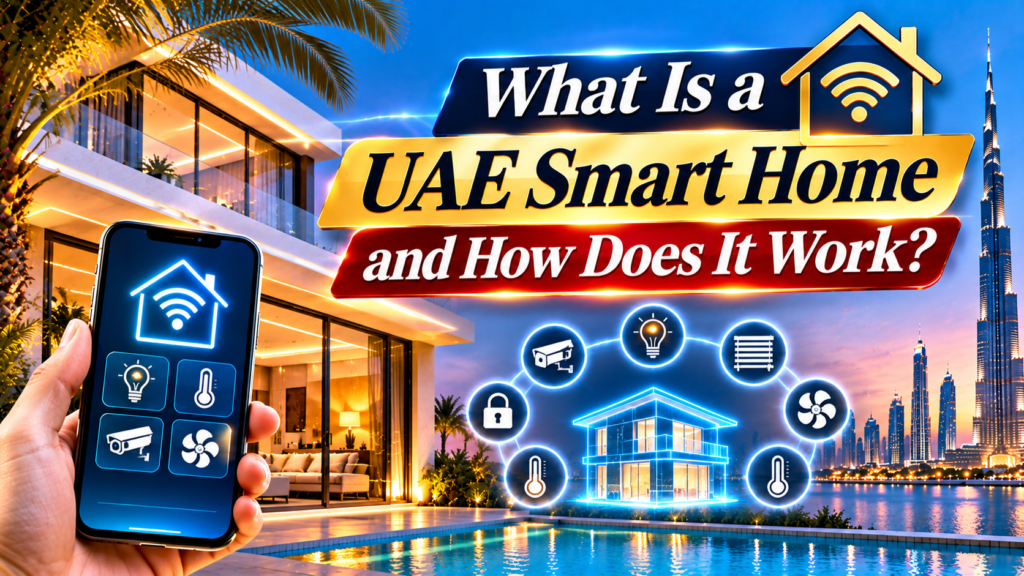
Smart homes can improve property monitoring, but connected technology also introduces cybersecurity and privacy considerations.
Every internet-connected device may create a potential entry point if it is poorly configured or not regularly updated.
For this reason, homeowners should pay attention to digital security when installing smart home systems.
How Can Homeowners Protect Their Smart Homes?
Consider the following precautions:
1. Use strong passwords: Avoid simple or repeated passwords across smart devices and applications.
2. Enable two-factor authentication: Use additional verification wherever supported.
3. Update device software: Install security updates and firmware upgrades regularly.
4. Secure the Wi-Fi network: Use modern encryption and a strong router password.
5. Choose reputable brands: Research manufacturers and their privacy and security practices.
6. Review device permissions: Avoid giving applications unnecessary access to personal information.
7. Secure remote access: Use trusted applications and disable unnecessary remote-access features.
8. Protect security cameras: Change default credentials and carefully manage who can view camera footage.
Homeowners should also consider what happens if the internet connection or electricity supply becomes unavailable.
Where possible, select systems that retain essential local functions during connectivity interruptions.
12. Can Smart Homes Work Without an Internet Connection?
Yes, some smart home systems can continue performing selected functions without an active internet connection.
However, their capabilities depend on the devices and communication architecture.
For example, certain locally controlled systems can operate lighting schedules, motion sensors, and connected switches through a local hub.
However, cloud-dependent functions may stop working temporarily.
These may include:
- Remote smartphone access.
- Cloud-based voice assistant services.
- External notifications.
- Cloud video storage.
- Certain artificial intelligence features.
Homeowners should understand which features require internet access and which can operate locally.
A reliable home network is still important for a smooth smart home experience.
13. What Should You Consider Before Installing a Smart Home System in the UAE?
Installing smart home technology requires planning, particularly when dealing with new properties or existing residential buildings.
Before investing in automation, homeowners should consider several important factors.
Property Compatibility
Check whether the existing electrical systems, air conditioning equipment, wiring, and appliances are compatible with the selected automation products.
Internet Connectivity
A stable internet connection and suitable Wi-Fi coverage are important for many smart home devices.
Larger villas may require additional access points or a properly designed network.
Device Compatibility
Not all smart devices communicate with one another.
Homeowners should check whether products support common standards such as Matter, Zigbee, or other compatible platforms.
Installation Quality
Professional installation may be necessary for electrical systems, smart locks, integrated air conditioning controls, and whole-house automation.
Future Expansion
Choose a system that allows additional devices and features to be introduced later.
Maintenance and Support
Check warranty conditions, software support, replacement availability, and technical assistance before selecting a brand or installer.
Privacy and Data Protection
Understand how devices collect, process, and store personal information.
For properties in the UAE, homeowners should also check applicable local building, electrical, telecommunications, and data-protection requirements.
14. Are Smart Homes Suitable for Apartments and Villas in the UAE?
Absolutely. Smart home technology can be installed in both apartments and villas, although the requirements may differ.
Smart Apartments
Smart apartments can benefit from compact automation systems that focus on essential household functions.
Popular choices include:
- Smart lighting.
- Digital door locks.
- Smart thermostats.
- Video doorbells.
- Smart plugs.
- Automated curtains.
Apartments may have certain restrictions regarding electrical modifications, external cameras, building access systems, and network installations.
Residents should check with building management before making changes.
Smart Villas
Villas generally provide more flexibility for comprehensive automation.
Homeowners can integrate lighting, security, air conditioning, swimming pool equipment, garden irrigation, garage doors, and entertainment systems.
Advanced villa automation may include:
- Whole-house lighting control.
- Multi-zone climate management.
- Automated garden irrigation.
- Smart garage access.
- Outdoor security cameras.
- Swimming pool monitoring.
- Integrated home theatre systems.
Larger properties may require a professional automation design to ensure that all devices communicate reliably.
15. How Are Real Estate Developers Using Smart Home Technology in the UAE?
Smart home technology is becoming an important consideration in modern residential development.
Property developers increasingly explore connected features to improve the residential experience and differentiate their projects.
In Dubai, Abu Dhabi, Sharjah, and other Emirates, technology-enabled residential concepts are contributing to the evolution of modern housing.
Some developments offer selected smart features as part of their residential packages, while others allow buyers to customise their automation requirements.
These features may include:
- Digital access control.
- Automated lighting.
- Smart climate controls.
- Connected security systems.
- Intelligent building management.
- Energy monitoring solutions.
Smart technology can also support property management by providing information about selected building systems and equipment.
However, buyers should distinguish between basic smart features and fully integrated home automation.
A property advertised as a smart home may only include a few connected devices rather than a complete automation ecosystem.
Therefore, it is important to understand exactly what is included before purchasing or renting a property.
16. What Is the Role of Artificial Intelligence in UAE Smart Homes?
Artificial intelligence is creating new possibilities for home automation.
Traditional smart devices usually follow predefined instructions. AI-powered systems can go further by analysing information, identifying patterns, and helping automate certain activities.
For example, an intelligent climate control system may analyse temperature changes and household preferences to recommend more suitable cooling settings.
AI-enabled security systems may also help distinguish between different types of movement and identify unusual activity.
Some potential applications include:
- Personalised temperature recommendations.
- Intelligent lighting adjustments.
- Predictive maintenance alerts.
- Voice-controlled household management.
- Smart energy recommendations.
- Advanced security monitoring.
- Automated household routines.
However, the level of intelligence varies between products.
Not every device marketed as an AI-powered smart home product offers advanced learning or autonomous decision-making.
Homeowners should evaluate actual features rather than relying only on marketing claims.
17. What Are the Challenges of Smart Home Technology in the UAE?
Although smart homes provide several advantages, they also come with certain challenges.
Understanding these issues can help homeowners make informed decisions.
High Initial Investment
Advanced automation systems can require significant upfront investment, particularly in large villas.
Technical Complexity
Different devices may use different applications, communication standards, and operating systems.
Without proper planning, managing multiple platforms can become inconvenient.
Internet Dependence
Some connected functions require reliable internet access.
Connectivity interruptions may temporarily affect remote monitoring and cloud-based automation.
Cybersecurity Risks
Poorly secured devices may expose personal information or create opportunities for unauthorised access.
Maintenance Requirements
Smart devices require software updates, occasional troubleshooting, and sometimes hardware replacement.
Compatibility Problems
Certain older appliances may not work with newer automation platforms without additional controllers or adapters.
Despite these challenges, careful product selection and professional installation can make smart home technology more practical and reliable.
18. What Is the Future of Smart Homes in the UAE?
The future of smart homes in the UAE is closely connected to the country’s broader ambitions in digital innovation, sustainability, artificial intelligence, and advanced urban development.
As connected devices become more accessible, home automation is likely to become an increasingly familiar feature of residential properties.
Several developments may influence the next generation of smart homes.
AI-Powered Personalisation
Future systems may become better at understanding household routines and suggesting personalised settings.
Greater Energy Efficiency
Smart energy management systems may become more sophisticated, helping residents coordinate cooling, lighting, appliances, and other household equipment.
Integration With Renewable Energy
Smart homes may increasingly connect with rooftop solar systems, battery storage, and intelligent energy management platforms where suitable.
Advanced Security Technology
Future residential security solutions may combine improved access control, intelligent monitoring, and more sophisticated alerts.
Connected Communities
Smart homes may become more closely integrated with smart buildings and connected residential communities.
Better Device Compatibility
Common standards such as Matter may help reduce compatibility problems and make it easier to combine products from different manufacturers.
The long-term direction is towards homes that are more connected, adaptable, efficient, and responsive to the needs of residents.
19. Is Investing in a UAE Smart Home Worth It?
Is a smart home a worthwhile investment for UAE homeowners?
For many residents, the answer can be yes, particularly when the technology addresses practical household needs.
A homeowner who wants better control over air conditioning, lighting, and security may benefit from a relatively simple smart home setup.
Similarly, families living in larger villas may find integrated automation useful for managing multiple rooms and household systems.
However, investing in smart home technology should not be about purchasing every available device.
The better approach is to identify everyday problems and select technologies that provide meaningful solutions.
For example:
- If electricity consumption is a concern, consider smart energy monitoring.
- If convenience is the priority, begin with lighting and climate automation.
- If property security is important, consider connected cameras and smart locks.
- If privacy is a priority, choose products with clear data policies and local-control options.
- If future expansion matters, select a flexible and compatible automation platform.
The value of a smart home depends on how effectively its technology improves everyday living.
20. How Can You Start Building a Smart Home in the UAE?
You do not need to transform an entire property immediately.
A gradual approach can make smart home technology easier to understand, manage, and afford.
Here is a simple starting plan:
Step 1: Identify your priorities.
Decide whether you want better security, energy management, convenience, or entertainment control.
Step 2: Check your existing infrastructure.
Review Wi-Fi coverage, electrical systems, air conditioning compatibility, and existing appliances.
Step 3: Select a smart home platform.
Choose an ecosystem that supports your preferred devices and allows future expansion.
Step 4: Start with essential devices.
Consider smart bulbs, switches, plugs, thermostats, or security cameras.
Step 5: Configure automation routines.
Create schedules and automatic actions that match your daily lifestyle.
Step 6: Review security settings.
Enable strong authentication, update devices, and check privacy permissions.
Step 7: Expand gradually.
Add smart curtains, connected appliances, advanced sensors, or integrated security when required.
This approach allows homeowners to develop a smart home according to their changing needs and available budget.
Frequently Asked Questions About UAE Smart Homes
1. What is a smart home in the UAE?
A smart home in the UAE is a residential property that uses connected devices, sensors, automation systems, and digital applications to control household functions such as lighting, air conditioning, security, curtains, and appliances.
2. How does a smart home work?
A smart home works by connecting different devices through wireless networks, controllers, sensors, and software applications. Residents can operate devices through mobile applications, voice commands, or automated schedules.
3. How much does a smart home cost in Dubai?
The cost depends on the property size, technology, devices, and installation requirements. A basic setup may start at around AED 1,000, while advanced villa automation can cost AED 60,000 or more. These are indicative estimates rather than fixed market prices.
4. Can I convert my existing UAE apartment into a smart home?
Yes. Many existing apartments can be upgraded with smart bulbs, switches, plugs, cameras, digital locks, and compatible climate controls without requiring complete renovation. Building permissions may be necessary for certain installations.
5. Are smart homes energy-efficient?
Smart homes can support energy efficiency through automated lighting, smart thermostats, energy monitoring, and intelligent appliance controls. Actual savings depend on how the devices are configured and used.
6. Do smart homes require Wi-Fi?
Many smart home devices use Wi-Fi, but others communicate through Bluetooth, Zigbee, Z-Wave, Thread, or local automation hubs. Some functions can continue working without internet access.
7. Are smart home systems secure?
Smart home systems can provide advanced security monitoring, but they also require cybersecurity protection. Strong passwords, two-factor authentication, regular software updates, and secure networks are important.
8. Can I control my UAE smart home while travelling abroad?
Yes. Many smart home systems allow remote access through smartphone applications, provided the devices have an internet connection and remote access is properly configured.
9. Which smart home devices should beginners buy first?
Beginners can start with smart bulbs, smart plugs, compatible thermostats, motion sensors, and security cameras. These devices offer practical benefits without requiring a complete automation installation.
10. Are smart homes suitable for rental properties in Dubai?
Yes. Tenants can use portable smart devices such as smart bulbs, plugs, speakers, and compatible sensors. However, permanent electrical modifications, digital locks, and external cameras may require the landlord’s or building management’s approval.
11. Do smart homes increase property value in the UAE?
Smart home features may improve a property’s appeal to technology-conscious buyers and tenants. However, they do not guarantee a higher selling price or rental return. Location, construction quality, market conditions, and overall property features remain important.
12. What is the difference between a smart home and home automation?
A smart home uses connected devices and technologies to improve household management. Home automation refers specifically to programming these devices to perform actions automatically, such as switching off lights when a room becomes empty.
13. Can smart home devices work together?
Yes, provided they support compatible platforms or communication standards. Homeowners should check compatibility before purchasing devices from different manufacturers.
14. Are smart homes suitable for UAE summers?
Yes. Smart climate control, temperature sensors, automated curtains, and energy monitoring can help residents manage indoor comfort and cooling more efficiently during hot weather.
15. What is the future of smart homes in the UAE?
The future of smart homes in the UAE is expected to involve greater AI integration, improved energy management, connected security, renewable energy integration, and better compatibility between smart devices.
Conclusion: Are Smart Homes Changing the Future of Living in the UAE?
Smart homes are becoming an important part of the UAE’s evolving residential landscape. By combining connected devices, automation, artificial intelligence, and intelligent energy management, they are changing how residents interact with their living spaces.
From smart apartments in Dubai to luxury villas in Abu Dhabi, home automation offers opportunities to improve convenience, security, comfort, and energy management.
The biggest advantage of smart home technology is not simply the ability to control appliances through a smartphone. It is the opportunity to create a living environment that responds to household needs and makes everyday activities easier.
However, choosing the right technology is essential. Homeowners should consider their budgets, property requirements, device compatibility, cybersecurity, and long-term maintenance before investing.
As the UAE continues to embrace digital innovation and sustainable development, smart homes are likely to play an increasingly important role in the future of residential living.
Ultimately, a UAE smart home is more than a technologically advanced property. It represents a new approach to comfortable, connected, secure, and intelligent living.
Do Follow Faten El-Hakim on Instagram
Read More – Faten El-Hakim: Helping People Rediscover Themselves Through Clinical Hypnotherapy