




How to Open a Corporate Bank Account in UAE: Complete Guide for Businesses
Opening a corporate bank account in the UAE is one of the most important steps after establishing a company. Whether you are launching a start up in Dubai, operating an established company in Abu Dhabi, setting up a free zone business, or expanding an international company into the UAE, having a dedicated business bank account makes it easier to manage payments, receive customer funds, pay suppliers, process salaries, and conduct local and international transactions.
- What Is a Corporate Bank Account in UAE?
- Why Do Businesses Need a Corporate Bank Account in UAE?
- Who Can Open a Corporate Bank Account in UAE?
- Requirements to Open a Corporate Bank Account in UAE
- 1. Valid Trade Licence or Certificate of Incorporation
- 2. Memorandum and Articles of Association
- 3. Board Resolution
- 4. Passport and Emirates ID
- 5. Proof of Business Address
- 6. Company Bank Statements
- 7. Business Plan or Company Profile
- 8. Ultimate Beneficial Owner Information
- 9. Power of Attorney
- 10. Additional KYC and Compliance Documents
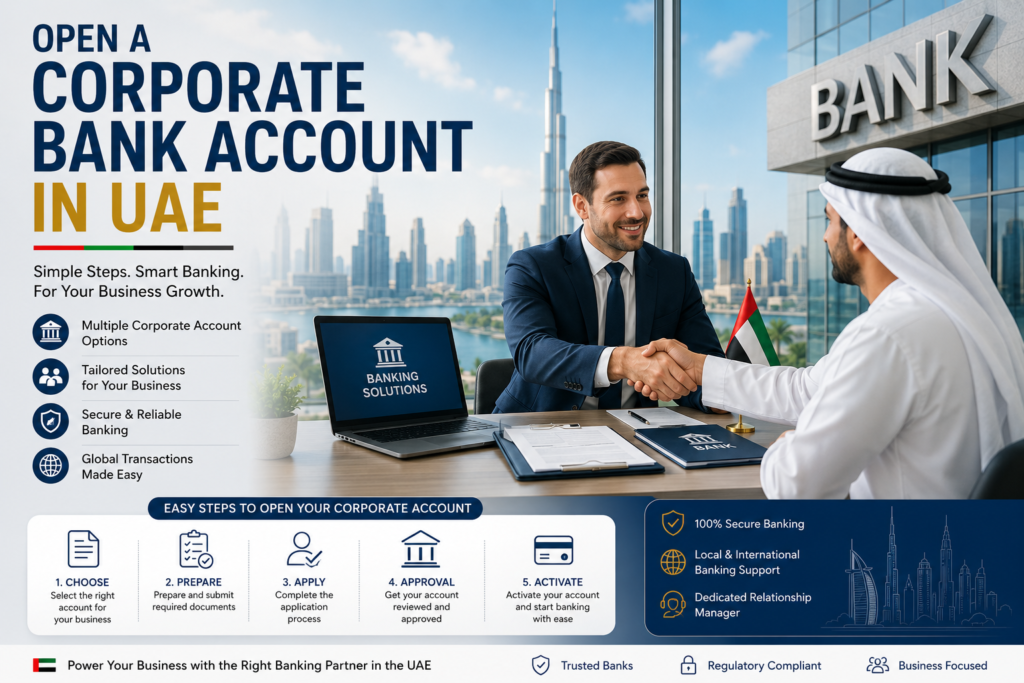
- Step-by-Step Process to Open a Corporate Bank Account in UAE
- Step 1: Establish Your UAE Company
- Step 2: Choose the Right UAE Bank
- Step 3: Prepare the Required Documents
- Step 4: Submit the Application
- Step 5: Complete KYC Verification
- Step 6: Bank Assessment and Approval
- Step 7: Account Activation
- How Long Does It Take to Open a Corporate Bank Account in UAE?
- Corporate Bank Account Fees in UAE
- Minimum Balance for a Corporate Bank Account
- Can a Startup Open a Corporate Bank Account in UAE?
- Can Foreigners Open a Corporate Bank Account in UAE?
- Can a Free Zone Company Open a Corporate Bank Account?
- Corporate Bank Account for International Businesses
- Common Reasons for Delays in Corporate Bank Account Opening
- Tips for Getting a Corporate Bank Account Approved
- Corporate Bank Account vs Personal Bank Account
- Best Bank for a Corporate Account in UAE
- Corporate Banking Services Available in UAE
- Frequently Asked Questions
- Final Checklist for Opening a Corporate Bank Account in UAE
The UAE has developed into one of the world’s leading business and financial centres, attracting entrepreneurs, investors, multinational companies, and small and medium-sized enterprises. Its banking sector offers a wide range of corporate and business banking services, including current accounts, online banking, international transfers, merchant services, trade finance, business cards, payroll solutions, and foreign currency facilities.
However, opening a corporate bank account is not simply a matter of submitting a company licence. Banks must complete customer due diligence and understand the company’s ownership, activities, source of funds, expected transactions, and beneficial owners before approving an account.
This guide explains how to open a corporate bank account in UAE, the documents generally required, the eligibility criteria, the application process, potential costs, common reasons for delays, and practical tips for improving your chances of a smooth approval.
What Is a Corporate Bank Account in UAE?
A corporate bank account is a bank account opened in the name of a legally registered business rather than an individual. It allows a company to separate its business finances from the personal finances of its owners and directors.
Depending on the company and bank, a corporate account may provide access to services such as:
- Business current accounts
- AED and foreign-currency accounts
- Local and international transfers
- Online and mobile corporate banking
- Business debit or credit cards
- Cheque facilities
- Salary and payroll services
- Merchant payment solutions
- Trade finance
- Letters of credit and guarantees
- Cash-management services
- Foreign exchange services
- Financing and working-capital facilities
The exact products available depend on the bank, company structure, industry, transaction profile, and eligibility requirements.
Why Do Businesses Need a Corporate Bank Account in UAE?
A dedicated corporate bank account provides an organised way to manage business finances. Instead of receiving company revenue into a personal account, businesses can conduct transactions through an account registered under the company’s legal name.

Key advantages include:
1. Professional financial management: A corporate account makes it easier to track income, expenses, supplier payments, payroll, taxes, and other business transactions.
2. Separation of personal and business funds: Keeping company finances separate from personal money can improve accounting and financial transparency.
3. Easier customer payments: Businesses can provide customers with official company banking details for receiving payments.
4. International transactions: Companies involved in imports, exports, consulting, technology, investment, or international trade may need regular cross-border payment facilities.
5. Access to business banking services: A corporate relationship can provide access to merchant services, trade finance, business cards, credit facilities, and other financial products.
6. Better financial credibility: A properly maintained business banking relationship can support a company’s professional image when dealing with suppliers, customers, investors, and commercial partners.
Who Can Open a Corporate Bank Account in UAE?
Businesses legally established in the UAE can generally apply for a business or corporate bank account, subject to the individual bank’s eligibility criteria and due-diligence requirements.
For example, ADCB states that a business entity incorporated in the UAE with a valid commercial licence issued by the relevant UAE authority can apply for a business account.
Businesses may be established through different jurisdictions and structures, including:
- Mainland companies
- Free zone companies
- Sole establishments
- Limited liability companies
- Professional companies
- Partnerships
- Branches of foreign companies
- Other permitted corporate structures
Not every bank accepts every company structure or industry. Some banks may also have specific requirements based on the company’s ownership structure, expected turnover, country of incorporation, business activity, and the residence status of shareholders and directors.
Therefore, it is important to compare bank eligibility criteria before submitting an application.
Requirements to Open a Corporate Bank Account in UAE
One of the most important parts of opening a corporate bank account is preparing the required documentation.
There is no single universal document list for every UAE bank. Requirements can vary according to the bank, legal structure, business activity, ownership structure, and risk profile.
For example, Emirates NBD currently lists documents such as a valid trade or commercial licence, constitutional documents, identity documents for shareholders and partners, and proof of address among its business-account requirements.
Common requirements include the following:
1. Valid Trade Licence or Certificate of Incorporation
A valid UAE trade licence is usually one of the most important documents required to open a corporate bank account.
Depending on the company structure, the bank may request:
- Commercial or trade licence
- Professional licence
- Industrial licence
- Free zone licence
- Certificate of incorporation
- Commercial registration documents
- Other company registration certificates
The document should be valid and clearly show the company’s registered business activity.
2. Memorandum and Articles of Association
Banks commonly require constitutional documents that explain how the company is structured and operated.
These may include:
- Memorandum of Association (MOA)
- Articles of Association (AOA)
- Partnership agreement
- General partnership contract
- Company formation documents
- Amendments to constitutional documents
The bank uses these documents to understand the company’s legal structure and ownership.
3. Board Resolution
A Board Resolution may be required to confirm who is authorised to open and operate the company’s bank account.
It may specify:
- The bank where the account will be opened
- Names of authorised signatories
- Account operating instructions
- Signing powers
- Banking facilities requested
- Authority to conduct transactions
The exact format required can vary by bank and company structure.
4. Passport and Emirates ID
Banks normally need identification documents for relevant individuals connected with the company.
These may include:
- Shareholders
- Beneficial owners
- Directors
- Managers
- Authorised signatories
- Attorneys or representatives, where applicable
For UAE residents, banks may request both passport and Emirates ID documentation.
Emirates NBD’s current business-account guidance, for example, requests passport and Emirates ID copies for partners and authorised signatories.
5. Proof of Business Address
Banks may ask for evidence confirming where the business operates.
Depending on the circumstances, this can include:
- Tenancy contract
- Ejari or equivalent tenancy documentation
- Office lease
- Registered business address
- Utility documentation
- Other acceptable proof of address
The requirement can differ depending on the bank and company type.
6. Company Bank Statements
An existing company may be asked to provide historical bank statements.
For example, Emirates NBD states that its eligibility criteria can include a six-month company bank statement for an existing company, while a partner’s bank statement may be requested for a new company.
Bank statements help the bank understand the company’s financial activity and expected transaction profile.
7. Business Plan or Company Profile
A business plan may be particularly useful for startups, newly established companies, or businesses with limited banking history.
The bank may want to understand:
- What the company does
- Who its customers are
- Where customers are located
- Who the suppliers are
- Expected annual turnover
- Expected monthly transaction volume
- Countries involved in transactions
- Source of initial capital
- Expected source of revenue
A clear company profile can help explain the commercial purpose of the account.
8. Ultimate Beneficial Owner Information
Banks need to identify the individuals who ultimately own or control the business.
This is commonly referred to as Ultimate Beneficial Owner (UBO) information.
If a company has a complex ownership structure, the bank may request additional corporate documents to establish ownership all the way through the structure.
This is particularly important for companies with:
- Multiple shareholders
- Corporate shareholders
- Holding companies
- International ownership
- Multi-layered structures
- Trust or investment structures
9. Power of Attorney
If someone other than the company’s directors or authorised representatives is acting on behalf of the business, a Power of Attorney (POA) may be required.
The bank may review the POA to confirm the individual’s authority to open or operate the account.
10. Additional KYC and Compliance Documents
Banks can request additional information as part of their Know Your Customer (KYC) and anti-money-laundering controls.
Emirates NBD explains that banks request identity information to comply with KYC and anti-money-laundering requirements and may request additional documents where necessary.
Additional information may include:
- Source of funds
- Source of wealth
- Expected transaction volumes
- Major customer information
- Supplier information
- Contracts or invoices
- Website details
- Business plan
- Tax-related information
- Details of related companies
- Information about international transactions
Not every business will be asked for all of these documents.
Step-by-Step Process to Open a Corporate Bank Account in UAE
The process can vary from one bank to another, but most applications follow a similar structure.
Step 1: Establish Your UAE Company
Before applying for a corporate bank account, the company generally needs to be legally established and hold the appropriate licence or incorporation documents.
Your company documentation should clearly identify:
- Legal company name
- Business activity
- Registered address
- Shareholders
- Directors or managers
- Ownership structure
Make sure the information is consistent across all documents.
Step 2: Choose the Right UAE Bank
Selecting the right bank is an important decision.
Do not choose a bank solely because it is well known. Consider whether the bank’s corporate banking products match your business requirements.
Compare:
- Account opening requirements
- Minimum balance requirements
- Monthly fees
- Transaction charges
- International transfer fees
- Foreign-currency options
- Online banking facilities
- Business debit cards
- Cheque facilities
- Payroll services
- Merchant services
- Trade finance
- Financing options
- Branch and relationship-manager support
- International banking capabilities
The cheapest account is not always the best option if your company conducts frequent international transactions.
Step 3: Prepare the Required Documents
Create a complete document package before submitting your application.
A typical checklist may include:
- Valid UAE trade licence
- Certificate of incorporation, where applicable
- MOA/AOA
- Board Resolution
- Passport copies
- Emirates ID copies
- Proof of business address
- Shareholder information
- UBO information
- Company profile
- Business plan, if requested
- Existing bank statements
- Source-of-funds information
- POA, where applicable
Keeping documents current and consistent can reduce unnecessary back-and-forth with the bank.
Step 4: Submit the Application
Depending on the bank, you may be able to start the application online, through a relationship manager, or at a branch or business banking centre.
Some UAE banks now offer digital business-account applications. Emirates NBD, for example, describes a digital process involving business information, financial details, shareholders or POA information, and selection of banking services.
Step 5: Complete KYC Verification
After submitting the application, the bank reviews the company and associated individuals.
The bank may verify:
- Company registration
- Business activity
- Shareholder identity
- UBO information
- Authorised signatories
- Source of funds
- Expected transactions
- Geographic exposure
- Business model
You may be contacted if additional information or documents are required.
Step 6: Bank Assessment and Approval
The bank evaluates the application based on its internal policies and regulatory requirements.
The review period can vary significantly. A straightforward application with complete documentation may be processed more efficiently, while companies with complex ownership, international operations, unusual business models, or incomplete documentation may require additional review.
Therefore, applicants should avoid relying on a fixed approval timeline unless the bank has specifically provided one.
Step 7: Account Activation
Once the application is approved and the bank completes its procedures, the account can be activated.
Depending on the bank and package, you may receive:
- Corporate account number
- IBAN
- Online banking access
- Mobile banking access
- Debit cards
- Cheque book
- Payment tools
- Other selected banking services
For example, Emirates NBD states that after verification and assessment, successful applicants receive their bank account and business online-banking details.
How Long Does It Take to Open a Corporate Bank Account in UAE?
There is no single standard processing time for every UAE corporate bank account.
The timeline can depend on:
- Bank selected
- Company structure
- Ownership complexity
- Nationality and residence of shareholders
- Business activity
- Completeness of documentation
- Expected transaction profile
- Whether the company is newly established
- Whether additional compliance checks are required
A simple application with clear documentation may move faster than a complex application involving multiple corporate shareholders or international transactions.
Applicants should therefore prepare all requested documents in advance and respond quickly if the bank asks for clarification.
Corporate Bank Account Fees in UAE
Corporate bank account costs vary between banks and account packages.
Potential charges may include:
- Monthly account fees
- Minimum-balance fees
- Local transfer fees
- International transfer fees
- Foreign-exchange charges
- Cash deposit fees
- Cheque-related fees
- Debit or corporate card fees
- Online banking charges
- Merchant-service fees
- Trade finance fees
Some banks may waive or reduce certain charges if the company maintains a specified balance or meets other conditions.
Before opening an account, review the bank’s current Key Facts Statement, schedule of charges, and account terms and conditions rather than relying on general online estimates.
Minimum Balance for a Corporate Bank Account
Some UAE business bank accounts have minimum-balance requirements, while others may have packages designed for startups or smaller businesses.
The minimum balance can depend on:
- Bank
- Account type
- Business size
- Banking package
- Currency
- Relationship with the bank
Failing to maintain the required balance may result in monthly charges or other fees.
For this reason, companies should compare account packages carefully and calculate the likely banking cost based on their expected cash balance and transaction volume.
Can a Startup Open a Corporate Bank Account in UAE?
Yes, startups can apply for corporate or business banking in the UAE, but approval depends on the bank’s eligibility and due-diligence requirements.
A newly incorporated company may not have historical revenue or company bank statements. In such cases, the bank may place greater importance on:
- Business model
- Founder background
- Source of initial capital
- Business plan
- Customer contracts
- Expected revenue
- Company website
- Office or registered address
- Ownership structure
- Expected transaction activity
For a new business, it is especially important to explain clearly how the company will generate revenue and how the account will be used.
Can Foreigners Open a Corporate Bank Account in UAE?
Foreign-owned UAE companies can apply for corporate banking, subject to the bank’s eligibility requirements and compliance procedures.
Foreign shareholders may be required to provide identification and additional information about their residence, source of funds, business activities, and ownership structure.
The fact that a company has foreign shareholders does not by itself guarantee or prevent account approval. Each application is assessed according to the bank’s policies.
Can a Free Zone Company Open a Corporate Bank Account?
Free zone companies can apply for corporate bank accounts in the UAE, although individual banks may have different eligibility rules.
A free zone company may be asked to provide:
- Free zone trade licence
- Certificate of incorporation
- MOA/AOA
- Shareholder documents
- Passport and Emirates ID documents where applicable
- Proof of address
- Board resolution
- UBO information
- Business information
- Financial statements or bank statements, if available
Before applying, confirm that the selected bank accepts your specific free zone and business activity.
Corporate Bank Account for International Businesses
Companies that conduct international business should pay particular attention to banking capabilities.
If your company expects to receive or send international payments, consider:
- Supported currencies
- International transfer charges
- Foreign-exchange rates
- SWIFT transfer capabilities
- Payment processing times
- Correspondent banking arrangements
- Online transaction limits
- Trade finance services
- Compliance requirements
Companies involved in import and export activities may also benefit from banking services such as letters of credit, guarantees, documentary collections, and trade-finance facilities.
Common Reasons for Delays in Corporate Bank Account Opening
Although every application is different, several issues can make the process slower.
Incomplete documentation: Missing company documents or outdated identification can result in additional requests.
Unclear business activity: If the company’s licensed activity does not clearly explain the expected transactions, the bank may request more information.
Complex ownership structure: Companies with multiple corporate shareholders or international ownership may require additional verification.
Insufficient financial information: A startup without historical banking activity may need to provide additional evidence explaining its expected business activity and source of funds.
Inconsistent information: Differences between the trade licence, MOA, passport information, application form, website, or other documents can lead to clarification requests.
High-risk or regulated activities: Certain industries may require enhanced due diligence or may not be accepted by every bank.
Tips for Getting a Corporate Bank Account Approved
Preparing properly can make the application process more efficient.
1. Choose a bank that understands your industry: A bank experienced with your type of business may be better positioned to understand your transaction requirements.
2. Keep your business explanation simple: Be prepared to explain what your company does, who your customers are, where revenue comes from, and how money will move through the account.
3. Prepare a professional company profile: A concise company profile can explain your business model, management team, customers, suppliers, markets, and expected revenue.
4. Keep all documents consistent: Make sure names, ownership percentages, addresses, and company information match across documents.
5. Be transparent about international transactions: If you expect to receive payments from or send payments to other countries, disclose this clearly during the application process.
6. Maintain proper financial records: Existing companies should be ready to provide bank statements, invoices, contracts, financial statements, or other evidence of legitimate business activity if requested.
7. Respond quickly to compliance requests: Delays in responding to the bank can extend the account-opening process.
Corporate Bank Account vs Personal Bank Account
A personal bank account is designed primarily for an individual’s financial needs, while a corporate bank account is designed to manage company finances.
| Feature | Personal Account | Corporate Account |
|---|---|---|
| Account holder | Individual | Company/legal entity |
| Business transactions | Generally not intended for company operations | Designed for business transactions |
| Corporate payments | Limited | Supported |
| Payroll | Not normally designed for business payroll | Available through suitable services |
| Business banking | Limited | Extensive |
| Trade finance | Generally unavailable | Available depending on eligibility |
| Multiple authorised users | Limited | Can be structured around company authorities |
| Accounting separation | Less suitable | Better suited to business accounting |
Using the correct account type helps maintain clear separation between personal and corporate finances.
Best Bank for a Corporate Account in UAE
There is no single best corporate bank for every company.
The right bank depends on your business requirements.
For example, a startup may prioritise low fees and simple digital banking, while an established trading company may prioritise international transfers, foreign currencies, trade finance, and relationship-manager support.
When comparing banks, ask:
- Does the bank accept my company structure?
- Does it support my business activity?
- What are the minimum balance requirements?
- What are the monthly fees?
- What are international transfer costs?
- Which currencies are available?
- Is online corporate banking included?
- Can I issue corporate cards?
- Are payroll services available?
- Can the bank provide trade finance?
- What documentation is required?
- Is branch or relationship-manager support available?
Taking time to compare these factors can help your company choose a banking relationship that remains useful as the business grows.
Corporate Banking Services Available in UAE
Beyond a basic business current account, UAE banks can offer a broad range of corporate banking services.
These can include:
Business current accounts: For everyday company transactions.
Digital banking: Allows businesses to manage accounts, payments, transfers, and other financial activities online.
Payroll solutions: Helps businesses process employee salaries efficiently.
Merchant services: Enables businesses to accept card and other electronic payments.
Trade finance: Supports eligible businesses involved in import, export, and commercial trade.
Foreign currency accounts: Useful for businesses receiving or making payments in currencies other than AED.
Business cards: Corporate cards can help manage approved business expenses.
Financing: Eligible companies may apply for working-capital facilities, loans, overdrafts, or other forms of business finance.
The availability of each service depends on the bank, account package, company profile, and approval criteria.
Frequently Asked Questions
Q1. Is a UAE trade licence required to open a corporate bank account?
Ans: A valid UAE trade or commercial licence is commonly required for UAE-incorporated businesses, although exact requirements depend on the bank and legal structure. ADCB, for example, states that a UAE-incorporated business with a valid commercial licence can apply for a business account.
Q2. What documents are needed for a corporate bank account in UAE?
Ans: Common documents include a valid trade licence, incorporation documents, MOA/AOA, identification documents for shareholders and authorised signatories, proof of address, and ownership information. Banks may request additional KYC, financial, or source-of-funds documentation.
Q3. Can I open a corporate account for a newly established company?
Ans: Yes, newly established businesses can apply, but the bank may request additional information about the business model, source of initial capital, expected revenue, founders, and anticipated transactions.
Q4. Can a free zone company open a bank account in the UAE?
Ans: Yes, free zone companies can apply for UAE corporate banking, subject to the eligibility criteria and policies of the selected bank.
Q5. Do all UAE banks require a minimum balance?
Ans: No. Requirements vary between banks and account packages. Always check the current fee schedule and account terms before choosing an account.
Q6. Can a corporate account receive international payments?
Ans: Many UAE corporate accounts support international payments, but the currencies, transfer methods, charges, limits, and compliance requirements vary by bank and account type.
Q7. Can a foreign-owned company open a UAE corporate bank account?
Ans: Foreign-owned UAE companies can apply, subject to the bank’s eligibility criteria and KYC requirements. Additional ownership and source-of-funds information may be requested.
Final Checklist for Opening a Corporate Bank Account in UAE
Before submitting your application, make sure you have reviewed the following:
- Valid UAE trade or commercial licence
- Certificate of incorporation, where applicable
- MOA/AOA or other constitutional documents
- Board Resolution, if required
- Passport copies of relevant shareholders and authorised signatories
- Emirates ID copies, where applicable
- Proof of business address
- UBO information
- Company profile
- Business plan, if required
- Existing bank statements, if available
- Source-of-funds information
- Customer or supplier information, if requested
- Power of Attorney, if applicable
- Expected transaction details
- Preferred account currencies
- Banking services required
- Understanding of fees and minimum-balance requirements
Conclusion
Opening a corporate bank account in UAE is an essential part of establishing and operating a successful business. From receiving customer payments and paying suppliers to managing payroll and conducting international transactions, a dedicated business account provides the financial infrastructure companies need to operate efficiently.
The process generally starts with selecting an appropriate bank and preparing the company’s legal and identification documents. The bank then reviews the application, performs KYC and compliance checks, verifies ownership and business activity, and may request additional financial or commercial information before approving the account.
The most important step is preparation. A valid business licence, complete corporate documents, clear ownership information, transparent source of funds, and a well-explained business model can make the application process more straightforward.
Because UAE corporate bank account requirements, fees, minimum balances, and eligibility criteria vary between banks, businesses should always confirm the latest requirements directly with their chosen bank before applying. Current bank guidance shows that documentation can differ according to the company type and that additional documents may be requested during the review.
With the right banking partner and properly prepared documentation, businesses can establish a corporate banking relationship that supports everyday operations while providing a foundation for future growth in the UAE and international markets.
Do follow us on Instagram
Read More – How to Open a Bank Account in the UAE