How Inclusive Playground Design Supports Children Across the GCC
Public playgrounds are among the most important shared spaces in a city. They allow children to explore, develop physical skills, build friendships, and spend time outdoors. For families, playgrounds also provide opportunities to connect with neighbours and participate in community life.
- 1. Why Inclusive Playground Design in the Gulf Is Becoming More Important
- 2. How Dubai and Abu Dhabi Are Supporting More Accessible Public Parks
- 3. What Saudi Arabia, Qatar and Oman Reveal About Inclusive Play Spaces
- 4. How Sensory, Physical and Social Design Can Create More Inclusive Playgrounds
- 5. Why Climate-Responsive Design Is Essential for Gulf Playgrounds
- 6. The Challenges of Making Gulf Playgrounds Truly Inclusive
- 7. The Future of Inclusive Playgrounds and Child-Friendly Gulf Cities
- Conclusion
However, conventional playgrounds do not always meet the needs of every child.
A playground may have swings, slides, and climbing structures but remain difficult to use for children with mobility impairments. Some play areas create challenges for children with sensory sensitivities, while others provide few opportunities for children with different communication, developmental, or learning needs.
These limitations are encouraging a wider discussion about how public spaces should be designed.
Across the Gulf Cooperation Council, municipal authorities, urban planners, accessibility specialists, and community organisations are paying greater attention to creating environments that welcome children of different ages and abilities.
This is contributing to the importance of inclusive playground design in the Gulf, an approach that considers physical accessibility, sensory experiences, social interaction, comfort, and the overall usability of outdoor spaces.
Inclusive playgrounds aim to create opportunities for children to participate in play together rather than separating them according to disability or individual support needs.
A thoughtfully designed play space might include wheelchair-accessible routes, ground-level activities, accessible swings, tactile features, quiet areas, shaded seating, and clear signage.
However, inclusion requires more than installing specialised equipment.
Children must be able to reach the playground, move between activities, interact with others, and use appropriate facilities comfortably.
Practical examples already exist across the region.
Dubai Municipality has introduced accessibility improvements in major parks. Riyadh has incorporated inclusive play areas into its neighbourhood park development, while Qatar’s Al Legtaifiya Park has provided a dedicated inclusive playground.
Abu Dhabi has established public-realm accessibility guidance, and Saudi Arabia’s King Salman Center for Disability Research has produced an Inclusive Parks Guide.
International organisations are also strengthening the case for child-friendly urban planning.
In January 2026, the World Health Organization, UNICEF, and UN-Habitat published guidance encouraging cities to design safe, accessible, and inclusive public spaces for children.
These developments show that inclusive playground design is becoming an important consideration in urban development.
However, the success of these projects depends on how effectively they meet the experiences and needs of the children and families who use them.
1. Why Inclusive Playground Design in the Gulf Is Becoming More Important
As Gulf cities expand their public parks, residential neighbourhoods, and recreational infrastructure, questions about who can use these spaces are becoming more important.
A modern playground should offer more than visually attractive equipment.
It should provide meaningful opportunities for different children to participate.
Understanding Inclusive Playground Design
An inclusive playground is designed to accommodate a wide range of physical, sensory, cognitive, and developmental needs.
This does not mean every child must be able to use every piece of equipment in exactly the same way.
Instead, the environment should provide varied and equitable opportunities for play, exploration, independence, and interaction.
For example, children may access a shared play experience through different routes or activities.
The Difference Between Accessibility and Inclusion
Accessibility focuses on whether people can enter, move through, and use a facility.
Inclusion considers whether they can meaningfully participate in the experiences available.
A playground may have an accessible entrance but offer limited activities for a child using a wheelchair.
Similarly, a ramp may lead to an elevated platform without providing any meaningful play features at the top.
Inclusive design goes further by considering what children can actually do within the space.
Why Urban Planning Matters
Public parks form part of the wider urban environment.
Families may need safe pedestrian routes, accessible parking, public transport connections, and suitable crossing points to reach them.
Even an exceptionally designed playground may remain underused if reaching it is difficult.
Inclusion therefore begins before the playground entrance.
Traditional and Inclusive Playground Design Compared
| Design Consideration | Conventional Approach | Inclusive Approach |
|---|---|---|
| Access | Basic entrance and paths | Connected, accessible routes |
| Equipment | Standard play structures | Varied activities for different abilities |
| Sensory Experience | Primarily visual and physical | Tactile, auditory and quiet options |
| Social Interaction | Informal group play | Multiple ways to participate together |
| Seating | General benches | Accessible and shaded caregiver spaces |
| Navigation | Basic signs | Clear, multimodal information |
| Safety | Equipment protection | Safety, accessibility and appropriate challenge |
Why Demand Is Difficult to Measure
Municipal investments and accessibility initiatives indicate increasing institutional attention.
However, they do not provide a complete measure of how many families across the GCC are requesting inclusive playgrounds.
Understanding actual demand requires community consultation, usage research, and feedback from children with different abilities.
2. How Dubai and Abu Dhabi Are Supporting More Accessible Public Parks
The UAE offers useful examples of how inclusive playground design connects with wider public-space accessibility policies.
Dubai and Abu Dhabi have developed initiatives addressing parks, recreational facilities, and the participation of People of Determination.
Dubai Municipality’s Inclusive Parks
Dubai Municipality provides information on inclusive parks and gardens, identifying facilities intended to improve accessibility and comfort for People of Determination.
These include accessible pathways, adapted playground equipment, and selected inclusive play areas.
The municipality also provides information about accessibility-related services within public parks.
However, the facilities available differ between locations.
Families should not assume that every park offers identical equipment or sensory features.
Upgrading Existing Parks
At the AccessAbilities Expo in October 2025, Dubai Municipality highlighted accessibility improvements across major parks.
The municipality identified Mushrif National Park, Creek Park, Zabeel Park, Safa Park, Mamzar Beach Park, and Quranic Park among locations receiving accessibility attention.
Its announcements also described plans involving sensory rooms, adaptive play areas, and improved mobility routes.
These developments demonstrate how inclusion can involve upgrading existing public spaces rather than only building new parks.
Autism-Friendly Park Facilities
In October 2025, Dubai announced that eight public parks and recreational destinations had received Certified Autism Center recognition.
The announcement identified improvements such as clearer signage, sensory-friendly areas, quiet rooms, and more accessible facilities.
Such measures can help some visitors manage sensory demands.
However, certification does not establish that every feature is suitable for every autistic child.
Individual preferences and support needs can vary considerably.
Dubai’s Wider Park Development
In April 2026, Dubai Municipality announced plans to open 35 parks during the year, with an investment of AED 348 million.
The planned facilities included more than 60 children’s play areas.
The announcement placed park development within the Dubai 2040 Urban Master Plan and emphasised accessible neighbourhood recreation.
However, these figures represent planned parks and overall recreational infrastructure.
They should not be interpreted as the number of fully inclusive playgrounds completed in 2026.
Abu Dhabi’s Public-Realm Standards
Abu Dhabi’s Sahel Public Realm Rating System includes provisions concerning accessible playgrounds and play areas.
Its guidance calls for accessible connections between playgrounds and important surrounding facilities, including parking, public transport stops, and drop-off areas.
The framework also refers to the Abu Dhabi International Accessibility Standards and the Public Realm Design Manual.
This demonstrates how accessibility can be integrated into urban development assessment.
UAE Initiatives Compared
| Initiative | Location | Main Relevance |
|---|---|---|
| Dubai Inclusive Parks | Dubai | Adapted recreational facilities |
| Autism-Friendly Park Recognition | Dubai | Sensory accessibility and visitor support |
| Dubai Parks Strategy | Dubai | Expansion of neighbourhood recreation |
| Sahel Public Realm Rating System | Abu Dhabi | Accessible public-space design |
| Abu Dhabi People of Determination Strategy | Abu Dhabi | Wider accessibility and participation |
Why Integrated Planning Matters
A playground should not be evaluated separately from the surrounding park.
Accessible toilets, shaded rest areas, connected routes, and suitable visitor information can be as important as the equipment itself.
3. What Saudi Arabia, Qatar and Oman Reveal About Inclusive Play Spaces
Several other Gulf countries have introduced initiatives relevant to inclusive recreation.
Their approaches include accessibility codes, park development, community partnerships, and specialised playground projects.
Riyadh’s Accessible Public Parks
In March 2025, Riyadh Municipality reported the development of 87 new parks over the preceding three years.
The municipality identified inclusive play areas for people with disabilities among the facilities introduced as part of park modernisation.
Other additions included sports facilities, cycling paths, fitness equipment, and community spaces.
These developments suggest that accessibility is becoming part of broader neighbourhood park planning.
However, the announcement does not establish that all 87 parks provide the same inclusive playground equipment.
Riyadh’s Universal Accessibility Code
In February 2025, the Royal Commission for Riyadh City announced its Universal Accessibility Code for People with Disabilities.
The code addresses different disability-related requirements, including physical, visual, auditory, and cognitive accessibility.
It provides a broader foundation for designing inclusive urban environments.
However, planners must identify which provisions apply to a particular development.
Saudi Arabia’s Inclusive Parks Guide
The King Salman Center for Disability Research has developed an Inclusive Parks Guide through its Universal Access programme.
The guide aims to support the design of parks that accommodate children with disabilities.
This represents an important connection between disability research and practical environmental design.
Qatar’s Al Legtaifiya Park
Qatar’s Al Legtaifiya Park provides an established example of inclusive playground development.
In 2017, Sasol and Qatar’s Ministry of Municipality and Environment opened an inclusive playground through the Accessible Qatar initiative.
The project was designed to enable children of different abilities to participate in play.
Qatar’s Ministry of Municipality subsequently identified the park as a prominent example of accessibility provision, including facilities intended for wheelchair users.
Al Bidda Park in Doha
Al Bidda Park also identifies accessibility as part of its design.
Its official visitor information describes step-free access across the park and its buildings, with many pathways accessible to wheelchair users.
The park states that its eight play areas include equipment suitable for children with limited mobility and learning difficulties.
This provides an example of inclusive features incorporated into a larger public recreational destination.
Oman’s Emerging Playground Projects
In 2026, playground equipment manufacturer Industrias Agapito described an inclusive playground project at Bawshar Park in Muscat.
The company presented the project as an accessible environment encouraging shared play among children with different abilities.
This is a supplier-reported project description rather than an independent accessibility audit.
It nonetheless illustrates growing commercial interest in inclusive recreational infrastructure.
Regional Examples Compared
| Location | Project or Initiative | Inclusive Design Focus |
|---|---|---|
| Riyadh | Neighbourhood park development | Inclusive play facilities |
| Riyadh | Universal Accessibility Code | Wider urban accessibility |
| Saudi Arabia | Inclusive Parks Guide | Design guidance |
| Doha | Al Legtaifiya Park | Shared play for different abilities |
| Doha | Al Bidda Park | Accessible routes and play equipment |
| Muscat | Bawshar Park | Inclusive playground development |
Why These Examples Matter
The projects demonstrate different approaches to inclusion.
Some focus on individual playgrounds, while others address accessibility across entire urban environments.
Both approaches can contribute to better public spaces when implemented effectively.
4. How Sensory, Physical and Social Design Can Create More Inclusive Playgrounds
An inclusive playground must consider how different children experience the same space.
Children may have different mobility requirements, sensory preferences, communication methods, and confidence levels.
Consequently, providing a broad range of play experiences is often more useful than relying on a single specialised structure.
Accessible Movement and Circulation
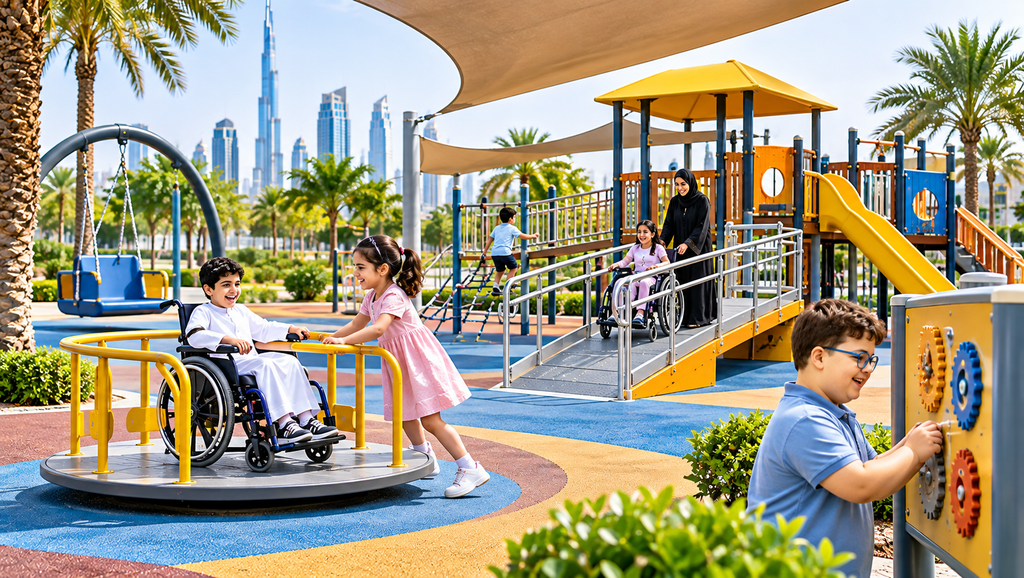
Children using wheelchairs or other mobility aids need suitable routes between play areas.
Surfaces should allow appropriate movement, while transitions between different activities should be planned carefully.
However, accessible paths alone are insufficient if the available play equipment cannot be used meaningfully.
Ground-Level Activities
Ground-level play panels, interactive features, and imaginative play environments may allow children to participate without accessing elevated structures.
These options can benefit children with different mobility and developmental needs.
However, designers should avoid concentrating all accessible activities in one isolated corner.
Inclusive playgrounds should encourage shared play across the site.
Sensory Play
Sensory features can include textured surfaces, musical elements, tactile panels, water play, and visual experiences.
These activities may provide different ways to explore an environment.
However, high levels of sound, movement, or visual stimulation can be uncomfortable for some children.
A balanced playground should include quieter options.
Quiet Areas and Retreat Spaces
Some children may prefer temporary separation from busy group activities.
Quiet spaces can offer a place to rest, regulate sensory experiences, or observe play before participating.
These spaces should remain accessible and appropriately supervised.
They should not be treated as areas where children with disabilities must play separately.
Inclusive Social Experiences
Playgrounds can encourage cooperation through group activities, imaginative environments, and equipment that accommodates different participation styles.
For example, shared musical features or interactive ground-level games can allow children to communicate through movement, sound, or gestures.
However, social interaction should not be forced.
Children should have options to play independently as well.
Key Design Features
| Feature | Potential Benefit |
|---|---|
| Accessible Routes | Easier movement across the playground |
| Varied Play Equipment | Different participation opportunities |
| Ground-Level Activities | Shared play without elevated access |
| Sensory Features | Diverse exploration and learning |
| Quiet Spaces | Reduced sensory overload |
| Clear Signage | Better orientation and communication |
| Shaded Seating | Comfort for children and caregivers |
| Accessible Toilets | Longer, more comfortable visits |
What Research Suggests
A peer-reviewed review of inclusive playground design identified several useful principles.
These included varied play opportunities, accessible surfaces, suitable challenges, sensory options, quiet spaces, recognisable features, and shaded areas.
However, the review also highlighted the need to evaluate how children actually interact with these environments.
Inclusive design is not simply a list of equipment purchases.
5. Why Climate-Responsive Design Is Essential for Gulf Playgrounds
The Gulf’s climate creates important considerations for outdoor recreation.
High temperatures, strong sunlight, humidity, and seasonal weather conditions can affect when and how children use playgrounds.
Inclusive design should therefore consider environmental comfort alongside physical accessibility.
The Importance of Shade
Shaded areas can reduce exposure to direct sunlight.
Playground planners may use trees, canopies, shelters, or other shading structures.
However, the performance of each solution depends on its location, orientation, materials, and maintenance.
Shade should cover relevant routes, seating areas, and selected play activities rather than only the playground entrance.
Heat and Playground Surfaces
Some playground surfaces and equipment materials can become very hot in direct sunlight.
This can create discomfort and potential contact-burn risks.
Children who have difficulty communicating discomfort or moving away from a hot surface may require additional consideration.
Designers should assess surface temperatures and select materials suitable for local conditions.
Water and Sensory Play
Water features may provide enjoyable sensory experiences.
However, they introduce requirements involving hygiene, water quality, drainage, and supervision.
Water use must also be considered within the region’s resource-management priorities.
These facilities should be designed around applicable health and safety requirements.
Accessible Rest Areas
Caregivers may need shaded seating close to play activities.
Accessible restrooms, drinking-water facilities, and suitable circulation routes can support longer visits.
Such features matter for families with children who require additional assistance.
Climate-Responsive Features
| Design Element | Main Consideration |
|---|---|
| Shade Structures | Reduce direct sun exposure |
| Trees and Landscaping | Improve environmental comfort |
| Surface Materials | Limit unsafe heat accumulation |
| Drinking Water | Support hydration |
| Rest Areas | Provide comfortable breaks |
| Ventilated Layout | Encourage air movement |
| Evening Lighting | Support appropriate cooler-hour use |
| Maintenance Plans | Keep facilities safe during seasonal conditions |
Why Technology Is Not Always the Answer
Smart sensors and environmental monitoring may help park operators understand conditions.
However, simple measures such as appropriate shade, accessible seating, and safe materials can be equally important.
Technology should support good design rather than replace it.
6. The Challenges of Making Gulf Playgrounds Truly Inclusive
Inclusive playground projects can face financial, technical, and operational challenges.
Specialised equipment may require additional investment, while existing parks may have limited space for upgrades.
However, accessibility should not be treated as an optional decoration added after construction.
The Importance of Universal Design
Universal design seeks to create environments usable by a broad range of people without requiring unnecessary separation.
Its principles can guide playground planning.
However, universal design does not mean every child has identical needs.
Some users may still require specialised support or individual accommodations.
Understanding Standards
ISO 21542:2021 addresses accessibility and usability in the built environment.
Playground design may also involve equipment safety standards, such as ASTM F1487, and relevant accessibility requirements.
However, standards have different purposes.
Meeting an equipment safety specification does not automatically establish that a playground is fully inclusive.
Local regulations and the latest applicable editions must be verified.
Maintaining Specialised Equipment
Accessible swings, sensory features, and moving equipment require inspection and maintenance.
If essential features remain out of service, the playground may become less usable for some children.
Facility operators should establish clear maintenance responsibilities.
Consulting Families and Children
Playground design decisions should include the perspectives of children with disabilities and their caregivers.
Families may identify practical problems that designers overlook.
These could involve transfer access, confusing layouts, inadequate shade, limited seating, or difficulties reaching the site.
However, consultation should represent a variety of experiences rather than relying on one perspective.
Common Challenges and Responses
| Challenge | Potential Consequence | Practical Response |
|---|---|---|
| Limited Accessibility Budget | Incomplete facilities | Integrate inclusion from initial planning |
| Poor Circulation | Some children cannot reach activities | Continuous accessible routes |
| Isolated Equipment | Reduced shared play | Integrate activities throughout the site |
| Excessive Sensory Stimulation | Discomfort | Quiet spaces and balanced zones |
| Inadequate Maintenance | Unusable equipment | Regular inspection |
| Insufficient Shade | Restricted outdoor use | Climate-responsive planning |
| Weak Community Consultation | Design mismatches | Participatory planning |
| Unclear Standards | Inconsistent implementation | Technical review |
Why Independent Assessment Matters
A playground may be marketed as inclusive without demonstrating how it accommodates different needs.
Accessibility audits, user feedback, and observed participation can help establish whether the environment works as intended.
7. The Future of Inclusive Playgrounds and Child-Friendly Gulf Cities
Inclusive playground design could become a more established part of urban planning as Gulf cities develop new parks, residential communities, educational facilities, and recreational destinations.
However, lasting progress will depend on making inclusion a routine design requirement rather than an exceptional project feature.
The 2026 International Urban Spaces Guide
In January 2026, WHO, UNICEF, and UN-Habitat published the Guide to Creating Urban Public SPACES for Children.
The guide encourages cities to create safe, inclusive, and child-friendly public environments.
Its framework considers safety, opportunities for play, equitable access, health, inclusion, sustainability, and resilience.
The publication supports the view that children’s needs should be included in mainstream urban planning.
Integrating Inclusive Play Into New Neighbourhoods
Urban planners may incorporate accessible playgrounds into residential developments, community parks, school grounds, and public recreational corridors.
However, access should not depend exclusively on living in a premium residential development.
Public-space planning should consider whether children in different neighbourhoods have meaningful opportunities for recreation.
The Role of Public-Private Partnerships
Municipalities may work with developers, equipment manufacturers, disability organisations, and community groups to develop inclusive play spaces.
Such partnerships can contribute resources and specialist knowledge.
However, public access, long-term maintenance, and accountability should remain clear.
A Practical Inclusive Playground Design Checklist
- Consult children with different disabilities and support needs.
- Involve parents, caregivers, and accessibility specialists.
- Confirm relevant local accessibility and playground standards.
- Provide accessible routes from surrounding streets and parking.
- Ensure meaningful ground-level play opportunities.
- Include suitable access to selected elevated activities.
- Offer diverse physical, sensory, and imaginative experiences.
- Integrate inclusive equipment throughout the playground.
- Provide quiet and lower-stimulation areas.
- Include shaded spaces and appropriate resting facilities.
- Evaluate surface materials for heat and safety.
- Provide accessible toilets and drinking water where appropriate.
- Use understandable signs and wayfinding features.
- Establish equipment maintenance and inspection procedures.
- Evaluate the site with actual users after opening.
How Cities Should Measure Playground Inclusion
The number of installed accessible swings or ramps is not enough to determine whether a playground is successful.
Cities should consider accessibility, participation, comfort, safety, and maintenance.
Suggested Performance Indicators
| Indicator | What It Measures |
|---|---|
| Accessible Route Coverage | Ability to move throughout the site |
| Inclusive Play Opportunities | Variety of usable activities |
| User Satisfaction | Experiences of children and families |
| Equipment Availability | Maintenance reliability |
| Sensory Comfort | Suitability of different play zones |
| Shade Coverage | Environmental comfort |
| Accessibility Audit Results | Compliance and practical usability |
| Family Participation | Engagement with the wider community |
| Travel Accessibility | Ability to reach the playground |
| Safety Incidents | Operational safety performance |
Opportunities for Gulf Designers and Businesses
Inclusive playground development could create opportunities for landscape architects, urban planners, equipment manufacturers, accessibility consultants, maintenance providers, and environmental design specialists.
Universities may also contribute research involving child development, disability inclusion, urban heat, and public-space usage.
However, commercial success should not be measured only through equipment sales.
The quality of completed environments and their long-term usability matter more.
Why Inclusive Play Is a Community Investment
A playground can bring families together across different ages, backgrounds, and abilities.
When children can participate in shared experiences, public spaces become more welcoming.
However, inclusion cannot be guaranteed through physical design alone.
Positive social experiences also depend on community awareness, respectful behaviour, and appropriate support.
Conclusion
Inclusive playground design is becoming an important consideration for Gulf cities seeking to develop more accessible and family-friendly public spaces.
Examples from Dubai, Abu Dhabi, Riyadh, Doha, and Muscat demonstrate different approaches to improving the usability of parks and recreational facilities.
These include adapted play equipment, accessible circulation routes, sensory-friendly features, specialised design guidance, and neighbourhood park development.
However, genuine inclusion requires more than meeting minimum accessibility requirements.
A playground must provide meaningful opportunities for children with different abilities to explore, interact, and enjoy outdoor activities.
The Gulf’s climate also makes shading, surface safety, and environmental comfort essential design considerations.
For municipalities, the priority should be integrating inclusion into public-space planning and maintaining facilities after construction.
For designers and developers, the opportunity lies in creating attractive environments that support varied experiences rather than separating users according to disability.
For families and community organisations, meaningful participation in planning can help ensure that playgrounds respond to real needs.
Ultimately, the future of inclusive playground design in the Gulf will depend on how effectively cities turn accessibility commitments into everyday experiences.
A successful playground is not simply one that children can enter.
It is one where children of different abilities can participate, play, and feel that the space belongs to them.
Do follow us on Instagram
Read More – How Subscription Fatigue Is Changing Household Spending Decisions in the Middle East