


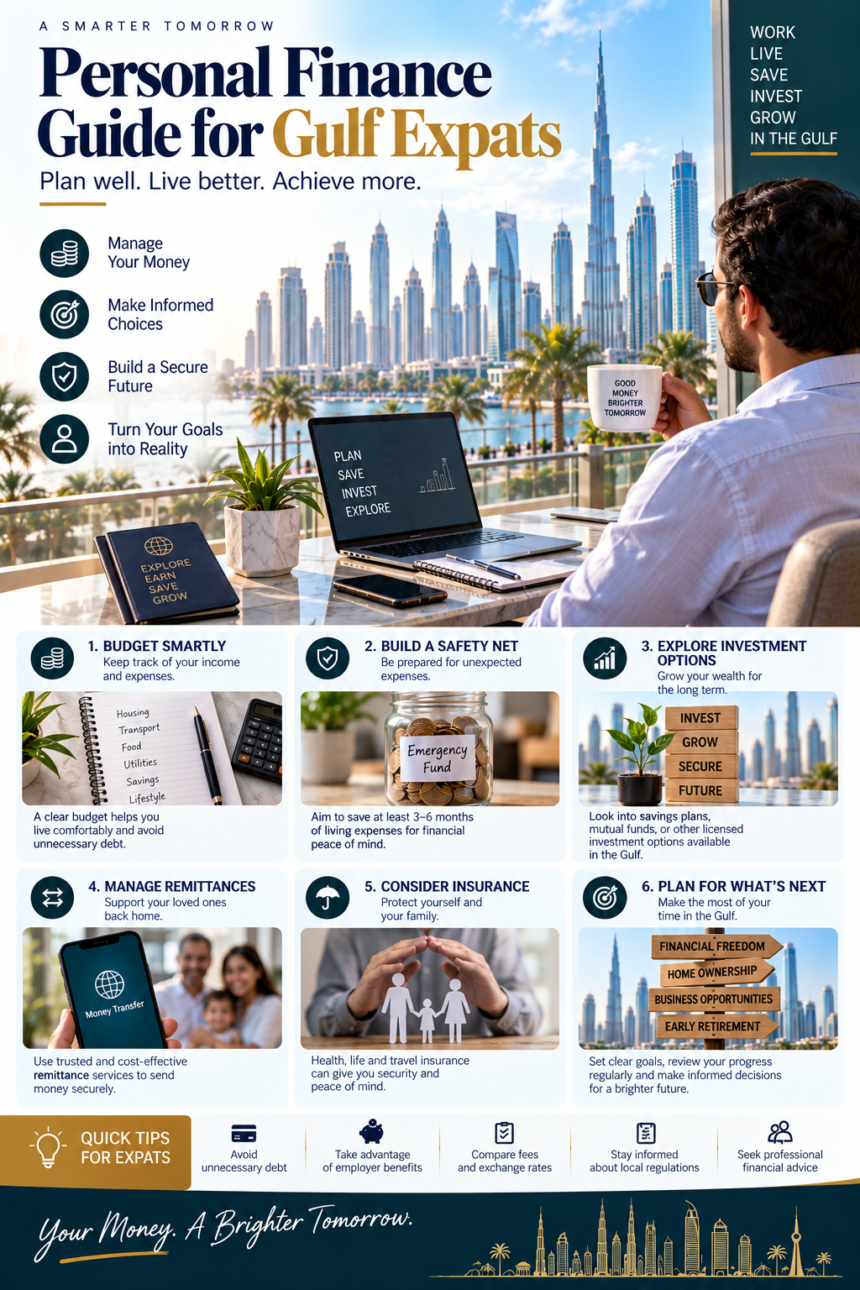
Personal Finance Guide for Gulf Expats: How to Manage Your Money Better
Moving to the Gulf can create an excellent opportunity to improve your finances, but earning a good salary does not automatically lead to financial security. Dubai, Abu Dhabi, Riyadh, Doha, Kuwait City, Manama and Muscat offer very different lifestyles, yet expatriates across the GCC often face the same financial decisions: how much to spend on housing, whether to buy a car, how much to send home, where to keep savings and how to prepare for eventually leaving the region.
- Personal Finance Guide for Gulf Expats: Start With These 5 Numbers
- 1. Build Your Budget Around Your Real Salary
- 2. Control Housing Before It Controls Your Budget
- 3. Build an Emergency Fund Early
- 4. Do Not Let Lifestyle Inflation Follow Every Salary Increase
- 5. Understand the Tax Environment, But Do Not Build Your Life Around It
- 6. Keep Separate Accounts for Different Financial Goals
- 7. Use Credit Cards as a Payment Tool, Not Extra Income
- 8. Be Careful With Personal Loans and Car Finance
- 9. Send Money Home With a Plan
- 10. Start Investing Before You Feel Rich
- 11. Do Not Put Everything Into Property
- 12. Plan for Retirement Even If Your Gulf Stay Is Temporary
- 13. Protect Yourself With the Right Insurance
- 14. Keep Money Ready for Relocation
- 15. Track Your Net Worth, Not Just Your Salary
- Personal Finance in the UAE
- Personal Finance in Saudi Arabia
- Personal Finance in Qatar
- Personal Finance in Kuwait
- Personal Finance in Bahrain
- Personal Finance in Oman
- The 50/30/20 Rule: Does It Work for Gulf Expats?
- Salary Increase? Use This Rule
- Bonus Received? Do Not Spend It Immediately
- Common Financial Mistakes Gulf Expats Make
- Your Monthly Gulf Money Check-Up
- A Simple Financial Roadmap for New Gulf Expats
- Personal Finance Guide for Gulf Expats: What Should Come First?
- Final Thoughts on Personal Finance for Gulf Expats
The challenge is that Gulf expat finances can look stronger than they really are. A generous salary package can quickly disappear through expensive accommodation, frequent dining, car payments, travel, school fees and lifestyle upgrades. Someone earning considerably more than they did in their home country can therefore still finish every month with very little left.
The solution is not to stop enjoying life. It is to give every part of your income a purpose. A strong financial plan should cover current living costs while also building emergency savings, protecting your family and creating assets for the future.
This Personal Finance Guide for Gulf Expats explains 15 essential money rules that can help residents across the UAE, Saudi Arabia, Qatar, Kuwait, Bahrain and Oman build a more organised financial life.
Personal Finance Guide for Gulf Expats: Start With These 5 Numbers
Before choosing investments or opening additional accounts, understand your current position. Five numbers can reveal more about your finances than your salary alone.
| Number | What It Tells You |
|---|---|
| Monthly net income | Money actually available to you |
| Essential expenses | Minimum cost of maintaining your life |
| Total debt payments | How much income is already committed |
| Monthly savings | How much wealth you are actually building |
| Emergency fund | How long you could survive without income |
Write these numbers down.
If you earn AED 20,000 a month but spend AED 19,000, your financial position may be weaker than someone earning AED 12,000 and consistently saving AED 4,000.
Income creates potential. Your saving rate determines how much of that potential you keep.
1. Build Your Budget Around Your Real Salary
A budget should begin with the amount that actually reaches your account, not the headline salary mentioned in your employment package.
Expatriate compensation can include basic salary, housing allowances, transport allowances, bonuses, commissions, school support and other benefits. Some components may be paid monthly while others arrive annually or depend on performance.
Separate guaranteed income from uncertain income.
Your normal lifestyle should ideally be affordable from dependable monthly income. Bonuses and commissions can then be used for additional savings, investing, travel or major purchases rather than becoming necessary to pay ordinary bills.
A Simple Gulf Expat Budget Framework
| Category | Example Target |
|---|---|
| Housing and utilities | 25–35% |
| Food and daily living | 10–15% |
| Transport | 10–15% |
| Personal/lifestyle | 10–15% |
| Savings and investing | 20%+ |
| Insurance/family/other | Remaining amount |
These percentages are not universal rules. Housing costs, family size, school fees and salary levels can completely change the calculation.
The important principle is to decide where your money should go before it disappears.
2. Control Housing Before It Controls Your Budget
Housing is often the largest expense in an expatriate household, making it one of the most important financial decisions you will make.
A more expensive apartment can offer a better location, larger rooms, additional facilities and a prestigious address. However, every additional amount committed to rent is money that cannot be used for savings, investments or other priorities.
Do not compare properties only by annual rent. Consider the complete housing cost.
Real Housing Cost = Rent + Utilities + Internet + Parking + Commuting + Furnishing + Applicable Fees
A cheaper home located far from work may increase fuel, tolls and commuting time. An expensive apartment close to the office may reduce transportation expenses.
The best home is therefore not necessarily the cheapest or most luxurious one. It is the property that fits comfortably within your overall financial plan.
3. Build an Emergency Fund Early
An emergency fund should be one of the first major financial goals for a Gulf expatriate.
Expat life can change quickly. Employment may end unexpectedly, a family emergency may require international travel, a vehicle may need repairs or relocation plans may suddenly change.
Without savings, these situations can push someone towards credit cards or personal loans.
A common starting target is several months of essential expenses rather than several months of salary.
If your household requires 10,000 in local currency each month to cover essential commitments, an emergency fund based on that amount is more useful than calculating it from a much higher gross salary.
Emergency Fund Progress
Stage 1: Save one month of essential expenses.
Stage 2: Build towards three months.
Stage 3: Work towards six months or another level appropriate to your job stability and family responsibilities.
Keep emergency money accessible. Funds needed during a genuine crisis should not depend entirely on selling volatile investments at the right moment.
4. Do Not Let Lifestyle Inflation Follow Every Salary Increase
One of the biggest financial traps in the Gulf is lifestyle inflation.
Your first salary increase can lead to a better apartment. The next promotion brings a more expensive car. Soon dining becomes more frequent, holidays become more luxurious and monthly subscriptions multiply.
None of these choices is automatically wrong. The problem begins when every increase in income produces an equal increase in spending.
Try using a simple rule whenever your salary increases:
Increase your lifestyle a little, but increase your savings first.
If your monthly salary rises by 3,000, you do not necessarily need to add 3,000 to your monthly spending. Allocating a significant portion of the increase to savings or investing allows your standard of living and financial security to improve together.
5. Understand the Tax Environment, But Do Not Build Your Life Around It
The Gulf is widely associated with attractive personal tax conditions, but expatriates should avoid assuming that “living in the Gulf” automatically means they have no tax responsibilities anywhere.
Your obligations can depend on your country of residence, nationality in certain tax systems, time spent in different jurisdictions, investments, property, business activities and income generated outside your Gulf salary.
The situation is also evolving. Tax rules are national rather than one permanent GCC-wide system.
This means financial planning should include two questions:
What taxes apply where I currently live?
What obligations might I still have in my home country or another jurisdiction?
If your situation involves multiple countries, substantial investments, business income or property, professional tax advice may be worthwhile.
6. Keep Separate Accounts for Different Financial Goals
Keeping all your money in one account makes it difficult to see what is genuinely available to spend.
A simple account structure can make budgeting much easier.
The 4-Bucket System
| Account/Bucket | Purpose |
|---|---|
| Spending | Rent, food, transport and monthly bills |
| Emergency | Unexpected essential expenses |
| Short-term goals | Travel, car, wedding, relocation |
| Long-term wealth | Investing and retirement |
You do not necessarily need four different banks. The goal is to separate money mentally or digitally so that long-term savings do not appear to be disposable cash.
Automating transfers immediately after payday can make this system even more effective.
Salary arrives → Savings move automatically → Bills are covered → Remaining money becomes spending money.
This reverses the common habit of spending first and saving whatever remains.
7. Use Credit Cards as a Payment Tool, Not Extra Income
Credit cards can be useful for everyday payments, travel benefits, rewards and managing cash flow. They become dangerous when the credit limit begins to feel like part of your income.
If you cannot afford a purchase from your existing money, putting it on a credit card does not make it affordable. It simply delays the financial impact and may add expensive interest or fees.
A strong credit-card routine is straightforward:
- Know your statement date.
- Know your payment due date.
- Review transactions regularly.
- Avoid unnecessary cash advances.
- Pay the full statement balance where possible.
- Do not maintain several cards without a clear reason.
- Never use credit to maintain an unaffordable lifestyle.
Rewards are valuable only when the underlying spending was necessary and the card is managed responsibly.
Spending 1,000 unnecessarily to receive a small reward is still losing money.
8. Be Careful With Personal Loans and Car Finance
Access to finance can make expensive purchases feel affordable because the focus moves from total cost to monthly payment.
A vehicle costing 150,000 may feel manageable when presented only as a monthly instalment. The same psychology applies to personal loans and other financed purchases.
Before borrowing, calculate:
Total Repayment = Monthly Instalments + Upfront Costs + Financing Charges + Applicable Fees
Then ask another question:
What percentage of my monthly income will already be committed before I pay rent, food and other expenses?
Debt reduces flexibility. This matters particularly for expatriates because employment and residency can be closely connected.
Avoid borrowing the maximum amount simply because a lender is willing to provide it.
9. Send Money Home With a Plan
Remittances are a major part of financial life for many Gulf expatriates. Supporting parents, children or other family members can be an important responsibility, but transfers should still be integrated into the monthly budget.
Sending different amounts whenever relatives request money can make personal financial planning difficult.
Where practical, establish a regular amount for family support and treat it as a planned expense.
Better Remittance Routine
Monthly income
↓
Essential Gulf expenses
↓
Emergency savings
↓
Planned family support
↓
Investing and goals
↓
Discretionary spending
Transfer fees and exchange rates also matter. Small differences become meaningful when money is sent internationally every month for many years.
Compare the total amount received by your family rather than looking only at the advertised transfer fee.
10. Start Investing Before You Feel Rich
Many expatriates postpone investing because they believe they need a very high income or a large amount of savings before beginning.
Time can be more valuable than waiting for the perfect salary.
Someone who invests consistently for 15 years can be in a stronger position than someone who earns considerably more but starts only a few years before retirement.
The appropriate investment depends on your risk tolerance, time horizon, tax situation and future plans. Diversification is generally more sensible than placing your entire financial future into one company, property or speculative asset.
Match the Money to the Goal
| Goal | Typical Time Horizon | General Priority |
|---|---|---|
| Emergency fund | Immediate | Liquidity and stability |
| Holiday | Under 1 year | Accessible savings |
| Car purchase | 1–3 years | Lower volatility |
| Property deposit | Several years | Balanced approach based on timeline |
| Retirement | Long term | Growth and diversification |
| Children’s education | Long term | Structured investing |
Money you need next year should generally not be treated the same way as money intended for retirement decades later.
11. Do Not Put Everything Into Property
Property is extremely popular among Gulf expatriates, particularly in markets such as Dubai and increasingly across other regional investment destinations.
Real estate can be an important part of a long-term financial plan, but it should not automatically become the entire plan.
A person may own a valuable apartment while having almost no accessible cash. If employment suddenly ends or a major emergency occurs, selling property can take time and involve transaction costs.
Consider your entire balance sheet.
Property + Investments + Cash + Retirement Assets – Debt = Net Worth
The goal is not simply to own impressive assets. It is to build a financial position that remains resilient when circumstances change.
Diversification can reduce dependence on one market, one property or one country.
12. Plan for Retirement Even If Your Gulf Stay Is Temporary
A common expat mistake is treating Gulf employment as a temporary phase and postponing retirement planning until returning home.
Five temporary years can easily become ten or fifteen.
If those years pass without consistent investing, a significant wealth-building opportunity may be lost.
Retirement planning becomes especially important when an expatriate does not participate in the same government pension arrangements available to citizens in the country of residence.
Ask yourself:
- At what age would I like to stop full-time work?
- Where do I expect to retire?
- What currency will my future expenses use?
- What assets am I building now?
- How much do I invest every month?
- What happens if I leave the Gulf earlier than expected?
You do not need perfect answers today. You need a plan that becomes clearer over time.
13. Protect Yourself With the Right Insurance
Building wealth is only one side of financial planning. Protecting yourself against large unexpected losses is equally important.
Health insurance arrangements vary across GCC countries and employment packages. Residents should understand exactly what their employer-provided policy covers rather than assuming every medical expense is included.
Families may also need to consider life insurance where other people depend heavily on one person’s income.
Vehicle insurance, home contents protection and travel insurance can also matter depending on your circumstances.
Insurance Check
| Risk | Question to Ask |
|---|---|
| Health | What treatments and hospitals are covered? |
| Life | Would dependants be financially secure? |
| Car | What does the policy actually cover? |
| Home | Are valuable belongings protected? |
| Travel | Are medical emergencies abroad covered? |
Insurance should protect against financial events you would struggle to absorb yourself.
14. Keep Money Ready for Relocation
Every expatriate should eventually consider an uncomfortable but important question:
What would happen financially if I had to leave the Gulf within the next few months?
Relocation can involve flights, temporary accommodation, shipping, deposits, loan settlements, vehicle sale expenses and other unexpected costs.
Keeping a relocation reserve separate from ordinary savings can therefore be useful, particularly if your employment situation is uncertain.
This also prevents you from becoming financially trapped by your lifestyle.
Someone with large monthly debt commitments, no emergency savings and an expensive car can find an unexpected relocation extremely stressful.
Financial flexibility is one of the most valuable assets an expatriate can build.
15. Track Your Net Worth, Not Just Your Salary
Salary is important, but it does not tell you whether you are becoming wealthier.
Net worth provides a better long-term measurement.
Calculate Your Net Worth
Assets
- Cash
- Savings
- Investments
- Property equity
- Retirement accounts
- Other valuable financial assets
Minus Liabilities
- Credit-card debt
- Personal loans
- Car finance
- Mortgages
- Other debt
= Net Worth
Calculate this every six or twelve months.
Your salary may remain unchanged while your net worth increases because you are reducing debt and building investments. Alternatively, your salary may rise significantly while your net worth barely moves because lifestyle spending has increased at the same speed.
That makes net worth one of the most useful personal finance numbers to track.
Personal Finance in the UAE
The UAE is attractive to expatriates partly because individuals generally do not face a conventional personal income tax on employment income. However, residents still encounter other taxes and costs through consumption, property, business activities and everyday transactions.
Dubai and Abu Dhabi can also encourage rapid lifestyle inflation. Premium housing, cars, restaurants, travel and entertainment are readily available, making disciplined budgeting particularly valuable.
Residents should use the UAE’s earning opportunities to build long-term assets rather than assuming a high salary will continue indefinitely.
A strong UAE financial plan should therefore balance enjoying the lifestyle with maintaining an emergency fund, controlling debt and investing consistently.
Personal Finance in Saudi Arabia
Saudi Arabia’s rapidly changing economy has created opportunities across construction, technology, healthcare, tourism, finance and major development projects.
For expatriates, the size of cities such as Riyadh can make transport and housing significant budget categories. A cheaper home located far from work can create substantial commuting expenses, while vehicle ownership can add insurance, maintenance and financing commitments.
Salary packages should therefore be evaluated as a whole rather than through the basic salary alone.
Housing support, transport, family benefits and other employment components can materially change the real value of an offer.
Residents should also consider how much of their income can consistently be converted into savings rather than focusing only on the size of the package.
Personal Finance in Qatar
Qatar can offer attractive employment packages in sectors such as energy, aviation, healthcare, education and professional services.
Housing is often one of the largest expenses for expatriates, particularly in popular areas of Doha. Families also need to consider education, transport and international travel when constructing their budgets.
Someone receiving employer-provided housing or schooling support may have a very different financial position from another person earning a similar salary but paying these costs independently.
This is why comparing Gulf job offers purely by salary can be misleading.
Always calculate the value of the complete compensation package and subtract the real cost of maintaining your intended lifestyle.
Personal Finance in Kuwait
Kuwait remains an important employment destination for expatriates, and private vehicles, housing and family expenses can account for a large share of household spending.
For 2026/27, Kuwait’s official budget records zero revenue under taxes on income, profits and capital gains by individuals. That favourable environment does not remove the need for disciplined personal planning.
Residents should focus on how much of their earnings can be retained after accommodation, transportation, family support and lifestyle expenses.
Building savings outside the monthly spending account can be particularly useful because it reduces the temptation to treat every available dinar as disposable income.
Personal Finance in Bahrain
Bahrain offers a comparatively compact lifestyle, but residents still need to budget carefully for housing, transport, education and entertainment.
Consumption taxes also matter. Bahrain currently applies a standard VAT rate of 10% to taxable goods and services, although some supplies are zero-rated or exempt.
For consumers, the lesson is straightforward: personal finance should consider the real cost of spending rather than looking only at headline salary and assumptions about income taxation.
Expatriates who work in financial services, professional services or other sectors should use automatic saving and investing to ensure that long-term goals progress alongside current lifestyle spending.
Personal Finance in Oman
Oman deserves special attention because its personal tax environment is changing.
A Personal Income Tax Law has been issued and is scheduled to take effect from the beginning of 2028. Under the law, individuals whose total annual income exceeds OMR 42,000 can fall within the new framework, with a 5% rate applying to taxable income according to the law’s conditions, exemptions and deductions.
This is particularly relevant for higher-income expatriates planning to remain in Oman beyond 2027.
Residents should therefore avoid making long-term financial assumptions based entirely on today’s tax environment. As implementation approaches, affected individuals should review the detailed rules and obtain professional advice where necessary.
For most households, the fundamental financial principles remain the same: control housing costs, maintain liquidity, avoid excessive debt and build long-term investments.
The 50/30/20 Rule: Does It Work for Gulf Expats?
The popular 50/30/20 budgeting framework divides income into 50% for needs, 30% for wants and 20% for saving.
It can provide a useful starting point, but Gulf expatriates may need to modify it.
A family paying private school fees may have much higher essential expenses. Someone whose employer provides housing may be able to save far more than 20%. A single professional sharing accommodation could potentially direct a substantial percentage of income towards investments.
A More Flexible Gulf Model
| Financial Situation | Possible Savings Goal |
|---|---|
| High essential expenses | Start with 10–15% |
| Average stable household | Aim for 20%+ |
| Housing provided by employer | Consider 30%+ |
| Single professional with low expenses | Potentially 30–40%+ |
| Aggressive wealth-building phase | Save as much as sustainably possible |
The percentages matter less than consistently spending below your means.
Salary Increase? Use This Rule
When your salary rises, decide what happens to the extra money before your lifestyle absorbs it.
For example:
Salary increase: 2,000
→ 1,000 to investing
→ 500 to a financial goal
→ 500 to improving your lifestyle
This allows you to enjoy career progress without sacrificing wealth creation.
The exact split can change, but automatically saving part of every raise is one of the easiest ways to increase your long-term savings rate.
Bonus Received? Do Not Spend It Immediately
Bonuses feel different from normal salary because they arrive as a larger amount at once. This can make expensive purchases feel easier to justify.
Before spending a bonus, divide it according to your priorities.
Example Bonus Plan
40% Long-term investments
25% Emergency fund or major financial goal
20% Debt repayment
15% Travel, shopping or enjoyment
Someone without debt could redirect that portion towards investing or another goal.
The purpose is not to remove enjoyment. It is to make sure a successful year improves both your lifestyle and your balance sheet.
Common Financial Mistakes Gulf Expats Make
Many expatriates arrive intending to save aggressively but discover several years later that their assets have barely grown.
The most common reasons are rarely complicated:
- Choosing accommodation that consumes too much income
- Financing an unnecessarily expensive car
- Increasing spending after every promotion
- Carrying credit-card balances
- Sending money home without a fixed plan
- Keeping all savings in cash indefinitely
- Investing without understanding risk
- Buying property without maintaining liquidity
- Ignoring retirement
- Having no emergency fund
- Depending entirely on employer benefits
- Failing to plan for eventual relocation
The danger is that these mistakes often feel affordable month by month.
Their real impact becomes visible only after several years.
Your Monthly Gulf Money Check-Up
Once a month, spend 15 minutes reviewing your finances.
Ask yourself:
☐ Did I save or invest this month?
☐ Did my credit-card balance get paid?
☐ Did any subscription or recurring expense increase?
☐ Am I still within my housing and transport budget?
☐ Did I add unnecessary debt?
☐ Is my emergency fund growing?
☐ Are family remittances within the planned amount?
☐ Did I make progress towards my major financial goal?
☐ Is there a large expense coming next month?
☐ Is my lifestyle becoming more expensive without me noticing?
You do not need to analyse every coffee purchase. The purpose is to identify larger patterns before they become problems.
A Simple Financial Roadmap for New Gulf Expats
The first year after moving can be financially chaotic, so priorities help.
Months 1–3: Stabilise
Understand your real monthly expenses, avoid unnecessary major purchases and begin building a cash reserve.
Months 4–6: Protect
Build the emergency fund further, review insurance and eliminate expensive short-term debt.
Months 7–9: Build
Start or increase regular long-term investing and organise remittances and savings goals.
Months 10–12: Review
Calculate your net worth, evaluate your savings rate and create goals for the following year.
By the end of the first year, you should understand not only how much you earn in the Gulf but how much of that income you are actually keeping.
Personal Finance Guide for Gulf Expats: What Should Come First?
When several financial goals compete for your salary, use a simple priority structure:
1. Essential living costs
Keep housing, food, utilities and transportation under control.
2. Emergency savings
Build protection against unexpected changes.
3. Expensive debt
Reduce debt that is creating significant financing costs.
4. Protection
Review health and other important insurance.
5. Long-term investing
Build assets consistently.
6. Major goals
Save for property, education, travel or other priorities.
7. Lifestyle upgrades
Increase discretionary spending only after the foundations are secure.
This order will not fit every household perfectly, but it prevents luxury spending from taking priority over financial security.
Final Thoughts on Personal Finance for Gulf Expats
Living and working in the Gulf can create a powerful opportunity to improve your financial future, particularly when your income rises faster than your lifestyle.
But geography alone will not build wealth.
The expatriates who make the strongest financial progress are usually not the people with the most impressive salaries. They are the people who consistently keep a meaningful part of what they earn.
Start with the fundamentals. Understand your real income, control housing and transportation costs, create an emergency fund and avoid unnecessary debt. Once those foundations are secure, automate savings, invest for long-term goals and monitor your net worth.
At the same time, enjoy the experience of living abroad. Personal finance should not turn every restaurant meal, holiday or purchase into a source of guilt. The objective is to create a lifestyle you can afford while making sure your future receives part of every salary you earn.
For Gulf expats, perhaps the most useful financial question is not “How much am I earning?”
It is “How much stronger will my financial position be when my time in the Gulf eventually ends?”
If you can answer that question positively year after year, your Gulf career is doing more than funding your present lifestyle. It is helping build your future.
Do follow us on Instagram
Read More – How Credit Cards Work in Gulf Countries: 12 Essential Things Expats Should Know