



Common Credit Card Mistakes Gulf Expats Should Avoid
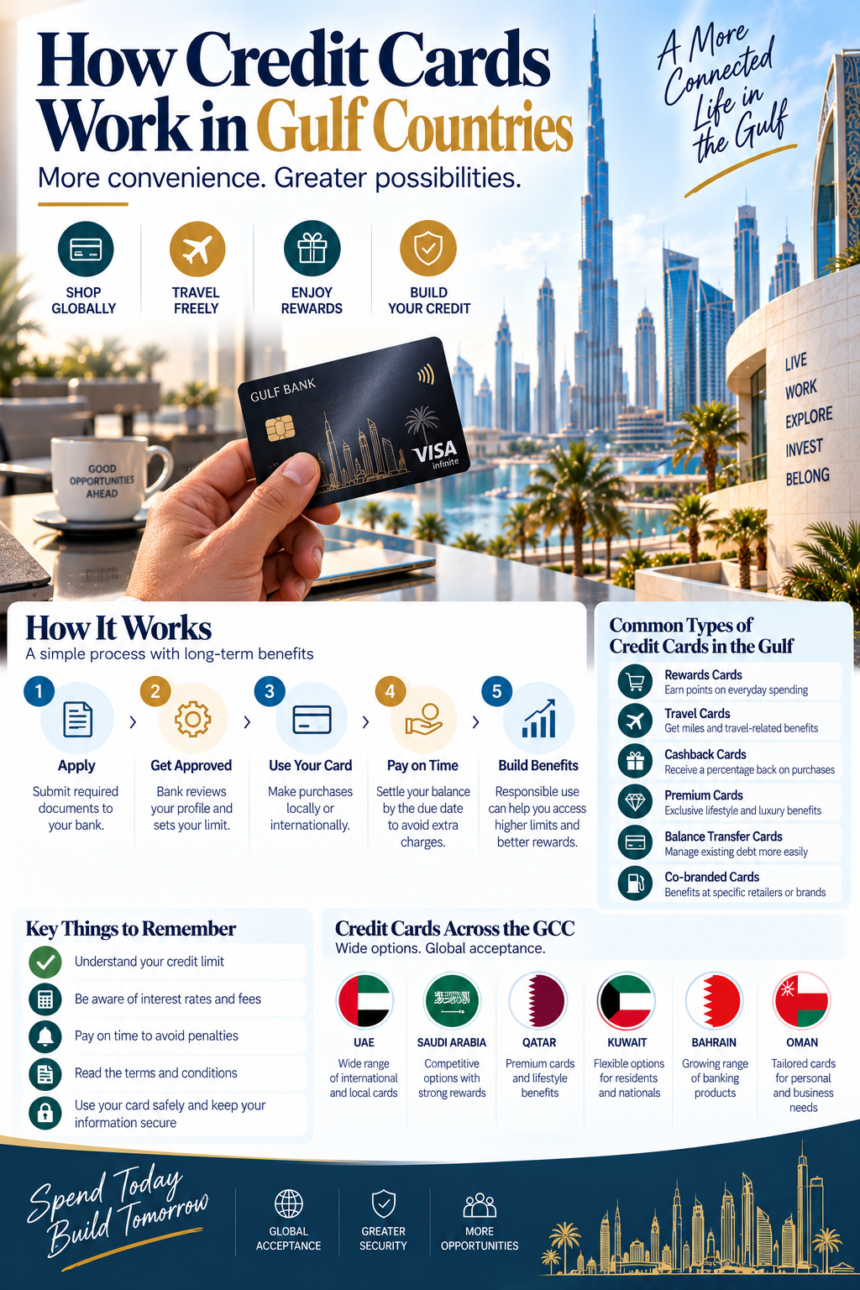
How Credit Cards Work in Gulf Countries is important for expatriates living in the UAE, Saudi Arabia, Qatar, Bahrain, Oman and Kuwait because credit cards are widely used for shopping, online payments, travel bookings, subscriptions and everyday expenses across the GCC.
- Common Credit Card Mistakes Gulf Expats Should Avoid
- How Credit Cards Work in Gulf Countries: 2026 Overview
- 1. Credit Cards Compared With Debit and Prepaid Cards
- 2. Credit Card Eligibility for Gulf Expats
- 3. Credit Limits and Available Credit
- 4. Monthly Statements and Payment Due Dates
- 5. Full Payments and Minimum Payments
- 6. Interest, Profit Rates and Financing Costs
- 7. Annual Fees and Other Credit Card Charges
- 8. Cash Withdrawals and Cash Advances
- 9. Rewards, Cashback and Travel Benefits
- 10. International Purchases and Foreign Currency Fees
- 11. Credit Scores and Responsible Card Use
- 12. Credit Card Security and Fraud Protection
- Credit Cards in the UAE
- Credit Cards in Saudi Arabia
- Credit Cards in Qatar
- Credit Cards in Bahrain
- Credit Cards in Oman
- Credit Cards in Kuwait
- Islamic Credit Cards and Conventional Credit Cards
- Supplementary Credit Cards for Family Members
- Credit Card Instalment Plans
- Credit Cards When Changing Jobs
- Credit Cards Before Leaving the Gulf
- Choosing the Right Credit Card in the GCC
- Common Credit Card Mistakes Gulf Expats Should Avoid
- Practical Credit Card Checklist for Expats
- Final Thoughts on Credit Cards in Gulf Countries
Gulf banks offer a large range of cards, from simple entry-level products to premium cards offering airline miles, cashback, airport lounge access, hotel benefits and other rewards.
However, a credit card is also a form of borrowing.
When a cardholder makes a purchase, the bank or card issuer generally pays the merchant and the customer later repays the amount according to the card agreement. Paying the full statement balance by the due date can make credit cards convenient for everyday spending, while repeatedly carrying balances can make them significantly more expensive.
The exact rules, fees and consumer protections are not identical across the Gulf.
The UAE, Saudi Arabia, Qatar, Bahrain, Oman and Kuwait each regulate banks and card issuers through their own central banks. Individual issuers can also set different salary requirements, limits, reward structures and fees within those regulatory frameworks.
For expats, the smartest approach is to understand how the card works before focusing on miles, cashback or premium benefits.
How Credit Cards Work in Gulf Countries: 2026 Overview
A credit card gives the customer access to a pre-approved credit facility.
Imagine a bank gives you a credit card with a limit of AED 20,000 in the UAE.
If you spend AED 3,000, your available credit may fall to approximately AED 17,000 until you repay some or all of the balance.
At the end of a billing period, the bank produces a statement containing information such as:
- Purchases
- Refunds
- Payments
- Fees
- Outstanding balance
- Minimum payment
- Payment due date
- Available credit
- Interest or profit charges where applicable
The terminology and calculations differ between banks, particularly between conventional and Islamic products.
Regulators increasingly require clear disclosure.
The UAE Central Bank’s Consumer Protection Standards, for example, require credit-card statements to disclose matters including the outstanding balance, annual interest or profit rate, fees and the cost implications of paying only the minimum amount.
Saudi Arabia also introduced updated credit-card rules in 2025 aimed at improving transparency, disclosure and the operation of credit cards.
The basic principle is simple: a credit card should be treated as borrowed money, not additional income.
1. Credit Cards Compared With Debit and Prepaid Cards
A credit card is different from a debit card.
Debit card
A debit card normally uses money already held in your bank account.
If your account contains the equivalent of $2,000, your spending is generally limited by your available balance and transaction limits.
Credit card
A credit card uses money provided by the bank or card issuer up to an approved credit limit.
You repay that amount later.
Prepaid card
A prepaid card generally allows you to load money onto the card before spending it.
Kuwait’s Central Bank provides a useful official distinction. It describes debit cards as linked to the customer’s available bank balance, prepaid cards as stored-value products funded in advance and credit cards as products that provide credit to customers.
For people who are new to managing credit, a debit or prepaid card can sometimes provide greater spending control.
Credit cards become useful when the customer understands statement cycles, due dates and repayment costs.
2. Credit Card Eligibility for Gulf Expats
Receiving a salary in the Gulf does not automatically mean every bank will approve you for every credit card.
Banks typically consider factors such as:
- Monthly salary
- Employer
- Length of employment
- Residency
- Credit history
- Existing loans
- Existing credit cards
- Overall monthly obligations
- Internal bank policies
Premium cards generally require stronger income or financial profiles than entry-level cards.
The UAE currently maintains specific regulatory requirements relating to credit-card issuance. Existing Central Bank rules state that cards should generally be issued to customers with annual income of at least AED 60,000, while cards can also be secured against qualifying pledged deposits under specified conditions.
That is a regulatory threshold, not a guarantee that every UAE bank will issue a card at that income.
Individual products may require substantially higher salaries.
Banks also assess whether customers can afford additional credit.
The UAE’s newer responsible-financing framework requires financial institutions to assess customers’ ability to meet credit obligations and review relevant credit information before granting credit. The updated provisions become effective in September 2026.
Expats should therefore apply for cards that realistically match their income rather than submitting applications for many premium products at once.
3. Credit Limits and Available Credit
The credit limit is the maximum amount the issuer allows you to borrow through the card, subject to the agreement.
If your limit is 10,000 and you spend 4,000, you generally have around 6,000 remaining before considering pending transactions, fees or other adjustments.
Paying the balance restores available credit.
A larger limit may look attractive, but it is not automatically better.
For someone earning a moderate salary, an unnecessarily high limit can encourage overspending and create greater financial difficulty if the balance accumulates.
Kuwait applies particularly clear regulatory limits. The Central Bank of Kuwait states that the permitted credit-card limit for instalment-type credit cards can reach up to ten times the customer’s net monthly salary, capped at KWD 10,000, subject to applicable debt-to-income requirements.
Other GCC countries regulate consumer lending differently, so consumers should not assume that Kuwait’s limit applies elsewhere.
Your personal target should not be the highest credit limit available.
It should be the smallest limit that comfortably supports normal spending and travel requirements.
4. Monthly Statements and Payment Due Dates
Understanding the statement cycle is one of the most important parts of using a credit card responsibly.
A typical card operates through a monthly billing cycle.
For example:
Statement date: 1 September
Statement balance: AED 5,000
Payment due date: 26 September
You then decide how much of that balance to repay according to the agreement.
Transactions made after the statement date normally appear on the next statement.
Consumers should review every statement rather than relying only on app notifications.
Check:
- Purchase amounts
- Merchant names
- Refunds
- Foreign currency transactions
- Fees
- Cash withdrawals
- Payments
- Interest/profit charges
If something looks unfamiliar, investigate quickly.
Saudi Arabia’s updated credit-card rules require agreements to specify details such as the statement date, due date, credit limit, minimum payment, payment terms and grace period.
Clear statement dates make financial planning much easier.
5. Full Payments and Minimum Payments
This is the most important financial distinction on a credit-card statement.
Full payment
You repay the entire statement balance by the due date.
Subject to the card’s terms and transaction type, this can prevent interest or financing costs from being charged on ordinary purchases.
Minimum payment
You pay only the minimum amount required by the issuer.
The remaining balance continues into future billing periods and may generate additional interest, profit or other financing costs.
The UAE Central Bank requires card statements to warn consumers that paying only the minimum means paying more in interest, profit or fees and taking longer to clear the balance.
That warning matters.
A minimum payment should not be interpreted as the amount the bank recommends paying.
It is generally the smallest amount required to avoid failing to make the required payment under the agreement.
If financially possible, paying the full statement balance by the due date is usually the simplest way to avoid turning everyday spending into long-term debt.
6. Interest, Profit Rates and Financing Costs
Conventional cards typically describe borrowing costs using interest rates, while Islamic products may use different Sharia-compliant structures and terminology.
Customers should compare the actual annual rate and total financing cost, not simply the monthly percentage shown in marketing.
A monthly rate can appear small until it is understood over a full year.
The UAE Central Bank requires annual interest or profit rates on credit cards to be separately disclosed. It also requires unpaid credit-card balances to be calculated using the reducing-balance method under its Consumer Protection Standards.
The same standards provide that financial institutions should not charge interest or finance fees on ordinary outstanding credit-card purchases when the statement balance is paid completely by the due date, excluding cash-advance transactions.
Saudi Arabia’s 2025 rules similarly introduced clearer requirements around card costs and grace periods. SAMA’s official FAQ states that cardholders must receive a grace period of at least 25 days from statement issuance under the applicable rules.
Always check the actual terms of your card rather than applying another country’s rules to it.
7. Annual Fees and Other Credit Card Charges
Credit cards can carry several different fees.
Potential charges include:
- Annual membership fee
- Late-payment fee
- Cash withdrawal fee
- Foreign currency fee
- Replacement-card fee
- Balance-transfer fee
- Instalment-plan fee
- Supplementary-card fee
- Over-limit charges where permitted
Not every card charges every fee.
Some waive annual fees permanently. Others provide a free first year and charge later.
Premium cards often charge higher annual fees because they provide benefits such as airport lounges, travel rewards and insurance.
Saudi Arabia’s current rules specify that a card issuer cannot charge the annual fee before the customer activates the card. SAMA also says an unactivated card may be cancelled after 90 days.
Bahrain also regulates certain retail banking fees. CBB’s published standard-fee framework includes controls covering items such as card replacement and certain international card usage charges.
Before accepting any card, download the current fee schedule.
Do not rely solely on what a salesperson tells you.
8. Cash Withdrawals and Cash Advances
Using a credit card at an ATM is different from using a debit card.
A debit-card ATM withdrawal uses money in your bank account.
A credit-card cash withdrawal usually creates borrowing against the card.
This can be an expensive way to access cash because separate withdrawal fees and different financing rules may apply.
Before withdrawing cash, check:
- Cash withdrawal fee
- Maximum withdrawal limit
- Applicable interest or profit treatment
- Foreign ATM charges
- Currency conversion costs
Saudi Arabia’s rules require issuers to tell customers the cash withdrawal limit and the applicable withdrawal fees.
Unless there is a genuine need, using a debit card for cash and reserving the credit card for purchases can make financial management simpler.
9. Rewards, Cashback and Travel Benefits
Rewards are one of the main reasons people choose credit cards in the Gulf.
Banks compete through offers such as:
- Airline miles
- Cashback
- Reward points
- Hotel loyalty benefits
- Airport lounge access
- Cinema discounts
- Dining offers
- Travel insurance
- Golf privileges
The benefit should match your actual spending.
An airline card makes little sense if you rarely travel.
A fuel or supermarket cashback card may provide much greater real value for a family.
Before choosing a rewards card, check:
- Reward earning rate
- Eligible spending categories
- Monthly cashback caps
- Expiry dates
- Redemption rules
- Annual fee
- Excluded transactions
A card offering “up to 10% cashback” may apply that rate only to limited spending categories or up to a small monthly maximum.
Rewards should be treated as a bonus for spending you would make anyway.
They should not become a reason to spend more.
10. International Purchases and Foreign Currency Fees
Gulf residents often travel internationally, shop from overseas websites and pay for services billed in other currencies.
That makes foreign transaction costs especially important.
When you make a purchase in a foreign currency, the final amount can include:
- Card network exchange rate
- Bank currency conversion
- International transaction fee
- Merchant currency conversion
A merchant may sometimes offer to charge your card in your home or Gulf currency instead of the merchant’s local currency.
This process is commonly known as dynamic currency conversion.
The displayed amount can seem convenient because you immediately know the value in familiar currency, but the conversion rate may not always be favourable.
Compare your bank’s foreign currency terms before travelling.
Saudi Arabia’s current credit-card rules allow international purchase transaction fees for qualifying card transactions where the merchant is located outside the Kingdom, while separate rules apply to cash withdrawals.
Frequent travellers should place foreign currency fees near the top of their card-comparison checklist.
11. Credit Scores and Responsible Card Use
Credit-card behaviour can influence your wider ability to borrow.
Banks may report credit information to national credit-information systems or bureaux according to local regulations.
That means repeated late payments or high levels of borrowing can influence future applications for:
- Personal loans
- Car finance
- Mortgages
- Additional credit cards
Responsible credit-card habits include:
- Paying on time
- Keeping balances manageable
- Avoiding unnecessary cash advances
- Monitoring statements
- Maintaining realistic limits
- Avoiding excessive applications
Do not apply for several cards simply because every bank offers a joining bonus.
A customer with five cards can quickly lose track of statement dates and payment obligations.
For many expats, one or two carefully selected cards are enough.
12. Credit Card Security and Fraud Protection
Credit cards provide convenience, but card fraud remains a major risk.
Protect:
- Card number
- Expiry date
- CVV
- PIN
- Online banking password
- One-time passwords
No genuine unexpected caller should persuade you to reveal an OTP simply by claiming your card is about to be suspended.
Keep transaction notifications switched on.
If you see an unfamiliar purchase, contact the bank immediately using its official number.
Saudi consumer-protection rules require banks and card issuers to provide 24-hour channels for reporting lost or stolen cards, fraud and disputed credit-card transactions.
Oman’s Central Bank similarly advises cardholders to avoid sharing PIN or card information, enable banking notifications, use cards only on trusted websites and report lost or stolen cards immediately.
These are good habits regardless of which GCC country you live in.
Credit Cards in the UAE
The UAE has one of the Gulf’s most competitive credit-card markets.
Banks offer everything from straightforward cashback cards to premium airline and travel products.
Current Central Bank rules provide important consumer protections.
Card statements must clearly disclose relevant fees, annual interest or profit rates, foreign exchange information and outstanding balances. They must also illustrate the consequences of making only minimum payments.
Existing UAE regulations generally set AED 60,000 in annual income as the regulatory minimum for unsecured credit-card issuance, with secured-card options available against qualifying pledged deposits.
The Central Bank’s responsible-financing rules also require lenders to evaluate a customer’s ability to service credit rather than providing unlimited borrowing simply because the customer requests it.
For UAE expats, key comparison points include annual fees, foreign currency charges, airport benefits, cashback caps and whether the card continues to make sense if salary or employment changes.
Credit Cards in Saudi Arabia
Saudi Arabia updated its credit-card issuance and operation rules in June 2025, with further official guidance published in September 2025. The rules remain in force in 2026.
The framework emphasises clearer disclosure and fair operation.
Among the requirements:
- Cards cannot be issued without a documented customer request.
- Applicants must be notified of approval or rejection within the required timeframe.
- Annual fees cannot be charged before activation.
- Agreements must disclose key fees and payment terms.
- A minimum grace period applies under the regulations.
- Customers must be informed of cash withdrawal limits and charges.
Saudi Arabia also prohibits merchants from adding certain extra charges merely because consumers pay with credit, debit or other covered payment methods under the consumer-protection framework.
Expats should nevertheless compare individual bank cards carefully because reward programmes and eligibility differ substantially.
Credit Cards in Qatar
Qatar’s card market includes conventional and Islamic banks offering credit cards for residents who meet their individual eligibility criteria.
The Qatar Central Bank regulates the country’s financial institutions and maintains a dedicated Customer Protection Department.
QCB describes financial consumer protection as requiring fair and transparent treatment and helping customers make informed financial decisions. Its Customer Protection Department also receives financial complaints and feedback.
For expats, practical considerations include:
- Salary requirement
- QID and residency
- Credit limit
- Annual fee
- Reward programme
- Travel fees
- Full and minimum payment conditions
Cardholders should read the Key Facts Statement or equivalent disclosure supplied by the issuer before activation.
Credit Cards in Bahrain
Bahrain has one of the region’s longest-established banking sectors and provides conventional and Islamic credit-card options.
The Central Bank of Bahrain regulates retail banking and consumer finance.
CBB’s regulatory material treats credit cards as a form of consumer credit, meaning card lending forms part of the wider credit-risk and consumer-protection framework.
Bahrain also maintains standard fee rules for certain retail-banking card services, including replacement cards and international usage.
Consumers who experience a problem should first raise it with their financial institution. The CBB provides a complaint escalation process and monitors complaints involving regulated entities.
As elsewhere in the Gulf, the best card is not necessarily the one offering the largest introductory reward.
Credit Cards in Oman
Credit cards are available through Oman’s licensed retail banks alongside debit and prepaid products.
The Central Bank of Oman supervises licensed banks and has authority over rules covering financial conduct, customer protection and financial literacy under Oman’s current banking framework.
Oman is also developing its domestic card infrastructure through the Maal National Payment Card. CBO states that the system supports debit, prepaid and credit-card structures and is designed to strengthen local payments and financial inclusion.
The Maal initiative does not automatically replace existing international credit cards; the Central Bank specifically says existing cards remain valid.
Expats should compare individual bank conditions, particularly salary eligibility, annual charges, rewards and international usage costs.
Credit Cards in Kuwait
Kuwait provides particularly detailed official information about credit cards.
The Central Bank distinguishes between credit cards that allow balances to be repaid in instalments and charge cards that require full repayment by the due date.
CBK states that the maximum permitted credit-card limit for instalment credit can be up to ten times the customer’s net monthly salary, capped at KWD 10,000, subject to applicable debt-to-income rules. The repayment period for credit-card balances under this framework should not exceed one year.
Kuwait also updated its Consumer Protection Guide in October 2025 to reflect newer regulatory and technical developments and promote greater transparency in banking relationships.
Consumers who cannot resolve a complaint directly with their bank can use the Central Bank’s defined complaint and appeal process.
Islamic Credit Cards and Conventional Credit Cards
Islamic credit cards are widely available in the Gulf.
Instead of conventional interest structures, Islamic cards are designed around Sharia-compliant contractual arrangements.
The exact structure depends on the issuer and product.
For consumers, the practical experience may still include:
- Monthly statements
- Credit limits
- Minimum payments
- Annual fees
- Rewards
- Instalment services
However, the financial contract and terminology can differ.
Customers choosing Islamic banking should examine the total cost rather than assuming every Sharia-compliant card has the same pricing.
Similarly, conventional cardholders should compare annual interest rates and fees rather than assuming every card works identically.
Supplementary Credit Cards for Family Members
Banks may allow the primary cardholder to issue supplementary cards to eligible family members.
The primary customer usually remains responsible for the spending and debt generated through supplementary cards according to the card agreement.
Saudi Arabia’s current rules explicitly permit supplementary cards following a documented customer request and place responsibility for the supplementary card’s obligations on the primary customer.
If giving a supplementary card to a spouse or older child, set clear spending expectations.
Check whether the bank allows individual spending limits for supplementary cards.
Credit Card Instalment Plans
Many Gulf banks allow qualifying purchases to be converted into fixed instalments.
These plans can be useful for large planned expenses, but “0% instalment” does not automatically mean completely free.
Check for:
- Processing fee
- Early settlement charge
- Minimum purchase amount
- Participating merchants
- Instalment duration
- Cancellation rules
Compare the total cost with simply paying the purchase from savings.
Instalments should not become a way of making unaffordable purchases appear affordable by looking only at the monthly figure.
Credit Cards When Changing Jobs
Employment changes can affect credit-card relationships.
A bank may have approved the card partly because of your salary and employer.
If salary transfers stop, account conditions or credit facilities may be reviewed depending on the bank and country.
Before changing jobs:
- Maintain sufficient funds for upcoming card payments.
- Check whether salary-transfer conditions apply.
- Update the bank when required.
- Avoid taking large new card debt immediately before employment changes.
The safest approach is to maintain an emergency fund separate from your available credit.
Credit Cards Before Leaving the Gulf
Do not leave a GCC country permanently without addressing outstanding card balances.
Before relocation:
- Repay outstanding debt.
- Stop recurring subscriptions.
- Redeem valuable rewards.
- Download statements.
- Cancel unnecessary supplementary cards.
- Request formal card cancellation.
- Keep written confirmation.
- Update contact details.
Simply cutting the physical card does not close the account.
Likewise, stopping use of the card does not cancel recurring annual fees or subscriptions.
Ask the issuer for confirmation that the account is fully settled and closed.
Choosing the Right Credit Card in the GCC
A simple comparison can help.
| Your priority | Card feature to compare |
|---|---|
| Everyday spending | Cashback |
| Frequent flying | Airline miles |
| International travel | Low foreign currency fees |
| Airport use | Lounge access |
| Family expenses | Grocery and fuel rewards |
| Low annual spending | No annual fee |
| Large purchases | Instalment options |
| Islamic banking | Sharia-compliant structure |
| Online shopping | Security and purchase benefits |
| Simple budgeting | Low limit and straightforward fees |
Do not compare only welcome bonuses.
A large sign-up reward may be worth less than a card with lower ongoing fees over several years.
Common Credit Card Mistakes Gulf Expats Should Avoid
Paying only the minimum every month
This can significantly increase repayment time and cost.
Treating the credit limit as savings
Available credit is borrowed money.
Taking cash advances unnecessarily
Cash withdrawals can have separate fees and treatment.
Ignoring annual fees
A card that was free in year one may become expensive later.
Overspending for rewards
Spending AED 1,000 unnecessarily to earn AED 20 in cashback is not a saving.
Having too many cards
Multiple statement dates make financial management harder.
Missing payment dates
Set automatic payments or reminders.
Ignoring foreign currency fees
Frequent travellers should compare these carefully.
Sharing OTPs
Never disclose authentication codes.
Leaving the Gulf without cancelling cards
Outstanding accounts can cause future financial problems.
Practical Credit Card Checklist for Expats
Before applying for a Gulf credit card:
- Confirm eligibility.
- Compare at least three products.
- Check the annual fee.
- Check the annual interest or profit rate.
- Understand the minimum payment.
- Check the payment due date.
- Review cash withdrawal charges.
- Compare foreign currency fees.
- Read reward-programme limits.
- Check supplementary card charges.
- Review instalment-plan costs.
- Use a realistic credit limit.
- Turn on transaction alerts.
- Set an automatic payment or reminder.
- Review every monthly statement.
- Report suspicious transactions immediately.
- Keep emergency savings separate from credit.
- Clear outstanding balances before permanent relocation.
Final Thoughts on Credit Cards in Gulf Countries
Learning How Credit Cards Work in Gulf Countries can help expats use cards as convenient financial tools without allowing them to become expensive debt.
Across the GCC, the basic structure is similar.
A bank provides a credit limit. You make purchases. The bank produces a statement. You repay according to the card agreement.
What changes between cards and countries are the eligibility requirements, limits, financing costs, consumer protections, rewards and fees.
In the UAE, Central Bank rules require extensive disclosure around credit-card costs and the consequences of making minimum payments.
Saudi Arabia introduced updated credit-card rules in 2025 covering issuance, disclosure, grace periods, annual fees and card operations.
Qatar regulates card issuers through Qatar Central Bank and provides a dedicated financial consumer-protection framework.
Bahrain regulates cards as part of its wider retail banking and consumer finance sector, while the Central Bank provides formal complaint procedures.
Oman is continuing to develop its digital payments infrastructure, including the Maal National Payment Card system under Central Bank supervision.
Kuwait provides particularly clear official rules around credit-card types, borrowing limits and repayment periods.
For most expats, the safest strategy is simple: choose a card that matches normal spending, keep the credit limit manageable and repay the full statement balance whenever financially possible.
Rewards, airline miles and premium benefits are useful only after the fundamentals are under control.
A well-managed credit card can make travel, online payments and everyday spending easier. A poorly managed one can turn ordinary purchases into long-term debt.
The difference usually comes down to one habit: understanding exactly what you owe and paying it on time.
Do follow us on Instagram
Read More – How to Open a Bank Account in GCC Countries: 12 Essential Steps for Expats