


How Ramadan Changes the Rhythm of Daily Life
Ramadan changes much more than meal times across the Arabian Gulf. For approximately one lunar month, the normal rhythm of work, shopping, traffic, dining, family life and entertainment shifts across the UAE, Saudi Arabia, Qatar, Bahrain, Oman and Kuwait.
- How Ramadan Changes the Rhythm of Daily Life
- Working Hours Become Shorter During Ramadan
- Mornings and Afternoons Become Quieter
- Life Becomes Busier Before Iftar
- Iftar Changes the Evening Routine
- Gulf Cities Stay Awake Much Later at Night
- Restaurants Change Their Ramadan Timings
- Shopping Malls Stay Open Later
- Traffic Patterns Change During Ramadan
- Prayer Becomes More Visible in Daily Life
- Charity and Community Activities Increase
- Family Gatherings Become More Important
- Traditional Ramadan Foods Return to Daily Tables
- Ramadan in the UAE
- Ramadan in Saudi Arabia
- Ramadan in Qatar
- Ramadan in Bahrain
- Ramadan in Oman
- Ramadan in Kuwait
- How Ramadan Changes Life for Non-Muslim Residents and Visitors
- What Changes During the Final Ten Nights?
- How Eid Al-Fitr Changes the Rhythm Again
- Ramadan Daily Life Across the GCC at a Glance
- Final Thoughts on Ramadan in GCC Countries
Understanding Ramadan in GCC Countries is especially useful for visitors and new residents because a city can feel noticeably different from one part of the day to another. A shopping district that seems quiet in the afternoon may become crowded after midnight. Restaurants that normally serve lunch may change their hours, while roads can become particularly busy shortly before sunset.
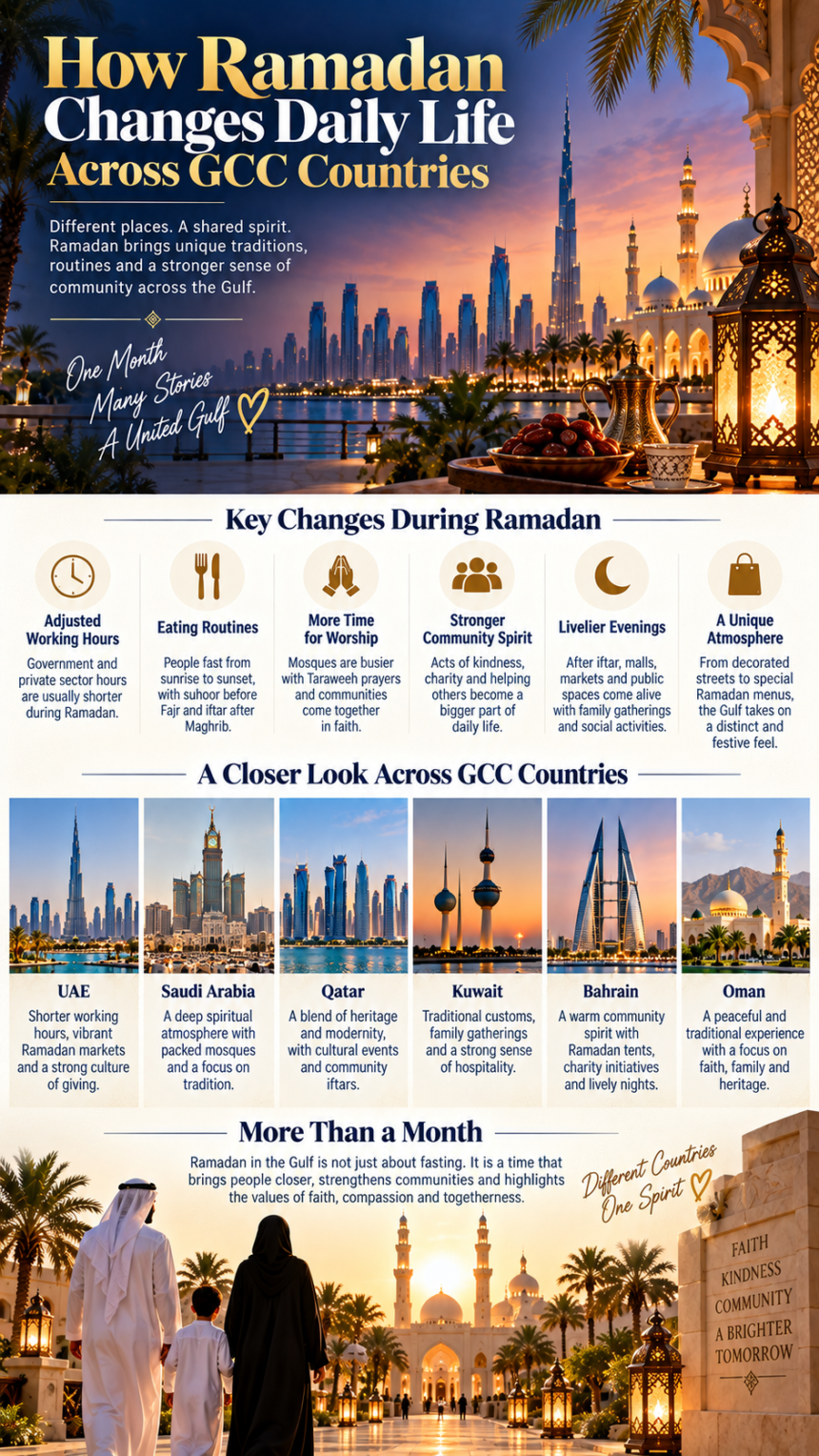
Work schedules also change. In several GCC countries, labour laws provide shorter Ramadan working hours, although the rules differ according to country, sector and sometimes whether the employee is Muslim. The UAE reduces private-sector working hours by two hours per day during Ramadan, while Saudi Arabia limits Ramadan working hours for Muslim employees to six hours a day or 36 hours per week. Oman and Bahrain also provide reduced hours for Muslim workers under their labour laws.
At the same time, Ramadan is not simply a month of restrictions. It is one of the most social periods of the Gulf year. Families gather for iftar, mosques become more active, charitable initiatives expand, markets stay open late and many cities become livelier after sunset than they are during the daytime.
How Ramadan Changes the Rhythm of Daily Life
The biggest change during Ramadan is the timing of the day.
For Muslims observing the fast, food and drink are avoided between dawn and sunset. The day therefore revolves around suhoor, the pre-dawn meal, daily work and prayer, iftar at sunset and evening prayers followed by family gatherings, shopping or social activities.
This produces a very different daily pattern from the rest of the year.
A typical Gulf city might be relatively calm during the morning, become even quieter in the late afternoon and then change almost immediately after sunset. Restaurants fill, families meet, streets become active again and malls may remain busy until very late.
Qatar Tourism describes this clearly, noting that Doha comes alive after iftar as shops, restaurants and cultural venues reopen or become much more active.
Working Hours Become Shorter During Ramadan
One of the most practical changes affects offices and workplaces.
In the UAE private sector, official working hours are reduced by two hours per day during Ramadan. Unlike several neighbouring systems, the UAE government’s guidance does not restrict this reduction only to Muslim workers.
Saudi Arabia’s labour rules provide that Muslim workers should not exceed six working hours per day or 36 hours per week during Ramadan.
Oman’s Labour Law limits Ramadan work for Muslim workers to six hours a day or 30 hours per week, while Bahrain’s labour law provides a maximum of six hours per day or 36 hours per week for Muslim workers.
Qatar’s Labour Law also provides a Ramadan maximum of six hours per day and 36 hours per week.
Exact government, school, bank and private business schedules can still vary, so visitors should check individual organisations instead of assuming ordinary opening hours remain unchanged.
Mornings and Afternoons Become Quieter
Ramadan mornings frequently move at a slower pace.
People who attended late evening prayers, visited relatives or stayed awake for suhoor may begin the next day later than usual. Some shops open later, while restaurants that normally depend on breakfast and lunch business may not operate during the morning.
The afternoon becomes particularly quiet as sunset approaches.
This does not mean Gulf cities stop functioning. Government offices, workplaces, airports, transport systems and major attractions continue operating. However, the social energy of the city gradually shifts away from midday and towards the evening.
For visitors, this can actually make daytime visits to some museums and attractions feel calmer, although Ramadan-specific hours should always be checked before travelling.
Life Becomes Busier Before Iftar
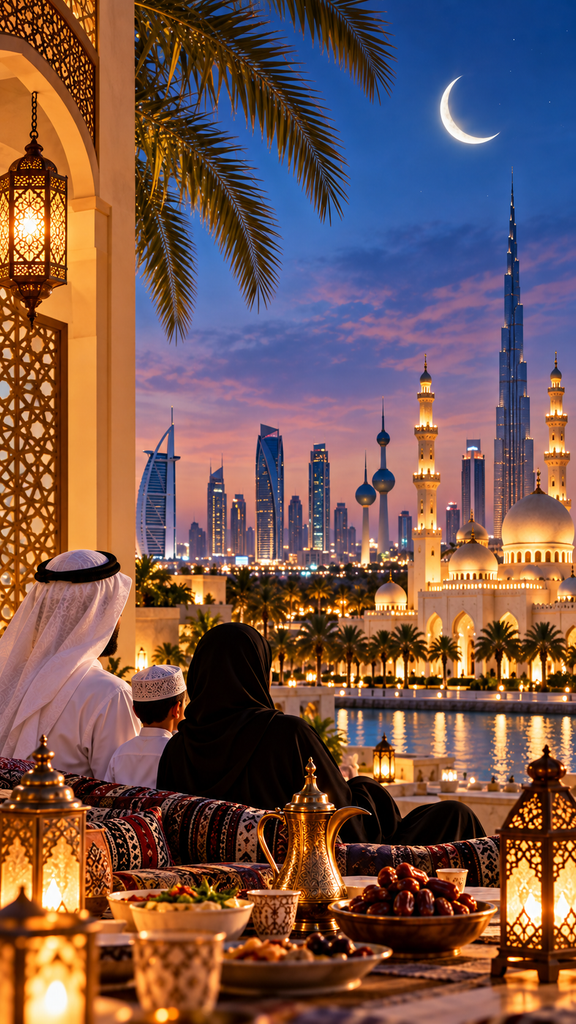
The period immediately before sunset is one of the most noticeable parts of a Ramadan day.
Workers leave offices, people collect food, families travel home and restaurants prepare for the evening meal. Roads that were relatively quiet earlier in the afternoon can suddenly become busy.
Iftar is not simply dinner. It marks the end of an entire day of fasting, so people naturally want to be where they plan to break the fast before the sunset call to prayer.
Visitors should avoid scheduling extremely tight airport transfers or restaurant journeys shortly before sunset.
Leaving earlier than normal reduces both stress and the risk of getting caught in concentrated pre-iftar traffic.
Iftar Changes the Evening Routine
At sunset, the daily atmosphere changes almost immediately.
The fast is traditionally broken with dates and water before a larger meal. Families, colleagues and friends gather at homes, restaurants, hotels, mosques and community venues.
Across the GCC, hotels frequently offer elaborate Ramadan iftar buffets, while community organisations and charitable groups provide meals for workers and others.
The meal is as much about social connection as food.
In Saudi Arabia’s Makkah and Madinah, official tourism guidance describes communal iftar as an important part of Ramadan, with designated areas filling with worshippers before the evening prayers.
For international visitors, joining a hotel or restaurant iftar can be one of the easiest ways to experience Ramadan culture respectfully.
Gulf Cities Stay Awake Much Later at Night
One of the biggest misconceptions about Ramadan is that nightlife disappears completely.
In many GCC cities, everyday life simply moves later.
After iftar and evening prayers, families go shopping, visit relatives, eat in restaurants, walk around markets or attend cultural events. Some venues remain active well beyond midnight.
Qatar’s official 2026 Ramadan programme illustrated this shift clearly. Ramadan events at Heenat Salma operated from 8pm until 1am, while Souq Waqif stores reopened after iftar and restaurants operated between iftar and suhoor.
Saudi tourism guidance similarly notes that activity in Makkah and Madinah continues deep into the night following Isha and Taraweeh prayers.
For travellers who normally sleep early, Ramadan may require adjusting the schedule to experience the most interesting part of the day.
Restaurants Change Their Ramadan Timings
Dining habits change considerably during Ramadan.
Some restaurants remain open during the daytime, particularly in international hotels and designated tourist areas. Others close until late afternoon or prepare only takeaway orders before sunset.
In the UAE, the government states that non-Muslims can find daytime dining options in shopping malls and designated areas, while restaurants operate fully again around iftar.
Qatar asks visitors to avoid eating, drinking or smoking openly in public during fasting hours, although hotels may provide dining facilities away from public view.
Oman is stricter. Its tourism authority states that eating, drinking and smoking publicly during daylight fasting hours are prohibited by law and custom.
Therefore, the same dining behaviour should not automatically be carried from one GCC country to another.
Shopping Malls Stay Open Later
Ramadan transforms shopping habits as much as restaurant habits.
Instead of concentrating activity in the afternoon, many people shop after iftar or Taraweeh prayers. As a result, malls, souqs and retail districts can remain active late into the night.
The UAE government’s Ramadan guidance notes that malls stay open until late, while supermarkets and grocery stores generally continue operating.
Qatar provides an especially visible example. During Ramadan, Souq Waqif has operated with a morning shopping period followed by reopening after iftar until midnight.
The result is a shopping environment that can feel surprisingly energetic at 10pm or 11pm.
Visitors should check Ramadan timings individually because Google listings and standard business schedules may not always immediately reflect temporary Ramadan changes.
Traffic Patterns Change During Ramadan
Normal rush-hour assumptions often become less reliable during Ramadan.
Morning commuting can change because working hours are shortened. Afternoon traffic may increase earlier as employees finish work, while the period immediately before sunset can become particularly busy.
Following iftar, roads may calm temporarily before another wave of traffic develops as people head towards malls, mosques, restaurants and family gatherings.
Late-night traffic can therefore be heavier than visitors expect.
Saudi Arabia’s official Ramadan guidance advises travellers in Makkah to allow additional time for movement because evening activity increases considerably around Al Masjid Al Haram.
If you have an important reservation, flight or meeting, build more flexibility into the schedule than you normally would.
Prayer Becomes More Visible in Daily Life
Prayer is part of everyday Muslim life throughout the year, but Ramadan makes its role more visible.
After the evening Isha prayer, many Muslims participate in additional Taraweeh prayers. Mosques therefore become especially busy at night.
In Qatar, official tourism information describes Taraweeh as a major Ramadan tradition and notes that mosques aim to complete the recitation of the Qur’an during the holy month.
Saudi Arabia sees particularly intense religious activity in Makkah and Madinah. Worship continues late into the night, and the final ten nights become especially significant as Muslims seek Laylat Al-Qadr.
Visitors near major mosques should expect increased pedestrian movement and occasional traffic management around prayer times.
Charity and Community Activities Increase
Ramadan places a strong emphasis on generosity.
Across the GCC, people donate food, money and other assistance. Businesses launch charitable campaigns, community organisations distribute meals and mosques arrange large-scale iftar programmes.
The social effect is visible in everyday life.
Food boxes may be distributed before sunset, volunteers gather at community locations and companies organise Ramadan initiatives beyond their ordinary commercial activities.
Qatar Tourism describes charitable giving as one of the central themes of the holy month, alongside fasting and spiritual reflection.
For visitors, this helps explain why Ramadan should not be understood only through restrictions on daytime eating. Community generosity is equally central to the month’s identity.
Family Gatherings Become More Important
Ramadan is one of the most family-centred periods of the Gulf year.
Iftar may involve immediate relatives, while later evening gatherings can bring together extended families, neighbours and friends.
Homes become major social spaces.
In Oman, Ramadan traditions include families gathering at the home of senior relatives for iftar and exchanging dishes with neighbours before sunset.
Kuwaiti culture similarly emphasises strong relationships between relatives, friends and neighbours during religious occasions.
This also explains why evenings can continue for many hours. Iftar may be followed by prayer, coffee, desserts and another family visit before suhoor.
Traditional Ramadan Foods Return to Daily Tables
Certain foods become closely associated with Ramadan.
Qatar Tourism highlights dishes such as harees, thareed and luqaimat as regular features of Ramadan tables.
Harees, based on wheat and meat, is also deeply associated with Ramadan traditions elsewhere in the Gulf. Kuwait’s government heritage information records the traditional preparation known as Daq Al-Harees, where families historically prepared wheat before Ramadan.
Dates, soups, rice dishes, sweets and Arabic coffee also become more visible across restaurants and homes.
For travellers interested in Gulf food culture, Ramadan can therefore be a particularly rewarding period because many traditional dishes receive more attention than during ordinary months.
Ramadan in the UAE
The UAE combines a strong Ramadan atmosphere with relatively accessible services for international visitors.
Workdays become shorter, with private-sector hours reduced by two hours each day. Malls commonly remain open late, supermarkets continue operating and tourist attractions generally remain accessible.
The most significant shift comes after sunset.
Dubai and Abu Dhabi fill with hotel iftars, Ramadan tents, night markets and family gatherings. Cities that may seem unusually quiet during the late afternoon can become very active later in the evening.
Non-Muslims are not expected to fast, but visitors should still respect Ramadan etiquette around people who are observing the fast.
Ramadan in Saudi Arabia
Ramadan has an especially powerful impact on daily life in Saudi Arabia.
Working hours for Muslim employees are reduced to a maximum of six hours per day or 36 hours per week under labour rules.
Social and commercial activity moves later into the evening, while religious activity becomes particularly important.
In Makkah, daily life increasingly centres around Al Masjid Al Haram. In Madinah, visitors spend extended periods around the Prophet’s Mosque in worship, Qur’an recitation and reflection. Both cities remain active well into the night.
Elsewhere, Saudi Arabia’s official Ramadan programme promotes evening experiences across Riyadh, Historic Jeddah, Diriyah and cultural destinations around the Kingdom.
Ramadan in Qatar
Qatar offers one of the clearest examples of the nighttime Ramadan lifestyle.
During the day, many businesses operate on altered schedules. After iftar, Doha becomes much more active.
Visit Qatar notes that public places, shops, restaurants and cultural venues often become busiest after sunset.
Traditional activities also remain highly visible.
The Ramadan cannon is fired to announce iftar at locations including Souq Waqif and Katara, while Garangao brings children into the streets midway through Ramadan to receive sweets and nuts.
These traditions mean the month’s effect reaches beyond fasting into food, entertainment, children’s activities and public culture.
Ramadan in Bahrain
Bahrain combines family life and modern dining with long-established Ramadan traditions.
One of the most visible is the iftar cannon. Bahrain Tourism says the tradition dates back to the 1930s and continues across all four governorates. A cannon shot marks iftar each day, while another is associated with imsak before dawn.
Commercial and family activity shifts into the evening, while restaurants and hotels organise special Ramadan meals.
Working schedules are also affected. Bahrain’s labour law limits Muslim workers to six hours per day or 36 hours per week during Ramadan.
For visitors, the evening hours provide the strongest opportunity to experience the country’s Ramadan atmosphere.
Ramadan in Oman
Ramadan produces a more restrained daytime atmosphere in Oman.
Oman’s official tourism guidance asks people to dress modestly and states that public eating, drinking and smoking during fasting hours are prohibited. Loud music in public is also restricted, while nightlife entertainment is generally reduced during the month.
At the same time, family life becomes extremely active after sunset.
Neighbours exchange food, families visit relatives and traditional bazaars known as Al Habtat form part of the Ramadan period.
Working life also changes. The Labour Law sets a maximum of six hours per day or 30 hours per week during Ramadan for Muslim employees.
The result is a month with quieter public days but strongly social evenings.
Ramadan in Kuwait
Kuwait’s Ramadan routine includes shortened or adjusted working schedules, changes in restaurant operations and strong family traditions.
Exact official schedules are announced for different sectors. For example, Kuwait’s banks adjusted customer service hours during Ramadan 2026, with many ordinary branches operating from 10am until 1:30pm and selected mall branches reopening in the evening.
Public eating and drinking during Ramadan fasting hours are also legally restricted in Kuwait.
Family culture becomes particularly visible through Qarqiaan, traditionally celebrated on the 13th, 14th and 15th nights of Ramadan. Children visit neighbourhood homes singing and receive sweets and nuts.
Markets also experience increased demand for traditional Ramadan foods and household supplies, leading retailers and cooperative societies to prepare additional stock before the month begins.
How Ramadan Changes Life for Non-Muslim Residents and Visitors
Non-Muslims continue working, travelling and participating in ordinary life during Ramadan, but the surrounding timetable changes.
Lunch meetings may be less common. Workplaces may finish earlier. Restaurants can operate differently, while evening invitations become more frequent.
Visitors should also pay closer attention to public etiquette.
In Qatar, tourists are asked to avoid public eating, drinking and smoking during daylight fasting hours.
In Oman and Kuwait, restrictions are more explicit and legally significant.
The easiest approach is to check the rules of the specific country rather than assuming that practices in Dubai automatically apply in Muscat or Kuwait City.
What Changes During the Final Ten Nights?
The final ten nights create another shift in Ramadan life.
For observant Muslims, this is an especially important period because one of these nights is Laylat Al-Qadr, the Night of Decree.
Religious activity increases, and many worshippers spend considerably more time in mosques.
This becomes particularly visible in Makkah and Madinah, where Visit Saudi advises visitors to expect larger crowds and intensified worship during the final ten nights.
Elsewhere in the GCC, late-night shopping and family activity can also increase as preparations for Eid Al-Fitr begin.
Visitors travelling during this period should expect busier mosques and commercial areas after sunset.
How Eid Al-Fitr Changes the Rhythm Again
Ramadan ends with the arrival of Eid Al-Fitr.
Daily fasting stops, normal meal patterns return and families gather for prayers, visits, celebrations and special meals.
Shopping centres and entertainment districts can become especially busy before and during Eid. Airports and roads also see increased movement as residents travel to visit relatives or take short holidays.
Qatar Tourism explains that the exact end of Ramadan is determined by the sighting of the new crescent moon, with Islamic lunar months lasting 29 or 30 days.
Visitors should therefore avoid treating the expected Eid date as absolutely fixed until official authorities confirm it.
Ramadan Daily Life Across the GCC at a Glance
| Part of Daily Life | Typical Ramadan Change |
|---|---|
| Work | Shorter or adjusted hours |
| Morning | Generally quieter |
| Afternoon | Activity slows before sunset |
| Before iftar | Increased road and food-shopping activity |
| Sunset | Families and communities break the fast |
| Restaurants | Timings change, with major focus on iftar |
| Shopping | More activity after sunset |
| Mosques | Increased attendance, especially at night |
| Family life | More gatherings and visits |
| Charity | Food distribution and donations increase |
| Nightlife | Becomes later and more family-oriented |
| Traffic | Rush periods shift |
| Traditional food | Ramadan dishes become more prominent |
| Final ten nights | Increased worship and mosque activity |
| End of Ramadan | Eid preparations intensify |
The broad pattern is shared across the GCC, but legal requirements, restaurant policies and working-hour regulations still differ by country.
Final Thoughts on Ramadan in GCC Countries
Ramadan in GCC Countries changes the clock of daily life.
The UAE shortens workdays while malls, attractions and dining increasingly move into the evening. Saudi Arabia experiences a deeper religious rhythm, particularly in Makkah and Madinah, where worship continues late into the night.
Qatar combines altered daytime schedules with busy post-iftar streets, Ramadan cannons and Garangao celebrations. Bahrain preserves its historic iftar cannon while family and dining activity shifts later into the evening.
Oman becomes quieter during the day and places greater emphasis on modest public behaviour, family visits and traditional community gatherings. Kuwait similarly changes working and dining routines while maintaining traditions such as Qarqiaan.
Across all six countries, mornings become calmer, sunset becomes the central turning point of the day and evenings become longer and more social.
The most important thing for visitors is flexibility. Check opening hours, plan around sunset traffic, respect people who are fasting and experience the city after dark.
Ramadan does not simply slow the Gulf down. It reorganises the day around faith, family, generosity and community, creating a rhythm that visitors will not experience at any other time of the year.
Do follow us on Instagram
Read More – How Ramadan Changes Daily Life Across GCC Countries