


Complete 2026 Guide Renting vs Buying Property in Dubai
Deciding between renting vs buying property in Dubai is one of the most important financial decisions for residents, expatriates, investors, and families planning to stay in the emirate. Dubai offers a wide range of apartments, villas, townhouses, and investment properties, but the right choice depends on your budget, lifestyle, length of stay, financial goals, and plans for the future.
- Renting vs Buying Property in Dubai: The Basic Difference
- Why Is Dubai Property Attractive to Expats?
- Advantages of Renting Property in Dubai
- 1. Lower Upfront Financial Commitment
- 2. Greater Flexibility
- 3. Ability to Explore Dubai Neighborhoods
- 4. Less Responsibility for Major Property Costs
- 5. Access to Expensive Areas
- Disadvantages of Renting in Dubai
- 1. You Do Not Build Property Equity
- 2. Rent Can Increase
- 3. Less Long-Term Housing Security
- 4. No Direct Benefit From Property Appreciation
- Advantages of Buying Property in Dubai
- 1. You Build Equity
- 2. Potential Long-Term Investment
- 3. Greater Housing Stability
- 4. Potential Capital Appreciation
- 5. Potential Rental Income
- Disadvantages of Buying Property in Dubai
- 1. High Initial Cost
- 2. Mortgage Commitment
- 3. Maintenance and Service Charges
- 4. Less Flexibility
- Renting vs Buying: Financial Comparison
- Example: Renting vs Buying a Dubai Apartment
- How Long Should You Stay in Dubai Before Buying?
- Renting vs Buying for Expats
- Renting vs Buying for Families
- Renting vs Buying for Investors
- Dubai Rental Market and Rent Increases
- What Is the Best Area to Rent or Buy in Dubai?
- Buying Property With a Mortgage in Dubai
- Should You Rent or Buy an Apartment in Dubai?
- Should You Rent or Buy a Villa in Dubai?
- Dubai Property Buying Costs You Should Consider
- How to Decide Between Renting and Buying
- Common Mistakes When Renting in Dubai
- Common Mistakes When Buying Property in Dubai
- Renting vs Buying Property in Dubai: Quick Comparison
- Frequently Asked Questions
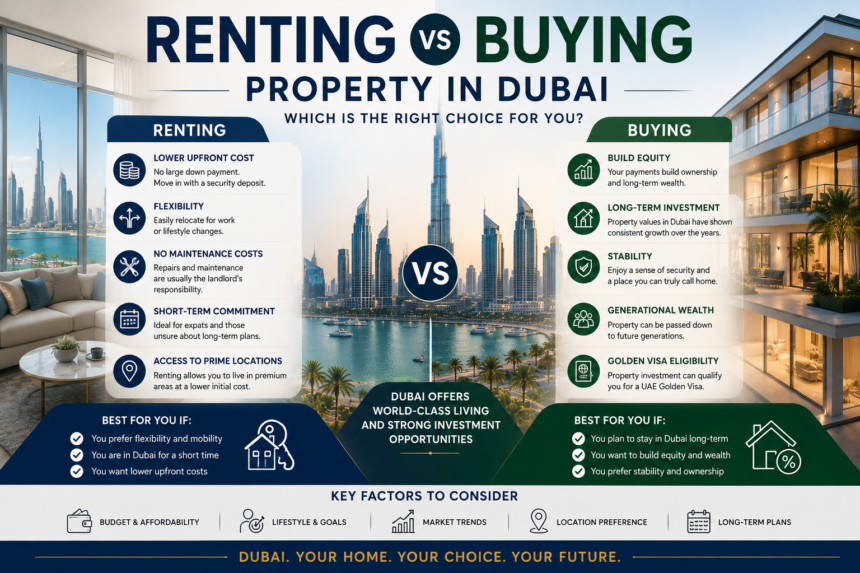
For some people, renting provides flexibility and lower upfront financial commitments. For others, buying a home can create long-term equity, provide greater stability, and potentially offer investment income. Neither option is automatically better for everyone. The key is understanding the financial and practical differences before making a decision.
Dubai’s property market also has specific rules for foreign ownership, rental contracts, mortgages, property registration, and residency benefits. The Dubai Land Department confirms that non-UAE nationals can own property in designated freehold areas, while all real-estate transactions must be properly registered to be legally recognized.
This complete guide to renting vs buying property in Dubai in 2026 explains the advantages and disadvantages of both options, the costs to consider, mortgage requirements, rental regulations, investment considerations, and how to decide which option is best for you.
Renting vs Buying Property in Dubai: The Basic Difference
The simplest way to understand the decision is to think about flexibility versus ownership.
When you rent a property, you pay for the right to live in it for a specified period. You do not build ownership equity in the property, but you also avoid many of the upfront costs associated with purchasing a home.
When you buy a property, you make a substantial initial investment and take responsibility for financing, ownership costs, maintenance, and other expenses. In return, you build an asset that may appreciate in value and can potentially generate rental income.
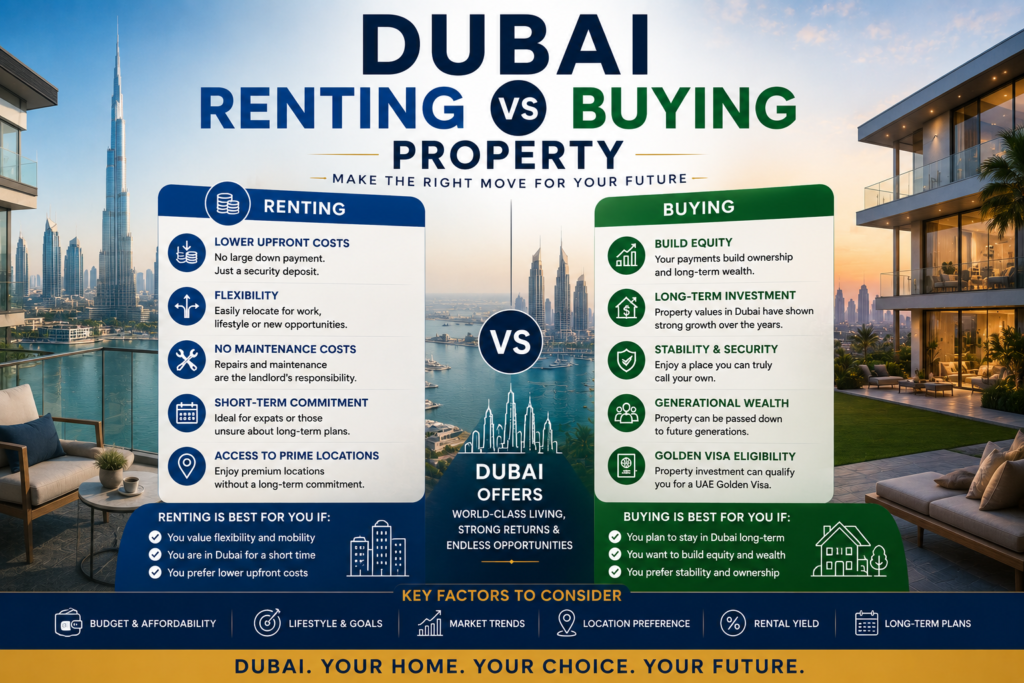
Renting may be better if:
- You are new to Dubai.
- You are unsure how long you will stay.
- Your job or location may change.
- You want lower upfront costs.
- You prefer flexibility.
- You do not want to manage a property.
- You want to test different neighborhoods before buying.
Buying may be better if:
- You plan to stay in Dubai for several years.
- You have sufficient savings for the purchase.
- You can comfortably afford mortgage payments.
- You want to build property equity.
- You want potential rental income.
- You prefer long-term housing stability.
- You are comfortable with property-related responsibilities.
Why Is Dubai Property Attractive to Expats?
Dubai is one of the most international cities in the Middle East and has a large expatriate population. Its property market includes affordable apartments, luxury residences, family villas, waterfront properties, and investment-focused developments.
Foreign ownership is permitted in designated freehold areas. According to the Dubai Land Department, ownership rights for foreign nationals are available in areas designated for foreign ownership under Dubai’s real-estate regulations.
This gives international buyers the opportunity to purchase property rather than remaining permanent renters.
For eligible investors, property ownership can also have residency implications. The UAE’s official Golden Visa information currently lists a five-year Golden Visa route for qualifying real-estate investments with a minimum capital requirement of AED 2 million, subject to the applicable conditions.
However, buying property should not be based solely on residency eligibility. The investment needs to make financial and lifestyle sense independently.
Advantages of Renting Property in Dubai
1. Lower Upfront Financial Commitment
One of the biggest advantages of renting is that you generally do not need the large amount of capital required to purchase a property.
Buying can involve:
- Down payment
- Registration fees
- Mortgage-related costs
- Bank valuation
- Agency fees
- Insurance
- Initial furnishing
- Maintenance expenses
Renting typically requires a security deposit, rental payments, and other tenancy-related expenses instead.
This makes renting attractive to people who want to preserve their savings for business, investments, education, or emergencies.
2. Greater Flexibility
Renting provides more flexibility if your circumstances change.
For example, you may:
- Change jobs.
- Move to another emirate.
- Relocate internationally.
- Upgrade to a larger home.
- Downsize after children leave home.
- Move closer to your workplace.
A tenant can generally make these changes more easily than a homeowner who needs to sell a property or manage it as an investment.
3. Ability to Explore Dubai Neighborhoods
Dubai has many distinct residential communities.
You may want to live in areas close to:
- Downtown Dubai
- Business districts
- Beaches
- Schools
- Metro stations
- Airports
- Shopping malls
- Entertainment areas
Renting allows you to experience a neighborhood before committing to purchasing property there.
This is particularly useful for people who have recently moved to Dubai.
4. Less Responsibility for Major Property Costs
Depending on the tenancy agreement and applicable rules, major structural or building-related maintenance responsibilities generally do not fall on the tenant in the same way they do on an owner.
This can make budgeting simpler.
However, tenants should always read their rental contract carefully because responsibility for certain repairs, utilities, and maintenance items can vary.
5. Access to Expensive Areas
Renting can allow you to live in a premium neighborhood without purchasing an expensive property.
Someone who cannot or does not want to invest millions of dirhams in a property may still be able to rent an apartment or villa in a desirable location.
Disadvantages of Renting in Dubai
Renting also has several disadvantages.
1. You Do Not Build Property Equity
Your rental payments generally provide housing but do not give you ownership of the property.
After years of renting, you may have spent a significant amount on accommodation without owning an asset.
2. Rent Can Increase
Dubai’s rental market can change over time.
The Dubai Land Department operates an official Rental Index that allows users to calculate average rental values and potential rent increases based on property and contract information.
The Smart Rental Index introduced by DLD uses factors such as rental values in the building, area averages, and building classification when determining applicable rental adjustments.
This means tenants should not assume that today’s rent will remain unchanged indefinitely.
3. Less Long-Term Housing Security
A homeowner generally has greater control over the property than a tenant.
Renters need to consider lease renewal conditions, potential rent changes, and the possibility of eventually moving.
4. No Direct Benefit From Property Appreciation
If the property you rent increases significantly in value, the owner benefits from that appreciation rather than the tenant.
Advantages of Buying Property in Dubai
1. You Build Equity
One of the strongest arguments for buying is the opportunity to build equity.
With a mortgage, part of your payment goes toward reducing the outstanding loan balance. Over time, this can increase your ownership stake in the property.
Equity can also increase if the property’s market value rises.
However, property values can fall as well as rise, so appreciation should never be treated as guaranteed.
2. Potential Long-Term Investment
A Dubai property can potentially serve two purposes:
- A home for you and your family
- An investment asset
If you later move out, you may be able to rent the property and generate rental income, subject to applicable rules and market conditions.
This can provide an additional income stream.
3. Greater Housing Stability
Buying can provide greater certainty for people who plan to remain in Dubai for the long term.
You are not making a decision about renewing a rental contract every year in the same way a tenant does.
You can also renovate or furnish your home according to applicable building and ownership rules.
4. Potential Capital Appreciation
Dubai property values can appreciate when demand, infrastructure, economic activity, and population growth support the market.
But investors should avoid assuming that every property will appreciate at the same rate.
Location, developer quality, property condition, supply, amenities, service charges, and market cycles can all influence future value.
5. Potential Rental Income
If you buy an investment property, rental income can help offset ownership costs.
The actual return depends on:
- Purchase price
- Annual rent
- Service charges
- Maintenance
- Vacancy periods
- Property management
- Financing costs
- Taxes and fees where applicable
A property with a high advertised rental yield is not automatically a good investment if the purchase price, service charges, or vacancy risk are also high.
Disadvantages of Buying Property in Dubai
1. High Initial Cost
Buying property requires more capital upfront than renting.
A buyer may need money for:
- Down payment
- Registration fees
- Agency commission
- Mortgage processing
- Valuation
- Insurance
- Furnishing
- Moving
- Maintenance
The exact amount depends on the property and financing structure.
2. Mortgage Commitment
A mortgage can become a significant long-term financial obligation.
The UAE Central Bank’s mortgage regulations establish maximum loan-to-value ratios, with different limits depending on whether the borrower is a UAE national or expatriate, whether the property is an owner-occupied first home or an investment property, and whether the property is completed or off-plan.
For example, the current CBUAE framework allows expatriates buying a first owner-occupied property worth up to AED 5 million to have a maximum LTV of 80%, while the maximum is 70% for a first owner-occupied property above AED 5 million. The maximum LTV for second and subsequent homes or investment properties is 60%, while off-plan properties have a maximum LTV of 50%.
These are regulatory maximums, not guarantees that a bank will approve your application at that level.
3. Maintenance and Service Charges
Owners are responsible for property-related expenses that tenants may not directly bear.
These can include:
- Repairs
- Maintenance
- Building service charges
- Insurance
- Property management
- Renovation
- Appliance replacement
For apartments, service charges can be particularly important when calculating investment returns.
4. Less Flexibility
Selling a property can take time.
If you suddenly need to relocate, you cannot necessarily dispose of the property as quickly as you can leave a rental home.
This is why buyers should consider their expected holding period.
Renting vs Buying: Financial Comparison
The most important comparison should not simply be monthly rent versus monthly mortgage payment.
You need to compare the complete cost of each option.
Renting costs can include:
- Annual rent
- Security deposit
- Agency fees
- Utilities
- Rental registration-related costs
- Moving costs
- Potential rent increases
- Furnishing
Buying costs can include:
- Down payment
- Mortgage interest/profit cost
- Property registration charges
- Agency commission
- Bank valuation
- Mortgage arrangement costs
- Service charges
- Maintenance
- Insurance
- Furnishing
- Property management
- Selling costs later
A mortgage payment that looks similar to monthly rent does not necessarily mean buying is financially cheaper.
Example: Renting vs Buying a Dubai Apartment
Consider a hypothetical apartment.
Suppose:
Annual rent: AED 100,000
A tenant might pay AED 100,000 per year in rent, plus the relevant deposit, transaction costs, utilities, and other living expenses.
Now consider a hypothetical property priced at:
Purchase price: AED 1.5 million
If an expatriate buyer receives an 80% mortgage, the maximum financing under the CBUAE regulatory LTV framework would be AED 1.2 million, meaning the buyer would need at least AED 300,000 as the down payment before considering other purchase-related expenses.
This is only an illustration. Actual bank approval, interest rate, valuation, fees, income requirements, and other costs can differ.
The buyer then needs to compare:
Total annual ownership cost = mortgage cost + service charges + maintenance + insurance + other expenses
against:
Total annual renting cost = rent + tenancy-related expenses
The comparison becomes more meaningful when calculated over five, seven, or ten years rather than one year.
How Long Should You Stay in Dubai Before Buying?
There is no universal minimum period.
However, buying tends to make more sense when you expect to remain in the property for a longer period because purchasing involves substantial transaction costs.
If you expect to stay for only one or two years, renting may provide greater flexibility.
If you expect to stay for five, seven, or ten years, buying may deserve serious consideration.

The correct time horizon depends on:
- Property price
- Mortgage rate
- Rental cost
- Expected appreciation
- Service charges
- Transaction costs
- Investment returns available elsewhere
- Your personal circumstances
Renting vs Buying for Expats
For expatriates, the decision can be particularly complicated.
A foreign resident may initially prefer renting because employment and residency circumstances can change.
For example, a professional moving to Dubai for the first time may not know whether they will stay for three years or fifteen years.
Renting allows them to:
- Understand Dubai’s neighborhoods.
- Learn the commuting patterns.
- Evaluate their employer.
- Understand the cost of living.
- Build savings.
- Research the property market.
- Decide whether long-term ownership makes sense.
After establishing financial and professional stability, buying may become more attractive.
Renting vs Buying for Families
Families often have different priorities from single professionals.
A family may place greater importance on:
- School proximity
- Larger living space
- Community facilities
- Parks
- Healthcare
- Stability
- Long-term neighborhood relationships
If children are enrolled in a school and the family expects to remain in Dubai for many years, purchasing may provide greater stability.
However, renting can still be preferable if parents expect to relocate or if their preferred school and workplace locations may change.
Renting vs Buying for Investors
An investor should approach the decision differently from an owner-occupier.
The key questions include:
- What is the expected rental income?
- What is the purchase price?
- What are the service charges?
- What is the expected vacancy rate?
- Is there mortgage financing?
- What is the net rental yield?
- What are the expected selling costs?
- Is the property in a high-demand location?
- Is the property completed or off-plan?
- What is the potential exit strategy?
Do not focus only on gross rental yield.
Gross rental yield formula:
Annual rental income ÷ property purchase price × 100
For example, if a property costs AED 1,500,000 and generates AED 90,000 in annual rent:
AED 90,000 ÷ AED 1,500,000 × 100 = 6% gross rental yield
But this is not the investor’s net return.
After accounting for service charges, maintenance, vacancy, management and financing expenses, the actual return may be considerably lower.
Dubai Rental Market and Rent Increases
Dubai tenants should understand how rental adjustments are determined.
The Dubai Land Department’s Rental Index allows tenants and landlords to check average rental values and calculate potential rental increases using information such as the contract expiry date, property type, location, number of rooms, and current annual rent.
DLD’s Smart Rental Index framework introduced a more detailed assessment of rental values, including building classification and differences between current rent and market averages. Its published framework states that rental increases can range from 0% to 20% depending on how far the current rent is below or above the applicable average.
Before signing or renewing a tenancy contract, tenants should therefore check the official rental information rather than relying solely on informal market estimates.
What Is the Best Area to Rent or Buy in Dubai?
The best area depends on your lifestyle and budget.
Downtown Dubai
Suitable for people who want:
- Central location
- Luxury apartments
- Proximity to major attractions
- Access to business and entertainment areas
Dubai Marina
Popular with residents who want:
- Waterfront living
- Restaurants
- Walkable areas
- Modern apartments
- Access to leisure facilities
Jumeirah
Attractive to families and residents looking for:
- Villas
- Beach access
- Established communities
- Premium residential environments
Business Bay
Suitable for professionals who want proximity to:
- Downtown
- Business districts
- Offices
- Restaurants
- Modern apartment developments
Dubai Hills Estate
Popular with families looking for:
- Modern homes
- Green spaces
- Schools
- Community facilities
- Villas and apartments
When comparing areas, do not evaluate them solely by property price. Consider commute time, rental demand, schools, transport, amenities, future development, and resale potential.
Buying Property With a Mortgage in Dubai
A mortgage can make buying property more accessible, but it also increases the importance of financial planning.
Before applying, understand:
- Down payment
- Interest/profit rate
- Loan duration
- Monthly payment
- Processing fees
- Valuation costs
- Insurance
- Early repayment conditions
- Total borrowing cost
The CBUAE mortgage framework states that the maximum mortgage tenor is 25 years and that debt-burden ratios are subject to regulatory limits.
Do not borrow the maximum amount simply because a bank approves it.
A safer approach is to ensure that the monthly mortgage remains affordable even if:
- Interest rates change.
- Your income temporarily falls.
- You have unexpected family expenses.
- The property remains vacant if it is an investment.
- Maintenance costs increase.
Should You Rent or Buy an Apartment in Dubai?
For many people, the decision can be summarized like this:
Rent if:
- You are new to Dubai.
- You are uncertain about your long-term plans.
- Your job location may change.
- You prefer liquidity.
- You want to test different communities.
- You do not have enough savings for a comfortable purchase.
Buy if:
- You have a stable income.
- You have adequate savings.
- You expect to stay for several years.
- You want to build equity.
- You understand the property market.
- You can comfortably manage ownership costs.
Should You Rent or Buy a Villa in Dubai?
Villas require even more careful financial analysis because purchase prices, maintenance costs, and utility expenses can be significantly higher than for apartments.
Families should consider:
- Number of bedrooms
- Garden and pool maintenance
- Community fees
- School distance
- Transportation
- Renovation costs
- Resale demand
Renting a villa may make sense for families who want a large home without committing significant capital.
Buying may make more sense for families who expect to stay long term and want to build an asset.
Dubai Property Buying Costs You Should Consider
A buyer should budget for more than the advertised property price.
Potential expenses include:
- Down payment
- Dubai Land Department registration fees
- Mortgage registration fees where applicable
- Real estate agency commission
- Bank processing charges
- Property valuation
- Insurance
- Service charges
- Maintenance
- Furnishing
The exact amount varies according to the transaction, property type, financing arrangement, and applicable regulations.
Before making an offer, ask for a complete cost breakdown.
How to Decide Between Renting and Buying
A practical decision framework can make the process easier.
Step 1: Calculate Your Annual Rent
Determine the total cost of renting, not just the advertised rent.
Include deposits, fees, utilities, parking, and other recurring expenses.
Step 2: Calculate Your Purchase Budget
Determine how much cash you can comfortably allocate to:
- Down payment
- Purchase costs
- Emergency savings
- Furnishing
- Initial repairs
Step 3: Calculate Your Mortgage
Get actual mortgage offers rather than relying on online calculators alone.
Compare interest rates, fees, terms, and early repayment conditions.
Step 4: Estimate Ownership Costs
Include:
- Service charges
- Maintenance
- Insurance
- Mortgage costs
- Property management
Step 5: Consider Your Time Horizon
Ask yourself:
Will I realistically live in or own this property for at least five years?
If the answer is uncertain, renting may provide more flexibility.
Step 6: Consider Alternative Investments
Buying property means putting a significant amount of capital into real estate.
Ask whether that money could generate better risk-adjusted returns elsewhere.
Common Mistakes When Renting in Dubai
Tenants should avoid:
- Choosing a property without checking the neighborhood.
- Ignoring commuting time.
- Failing to read the tenancy agreement.
- Assuming rent cannot increase.
- Not checking the official Rental Index.
- Ignoring maintenance responsibilities.
- Paying money without proper documentation.
- Choosing a property solely because it has a low rent.
The official DLD Rental Index can be used to check rental values and applicable rental information.
Common Mistakes When Buying Property in Dubai
Buyers should avoid:
- Buying solely because prices are rising.
- Ignoring service charges.
- Taking the maximum mortgage available.
- Failing to verify ownership documentation.
- Buying without checking the developer’s reputation.
- Ignoring location and resale demand.
- Underestimating transaction costs.
- Treating projected rental yields as guaranteed.
- Buying off-plan without understanding completion and financing risks.
For foreign buyers, property ownership should also be verified against the designated ownership areas and Dubai’s registration requirements. DLD emphasizes that real-estate transactions need to be registered in its records to be legally valid.
Renting vs Buying Property in Dubai: Quick Comparison
| Factor | Renting | Buying |
|---|---|---|
| Upfront cost | Lower | Higher |
| Flexibility | High | Lower |
| Ownership | No | Yes |
| Equity building | No | Yes |
| Maintenance responsibility | Usually lower | Higher |
| Long-term stability | Moderate | High |
| Potential appreciation | No direct benefit | Yes |
| Rental income | No | Possible |
| Mortgage required | No | Usually, if financed |
| Capital requirement | Lower | Higher |
| Best for short-term residents | Yes | Usually not |
| Best for long-term residents | Depends | Often attractive |
| Investment potential | Limited | Potentially significant |
Frequently Asked Questions
Q1. Is it cheaper to rent or buy property in Dubai?
Ans: It depends on the property, location, financing costs, rental price, and length of stay. Renting generally requires less money upfront, while buying can create equity over the long term.
Q2. Is buying property in Dubai a good investment?
Ans: It can be, but property investment involves market and liquidity risks. Investors should evaluate purchase price, rental income, service charges, financing, vacancy, and potential resale value before buying.
Q3. Can foreigners buy property in Dubai?
Ans: Yes. Foreign nationals can own property in designated freehold areas. The Dubai Land Department confirms that foreign ownership is permitted in areas designated for freehold ownership under Dubai’s real-estate regulations.
Q4. How much deposit is needed to buy property in Dubai?
Ans: The amount depends on the buyer, property type, value, financing arrangement, and bank. Under the CBUAE regulatory framework, expatriates purchasing a first owner-occupied property of up to AED 5 million can have a maximum LTV of 80%, subject to the lender’s approval and applicable requirements.
Q5. Can buying property in Dubai provide a Golden Visa?
Ans: Eligible real-estate investors can potentially qualify for a UAE Golden Visa. The official UAE government platform currently lists a five-year real-estate investment route with a minimum capital requirement of AED 2 million, subject to the applicable eligibility conditions.
Q6. Can landlords increase rent in Dubai?
Ans: Rental increases are regulated. Dubai’s official Rental Index allows users to calculate applicable rental information, while the Smart Rental Index considers factors including current rent, market averages, and building classification.
Q7. Is renting better for new expats in Dubai?
Ans: Renting is often a practical option for new expatriates because it allows them to understand the city, workplace commute, neighborhoods, and cost of living before making a major property investment.
Q8. How long should I stay in Dubai before buying property?
Ans: There is no official minimum period. However, people who expect to stay for several years may find buying more worth considering because purchasing involves significant transaction and financing costs.
Q9. Should I buy an off-plan property in Dubai?
Ans: Off-plan property can offer different pricing and payment structures, but it also carries development and completion risks. Mortgage financing for off-plan purchases is subject to stricter LTV limits under the CBUAE framework, with a maximum LTV of 50% under the cited regulations.
Q10. What is the most important factor when choosing between renting and buying?
Ans: Your long-term financial and lifestyle plan is the most important factor. Compare total rental costs with total ownership costs and consider how long you expect to stay in Dubai.
Final Verdict: Is Renting or Buying Better in Dubai?
There is no single answer to the question of whether renting or buying property in Dubai is better.
Renting is generally more attractive for people who value flexibility, want to preserve capital, are new to Dubai, or are uncertain about their long-term plans. It allows you to explore different communities without committing a large amount of money to a single property.
Buying can be more attractive for people with stable finances who expect to stay in Dubai for several years and want to build equity, potentially benefit from property appreciation, or generate rental income.
The most important factor is your personal financial position and time horizon.
If you have a stable income, substantial savings, a long-term plan, and a property that fits your needs and budget, buying may be worth considering.
If you are still establishing your career, moving between jobs, or uncertain about your future location, renting can provide valuable flexibility.
For investors, the decision should be based on net rental yield, financing costs, expected capital appreciation, vacancy risk, service charges, and exit strategy—not simply on the headline property price.
Dubai’s property market offers opportunities for both renters and buyers, but careful research is essential. Check official DLD information for property registration and rental calculations, understand mortgage requirements through regulated lenders, and obtain professional legal or financial advice when appropriate.
The right choice is not simply the option with the lowest monthly cost. It is the option that best fits your financial goals, lifestyle, risk tolerance, and plans for living in Dubai.
Do follow us on Instagram
Read More – Rent vs Buy Property in Dubai: Ultimate Success Guide for Smart Decisions