




Cybersecurity in the Gulf Is Becoming a Strategic Priority
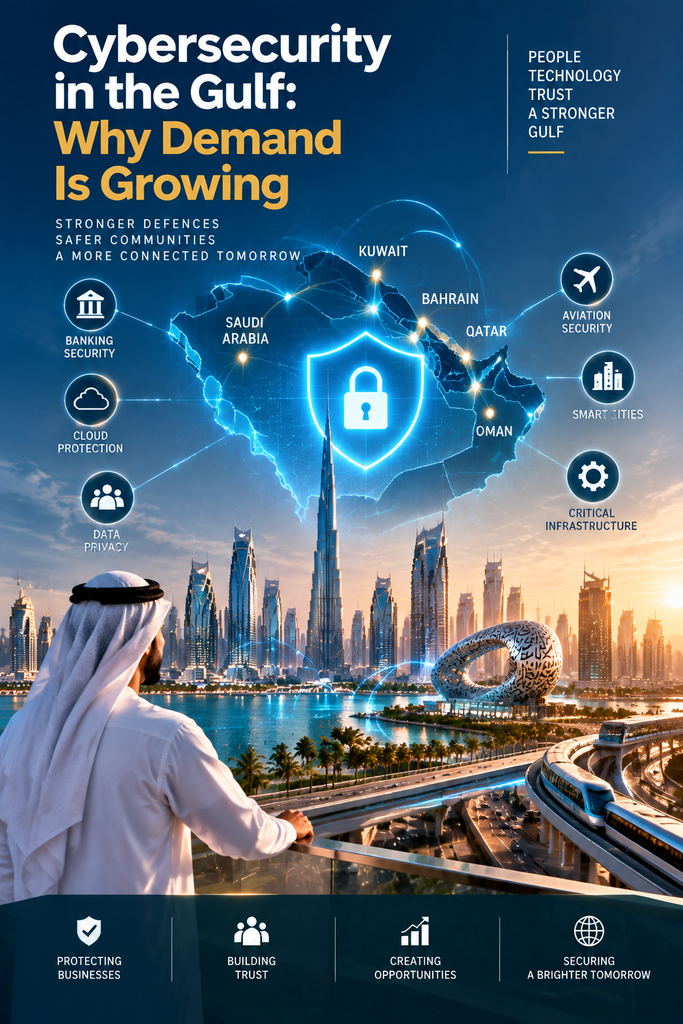
Cybersecurity in the Gulf has become one of the most important priorities as GCC countries accelerate digital transformation across banking, healthcare, government services, energy, transportation and smart cities.
- Why Cybersecurity in the Gulf Is Becoming More Important
- Digital Transformation Is Increasing Cyber Risks
- The UAE Is Building a Strong Cybersecurity Ecosystem
- Dubai’s Smart City Vision Requires Strong Cyber Protection
- Saudi Arabia Is Expanding Cybersecurity Investment
- Qatar Is Strengthening Protection for Digital Infrastructure
- Bahrain Is Becoming a Regional Cybersecurity Hub
- Oman Is Developing Cybersecurity Capabilities
- Kuwait Is Increasing Focus on Cyber Protection
- Artificial Intelligence Is Changing Cybersecurity
- Cloud Computing Is Creating New Security Needs
- The Growth of Cybersecurity Careers in the Gulf
- Cybersecurity Skills Becoming More Valuable
- Small Businesses Are Also Facing Cyber Risks
- Why Cybersecurity and Data Privacy Are Connected
- Cybersecurity Challenges Facing the Gulf
- GCC Countries Are Increasing Cybersecurity Cooperation
- How GCC Countries Compare in Cybersecurity Development
- What Is the Future of Cybersecurity in the Gulf?
- Quick Takeaway: Why Cybersecurity Demand Is Growing
- Cybersecurity in the Gulf Is Becoming a Strategic Priority
The same technologies that are making daily life more connected are also creating new security challenges. Digital payments, cloud platforms, artificial intelligence, Internet of Things devices and online government services have increased the amount of valuable data stored and exchanged digitally.
As Gulf economies move toward technology-driven growth, cybersecurity is no longer considered only an IT issue. It has become a national security, business continuity and economic development priority.
From the UAE and Saudi Arabia to Qatar, Oman, Bahrain and Kuwait, governments are investing in stronger cyber defence systems, regulations, skilled professionals and advanced security technologies.
The growing demand is also creating new career opportunities in areas such as ethical hacking, cloud security, threat intelligence, security operations and digital forensics.
Why Cybersecurity in the Gulf Is Becoming More Important
The Gulf region is undergoing one of the fastest digital transformations in the world.
Government services are moving online. Banks are expanding digital platforms. Businesses are adopting cloud systems. Smart-city projects are connecting millions of devices.
However, every new digital connection creates a potential security risk.
A cyberattack can affect:
| Sector | Possible Cybersecurity Impact |
|---|---|
| Banking | Financial fraud and customer data theft |
| Energy | Disruption of critical infrastructure |
| Healthcare | Exposure of sensitive medical information |
| Government | Data breaches and service interruption |
| Transport | Operational disruption |
| Businesses | Financial loss and reputation damage |
| Smart cities | Risks to connected systems |
This is why cybersecurity investment is growing alongside digital innovation.
The goal is not only to respond after an attack happens, but to predict threats, prevent breaches and build systems that remain secure from the beginning.
Digital Transformation Is Increasing Cyber Risks
GCC countries are creating some of the world’s most advanced digital environments.
Smart cities, automated services and connected infrastructure improve efficiency, but they also expand the number of possible entry points for cybercriminals.
For example, a smart building may include:
- Connected security systems
- Digital access controls
- Internet-connected devices
- Automated energy management
- Cloud-based monitoring
Each connected system requires protection.
A weakness in one area can potentially affect a much larger network if security controls are not properly designed.
This is why cybersecurity is becoming a fundamental part of digital transformation rather than an additional feature.
The UAE Is Building a Strong Cybersecurity Ecosystem
The UAE has made cybersecurity a major national priority as it develops its digital economy.
The country has invested in cybersecurity regulations, government protection systems, awareness programmes and technology infrastructure.
The UAE Cybersecurity Council was established to strengthen national cybersecurity capabilities and coordinate efforts across government and critical sectors. (csc.gov.ae)
The UAE’s position as a global business and technology hub also increases the importance of cyber protection.
Dubai and Abu Dhabi host international companies, financial institutions, technology firms and government platforms, making cybersecurity essential for maintaining trust.
UAE Cybersecurity Focus Areas
| Area | Development |
|---|---|
| Government security | Protection of digital public services |
| Financial security | Safer digital banking and payments |
| Cloud protection | Securing business data |
| AI security | Managing new technology risks |
| Critical infrastructure | Protecting essential systems |
| Cyber awareness | Training users and organisations |
The UAE is also focusing on developing local cybersecurity talent to support long-term digital growth.
Dubai’s Smart City Vision Requires Strong Cyber Protection
Dubai’s smart-city development has increased the importance of cybersecurity.
Connected transport systems, digital government services, smart buildings and automated infrastructure depend heavily on secure technology networks.
A smart city is not only about collecting data. It is also about protecting that data.
Cybersecurity supports:
- Digital identity systems
- Online government transactions
- Smart mobility
- Connected infrastructure
- Business platforms
- Public services
As cities become more intelligent, cybersecurity becomes one of the foundations that allows innovation to continue safely.
Saudi Arabia Is Expanding Cybersecurity Investment
Saudi Arabia’s digital transformation under Vision 2030 has created strong demand for cybersecurity solutions.
The Kingdom has expanded digital government services, cloud adoption, fintech platforms and technology-based industries.
The National Cybersecurity Authority (NCA) plays a central role in developing cybersecurity standards, policies and protection frameworks. (nca.gov.sa)
Saudi Arabia has also introduced the Essential Cybersecurity Controls (ECC), which provide cybersecurity requirements for government entities and critical organisations.
Saudi Cybersecurity Growth Areas
| Sector | Cybersecurity Need |
|---|---|
| Banking | Protection of digital financial services |
| Energy | Security of critical infrastructure |
| Government | Protection of citizen data |
| Cloud computing | Secure data management |
| Artificial intelligence | Responsible technology use |
| Defence | Protection against advanced threats |
The Kingdom’s growing technology sector is also increasing demand for cybersecurity professionals.
Qatar Is Strengthening Protection for Digital Infrastructure
Qatar has invested heavily in cybersecurity as part of its digital development.
The country has focused on protecting government systems, financial services, energy infrastructure and major digital platforms.
Qatar’s National Cyber Security Strategy provides a framework for improving cyber resilience and strengthening cooperation between government organisations and private companies.
Qatar Cybersecurity Priorities
| Priority | Purpose |
|---|---|
| Cyber resilience | Reduce impact of attacks |
| Awareness | Improve security behaviour |
| Infrastructure protection | Secure important systems |
| Incident response | Faster reaction to threats |
| Skills development | Build cybersecurity talent |
Major events and international business activities have also increased Qatar’s focus on protecting digital infrastructure.
Bahrain Is Becoming a Regional Cybersecurity Hub
Bahrain has developed a strong reputation in financial technology and digital services.
Because the country has a significant banking sector, cybersecurity is especially important.
Financial institutions require advanced protection against:
- Payment fraud
- Data theft
- Identity attacks
- Online scams
- System disruption
Bahrain’s cybersecurity approach combines financial regulation, digital innovation and security awareness.
The country’s fintech growth also increases demand for cybersecurity specialists who can protect digital financial platforms.
Oman Is Developing Cybersecurity Capabilities
Oman is strengthening cybersecurity as part of its digital transformation plans.
The country is expanding online government services, digital payments and technology-based businesses, creating greater demand for cyber protection.
Key areas include:
- Government cybersecurity
- Data protection
- Digital identity
- Network security
- Cyber awareness
As more businesses adopt digital systems, cybersecurity becomes increasingly important for small and medium enterprises as well as large organisations.
Kuwait Is Increasing Focus on Cyber Protection
Kuwait’s growing digital economy has increased attention toward cybersecurity.
Banks, government services and businesses are adopting more digital solutions, making protection against cyber threats essential.
Cybersecurity priorities include:
- Financial system protection
- Digital payment security
- Data privacy
- Business continuity
- Risk management
As Kuwait modernises its technology infrastructure, cybersecurity will remain a key requirement for safe digital growth.
Artificial Intelligence Is Changing Cybersecurity
Artificial intelligence is becoming one of the most important technologies in cybersecurity.
Cybersecurity teams are using AI to analyse large amounts of data and identify suspicious activity faster.
How AI Helps Cybersecurity
| AI Application | Benefit |
|---|---|
| Threat detection | Finds unusual behaviour quickly |
| Automated monitoring | Provides 24/7 security analysis |
| Fraud detection | Identifies suspicious transactions |
| Incident response | Speeds up reaction time |
| Risk analysis | Predicts possible vulnerabilities |
However, AI is also creating new challenges.
Cybercriminals can use artificial intelligence to create more advanced attacks, automate scams and develop more convincing phishing messages.
This means cybersecurity teams must continuously improve their technology and skills.
Cloud Computing Is Creating New Security Needs
Many Gulf organisations are moving their operations to cloud platforms.
Cloud technology offers flexibility and efficiency, but it requires strong security practices.
Companies need protection for:
- Cloud databases
- Digital applications
- User identities
- Access controls
- Sensitive information
Cloud cybersecurity is becoming one of the fastest-growing areas within the industry.
Businesses increasingly need specialists who understand both cloud technology and security management.
The Growth of Cybersecurity Careers in the Gulf
The rising demand for protection is creating new career opportunities.
Organisations across the GCC need professionals who can identify threats, protect systems and respond to incidents.
Popular Cybersecurity Careers
| Role | Main Responsibility |
|---|---|
| Security Analyst | Monitor and investigate threats |
| Ethical Hacker | Test systems for weaknesses |
| Cloud Security Specialist | Protect cloud environments |
| Digital Forensics Expert | Investigate cyber incidents |
| Security Engineer | Build protection systems |
| Risk Consultant | Manage cybersecurity planning |
| Incident Response Specialist | Handle attacks |
As governments and businesses increase cybersecurity spending, demand for skilled professionals is expected to continue growing.
Cybersecurity Skills Becoming More Valuable
Modern cybersecurity requires a combination of technical and analytical skills.
Important skills include:
- Network security
- Programming knowledge
- Cloud platforms
- Artificial intelligence
- Risk management
- Digital investigation
- Data protection
- Security testing
Certifications such as cybersecurity, cloud security and ethical hacking qualifications can also help professionals build specialised careers.
The industry increasingly values practical problem-solving skills alongside academic knowledge.
Small Businesses Are Also Facing Cyber Risks
Cybersecurity is not only a concern for governments and large corporations.
Small businesses are increasingly targeted because they often have fewer security resources.
Common risks include:
- Phishing emails
- Weak passwords
- Payment fraud
- Customer-data theft
- Malware attacks
Basic Security Steps for Businesses
✓ Use multi-factor authentication
✓ Regularly update software
✓ Train employees about scams
✓ Backup important data
✓ Control access permissions
✓ Monitor suspicious activity
As more small businesses move online, cybersecurity awareness becomes essential.
Why Cybersecurity and Data Privacy Are Connected
Data has become one of the most valuable resources in the digital economy.
Banks, hospitals, retailers and governments collect enormous amounts of information.
Protecting this data requires:
- Secure storage
- Strong access controls
- Privacy policies
- Encryption
- Responsible data management
Consumers increasingly expect organisations to protect their personal information.
A cybersecurity failure can damage not only finances but also public trust.
Cybersecurity Challenges Facing the Gulf
Despite major progress, several challenges remain.
Major Challenges
| Challenge | Why It Matters |
|---|---|
| Skilled talent shortage | Demand is growing faster than available experts |
| Advanced cyber threats | Attack methods are becoming more sophisticated |
| Digital expansion | More systems create more risks |
| Human error | Employees remain a major security factor |
| AI-powered attacks | Criminal methods are becoming smarter |
| SME protection | Smaller companies need more awareness |
Solving these challenges requires cooperation between governments, businesses, universities and technology companies.
GCC Countries Are Increasing Cybersecurity Cooperation
Cyber threats do not follow national borders.
A cyberattack affecting one country can potentially impact businesses, financial systems or infrastructure across the region.
This has encouraged GCC countries to strengthen cooperation through:
- Information sharing
- Joint cybersecurity discussions
- Regional standards
- Training programmes
- Technology partnerships
A connected digital economy requires connected cybersecurity strategies.
How GCC Countries Compare in Cybersecurity Development
| Country | Main Cybersecurity Focus |
|---|---|
| UAE | National cyber strategy, smart-city protection, digital economy security |
| Saudi Arabia | Critical infrastructure, government security, cybersecurity standards |
| Qatar | Digital infrastructure protection and resilience |
| Bahrain | Financial-sector cybersecurity and fintech protection |
| Oman | Digital transformation security and awareness |
| Kuwait | Banking, government and data protection |
Each country has different priorities, but the overall direction is similar: building safer digital economies.
What Is the Future of Cybersecurity in the Gulf?
The next phase of cybersecurity will become more automated, intelligent and integrated.
Future developments may include:
- AI-powered threat detection
- Automated security systems
- Stronger digital identity protection
- Advanced cloud security
- More cybersecurity training
- Greater public-private cooperation
As Gulf countries continue investing in artificial intelligence, smart cities and digital services, cybersecurity will become even more important.
Technology growth cannot succeed without trust.
Quick Takeaway: Why Cybersecurity Demand Is Growing
The demand for cybersecurity professionals and solutions is increasing because:
- More services are moving online.
- Digital payments are expanding.
- Smart cities are creating connected systems.
- Businesses are adopting cloud technology.
- Cyber threats are becoming more advanced.
- Governments are prioritising digital security.
Cybersecurity is becoming one of the foundation industries supporting the Gulf’s digital future.
Cybersecurity in the Gulf Is Becoming a Strategic Priority
Cybersecurity in the Gulf is no longer only about protecting computers and networks. It has become a key requirement for economic growth, digital transformation and national resilience.
The UAE is securing its smart-city ambitions. Saudi Arabia is strengthening cyber protection under Vision 2030. Qatar, Bahrain, Oman and Kuwait are also expanding cybersecurity capabilities as their digital economies grow.
The future Gulf economy will depend heavily on technology, but technology can only create value when people and organisations trust the systems they use.
That is why cybersecurity demand will continue rising across the GCC.
As financial services, artificial intelligence, cloud computing and smart infrastructure expand, cybersecurity professionals and solutions will become essential parts of the region’s next digital chapter.
Do follow us on Instagram
Read More – FinTech Growth Across GCC Countries: How Digital Finance Is Transforming the Gulf