How Climate Change and Land Degradation Affect Dust Storm Activity
Imagine looking outside on a sunny morning and suddenly noticing the sky turning yellow, orange or brown. Buildings begin disappearing behind a thick layer of dust, visibility drops and strong winds sweep across roads and open landscapes.
- 1. The Middle East Contains Vast Deserts That Supply Sand and Dust
- 2. Strong Shamal Winds Frequently Carry Dust Across the Arabian Gulf
- 3. Hot Weather, Limited Rainfall and Dry Soil Make Dust Easier to Lift
- 4. Thunderstorms, Haboobs and Atmospheric Pressure Systems Trigger Major Events
- 5. Land Degradation and Human Activities Can Make Storms More Severe
- 6. Why Iraq, Saudi Arabia, Kuwait and Other Gulf Countries Experience Frequent Dust Events
- 7. How Sandstorms Affect Human Health, Transportation and Daily Life
- 8. How Middle Eastern Countries Can Predict and Reduce the Impact of Sandstorms
- Satellite monitoring
- Weather forecasting models
- Land restoration and prevention
- How to stay safer during a dust storm
- Conclusion
This is a familiar weather phenomenon in many parts of the Middle East, where sandstorms and dust storms can develop rapidly and affect entire cities.
From Saudi Arabia and the United Arab Emirates to Iraq, Kuwait, Qatar and surrounding countries, powerful winds regularly carry enormous quantities of sand and fine dust across deserts, agricultural plains and populated areas.
But why are sandstorms so common in the Middle East?
The answer involves a combination of geography, climate, seasonal winds, dry soil conditions and human activities.
The region contains some of the world’s largest deserts, including the Rub’ al Khali, An Nafud and the Syrian Desert. These landscapes provide extensive sources of loose mineral particles that can be lifted into the atmosphere when winds become sufficiently strong.
The Middle East also experiences particular wind patterns, including the Shamal, a northwesterly wind that can transport dust from Iraq and surrounding areas toward the Arabian Gulf.
According to the World Meteorological Organization (WMO), sand and dust storms develop when strong winds lift particles from dry and exposed ground. Fine particles can then travel hundreds or even thousands of kilometres, affecting places far from the original source.
However, not every storm is caused by sand dunes.
Dried lakebeds, degraded agricultural land, exposed floodplains and disturbed soils can produce enormous quantities of airborne dust.
Climate change, drought and unsustainable land management may also influence the intensity and distribution of these events.
Beyond creating dramatic skies, dust-laden weather can disrupt transportation, reduce air quality, affect agriculture and create health risks, particularly for people with respiratory conditions.
Understanding the science behind these storms helps explain why they occur so frequently and what can be done to reduce their impact.
1. The Middle East Contains Vast Deserts That Supply Sand and Dust
One of the main reasons dust storms are common in the Middle East is the region’s geography.
Large parts of the Arabian Peninsula and neighbouring areas contain dry landscapes with limited vegetation and exposed surface materials.
These conditions make it easier for strong winds to lift loose particles from the ground.
The Arabian Desert stretches across much of Saudi Arabia and extends into neighbouring countries.
Within this broader region lies the Rub’ al Khali, also known as the Empty Quarter, one of the world’s largest continuous sand seas.
Other important desert landscapes include An Nafud in northern Saudi Arabia, Ad Dahna in central Arabia and the Syrian Desert extending across parts of the northern Middle East.
These regions contain extensive areas where wind can interact with loose sediment.
However, there is an important difference between a landscape covered in large sand grains and one containing fine dust.
Sand particles are relatively heavy and often move close to the ground.
Finer dust particles can be lifted much higher and remain suspended in the atmosphere for longer periods.
As a result, the most visible dust clouds affecting cities may originate from dry plains, exposed soils or ancient lakebeds rather than the tallest sand dunes.
A scientific study published in 2025 mapped global dust sources using satellite observations and identified sandy deserts, dry lakes and other exposed land surfaces as important sources across Southwest Asia.
Why vegetation matters
Plants help protect the ground from wind erosion.
Roots hold soil together, while leaves, stems and other vegetation reduce the movement of wind close to the surface.
In dry environments with sparse plant cover, more sediment remains exposed.
Strong winds can therefore remove loose particles more easily.
This is particularly important in areas experiencing drought or land degradation.
When vegetation declines, the surface can become increasingly vulnerable to erosion.
However, the amount of dust released also depends on soil composition, moisture, surface crusts and wind strength.
Not every desert produces the same amount of airborne dust.
| Landscape | Contribution to dust storms |
|---|---|
| Sand dunes | Supply movable sand grains and some dust |
| Dry desert plains | Expose loose mineral particles |
| Dried lakebeds | Can contain fine, easily transported sediment |
| Agricultural land | May release dust when soil is dry and exposed |
| Degraded grasslands | Lose protection against wind erosion |
| River floodplains | Can become dust sources during dry periods |
The large extent of these landscapes helps explain why dust storms are a recurring natural feature of Middle Eastern weather.
2. Strong Shamal Winds Frequently Carry Dust Across the Arabian Gulf
The Shamal is one of the most important wind systems associated with dust storms in the Middle East.
The Arabic word shamal means north, reflecting the direction from which these winds generally blow.
Shamal winds typically move from the north or northwest toward the southeast.
They can affect Iraq, Kuwait, eastern Saudi Arabia, Bahrain, Qatar and the Arabian Gulf.
When the winds become strong enough, they lift dust from exposed ground and transport it over considerable distances.
NASA describes the Shamal as an important cause of dust storms across Iraq and the Arabian Peninsula, particularly during late spring and summer.
These winds are influenced by large-scale atmospheric pressure patterns.
Air moves in response to differences in pressure, with its direction also affected by Earth’s rotation and other atmospheric forces.
During summer, pressure systems over the eastern Mediterranean and neighbouring regions can interact with lower-pressure areas farther southeast.
This arrangement can create persistent northwesterly airflow across parts of the Middle East.
Scientific research published in the Journal of Geophysical Research: Atmospheres describes the relationship between summer Shamal winds, regional pressure systems and dust transport toward the Arabian Gulf.
Why Iraq is an important source region
The Tigris-Euphrates basin contains extensive areas of sediment-rich land.
During dry conditions, exposed soils and disturbed surfaces can supply fine particles to strong winds.
Shamal winds may lift this material and transport it toward Kuwait, Saudi Arabia and neighbouring Gulf countries.
The dust can cross national boundaries, meaning a country may experience poor air quality even when the particles originated elsewhere.
NASA documented a large storm in February 2009 that developed around Iraq and northern Saudi Arabia before spreading across much of the Arabian Peninsula. NASA Science
Do Shamal winds occur only in summer?
No. They are particularly associated with summer dust activity, but winter Shamal events can also occur.
Winter systems may develop when atmospheric disturbances and cold fronts produce stronger regional winds.
Therefore, dust storms are possible outside the hottest months.
Major characteristics of Shamal winds
| Characteristic | Description |
|---|---|
| General direction | North or northwest |
| Commonly affected areas | Iraq, Kuwait, eastern Saudi Arabia and Gulf countries |
| Important season | Late spring and summer |
| Other occurrence | Winter events are also possible |
| Main dust mechanism | Strong winds lift particles from exposed surfaces |
| Regional effect | Dust can spread across several countries |
These seasonal wind patterns help explain why dust events can affect large parts of the region at approximately the same time.
3. Hot Weather, Limited Rainfall and Dry Soil Make Dust Easier to Lift
The Middle East contains some of the world’s driest regions.
Across much of the Arabian Peninsula, rainfall is limited and may occur during only a small number of weather events each year.
Long dry periods leave the ground exposed to wind erosion.
Soil moisture plays an important role in determining whether particles can become airborne.
When the ground contains sufficient moisture, water can help bind soil particles together.
As the surface dries, this binding effect becomes weaker, allowing loose material to move more readily under strong winds.
However, the relationship is not always straightforward.
Some dry soils develop hard surface crusts that temporarily resist erosion.
When these crusts are damaged by vehicles, construction, livestock or other disturbances, fine sediment may become exposed.
High temperatures can accelerate the drying of wet surfaces, particularly when humidity is low and winds are strong.
This makes the combination of heat, limited rainfall and dry soil important to dust storm formation.
Why drought increases the risk
Drought can reduce vegetation growth and decrease the amount of moisture stored in soil.
Over time, vegetation loss may expose additional sediment.
A storm arriving after a prolonged dry period can therefore encounter more easily eroded material.
The United Nations Convention to Combat Desertification (UNCCD) identifies drought, land degradation and unsuitable water-management practices as major drivers that can increase dust emissions.
Drought does not automatically produce a storm.
Strong winds are still required to lift and transport significant quantities of dust.
Likewise, a windy day will not necessarily produce severe dust conditions if the ground is moist or well protected.
The greatest risk occurs when several favourable conditions develop together.
Seasonal differences
Dust activity changes throughout the year.
In Iraq and parts of the Arabian Gulf, late spring and summer are important periods because of dry conditions and the Shamal wind system.
Other parts of the Middle East may experience significant dust events during winter and spring when frontal systems, atmospheric disturbances or thunderstorms produce strong winds.
This explains why there is no single dust storm season for the entire region.
| Environmental condition | Effect on dust formation |
|---|---|
| Long dry periods | Reduce surface moisture |
| High temperatures | Encourage drying under suitable conditions |
| Sparse vegetation | Leaves more soil exposed |
| Prolonged drought | Can increase available loose sediment |
| Damaged soil crust | Makes particles easier to release |
| Strong winds | Lift and transport exposed material |
The interaction between atmospheric conditions and the land surface is what makes certain locations especially vulnerable.
4. Thunderstorms, Haboobs and Atmospheric Pressure Systems Trigger Major Events
Not every dust storm begins with the Shamal.
Some develop rapidly when thunderstorms produce powerful winds near the ground.
Others result from broader weather systems that extend across several countries.
The mechanism responsible for a storm can influence how quickly it develops, how far it travels and how long it lasts.
How thunderstorms create dust walls
A thunderstorm contains rising and sinking air currents.
When rain-cooled air descends toward the ground, it can spread outward as a strong gust front.
If this moving air crosses dry, loose sediment, it may lift large quantities of dust.
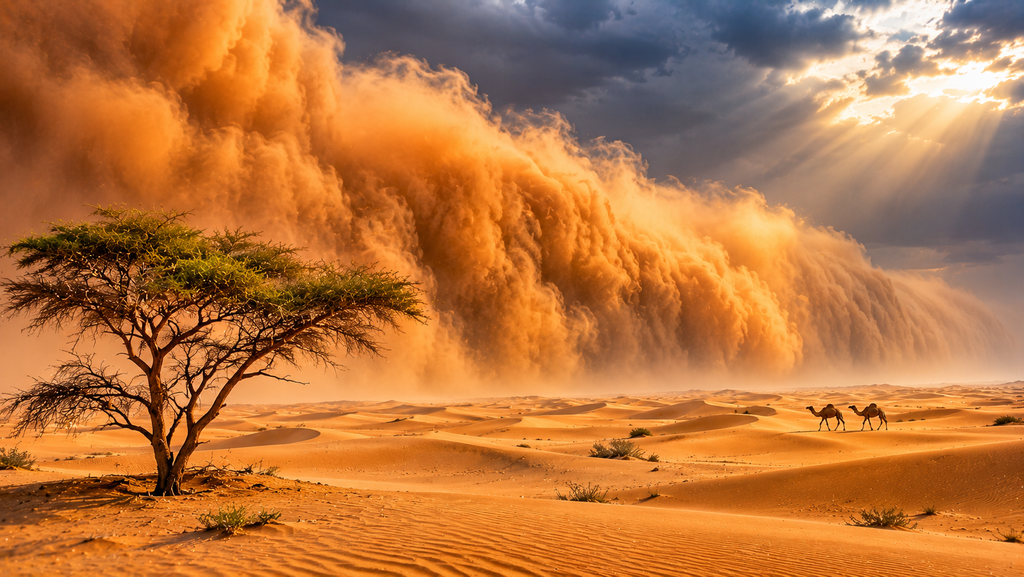
The resulting cloud can appear as a massive wall advancing across the landscape.
This type of event is often called a haboob.
Haboobs are associated with thunderstorm outflows and may form quickly, sometimes causing visibility to deteriorate within minutes.
NASA describes haboobs as one of the important forms of dust storm activity observed in arid regions, including parts of the Middle East.
Although the towering cloud may appear similar to a conventional wind-driven storm, the immediate atmospheric trigger is different.
How frontal systems produce dust
Weather fronts are boundaries between air masses with different characteristics.
Some frontal systems produce strong pressure gradients and gusty winds.
When these winds move across dry landscapes, they can lift dust and carry it over a wide area.
This mechanism is particularly relevant during certain winter and spring weather events.
Unlike some short-lived thunderstorm outflows, large-scale wind systems can maintain dusty conditions for extended periods.
The difference between sandstorms and dust storms
The terms are often used interchangeably in everyday conversation, but the particles behave differently.
Sand grains are usually larger and heavier.
They often move by bouncing or rolling close to the surface.
Fine dust particles can travel much farther because they remain suspended in moving air.
As a result, a city hundreds of kilometres from a desert source may experience hazy skies and poor air quality without encountering large quantities of blowing sand at ground level.
| Storm type | Main cause | Typical characteristic |
|---|---|---|
| Shamal-related dust storm | Persistent regional winds | Dust transported across large areas |
| Haboob | Thunderstorm outflow | Fast-moving wall of dust |
| Frontal dust storm | Strong winds associated with weather fronts | Widespread, sometimes prolonged conditions |
| Local blowing sand | Strong near-surface wind | Sand movement close to the ground |
| Long-range dust transport | Atmospheric movement of fine particles | Haze far from the source |
Understanding the difference between these events helps meteorologists issue more accurate forecasts and warnings.
5. Land Degradation and Human Activities Can Make Storms More Severe
Dust storms are a natural part of the Earth’s environmental system.
However, human activities can increase the amount of exposed sediment available for wind erosion.
This is especially important in dry environments where vegetation recovers slowly and freshwater resources are limited.
One major concern is land degradation.
Land becomes degraded when its ecological condition or productive capacity is reduced by processes such as erosion, vegetation loss, unsuitable land use or unsustainable water management.
Agricultural practices can contribute when soil is left exposed during dry and windy periods.
Overgrazing may reduce plant cover, while vehicles and heavy machinery can disturb fragile desert surfaces.
Construction sites and unpaved roads may also release local dust.
However, their contributions differ by location and should not be confused with the much larger natural dust sources found in some regional landscapes.
The World Health Organization estimates that approximately one-quarter of global dust emissions are associated with human activities, including land degradation, deforestation, unsuitable land management and related environmental changes. This is a broad global estimate, not a percentage established specifically for every Middle Eastern country.
The importance of water management
Wetlands and lakes can help retain fine sediments when water is present.
When these areas dry out, exposed lakebeds may become sources of airborne mineral dust.
The Tigris-Euphrates region is a particularly important example.
Changes in rainfall, drought, river flows and land management can influence how much sediment becomes exposed.
NASA has identified the basin as a major non-desert source of dust in the Middle East.
Protecting wetlands and managing freshwater resources can therefore contribute to reducing dust emissions from certain locations.
However, restoring vegetation or water to a source area does not automatically eliminate all regional storms.
Natural deserts will continue producing dust under suitable atmospheric conditions.
Does climate change cause more sandstorms?
Climate change may influence dust activity through changes in rainfall, drought, vegetation and atmospheric circulation.
However, the relationship is complicated.
Different areas can experience different trends, and increased dust activity cannot always be attributed to rising temperatures alone.
A 2024 study published in Atmospheric Chemistry and Physics reported that observed dust trends differ across the Middle East, with some locations showing increases and others decreases.
This means it is inaccurate to claim that every Middle Eastern country experiences more sandstorms every year.
The scientific evidence supports a more careful conclusion: climate change and human land-use practices can alter dust conditions, but regional outcomes depend on several interacting factors.
Human activities that can influence dust emissions
| Activity or condition | Potential effect |
|---|---|
| Overgrazing | Reduces protective vegetation |
| Unsuitable agricultural practices | Exposes fine soil particles |
| Wetland drainage | May expose sediment-rich surfaces |
| Excessive groundwater extraction | Can contribute to the drying of some water-dependent areas |
| Construction activity | Produces local airborne dust |
| Off-road vehicle movement | Disturbs fragile soils |
| Land restoration | Can reduce erosion when appropriately designed |
Improving land management is therefore an important part of reducing avoidable dust emissions, even though natural storms cannot be completely prevented.
6. Why Iraq, Saudi Arabia, Kuwait and Other Gulf Countries Experience Frequent Dust Events
Although dusty weather can affect many parts of the Middle East, the causes and frequency differ between countries.
Geography, prevailing winds, soil characteristics and local land-use conditions help determine where storms develop and where airborne particles travel.
Iraq and the Tigris-Euphrates basin
Iraq is particularly vulnerable because extensive dry plains and floodplain sediments provide important dust sources.
During late spring and summer, northwesterly winds can move across exposed land and carry particles toward population centres.
NASA documented multiple severe events in 2022, when large dust clouds affected Iraqi cities and disrupted daily life. The country’s dust problem is influenced by natural weather patterns as well as changes in water availability and land conditions.
Saudi Arabia
Saudi Arabia contains enormous desert regions, including An Nafud, Ad Dahna and the Rub’ al Khali.
Dust storms can affect cities and transportation routes when strong winds pass over suitable source areas.
However, the type of dust event varies across the Kingdom.
Northern and eastern areas may experience Shamal-related activity, while other locations can experience local wind-driven dust or thunderstorm-related events.
Kuwait
Kuwait’s geographical position makes it vulnerable to dust transported from Iraq and neighbouring desert regions.
Strong northwesterly winds can reduce visibility and affect transportation, outdoor activities and air quality.
The country’s relatively open terrain also contributes to exposure during suitable weather conditions.
United Arab Emirates
The UAE experiences dusty weather associated with regional wind systems and local environmental conditions.
The severity can vary between coastal cities, inland settlements and mountainous areas.
Dust may be transported from outside the country, demonstrating the importance of regional forecasting.
Qatar and Bahrain
Both countries can experience airborne dust transported across the Gulf region.
Their geographic locations expose them to regional atmospheric systems, while local construction and disturbed surfaces may contribute additional particles near some urban areas.
Oman and neighbouring regions
Oman’s varied geography creates differences between its coastal, mountain and desert environments.
Dust events may occur in interior desert areas, while other weather systems influence coastal and mountain conditions.
Countries such as Jordan, Syria and Iran also contain important dust-source regions.
The UNCCD’s regional assessment identifies Iraq, Saudi Arabia, Sudan and areas around the Arabian Gulf among locations reporting substantial dust storm activity. World Bank
Regional differences
| Country or region | Important influences |
|---|---|
| Iraq | Dry floodplains, exposed soils and Shamal winds |
| Saudi Arabia | Large desert regions and seasonal winds |
| Kuwait | Regional dust transport and open terrain |
| UAE | Desert conditions and transported dust |
| Qatar | Regional winds and airborne particles |
| Bahrain | Dust transport across the Gulf region |
| Oman | Local desert conditions and varied weather systems |
| Syria and Jordan | Arid landscapes and major dust-source areas |
These examples show why forecasting must consider weather patterns across national borders rather than focusing on one country alone.
7. How Sandstorms Affect Human Health, Transportation and Daily Life
Dust storms can create serious challenges for people living and working in affected areas.
The most immediate effects often involve poor visibility and declining air quality.
However, the consequences may extend to healthcare, agriculture, transport networks and economic activity.
Health risks from airborne particles
Dust clouds contain particles of different sizes.
Larger particles may irritate the eyes, nose and throat.
Smaller particles can travel deeper into the respiratory system.
In air-quality monitoring, PM10 generally refers to particles with aerodynamic diameters of 10 micrometres or less, while PM2.5 refers to particles measuring 2.5 micrometres or less.
Exposure to airborne particulate matter is associated with a range of health concerns, particularly when concentrations are high.
People with asthma, chronic respiratory conditions and certain cardiovascular conditions may face greater risks.
Children, older adults and people working outdoors can also require additional protection.
The World Health Organization identifies dust storms as an important environmental health issue and recommends improved monitoring, public warnings and measures to reduce exposure.
The impact on transportation
Visibility can deteriorate quickly during a severe event.
Drivers may struggle to see other vehicles, road markings or obstacles.
This can increase the risk of traffic accidents, especially on highways crossing open desert terrain.
Airports may also experience disruption when visibility falls below safe operating requirements.
Flight delays or cancellations depend on the severity of the event, airport procedures and aviation conditions.
Effects on agriculture
Wind-driven particles may damage sensitive crops or cover leaves with dust.
Dust accumulation can affect the amount of sunlight reaching plant surfaces.
Strong winds may also remove fertile topsoil, reducing agricultural productivity over time.
However, the effects differ according to crop type, storm severity and soil conditions.
Economic consequences
Businesses may experience interruptions when transportation is restricted or outdoor work becomes unsafe.
Cleaning and maintenance costs can increase after large dust events.
The World Bank and UNCCD have examined the economic costs of storms across the Middle East and North Africa, including their effects on health, infrastructure and productivity.
| Area affected | Possible consequence |
|---|---|
| Public health | Respiratory symptoms and greater exposure to particulate matter |
| Road transport | Reduced visibility and accident risk |
| Aviation | Delays or operational restrictions |
| Agriculture | Soil erosion and crop damage |
| Construction | Work interruptions and equipment exposure |
| Businesses | Disrupted operations and additional costs |
| Households | Dust infiltration and cleaning requirements |
Understanding these risks helps explain why early warnings and public safety information are essential.
8. How Middle Eastern Countries Can Predict and Reduce the Impact of Sandstorms
Although natural dust storms cannot be completely prevented, modern science makes it possible to monitor their development and reduce some of their impacts.
Meteorologists use satellite imagery, weather observations and atmospheric models to identify conditions that may produce significant dust events.
These tools can help authorities issue warnings before the most severe conditions reach populated areas.
Satellite monitoring
Satellites provide a broad view of dust movement across deserts and international borders.
NASA and other scientific organisations regularly observe large dust plumes using Earth-observation instruments.
Satellite data can help researchers identify possible source regions and examine how atmospheric conditions transport particles.
However, cloud cover, surface brightness and other factors can make certain observations difficult.
Weather forecasting models
Numerical weather models simulate atmospheric conditions using observations and physical equations.
Specialised dust models also consider wind speed, source surfaces and particle transport.
The WMO’s Sand and Dust Storm Warning Advisory and Assessment System supports international forecasting and research cooperation. World Meteorological Organization
Because dust moves across borders, this cooperation is particularly important in the Middle East.
Land restoration and prevention
Some avoidable dust emissions can be reduced through better land management.
Protecting natural vegetation, improving soil practices and maintaining suitable wetland conditions may help stabilise certain source areas.
The Food and Agriculture Organization identifies sustainable land management, drought preparedness and improved environmental practices as important parts of addressing dust storm risks.
However, planting trees or creating green spaces is not a universal solution.
Restoration must account for local ecology and water availability. Large irrigation-dependent projects could create additional pressure on scarce freshwater resources.
How to stay safer during a dust storm
People can reduce exposure by following reliable official warnings and taking practical precautions.
- Stay indoors when air quality is poor, particularly if you have respiratory or cardiovascular conditions.
- Close windows and doors to reduce dust entering indoor spaces.
- Use suitable indoor air filtration where available.
- Avoid unnecessary outdoor exercise during severe dusty conditions.
- If outdoor exposure cannot be avoided, a properly fitting particulate respirator such as an N95 can reduce inhalation of particles, though it does not remove every risk.
- Follow official road and aviation advisories, and avoid driving when visibility is dangerously low.
- Keep prescribed medications available and seek medical care for severe breathing difficulty or other concerning symptoms.
- Check local air-quality measurements and weather updates rather than judging conditions only by the colour of the sky.
A 2026 UNEP publication emphasises that better land management, forecasting and public preparedness can reduce the harm associated with sand and dust storms. UNEP – UN Environment Programme
Practical strategies for reducing the impact
| Strategy | Main purpose |
|---|---|
| Satellite monitoring | Tracks dust clouds and their movement |
| Dust forecasting models | Supports advance warnings |
| Air-quality monitoring | Measures particulate pollution |
| Public health advisories | Helps people reduce exposure |
| Sustainable agriculture | Protects soil from erosion |
| Wetland conservation | Reduces exposure of some fine sediments |
| Regional cooperation | Improves cross-border response |
| Public education | Encourages safer behaviour during storms |
The challenge is not to eliminate every natural dust event but to minimise avoidable emissions and protect communities when severe conditions occur.
Conclusion
Sandstorms are common in the Middle East because the region contains extensive dry landscapes, powerful seasonal wind systems and environmental conditions that favour the movement of loose particles.
Large deserts, exposed floodplains and dried lakebeds provide sources of sediment.
Strong winds, particularly the Shamal, can lift this material into the atmosphere and transport it across several countries.
Limited rainfall, drought and sparse vegetation make some surfaces more vulnerable to erosion.
Thunderstorms and weather fronts can also produce sudden and powerful dust events.
Human activities, including unsuitable land management and the disturbance of natural surfaces, may worsen conditions in particular locations.
However, the frequency and intensity of storms vary across countries and seasons, so regional trends should not be treated as identical everywhere.
These events create important challenges for health, transport, agriculture and economic activity.
Fortunately, modern weather monitoring, air-quality forecasting and improved environmental management can help reduce their impact.
Ultimately, sandstorms in the Middle East are the result of a powerful interaction between desert geography, atmospheric winds, climate conditions and human land use. Understanding these forces is essential for protecting people and building more resilient communities across the region.
Do follow us on Instagram
Read More – How Underground Water Reserves Sustain Life in the Arabian Desert