How Specialized Manufacturing Is Transforming Middle Eastern Industries
The Middle East’s industrial economy is entering a new phase as countries invest in manufacturing capabilities that extend beyond traditional production activities. Historically associated with petroleum processing, petrochemicals, metals, and energy-intensive industries, the region is increasingly exploring opportunities in pharmaceuticals, aerospace components, medical technology, electric vehicles, industrial automation, and advanced materials. This transformation reflects a broader effort to develop more diversified economies and participate in higher-value international supply chains.
- 1. Why Specialized Manufacturing Is Becoming Important to the Middle East
- 2. How GCC Industrial Strategies Are Supporting Advanced Manufacturing
- 3. The Specialized Manufacturing Sectors Creating New Economic Opportunities
- 4. How Artificial Intelligence and Industry 4.0 Are Transforming Production
- 5. Why Skilled Workers and Industrial Research Matter for Growth
- 6. Challenges Facing Specialized Manufacturing in the Middle East
- 7. The Future of Specialized Manufacturing in the Middle East’s Industrial Economy
Specialized manufacturing in the Middle East is becoming an important part of national industrial strategies as governments and businesses seek to combine technological expertise, skilled labour, and industrial infrastructure. Unlike conventional mass manufacturing, specialized production frequently involves complex technical processes, strict quality requirements, advanced machinery, and products designed for particular commercial or industrial applications.
The United Arab Emirates, Saudi Arabia, Oman, Qatar, and other regional economies are pursuing different approaches to industrial development. Some are expanding existing manufacturing clusters, while others are developing capabilities in emerging sectors that require research, engineering, and international partnerships.
These changes do not mean traditional industries are losing their importance. Petrochemicals, metals, food processing, and construction materials remain essential economic activities. However, adding more specialised manufacturing capabilities can increase industrial value, encourage innovation, and create opportunities for technically skilled workers.
Understanding this development reveals how specialized manufacturing could influence investment, employment, supply chains, and the future competitiveness of Middle Eastern economies.
1. Why Specialized Manufacturing Is Becoming Important to the Middle East
Specialized manufacturing involves producing goods that require particular technical expertise, sophisticated equipment, or highly controlled production methods. These products are often designed for specific industries rather than broad consumer markets.
Examples include precision-engineered aerospace components, medical devices, specialised chemicals, industrial sensors, advanced batteries, and customised machinery.
The economic value of these activities depends not simply on producing large quantities but also on meeting demanding performance and quality standards.
The Shift Toward Higher-Value Production
Traditional manufacturing often creates competitive advantages through production scale, available resources, established infrastructure, and cost efficiency.
Specialized manufacturing adds other sources of competitiveness, including product design, technical reliability, research, intellectual property, and manufacturing expertise.
For example, producing an ordinary metal component may involve relatively standard industrial processes. Manufacturing a precision component for aviation can require advanced machining, material testing, traceability, and rigorous quality assurance.
These additional requirements may create opportunities for suppliers capable of meeting demanding specifications.
However, high-value manufacturing also involves substantial investment and technical risk. Specialized production does not automatically generate higher profits.
The Role of Economic Diversification
Middle Eastern governments are increasingly interested in developing non-oil economic activities that create employment and strengthen industrial capabilities.
Manufacturing can support this objective because it connects multiple economic sectors.
A specialized industrial facility may require engineering services, software, equipment maintenance, packaging, transportation, testing, and technical training.
This creates potential demand for smaller businesses operating around major manufacturers.
Traditional and Specialized Manufacturing Compared
| Feature | Conventional Manufacturing | Specialized Manufacturing |
|---|---|---|
| Main Focus | Standardised products and production scale | Technical specifications and specialised applications |
| Equipment | General industrial machinery | Precision equipment and advanced systems |
| Workforce | Production and operational skills | Higher concentration of specialised technical skills |
| Research | Often focused on process improvements | May require extensive product and process development |
| Quality Requirements | Product and industry-dependent | Often demanding certification and traceability |
| Market Access | Broad consumer or industrial markets | Frequently specialised business customers |
| Competitive Advantage | Scale, cost, and efficiency | Reliability, innovation, and technical capability |
The two models frequently overlap. Large-scale manufacturers can use advanced technology, while specialized manufacturers may eventually achieve significant production volumes.
The distinction is useful for understanding how the region is expanding its industrial capabilities.
2. How GCC Industrial Strategies Are Supporting Advanced Manufacturing
Government industrial strategies play an important role in shaping manufacturing investment across the Gulf.
Policies addressing financing, infrastructure, industrial zones, research, and workforce development can influence where businesses establish production facilities.
However, national strategies contain targets rather than guarantees, and implementation progress differs between countries.
The UAE’s Operation 300bn
The UAE launched Operation 300bn in 2021 to strengthen its industrial sector and increase its contribution to national economic development.
The strategy aims to raise the industrial sector’s contribution to GDP from AED 133 billion to AED 300 billion by 2031.
Its priorities include pharmaceuticals, medical technology, advanced machinery, electrical equipment, renewable energy technologies, and other manufacturing activities.
The strategy also supports industrial innovation, technology adoption, export development, and increasing domestic value creation.
Emirates Development Bank was identified as an important financing partner, with an AED 30 billion financing portfolio allocated over five years to support priority sectors.
Saudi Arabia’s Industrial Transformation
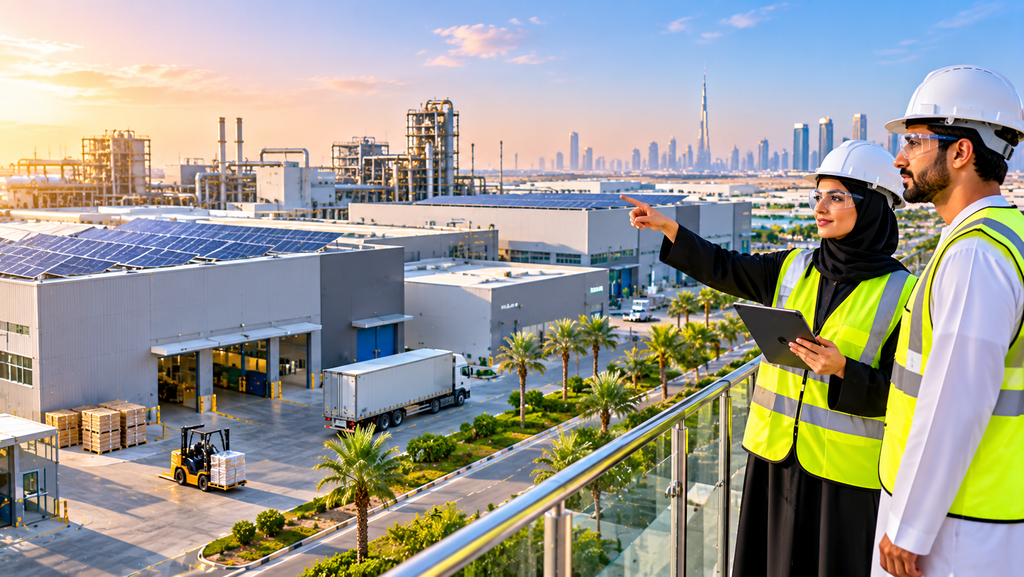
Saudi Arabia’s National Industrial Strategy identifies opportunities in sectors including automotive manufacturing, aerospace, medical devices, pharmaceuticals, renewable energy equipment, and machinery.
The Kingdom is seeking to develop stronger domestic industrial supply chains while attracting international investment and technology partnerships.
The Public Investment Fund also identifies advanced manufacturing and innovation as investment priorities.
Its areas of focus include electric vehicles, advanced biologics, aerospace components, artificial intelligence, and industrial technology.
These ambitions involve building production ecosystems rather than establishing isolated factories.
Oman’s Industrial Strategy 2040
Oman’s Industrial Strategy 2040 focuses on developing a more competitive manufacturing economy through technology, innovation, and value-added industrial activities.
In August 2026, the Ministry of Commerce, Industry and Investment Promotion reported that manufacturing contributed approximately OMR 3.7 billion to GDP at constant prices during 2025.
The strategy aims to increase manufacturing’s contribution to OMR 5.44 billion by 2030 and approximately OMR 10.7 billion by 2040.
The government has identified promising activities across food processing, chemicals, healthcare, metals, machinery, and environmental industries.
Qatar’s Manufacturing Development
Qatar’s National Manufacturing Strategy 2024–2030 emphasises smart manufacturing, research, productivity, and industrial diversification.
The strategy targets manufacturing value added of QAR 70.5 billion by 2030, alongside greater non-hydrocarbon exports and industrial investment.
These initiatives reflect efforts to build stronger domestic production capabilities and reduce excessive dependence on limited industrial activities.
Regional Industrial Strategy Comparison
| Country | Industrial Initiative | Strategic Emphasis |
|---|---|---|
| UAE | Operation 300bn | Advanced technology, industrial expansion, exports |
| Saudi Arabia | National Industrial Strategy | Industrial localisation, high-value sectors, supply chains |
| Oman | Industrial Strategy 2040 | Diversification, technology adoption, value-added industries |
| Qatar | National Manufacturing Strategy 2024–2030 | Smart manufacturing, innovation, productivity |
These strategies illustrate growing regional interest in industrial diversification, although each economy faces different market conditions and investment requirements.
3. The Specialized Manufacturing Sectors Creating New Economic Opportunities
Several manufacturing industries are particularly relevant to the Middle East’s industrial transformation.
These sectors often require specialised production environments, technical expertise, and reliable supply chains.
Pharmaceuticals and Medical Technology
Pharmaceutical manufacturing can support healthcare systems by creating domestic production capabilities for selected medicines and healthcare products.
Medical technology offers additional opportunities involving diagnostic equipment, medical devices, laboratory supplies, and specialised components.
However, these industries require rigorous quality management and regulatory approval.
A pharmaceutical manufacturer must meet applicable production standards, while a medical-device producer may need product-specific certification and testing.
Such requirements can create barriers to entry but also encourage investment in specialised knowledge.
Aerospace and Precision Engineering
Aerospace manufacturing requires extremely high levels of precision, documentation, and reliability.
Components may be exposed to demanding mechanical and environmental conditions, making material quality and manufacturing accuracy particularly important.
The UAE has established aerospace manufacturing capabilities, while Saudi Arabia’s industrial development plans identify aviation and aerospace as priority areas.
Potential opportunities include component manufacturing, maintenance-related production, specialised materials, and engineering services.
Automotive and Electric Vehicle Production
Automotive manufacturing is another area attracting investment.
Saudi Arabia’s advanced manufacturing agenda includes the development of electric vehicle production and supporting industrial supply chains.
Automotive production requires more than assembling complete vehicles. It also depends on batteries, electronics, mechanical parts, software systems, and specialised production equipment.
Developing local suppliers can be important for creating a competitive manufacturing ecosystem.
Advanced Materials and Industrial Chemicals
The Middle East already has significant experience in petrochemicals and materials processing.
Specialized manufacturing can build on this foundation by developing products with more demanding technical characteristics.
Examples include performance polymers, specialised coatings, engineered materials, and chemicals used in industrial applications.
Promising Manufacturing Segments
| Sector | Specialized Products | Technical Requirements |
|---|---|---|
| Pharmaceuticals | Medicines and biological products | Controlled environments and regulatory compliance |
| Medical Technology | Diagnostic devices and medical equipment | Product testing and certification |
| Aerospace | Precision components | Advanced machining and traceability |
| Automotive | Components and electric vehicle systems | Engineering, electronics, and quality control |
| Advanced Materials | Engineered polymers and coatings | Materials research and process control |
| Renewable Energy | Electrical systems and energy equipment | Technical testing and equipment standards |
| Industrial Machinery | Custom equipment and automation systems | Mechanical design and systems integration |
Each sector offers different commercial opportunities.
Businesses must evaluate demand, production costs, regulatory requirements, and access to qualified personnel before investing.
4. How Artificial Intelligence and Industry 4.0 Are Transforming Production
Advanced manufacturing is increasingly associated with Industry 4.0, a term describing the integration of digital technologies into industrial operations.
These technologies include industrial sensors, robotics, artificial intelligence, connected equipment, and digital monitoring systems.
Their purpose is to improve productivity, consistency, and decision-making across production processes.
Smart Factories and Connected Equipment
Modern manufacturing facilities can collect operational data from machines and production lines.
Sensors may monitor temperature, vibration, pressure, energy consumption, and equipment performance.
This information can help engineers identify inefficiencies and detect potential problems before equipment failures disrupt production.
However, technology must be supported by reliable data, appropriate maintenance, and skilled employees.
Installing advanced machinery does not automatically produce better operational outcomes.
Artificial Intelligence in Quality Control
AI systems may assist with identifying product defects through image analysis or interpreting manufacturing data.
For example, computer vision technology could examine manufactured components for visible irregularities.
Predictive models may also help identify conditions associated with equipment failure.
These applications can support operational efficiency, but they require testing to ensure their reliability.
Human oversight remains particularly important in safety-sensitive industries.
Industrial Automation and Robotics

Robotic systems can perform repetitive or highly precise tasks under controlled conditions.
In specialised manufacturing, automation may help maintain consistent production standards and reduce certain operational risks.
However, complex products may continue to require substantial human expertise for design, testing, supervision, and troubleshooting.
Automation can therefore change the nature of industrial employment rather than eliminate the need for skilled workers.
The Role of Digital Twins
Digital twins are virtual representations of physical systems that use models and, in some applications, operational data to simulate performance.
Manufacturers may use them to assess production layouts, monitor equipment, or test potential process changes.
This can be valuable when physical experimentation is expensive or disruptive.
Nevertheless, the accuracy of a digital twin depends on the quality of its underlying models and information.
Technology Adoption Across Manufacturing
| Technology | Manufacturing Application | Potential Benefit |
|---|---|---|
| Artificial Intelligence | Quality analysis and forecasting | Improved decision-making |
| Industrial Robotics | Automated production tasks | Greater consistency |
| IoT Sensors | Equipment monitoring | Better operational visibility |
| Digital Twins | Process simulation | More informed planning |
| Additive Manufacturing | Prototypes and selected specialised components | Design flexibility |
| Advanced Analytics | Production performance evaluation | Improved resource efficiency |
Technology adoption should reflect specific industrial needs rather than a general desire to appear innovative.
The most useful investments are those that address measurable production challenges.
5. Why Skilled Workers and Industrial Research Matter for Growth
Specialized manufacturing depends on people capable of operating advanced equipment, interpreting technical information, and maintaining quality standards.
As industrial processes become more sophisticated, companies require employees with expertise extending beyond routine production tasks.
This creates opportunities for technical education, vocational training, and engineering research.
The Importance of Technical Skills
A precision manufacturing facility may require mechanical technicians, quality inspectors, automation specialists, electrical engineers, and equipment maintenance professionals.
Pharmaceutical production involves additional expertise in laboratory procedures, quality assurance, and regulated manufacturing practices.
Automotive and aerospace industries require combinations of mechanical engineering, electronics, software, and materials knowledge.
These roles demonstrate why industrial development must be connected to education and workforce planning.
Vocational Education and Applied Training
Vocational institutions can help prepare workers through practical instruction, workshops, industry placements, and technical certifications.
Apprenticeship programmes may also support the transition from classroom learning to industrial employment.
For example, students studying industrial automation could develop practical skills through supervised training involving programmable controllers and machinery.
However, qualifications must reflect actual workplace requirements.
Strong partnerships between educational institutions and employers can improve this alignment.
Research and Development
Industrial research supports the development of new products, processes, and production techniques.
Universities and research centres can collaborate with manufacturers on materials, engineering, automation, and product design.
These partnerships may help businesses solve specific technical problems while developing local expertise.
However, research outcomes can be uncertain and commercial development often requires sustained investment.
Creating Career Opportunities
Specialized manufacturing can support employment across several occupational categories:
- Mechanical and electrical engineering.
- Industrial robotics and automation.
- Quality assurance and product testing.
- Materials science and chemical engineering.
- Industrial software and cybersecurity.
- Equipment maintenance and technical operations.
- Research and product development.
- Supply chain and production management.
The employment impact depends on the scale of investment, level of automation, and availability of domestic suppliers.
Highly automated factories may create fewer direct production jobs than labour-intensive facilities while generating demand for different technical occupations.
6. Challenges Facing Specialized Manufacturing in the Middle East
Although specialized manufacturing offers potential economic benefits, establishing competitive production facilities involves considerable challenges.
Businesses must navigate capital requirements, technology acquisition, supply chain development, regulatory standards, and global competition.
High Initial Investment Requirements
Advanced production equipment can require substantial upfront expenditure.
Specialised factories may also need testing laboratories, controlled environments, technical certification, and dedicated infrastructure.
These expenses can make market entry difficult for smaller manufacturers.
Financing arrangements, industrial partnerships, and shared infrastructure may help address some barriers.
However, investment decisions should be supported by realistic demand forecasts and cost assessments.
Dependence on Imported Components
A manufacturer may assemble sophisticated products locally while continuing to import critical components.
This can limit the extent of domestic value creation and expose production to international supply disruptions.
Developing local suppliers can reduce certain dependencies, but it may be economically impractical to manufacture every component domestically.
Companies must evaluate which activities offer genuine competitive advantages.
International Competition
Middle Eastern manufacturers compete with established industrial regions possessing extensive experience, supplier networks, and research capabilities.
Entering these markets requires consistent quality, competitive pricing, and reliable delivery.
Specialized manufacturers may also face demanding qualification processes before becoming approved suppliers to major international customers.
Key Industrial Challenges
| Challenge | Potential Impact | Possible Response |
|---|---|---|
| High Capital Costs | Expensive market entry | Appropriate financing and partnerships |
| Skills Shortages | Difficulty operating advanced facilities | Technical education and training |
| Imported Inputs | Supply chain vulnerability | Supplier diversification and selective localisation |
| Certification Requirements | Longer product approval processes | Early quality and regulatory planning |
| Technology Dependence | Limited domestic expertise | Research partnerships and knowledge transfer |
| Global Competition | Pressure on pricing and quality | Specialisation and operational efficiency |
| Energy and Water Use | Environmental and operating costs | Resource-efficient production systems |
Sustainability and Resource Efficiency
Manufacturing can consume significant amounts of energy, water, and raw materials.
Industrial development strategies increasingly recognise the importance of resource efficiency and environmental performance.
Companies may benefit from energy management systems, waste recovery, efficient cooling technologies, and improved production processes.
However, environmental performance should be evaluated using measurable outcomes rather than broad sustainability claims.
The appropriate solutions depend on each industry’s production requirements.
7. The Future of Specialized Manufacturing in the Middle East’s Industrial Economy
The long-term development of specialized manufacturing will depend on whether regional economies can build industrial systems capable of competing through quality, reliability, technical expertise, and innovation.
Large infrastructure projects and investment announcements are important, but lasting industrial competitiveness requires functioning supply chains, qualified workers, and commercially successful products.
The Importance of Industrial Clusters
Industrial clusters bring together manufacturers, suppliers, service providers, research institutions, and supporting infrastructure.
A specialised automotive cluster, for example, may include vehicle assembly facilities, component suppliers, testing services, software companies, and technical training providers.
Locating related businesses near one another can reduce coordination costs and encourage knowledge sharing.
However, clustering is effective only when businesses have meaningful commercial relationships.
Opportunities for Small and Medium Enterprises
Specialized manufacturing is not limited to large corporations.
Smaller businesses can provide precision components, technical maintenance, specialised packaging, engineering services, and industrial software.
Some SMEs may develop expertise in narrow product categories that larger manufacturers prefer to outsource.
Successful participation often requires certification, consistent quality, and dependable delivery.
How Businesses Can Evaluate Opportunities
Before establishing a specialised manufacturing operation, investors should examine several practical factors.
These include customer demand, production requirements, supplier availability, access to technical expertise, and applicable regulatory standards.
A commercially attractive industry at the national level may not automatically support every proposed factory.
Manufacturing Investment Checklist
- Identify the intended product and customer market.
- Assess regional and international demand.
- Evaluate technical and certification requirements.
- Calculate capital and operating expenditure.
- Examine local infrastructure and utility availability.
- Identify reliable suppliers and logistics partners.
- Assess workforce and training requirements.
- Investigate suitable industrial zones and incentives.
- Evaluate environmental and resource requirements.
- Develop realistic production and financial forecasts.
Measuring Industrial Success
The effectiveness of specialized manufacturing should be evaluated using multiple indicators.
These may include industrial value added, export performance, product quality, workforce productivity, research activity, and participation by domestic suppliers.
Factory numbers alone provide an incomplete picture.
A smaller manufacturing operation producing high-value components may contribute different economic benefits from a large facility producing standardised products.
Similarly, the creation of technical jobs and local supplier relationships can generate benefits extending beyond direct factory output.
Building Long-Term Industrial Competitiveness
The Middle East’s industrial transformation will require sustained coordination between governments, manufacturers, investors, educational institutions, and technology providers.
Policies can encourage investment, but companies must ultimately develop competitive products and sustainable operations.
The region’s existing industrial infrastructure, access to energy resources, transport connectivity, and growing interest in advanced technology provide useful foundations.
However, international competition, technological change, and investment risks will continue to influence outcomes.
Conclusion
Specialized manufacturing in the Middle East represents an important opportunity for industrial diversification and technological development.
As governments and businesses invest in pharmaceuticals, aerospace, automotive components, advanced materials, renewable energy equipment, and industrial automation, manufacturing activity is expanding beyond traditional production categories.
National strategies in the UAE, Saudi Arabia, Oman, and Qatar demonstrate growing interest in developing more sophisticated industrial capabilities.
Yet successful transformation requires more than ambitious targets.
Competitive manufacturing depends on skilled workers, reliable supply chains, research, quality standards, and financially sustainable investment.
The development of specialised industrial clusters could also create opportunities for smaller companies supplying components, technology, and professional services.
Ultimately, the future of the Middle East’s industrial economy will depend not simply on how much the region manufactures, but on the technical sophistication, competitiveness, and lasting value of what it produces.
By connecting industrial investment with innovation and workforce development, specialized manufacturing could become an increasingly important contributor to the region’s economic diversification and long-term industrial growth.
Do follow us on Instagram
Read More – How Subscription-Based Business Models Are Changing Consumer Spending in the Gulf