


To Start a Business in Dubai Ultimate Guide For Business Start-up Solution
To start business in Dubai has become an attractive option for entrepreneurs, investors, freelancers, and international companies looking to establish a presence in one of the world’s major commercial hubs. Dubai combines modern infrastructure, international connectivity, a diverse customer base, business-friendly policies.
- Why Start Business in Dubai?
- Types of Businesses You Can Start in Dubai
- Mainland vs Free Zone: Which Is Better?
- Starting a Mainland Business in Dubai
- Starting a Free-Zone Business in Dubai
- 100% Foreign Ownership in Dubai
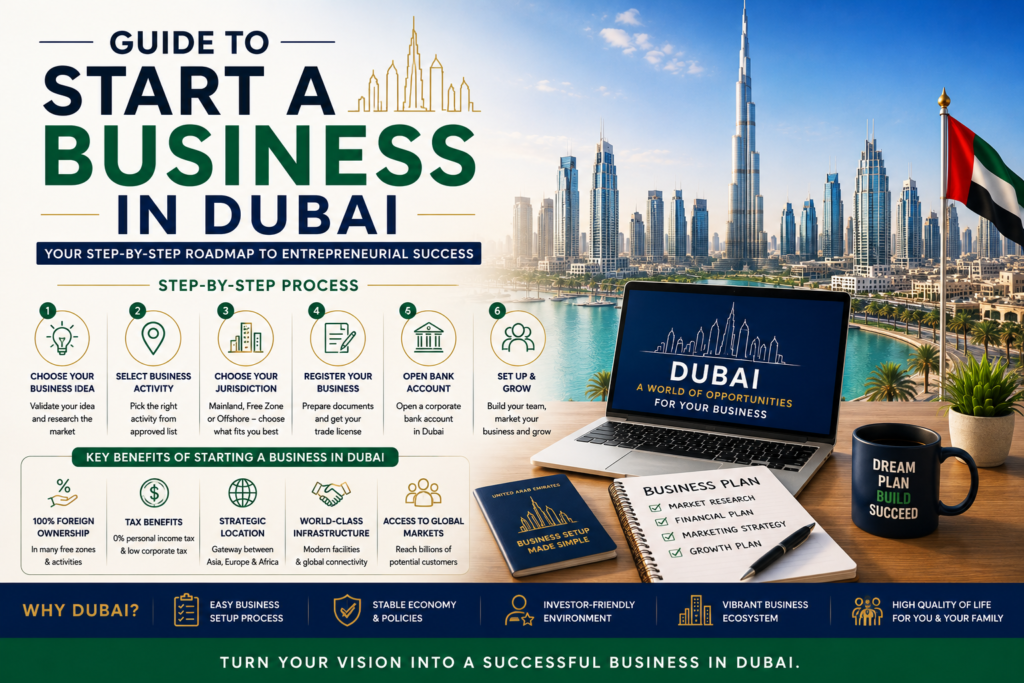
- Step-by-Step Process to Start a Business in Dubai
- 1. Choose Your Business Idea
- 2. Select Your Business Activity
- 3. Choose Your Jurisdiction
- 4. Choose the Legal Structure
- 5. Reserve Your Trade Name
- 6. Apply for Initial Approval
- 7. Prepare the Required Documents
- 8. Secure a Business Location
- 9. Obtain Your Business Licence
- How Much Does It Cost to Start a Business in Dubai?
- Corporate Tax in Dubai
- VAT in Dubai
- Open a Corporate Bank Account
- Business Visas and Residency
- Starting an E-Commerce Business in Dubai
- Popular Business Ideas in Dubai
- Hiring Employees in Dubai
- Marketing Your Dubai Business
- Accounting and Record Keeping
- Common Mistakes When Starting a Business in Dubai
- Business Setup Checklist for Dubai
- Is Dubai a Good Place to Start a Business in 2026?
- Frequently Asked Questions About Starting a Business in Dubai
It established financial services, and access to markets across the Middle East, Asia, Africa, and Europe. In 2026, the emirate continues to provide multiple routes for entrepreneurs, including mainland companies, free-zone businesses, professional businesses, e-commerce ventures, and specialized commercial structures.
However, starting a company in Dubai is more than simply obtaining a trade licence. Entrepreneurs need to choose the right business activity, legal structure, jurisdiction, premises, approvals, tax registrations, banking arrangements, and immigration options. The right setup depends heavily on what you plan to sell, where your customers are located, whether you need a physical office, and whether your company will operate primarily inside the UAE or internationally.
This complete guide to starting a business in Dubai explains the process step by step, including business setup options, licences, costs, taxes, ownership, documentation, banking, visas, and practical considerations for new entrepreneurs.
Why Start Business in Dubai?
Dubai has developed into a major international centre for trade, finance, tourism, technology, logistics, real estate, professional services, and entrepreneurship. Its geographic position allows companies to connect relatively easily with markets across Europe, Asia, Africa, and the Middle East.
Dubai also offers a sophisticated ecosystem for businesses, including airports, seaports, financial institutions, digital services, coworking spaces, business centres, accelerators, free zones, and professional support providers.
The Dubai government describes the emirate as offering flexible business setup options, free zones, incubators, digital commerce tools, and founder-support initiatives.

Some major reasons entrepreneurs consider Dubai include:
- Strategic international location
- Modern transport and logistics infrastructure
- Large international business community
- Access to global markets
- Multiple company-formation options
- Free-zone ecosystems for specialized industries
- Strong digital infrastructure
- International banking and financial services
- Growing technology and innovation sectors
- Tourism and hospitality opportunities
- Opportunities for international entrepreneurs and investors
Dubai is therefore not only a place to register a company; it can also serve as a regional base from which a business can expand.
Types of Businesses You Can Start in Dubai
Dubai supports a wide range of commercial activities. The right opportunity depends on your skills, capital, target customers, and experience.
Popular business sectors include:
- E-commerce
- Information technology
- Artificial intelligence
- Digital marketing
- Consulting
- Real estate
- Construction
- Logistics
- Import and export
- Tourism
- Hospitality
- Food and beverage
- Retail
- Professional services
- Media and content creation
- Financial technology
- Healthcare
- Education
- Beauty and wellness
- Manufacturing
Before registering a company, it is important to define your exact activity. The business activity affects the licence you need, possible approvals, premises requirements, and sometimes the jurisdiction that makes the most sense.
The UAE government states that investors can choose from more than 2,000 business activities, and the selected activity forms the basis for determining the appropriate licence and legal structure.
Mainland vs Free Zone: Which Is Better?
One of the most important decisions when starting a business in Dubai is choosing between a mainland company and a free-zone company.
There is no universally better option. The correct choice depends on your business model.
Starting a Mainland Business in Dubai
A mainland company operates under the jurisdiction of Dubai’s Department of Economy and Tourism (DET). Mainland businesses can be suitable for entrepreneurs who want to serve customers throughout the UAE and operate directly in the local market.
Dubai’s official business portal identifies mainland and free-zone setups as the two principal business-set-up options.
A mainland setup can be particularly useful if you plan to:
- Open a shop in Dubai
- Operate a restaurant
- Establish a local consultancy
- Provide services to UAE customers
- Bid for certain local contracts
- Employ staff for a physical operation
- Operate a business requiring specific mainland premises
Starting a Free-Zone Business in Dubai
Dubai has several free zones designed around different sectors and business models. Free zones can offer specialized infrastructure, streamlined company formation, and sector-specific ecosystems.
Free zones can be particularly attractive for:
- International trading companies
- Technology businesses
- Digital companies
- Media businesses
- Startups
- Logistics companies
- E-commerce businesses
- Professional service companies
- Companies primarily serving international customers
Free zones generally allow companies to operate within the zone and internationally, but access to the UAE mainland market is regulated. Depending on the activity, a free-zone business may need a licensed mainland distributor, branch, or other required authorization to conduct business directly in the mainland market.
Therefore, do not select a free zone simply because its initial package appears cheaper. Consider where your customers are and how you intend to sell your products or services.
100% Foreign Ownership in Dubai
One of Dubai’s major attractions for international entrepreneurs is the availability of 100% foreign ownership for many activities.
The UAE’s Commercial Companies Law permits full foreign ownership of mainland companies for many business activities. However, certain strategic activities remain subject to specific ownership restrictions or additional requirements.
This means foreign entrepreneurs do not automatically need an Emirati partner simply because they want to establish a mainland company.
However, ownership rules depend on the specific business activity. Activities involving areas such as security and defence, telecommunications, banking and certain financial services, commercial agencies, Hajj and Umrah organizing, and other regulated fields can have special requirements.
Always check the exact activity before forming the company.
Step-by-Step Process to Start a Business in Dubai
The company-formation process can be divided into several stages.
1. Choose Your Business Idea
Start by defining exactly what your company will do.
Ask yourself:
- What problem does my business solve?
- Who are my customers?
- Where are my customers located?
- How will I make money?
- Who are my competitors?
- What is my expected startup budget?
- Do I need employees?
- Do I need a physical shop or office?
- Will I sell inside the UAE or internationally?
A strong business idea should be supported by market research rather than assumptions.
2. Select Your Business Activity
Your business activity is one of the most important elements of the setup process.
For example, an entrepreneur starting an online consultancy may require a professional or consulting-related activity, while an importer may need a commercial activity.
Your selected activity can determine:
- Licence type
- Additional approvals
- Office requirements
- Regulatory requirements
- Permitted services
- Appropriate jurisdiction
Dubai’s official business guidance emphasizes choosing the business activity before selecting the appropriate licence and legal form.
3. Choose Your Jurisdiction
After identifying your activity, decide whether you need:
- Dubai mainland
- A Dubai free zone
- Another specialized jurisdiction
Think beyond the initial licence price.
Consider:
- Customer location
- Office requirements
- Employee requirements
- Visa needs
- Import/export requirements
- Banking
- Regulatory approvals
- Future expansion
A slightly more expensive setup can be more economical over the long term if it matches your business model better.
4. Choose the Legal Structure
Your company needs an appropriate legal form.
Depending on the business, possible structures can include an LLC, sole establishment, branch, or other approved forms.
The legal structure affects ownership, liability, documentation, governance, and applicable regulations.
For many entrepreneurs, an LLC can be a practical structure, but it is not automatically the right option for every business.
Professional advice may be useful if you have multiple shareholders, international investors, intellectual property, or complex operations.
5. Reserve Your Trade Name
Your company needs an approved business name.
The name should comply with applicable UAE naming rules and should not conflict with existing registered names or violate public policy.
When selecting a name:
- Keep it professional.
- Make it easy to remember.
- Check availability.
- Avoid prohibited words.
- Make sure it reflects your business.
- Consider future expansion before choosing an overly narrow name.
Your trade name can become an important part of your brand identity, so do not select it purely because it is available.
6. Apply for Initial Approval
Initial approval is an important stage in the mainland company-formation process.
Dubai’s official guidance explains that the Department of Economy and Tourism reviews the application and supporting documents before granting initial approval. This allows the entrepreneur to move forward with subsequent setup requirements.
Depending on the company and activity, documents can include identification documents, visa or residence information, company constitutional documents, and other supporting material.
Certain activities may also require approval from other government authorities.
7. Prepare the Required Documents
Documentation varies according to the legal form, nationality, activity, and company structure.
Common documents may include:
- Passport copies
- Emirates ID, where applicable
- Visa or residence information
- Trade-name information
- Business activity details
- Memorandum of Association, where required
- Lease agreement
- Additional government approvals
- Parent-company documents for branches
Foreign documents may require authentication and legal Arabic translation. Dubai’s official guidance specifies additional attestation and translation requirements for certain foreign documents.
Prepare documents early to reduce delays.
8. Secure a Business Location
A Dubai business generally needs an appropriate business address, depending on the licence and jurisdiction.
The premises requirement can vary according to your activity.
For example:
- A retail business may require a physical shop.
- A restaurant needs suitable commercial premises and approvals.
- A consultancy may operate from an office or permitted business centre.
- A manufacturing company needs industrial facilities.
- Some eligible businesses can use flexible or coworking arrangements.
The UAE government states that businesses must have an appropriate physical address and that premises must comply with applicable emirate and municipal requirements.
Do not sign an expensive lease before confirming that the property is suitable for your intended business activity.
9. Obtain Your Business Licence
Once the required approvals, documents, premises, and payments are completed, you can obtain the business licence.
Dubai mainland licences can broadly cover activities such as:
- Commercial
- Industrial
- Professional
- Other specialized categories and permitted activities
Dubai’s official portal identifies commercial, industrial, professional, e-trader and other licensing routes depending on the nature of the business.
Your licence is not simply paperwork—it defines what your company is legally authorized to do.
If you later want to add activities, check whether additional approval or licence modification is required.
How Much Does It Cost to Start a Business in Dubai?
There is no single fixed price for starting a business in Dubai.
The total cost depends on factors such as:
- Business activity
- Mainland or free-zone jurisdiction
- Licence type
- Legal structure
- Number of shareholders
- Office requirements
- Visa requirements
- Number of employees
- Regulatory approvals
- Immigration costs
- Insurance
- Banking
- Accounting
- Renewal fees
This is why claims such as “start a Dubai company for exactly X amount” should be treated carefully.
A low-cost licence package may not include office space, visas, immigration services, government fees, insurance, banking, accounting, or other expenses.
Common startup expenses include:
- Trade licence
- Company registration
- Trade-name reservation
- Office or workspace
- Government approvals
- Visa and immigration expenses
- Emirates ID-related costs
- Medical examination where applicable
- Corporate bank account setup
- Accounting and bookkeeping
- Insurance
- Website and marketing
- Employee recruitment
- Equipment and technology
Create a complete startup budget instead of comparing licence prices alone.
Corporate Tax in Dubai
One of the biggest changes entrepreneurs need to understand is that the UAE now has a federal Corporate Tax regime.
Corporate Tax applies to businesses within its scope, including companies operating under commercial licences. The standard rate is:
- 0% on taxable income up to AED 375,000
- 9% on taxable income exceeding AED 375,000
Special rules apply to qualifying large multinational enterprises under the UAE’s implementation of the international minimum-tax framework.
The introduction of Corporate Tax means entrepreneurs should no longer assume that establishing a company in Dubai automatically means operating without corporate tax.
Tax treatment depends on factors such as taxable income, business structure, free-zone status, qualifying income rules, and other provisions.
Maintain accurate accounting records from the beginning.
VAT in Dubai
Businesses may also need to register for Value Added Tax (VAT).
For UAE-resident businesses, VAT registration becomes mandatory when taxable supplies and imports exceed AED 375,000 over the previous 12 months or are expected to exceed that threshold within the next 30 days.
Voluntary registration is available when the applicable threshold of AED 187,500 is exceeded, subject to the rules.
VAT registration is not determined simply by whether you have a mainland or free-zone company. The nature and value of taxable supplies matter.
Once registered, businesses have ongoing VAT compliance responsibilities, including maintaining records and filing returns.
The FTA states that standard VAT return periods are generally quarterly for businesses with annual turnover below AED 150 million and monthly for businesses with turnover of AED 150 million or more, although the FTA can assign different tax periods.
Open a Corporate Bank Account
After establishing your company, you will generally want a dedicated business bank account.
A corporate account helps separate personal and company finances and makes it easier to manage:
- Customer payments
- Supplier payments
- Salaries
- Rent
- Taxes
- International transfers
- Business expenses
Banks can conduct detailed compliance checks, so opening an account should not be treated as an automatic step.
Prepare information such as:
- Company licence
- Incorporation documents
- Shareholder information
- Passport copies
- Business plan
- Expected transaction volumes
- Source of funds
- Customer and supplier information
- Proof of business activity
A clear and genuine business model can make the compliance process easier.
Business Visas and Residency
Entrepreneurs who want to live in Dubai may need an appropriate residence status.
Depending on circumstances, business owners and investors may have access to residency routes associated with their company or other qualifying programs.
The number of visas a company can obtain can depend on factors including:
- Office size
- Company type
- Jurisdiction
- Immigration rules
- Number of employees
- Business activity
Do not assume that every licence package automatically provides the same number of visas.
If you are establishing a company specifically to relocate to Dubai, calculate the costs and requirements for both the company and your residency.
Starting an E-Commerce Business in Dubai
E-commerce is one of the attractive business models for entrepreneurs who want to operate with relatively limited physical infrastructure.
Possible e-commerce businesses include:
- Fashion
- Electronics
- Beauty products
- Home products
- Specialty foods
- Digital products
- Subscription services
- B2B products
However, online businesses still need to comply with applicable licensing, consumer, tax, payment, product, and data requirements.
Dubai’s official business platform specifically provides guidance for entrepreneurs starting e-commerce companies, including licensing and approval requirements.
Before launching an online store, determine:
- Where your customers live
- Where inventory will be stored
- How products will be imported
- Which payment gateway you will use
- How deliveries will be handled
- Whether products require special approvals
- Whether VAT applies
- How returns and refunds will be managed
Popular Business Ideas in Dubai
Dubai’s economy offers opportunities across multiple industries.
1. E-Commerce: An online store can target UAE customers or international markets. Niche products can be particularly useful for smaller entrepreneurs competing against large retailers.
2. Digital Marketing Agency: Companies increasingly need social media management, SEO, advertising, content, branding, and digital strategy.
3. Technology Services: Software development, cybersecurity, cloud services, artificial intelligence, and IT consulting are areas with strong long-term potential.
4. Real Estate Services: Dubai’s property market supports businesses connected with brokerage, property management, marketing, and related professional services, subject to the relevant licensing and regulatory requirements.
5. Tourism and Hospitality: Dubai’s international tourism market creates opportunities for travel services, experiences, hospitality support, and specialized tourism businesses.
6. Consulting: Professionals with expertise in finance, management, HR, technology, marketing, or strategy can explore consulting businesses subject to the appropriate licensing.
7. Logistics and Trading: Dubai’s airports, ports, roads, and international connections make logistics and trading important parts of the business ecosystem.
Hiring Employees in Dubai
As your company grows, you may need employees.
Hiring requires compliance with applicable employment and immigration rules.
Before recruiting, calculate the full cost of an employee rather than salary alone.
Consider:
- Salary
- Visa costs
- Work authorization
- Health insurance
- Office space
- Equipment
- Recruitment
- Leave
- End-of-service obligations
- Other statutory requirements
A business that grows too quickly without budgeting for staff-related costs can experience cash-flow problems.
Marketing Your Dubai Business
Obtaining a licence does not guarantee customers.
Once your company is established, develop a marketing strategy around your target audience.
Useful channels can include:
- Google Search
- SEO
- Social media
- Email marketing
- Content marketing
- Partnerships
- Events
- Influencer marketing
- Local networking
- Paid advertising
For a Dubai-focused company, local SEO can be particularly useful. Optimize your website for searches involving your service and locations, maintain accurate business information, and create useful content for customers.
Your website should clearly communicate:
- What you offer
- Who you serve
- Where you operate
- Pricing or quotation process
- Contact information
- Company credentials
- Customer reviews
- Frequently asked questions
Accounting and Record Keeping
Good accounting should begin on the first day of business.
Keep records of:
- Sales
- Purchases
- Expenses
- Bank transactions
- Invoices
- Payroll
- Assets
- Liabilities
- Tax documents
Accurate records help you understand profitability and support tax compliance.
Consider hiring a qualified accountant or professional adviser if you are unfamiliar with UAE accounting and tax rules.
Common Mistakes When Starting a Business in Dubai
New entrepreneurs can avoid many problems by planning carefully.
Choosing the cheapest licence: The cheapest package is not necessarily the best option. A licence must match your business activity and future plans.
Choosing the wrong jurisdiction: A free zone can be excellent for one business and inconvenient for another. Consider where your customers are located.
Ignoring taxes: Corporate Tax and VAT requirements should be considered from the beginning.
Underestimating operating costs: Office rent, employee expenses, software, insurance, accounting, marketing, and renewals can add up quickly.
Failing to research the market: Dubai is competitive. A strong business concept needs a clear target market and competitive advantage.
Mixing personal and business finances: Maintain separate financial records and a dedicated corporate bank account.
Signing a long lease too early: Confirm licensing and premises requirements before committing to expensive commercial space.
Ignoring regulatory approvals: Some industries require approval from specialized government authorities.
Business Setup Checklist for Dubai
Use this checklist when planning your company:
Before Registration
- Define your business idea.
- Research your target market.
- Identify competitors.
- Select your business activity.
- Choose mainland or free zone.
- Select your legal structure.
- Estimate startup and operating costs.
- Choose a business name.
During Setup
- Reserve the trade name.
- Obtain initial approval.
- Prepare company documents.
- Obtain additional approvals if required.
- Secure suitable premises.
- Submit the final application.
- Pay applicable fees.
- Obtain your business licence.
After Licensing
- Apply for residency/visas where applicable.
- Open a corporate bank account.
- Register for Corporate Tax where required.
- Register for VAT when required.
- Set up accounting.
- Arrange insurance.
- Hire employees if necessary.
- Launch your website.
- Start marketing.
- Maintain ongoing compliance.
Is Dubai a Good Place to Start a Business in 2026?
For many entrepreneurs, Dubai remains an attractive place to launch and expand a business in 2026. Its international connectivity, infrastructure, diverse economy, free-zone ecosystem, digital services, and relatively open foreign-investment environment provide a strong foundation for businesses across numerous industries.
However, Dubai is not a guaranteed shortcut to business success. Competition can be intense, operating costs can be substantial, and regulatory requirements need to be taken seriously.
The strongest entrepreneurs are those who enter the market with:
- A validated business idea
- A realistic financial plan
- A clearly defined target customer
- The correct licence
- The right jurisdiction
- Strong accounting
- Appropriate tax planning
- Effective marketing
- A long-term growth strategy
Frequently Asked Questions About Starting a Business in Dubai
Q1. Can foreigners start a business in Dubai?
Ans: Yes. Foreign investors can establish businesses in Dubai, and UAE law allows 100% foreign ownership for many mainland activities. Certain strategic and regulated activities remain subject to specific requirements.
Q2. How much does it cost to start a business in Dubai?
Ans: There is no universal startup cost. Expenses vary according to the licence, activity, jurisdiction, premises, visas, employees, approvals, and other requirements.
Q3. Is mainland or free zone better for business in Dubai?
Ans: Neither is automatically better. Mainland can be suitable for businesses targeting the UAE local market, while free zones can be attractive for international, specialized, and sector-focused businesses. Free-zone access to the mainland is subject to applicable rules and approvals.
Q4. Do Dubai businesses pay corporate tax?
Ans: Businesses within the scope of UAE Corporate Tax can be subject to 0% on taxable income up to AED 375,000 and 9% on taxable income above AED 375,000, subject to the applicable legislation and special rules.
Q5. Do businesses in Dubai need VAT registration?
Ans: A UAE-resident business generally must register for VAT when taxable supplies and imports exceed AED 375,000 over the previous 12 months or are expected to exceed that amount within the next 30 days. Voluntary registration is possible above AED 187,500 under the applicable rules.
Q6. Can I start an online business in Dubai?
Ans: Yes. Dubai provides licensing options for e-commerce and digital businesses, but the appropriate activity, licence, and approvals depend on what you sell and how you operate.
Q7. Do I need an office in Dubai?
Ans: Requirements vary according to the business activity, licence and jurisdiction. Some businesses require physical premises, while certain structures can use flexible office or coworking solutions where permitted.
Q8. Can I get a residence visa through my Dubai company?
Ans: Business owners and employees may be eligible for residence arrangements subject to the relevant company, immigration and visa requirements. The exact number and type of visas available can depend on the company’s structure, premises and jurisdiction.
Q9. What documents are required to start a business in Dubai?
Ans: Common documents include passport copies, identification and visa information, trade-name details, constitutional documents, lease documents, and additional approvals where applicable. Foreign documents may need attestation and legal translation.
Q10. What is the first step to starting a business in Dubai?
Ans: The best first step is to define your business activity and business model. From there, determine the appropriate jurisdiction, legal structure and licence before committing to premises or other major expenses. Dubai’s official guidance places identifying the business activity at the beginning of the mainland setup process.
Final Thoughts
Starting a business in Dubai can provide access to one of the world’s most internationally connected commercial environments. Whether you want to establish an e-commerce company, consulting firm, technology startup, trading company, restaurant, professional service business, or another venture, Dubai offers several structures designed for different business models.
The most important decision is not simply how cheaply you can obtain a business licence. Instead, focus on choosing the correct activity, legal structure, jurisdiction, premises, and regulatory framework for your long-term objectives.
For foreign entrepreneurs, the availability of full ownership for many activities makes Dubai particularly attractive, while mainland and free-zone options provide flexibility for different types of businesses.
At the same time, entrepreneurs should understand that the UAE now has a formal Corporate Tax system and VAT obligations can apply once the relevant thresholds are reached.
The best approach is therefore to plan carefully, verify the latest government requirements, prepare a realistic budget, and establish proper accounting and compliance systems from the beginning.
Dubai can be a powerful place to build a business—but the key to success is choosing the right structure, understanding the rules, knowing your market, and building a company that can grow beyond the initial setup.
Do follow us on Instagram
Read More – How to Start a Business in Dubai Ultimate Step-by-Step Guide