



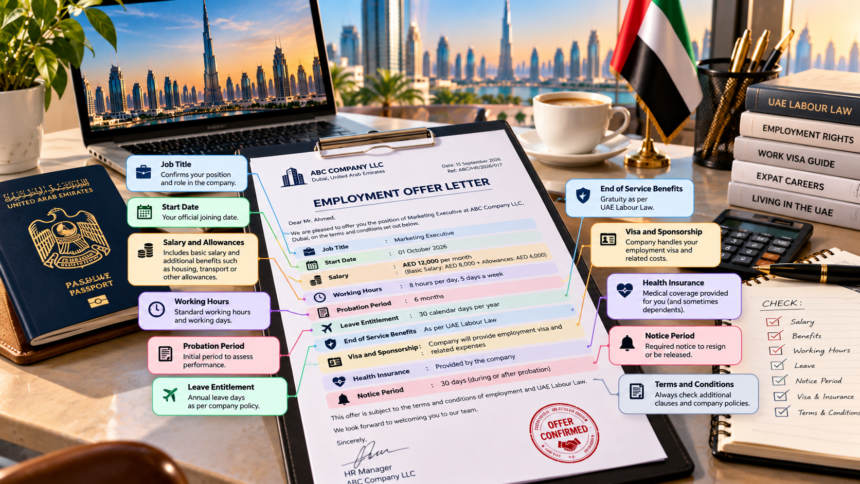
Common Mistakes People Make When Reading a UAE Employment Offer Letter
UAE employment offer letter details should be checked carefully before you resign from your current job, relocate to the country or agree to start work with a new employer. A UAE job offer is more than a summary of salary. It can contain important information about your job title, basic salary, allowances, work location, probation, benefits, notice period and other conditions that may shape your employment for years.
- UAE Employment Offer Letter: Quick Checklist
- Check the Employer’s Legal Name
- Verify That the Offer Is Genuine
- Never Pay for a UAE Job Offer
- Make Sure the Job Title Matches What You Were Promised
- Read the Job Description, Not Just the Title
- Understand Basic Salary vs Total Salary
- Why the Basic Salary Matters So Much
- Check Whether Allowances Are Fixed or Conditional
- Understand Whether the Bonus Is Guaranteed
- Check the Employment Type
- Understand the Contract Duration
- Check the Probation Period
- Read the Notice Period Carefully
- Check Whether the Notice Period Is Equal for Both Sides
- Understand Working Hours
- Ask How Overtime Works
- Check the Weekly Working Days
- Check the Annual Leave Entitlement
- Understand Sick Leave
- Check Medical Insurance Details
- Check Annual Flight Benefits
- Understand Relocation Benefits
- Confirm Who Pays Visa and Work Permit Costs
- Compare the Offer With the Final Employment Contract
- Read the Non-Compete Clause Carefully
- Check Confidentiality and Intellectual Property Clauses
- Review Side-Job Restrictions
- Check the Work Location
- Understand Hybrid and Remote Work Promises
- Understand End-of-Service Benefits
- Check Whether the Employer Uses the Savings Scheme
- Look for Training or Repayment Clauses
- Read Any Clawback Clause
- Understand the Joining Date
- Do Not Resign Only Because You Received a Verbal Offer
- Watch for Offer Letter Red Flags
- Questions to Ask HR Before Signing
- Compare Two UAE Job Offers Properly
- Calculate the Real Value of the Offer
- Keep a Copy of Everything You Sign
- What to Do if the Final Contract Is Different From the Offer
- Remember That Not Every UAE Employee Uses the Same Framework
- A UAE Employment Offer Letter Review Checklist
- Common Mistakes People Make When Reading a UAE Employment Offer Letter
- How to Understand a UAE Employment Offer Letter Before Signing
For most private-sector employees, the employment relationship is governed by the UAE Labour Law and Ministry of Human Resources and Emiratisation procedures. The UAE Government states that a formal job offer should describe the rights and obligations of both parties, and the employment contract that follows should be based on the offer accepted by the employee. Once agreed terms have been formalised, they cannot simply be changed in a way that undermines the worker’s rights without the employee’s consent and the required approval.
That makes it important to understand every number and clause before signing. AED15,000 per month does not necessarily mean AED15,000 basic salary, while a generous-looking package may become less attractive after you examine housing, transport, insurance, bonus conditions, working hours and the notice period.
This guide explains how to read a UAE employment offer letter, what each major section means, which details deserve extra attention and what to verify before accepting a job.
UAE Employment Offer Letter: Quick Checklist
Before looking at individual clauses, read the offer once from beginning to end and highlight anything that involves money, time or restrictions. Those are usually the sections most likely to affect you later.
A proper offer should make the role and package reasonably clear. MOHRE guidance says workers should understand the job title, responsibilities, salary, benefits and detailed working conditions before accepting the offer.
| Offer Letter Section | What to Check |
|---|---|
| Employer | Correct legal company name |
| Job title | Matches role discussed |
| Work location | Emirate, office or site |
| Employment type | Full-time, part-time or other model |
| Basic salary | Amount shown separately |
| Allowances | Housing, transport and other fixed amounts |
| Total salary | Full monthly package |
| Bonus | Guaranteed or performance-based |
| Probation | Duration and conditions |
| Working hours | Daily/weekly schedule |
| Weekly rest | Working days and weekends |
| Annual leave | Number of days |
| Medical insurance | Who is covered |
| Flights | Whether annual ticket is included |
| Notice period | Length for termination |
| Non-compete | Scope and duration |
| Joining date | Realistic and confirmed |
| Work permit | Employer responsibility |
| Other conditions | Any special clauses |
Do not assume that something mentioned verbally during an interview will automatically become part of your employment package. If it matters to your decision, ask for it to be reflected clearly in writing.
Check the Employer’s Legal Name
The first thing to confirm is who is actually hiring you.
A company may operate under a well-known commercial brand while the legal entity listed on the employment paperwork has a different name. That can be completely legitimate, particularly in larger business groups, but you should understand the relationship before signing.
Compare the company name on the offer with the recruiter email, company website and any MOHRE documentation provided to you.
If the legal entity is completely unfamiliar, ask HR to explain why the offer comes from that company rather than the brand you interviewed with.
This is particularly important when working for groups that operate several subsidiaries or free-zone entities.
Verify That the Offer Is Genuine
A professional-looking PDF is not enough to prove that a UAE employment offer is authentic.
The UAE Government warns job seekers about employment and visa fraud and states that candidates receiving UAE private-sector job offers should obtain the relevant official employment offer and verify its validity through MOHRE channels.
MOHRE provides an online Employment Offers and Contracts service where users can view contract-related information using transaction details, passport information, nationality and date of birth.
MOHRE also explains that approved job offers include identifying information that can be checked through its official channels.
Offer Verification Checklist
| Check | Status |
|---|---|
| Company domain email used | □ |
| Company exists and can be independently verified | □ |
| Recruiter identity checked | □ |
| Official offer details available | □ |
| MOHRE reference/transaction details verified where applicable | □ |
| No unexplained payment requested | □ |
| Job responsibilities match interview discussion | □ |
If the company asks you to transfer money to secure the job, visa or mandatory recruitment process, investigate carefully before proceeding.
Never Pay for a UAE Job Offer
Job seekers should be particularly cautious when a recruiter asks them to pay visa, recruitment or processing fees.
The UAE Government states that recruitment and employment-related costs should be borne by the employer, and official job-search guidance warns candidates against companies or agencies demanding payment for visa or medical processing as a condition of employment.
MOHRE guidance also says employers are responsible for recruitment and deployment costs associated with bringing the worker into employment.
A request for payment should therefore be treated as a serious warning sign rather than a normal part of accepting employment.
Make Sure the Job Title Matches What You Were Promised
Job titles affect more than LinkedIn.
Your title can influence future job applications, internal seniority, professional licensing in some sectors and how your experience is understood by future employers.
If you interviewed for “Senior Marketing Manager” but the written offer says “Marketing Executive,” ask why.
A company may have an internal reason for using a specific classification, but you should understand it before accepting.
The UAE Government states that the employment contract should specify the type of work and relevant conditions, making consistency between the offer and the actual role important.
Read the Job Description, Not Just the Title
A prestigious title can hide responsibilities that are much more junior than expected.
Look at the actual duties and ask yourself whether they match the interviews you had. Pay attention to phrases such as “other duties as required,” particularly if most responsibilities are vague.
A clear offer should allow you to understand what you are being hired to do.
Check whether you will be responsible for:
- Managing people
- Meeting sales targets
- Travelling
- Working across GCC markets
- Handling client accounts
- Working on weekends
- Being on call
- Managing budgets
- Working from multiple locations
Unexpected responsibility is easier to resolve before signing than after joining.
Understand Basic Salary vs Total Salary
This is one of the most important sections of a UAE employment offer letter.
The total monthly amount can consist of basic salary plus several allowances. MOHRE employment documentation distinguishes basic salary from total wage, with basic salary excluding allowances while total wage can include additional components paid for the employee’s work.
For example:
| Salary Component | Example |
|---|---|
| Basic salary | AED8,000 |
| Housing allowance | AED4,000 |
| Transport allowance | AED2,000 |
| Other allowance | AED1,000 |
| Total monthly salary | AED15,000 |
Two offers with the same AED15,000 total salary may therefore have very different basic salaries.
That matters because some statutory calculations, particularly end-of-service gratuity under the traditional system, are based on basic salary rather than the full package.
Why the Basic Salary Matters So Much
Suppose two companies both offer AED20,000 per month.
One company may structure the package as AED15,000 basic salary plus AED5,000 allowances, while another offers AED8,000 basic salary plus AED12,000 allowances.
The monthly amount may look identical, but gratuity calculations under the traditional UAE private-sector system use the employee’s last basic salary rather than housing, transport and other allowances.
That means the structure of the salary can affect your eventual end-of-service entitlement.
Do not compare offers only by total monthly salary. Compare the basic salary percentage as well.
Check Whether Allowances Are Fixed or Conditional
Housing, transport, telephone and other allowances should be clearly explained.
Ask whether they are fixed monthly payments included in your salary or reimbursements available only when you submit receipts.
For example, “transport provided” could mean a company vehicle rather than a cash transport allowance. “Housing provided” could mean company accommodation rather than money added to your monthly salary.
These differences affect both lifestyle and financial planning.
Questions to Ask About Allowances
- Is the allowance paid every month?
- Is it included in the total package?
- Is it paid only against receipts?
- Is accommodation provided instead of cash?
- Does the allowance continue during annual leave?
- Can the employer change it later?
- Does the offer specify the exact amount?
The answer should be clear before you calculate your real take-home package.
Understand Whether the Bonus Is Guaranteed

A bonus should never be treated as fixed salary unless the offer explicitly guarantees it.
Terms such as “up to 20%,” “performance bonus,” “discretionary bonus” and “target incentive” all mean different things.
Ask what determines payment, when bonuses are paid and whether employees must still be employed on the payout date.
For sales positions, check commission calculations carefully. A high commission percentage may sound attractive until you discover that it applies only after a difficult threshold is reached.
Bonus Questions Worth Asking
| Question | Why It Matters |
|---|---|
| Is the bonus guaranteed? | Determines income certainty |
| What is the target? | Shows difficulty |
| How is performance measured? | Reduces ambiguity |
| When is payment made? | Affects cash flow |
| Is it prorated? | Important for first year |
| What happens if I resign before payout? | Could affect entitlement |
Do not budget your monthly living costs around a discretionary payment.
Check the Employment Type
Private-sector employment can use different work arrangements.
The UAE framework recognises models including full-time, part-time, temporary, flexible, remote and job-sharing arrangements.
Make sure your offer reflects the arrangement discussed during recruitment.
If you were promised a hybrid role but the offer describes a fully office-based position, ask for clarification before accepting.
The written arrangement matters more than an informal assumption.
Understand the Contract Duration
The offer or employment documentation should identify the contract duration and relevant renewal conditions.
Current official UAE guidance describes private-sector employment contracts as fixed-term arrangements and explains that they can be extended or renewed.
Read the exact dates and renewal wording instead of assuming that a fixed-term contract means you must remain with the employer until the final date under all circumstances.
Employment can still be terminated in accordance with the UAE Labour Law and the contractual notice provisions.
The practical issue is therefore not only the contract end date but also the notice period and termination conditions.
Check the Probation Period
Probation is another clause that deserves careful attention.
Under the UAE Labour Law, probation cannot exceed six months from the employee’s starting date. An employer may terminate the employee during probation after providing at least 14 days’ written notice.
Employees also have specific notification requirements when they resign during probation. If the employee wants to move to another UAE employer, the general requirement is at least one month’s written notice. If the employee intends to leave the UAE, the general requirement is at least 14 days.
Probation Quick Guide
| Situation | General Rule |
|---|---|
| Maximum probation | 6 months |
| Employer terminates during probation | At least 14 days’ written notice |
| Employee moves to another UAE employer | At least 1 month written notice |
| Employee leaves UAE | At least 14 days written notice |
Do not treat probation as a period where either side can simply walk away without procedure.
Read the Notice Period Carefully
The notice period determines how quickly you can leave the role later.
Under the federal private-sector framework, the contractual notice period generally must be at least 30 days and no more than 90 days. The contract continues throughout the notice period, and the employee remains entitled to their wage while serving it.
A 90-day notice period may make future job changes more difficult because some employers want candidates to join quickly.
Notice Period Comparison
| Notice Period | Career Impact |
|---|---|
| 30 days | Easier mobility |
| 45 days | Moderate |
| 60 days | Requires more planning |
| 90 days | Can significantly delay joining |
The correct notice period depends on your role and seniority, but you should know exactly what you are agreeing to.
Check Whether the Notice Period Is Equal for Both Sides
Official guidance states that the notice period should be the same for both employer and employee unless a difference is more favourable to the worker.
If your offer says that you must provide 90 days but the employer can end the relationship with only 30 days under normal circumstances, ask HR to clarify the clause.
Never assume unusual wording is standard simply because it appears inside a professional-looking offer.
Understand Working Hours
For most private-sector employees covered by the standard federal rules, normal working hours are eight hours per day or 48 hours per week. Certain categories and sectors can have different arrangements. During Ramadan, normal working hours are reduced by two hours per day under the applicable private-sector rules.
The offer should make the working schedule clear enough for you to understand your normal week.
Ask whether you will work:
- Five days or six days
- Fixed hours or shifts
- Weekends
- Evenings
- Rotating shifts
- On-call periods
- Remote or hybrid days
A role with the same salary but significantly longer working hours is not financially equivalent.
Ask How Overtime Works
Do not assume that every hour beyond the normal schedule will automatically create an additional cash payment.
Overtime rules can depend on the role, work arrangement and applicable Labour Law provisions.
If the position regularly requires evenings, weekends or event coverage, ask how additional hours are treated.
For senior positions, it is especially useful to understand the practical expectation rather than focusing only on what appears in the standard contract.
A job that regularly involves 55 or 60 hours per week should be evaluated differently from one with a predictable 40-hour schedule.
Check the Weekly Working Days
Some UAE offices operate Monday to Friday, while others may work six days or use sector-specific schedules.
Never assume the weekend structure.
Ask whether Saturday or Sunday work is expected, particularly in hospitality, retail, healthcare, construction, media and customer-facing sectors.
If weekend work rotates among team members, understand how frequently your turn will occur.
This affects your lifestyle just as much as the salary.
Check the Annual Leave Entitlement
Under the standard federal private-sector framework, employees who complete one year of service are entitled to 30 days of fully paid annual leave. Employees with more than six months but less than one year of service accrue two days for each month of service.
An employer may offer more generous leave, but the offer should not provide less than applicable legal entitlements.
Leave Questions to Ask
| Question | Why It Matters |
|---|---|
| How many annual leave days? | Understand entitlement |
| Are they calendar or working days? | Major practical difference |
| Can unused leave carry over? | Affects planning |
| Is there a blackout period? | Important for travel |
| When can leave first be taken? | Important for new hires |
| Is leave encashment available? | Useful at year-end |
Read the company’s leave policy in addition to the offer if one is available.
Understand Sick Leave
After completing probation, private-sector employees can generally receive up to 90 days of sick leave per year of service under the federal rules.
The current structure is up to 15 days at full pay, the next 30 days at half pay and the remaining 45 days unpaid. Paid sick-leave entitlement generally does not apply during probation, although unpaid sick leave may be granted based on an appropriate medical report.
An offer letter may not list every statutory leave entitlement, so absence from the offer does not automatically mean the right does not exist.
However, company benefits that go beyond the legal minimum should be confirmed in writing.
Check Medical Insurance Details
Do not stop at the phrase “medical insurance provided.”
Ask what type of plan you will receive, when coverage starts and whether dependants are included.
A plan covering only the employee is very different financially from a family package covering a spouse and children.
Health Insurance Questions
- Which insurer is used?
- What network is included?
- Is dental included?
- Is maternity included where relevant?
- Are dependants covered?
- Does coverage begin on the first working day?
- Is there a co-payment?
- Is worldwide emergency coverage included?
The value of a strong insurance plan can be significant, especially for families.
Check Annual Flight Benefits
Annual flight tickets are common in some UAE employment packages but are not universally guaranteed by every company.
Read the wording carefully.
“Annual ticket provided” might mean the employer books a ticket, pays a fixed cash allowance or reimburses a ticket up to a limit.
Also check whether the benefit covers only the employee or includes eligible family members.
A flight benefit that looks small monthly can become meaningful for a family travelling internationally each year.
Understand Relocation Benefits
Candidates moving from another country should ask whether the company provides relocation assistance.
This may include temporary accommodation, airfare, shipping support, airport transfer or an initial settling-in allowance.
Clarify whether each benefit is paid directly by the employer or reimbursed after you submit receipts.
If you need to pay substantial relocation costs yourself, include those expenses when evaluating the first-year value of the offer.
Confirm Who Pays Visa and Work Permit Costs
For employment covered by MOHRE rules, recruitment, work-permit and related employment-processing costs are generally the employer’s responsibility. Official UAE guidance specifically tells workers that recruitment and residency-processing expenses should be borne by the employer.
The work process includes receiving the formal offer, signing the employment contract and obtaining the appropriate work permit and residence documentation.
A tourist or visit visa does not legally authorise someone to work in the UAE.
Be cautious if an employer tells you to begin full-time work while they “sort the visa later.”
Compare the Offer With the Final Employment Contract
One of the most important protections for job seekers is consistency between the accepted offer and the employment contract.
The UAE Government states that employment contracts should be based on the job offer signed by both parties. Changes to agreed provisions require the worker’s consent, must remain within the law and may require MOHRE approval.
MOHRE also advises workers to keep a copy of the offer they signed.
Compare These Details Side by Side
| Item | Offer | Final Contract |
|---|---|---|
| Job title | ___ | ___ |
| Basic salary | ___ | ___ |
| Allowances | ___ | ___ |
| Total salary | ___ | ___ |
| Work location | ___ | ___ |
| Probation | ___ | ___ |
| Notice | ___ | ___ |
| Contract duration | ___ | ___ |
| Working arrangement | ___ | ___ |
Do not sign automatically if the figures have changed.
Read the Non-Compete Clause Carefully
A non-compete clause can affect your next career move.
UAE Labour Law allows employers to use non-compete restrictions when an employee’s role gives access to clients or business secrets, but the restriction must be limited to what is necessary to protect legitimate business interests. It should define time, geographic scope and nature of work, and the restrictive period cannot exceed two years after employment ends.
The implementing regulations also provide further conditions and exceptions, and an employer alleging a violation carries the burden of proving the relevant harm in a dispute.
If you work in sales, consulting, finance, recruitment, technology or another sector involving sensitive client relationships, pay particular attention to this section.
Check Confidentiality and Intellectual Property Clauses
Confidentiality clauses are normal in many professional roles.
The important question is how broadly they are written.
You should expect to protect customer information, internal financial data, business strategies and proprietary materials. However, review any wording that appears to claim ownership over work completely unrelated to your job or created independently outside working hours.
Creative professionals, software developers, researchers and consultants should pay particular attention to intellectual-property provisions.
If the clause is unclear and potentially significant to your outside work, consider obtaining professional advice before signing.
Review Side-Job Restrictions
Employees increasingly undertake freelance work, consulting or personal business activities.
Do not assume your new employer allows them.
Check whether the offer or company policy restricts working for other businesses, freelancing, owning competing companies or accepting paid assignments.
Even where another form of work can be legally permitted, the employee may still need the appropriate permit and must comply with contractual obligations.
If you have an existing side business, disclose the issue before signing rather than after the employer discovers it.
Check the Work Location
“Dubai” can describe a huge geographic area.
An office in Downtown Dubai creates a very different commute from one in Dubai South, Jebel Ali or an industrial area.
Ask for the exact location before accepting if commute matters to you.
Also check whether the employer can transfer you to other offices, client sites or emirates.
Location Questions
| Question | Why It Matters |
|---|---|
| Exact office address? | Commute |
| Parking provided? | Driving cost |
| Metro accessible? | Transport options |
| Client-site work required? | Daily travel |
| GCC travel required? | Lifestyle |
| Relocation possible? | Future planning |
A higher salary may lose much of its appeal if the commute adds two hours to every working day.
Understand Hybrid and Remote Work Promises
If hybrid work influenced your decision, make sure the arrangement is clear.
“Flexible working” can mean anything from two remote days per week to occasional work-from-home permission subject to manager approval.
Ask whether remote days are guaranteed, fixed or discretionary.
If the company’s policy changes, the written contract and official policy will usually matter more than a recruiter’s casual comment during an interview.
Understand End-of-Service Benefits
For eligible expatriate private-sector workers under the traditional gratuity system, end-of-service gratuity becomes available after at least one year of continuous service.
The calculation uses the last basic salary. Current official guidance states that eligible employees receive 21 days of basic salary for each year during the first five years and 30 days for each year beyond five, with the statutory total capped at two years’ wage.
Traditional Gratuity Framework
| Service | General Calculation |
|---|---|
| Less than 1 year | No standard gratuity |
| 1–5 years | 21 days’ basic salary per year |
| Over 5 years | 30 days per year after first 5 |
| Maximum | Up to 2 years’ wage |
This is another reason to pay attention to how much of your monthly package is classified as basic salary.
Check Whether the Employer Uses the Savings Scheme
The UAE also has a voluntary alternative end-of-service benefits system.
Under the Savings Scheme, participating employers make monthly contributions into approved investment funds, with employees receiving the eligible contributions and investment returns instead of relying solely on the traditional gratuity approach.
Ask HR which system applies to you.
Do not calculate future gratuity using the traditional formula if the company has enrolled eligible employees in the alternative scheme.
Look for Training or Repayment Clauses
Some employers pay for expensive certifications, relocation or specialist training and include repayment conditions if an employee resigns within a particular period.
Read these clauses carefully.
Ask what costs are recoverable, under what circumstances and how the amount reduces over time.
A vague clause saying the employee must repay “all training costs” could become important if you later leave the company.
Never assume that a repayment clause is irrelevant simply because you do not currently plan to resign.
Read Any Clawback Clause
Senior roles may include joining bonuses, relocation payments or guaranteed incentives that must be repaid if the employee leaves within a specified period.
For example, a company may provide AED30,000 as a joining bonus but require repayment if you resign within twelve months.
That benefit should therefore not be treated as completely unconditional income.
Mark any repayment deadline in your records before spending a large one-time payment.
Understand the Joining Date
Do not agree to a joining date that conflicts with your current notice period.
If you are currently employed, check your existing contract first. Standard private-sector notice periods generally fall between 30 and 90 days.
Tell the new employer your realistic availability.
An early release may be possible if your existing employer agrees, but it should not be treated as guaranteed.
Starting a new relationship by breaking a promise about your availability is unnecessary.
Do Not Resign Only Because You Received a Verbal Offer
A phone call saying “Congratulations, you are selected” is not the same as having a complete employment offer.
Wait until you receive written terms and understand any conditions attached to the offer.
Ask whether it remains subject to:
- Background checks
- Management approval
- Reference checks
- Degree verification
- Medical requirements
- Work-permit approval
Only then can you understand how secure the proposed move actually is.
Watch for Offer Letter Red Flags
Several warning signs deserve additional investigation.
| Red Flag | Why It Matters |
|---|---|
| Salary different from interview discussion | Terms may have changed |
| No basic salary breakdown | Makes package unclear |
| Large unexplained deductions | Could affect take-home pay |
| Requirement to pay recruitment fee | Major warning sign |
| Work requested on tourist visa | Not lawful employment setup |
| Job title changed | Career impact |
| Very broad non-compete | Could restrict next move |
| Benefits only promised verbally | Difficult to enforce later |
| Unclear work location | Commute and relocation risk |
| Pressure to sign immediately | Reduces review time |
| No verifiable company details | Possible scam |
| Blank sections in offer | Never sign incomplete terms |
A strong employer should be willing to answer reasonable questions about the offer.
Questions to Ask HR Before Signing
Do not feel that asking questions makes you difficult.
Professional candidates are expected to understand what they are accepting.
Useful questions include:
- What is my exact basic salary?
- Which allowances are fixed?
- Is the bonus guaranteed or discretionary?
- What are my normal working hours?
- Is weekend work required?
- What is my probation period?
- What is the notice period?
- How many annual leave days do I receive?
- What medical insurance plan is provided?
- Are dependants covered?
- Is an annual flight allowance included?
- Does the company use traditional gratuity or the Savings Scheme?
- Are hybrid days contractual or discretionary?
- Is there a non-compete clause?
- Are there repayment or clawback conditions?
- Who handles work-permit and residency costs?
Write the answers down rather than relying on memory.
Compare Two UAE Job Offers Properly
A salary comparison alone is not enough.
Use a broader scorecard.
| Factor | Offer A | Offer B |
|---|---|---|
| Basic salary | ___ | ___ |
| Total salary | ___ | ___ |
| Bonus | ___ | ___ |
| Insurance | ___ | ___ |
| Family coverage | ___ | ___ |
| Annual flight | ___ | ___ |
| Working days | ___ | ___ |
| Working hours | ___ | ___ |
| Hybrid work | ___ | ___ |
| Commute | ___ | ___ |
| Notice period | ___ | ___ |
| Role seniority | ___ | ___ |
| Growth potential | ___ | ___ |
| Company stability | ___ | ___ |
The offer with the higher monthly salary is not always the stronger long-term career choice.
Calculate the Real Value of the Offer
Suppose one company offers AED18,000 with medical insurance for your family, an annual flight allowance and a short commute. Another offers AED20,000 but covers only you, requires a long daily drive and has no travel benefit.
The AED2,000 difference may disappear after you calculate insurance, fuel, Salik, parking and flights.
Think in annual terms rather than monthly salary alone.
Include:
- 12 months of fixed salary
- Probable bonus
- Insurance value
- Flight benefit
- Transport costs
- Parking
- Relocation expenses
- Other fixed benefits
This gives you a more realistic comparison.
Keep a Copy of Everything You Sign
MOHRE and UAE Government worker guidance specifically advises employees to keep copies of their signed job offer and employment documents.
Store copies of:
- Job offer
- Final employment contract
- Job description
- Benefit schedule
- Company policies referenced in the offer
- Bonus plan
- Non-compete
- Any written amendments
Keep them somewhere you control rather than only inside your future company email account.
These documents may become important years later.
What to Do if the Final Contract Is Different From the Offer
Do not ignore the difference.
Compare the documents line by line and ask HR to correct the inconsistency before signing.
Current official guidance says the employment contract should be based on the accepted job offer and that changes must follow the proper rules, including employee consent and applicable approval requirements.
If the discrepancy involves salary, title, benefits or another major term, obtain clarification in writing.
For unresolved private-sector employment issues under MOHRE jurisdiction, official Ministry channels are preferable to relying solely on informal online advice.
Remember That Not Every UAE Employee Uses the Same Framework
This guide mainly addresses private-sector employment governed by the federal UAE Labour Law and MOHRE.
Employees in some free zones or specialised jurisdictions may operate under different procedures, while DIFC and ADGM have their own employment frameworks. Government employees are also subject to different rules.
Before relying on any specific provision, identify which legal and regulatory framework applies to your employer.
If your offer is from a DIFC, ADGM, government or specialised free-zone entity, review the relevant authority’s employment rules alongside the offer.
A UAE Employment Offer Letter Review Checklist
Use this before signing any new private-sector job offer.
| Offer Detail | Checked? |
|---|---|
| Employer verified | □ |
| Legal entity confirmed | □ |
| Job title correct | □ |
| Responsibilities understood | □ |
| Basic salary identified | □ |
| Allowances identified | □ |
| Total package calculated | □ |
| Bonus conditions understood | □ |
| Probation checked | □ |
| Notice period checked | □ |
| Working hours checked | □ |
| Working days checked | □ |
| Annual leave checked | □ |
| Medical insurance checked | □ |
| Flight benefit checked | □ |
| Relocation benefit checked | □ |
| Work location confirmed | □ |
| Remote/hybrid policy confirmed | □ |
| Non-compete reviewed | □ |
| Confidentiality clause reviewed | □ |
| Repayment clauses reviewed | □ |
| End-of-service system confirmed | □ |
| Joining date realistic | □ |
| Visa/work permit process understood | □ |
| Copy saved securely | □ |
If you cannot confidently complete several of these boxes, ask more questions before accepting.
Common Mistakes People Make When Reading a UAE Employment Offer Letter
Most offer-letter mistakes happen because candidates become excited about receiving the job and stop analysing the details.
| Common Mistake | Better Approach |
|---|---|
| Look only at total salary | Check basic salary and allowances |
| Assume bonus is guaranteed | Read performance conditions |
| Ignore notice period | Consider future mobility |
| Ignore probation | Understand exit rules |
| Trust verbal benefits | Get important terms in writing |
| Ignore commute | Check exact work location |
| Assume hybrid work is permanent | Confirm policy |
| Ignore non-compete | Review restrictions carefully |
| Pay visa fees | Verify employer responsibility |
| Work on tourist visa | Wait for correct authorisation |
| Sign without saving copy | Keep all documents |
| Resign after verbal offer | Wait for formal written terms |
| Ignore contract differences | Compare with signed offer |
A few minutes of excitement should never replace careful review of a document that may control years of your working life.
How to Understand a UAE Employment Offer Letter Before Signing
Understanding a UAE employment offer letter starts with separating the exciting part of receiving a job from the practical work of evaluating the employment terms.
First, verify who is offering you the position and confirm that the offer is genuine. UAE authorities provide MOHRE channels that allow job seekers to review employment-offer and contract information, while government guidance warns candidates not to pay recruitment or visa fees to obtain employment.
Next, understand the salary structure. Basic salary and total salary are not the same, and this difference can matter for end-of-service benefits. Traditional gratuity calculations for eligible expatriate private-sector employees are based on basic salary rather than the complete allowance package.
Review probation, notice and working arrangements carefully. Probation cannot exceed six months under the federal Labour Law, while standard contractual notice periods generally range from 30 to 90 days. Normal private-sector working hours are generally eight hours per day or 48 hours per week, subject to applicable exceptions.
Check annual leave, medical insurance, bonus conditions, flights, work location and hybrid arrangements. A higher monthly salary may not compensate for weaker insurance, a long commute or significantly longer working hours.
Read restrictive clauses as seriously as financial ones. A non-compete can be used in qualifying circumstances, but it must be properly limited and cannot exceed two years under the federal framework.
Finally, compare the employment contract with the job offer you accepted. The UAE Government states that the final contract should be based on the offer, and agreed terms should not simply be replaced without the employee’s consent and the required legal process.
A good offer letter should leave you with fewer questions, not more. If an important part of the package is unclear, resolve it before signing rather than hoping it will be sorted out after joining.
Do follow us on Instagram
Read More – Healthiest Cuisines Around the World: 12 Nutritious Food Cultures