


Which Is Better in the UAE Mainland vs Free Zone Company?
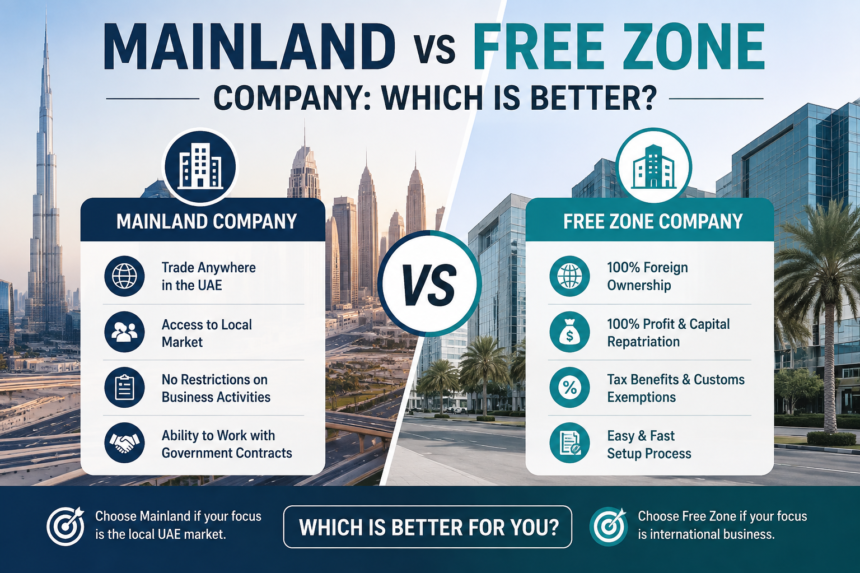
Starting a company in the United Arab Emirates (UAE) is an attractive option for entrepreneurs, investors, start-ups, and international businesses. However, one of the most important decisions you need to make before incorporating a business is choosing between a Mainland company and a Free Zone company.
- Mainland vs Free Zone Company: Quick Comparison
- What Is a Mainland Company in the UAE?
- What Is a Free Zone Company in the UAE?
- Mainland vs Free Zone: Ownership
- Mainland vs Free Zone: Access to the UAE Market
- Mainland vs Free Zone: Corporate Tax
- Mainland vs Free Zone: Business Setup Cost
- Mainland vs Free Zone: Office Requirements
- Mainland vs Free Zone: Visa Options
- Mainland vs Free Zone for Trading Businesses
- Mainland vs Free Zone for Professional Services
- Mainland vs Free Zone for E-Commerce
- Mainland vs Free Zone: Government Contracts
- Advantages of Mainland Company
- Disadvantages of Mainland Company
- Advantages of Free Zone Company
- Disadvantages of Free Zone Company
- Mainland vs Free Zone: Which Is Better for Startups?
- Mainland vs Free Zone: Which Is Better for Foreign Investors?
- Mainland vs Free Zone: Which Is Better for International Business?
- How to Choose Between Mainland and Free Zone
- Mainland vs Free Zone: The Final Verdict
Both business structures offer important advantages, but they are designed for different business objectives. A Mainland company can be particularly suitable for businesses that want direct access to customers across the UAE, while a Free Zone company can be attractive for international trading, specialised activities, and businesses seeking a streamlined setup environment.
The right choice depends on your business activity, target customers, ownership requirements, office needs, budget, tax position, and long-term expansion plans.
This guide explains the key differences between Mainland vs Free Zone companies in the UAE, including ownership, market access, taxation, costs, licensing, visas, office requirements, benefits, limitations, and suitability for different types of businesses.
Mainland vs Free Zone Company: Quick Comparison
Before exploring the details, here is a quick overview:
| Feature | Mainland Company | Free Zone Company |
|---|---|---|
| UAE local market access | Generally broad access | Mainland access is regulated |
| Foreign ownership | 100% available for many activities | Generally 100% foreign ownership |
| International business | Yes | Excellent for international trade |
| Government contracts | Generally suitable | May require additional arrangements |
| Corporate tax | Standard UAE CT rules apply | 0% on qualifying income for eligible QFZPs; 9% on taxable income that is not qualifying |
| Business setup | Depends on activity and emirate | Often streamlined |
| Office options | Flexible, subject to activity/licence requirements | Packages and requirements vary by free zone |
| Business activities | Broad range, subject to licensing | Activity options vary by free zone |
| Mainland sales | Direct | Subject to applicable rules, licences and arrangements |
| Best for | UAE-focused businesses and local operations | International, specialised and free-zone-focused businesses |
It is important to remember that rules can differ by emirate, business activity, regulator, and individual free zone. Therefore, the cheapest or most popular option is not necessarily the best option for every entrepreneur.
What Is a Mainland Company in the UAE?
A Mainland company is a business licensed by the relevant economic department or licensing authority of an emirate to operate in the UAE mainland market.
Mainland businesses can serve customers within the UAE and internationally, subject to their licence and applicable regulatory requirements. The UAE government also allows full foreign ownership for commercial companies in many activities, although certain strategic activities can have specific ownership or regulatory requirements.
For entrepreneurs whose primary objective is to sell products or services directly to customers throughout the UAE, a Mainland structure can provide significant flexibility.
Key Advantages of a Mainland Company
- Access to the UAE mainland market.
- Ability to conduct business across different locations, subject to licensing requirements.
- Potential eligibility for government and private-sector contracts.
- Flexible options for office locations.
- Suitable for businesses targeting UAE residents and companies.
- Broad range of commercial, professional and industrial activities.
- Suitable for businesses planning to expand their physical presence in the UAE.
A Mainland company can therefore be particularly useful for restaurants, retail businesses, professional services, construction companies, consultancies, real estate-related businesses and companies that depend heavily on UAE-based customers.
What Is a Free Zone Company in the UAE?
A Free Zone company is established within one of the UAE’s designated economic free zones. Free zones are designed to provide specialised business environments, modern infrastructure, streamlined administration and access to international markets.
Free Zone businesses generally benefit from full foreign ownership and can conduct international import, export and re-export activities. However, selling directly into the UAE mainland market is regulated and may require a mainland distributor, branch, licence or other applicable arrangement.
There are many free zones across the UAE, with different specialisations. Some focus on logistics and trading, while others specialise in technology, media, finance, manufacturing, healthcare, commodities or professional services.
Key Advantages of a Free Zone Company
- 100% foreign ownership is generally available.
- Streamlined business setup.
- Access to specialised business communities.
- International trading and re-export opportunities.
- Modern infrastructure and business facilities.
- Various office and licensing packages.
- Potential corporate tax advantages for qualifying income.
- Suitable for international entrepreneurs and investors.
The UAE government identifies foreign ownership, simplified procedures, infrastructure and business ecosystems among the advantages offered by free zones.
Mainland vs Free Zone: Ownership
Ownership is one of the most common considerations when comparing Mainland and Free Zone companies.
Today, 100% foreign ownership is available for many mainland commercial activities, meaning foreign investors do not automatically need a UAE national shareholder for many businesses. However, ownership rules can vary for strategic activities and regulated sectors.
Free Zone companies have traditionally been popular with international investors because they generally allow full foreign ownership within the applicable free zone framework.
Which Is Better for Ownership?
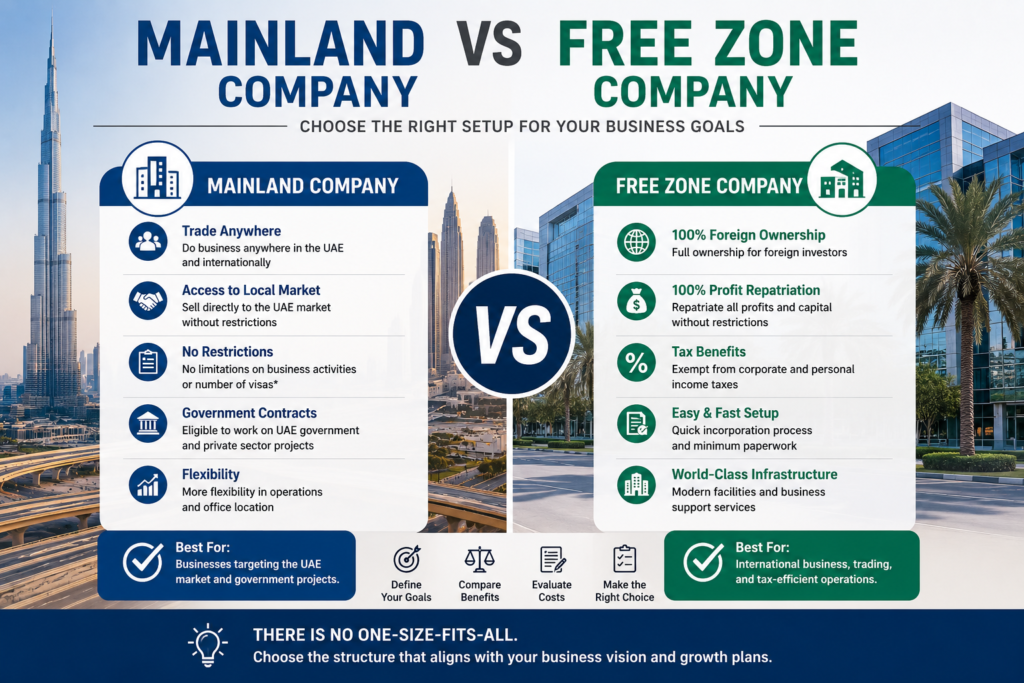
If your business activity qualifies for 100% foreign ownership on the Mainland, the ownership advantage of a Free Zone may be less significant than it once was.
However, a Free Zone can still be attractive because of its specialised regulatory environment and simplified incorporation process.
Mainland vs Free Zone: Access to the UAE Market
Market access is one of the biggest differences between the two structures.
A Mainland company is generally designed to operate directly in the UAE mainland market. This makes it attractive for businesses that depend on local customers, local contracts, physical stores, restaurants, service operations and UAE-based clients.
A Free Zone company can trade internationally and operate within its free zone, but direct access to the mainland market is subject to applicable rules. The UAE government’s official guidance states that Free Zone companies generally need appropriate arrangements, such as a mainland distributor, branch or required mainland licence, to sell goods or services directly in the mainland market.
Choose Mainland if:
- Most of your customers are in the UAE.
- You need to sell directly to mainland customers.
- You want to open outlets across the UAE.
- You plan to work extensively with UAE companies.
- Government contracts are an important part of your strategy.
Choose Free Zone if:
- Most of your customers are outside the UAE.
- You focus on import, export or re-export.
- Your operations are concentrated within a specific free zone.
- You operate in a specialised industry supported by a particular free zone.
Mainland vs Free Zone: Corporate Tax
Tax is another important factor when choosing a business structure.
The UAE Corporate Tax system applies to businesses in the UAE, including businesses operating in Free Zones. However, qualifying Free Zone Persons can benefit from a 0% Corporate Tax rate on Qualifying Income, while taxable income that does not meet the qualifying-income conditions can be subject to the standard 9% rate.
This means entrepreneurs should not assume that every Free Zone company automatically pays zero corporate tax.
To qualify as a Qualifying Free Zone Person, an entity must satisfy specific conditions, including maintaining adequate substance in the UAE, earning qualifying income, complying with transfer pricing requirements and meeting other applicable requirements.
The tax treatment can therefore depend on the company’s activities, customers, transactions, income and compliance position.
Important Tax Considerations
Businesses should consider:
- Whether their income qualifies for the Free Zone 0% rate.
- Whether they conduct excluded activities.
- Where customers and counterparties are located.
- Whether the business has sufficient substance.
- Corporate Tax registration and filing requirements.
- Transfer pricing obligations.
- VAT obligations where applicable.
The Federal Tax Authority makes clear that Free Zone entities are not automatically exempt from Corporate Tax. Qualifying Free Zone Persons can receive 0% on qualifying income, while non-qualifying taxable income can be subject to 9%.
For this reason, tax planning should be based on the actual business model rather than simply choosing a Free Zone because it is advertised as “tax free.”
Mainland vs Free Zone: Business Setup Cost
The cost of establishing a company varies significantly depending on the emirate, business activity, licence type, office requirements, number of visas, legal structure and other government or regulatory fees.
Free zones often provide packaged incorporation options, which can make initial budgeting easier. Some offer low-cost packages for startups and freelancers, while others are designed for larger companies and international investors.
Mainland setup costs can also be competitive, particularly when a business needs flexibility to operate directly across the UAE.
Costs You Should Consider
Do not compare only the advertised licence price. Consider the complete annual cost, including:
- Trade licence fees.
- Registration fees.
- Office or workspace costs.
- Visa costs.
- Establishment or immigration-related charges.
- Government approvals.
- Regulatory approvals for specialised activities.
- Corporate Tax compliance.
- Accounting and bookkeeping.
- Audit requirements, where applicable.
- VAT compliance, where applicable.
- Renewal fees.
- Customs and import-related costs for trading businesses.
A Free Zone package may appear cheaper initially, but additional office, visa, activity or compliance requirements can affect the final cost.
Mainland vs Free Zone: Office Requirements
Office requirements differ according to the business activity and licensing authority.
Mainland businesses may have a wider choice of office locations, although certain activities can have specific premises requirements.
Free zones often offer different workspace options, including shared offices, flexi-desk arrangements, serviced offices, warehouses and dedicated commercial premises. The available options depend on the individual free zone and business activity.
For a small consultancy, for example, a flexible office package may be sufficient. A manufacturing company, on the other hand, may require a warehouse or industrial facility.
Therefore, office requirements should be evaluated according to the actual business operation rather than simply the licence price.
Mainland vs Free Zone: Visa Options
Both Mainland and Free Zone companies can potentially sponsor employees and obtain investor or partner visas, subject to the applicable immigration rules and the company’s licence, office capacity and other requirements.
The number of visas available can depend on factors such as:
- Office size.
- Business activity.
- Licence type.
- Immigration regulations.
- Free zone rules.
- Number of employees.
- Company structure.
If hiring a large workforce is central to your business plan, compare visa capacity and workspace requirements before selecting a jurisdiction.
Mainland vs Free Zone for Trading Businesses
Trading companies need to pay special attention to customs, logistics, warehousing and market access.
Free zones can be highly attractive for import, export and re-export businesses because they provide access to logistics infrastructure and international trade networks. The UAE government notes that Free Zones facilitate import, export and re-export activities, with customs arrangements applying according to the applicable rules.
A business that imports products, stores them in a warehouse and then exports them to other countries may find a Free Zone particularly suitable.
However, a business that primarily imports products and sells them directly to customers throughout the UAE may find a Mainland structure more practical, depending on the activity and distribution model.
Mainland vs Free Zone for Professional Services
Consultants, marketing agencies, technology companies, designers, software businesses and other professional service providers can consider both structures.
A Free Zone can be attractive when the business focuses on international clients or wants to benefit from a specialised business ecosystem.
A Mainland company may be preferable when the business intends to build a large UAE client base and conduct direct local operations.
For example, a consulting firm serving international clients could find a Free Zone structure suitable, while a local facilities-management or contracting business may benefit from a Mainland setup.
Mainland vs Free Zone for E-Commerce
E-commerce entrepreneurs should look beyond the website and consider where their customers are located.
If an online business mainly serves UAE customers, a Mainland setup may offer a more straightforward structure for local operations, subject to the relevant licence and activity requirements.
If the company primarily imports products, stores them in a free-zone facility and exports them internationally, a Free Zone may offer advantages.
The ideal structure therefore depends on the company’s fulfilment model, warehouse location, customer base, product category and distribution arrangements.
Mainland vs Free Zone: Government Contracts
Businesses that want to participate extensively in UAE government projects should carefully examine licensing and procurement requirements.
A Mainland company can be advantageous for businesses whose strategy involves direct participation in UAE public-sector projects. Depending on the project and authority, additional registration, classification, approvals or sector-specific requirements may apply.
Free Zone businesses may also participate in various commercial activities, but government procurement requirements should be checked on a project-by-project basis.
If government contracts represent a major part of your expected revenue, investigate the relevant procurement and licensing requirements before incorporation.
Advantages of Mainland Company
A Mainland company may be the better choice if your priority is broad UAE market access.
Main benefits include:
- Direct access to the mainland market.
- Strong suitability for UAE-focused businesses.
- Flexibility to serve customers across different emirates.
- Potential access to government and large private-sector contracts.
- Wide range of business activities.
- Flexible location options.
- Suitable for retail, restaurants, contracting and many professional services.
- Good option for businesses planning extensive local expansion.
Disadvantages of Mainland Company
Despite its flexibility, a Mainland company may not be ideal for every entrepreneur.
Potential considerations include:
- Licensing requirements can vary by activity.
- Certain activities require additional approvals.
- Office requirements may increase operating costs.
- Regulated industries can involve additional compliance.
- Corporate Tax and other regulatory obligations must be managed.
- Total setup costs depend heavily on business activity and operating requirements.
Advantages of Free Zone Company
Free Zone companies remain popular because they provide a business-friendly environment for international investors.
Main benefits include:
- Generally full foreign ownership.
- Streamlined incorporation.
- International trade opportunities.
- Specialised industry ecosystems.
- Modern infrastructure.
- Flexible office packages in many free zones.
- Potential 0% Corporate Tax on qualifying income for qualifying Free Zone Persons.
- Convenient options for startups and international entrepreneurs.
- Strong logistics advantages in relevant free zones.
Disadvantages of Free Zone Company
A Free Zone company also has limitations that should be considered.
Potential challenges include:
- Direct mainland sales can be subject to regulatory requirements.
- Free Zone licences are often tied to specific activities.
- Some free zones have restrictions or conditions relating to office space and visas.
- Tax benefits depend on meeting the relevant requirements.
- Different free zones have different fee structures and regulations.
- A business may need additional arrangements if it wants to expand significantly into the mainland market.
The UAE government specifically notes that Free Zone companies operate under a separate framework and that mainland access is regulated.
Mainland vs Free Zone: Which Is Better for Startups?
For startups, the answer depends primarily on the target market and business model.
A startup serving UAE consumers directly may prefer a Mainland company because local market access is central to its business model.
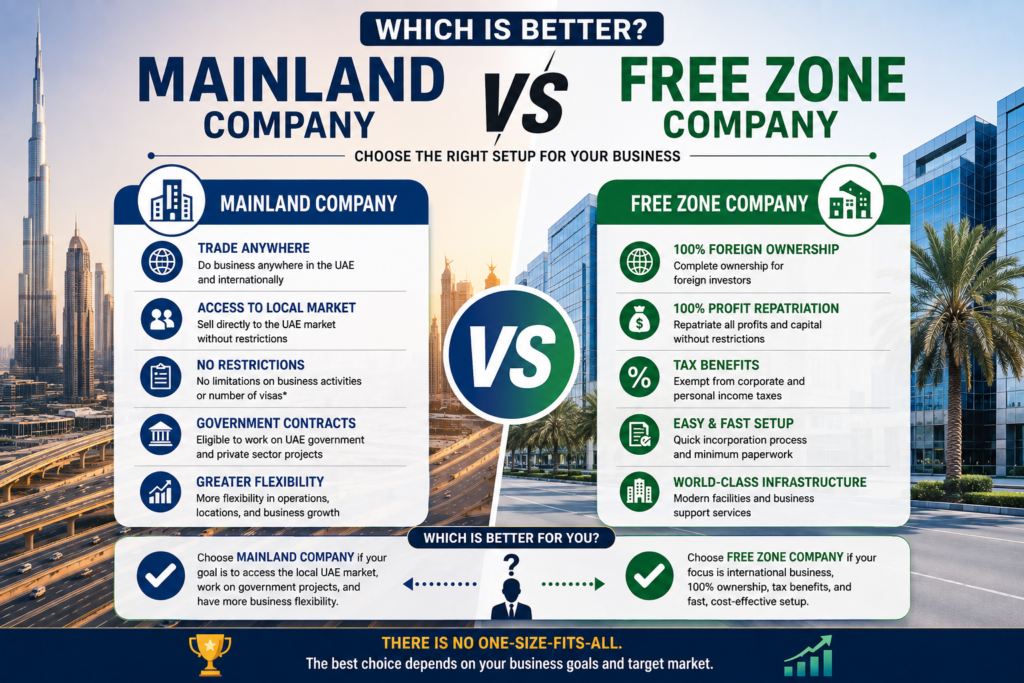
A technology startup selling software internationally may prefer a Free Zone that offers suitable technology infrastructure, networking opportunities and business support.
Startups should compare the total cost of ownership rather than focusing only on the initial registration fee.
Mainland vs Free Zone: Which Is Better for Foreign Investors?
Foreign investors can benefit from both options.
Free Zones are particularly attractive because they generally offer full foreign ownership and simplified incorporation environments.
However, Mainland companies can also provide full foreign ownership for many activities under current UAE rules.
Therefore, foreign investors should focus on the business objective rather than assuming that Free Zone automatically means better ownership terms.
Mainland vs Free Zone: Which Is Better for International Business?
For companies focused on international trade, import, export, re-export or cross-border services, a Free Zone can be highly attractive.
Free Zones are designed to support international commerce and often provide strategic access to airports, ports, warehouses and logistics networks.
However, a Mainland company can also conduct international business. The key difference is whether the company also needs extensive direct access to the UAE domestic market.
How to Choose Between Mainland and Free Zone
Before making a final decision, ask the following questions:
- Where are my customers located?
If most customers are in the UAE mainland, Mainland may be more practical. - Do I need direct UAE market access?
If yes, examine Mainland licensing and applicable Free Zone mainland-access requirements carefully. - Will I import and export goods?
A Free Zone may offer strong logistical advantages. - What is my exact business activity?
Some activities are better suited to specific jurisdictions and may require additional approvals. - How many employees will I hire?
Compare visa and office requirements. - Do I need a physical retail location?
Mainland may be more suitable for businesses dependent on local storefronts. - Will I work with government entities?
Check procurement and licensing requirements before deciding. - Does tax treatment matter to my business model?
Do not assume all Free Zone income qualifies for 0% Corporate Tax. - Where do I want the company to be in five years?
Choose a structure that supports long-term expansion rather than only today’s needs.
Mainland vs Free Zone: The Final Verdict
So, which is better: Mainland or Free Zone?
There is no universal answer.
A Mainland company is generally better for businesses that prioritise direct access to the UAE domestic market, local customers, physical operations, government opportunities and broad UAE expansion.
A Free Zone company can be better for businesses focused on international trade, specialised industries, international clients, re-export activities and a streamlined business environment.
The decision should be based on your business activity, target market, operational requirements, tax position and expansion plans.
Choose Mainland if:
- Your main customers are in the UAE.
- You need direct mainland market access.
- You plan to operate retail outlets or physical locations.
- You want broad local business flexibility.
- Government or major UAE contracts are important.
- You expect significant domestic expansion.
Choose Free Zone if:
- Your business is internationally focused.
- You primarily import, export or re-export.
- You want to operate within a specialised business ecosystem.
- You want a streamlined incorporation process.
- Your business can operate effectively within the Free Zone framework.
- Your income and activities can meet the requirements for applicable Free Zone Corporate Tax benefits.
Conclusion
Choosing between a Mainland vs Free Zone company in the UAE is one of the most important decisions for a new business. Both structures provide significant opportunities, but the best option depends on how you plan to operate.
Mainland companies offer strong access to the UAE domestic market and can be particularly suitable for businesses with local customers, physical operations and ambitious UAE expansion plans. Free Zone companies, meanwhile, can provide an attractive environment for international businesses, specialised activities, import-export operations and entrepreneurs looking for streamlined setup options.
Tax should also be considered carefully. Free Zone companies can benefit from a 0% Corporate Tax rate on qualifying income when they satisfy the applicable conditions, but Free Zone status does not automatically make all company income tax-free.
Ultimately, the best business structure is the one that matches your business activity, customers, budget, ownership requirements, operational model and long-term goals.
Before incorporating, compare the specific licensing authority, business activity, office requirements, visa options, tax obligations and market-access rules that apply to your proposed company. Regulations and requirements can change, so entrepreneurs should verify the latest requirements with the relevant UAE authority or qualified business adviser before making a final decision.
Do follow us on Instagram
Read More – Freelance Visa vs Company Setup in Dubai Which One Should You Choose?