



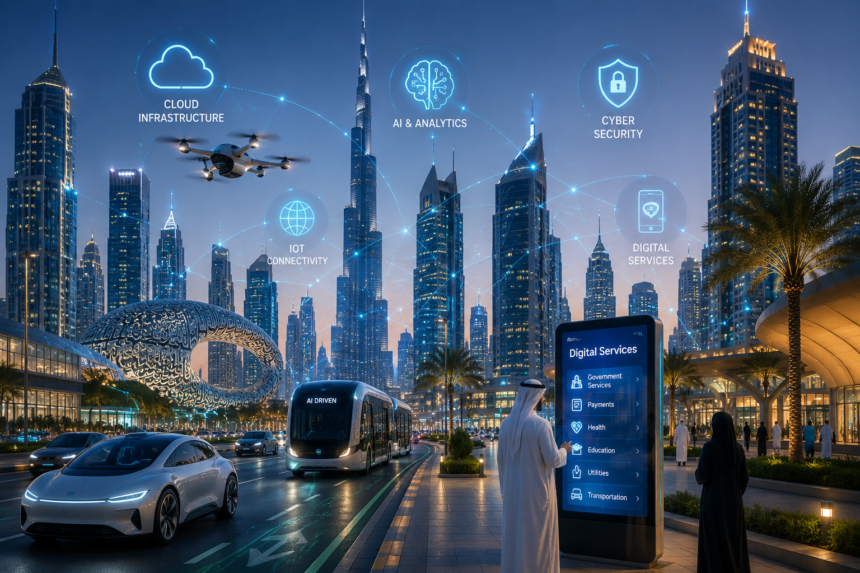
From AI to Smart Cities: How Technology Is Changing the Gulf
For decades, Gulf economies were primarily associated with oil, gas, construction and large infrastructure projects. Today, another transformation is taking place. Governments, businesses and consumers across the region are becoming increasingly digital.
- What Does Digital Transformation in Gulf Regions Actually Mean?
- Why Gulf Countries Are Investing So Heavily in Digital Transformation
- Saudi Arabia Is Using Technology to Support Vision 2030
- Digital Government Is Changing Everyday Life
- Gulf Governments Are Moving Toward Connected Services
- Artificial Intelligence Is Accelerating the Gulf’s Digital Transformation
- Data Centres Are Becoming the New Digital Infrastructure
- Cloud Computing Is Changing How Gulf Businesses Operate
- FinTech Is Changing How Money Moves
- E-commerce Is Transforming Gulf Retail
- Smart Cities Are Turning Digital Technology Into Physical Infrastructure
- Healthcare Is Becoming More Digital
- Digital Transformation Is Changing Gulf Tourism
- Logistics and Ports Are Becoming Smarter
- Energy Companies Are Becoming Technology Companies Too
- Cybersecurity Is Becoming Critical Infrastructure
- Digital Transformation Is Creating New Careers
- Human Skills Could Become More Valuable, Not Less
- SMEs Could Benefit From Digital Transformation
- Digital Transformation Could Make the GCC More Connected
- Biggest Areas Being Changed by Digital Transformation
- What Are the Biggest Challenges?
- What Could the Digital Gulf Look Like by 2030?
- FAQs About Digital Transformation in Gulf Regions
- Conclusion
Digital Transformation in Gulf Regions is changing how people access government services, make payments, receive healthcare, operate businesses, shop, travel and work. Artificial intelligence, cloud computing, 5G, digital payments, smart-city technology and data-driven services are moving from experimental projects into everyday economic infrastructure.
The scale of this shift is significant. The World Bank’s 2025 Gulf Economic Update described digital transformation as a powerful engine for economic diversification and reported that all GCC countries now have advanced telecommunications networks, with 5G coverage exceeding 90%. It also highlighted major investments in data centres and high-performance computing, with Saudi Arabia and the UAE emerging as regional leaders in AI readiness.
This means the Gulf’s digital transformation is no longer simply about replacing paperwork with apps.
It is becoming part of a much larger effort to build more diversified, productive and technology-driven economies.
What Does Digital Transformation in Gulf Regions Actually Mean?
Digital transformation is sometimes confused with simply using more technology.
The real concept is broader.
A company scanning paper documents into PDFs has digitized information.
A company redesigning its entire operation around cloud systems, automation, data and artificial intelligence is undergoing digital transformation.
The same principle applies to governments.
Digital transformation can involve:
- moving public services online,
- introducing digital identities,
- automating administrative processes,
- using cloud infrastructure,
- integrating artificial intelligence,
- building smart-city systems,
- adopting digital payments,
- analysing large datasets,
- strengthening cybersecurity,
- and connecting previously separate government systems.
The ultimate goal is not technology itself.
It is better outcomes through technology.
For governments, that may mean faster services.
For companies, it can mean greater productivity.
For consumers, it often means convenience.
For economies, it can create entirely new industries.
Why Gulf Countries Are Investing So Heavily in Digital Transformation
The Gulf Cooperation Council includes Saudi Arabia, the UAE, Qatar, Kuwait, Bahrain and Oman.
Although their economies differ in size and structure, they share an important strategic challenge: building sustainable economic growth beyond hydrocarbons.
Digital technology provides one path toward that diversification.
Technology can create new industries without depending directly on oil production.
Software companies can export services.
FinTech companies can modernize finance.
AI startups can develop intellectual property.
E-commerce can help small businesses reach larger markets.
Cloud computing can support thousands of companies simultaneously.
Digital transformation can also make established industries more productive.
An oil company can use AI for predictive maintenance.
A logistics company can optimize routes.
A hospital can analyse medical images.
A government can automate routine processes.
This explains why digitalization increasingly appears alongside economic diversification in national development strategies.
The World Bank argues that diversification and digital transformation are now essential to the Gulf’s long-term stability and prosperity.
Suggested image placement: GCC map connected through digital networks, data centres and smart cities.
Saudi Arabia Is Using Technology to Support Vision 2030
Saudi Arabia offers one of the clearest examples of digital transformation being connected directly to national economic strategy.
Under Saudi Vision 2030, digital transformation has become an important enabler of government efficiency, private-sector development and economic competitiveness.
The Kingdom has invested heavily in:
- cloud computing,
- artificial intelligence,
- cybersecurity,
- digital government,
- digital identity,
- telecommunications,
- and data infrastructure.
Its digital government ecosystem includes platforms and institutions such as Absher, Nafath, the Digital Government Authority and the Saudi Data and AI Authority.
Saudi Arabia’s 2025 National Transformation Program report says government digital transformation reached 88.3%, while digital government initiatives generated more than $2.4 billion in savings during 2025.
This illustrates one of the most practical benefits of digital transformation.
Technology can improve services while also reducing administrative costs.
Digital Government Is Changing Everyday Life
One of the most visible changes across Gulf countries is the movement of government services online.
Traditionally, many administrative processes required physical visits, paperwork and waiting.
Digital government changes that experience.
Residents can increasingly access services through websites, applications and integrated government platforms.
The UAE’s digital transformation framework, for example, focuses on digital services, platforms, proactive services and more personalized user experiences.
This can affect routine activities such as:
- paying government fees,
- accessing documents,
- managing visas,
- interacting with municipalities,
- using healthcare services,
- accessing business services,
- and completing administrative applications.
The biggest benefit is often not dramatic.
It is time.
A process that previously required visiting an office may increasingly be completed from a smartphone.
Multiply those saved hours across millions of residents and businesses, and the economic impact becomes substantial.
Gulf Governments Are Moving Toward Connected Services
The next stage goes beyond putting individual services online.
Governments increasingly want systems to communicate with one another.
The UAE describes this as a whole-of-government approach, moving away from isolated administrative silos toward connected networks capable of providing more personalized and accessible public services.
This creates the possibility of services becoming more proactive.
Instead of a resident repeatedly submitting the same information to different departments, authorized government systems could potentially share relevant data.
Instead of waiting for someone to discover which service they need, a digital system could guide them automatically.
This changes the relationship between citizens and government.
The traditional model is:
Find department → Submit request → Wait → Follow up
The emerging model could increasingly become:
Life event → Digital identification → Connected services → Automatic or simplified completion
That is a much deeper transformation than simply creating government websites.
Artificial Intelligence Is Accelerating the Gulf’s Digital Transformation
AI is becoming one of the biggest forces behind the next phase of digital transformation.
The World Bank’s latest Gulf analysis highlights accelerating AI adoption across GCC economies, supported by advanced connectivity, data centres and high-performance computing infrastructure.
AI can analyse enormous amounts of information and identify patterns far faster than manual processes.
Potential Gulf applications include:
- government-service automation,
- medical diagnostics,
- financial fraud detection,
- logistics optimization,
- predictive maintenance,
- customer support,
- energy management,
- cybersecurity,
- education,
- and smart-city operations.
Saudi Arabia and the UAE are particularly active in this field.
Saudi Arabia’s Vision 2030 Annual Report 2025 describes the country’s transition toward a digital and knowledge economy as being supported by investment in technology, infrastructure, research and education.
AI therefore represents more than another software trend.
It could become an operating layer across the Gulf’s digital economy.
Data Centres Are Becoming the New Digital Infrastructure
Traditional economies depend on roads, ports and electricity networks.
Digital economies depend increasingly on another form of infrastructure: computing.
Every cloud application, AI model, digital payment and online government service requires physical computing infrastructure somewhere.
That is why data centres are becoming strategically important across the Gulf.
Countries are investing in:
- cloud regions,
- data centres,
- high-performance computing,
- AI infrastructure,
- network connectivity,
- and cybersecurity.
The World Bank specifically identifies significant GCC investment in data centres and high-performance computing as a major contributor to AI readiness.
This is an important change in how infrastructure should be understood.
A large data centre may not be as visually iconic as a skyscraper or airport.
But economically, it can be just as important.
Thousands of businesses can build digital services on top of that computing capacity.
Cloud Computing Is Changing How Gulf Businesses Operate
Before cloud computing, companies often purchased and maintained their own physical servers.
That required capital, IT teams, maintenance and continuous upgrades.
Cloud technology allows businesses to access computing resources as services.
This can help companies scale more quickly and experiment with new products without purchasing all the infrastructure themselves.
The World Bank describes cloud computing as an important component of government digital transformation because it can improve scalability, efficiency and sustainability, while also creating issues around privacy, cybersecurity and data sovereignty.
For Gulf businesses, cloud adoption can support:
- remote working,
- digital applications,
- AI systems,
- data analytics,
- online collaboration,
- cybersecurity,
- and business automation.
Cloud computing is particularly valuable for startups.
A small company can potentially access sophisticated infrastructure that once would have required significant upfront investment.
FinTech Is Changing How Money Moves
Financial services are one of the most visible areas of Gulf digital transformation.
Consumers increasingly use:
- mobile banking,
- digital wallets,
- contactless payments,
- instant transfers,
- digital investment platforms,
- and online financial services.
Behind the scenes, banks and FinTech companies are investing in automation, AI, open banking and cloud technology.
This affects both consumers and businesses.
A small company can collect digital payments.
An employee can transfer money internationally from a phone.
A bank can use AI to identify suspicious transactions.
A consumer can apply for certain financial products without visiting a branch.
As these systems mature, financial services become less connected to physical locations.
Banking becomes something that happens inside the wider digital economy.
E-commerce Is Transforming Gulf Retail
Digital transformation is also changing how Gulf consumers shop.
Shopping malls remain important parts of life in cities such as Dubai, Riyadh, Doha and Kuwait City.
But the smartphone has become another major retail destination.
Consumers can discover a product through social media, compare prices online, pay digitally and receive it at home.
This has created opportunities across:
- online marketplaces,
- digital payments,
- delivery,
- warehousing,
- social commerce,
- online marketing,
- and retail technology.
The transformation also affects traditional retailers.
Physical stores increasingly connect with digital channels through click-and-collect services, online inventory, mobile loyalty programs and home delivery.
The future is therefore unlikely to be physical retail versus e-commerce.
It is more likely to be a connected system where customers move freely between both.
Smart Cities Are Turning Digital Technology Into Physical Infrastructure
Digital transformation becomes particularly interesting when it moves beyond screens.
Smart-city technology connects physical infrastructure with data.
Sensors, cameras, networks and software can help cities understand what is happening in real time.
Potential applications include:
- traffic management,
- parking,
- energy consumption,
- waste management,
- public safety,
- water systems,
- public transportation,
- and environmental monitoring.
AI can make these systems even more intelligent.
For example, instead of traffic signals operating on fixed schedules, smart systems can potentially respond to changing traffic conditions.
Buildings can adjust cooling according to occupancy.
Energy networks can forecast demand.
Public transport systems can analyse passenger patterns.
This turns a city into a continuously evolving data environment.
Healthcare Is Becoming More Digital
Healthcare is another area where technology could directly improve people’s lives.
Digital health can include:
- telemedicine,
- electronic health records,
- AI diagnostics,
- medical imaging,
- remote patient monitoring,
- digital appointments,
- and automated hospital operations.
AI systems can help medical professionals analyse information faster.
For example, software may highlight suspicious areas in a medical scan for a doctor to examine.
Digital records can also make patient information easier for authorized healthcare professionals to access.
But healthcare digitalization requires particularly strong safeguards.
Medical data is highly sensitive.
Systems need security, privacy, accuracy and clear human oversight.
The goal should be to help healthcare professionals make better decisions, not simply automate medicine for the sake of technology.
Digital Transformation Is Changing Gulf Tourism
Tourism is strategically important across several Gulf economies.
Technology increasingly influences the entire visitor journey.
Before arriving, travellers may use AI-powered search tools to plan trips.
At airports, digital systems can streamline processes.
Hotels can personalize services through apps and customer data.
Tourists can use digital maps, mobile payments, translation tools and smart transportation.
Technology can also help tourism authorities understand visitor behavior and demand patterns.
The future tourist experience could become increasingly personalized.
Instead of spending hours building an itinerary manually, an AI travel assistant might create recommendations based on:
- budget,
- location,
- interests,
- available time,
- weather,
- and real-time availability.
Digital transformation therefore does not replace tourism.
It changes how tourism is experienced.
Logistics and Ports Are Becoming Smarter

The Gulf’s geographical position makes logistics strategically important.
Major ports, airports and logistics centres connect Europe, Asia and Africa.
Digital technologies can improve these networks.
AI and data analytics can help companies predict demand, optimize routes and manage warehouses.
Internet-connected sensors can track shipments.
Automated systems can manage inventory.
Digital documentation can reduce paperwork.
Predictive maintenance can identify equipment problems before machinery fails.
Even small efficiency improvements can matter significantly when applied across enormous logistics networks.
This makes digital transformation particularly valuable for economies positioning themselves as international trade hubs.
Energy Companies Are Becoming Technology Companies Too
Digital transformation is also changing traditional Gulf industries.
Oil and gas companies increasingly use advanced technology for:
- predictive maintenance,
- remote monitoring,
- automated inspections,
- geological analysis,
- safety,
- and operational optimization.
Renewable-energy systems similarly depend on data.
Solar farms can use AI to predict generation.
Smart grids can balance electricity supply and demand.
Buildings can automatically reduce unnecessary energy use.
This demonstrates an important point about economic diversification.
Digital transformation does not always mean replacing traditional industries.
Sometimes it means making those industries smarter, safer and more productive.
Cybersecurity Is Becoming Critical Infrastructure
Every benefit of digital transformation creates a corresponding security challenge.
Moving services online increases convenience.
It also creates more potential attack surfaces.
Connecting infrastructure creates valuable data.
It also creates cybersecurity risks.
Using AI improves automation.
Attackers can use AI too.
Cybersecurity therefore becomes increasingly important as Gulf economies digitalize.
Organizations need to protect:
- customer data,
- financial transactions,
- government systems,
- cloud infrastructure,
- healthcare information,
- and critical infrastructure.
The more valuable the digital economy becomes, the more valuable its information becomes to criminals.
Cybersecurity can no longer be treated as an optional IT expense.
It is becoming part of the infrastructure required for digital trust.
Digital Transformation Is Creating New Careers
One of the biggest questions is what digital transformation means for workers.
Some repetitive tasks will become automated.
But technology is also creating new roles.
High-growth areas can include:
- artificial intelligence,
- cybersecurity,
- cloud computing,
- software development,
- data science,
- digital marketing,
- FinTech,
- e-commerce,
- UX design,
- automation,
- and technology project management.
Saudi Arabia’s digital transformation strategy, for example, explicitly connects the digital and knowledge economy with new opportunities for employment and growth.
However, the biggest change may happen inside traditional professions.
An accountant may use AI.
A doctor may use digital diagnostics.
A marketer may work with automated analytics.
An engineer may use digital twins.
A journalist may use data tools.
The future workforce will therefore need digital skills even when the job itself is not classified as a technology job.
Human Skills Could Become More Valuable, Not Less
Automation creates an interesting paradox.
As machines become better at routine tasks, certain human abilities may become more important.
These include:
- critical thinking,
- creativity,
- communication,
- leadership,
- judgment,
- negotiation,
- and empathy.
An AI system can summarize information.
A manager still needs to decide what to do with it.
Software can generate marketing ideas.
A creative professional still needs to understand culture and audience.
An algorithm can detect patterns in medical information.
A doctor remains responsible for interpreting the wider clinical situation.
This means the most valuable workers may not necessarily be those who compete directly with technology.
They may be those who know how to work effectively with it.
SMEs Could Benefit From Digital Transformation
Large corporations can afford enormous technology departments.
Small businesses usually cannot.
Cloud computing and AI are beginning to change that equation.
A small company can now access tools for:
- accounting,
- customer service,
- marketing,
- design,
- inventory,
- analytics,
- e-commerce,
- and automation.
Many are available through relatively affordable subscriptions.
This allows small teams to perform tasks that once required larger departments.
The World Bank has specifically recommended supporting GCC SMEs in adopting AI as part of the region’s digital transformation.
This could become particularly important for economic diversification because SMEs are major sources of entrepreneurship and employment.
Digital Transformation Could Make the GCC More Connected
The six GCC economies have their own regulations, strategies and technology ecosystems.
But digitalization also creates opportunities for regional integration.
Imagine increasingly connected systems for:
- payments,
- digital identities,
- trade documentation,
- customs,
- business services,
- logistics,
- and data exchange.
A more connected digital market could make it easier for Gulf businesses to expand across neighboring countries.
The World Bank has highlighted regional cooperation on digital infrastructure and AI centres of excellence as important steps toward building a more unified digital market.
That could make the combined GCC technology market significantly more attractive.
A startup would no longer think only about customers in one city.
It could build for an increasingly interconnected regional economy.
Biggest Areas Being Changed by Digital Transformation
| Sector | Major Digital Change |
|---|---|
| Government | Online and proactive public services |
| Banking | Digital payments, FinTech and AI |
| Healthcare | Digital records and AI-assisted diagnostics |
| Retail | E-commerce and omnichannel shopping |
| Transport | Smart mobility and intelligent traffic systems |
| Logistics | Automation and data-driven supply chains |
| Energy | AI, smart grids and predictive maintenance |
| Tourism | Personalized digital travel experiences |
| Business | Cloud computing and automation |
| Employment | New digital careers and changing skill requirements |
| Cities | Connected infrastructure and smart services |
| Cybersecurity | Greater protection of digital infrastructure |
The important point is that these changes do not happen independently.
They reinforce each other.
Cloud infrastructure enables AI.
AI improves government services.
Digital identity supports financial services.
Digital payments support e-commerce.
5G connects smart infrastructure.
Cybersecurity protects the entire system.
What Are the Biggest Challenges?
The Gulf’s digital transformation creates major opportunities, but it also introduces difficult challenges.
Skills shortages could become a significant issue.
Advanced digital economies need engineers, researchers, cybersecurity specialists and data professionals.
Cybersecurity becomes increasingly important as more critical services move online.
Privacy requires clear rules around how information is collected, stored and used.
AI governance will become more important as automated systems influence real-world decisions.
Workforce disruption could affect employees whose routine tasks become automated.
Digital inclusion also matters. Services should remain accessible to people with different abilities and levels of technical knowledge.
The World Bank has emphasized reskilling, SME adoption, innovation ecosystems and regional cooperation as important priorities for maximizing the Gulf’s digital transformation.
What Could the Digital Gulf Look Like by 2030?
By 2030, the phrase “digital transformation” may sound increasingly outdated.
Why?
Because digital technology may simply become the normal way the economy works.
Residents could interact with governments through intelligent digital assistants.
AI could manage routine business workflows.
Healthcare systems could use predictive analytics.
Banks could provide increasingly personalized financial services.
Smart-city infrastructure could adjust automatically according to demand.
Autonomous systems could become more common in logistics and transportation.
Businesses could operate across borders through cloud-based platforms.
Workers could collaborate with AI throughout the working day.
The transformation will therefore move from digitizing individual processes to connecting entire economic systems.
That is when its biggest impact could become visible.
FAQs About Digital Transformation in Gulf Regions
What is Digital Transformation in Gulf Regions?
It refers to the adoption of technologies such as AI, cloud computing, digital government, 5G, digital payments, cybersecurity and smart-city infrastructure across Saudi Arabia, the UAE, Qatar, Kuwait, Bahrain and Oman.
Why are Gulf countries investing in digital transformation?
Digital transformation supports economic diversification, government efficiency, private-sector productivity and the creation of new industries beyond traditional hydrocarbon sectors. The World Bank describes it as an important engine for GCC economic diversification.
Which Gulf countries are leading digital transformation?
All six GCC countries are investing in digital infrastructure. Saudi Arabia and the UAE have become particularly prominent in areas such as AI, data centres, digital government and startup ecosystems.
How is digital transformation changing jobs in the Gulf?
Automation is changing repetitive work while creating opportunities in AI, cybersecurity, software, cloud computing, data science, digital marketing, e-commerce and related fields. Traditional professions are also becoming more technology-driven.
How is AI being used in Gulf countries?
Potential applications include government services, healthcare, banking, logistics, energy, cybersecurity, education and smart-city management.
Why is 5G important for Gulf digital transformation?
Fast mobile connectivity supports cloud applications, IoT systems, smart infrastructure and advanced digital services. The World Bank reported that 5G coverage exceeds 90% across GCC countries.
What are the main challenges of digital transformation in the GCC?
Cybersecurity, privacy, digital skills, AI governance, workforce disruption and ensuring smaller businesses can access advanced technologies are among the key challenges.
Conclusion
Digital Transformation in Gulf Regions is becoming one of the most important forces reshaping the economic future of the Middle East.
Saudi Arabia, the UAE, Qatar, Bahrain, Oman and Kuwait are investing in connectivity, digital government, cloud infrastructure, artificial intelligence, cybersecurity and new technology businesses.
The foundations are already substantial. According to the World Bank, all GCC countries now have advanced telecommunications networks with more than 90% 5G coverage, while investment in data centres and high-performance computing is strengthening the region’s AI capabilities.
But technology itself is not the most important part of this transformation.
What matters is what people can do with it.
A resident can access government services more easily.
A small business can reach customers digitally.
A hospital can analyse information faster.
A bank can detect fraud more effectively.
A logistics company can optimize thousands of deliveries.
A young professional can build a career in an industry that barely existed a generation ago.
There are still significant challenges involving skills, privacy, cybersecurity, regulation and the impact of automation on employment.
Yet the direction is becoming increasingly clear.
The Gulf is moving from an economy that simply uses digital technology toward one where digital infrastructure, AI and data are increasingly built into how governments, businesses and cities operate.
And that transformation could prove just as important to the region’s next economic chapter as the physical infrastructure that shaped the Gulf’s previous one.
follow us on Instagram
Read More – Cybersecurity Careers in Dubai: Skills, Jobs and Opportunities in a Digital Economy