


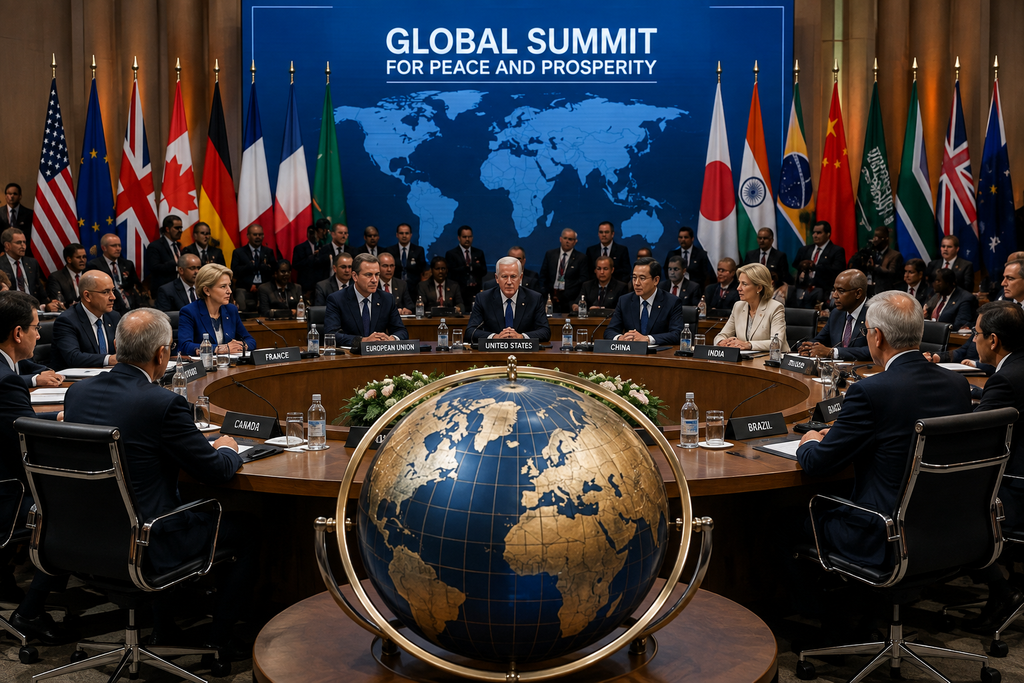
World leaders and international summit setting with a globe in the foreground.
The world in 2026 is being shaped by several major forces at the same time. Wars continue to influence international security, trade tensions are affecting major economies, artificial intelligence has become part of geopolitical competition, and instability in the Middle East is once again influencing global energy markets.
- 1. The Russia Ukraine War Remains a Major Global Security Crisis
- 2. Middle East Tensions Are Again Affecting Global Energy Security
- 3. Iran Has Become One of the Biggest Geopolitical Stories of 2026
- 4. The Gaza Conflict Remains Politically Unresolved
- 5. Trade Tensions Are Reshaping the Global Economy
- 6. The Global Economy Is Facing a New Sovereign Debt Challenge
- 7. Artificial Intelligence Has Become a Geopolitical Competition
- 8. Robots Are Moving From Demonstrations to Real Work
- 9. AI and Technology Companies Are Gaining Political Influence
- 10. North Korea Remains a Major Nuclear Security Concern
- 11. Diplomacy Still Matters Even During Major Conflicts
- 12. Energy Security Is Returning to the Centre of World Politics
- Major Global Issues to Watch in 2026
- How Readers Should Follow World News More Effectively
- FAQs About World News and Current Affairs 2026
- Conclusion
Understanding World News and Current Affairs 2026 therefore requires looking beyond individual headlines.
A missile strike in Ukraine can affect European security. Tension in the Strait of Hormuz can influence oil prices thousands of kilometres away. A tariff decision between the United States and Canada can affect businesses and consumers. Competition between Washington and Beijing over artificial intelligence can shape how technology develops globally.
As of August 20, 2026, several major developments illustrate how interconnected global politics, economics and technology have become. Recent Russian strikes have intensified concerns over the Ukraine war, Middle East tensions continue around Iran and the Strait of Hormuz, and the United States is increasingly treating AI competition with China as a strategic issue.
Here are the major global trends shaping current affairs in 2026 and why they matter.
1. The Russia Ukraine War Remains a Major Global Security Crisis
More than four years after Russia launched its full-scale invasion of Ukraine in February 2022, the conflict continues to influence European and international politics.
The war has evolved through different stages, but missile attacks, drone warfare and pressure on critical infrastructure remain major features.
On August 20, 2026, Russian strikes killed 16 people in Kyiv and the surrounding region and injured more than 40, according to Ukrainian authorities cited by Reuters. Ukraine said the assault involved ballistic, cruise and hypersonic missiles alongside 168 drones.
The attack highlighted one of Ukraine’s most important challenges: air defence.
Ukrainian President Volodymyr Zelenskiy said shortages of air-defence missiles were costing lives, increasing pressure on Kyiv’s international partners to continue military support.
At the same time, limited humanitarian cooperation continues.
Russia and Ukraine exchanged 103 prisoners of war each on August 19, showing that some communication channels remain active even while broader peace negotiations remain deeply divided.
Why the Ukraine War Still Matters Globally
The conflict affects much more than Russia and Ukraine.
It influences:
- European defence spending
- NATO strategy
- energy security
- agricultural exports
- sanctions
- global grain markets
- weapons production
- relations between Russia and Western governments
The Black Sea has also remained strategically important because both Russia and Ukraine use it for trade and military operations.
Russia rejected the idea of a Black Sea ceasefire in August 2026 amid continuing attacks affecting commercial shipping. Concerns over maritime security have contributed to uncertainty around agricultural exports and global food prices.
The war therefore remains one of the defining stories in global current affairs.
Suggested image placement: Map showing Ukraine, Russia and the Black Sea with subtle geopolitical graphics.
2. Middle East Tensions Are Again Affecting Global Energy Security
The Middle East remains another major focus of international attention.
The conflict involving Iran, the United States and regional actors has created renewed concerns about security around the Persian Gulf.
One location matters particularly strongly: the Strait of Hormuz.
This narrow maritime passage connects the Persian Gulf with international shipping routes and plays an important role in global energy transportation.
In August 2026, Washington and Tehran publicly contradicted each other over whether the Strait of Hormuz was open to shipping. U.S. President Donald Trump said it was open, while Iran maintained that it remained closed.
Shipping uncertainty quickly affected energy markets.
Oil prices rose to nearly four-week highs on August 19 as investors worried about escalating Middle East tensions, reduced shipping activity and uncertainty surrounding Hormuz.
Why Hormuz Matters to the World
The Gulf is one of the world’s most important energy-producing regions.
Disruption around major shipping routes can affect:
- crude oil prices
- LNG supplies
- shipping insurance
- freight costs
- aviation costs
- manufacturing
- inflation
- government energy policies
The impact can extend far beyond the Middle East.
European and Asian economies that depend heavily on imported energy can experience higher costs when supply routes become uncertain.
This demonstrates how a regional military or diplomatic crisis can quickly become a global economic issue.
3. Iran Has Become One of the Biggest Geopolitical Stories of 2026
Iran’s confrontation with the United States and regional governments has emerged as one of the most consequential geopolitical developments of the year.
On August 20, President Trump warned that countries providing economic support to Iran could face consequences from Washington.
The tensions have also affected relations between Iran and Gulf states.
Reuters reported that the UAE suspended financial and economic transactions with Iran amid escalating regional tensions and security concerns.
Iran has meanwhile warned Gulf governments against supporting U.S. military actions, increasing concerns that a wider regional confrontation could affect energy infrastructure and international shipping.
This situation creates difficult choices for regional governments.
Gulf countries have spent years developing tourism, aviation, finance, logistics and technology industries.
Regional instability threatens those economic ambitions.
The challenge is therefore not only military.
It is also economic and diplomatic.
4. The Gaza Conflict Remains Politically Unresolved
The Gaza conflict continues to be another important element of Middle East current affairs.
Although diplomatic efforts have attempted to create a longer-term settlement, major disagreements remain over Israeli withdrawal, Hamas disarmament, security arrangements and reconstruction.
U.S. diplomatic efforts in August involved meetings with Egyptian, Qatari and Turkish mediators aimed at advancing a Gaza peace plan.
However, the proposed path remains politically difficult.
Israeli Prime Minister Benjamin Netanyahu publicly rejected key parts of the U.S.-backed plan earlier in August.
The United States has nevertheless committed more than $206 million toward a proposed international stabilization force and related infrastructure for Gaza.
What Makes a Gaza Settlement So Difficult?
Any lasting agreement needs to address several interconnected issues:
- Israeli security
- Palestinian governance
- Hamas disarmament
- Israeli military withdrawal
- humanitarian assistance
- reconstruction
- Palestinian statehood
- regional diplomatic guarantees
Agreement on one issue does not automatically resolve the others.
That is why peace initiatives can generate headlines without producing an immediate political settlement.
The Gaza situation is likely to remain important to World News and Current Affairs 2026, particularly because developments influence relations between Israel, Gulf governments, Egypt, Turkey, the United States and European countries.
5. Trade Tensions Are Reshaping the Global Economy
Wars are not the only source of international tension.
Trade policy has become increasingly political.
Governments are using tariffs, industrial subsidies, export controls and investment restrictions to protect strategic industries or pressure trading partners.
One of the clearest recent examples involves the United States and Canada.
President Trump temporarily paused new 50% tariffs on some Canadian goods on August 18 as Washington and Ottawa continued negotiations.
The two countries were subsequently discussing a potential agreement covering automobiles, steel and aluminium.
The dispute is significant because Canada and the United States have one of the world’s largest bilateral trading relationships.
Why Tariffs Affect Ordinary People
Tariffs are taxes placed on imported goods.
Although governments impose them on imports, the economic consequences can spread through supply chains.
Businesses may face higher material costs.
Retailers may increase prices.
Manufacturers may relocate production.
Consumers may pay more.
Companies may delay investment because they do not know what future trade rules will look like.
This means trade disputes are not simply disagreements between politicians.
They can influence:
- jobs
- prices
- investment
- manufacturing
- currency markets
- corporate profits
- economic growth
International trade is therefore becoming an increasingly important part of global political strategy.
6. The Global Economy Is Facing a New Sovereign Debt Challenge
Another issue attracting international attention is government debt.
Many governments borrowed heavily during previous economic crises and continue to face high spending requirements.
Investors have therefore become increasingly sensitive to how governments finance their debt.
On August 19, longer-term global bond yields fell after the U.S. Treasury announced plans to increase liquidity support for longer-dated securities following a selloff driven partly by concerns over rising sovereign debt.
Bond-market movements may seem distant from everyday life, but they matter.
Government borrowing costs can influence:
- mortgage rates
- business loans
- infrastructure spending
- taxation
- currencies
- financial markets
- pension investments
When investors demand higher returns to lend money to governments, borrowing becomes more expensive.
That can create difficult policy decisions.
Governments must choose between higher taxes, lower spending, more borrowing or accepting larger deficits.
7. Artificial Intelligence Has Become a Geopolitical Competition
Artificial intelligence was once discussed mainly as a technology-sector issue.
That has changed dramatically.
AI is increasingly treated as strategic infrastructure similar to energy, defence technology and semiconductors.
The United States and China are competing over:
- advanced AI models
- semiconductors
- computing infrastructure
- data centres
- AI talent
- robotics
- cloud technology
- international technology partnerships
Reuters reported on August 14 that Washington was preparing to pressure international partners to align more clearly with the United States in its AI competition with China.
The strategy reportedly involves cooperation around technology supply chains and AI infrastructure.
Why the AI Race Matters
Countries leading in artificial intelligence may gain economic and strategic advantages.
AI could influence:
- military systems
- scientific research
- manufacturing
- healthcare
- financial services
- intelligence analysis
- cybersecurity
- robotics
- education
- business productivity
This is why governments increasingly view AI leadership as a national-security issue.
Companies are building increasingly powerful AI systems, but the infrastructure behind them depends on global supply chains.
Advanced chips may be designed in one country, manufactured in another, incorporated into servers elsewhere and installed in data centres thousands of kilometres away.
Controlling those supply chains can therefore create strategic influence.
8. Robots Are Moving From Demonstrations to Real Work
The AI revolution is also becoming physical.
Robotics companies are increasingly trying to move humanoid robots from exhibitions into commercial workplaces.
At the World Robot Conference in Beijing in August 2026, Chinese manufacturers demonstrated humanoid robots performing activities such as sorting parcels, packing mobile phones and helping with household tasks. More than 300 companies participated, displaying over 2,000 exhibits.
This represents an important shift.
For years, humanoid robots often attracted attention because they looked futuristic.
The industry is now focused increasingly on practical questions:
Can they perform useful work?
Can they operate reliably?
Can companies afford them?
Can they work safely beside humans?
If those problems are solved, robotics could significantly affect warehouses, factories, logistics operations and eventually homes.
9. AI and Technology Companies Are Gaining Political Influence
Technology is not only changing economies.
It is also changing politics.
Reuters reported on August 20 that companies and wealthy individuals associated with AI, cryptocurrency and online betting were contributing record amounts of money ahead of the 2026 U.S. midterm elections.
More than $517 million had already flowed from these emerging industries into political spending, according to Reuters’ analysis.
This raises an important global issue.
As technology companies become more economically powerful, they also gain more ability to influence regulations governing their industries.
AI companies have strong interests in rules involving:
- model safety
- copyright
- data
- competition
- national security
- energy
- computing infrastructure
The political influence of technology companies may therefore become one of the defining governance questions of the next decade.
10. North Korea Remains a Major Nuclear Security Concern
East Asia continues to face another long-term security issue: North Korea’s nuclear weapons programme.
South Korea’s defence minister said on August 20 that North Korea was estimated to possess between 80 and 120 nuclear warheads, though exact numbers remain difficult to confirm.
Diplomatic efforts are simultaneously continuing.
Chinese Foreign Minister Wang Yi travelled to Seoul in August as discussions intensified around potentially reviving diplomacy involving North Korea.
The Korean Peninsula remains strategically important because it involves several major powers:
- South Korea
- North Korea
- China
- Japan
- the United States
- Russia
A crisis on the peninsula could therefore have consequences far beyond East Asia.
11. Diplomacy Still Matters Even During Major Conflicts
The international news cycle can make the world appear permanently trapped in conflict.
But diplomacy continues in the background.
Russia and Ukraine still conduct prisoner exchanges.
Middle Eastern governments continue mediating over Gaza.
The United States and Canada continue negotiating despite serious trade disagreements.
South Korea and China remain engaged over regional security.
Even Myanmar’s long-running civil war has seen signs of a possible diplomatic opening. Reuters reported in August that political negotiations were receiving greater attention as international efforts explored whether a negotiated solution could become possible.
These developments are important because major conflicts rarely end through military pressure alone.
Eventually, political arrangements are usually required.
Diplomacy may move slowly and repeatedly fail, but it remains essential.
12. Energy Security Is Returning to the Centre of World Politics
For several years, international discussions about energy increasingly focused on renewable power and climate change.
Those issues remain important.
But geopolitical instability has returned traditional energy security to the centre of global politics.
Oil and gas markets are particularly sensitive to conflict around the Middle East.
The current uncertainty surrounding Hormuz illustrates the problem.
When shipping slows, markets react.
European energy security also remains vulnerable.
Reuters reported earlier in August that European natural-gas storage levels were unusually low as Middle Eastern disruptions tightened global gas supplies, increasing concerns about winter procurement costs.
Countries are therefore trying to balance several goals simultaneously:
Affordable energy
Reliable energy
Low-carbon energy
Achieving all three at once is difficult.
Major Global Issues to Watch in 2026
| Global Issue | Why It Matters |
|---|---|
| Russia Ukraine war | European security and global trade |
| Iran tensions | Gulf security and energy markets |
| Gaza | Middle East diplomacy and humanitarian concerns |
| U.S. trade policy | Global supply chains and inflation |
| U.S. China AI rivalry | Technology leadership and national security |
| Sovereign debt | Government finances and interest rates |
| North Korea | Nuclear security in Asia |
| Robotics | Future manufacturing and employment |
| Energy security | Oil, gas and global inflation |
| AI regulation | Future rules governing powerful technologies |
These issues may appear separate, but they increasingly interact.
A geopolitical conflict can influence energy markets.
Higher energy prices can increase inflation.
Inflation can affect interest rates.
Interest rates influence government debt.
Trade tensions can reshape technology supply chains.
Technology restrictions can intensify geopolitical competition.
That interconnectedness is one of the defining characteristics of modern world affairs.
How Readers Should Follow World News More Effectively
The modern information environment produces thousands of headlines every hour.
Following everything is impossible.
A better approach is to focus on important themes.
1. Separate events from trends
One dramatic headline may disappear tomorrow.
A trend such as U.S.-China technology competition could influence international politics for years.
2. Check multiple reliable sources
Breaking news is often incomplete.
Early reports can change as more information becomes available.
3. Distinguish facts from predictions
Statements from political leaders tell you what they claim or intend, not necessarily what will happen.
4. Understand the economic connection
Many political events eventually affect trade, energy, currencies or financial markets.
5. Watch what governments do, not only what they say
Policies, military deployments, sanctions and budgets often reveal more than speeches.
This makes current-affairs coverage more useful than simply consuming breaking headlines.
FAQs About World News and Current Affairs 2026
What are the biggest world news stories in 2026?
Major issues include the Russia-Ukraine war, Middle East tensions involving Iran, Gaza diplomacy, U.S. trade disputes, global economic uncertainty, artificial-intelligence competition and concerns over energy security.
Why is the Strait of Hormuz important?
The Strait of Hormuz is a strategically important Gulf shipping route used for major international energy shipments. Disruption can influence global oil prices and shipping costs.
Is the Russia Ukraine war still continuing in 2026?
Yes. Fighting continues, including missile and drone attacks, although humanitarian arrangements such as prisoner exchanges also continue periodically.
Why are the United States and China competing over AI?
Both countries view advanced AI as important for economic competitiveness, national security, military capabilities and technological leadership. Washington is increasingly seeking international alignment around its AI supply-chain strategy.
Are global trade tensions increasing?
Trade disputes remain significant. Recent U.S.-Canada negotiations over tariffs demonstrate how trade policy is increasingly being used as part of broader economic and political strategy.
Why is energy security important again?
Middle Eastern instability and disruption risks around major shipping routes can influence oil and gas supply. European gas-storage concerns have also increased attention on reliable energy supplies.
Will AI become more important in global politics?
Very likely. AI is increasingly connected with defence, computing infrastructure, semiconductor supply chains, economic competitiveness and international political influence.
Conclusion
World News and Current Affairs 2026 reveal a world becoming more interconnected but also more competitive.
The Russia-Ukraine conflict remains unresolved. Middle Eastern instability is affecting energy markets. Gaza’s political future continues to be negotiated. Trade tensions are reshaping economic relationships. Government debt is attracting greater market attention.
At the same time, another form of competition is accelerating.
Artificial intelligence, advanced semiconductors, robotics, data centres and computing infrastructure are becoming strategic assets.
That means international power is increasingly defined not only by military strength or natural resources, but also by technology, data, supply chains and economic resilience.
The most important lesson from the world’s major stories in 2026 is therefore not that one crisis dominates everything else.
It is that the crises are increasingly connected.
A decision in Washington can influence manufacturers in Canada.
A shipping disruption in the Gulf can influence fuel prices in Asia or Europe.
A semiconductor restriction can alter AI development around the world.
A missile strike in Eastern Europe can influence defence policy across an entire continent.
For readers trying to understand global affairs, following individual headlines is no longer enough.
The real value comes from understanding how politics, economics, security, technology and energy interact to shape the world around us.
follow us on Instagram
Read More – Digital Transformation in Gulf Regions: How Technology Is Creating Powerful Change