



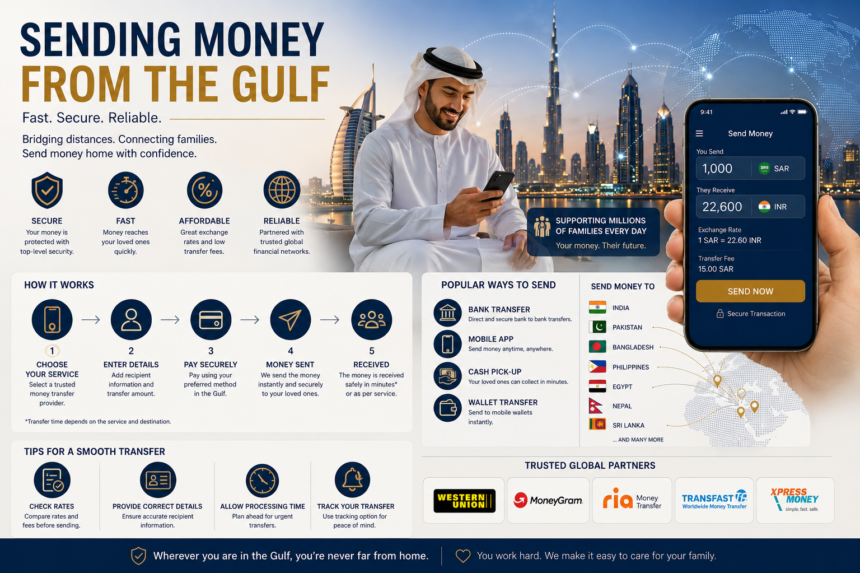
Gulf Remittances Explained: How Expats Can Send More for Less
For millions of expatriates working across the UAE, Saudi Arabia, Qatar, Kuwait, Bahrain and Oman, payday is not only about paying local expenses. Part of that income may support parents, spouses, children, education, mortgages or household bills thousands of kilometres away.
- Why Sending Money From the Gulf Matters So Much
- How Much Does an International Money Transfer Really Cost?
- 1. Compare the Exchange Rate, Not Just the Transfer Fee
- 2. Compare Banks, Exchange Houses and Digital Platforms
- 3. Always Use Licensed Remittance Providers
- 4. Understand Why Identity Verification Is Required
- 5. Check the Final Receiving Amount Before Pressing Send
- 6. Avoid Sending Tiny Amounts Too Frequently
- 7. Avoid Emergency Transfers When Possible
- Bank Deposit vs Cash Pickup: Which Is Better?
- Mobile Wallet Transfers Are Becoming More Important
- Why Exchange Rates Move
- GCC Currency Pegs Can Make Some Transfers More Predictable
- Sending Money From the UAE
- Sending Money From Saudi Arabia
- Sending Money From Qatar, Kuwait, Bahrain and Oman
- Why India Is Such an Important Gulf Remittance Destination
- Sending Money to Pakistan
- Sending Money to the Philippines
- Sending Money to Bangladesh, Nepal and Sri Lanka
- Common Remittance Scams to Avoid
- Hawala and Informal Transfers Require Particular Caution
- Should You Send Money Through Cryptocurrency?
- How Often Should You Send Money Home?
- Never Send Your Entire Salary Home
- Remittance and Savings Should Be Separate
- A Simple Money Transfer Comparison Method
- Example: Why “Zero Fee” Can Be Misleading
- Seven Smart Ways to Save on Gulf Remittances
- Mistakes That Can Make Money Transfers Expensive
- Questions to Ask Before Sending Money
- FAQs About Sending Money From the Gulf
- Conclusion
That makes Sending Money from the Gulf an important monthly financial decision. A transfer that appears cheap can become surprisingly expensive once exchange-rate margins and additional fees are included. At the same time, choosing an unlicensed or informal provider can expose both sender and recipient to much greater risks.
The latest World Bank remittance-cost data show why comparison matters. The global average cost of sending a typical $200 remittance was 6.36% in the third quarter of 2025, while the UN Sustainable Development Goal calls for reducing average remittance costs below 3% by 2030.
For Gulf residents, the good news is that competition between banks, exchange houses and digital platforms can create multiple options. The key is learning how to compare them properly.
Why Sending Money From the Gulf Matters So Much
The GCC is home to a large international workforce.
Many workers have financial responsibilities in other countries, particularly across South Asia, Southeast Asia, the Middle East and Africa.
Regular remittances may pay for:
- household expenses
- children’s education
- medical treatment
- rent or mortgages
- elderly parents
- weddings
- savings
- investments
- emergencies
- debt repayments
For the sender, a transfer might represent one part of a monthly salary.
For the family receiving it, that money may represent a major part of household income.
This is why even apparently small remittance costs matter.
If a worker sends money every month, an unnecessary fee is not paid once.
It may be paid 12 times every year.
How Much Does an International Money Transfer Really Cost?
Many people make one mistake when comparing remittance services.
They look only at the advertised transfer fee.
Imagine:
Provider A: “Zero transfer fee”
Provider B: “AED 15 transfer fee”
Provider A appears cheaper.
But it may offer a weaker exchange rate.
If Provider B gives the recipient significantly more rupees, pesos, taka or another destination currency, the supposedly more expensive service could actually be the better deal.
A transfer usually has several possible cost components:
- Upfront transfer fee
- Exchange-rate margin
- Receiving-bank fee
- Intermediary-bank charge
- Card or payment-method fee
- Fast-transfer premium
The figure that matters most is therefore:
How much money will the recipient actually receive?
That should be your main comparison point.
1. Compare the Exchange Rate, Not Just the Transfer Fee
This is probably the most important rule for Sending Money from the Gulf.
The exchange rate determines how much foreign currency your money buys.
There are usually two rates to think about.
The first is the market or reference exchange rate.
The second is the rate your bank, exchange house or transfer service actually offers.
The difference between the two can function as part of the transfer cost.
For example, imagine the market rate is:
1 AED = 24.00 units of the receiving currency
A provider offers:
1 AED = 23.50
That difference may appear small.
But if you send AED 5,000:
At 24.00:
120,000 units
At 23.50:
117,500 units
The recipient receives 2,500 fewer units even before considering other fees.
That is why a “zero-fee” service is not automatically free.
Smart rule: Compare the final receiving amount across providers at exactly the same moment.
2. Compare Banks, Exchange Houses and Digital Platforms
Gulf residents generally have several types of remittance channels available.
Banks
Banks provide convenient transfers directly from existing accounts.
Advantages can include:
- trusted financial infrastructure
- easy account integration
- saved beneficiaries
- scheduled transfers
- transaction records
Potential disadvantages can include:
- transfer fees
- exchange-rate margins
- intermediary-bank fees
- slower processing on some routes
Exchange Houses
Exchange houses are an established part of Gulf financial services.
They often serve popular remittance corridors and may offer both branch-based and digital transactions.
In the UAE, money transfer and currency exchange are regulated financial activities. The Central Bank’s current Exchange Business Regulation requires relevant exchange businesses to be licensed and supervised, and Category B and C exchange licences can include remittance operations.
Digital Remittance Services
Apps and online transfer platforms can make comparison easier.
Potential benefits include:
- fast setup
- transparent receiving amounts
- competitive rates
- mobile transfers
- transaction tracking
But digital does not automatically mean legitimate.
Always verify that the provider is appropriately licensed or regulated.
3. Always Use Licensed Remittance Providers
Saving money should never mean ignoring financial safety.
Regulators across the Gulf require money-transfer businesses to operate within regulated frameworks.
In Saudi Arabia, the Saudi Central Bank repeatedly warns customers to deal only with authorized financial institutions and provides official lists of licensed entities.
SAMA specifically identifies warning signs associated with unlicensed financial services, including:
- no official licence
- unrealistically attractive offers
- pressure to act quickly
- contact through unofficial social-media channels
- businesses using names similar to licensed institutions
The UAE follows a similar principle. The Central Bank regulates exchange houses and money-transfer activities through licensing and ongoing supervision.
If the rate looks unbelievably good, verify the provider before sending anything.
Losing the entire transfer is much more expensive than paying a reasonable legitimate fee.
4. Understand Why Identity Verification Is Required
First-time customers are sometimes frustrated when a remittance company asks for:
- passport
- Emirates ID or national residency identification
- mobile number
- beneficiary information
- source-of-funds information
- purpose of transfer
These checks are not necessarily unnecessary bureaucracy.
Money-transfer companies operate under anti-money-laundering and counter-terrorist-financing requirements.
In Saudi Arabia, SAMA’s rules require remittance-related arrangements to comply with AML and CFT requirements.
The UAE’s framework similarly requires exchange businesses to comply with regulatory and AML obligations.
A legitimate provider may therefore ask more questions when:
- the amount is unusually high
- the transaction pattern changes suddenly
- the recipient is new
- the destination presents higher compliance risk
- the source of funds requires verification
Do not attempt to bypass these checks through unofficial transfer channels.
5. Check the Final Receiving Amount Before Pressing Send
A good remittance platform should make the transaction understandable.
Before confirming, check:
You send: AED/SAR/QAR/KWD/BHD/OMR amount
Transfer fee: amount charged
Exchange rate: rate applied
Recipient gets: final destination-currency amount
If that information is unclear, do not rush.
The World Bank’s Remittance Prices Worldwide database tracks transfer costs across hundreds of international corridors precisely because costs vary significantly depending on the sender, recipient country and service provider. Its dataset currently covers 377 corridors from 48 sending countries to 111 receiving countries.
The best provider can therefore change depending on the corridor.
The cheapest way to send money from Dubai to India may not be the cheapest way to send from Dubai to Kenya.
6. Avoid Sending Tiny Amounts Too Frequently
Fixed transfer fees hurt small transactions more than large ones.
Suppose a provider charges AED 15.
If you transfer AED 300:
AED 15 = 5% of the amount
If you transfer AED 3,000:
AED 15 = 0.5%
The fee itself did not change.
Its impact did.
If your financial situation allows it, combining several very small transfers into a larger scheduled transfer may reduce the percentage lost to fixed charges.
However, do not delay genuinely urgent family expenses just to optimize a transfer fee.
Financial efficiency needs to remain practical.
7. Avoid Emergency Transfers When Possible
Urgency can be expensive.
Some services charge extra for:
- instant payout
- cash pickup
- card-funded transfer
- weekend processing
- expedited bank deposit
If the recipient does not need the money immediately, a standard bank-account transfer may cost less.
A useful strategy is to create a predictable remittance routine.
For example:
Salary arrives → household expenses separated → savings transferred → family remittance scheduled
This reduces last-minute decisions.
It also makes it easier to compare providers calmly instead of selecting whichever service promises the fastest delivery.
Bank Deposit vs Cash Pickup: Which Is Better?
Both can be useful.
Bank Deposit
Best when the recipient already has a bank account.
Advantages:
- money arrives directly into an account
- recipient does not need to travel
- easier financial record
- often convenient for repeat transfers
Cash Pickup
Useful when:
- recipient has limited banking access
- money is needed quickly
- local banking infrastructure is weak
- the transfer is an emergency
Potential disadvantages include:
- collection travel
- identity requirements
- safety concerns when carrying cash
- potentially higher transfer costs
The cheapest method is not automatically the best method if it creates inconvenience or risk for the recipient.
Mobile Wallet Transfers Are Becoming More Important
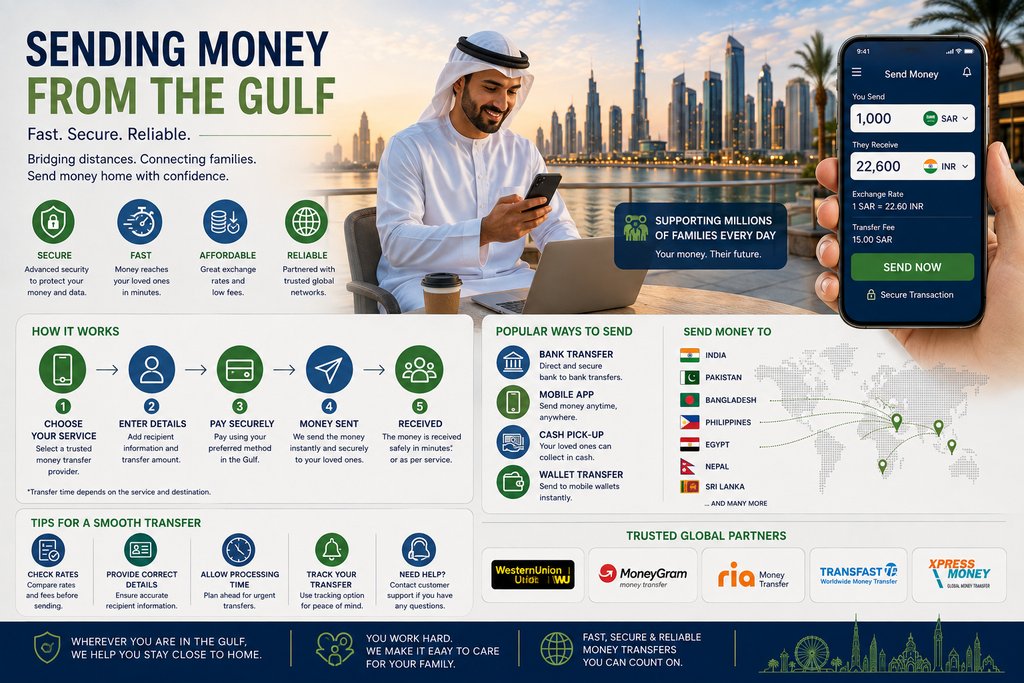
In several receiving markets, mobile wallets are becoming increasingly important.
Instead of sending money to a conventional bank account, remittance services may allow funds to enter a regulated mobile-money wallet.
That can help recipients:
- pay bills
- buy goods
- transfer money domestically
- avoid travelling to collect cash
Digital remittances can also create stronger transaction records.
But both sender and recipient should verify:
- provider legitimacy
- wallet limits
- withdrawal fees
- receiving fees
- currency-conversion costs
A free digital transfer followed by an expensive cash withdrawal may not be the cheapest overall solution.
Why Exchange Rates Move
Many expatriates ask:
Should I send today or wait for a better exchange rate?
Sometimes waiting can help.
Sometimes the rate moves in the opposite direction.
Currencies change because of factors such as:
- interest rates
- inflation
- economic growth
- political developments
- central-bank decisions
- oil prices
- investor demand
- market sentiment
Trying to predict currency markets perfectly is extremely difficult.
For regular family support, consistency may be more useful than speculation.
If you send money every month, trying to time the absolute best exchange rate can create unnecessary stress.
GCC Currency Pegs Can Make Some Transfers More Predictable
Several Gulf currencies are closely linked to the US dollar through fixed or managed exchange-rate arrangements.
This can create relative stability between those currencies and the dollar.
But the recipient’s currency may still move significantly.
For example, someone earning dirhams may see the amount of Indian rupees or Pakistani rupees received change over time because those currencies move against the dollar-linked dirham.
So even if your Gulf salary remains unchanged, the amount your family receives in local currency may rise or fall.
Sending Money From the UAE
The UAE has a highly developed remittance market because of its large expatriate workforce.
Residents can send money through:
- banks
- licensed exchange houses
- approved digital services
- other regulated money-transfer channels
The Central Bank’s current framework explicitly treats money transfer as a licensed exchange-business activity and supervises providers operating in the sector.
For consumers, strong competition can be useful.
Before transferring, compare at least two or three regulated services.
Pay particular attention to:
- INR
- PKR
- PHP
- BDT
- NPR
- LKR
- EGP
- other popular remittance corridors
Even small rate differences can matter when transferring regularly.
Sending Money From Saudi Arabia
Saudi Arabia also has a substantial remittance market connected with its large foreign workforce.
Customers have access to:
- local banks
- remittance centres
- licensed money exchange providers
- regulated payment services
SAMA maintains official listings of licensed institutions and has repeatedly reminded consumers to use authorized providers only.
This becomes especially important as digital advertisements for financial services increase.
Do not transfer money simply because an account on WhatsApp, Telegram or social media promises a better rate.
SAMA specifically identifies unofficial social-media channels and unrealistic offers among warning signs associated with unlicensed financial activity.
Sending Money From Qatar, Kuwait, Bahrain and Oman
The basic principles remain similar across the rest of the GCC.
Residents should use providers operating within the local regulatory framework and compare:
- total fee
- exchange rate
- payout option
- delivery time
- receiving amount
The biggest difference may come from the transfer corridor rather than the sending country itself.
High-volume routes can often attract greater competition among remittance providers.
Less common destinations may offer fewer options and potentially higher costs.
That is one reason there is no universal “best Gulf money transfer company.”
Why India Is Such an Important Gulf Remittance Destination
India has long been one of the world’s biggest recipients of international remittances.
Large Indian communities live across the UAE, Saudi Arabia, Qatar, Kuwait, Bahrain and Oman.
Money sent home may support:
- family consumption
- property payments
- education
- medical expenses
- investments
- savings accounts
Competition on Gulf-to-India corridors can be intense.
That can benefit consumers.
But senders should still compare the final rupee amount rather than assuming their usual provider remains cheapest forever.
Rates and promotions change.
Sending Money to Pakistan
Pakistan is another major remittance destination from the Gulf.
Workers across Saudi Arabia and the UAE in particular have historically represented important sources of formal remittance inflows.
The World Bank has previously noted strong Gulf-origin corridors into South Asia and that high transaction volumes and competition can help lower remittance costs.
Senders should compare:
- bank credit
- wallet delivery
- cash pickup
- transfer promotions
- receiving-bank charges
Formal channels also create documented remittance records, which can be useful for both households and national financial systems.
Sending Money to the Philippines
The Gulf is also home to a large Filipino workforce.
Common remittance needs include:
- household expenses
- tuition
- medical bills
- savings
- home construction
The recipient may have several payout choices.
These can include:
- bank accounts
- cash collection
- electronic wallets
Rather than automatically selecting the fastest option, compare the recipient’s actual needs.
If money can arrive in a bank account within one or two days at a better rate, paying extra for instant cash may be unnecessary.
Sending Money to Bangladesh, Nepal and Sri Lanka
These South Asian corridors are also important across GCC labour markets.
For lower-income workers in particular, remittance fees have a direct impact on how much salary reaches the family.
That is why the global policy goal of lowering remittance costs matters.
UN Sustainable Development Goal 10.c aims to reduce the average transaction cost of migrant remittances to below 3% and eliminate corridors where costs exceed 5% by 2030.
The World Bank’s latest available global average of 6.36% shows that there is still considerable progress to make.
Common Remittance Scams to Avoid
Money transfers naturally attract fraud because transactions can move quickly.
Warning signs include:
- guaranteed exchange rates far above legitimate providers
- sending money to a personal account instead of a regulated business
- WhatsApp-only transfer companies
- requests for OTP codes
- suspicious links
- unexpected “transfer release” charges
- fake customer-support accounts
- pressure to transfer immediately
Never share:
- OTP
- banking password
- card PIN
- full online-banking credentials
with someone claiming to help process a remittance.
Legitimate customer support should not need your secret banking password.
Hawala and Informal Transfers Require Particular Caution
Some communities have historically used informal value-transfer networks.
The UAE does permit legitimate hawala activity, but providers must be registered with the Central Bank. Operating hawala services without registration is not permitted.
Registered providers are also restricted in what services they may offer. Under the UAE framework, permitted activities include defined personal and certain commercial remittance services, while they may not provide unrelated financial products such as loans or virtual-asset services.
Consumers should therefore not assume that any person calling themselves a “hawala agent” is legitimate.
Verification remains essential.
Should You Send Money Through Cryptocurrency?
Cryptocurrency can technically transfer value across borders, but it should not automatically be treated as a cheaper remittance replacement.
Potential risks include:
- price volatility
- transaction fees
- conversion spreads
- scams
- wallet errors
- regulatory restrictions
- difficulty converting into local currency
A transfer appearing cheap on the blockchain may become expensive once the recipient converts the asset into cash.
The sender must also comply with applicable local financial regulations.
For ordinary household remittances, regulated banking or licensed money-transfer channels are generally much easier to understand.
How Often Should You Send Money Home?
There is no perfect frequency.
A useful choice depends on:
- recipient expenses
- salary schedule
- fixed fees
- exchange rates
- emergency needs
- budgeting habits
Weekly Transfers
Useful for frequent household needs but may multiply fixed fees.
Monthly Transfers
Often practical because most Gulf salaries are paid monthly.
Larger Less-Frequent Transfers
Can reduce the impact of fixed fees but requires the recipient to budget carefully.
For most workers, a structured monthly transfer can provide the clearest balance between cost and predictability.
Never Send Your Entire Salary Home
Supporting family is important.
But expatriates also need financial resilience where they live.
Keep enough money for:
- rent
- food
- transport
- emergencies
- medical expenses
- job changes
- flights home
- unexpected fees
Ideally, maintain an emergency fund before sending every available dirham or riyal overseas.
A worker who transfers almost everything and then needs to borrow locally can end up paying much more in debt costs.
Remittance and Savings Should Be Separate
Another useful habit is to separate family support from personal long-term savings.
For example:
Monthly income
→ local living expenses
→ family remittance
→ emergency savings
→ investments or long-term goals
If every available amount is transferred overseas without a personal savings plan, expatriates can work abroad for years without building financial security of their own.
Remittances should form part of a financial plan rather than replace one.
A Simple Money Transfer Comparison Method
Before every major transfer, create a quick comparison.
| Provider | You Send | Fee | Exchange Rate | Recipient Gets | Delivery |
|---|---|---|---|---|---|
| Bank A | Same amount | Compare | Compare | Compare | Standard |
| Exchange House | Same amount | Compare | Compare | Compare | Compare |
| Digital Service | Same amount | Compare | Compare | Compare | Compare |
You do not even need to calculate everything manually.
Enter the same transfer amount and recipient destination into each regulated provider.
Then look at:
Recipient Gets
That one number captures much of the real-world difference.
Example: Why “Zero Fee” Can Be Misleading
Imagine you send AED 2,000.
Provider A
Transfer fee: AED 0
Recipient gets: 46,500 currency units
Provider B
Transfer fee: AED 15
Recipient gets: 47,200 currency units
Despite charging a fee, Provider B delivers:
700 more units
to your family.
That is why advertisements should never replace comparison.
Seven Smart Ways to Save on Gulf Remittances
The most useful habits are straightforward:
- Compare the final receiving amount.
- Check the exchange-rate margin.
- Use licensed providers only.
- Avoid unnecessary instant-transfer fees.
- Combine very small transfers when practical.
- Compare several providers regularly.
- Keep transaction records and verify beneficiary details.
None requires advanced financial knowledge.
But together, they can reduce unnecessary costs significantly over several years.
Mistakes That Can Make Money Transfers Expensive
Choosing Only by Brand Recognition
A familiar provider may be good, but not necessarily cheapest for every corridor.
Focusing Only on Transfer Fees
Exchange-rate margins can cost more.
Sending at the Last Minute
Urgent transfers can reduce your choices.
Entering Beneficiary Details Incorrectly
Corrections can delay transactions and sometimes create additional charges.
Using Unlicensed Providers
A small apparent saving can expose the entire transfer to fraud or loss.
Ignoring Receiving Fees
Ask whether the recipient’s bank or wallet charges anything.
Never Comparing Again
The provider that was cheapest last year may not be cheapest today.
Questions to Ask Before Sending Money
Before confirming a transfer, check:
What exchange rate am I getting?
What is the total transfer fee?
How much will the recipient actually receive?
Will the recipient pay another fee?
When will the money arrive?
What happens if the transfer fails?
Is the provider licensed?
Can I track the transaction?
A trustworthy provider should make these answers reasonably clear.
FAQs About Sending Money From the Gulf
What is the cheapest way of Sending Money from the Gulf?
There is no single cheapest method for every country. Compare the final amount received through regulated banks, exchange houses and licensed digital remittance providers because rates and fees differ by corridor.
Should I choose a zero-fee money transfer?
Not automatically. A zero-fee service may use a less favourable exchange rate. Always compare how much the recipient gets after all costs.
Is it safe to send money through exchange houses in the UAE?
Use exchange houses licensed to conduct the relevant activity. The Central Bank of the UAE regulates exchange businesses and remittance operations through its licensing framework.
How can I verify a Saudi money-transfer company?
SAMA publishes information about licensed financial institutions and advises consumers to deal exclusively with authorized entities.
Why do money-transfer companies ask for identification?
Remittance providers must comply with regulatory, identity-verification and anti-money-laundering obligations. Additional information can be requested depending on the transaction.
What is the global average remittance cost?
The World Bank’s latest published quarterly report available in 2026 puts the global average cost of sending a typical $200 remittance at 6.36% in Q3 2025.
What is the global target for remittance costs?
UN Sustainable Development Goal 10.c targets an average cost below 3% by 2030 and seeks to eliminate remittance corridors with costs above 5%.
Is a bank transfer always safer than an app?
Not necessarily. A properly regulated digital provider can be legitimate. The key question is whether the institution is appropriately licensed and supervised, not whether the service operates through an app or physical branch.
Conclusion
Sending Money from the Gulf is no longer simply a choice between visiting a bank or walking into an exchange house.
Expatriates across the UAE, Saudi Arabia, Qatar, Kuwait, Bahrain and Oman increasingly have access to banks, exchange companies and digital remittance channels competing to move money across borders.
That competition can benefit consumers, but only when they compare transfers properly.
The most important number is not the advertised fee.
It is how much money reaches the person you are supporting.
Exchange-rate margins, transfer charges, receiving-bank fees and payment methods can all change that amount.
Cost also matters on a much bigger scale. The World Bank reports that the global average price of sending a typical $200 remittance was still 6.36% in Q3 2025, more than double the UN’s long-term target of below 3%.
Safety is equally important.
The UAE Central Bank regulates exchange houses and remittance businesses, while Saudi Arabia’s central bank explicitly warns people to use authorized financial institutions and avoid unlicensed operators.
For expatriates, a smart remittance strategy is therefore simple:
Use licensed providers. Compare the exchange rate. Check the final receiving amount. Avoid unnecessary speed charges. Keep transaction records. And never sacrifice security for a rate that looks too good to be true.
A few dirhams or riyals saved on one transfer may not seem significant.
Repeated every month for years, however, those savings can mean far more of your hard-earned money reaches the people you intended it for.
follow us on Instagram
Read More – Cost of Living Comparison: 6 Surprising GCC Differences