

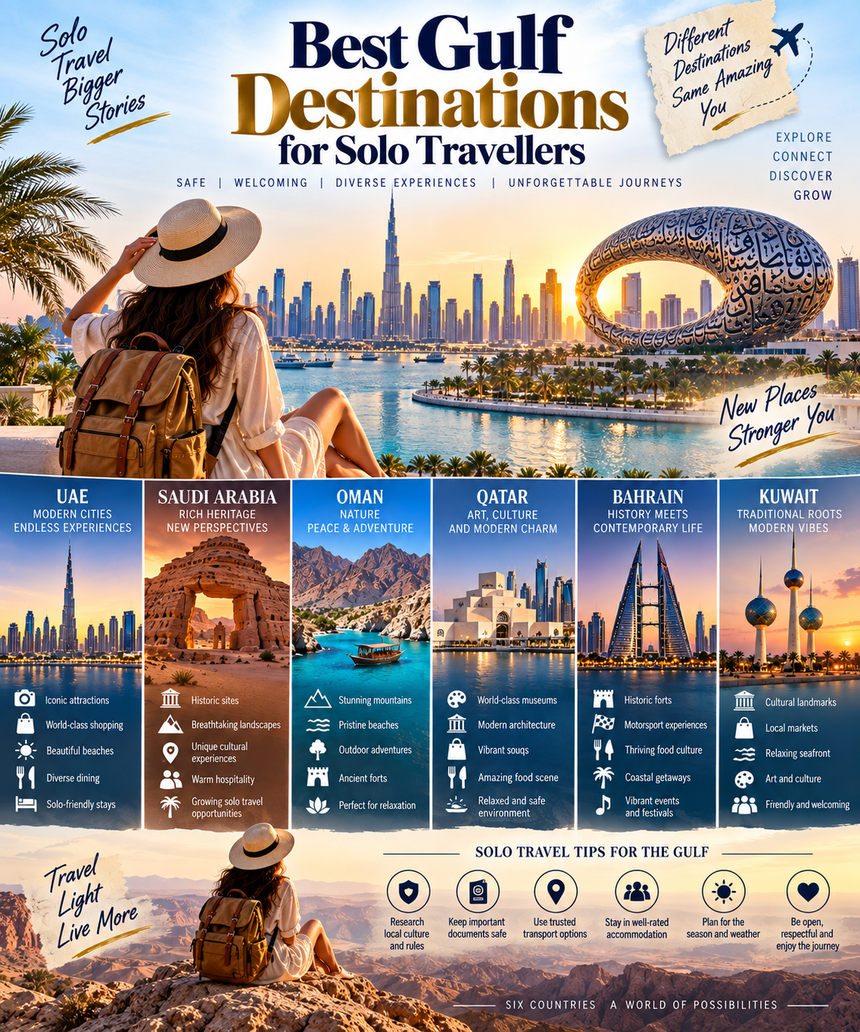
Solo Gulf Travel Planning Checklist
Solo travel in the Gulf can be very different from the stereotypical image of expensive resorts and organised group holidays. Across the UAE, Saudi Arabia, Qatar, Bahrain, Kuwait and Oman, independent travellers can explore historic neighbourhoods, museums, mountain landscapes, beaches, desert destinations and modern cities at their own pace.
- Why the Gulf Can Be Great for Solo Travellers
- Best Gulf Destinations for Solo Travellers at a Glance
- Dubai, UAE
- Abu Dhabi, UAE
- Muscat, Oman
- Doha, Qatar
- AlUla, Saudi Arabia
- Riyadh, Saudi Arabia
- Manama and Muharraq, Bahrain
- Kuwait City, Kuwait
- Jeddah, Saudi Arabia
- Ras Al Khaimah, UAE
- Best Gulf Destinations for Solo Female Travellers
- Best Gulf Destinations for First-Time Solo Travellers
- Best Gulf Destinations for Solo Travellers on a Budget
- What Can You Do Alone in the Gulf?
- How to Meet People While Travelling Solo in the GCC
- Transport Tips for Solo Travellers
- What to Know About Local Culture and Clothing
- Best Time for a Solo Gulf Trip
- Solo Gulf Travel Planning Checklist
- Final Thoughts on the Best Gulf Destinations for Solo Travellers
The Best Gulf Destinations for Solo Travellers are places where it is relatively straightforward to move around, where there is enough to do without needing a large group and where visitors can comfortably combine sightseeing, food, culture and independent experiences.
Dubai and Doha stand out for public transport and easy urban exploration. Abu Dhabi has an official guide specifically aimed at solo travellers and recommends everything from museums and beaches to public buses and cultural attractions. Muscat suits travellers who prefer a slower pace, while AlUla offers a completely different solo experience built around archaeology and dramatic desert landscapes.
The ideal destination depends on what kind of solo trip you want.
Why the Gulf Can Be Great for Solo Travellers
Solo travel becomes easier when a destination gives visitors several ways to structure their day without depending on a group.
The Gulf’s major cities are particularly good at this. Museums can be visited independently, waterfront promenades are ideal for relaxed walks, cafés provide easy breaks between attractions and organised desert or boat tours make it possible to experience activities that would be difficult to arrange completely alone.
Public transport also changes the experience considerably. Doha’s Metro currently covers more than 76 kilometres across three lines and 37 stations, including connections to Hamad International Airport, Souq Waqif, the National Museum of Qatar, Katara, West Bay and Education City.
Abu Dhabi provides public buses, taxis, bicycles and e-scooters, while its official solo-travel guide suggests spending at least three to four days to see the main highlights.
Solo travellers should still use the same practical precautions they would in any destination. Research local laws, keep valuables secure, use licensed transport and share remote excursion details with someone you trust.
Best Gulf Destinations for Solo Travellers at a Glance
| Destination | Best For | Getting Around | Ideal Solo Stay |
|---|---|---|---|
| Dubai | First solo Gulf trip | Metro, buses, taxis | 3 to 5 days |
| Abu Dhabi | Culture and relaxed travel | Buses and taxis | 3 to 4 days |
| Muscat | Slow travel and culture | Taxi, bus, tours | 3 to 4 days |
| Doha | Easy independent sightseeing | Excellent Metro | 2 to 4 days |
| AlUla | History and desert | Transfers and tours | 2 to 4 days |
| Riyadh | Modern Saudi culture | Metro, taxis | 3 to 4 days |
| Manama | Short solo getaway | Bus and taxi | 2 to 3 days |
| Kuwait City | Museums and city life | Bus and taxi | 2 to 3 days |
| Jeddah | Heritage and Red Sea | Taxi and ride-hailing | 3 days |
| Ras Al Khaimah | Mountains and adventure | Car or organised tours | 2 to 3 days |
For the easiest first trip, Dubai and Doha are particularly convenient. Muscat and AlUla require a little more planning but reward travellers with very different landscapes and a slower experience.
Dubai, UAE
Dubai is one of the easiest introductions to solo travel in the Gulf.
The city offers enough attractions to build completely different itineraries around culture, shopping, beaches, architecture, food or adventure. Visit Dubai has a dedicated solo-travel guide and describes the city as a popular destination for independent visitors.
A solo traveller can spend the morning exploring Al Fahidi and Dubai Creek, take the Metro towards Downtown Dubai in the afternoon and finish with a waterfront walk or restaurant without needing an organised itinerary.
Dubai is especially convenient because travellers do not need to rent a car for most mainstream sightseeing. The Metro and bus system connects many important districts, while taxis and ride-hailing services can fill the gaps.
Another advantage is the enormous range of organised activities. A traveller can join a desert safari, walking tour, boat trip or food experience without needing to assemble a group personally.
Best for: First-time solo travellers, city lovers, food, nightlife, shopping and short stopovers.
Consider Dubai if: You want a destination where every day can have a completely different theme.
Abu Dhabi, UAE
Abu Dhabi works particularly well for solo travellers who want a slightly slower city experience.
The emirate’s official tourism authority publishes a dedicated solo-travel guide covering transport, accommodation and things to do independently. It recommends attractions including Sheikh Zayed Grand Mosque, Louvre Abu Dhabi, Al Ain Oasis and Yas Island.
Public buses provide an inexpensive way to travel around the city, and the Hafilat Smart Card is used for payment. Taxis, bicycles and e-scooters provide additional options.
Cultural travellers have particularly strong choices. Sheikh Zayed Grand Mosque can be visited free of charge, including cultural tours, while Al Jahili Fort in Al Ain is another free attraction.
A relaxed solo itinerary can alternate between culture and downtime rather than trying to see everything quickly.
| Time | Solo Abu Dhabi Idea |
|---|---|
| Morning | Sheikh Zayed Grand Mosque |
| Late morning | Qasr Al Watan or museum |
| Afternoon | Louvre Abu Dhabi |
| Sunset | Corniche or Saadiyat |
| Evening | Dinner in the city |
Best for: Museums, architecture, beaches and slower city breaks.
Muscat, Oman
Muscat feels very different from Dubai or Doha, which is exactly why many independent travellers may enjoy it.
The Omani capital combines mountains, sea, traditional markets, forts and low-rise architecture. Experience Oman highlights the Royal Opera House, National Museum, traditional souqs and historic seafront promenades among the city’s main attractions.
Mutrah is particularly easy to enjoy alone. A traveller can explore the corniche, browse Mutrah Souq, visit nearby cultural attractions and stop at cafés without needing a fixed schedule.
Oman’s official tourism material also suggests walking experiences around Mutrah and other parts of old Muscat, including routes connecting forts, traditional homes and cultural sites.
The main challenge is transportation outside Muscat. Oman becomes much more spread out when you start adding mountains, wadis and desert destinations.
For those experiences, joining a small-group excursion can often be easier than renting a vehicle alone, particularly if the journey involves mountain roads or off-road driving.
Best for: Slow travel, photography, traditional culture, coastlines and travellers who dislike highly crowded cities.
Doha, Qatar
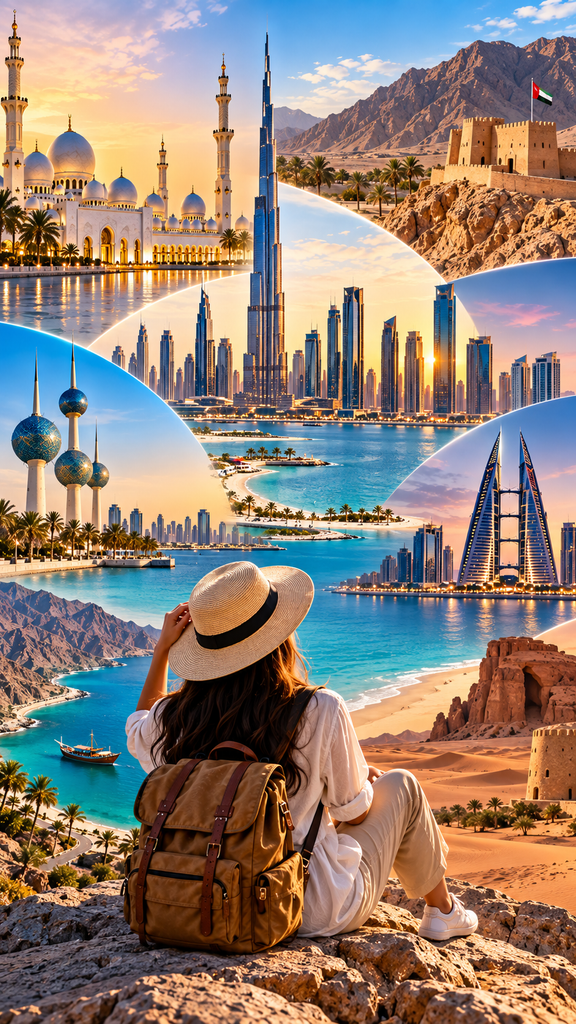
Doha may be one of the most convenient Gulf capitals for travellers who want to explore independently without renting a car.
Its Metro is the biggest advantage.
The network currently has three lines and 37 stations, and the Red Line links Hamad International Airport directly with central Doha. Other stations provide access to Souq Waqif, the National Museum of Qatar, Katara, West Bay, Education City and shopping areas.
That means a solo visitor can arrive at the airport, travel into the city and explore several major attractions without negotiating private transport every time.
Doha also has a useful balance between structured and unstructured sightseeing.
A traveller can spend several hours inside the Museum of Islamic Art or National Museum of Qatar, wander Souq Waqif, walk along the Corniche and visit Katara Cultural Village independently.
For desert experiences such as Khor Al Adaid, joining an organised excursion makes more sense.
Best for: First-time solo visitors, museums, architecture, public transport and short stays.
AlUla, Saudi Arabia
AlUla is one of the most distinctive choices for solo travellers who want history and nature rather than a traditional city break.
The destination is home to Hegra, Saudi Arabia’s first UNESCO World Heritage Site, together with AlUla Old Town, Elephant Rock and enormous desert landscapes. Visit Saudi also highlights hiking, hot-air ballooning and stargazing among its experiences.
AlUla is different from Dubai or Doha because many major archaeological experiences are structured around organised visits rather than completely independent wandering.
That can actually work well for someone travelling alone.
For example, current Hegra experiences include guided routes through the archaeological complex, with tours available in Arabic and English and advance booking recommended during the October to April high season.
Solo travellers can therefore spend part of the day on organised experiences and the rest exploring Old Town, cafés and viewpoints independently.
Best for: Archaeology, photography, desert scenery and travellers looking for something unusual.
Riyadh, Saudi Arabia
Riyadh provides a completely different Saudi solo travel experience.
It is a large, fast-developing capital where traditional heritage sites sit alongside contemporary architecture, restaurants, galleries and entertainment districts.
Visit Saudi describes Riyadh as combining modern architecture with cultural, artistic and sporting experiences throughout the year.
For solo visitors, the variety matters.
A traveller can spend one day learning about Saudi history, another exploring modern districts and another using the city as a base for an organised excursion outside the capital.
Riyadh also makes sense for travellers who enjoy restaurants and coffee culture. Sitting alone in a café or casual restaurant is an easy way to break up long sightseeing days without feeling that every activity needs to be a major attraction.
Best for: Contemporary Gulf culture, food, events and urban exploration.
Manama and Muharraq, Bahrain
Bahrain is particularly well suited to travellers who want a short solo trip.
The country is compact, so visitors can experience several cultural areas without committing to long intercity journeys.
Bahrain Tourism recommends Bahrain Fort, Manama Souq and traditional shopping areas for shorter stays. Bahrain Fort is a UNESCO World Heritage Site with archaeological remains linked to thousands of years of settlement.
Muharraq adds another dimension.
Its traditional streets and heritage buildings offer a slower experience than central Manama, making it particularly appealing to travellers who enjoy architecture and walking through historic neighbourhoods.
Because distances are relatively short, solo travellers can spend two or three days seeing a meaningful part of the kingdom without constantly changing accommodation.
Best for: Weekend solo trips, heritage, food and travellers who prefer compact destinations.
Kuwait City, Kuwait
Kuwait City tends to receive less attention on standard Gulf itineraries, which can make it interesting for experienced solo travellers looking for something different.
The Kuwait Government lists Kuwait Towers, Sheikh Jaber Al-Ahmad Cultural Centre and Al Shaheed Park among major visitor attractions. Al Shaheed Park covers around 200,000 square metres and combines gardens, museums, walkways and cultural spaces.
Museums are another strength. Official tourism information lists institutions covering Kuwaiti history, art, science and traditional life.
Kuwait also has an extensive bus network. Government information says Kuwait Public Transport Company operates services across regions and suburbs, alongside private operators such as CityBus.
However, the city is more spread out than compact destinations such as Doha or Bahrain, so solo travellers may still find taxis useful for selected journeys.
Best for: Museums, contemporary Gulf life, food and repeat visitors to the region.
Jeddah, Saudi Arabia
Jeddah is a strong choice for solo travellers who want history combined with the Red Sea.
The city’s biggest cultural attraction is historic Al-Balad, where traditional architecture, markets and narrow streets create one of Saudi Arabia’s most distinctive urban environments.
Visit Saudi highlights Jeddah for its beaches, Red Sea experiences and Historic Jeddah alongside the city’s modern attractions.
Unlike Riyadh, Jeddah has a strong coastal rhythm. A traveller can spend the morning exploring heritage areas, stop for local food and spend the evening around the waterfront.
It also works well as part of a longer Saudi itinerary because domestic travel can connect Jeddah with other major destinations.
Best for: Heritage, Red Sea atmosphere, food and travellers combining several Saudi cities.
Ras Al Khaimah, UAE
Ras Al Khaimah is one of the strongest Gulf options for a solo traveller who wants nature rather than another urban break.
The emirate combines beaches, desert landscapes and the Hajar Mountains. Jebel Jais gives visitors access to mountain scenery and organised adventure experiences, making it possible to add outdoor activities without arranging everything privately.
Transport requires more planning than Dubai or Doha because many attractions are spread out.
A hire car can give experienced travellers flexibility, while organised hotel transfers and activity tours may be more convenient for someone who does not want to drive alone.
Ras Al Khaimah works particularly well as a two-night addition to a longer Dubai trip.
Best for: Hiking, mountains, resorts, adventure and quiet escapes.
Best Gulf Destinations for Solo Female Travellers
For women travelling alone, destination choice is only one part of planning. Accommodation location, transport, local customs and the time of day can matter just as much.
Abu Dhabi’s tourism authority specifically describes the emirate as welcoming to solo female travellers while advising visitors to remain aware of their surroundings and respect local customs. Its guidance also notes that female tourists do not generally need to wear a hijab, although modest clothing is expected at religious and heritage sites.
Dubai and Doha are also practical choices because their transport systems make it easier to reduce dependence on unfamiliar drivers or complicated transfers.
Muscat can work particularly well for travellers seeking a quieter experience, although excursions outside the capital should be planned carefully.
Regardless of destination, use licensed transport, choose accommodation in established districts, keep family or friends aware of longer excursions and check cultural requirements before visiting religious sites.
Best Gulf Destinations for First-Time Solo Travellers
For a first solo trip to the Gulf, Dubai, Doha and Abu Dhabi are the easiest starting points.
Dubai offers the widest range of attractions and a strong transport network. Doha is compact enough to understand quickly and its Metro simplifies airport and city travel. Abu Dhabi provides culture, beaches and straightforward public transport within a calmer environment.
After gaining confidence, travellers can move towards destinations requiring more logistics.
Muscat introduces longer transfers and nature excursions. AlUla relies more heavily on booked experiences, while wider exploration of Oman or Saudi Arabia can involve long road journeys.
The best first destination is therefore not necessarily the most spectacular one. It is the place where the traveller can confidently understand transportation, accommodation and daily planning.
Best Gulf Destinations for Solo Travellers on a Budget
Solo travel has one major financial disadvantage: there is nobody to split hotel or taxi costs with.
Public transport therefore becomes particularly important.
Doha is strong for this reason because its Metro directly connects many areas useful to visitors. Dubai is similarly practical when accommodation is selected near Metro stations.
Abu Dhabi’s regular public buses provide another affordable option. The tourism authority states that city buses are among the cheapest ways to get around, with air-conditioned buses operating day and night.
Kuwait also has public bus networks covering multiple regions and suburbs.
Accommodation can still become the biggest expense. Solo travellers should compare budget hotels and serviced apartments rather than assuming that hostels will always be widely available.
What Can You Do Alone in the Gulf?
One of the easiest mistakes to make is thinking every solo day needs a group tour.
In reality, Gulf cities contain many activities that work particularly well alone.
| Activity | Good Destinations |
|---|---|
| Museum visits | Abu Dhabi, Doha, Riyadh, Kuwait |
| Heritage walks | Dubai, Jeddah, Bahrain, Muscat |
| Café hopping | Riyadh, Dubai, Doha, Muscat |
| Beach time | UAE, Qatar, Bahrain, Oman |
| Souq visits | Muscat, Doha, Dubai, Manama |
| Photography | AlUla, Muscat, Dubai |
| Desert tour | UAE, Qatar, Saudi Arabia |
| Mountain adventure | Ras Al Khaimah, Oman |
| Waterfront walks | Doha, Jeddah, Kuwait, Muscat |
| Cultural performances | Muscat, Riyadh, Kuwait |
The best strategy is to keep city sightseeing independent and use organised experiences only when transport, safety or specialist knowledge makes them useful.
How to Meet People While Travelling Solo in the GCC
Solo travel does not need to mean spending the entire trip alone.
Small-group walking tours, desert safaris, food tours, diving trips and organised adventure activities naturally create opportunities to meet other visitors.
Hotels and hostels with communal areas can help, although the social accommodation scene varies considerably between Gulf destinations.
Cultural workshops are another option. Cooking activities, heritage programmes and guided tours often produce more natural interaction than simply approaching strangers inside shopping centres.
At the same time, there is no need to force a highly social trip. One of the advantages of Gulf cities is that cafés, malls, museums and waterfronts make spending time alone feel completely normal.
Transport Tips for Solo Travellers
Transportation should influence where you choose to stay.
A cheaper hotel can become poor value if every attraction requires a long taxi ride.
In Dubai and Doha, staying near a Metro station can simplify almost the entire trip. In Abu Dhabi, check bus access and the distance to the attractions you most want to visit.
In Muscat, Bahrain and Kuwait, it is worth clustering each day’s attractions by area rather than repeatedly crossing the city.
For remote destinations such as AlUla, Jebel Jais, the Omani mountains or desert areas, book reliable transfers or reputable organised tours before departure.
Never assume that because two attractions look close on a map they are comfortable to walk between, particularly during Gulf summers.
What to Know About Local Culture and Clothing
The GCC countries share cultural similarities, but visitors should not treat them as identical.
Local expectations vary according to destination and setting. Beach resorts, shopping districts and religious sites can have very different dress requirements.
Modest clothing is a useful default when visiting traditional areas, government buildings, mosques and heritage sites.
Abu Dhabi’s official visitor guidance, for example, notes that female visitors do not generally need traditional clothing but should dress appropriately when entering religious and cultural attractions.
Solo travellers should also learn the local rules surrounding photography, alcohol, public behaviour and interactions at religious sites before arrival.
Respecting local customs usually makes the journey easier and opens the door to more meaningful cultural experiences.
Best Time for a Solo Gulf Trip
For most first-time visitors, November to March offers the easiest conditions for independent exploration.
Cooler weather makes walking through souqs, old neighbourhoods and waterfront areas much more comfortable.
This is particularly valuable for solo travellers because walking often becomes part of the experience rather than simply transportation.
AlUla’s winter temperatures are predicted around 6°C to 25°C, while its main high season for attractions such as Hegra generally falls between October and April.
Summer can still work well for Dubai, Doha, Abu Dhabi and other major cities if the trip is built around museums, malls and indoor attractions. However, outdoor walking becomes significantly more difficult during the hottest daytime hours.
Solo Gulf Travel Planning Checklist
Before leaving, check these essentials:
- Confirm passport and visa requirements for the destination.
- Book accommodation in a convenient, established area.
- Check public transport before choosing your hotel.
- Download offline maps and transport apps.
- Keep digital and physical copies of essential documents.
- Use licensed taxis or recognised transport services.
- Reserve remote desert or mountain excursions with established operators.
- Share longer excursion details with someone you trust.
- Carry mobile data or arrange an eSIM or local SIM.
- Research local clothing and cultural expectations.
- Avoid leaving valuables unattended on beaches or in public areas.
- Check weather conditions before hiking or desert activities.
- Keep water with you, especially outside during warmer months.
- Leave enough flexibility to change plans rather than overbooking every day.
Planning does not remove the independence that makes solo travel attractive. It simply gives you more freedom once you arrive.
Final Thoughts on the Best Gulf Destinations for Solo Travellers
The Best Gulf Destinations for Solo Travellers offer very different versions of independence.
Dubai is the easiest all-round choice for travellers who want transport, attractions and endless options. Abu Dhabi suits those looking for museums, architecture and a calmer pace, while Doha combines excellent Metro connections with cultural attractions in a relatively compact city.
Muscat is ideal for slower travel and traditional Gulf atmosphere. AlUla offers one of the region’s most memorable archaeological and desert experiences, while Riyadh and Jeddah reveal different sides of modern Saudi Arabia.
For shorter trips, Bahrain combines heritage and city life in a compact setting. Kuwait City rewards travellers interested in museums and everyday Gulf culture, while Ras Al Khaimah is a strong option for anyone who would rather spend their solo journey around mountains and outdoor experiences than skyscrapers.
The biggest advantage of travelling alone is flexibility. You can spend three hours inside a museum, change plans because the sunset looks good, join a desert group for a day and then spend the following morning quietly exploring a souq.
In the Gulf, that freedom can take you from futuristic skylines to ancient settlements, mountain trails, archaeological sites and waterfront promenades within one region.
Do follow us on Instagram
Read More – How to Plan a Multi-Country GCC Road Trip: Complete 2026 Guide