

Essential Rules for Responsible Wildlife Tourism
Wildlife may not be the first thing travellers associate with the Arabian Gulf, yet the region supports an extraordinary variety of animals across deserts, mountains, mangrove forests, islands, wetlands and coral reefs. Arabian oryx move through protected landscapes, whale sharks gather in Gulf waters, sea turtles return to Omani beaches, flamingos stop along migration routes and dolphins inhabit both the Arabian Gulf and Red Sea.
- Why the GCC Is Surprisingly Rich in Wildlife
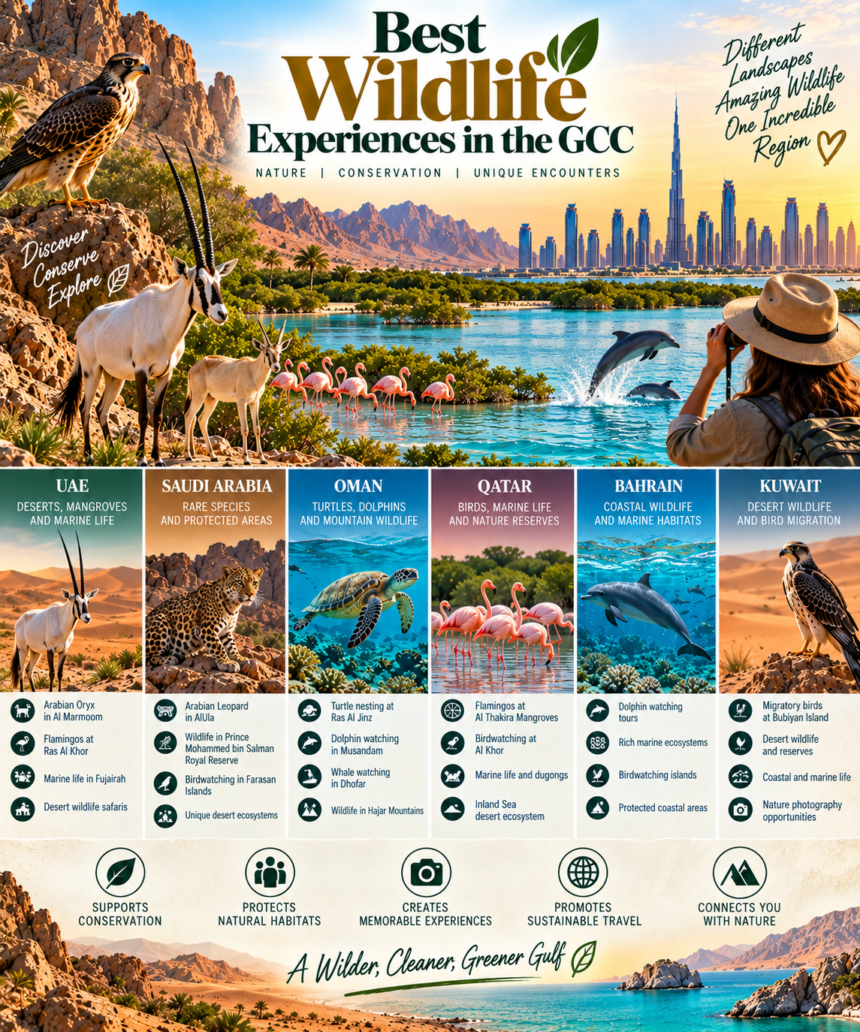
- Best Wildlife Experiences in the GCC at a Glance
- Go on Safari at Sir Bani Yas Island, UAE
- Explore Abu Dhabi’s Mangroves and Marine Wildlife
- Discover the Farasan Islands, Saudi Arabia
- Look for Mountain Wildlife in Saudi Arabia’s Raydah Reserve
- See Whale Sharks in Qatar
- Spot Flamingos, Dugongs and Desert Wildlife in Qatar
- Discover Wildlife Conservation in Bahrain
- Experience Hawar Island’s Natural Side
- Watch Green Turtles at Ras Al Jinz, Oman
- Explore Marine Wildlife Around the Daymaniyat Islands
- Discover Turtles and Migratory Birds on Masirah Island
- Go Birdwatching in Kuwait’s Jahra Reserve
- Best GCC Wildlife Experiences by Traveller Type
- When Is the Best Time for Wildlife Watching in the Gulf?
- How to Photograph Gulf Wildlife Responsibly
- Wildlife Experiences With Children
- Essential Rules for Responsible Wildlife Tourism
- GCC Wildlife Travel Checklist
- Final Thoughts on the Best Wildlife Experiences in the GCC
The Best Wildlife Experiences in the GCC can be found across the UAE, Saudi Arabia, Qatar, Bahrain, Oman and Kuwait. Some encounters involve guided safaris through large reserves, while others require an early-morning boat, a quiet kayak through mangroves or a night visit to a protected nesting beach.
Abu Dhabi’s Sir Bani Yas Island alone is home to more than 17,000 free-roaming animals. Saudi Arabia’s Farasan Islands protect coral reefs, mangroves, dolphins, turtles, migratory birds and the distinctive Farasan gazelle, while Qatar’s northeast coast hosts one of the world’s largest seasonal gatherings of whale sharks.
For travellers, the biggest difference between a good wildlife experience and a damaging one comes down to behaviour. Responsible wildlife tourism should keep animals wild, respect protected areas and allow sightings to happen without chasing, feeding or disturbing them.
Why the GCC Is Surprisingly Rich in Wildlife
The GCC may appear dominated by desert, but desert itself contains specialised ecosystems. Gazelles, Arabian oryx, foxes, wolves, reptiles and numerous bird species have adapted to environments where temperatures, water availability and vegetation can be extreme.
The coastline adds an entirely different world. The Arabian Gulf, Gulf of Oman, Arabian Sea and Red Sea support coral reefs, turtles, dolphins, whale sharks, dugongs, rays and extensive fish populations.
Mangroves provide another critical habitat. These coastal forests act as nurseries for marine species while supporting crabs, fish and birds. Wetlands and islands are particularly important during migration periods when birds travelling between continents use the Arabian Peninsula as a resting and feeding point.
Qatar alone reports more than 350 recorded bird species, over 200 of which are migratory. Its waters also support dugongs, dolphins, sea turtles and seasonal whale shark gatherings.
This diversity means Gulf wildlife tourism does not have one single season or one single landscape.
Best Wildlife Experiences in the GCC at a Glance
| Wildlife Experience | Destination | Country | What You May See |
|---|---|---|---|
| Wildlife safari | Sir Bani Yas Island | UAE | Oryx, gazelles, giraffes, cheetahs |
| Mangrove exploration | Abu Dhabi | UAE | Birds, fish and marine life |
| Island wildlife | Farasan Islands | Saudi Arabia | Gazelles, dolphins, turtles, birds |
| Mountain wildlife | Raydah Reserve | Saudi Arabia | Ibex, caracal, Arabian wolf, birds |
| Whale shark watching | Al Shaheen region | Qatar | Whale sharks |
| Wetland birdwatching | Al Thakhira | Qatar | Flamingos and migratory birds |
| Conservation reserve | Zallaq | Bahrain | Arabian oryx, Bahraini reem |
| Island nature escape | Hawar Islands | Bahrain | Coastal and island wildlife |
| Turtle watching | Ras Al Jinz | Oman | Green turtles |
| Marine wildlife | Daymaniyat Islands | Oman | Reef fish, turtles and marine species |
| Turtle and bird watching | Masirah Island | Oman | Four turtle species, pelicans, flamingos |
| Wetland birdwatching | Jahra | Kuwait | Resident and migratory birds |
Wild animals never operate according to tourism schedules, so none of these species should be treated as guaranteed sightings.
Go on Safari at Sir Bani Yas Island, UAE
For travellers who want a traditional wildlife safari without leaving the Gulf, Sir Bani Yas Island is one of the strongest choices.
The Arabian Wildlife Park occupies more than half of the island and contains more than 17,000 free-roaming animals. Guided 4×4 safaris allow visitors to look for Arabian oryx, gazelles, giraffes and other species across a large protected landscape. Cheetahs and hyenas also live within the reserve.
Unlike an ordinary city zoo, much of the experience revolves around travelling through the animals’ environment. Expert-guided drives help visitors understand both the species and the conservation work behind the island.
Sir Bani Yas was established as a Royal Nature Reserve in 1971 and today combines wildlife protection with accommodation, archaeological sites and outdoor experiences. Visitors can reach the island from the Jebel Dhanna jetty by boat.
For photographers, early and late parts of the day generally provide softer light, while families may find the guided safari format easier than attempting independent wildlife spotting.
Best for: Families, photographers, first-time wildlife travellers and safari enthusiasts.
Explore Abu Dhabi’s Mangroves and Marine Wildlife
Abu Dhabi’s wildlife experiences extend far beyond Sir Bani Yas.
Mangrove forests around the emirate provide habitats for birds, fish and other coastal species. Kayaking creates a quieter wildlife experience than a vehicle safari because visitors move slowly through narrow waterways and shallow environments.
Experience Abu Dhabi specifically promotes its mangroves as places to paddle through wildlife-rich waterways and hidden coves.
The emirate’s position across more than 200 islands also makes marine experiences important. Snorkelling and diving areas can contain reef life, while kayaking and paddleboarding provide opportunities to observe coastal ecosystems without entering deeper water.
The wildlife may be less dramatic than seeing a giraffe or cheetah, but this is precisely why mangrove trips are useful. They encourage travellers to notice smaller ecosystems rather than treating wildlife tourism only as a search for large animals.
Best for: Kayakers, birdwatchers, families and travellers staying in Abu Dhabi city.
Discover the Farasan Islands, Saudi Arabia
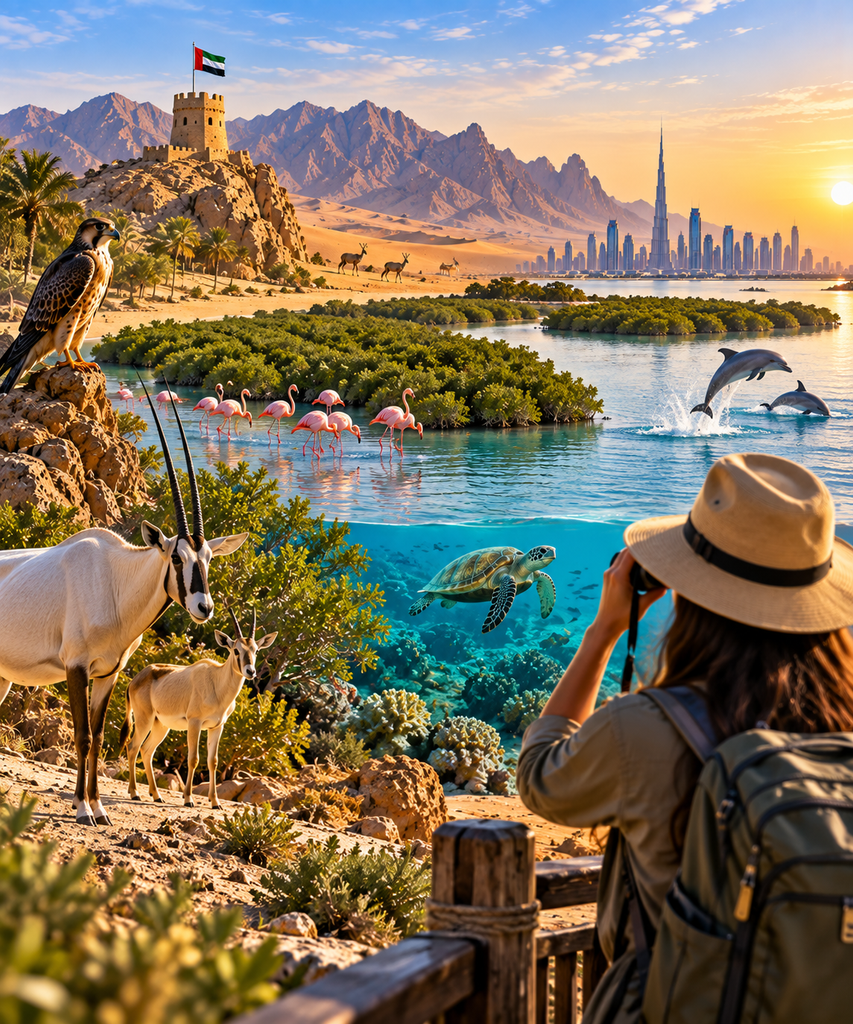
Saudi Arabia’s Farasan Islands offer one of the most complete combinations of terrestrial and marine wildlife in the GCC.
Located off Jazan, the protected archipelago contains more than 200 islands surrounded by turquoise water, coral reefs and mangrove ecosystems. Visit Saudi describes it as the Kingdom’s first natural reserve recognised under UNESCO’s Man and the Biosphere Programme.
On land, travellers may encounter the rare Farasan Idmi gazelle. Offshore wildlife includes dolphins and sea turtles, while the islands are also important for migratory birds. Coral ecosystems provide opportunities for diving and snorkelling.
The destination is particularly strong for travellers who do not want wildlife observation separated from the wider landscape. A day can include birdwatching, coastal exploration and marine activities rather than a single organised animal encounter.
Visit Saudi also identifies species such as the white-eyed gull, crab plover and sooty falcon among the birds associated with the islands.
Best for: Birdwatchers, divers, marine wildlife enthusiasts and adventurous travellers.
Look for Mountain Wildlife in Saudi Arabia’s Raydah Reserve
Saudi wildlife is not limited to deserts and islands.
Raydah Natural Reserve, near Aseer National Park in the Abha region, protects a mountainous ecosystem supporting animals that many travellers would never expect to find in Saudi Arabia.
Visit Saudi identifies the reserve as habitat for the Arabian wolf, caracal, rock hyrax, mongoose and Nubian ibex. Birdlife includes species such as the Yemen thrush, Arabian red-legged partridge, Arabian woodpecker and Yemen linnet.
Wildlife watching here is a very different experience from a safari park. Many species are elusive, and visitors should not arrive expecting guaranteed close encounters.
The attraction lies in exploring one of the Kingdom’s biodiversity hotspots while understanding how mountainous habitats differ from the open desert environments found elsewhere.
For serious birdwatchers and nature photographers, southern Saudi Arabia can be especially rewarding because its vegetation, elevation and climate differ significantly from central areas of the country.
Best for: Birdwatchers, hikers and experienced nature travellers.
See Whale Sharks in Qatar
One of the GCC’s most extraordinary wildlife events takes place offshore from Qatar.
Every year, whale sharks gather in the Al Shaheen region off Qatar’s northeast coast. Visit Qatar describes the event as one of the largest congregations of whale sharks anywhere in the world.
The season generally runs from April to September, and under exceptional conditions visitors may see very large numbers of the animals feeding near the surface. Visit Qatar states that gatherings can reach up to 300 whale sharks.
Access is controlled. Dedicated boat excursions depart with trained experts, allowing visitors to observe the whale sharks from a respectful distance rather than entering the area independently.
This is exactly the type of wildlife tourism where rules are essential. Whale sharks are endangered, and responsible viewing avoids crowding, chasing or touching the animals.
For travellers choosing only one major marine wildlife encounter in the GCC, Qatar’s whale sharks deserve serious consideration.
Best for: Bucket-list travellers, marine wildlife enthusiasts and photographers.
Spot Flamingos, Dugongs and Desert Wildlife in Qatar
Whale sharks receive the headlines, but Qatar supports a much wider range of wildlife.
The country says protected areas cover more than 23 percent of its land area. Its reserves include mangroves, deserts, wetlands and coastal ecosystems.
Al Thakhira is particularly useful for birdwatchers. Its mangrove environment attracts numerous birds, while flamingos are among the species that can be seen seasonally around Qatar’s coast.
Qatar also supports an important dugong population. Visit Qatar describes its waters as containing the world’s second-largest population of dugongs, with very large herds recorded historically.
Other wildlife includes gazelles, sand cats, red foxes, desert hares and numerous reptiles, although many desert species are difficult to spot.
For birdwatchers, spring and autumn migration periods are particularly interesting, while the cooler winter months are generally more comfortable for reserve exploration.
Best for: Birdwatching, marine wildlife and travellers wanting several ecosystems in one country.
Discover Wildlife Conservation in Bahrain
Bahrain’s most accessible conservation-focused wildlife experience can be found at the Mohammed bin Zayed Natural Reserve in Zallaq.
The reserve, formerly associated with Al Areen Wildlife Park and Reserve, has a long-standing mission centred on protecting and breeding plant and animal species. Conservation work places particular emphasis on endangered wildlife including the Bahraini Reem and Arabian oryx.
Not every section is open to tourism. One part remains restricted to researchers and specialists, while another allows public visitors to explore native plants and various birds, mammals and reptiles.
That separation is important because strong wildlife conservation sometimes requires keeping tourists away from the most sensitive habitats.
For families, the reserve provides a more educational experience than simply trying to spot animals in the wild. Children can learn about Arabian wildlife and conservation without long drives or difficult terrain.
Best for: Families, wildlife education and conservation awareness.
Experience Hawar Island’s Natural Side
The Hawar Islands provide another side of Bahrain’s wildlife experience.
Located offshore from the mainland, Hawar combines beaches, open water and a wider wildlife sanctuary. Bahrain Tourism describes Hawar Resort by Mantis as an eco-conscious island retreat surrounded by a rich wildlife environment.
For wildlife-minded travellers, the attraction should be the island ecosystem rather than only the resort.
Quiet coastal exploration, birdwatching and low-impact water activities can be incorporated into the stay, while the distance from central Manama creates a very different atmosphere from a conventional city holiday.
Travellers should remember that island wildlife can be especially vulnerable to disturbance. Noise, unmanaged boats and careless movement around nesting locations can have a much greater effect than visitors realise.
Best for: Couples, families and travellers wanting wildlife alongside an island stay.
Watch Green Turtles at Ras Al Jinz, Oman
Few wildlife experiences in the GCC are as memorable as watching a sea turtle return to the beach where generations before it have nested.
Ras Al Jinz, on Oman’s eastern coast, is an important nesting location for green turtles. Guided early-morning and evening experiences give visitors the opportunity to witness nesting activity while reserve staff control access to sensitive parts of the beach.
Experience Oman’s tourism guide describes Ras Al Jinz as one of the important breeding grounds for endangered green turtles in the Indian Ocean, with nesting activity particularly strong from July through September.
Turtle watching requires discipline.
Bright lights, flash photography, loud conversations or standing too close to nesting turtles can cause disturbance. Visitors should always follow guides rather than walking along nesting beaches independently at night.
The experience is especially valuable for families with older children because it turns conservation into something visible and immediate.
Best for: Families, wildlife photographers and conservation-focused travellers.
Explore Marine Wildlife Around the Daymaniyat Islands
Just offshore from Muscat, the Daymaniyat Islands provide one of Oman’s strongest marine experiences.
Snorkelling and diving trips allow visitors to explore coral reefs and abundant marine life in protected waters. Experience Oman promotes the islands specifically for their rich marine ecosystem and clear water.
Oman more broadly supports remarkable marine diversity. Official tourism material says its waters are home to around 20 cetacean species, while Indo-Pacific humpback dolphins are among those seen seasonally. The same guidance highlights rare Arabian Sea humpback whales as another important species found in Omani waters.
Dolphin-watching excursions also operate from Muscat, giving visitors an alternative when diving or snorkelling is not suitable.
Wild dolphin sightings should never be guaranteed, however. Responsible operators allow animals to choose whether to approach boats and avoid aggressive pursuit.
Best for: Snorkellers, divers, dolphin watchers and Muscat-based travellers.
Discover Turtles and Migratory Birds on Masirah Island
For a more remote wildlife journey, Masirah Island deserves a place on the itinerary.
Experience Oman identifies the island’s beaches as important nesting areas for several turtle species, including loggerhead, green, hawksbill and olive ridley turtles.
The island also attracts migratory birdlife, with pelicans and flamingos among the species highlighted by Oman’s tourism authority.
Masirah therefore works particularly well for travellers who enjoy wildlife as part of a slower nature trip rather than a tightly scheduled guided encounter.
Because nesting beaches are sensitive environments, visitors should seek local guidance rather than independently searching for turtles at night.
The quieter character of the island is one of its main strengths. Wildlife can be experienced within a broader landscape of beaches, sea and open space.
Best for: Road trips, birdwatchers, turtle enthusiasts and travellers seeking remote nature.
Go Birdwatching in Kuwait’s Jahra Reserve
Kuwait’s wetlands create another surprisingly rich wildlife environment.
The Al-Khuwaisat or Al-Jahra Natural Reserve covers approximately 18 square kilometres and was created to provide sanctuary for both endemic and migratory birds. Its landscape includes permanent and seasonal ponds, reed beds, coastal salt-tolerant vegetation and wetland habitat.
Access is tightly regulated, which makes this quite different from visiting an open public park.
The Environment Public Authority’s visitor rules prohibit feeding wildlife and drone use, limit vehicle numbers and apply seasonal public access arrangements. Current rules specify a public opening period from November to March under the reservation system.
Those restrictions are not an inconvenience to work around. They are part of protecting the birds visitors have come to see.
For committed birdwatchers, the reserve can reveal a side of Kuwait far removed from shopping centres and urban skylines.
Best for: Birdwatchers, nature photographers and conservation-minded visitors.
Best GCC Wildlife Experiences by Traveller Type
Not every wildlife destination suits every traveller. Families may prefer structured reserves, while experienced birdwatchers may value remote wetlands where sightings are less predictable.
| Traveller | Recommended Wildlife Experience |
|---|---|
| Families with children | Sir Bani Yas or Bahrain’s wildlife reserve |
| Marine wildlife lovers | Qatar whale sharks |
| Turtle enthusiasts | Ras Al Jinz or Masirah |
| Birdwatchers | Kuwait, Qatar or Farasan Islands |
| Divers | Saudi Red Sea or Daymaniyat Islands |
| Photographers | Sir Bani Yas, Farasan or Oman |
| Serious nature travellers | Raydah Reserve |
| Short city break | Abu Dhabi mangroves |
| Conservation-focused travellers | Bahrain or Oman turtle reserves |
| Island lovers | Farasan, Hawar or Sir Bani Yas |
For a first wildlife trip in the GCC, Abu Dhabi and Oman provide particularly easy combinations of accessible experiences and established tourism infrastructure.
When Is the Best Time for Wildlife Watching in the Gulf?
There is no single wildlife season across the GCC.
For desert animals and birdwatching, the cooler months from roughly November to March are usually the most comfortable for travellers. Qatar also highlights spring and autumn migration periods for birdwatchers.
Some of the region’s most exciting marine experiences occur in much warmer weather.
Qatar’s whale sharks gather from April through September. Oman’s Ras Al Jinz sees particularly strong green-turtle nesting activity between July and September.
Oman’s marine wildlife has additional seasonal windows. Official tourism guidance highlights Arabian Sea humpback whale viewing around December to March and whale sharks around September to November.
This means wildlife should determine the travel dates, rather than choosing flights first and then asking what animals happen to be around.
How to Photograph Gulf Wildlife Responsibly
Wildlife photography can easily become harmful when getting the shot becomes more important than the animal.
A long lens is almost always preferable to moving closer.
Never surround wildlife with several vehicles, block an animal’s route or pressure a guide to approach closer than regulations permit. Flash photography should be avoided around sensitive nocturnal animals and nesting turtles.
For birds, remain especially cautious around nests and feeding areas. If a bird repeatedly calls, flies away or changes behaviour because of your presence, move back.
Drone photography is not automatically acceptable simply because the landscape looks remote. Kuwait’s Jahra reserve, for example, explicitly prohibits drones.
A spectacular wildlife photograph is not worth causing stress to the animal in it.
Wildlife Experiences With Children
Wildlife tourism can be one of the best ways to introduce children to conservation, but the activity needs to match their age.
Young children may enjoy structured experiences such as Sir Bani Yas safaris or Bahrain’s public wildlife reserve, where logistics are relatively predictable.
Older children may appreciate turtle watching in Oman, snorkelling or kayaking through mangroves.
For marine experiences, parents should check swimming requirements, minimum ages, life-jacket availability and boat duration before booking.
Turtle viewing can involve late nights or very early mornings, while birdwatching may require children to remain quiet for long periods. These details matter more than whether the activity is described online as “family friendly.”
Whenever possible, explain conservation rules to children before arriving. Knowing why they cannot touch a turtle or feed a gazelle can turn restrictions into part of the learning experience.
Essential Rules for Responsible Wildlife Tourism
Responsible wildlife travel across the Gulf follows a few basic principles:
- Never feed wild animals.
- Never touch turtles, whale sharks, dolphins or other wildlife.
- Keep a respectful distance.
- Do not remove shells, coral, feathers, plants or eggs.
- Stay on marked routes inside reserves.
- Follow ranger and guide instructions.
- Avoid flash photography around sensitive species.
- Never chase animals for photographs.
- Choose operators that prioritise conservation over guaranteed sightings.
- Do not leave food packaging or other waste behind.
- Avoid standing on coral while snorkelling.
- Keep boats away from animals unless the wildlife approaches naturally.
- Respect seasonal closures and restricted zones.
- Do not publish exact nesting locations when this could increase disturbance.
Wildlife tourism works only when the animal’s welfare comes before the visitor’s convenience.
GCC Wildlife Travel Checklist
Before booking a wildlife-focused Gulf trip, check the practical details in advance.
| Question | Why It Matters |
|---|---|
| Is the animal present year-round? | Many sightings are seasonal |
| Is a permit required? | Protected reserves may restrict access |
| Is a guide compulsory? | Turtle beaches and reserves often control visitors |
| How long is the transfer? | Wildlife areas can be far from cities |
| Is the activity suitable for children? | Boat trips and night tours vary |
| Is swimming required? | Important for marine encounters |
| Is photography restricted? | Flash and drones may be prohibited |
| Does the operator feed wildlife? | A warning sign for responsible tourism |
| Is the experience guaranteed? | Ethical wildlife encounters should not promise wild sightings |
| What clothing is required? | Early mornings and boat trips can feel cooler than expected |
Carry binoculars where appropriate and avoid relying entirely on a phone camera. A pair of binoculars often produces a much better wildlife experience because there is less temptation to approach animals closely.
Final Thoughts on the Best Wildlife Experiences in the GCC
The Best Wildlife Experiences in the GCC reveal an Arabian Peninsula far more biologically diverse than the stereotype of endless desert suggests.
In the UAE, Sir Bani Yas Island delivers the region’s strongest safari-style experience with more than 17,000 free-roaming animals, while Abu Dhabi’s mangroves provide quieter encounters with coastal ecosystems.
Saudi Arabia combines mountain and marine biodiversity. The Farasan Islands protect gazelles, dolphins, sea turtles, coral reefs and migratory birds, while Raydah Reserve provides habitat for species including Arabian wolves, caracals and Nubian ibex.
Qatar offers one of the GCC’s most extraordinary seasonal encounters through its whale shark gatherings, while its wetlands, mangroves and coastal waters support flamingos, dugongs and hundreds of bird species.
Bahrain adds conservation-focused wildlife experiences and the natural landscapes of Hawar Island. Kuwait rewards patient birdwatchers around protected wetlands, while Oman may provide the broadest range of wildlife experiences of all, from green turtles at Ras Al Jinz and four turtle species around Masirah Island to coral reefs, dolphins and other marine life around its coast.
The best wildlife encounter is not necessarily the closest one. Seeing an animal behaving naturally from a respectful distance is more meaningful than forcing a photograph or interaction.
That principle is especially important as wildlife tourism grows across the Gulf. These experiences will remain extraordinary only if the animals and habitats that make them possible are given enough space to stay wild.
Do follow us on Instagram
Read More – Eco-Tourism Destinations Across the Gulf: 12 Incredible Nature Escapes