


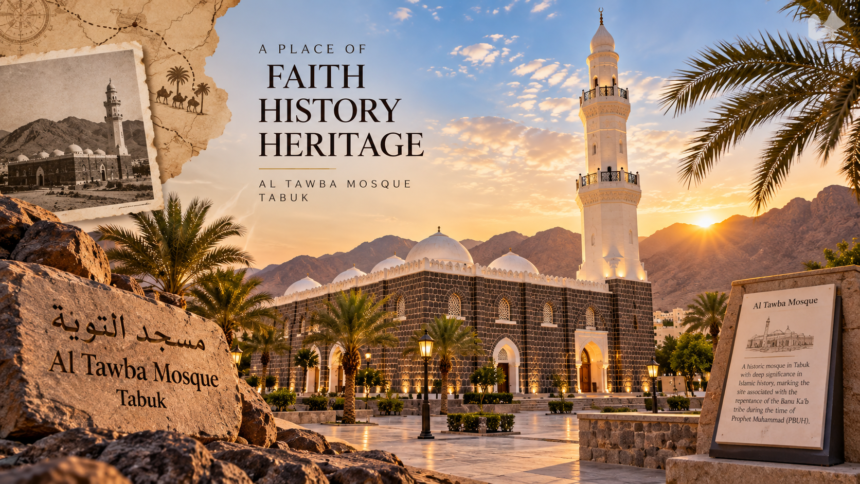
Al Tawba Mosque Tabuk and Its Place in Islamic History
Al Tawba Mosque Tabuk is one of the most important historic Islamic landmarks in the Tabuk region of Saudi Arabia. The mosque is closely associated with the events of the Battle of Tabuk, one of the final military expeditions led by Prophet Muhammad.
- Why Is Al Tawba Mosque Important?
- The Battle of Tabuk and the Mosque’s Story
- What Does the Name Al Tawba Mean?
- Did Prophet Muhammad Pray at the Site?
- When Was Al Tawba Mosque First Built?
- The Major Reconstruction in 1393 AH
- What Does Al Tawba Mosque Look Like Today?
- How the Mosque Helped Shape Tabuk
- Al Tawba Mosque and Tabuk’s Historic Landscape
- Why Was Tabuk Important Historically?
- The Story Behind the Army of Hardship
- The Mosque’s Connection With Surah Al Tawbah
- Why Do Visitors Still Come to Al Tawba Mosque?
- What Should Visitors Know Before Going?
- A Simple Timeline of Al Tawba Mosque
- What Makes Al Tawba Mosque Different?
- Al Tawba Mosque Tabuk Quick Facts
- A Respectful Way to Experience the Site
- Al Tawba Mosque Tabuk and the Future of Heritage Tourism
- Final Thoughts on Al Tawba Mosque Tabuk
Located in the heart of Tabuk, the mosque stands as a reminder of a period when the city became an important gathering point for the Prophet and his companions. Its significance is not limited to the building that visitors see today. The location itself is connected with the history of the Tabuk expedition and the Prophet’s stay in the region.
The site is also known by several names. Saudi tourism information notes that it is sometimes called the Archaeological Mosque and is known locally as the Prophet’s Mosque. Researchers and historians commonly refer to it as Al Tawba Mosque because of its association with the events surrounding the Battle of Tabuk and the revelation of Surah Al Tawbah.
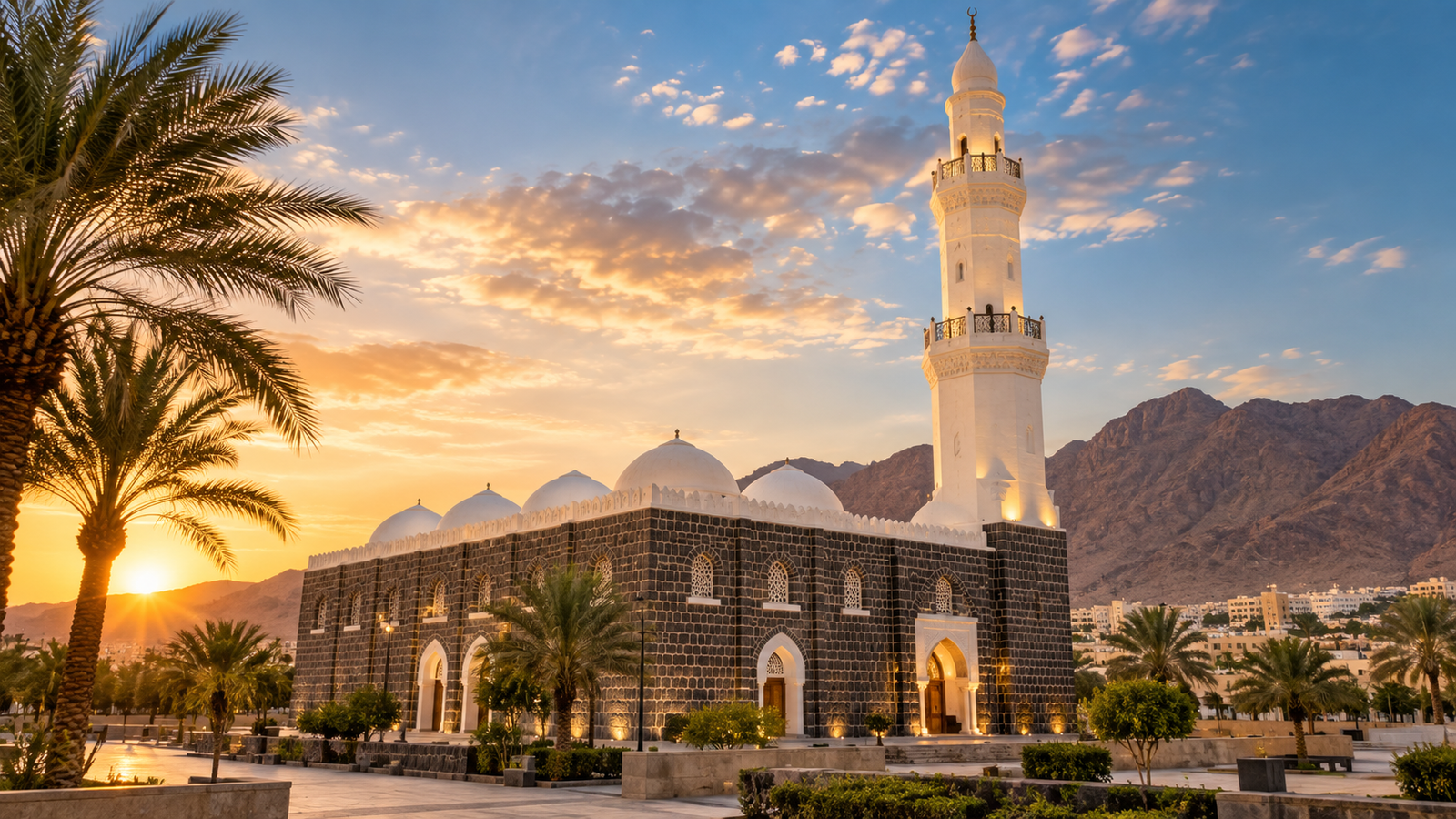
Today, the mosque combines historical significance with a modern structure inspired by the architectural style of the Prophet’s Mosque in Madinah.
That combination makes Al Tawba Mosque an interesting destination for visitors who want to explore both the religious history and architectural heritage of Tabuk.
Why Is Al Tawba Mosque Important?
The importance of Al Tawba Mosque comes from its connection with one of the most significant episodes in the early Islamic period.
The Battle of Tabuk took place in 9 AH, when Prophet Muhammad and his companions travelled north toward Tabuk. The journey was difficult because of the long distance, intense heat and limited resources.
The army associated with this expedition became known as Jaysh Al Usrah, commonly translated as the Army of Hardship, because of the challenging conditions faced by those who participated.
According to Saudi historical sources, the Prophet stayed in Tabuk for around 20 days and performed prayers with his companions at the location associated with the mosque.
This historical connection gives the site significance far beyond its physical architecture.
Quick historical overview
| Detail | Information |
|---|---|
| Location | Tabuk, Saudi Arabia |
| Historical connection | Battle of Tabuk |
| Major Islamic period | 9 AH |
| Traditional association | Prophet Muhammad and his companions |
| Current name | Al Tawba Mosque |
| Earlier names | Archaeological Mosque, Prophet’s Mosque |
| Major reconstruction | 1393 AH |
| Current capacity | Around 3,000 worshippers |
The Saudi official tourism platform describes the site as an important Islamic landmark associated with the events of the Battle of Tabuk.
The Battle of Tabuk and the Mosque’s Story
To understand Al Tawba Mosque, it is important to understand the historical setting of Tabuk itself.
In the ninth year after the Hijrah, Prophet Muhammad led an expedition north toward Tabuk. The journey took place during a particularly difficult period, with extreme heat and a long distance separating the army from Madinah.
The expedition became a test of commitment and endurance for the Muslim community.
The Saudi Press Agency describes the Tabuk expedition as the last of the Prophet’s military expeditions and highlights the hardships associated with the journey.
Tabuk was not simply a military destination.
The wider region had long been connected to movement between the Arabian Peninsula and the northern territories. Pilgrims, merchants and travellers passed through the area, helping establish its importance as a regional crossroads.
Saudi tourism information continues to describe Tabuk as a historic transit region that connected travellers and pilgrims moving between important parts of the region.
The mosque therefore sits within a much larger historical landscape.
What Does the Name Al Tawba Mean?
The name Al Tawba means repentance or turning back to God.
The mosque became associated with this name because of its connection with the events surrounding the Battle of Tabuk and Surah Al Tawbah.
Saudi Arabia’s official tourism platform explains that researchers use the name Al Tawba because of this historical association.
The name is therefore not simply an architectural label.
It connects the building with a major period in early Islamic history and with the spiritual themes associated with the events following the Tabuk expedition.
This is one reason the mosque remains important to visitors interested in Islamic history.
Did Prophet Muhammad Pray at the Site?
Saudi historical sources associate the location with the Prophet’s stay in Tabuk and state that he prayed there with his companions.
The official Saudi tourism website similarly states that it is traditionally believed that Prophet Muhammad prayed at the location where the mosque was later built.
It is important to distinguish between the historic location and the physical structure visible today.
The mosque building itself has been rebuilt and renovated over many centuries. The current structure is therefore not the original building from the time of the Prophet.
Instead, the importance of the site comes from the historical association of the location.
That distinction helps visitors understand why a modern-looking mosque can still have a history stretching back to the early Islamic period.
When Was Al Tawba Mosque First Built?
The mosque’s present structure is the result of several stages of construction and renovation.
According to Saudi official tourism information, Al Tawba Mosque was constructed during the rule of Caliph Umar ibn Abdulaziz in 98 AH, approximately 716 CE.
Saudi Press Agency sources also identify Umar ibn Abdulaziz as the ruler under whom the mosque was first established.
The earliest structure was considerably simpler than the mosque visitors see today.
It was initially an enclosed area without a roof.
Over the centuries, the site received attention and underwent several renovations.
This pattern is common among historic Islamic sites.
A mosque connected with an important location might be rebuilt multiple times as communities grow, construction techniques change and governments invest in preservation.
The Major Reconstruction in 1393 AH
One of the most important stages in the mosque’s modern history came in 1393 AH, corresponding to 1973 CE.
The mosque underwent a major reconstruction that gave it an architectural appearance inspired by the Prophet’s Mosque in Madinah.
This reconstruction transformed the physical appearance of the site while maintaining its historical identity.
The design created a stronger connection between the mosque and the architectural traditions associated with Madinah.
Today, the mosque can accommodate around 3,000 worshippers.
The result is a fascinating combination of historical memory and modern religious architecture.
What Does Al Tawba Mosque Look Like Today?
Visitors today see a mosque whose design reflects the architectural language associated with the Prophet’s Mosque.
Saudi official sources describe the building as having architecture that imitates the Prophet’s Mosque.
The current mosque includes architectural details designed for both worship and visitor comfort.
Saudi Press Agency reporting describes features including marble and granite finishes, glazed elements, decorative aluminium work and modern building systems.
Key Architectural Features
| Feature | Description |
|---|---|
| Architectural inspiration | Prophet’s Mosque in Madinah |
| Flooring | Marble and granite finishes |
| Facades | Modern glazed elements |
| Decorative elements | Aluminium and glass |
| Dome | Circular decorative dome |
| Courtyard | Open courtyard area |
| Capacity | Around 3,000 worshippers |
| Modern systems | Air conditioning and sound systems |
The modern structure demonstrates how historic religious sites can be preserved while still functioning as active places of worship.
How the Mosque Helped Shape Tabuk
Al Tawba Mosque is not an isolated historic building.
Its location became an important centre around which parts of old Tabuk developed.
Saudi Press Agency reporting describes the mosque as a nucleus around which neighbourhoods and markets developed. The area also became associated with travellers and pilgrims travelling between the Levant and the Arabian Peninsula.
This gives the mosque another layer of importance.
It was not only a religious landmark.
It was part of the development of a community.
Markets, residential areas and routes used by travellers grew around important sites such as the mosque and Tabuk Castle.
This connection between religious buildings and urban development can be seen throughout the history of many Middle Eastern cities.
Al Tawba Mosque and Tabuk’s Historic Landscape
A visit to Al Tawba Mosque can be combined with other historic locations in Tabuk.
The mosque is located close to Tabuk Castle, another major landmark in the city.
Saudi tourism information also highlights historic markets near the mosque, including the area now known as Al Jaddah.
Historic Tabuk Highlights
| Attraction | Why It Matters |
|---|---|
| Al Tawba Mosque | Islamic history and Battle of Tabuk connection |
| Tabuk Castle | Historic defensive landmark |
| Al Jaddah | Historic market area |
| Hejaz Railway heritage | Connection to regional travel history |
| Ancient water sites | Evidence of Tabuk’s long settlement history |
This makes the mosque part of a broader cultural itinerary rather than a standalone stop.
Visitors interested in history can spend time exploring several layers of Tabuk’s past in the same area.
Why Was Tabuk Important Historically?
Tabuk’s importance predates Islam.
The region has long served as a route between the Arabian Peninsula and northern territories.
Its position helped connect merchants, pilgrims and travellers.
Saudi tourism describes Tabuk as a region shaped by ancient journeys and movements between Egypt, Jordan and Madinah.
This geographical position helps explain why Tabuk appears repeatedly in historical narratives.
The city was positioned along important routes and had access to water sources that supported travellers in a challenging environment.
By the time of the Prophet’s expedition, Tabuk was already part of a wider regional landscape.
The Battle of Tabuk added a major chapter to that history.
The Story Behind the Army of Hardship
The Tabuk expedition is remembered for the difficult conditions faced by the Muslim army.
The journey took place during hot weather, and resources were limited.
The term Jaysh Al Usrah, or Army of Hardship, reflects the difficult circumstances surrounding the expedition.
Saudi historical reporting highlights the distance, heat and challenging conditions as important features of the journey.
For modern visitors, it can be difficult to imagine what such a journey involved.
There were no modern highways, air conditioning, reliable vehicles or established tourist infrastructure.
The journey required physical endurance and strong organisation.
This historical background adds meaning to the location associated with the mosque.
The Mosque’s Connection With Surah Al Tawbah
The name of the mosque is also connected with Surah Al Tawbah, the ninth chapter of the Quran.
Saudi official tourism information notes that the mosque is known as Al Tawba because of its association with the events of the Battle of Tabuk, after which Surah Al Tawbah was revealed.
For visitors interested in Islamic history, this connection provides another reason to explore the site’s story.
The mosque represents a physical location connected with a period in which major religious, political and social events were unfolding within the early Muslim community.
Why Do Visitors Still Come to Al Tawba Mosque?
For many visitors, the attraction is not simply architecture.
It is the opportunity to stand in a place associated with an important chapter of Islamic history.
The mosque offers a quieter experience than some of Saudi Arabia’s better-known religious destinations.
Visitors can reflect on:
- The Battle of Tabuk
- The Prophet’s stay in the region
- The history of early Islamic travel
- The development of Tabuk
- The evolution of Islamic architecture
- The relationship between historic sites and modern cities
Saudi tourism currently lists the mosque as a visitor attraction in Tabuk and states that no ticket is required to enter.
What Should Visitors Know Before Going?
Al Tawba Mosque is an active mosque rather than a museum.
That means visitors should approach the site with the same respect expected at other functioning places of worship.
Before visiting, remember:
- Dress modestly.
- Keep noise low.
- Respect people who are praying.
- Follow any instructions from mosque staff.
- Ask before photographing people.
- Avoid disrupting religious activities.
- Check current access arrangements before travelling.
Saudi tourism currently lists the mosque as open daily, but visitors should still check current information before making a dedicated trip because operating arrangements can change.
A Simple Timeline of Al Tawba Mosque
The mosque’s history becomes easier to understand when viewed as a timeline.
| Period | Historical Development |
|---|---|
| 9 AH | Battle of Tabuk and Prophet’s stay in Tabuk |
| 98 AH | Mosque established during the rule of Umar ibn Abdulaziz |
| Later centuries | Multiple renovations and continued use |
| 1393 AH | Major reconstruction |
| 1973 CE | Modern reconstruction completed around this period |
| Today | Active mosque and historic visitor landmark |
This timeline shows that the mosque’s history is not represented by one single building.
It is the history of a location that has remained significant across centuries.
What Makes Al Tawba Mosque Different?
Saudi Arabia has many historic mosques connected with important moments in Islamic history.
Al Tawba Mosque stands out because of its relationship with the Tabuk expedition and the development of the city around the historic site.
Its story combines several themes:
Early Islamic history
The site is associated with the Prophet’s stay in Tabuk.
The Battle of Tabuk
The location is connected with one of the final military expeditions of the Prophet.
Islamic architecture
Its current design draws inspiration from the Prophet’s Mosque.
Urban history
The surrounding area developed around the mosque, markets and travel routes.
Modern preservation
The mosque continues to function as a place of worship while preserving its historic association.
That combination gives the site an identity beyond architecture alone.
Al Tawba Mosque Tabuk Quick Facts
| Question | Answer |
|---|---|
| Where is Al Tawba Mosque? | Tabuk, Saudi Arabia |
| What is it associated with? | The Battle of Tabuk |
| Who is traditionally associated with the site? | Prophet Muhammad and his companions |
| Why is it called Al Tawba? | Its association with the events surrounding Surah Al Tawbah |
| When was the mosque first established? | 98 AH, according to Saudi official sources |
| Who built the early mosque? | It was established during the rule of Umar ibn Abdulaziz |
| When was it significantly rebuilt? | 1393 AH |
| What architecture inspired the modern building? | The Prophet’s Mosque in Madinah |
| How many worshippers can it accommodate? | Around 3,000 |
| Is entry ticketed? | Saudi tourism currently lists entry without a ticket |
| What is nearby? | Tabuk Castle and historic market areas |
A Respectful Way to Experience the Site
A visit to Al Tawba Mosque is best approached as a historical and spiritual experience rather than simply another sightseeing stop.
Take time to understand what happened in Tabuk before visiting.
Learn about the expedition.
Understand why the journey was difficult.
Explore the surrounding historic landscape.
Then look at the mosque itself.
The modern structure may appear relatively new compared with the age of the story associated with the location. That is because the building has been rebuilt and renovated many times.
The continuity lies in the site and its historical memory.
This is an important distinction when visiting historic religious buildings throughout Saudi Arabia.
Al Tawba Mosque Tabuk and the Future of Heritage Tourism
Saudi Arabia is increasingly developing its historic and cultural destinations as part of a broader tourism strategy.
Tabuk has become an important destination for visitors interested in archaeology, history, natural landscapes and Islamic heritage.
The continued preservation of places such as Al Tawba Mosque gives travellers an opportunity to explore stories that extend far beyond modern tourism.
At the same time, modern facilities allow historic religious sites to remain active rather than becoming purely museum pieces.
That balance is important.
A historic mosque can preserve its connection with the past while continuing to serve the community today.
Al Tawba Mosque represents this relationship particularly well.
Final Thoughts on Al Tawba Mosque Tabuk
Al Tawba Mosque Tabuk is more than an architectural landmark.
Its importance begins with the history of Tabuk itself and the events of the ninth year after the Hijrah, when Prophet Muhammad and his companions travelled north during the difficult Tabuk expedition.
The location is traditionally associated with the Prophet’s prayers during his stay in Tabuk. Centuries later, a mosque was established at the site during the rule of Umar ibn Abdulaziz in 98 AH. It was subsequently renovated several times before receiving a major reconstruction in 1393 AH inspired by the architectural style of the Prophet’s Mosque in Madinah.
Today, the mosque can accommodate around 3,000 worshippers and remains an active place of prayer. Its modern architecture, historical location and connection with the Battle of Tabuk make it one of the most distinctive Islamic heritage landmarks in the region.
For visitors exploring Tabuk, the mosque also provides a gateway into the wider history of the city.
Nearby Tabuk Castle, historic markets and other heritage sites help tell the story of a region shaped by travellers, pilgrims, merchants and communities for centuries.
Perhaps the most remarkable part of Al Tawba Mosque’s story is its continuity.
The building has changed.
Its architecture has evolved.
Its surroundings have developed.
But the historical memory attached to the location has remained.
That makes Al Tawba Mosque a meaningful destination for anyone interested in Islamic history, Saudi heritage and the remarkable journey of Tabuk from an ancient crossroads to a modern city.
A visit here is ultimately not only about seeing a mosque.
It is about standing in a place where history, faith, architecture and the story of an ancient city continue to meet.
Do follow us on Instagram
Read More – Best Waterparks in Dubai: The Ultimate Way to Beat the Heat