


World’s best smart cities using AI, digital services, sustainable transport and intelligent urban infrastructure
A smart city is no longer simply a place filled with sensors, fast internet and futuristic buildings. The most successful urban centres are increasingly judged by something far more practical: whether technology actually makes everyday life easier, safer, cleaner and more inclusive for the people who live there.
- World’s Best Smart Cities in 2026 at a Glance
- World’s Best Smart Cities in 2026 at a Glance
- 1. Zurich: Where Smart Technology Meets Everyday Reliability
- 2. Oslo: Smart Urban Living Through Sustainability
- 3. Geneva: Strong Infrastructure Before Flashy Technology
- 4. London: Data Becomes City Infrastructure
- 5. Copenhagen: Making Sustainable Mobility Smart
- 6. Dubai: AI Moves From Experiment to City Management
- 7. Lausanne: A Smaller City Competing With Global Capitals
- 8. Canberra: Technology With Space and Quality of Life
- 9. Singapore: Perhaps the Clearest Digital Smart-City Model
- 10. Abu Dhabi: Building an AI-Native Government
- What the World’s Best Smart Cities Have in Common
- Europe, Asia and the Gulf Are Building Different Smart Cities
- Why Different Smart-City Rankings Produce Different Winners
- The Challenges Even Smart Cities Have Not Solved
- What Will the Smart City of the Future Look Like?
- Frequently Asked Questions About the World’s Best Smart Cities
- Final Thoughts on the World’s Best Smart Cities
The World’s Best Smart Cities in 2026 illustrate this shift clearly. Some rely heavily on artificial intelligence and digital government services. Others combine technology with excellent public transport, cycling infrastructure, sustainability, healthcare, citizen participation and transparent government. The strongest performers usually succeed because several of these systems work together rather than because they have one spectacular technology project.
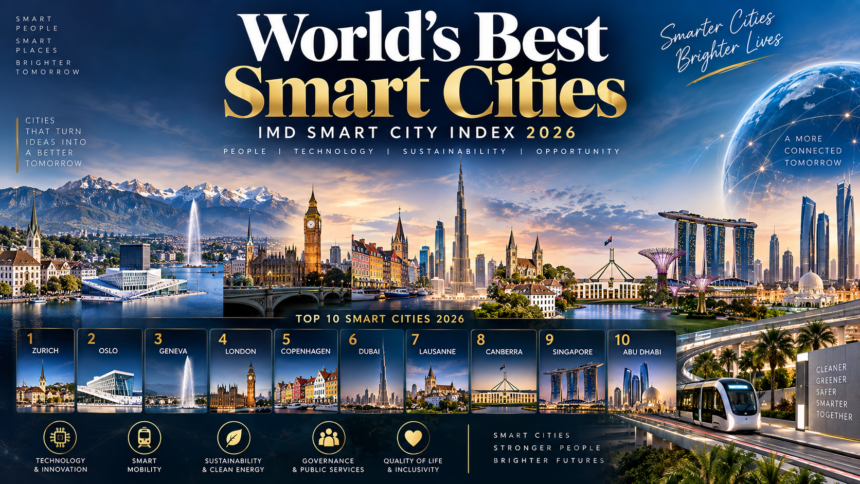
For this guide, the main reference is the IMD Smart City Index 2026, which assessed 148 cities worldwide. The index looks at residents’ perceptions of both urban infrastructure and technology across health and safety, mobility, activities, opportunities and governance. Zurich ranked first, followed by Oslo and Geneva, while London and Copenhagen completed the top five. Dubai ranked sixth and Abu Dhabi tenth, giving the UAE two cities in the global top 10.
Importantly, there is no single universal definition of the “smartest” city. The 2026 IESE Cities in Motion Index uses a broader set of measures covering areas such as economic strength, human capital, governance, environment, mobility, technology and international profile, and places London, New York and Paris at the top. Rankings therefore tell us different things depending on what they measure.
World’s Best Smart Cities in 2026 at a Glance
A futuristic skyline does not automatically create a smart city. The IMD World Competitiveness Center defines a smart city broadly as one that balances economic strength, applied technology, environmental concerns and inclusiveness in ways that improve residents’ quality of life.
The 2026 index is particularly interesting because most of its results come from resident surveys rather than simply counting technologies. Around 120 residents are surveyed in each city, and IMD uses three years of responses to create the final results. Cities are evaluated under two main pillars: Structures, meaning existing infrastructure, and Technology, meaning technological services available to residents.
That approach helps explain why installing more sensors or AI systems does not automatically move a city to the top of the ranking. Residents still need reliable public transport, healthcare, green spaces, employment opportunities, safety, transparent services and affordable daily life.
| Smart City Area | What It Means in Everyday Life |
|---|---|
| Mobility | Reliable public transport, cycling, traffic information |
| Digital Government | Services available online without unnecessary office visits |
| Sustainability | Cleaner energy, efficient buildings and lower emissions |
| Health | Accessible healthcare and digital appointment systems |
| Connectivity | Fast, reliable internet and digital infrastructure |
| Safety | Emergency services, safe public spaces and useful technology |
| Governance | Transparent information and public participation |
| Inclusion | Services that remain usable by different groups |
| Data | Better planning based on real urban information |
| Quality of Life | Technology producing tangible benefits for residents |
The biggest lesson is simple: a truly smart city uses technology as a tool, not as the final goal. IMD’s 2026 analysis places particular emphasis on trust and transparency, finding that high-performing cities often combine good infrastructure with citizen confidence in how institutions operate.
World’s Best Smart Cities in 2026 at a Glance
The following ranking comes directly from the IMD Smart City Index 2026 rather than being an editorial ranking created for this article.
| 2026 Rank | City | Country | IMD Rating | 2025 Rank |
|---|---|---|---|---|
| 1 | Zurich | Switzerland | AAA | 1 |
| 2 | Oslo | Norway | AA | 2 |
| 3 | Geneva | Switzerland | AA | 3 |
| 4 | London | United Kingdom | A | 6 |
| 5 | Copenhagen | Denmark | AA | 7 |
| 6 | Dubai | UAE | A | 4 |
| 7 | Lausanne | Switzerland | A | 10 |
| 8 | Canberra | Australia | A | 8 |
| 9 | Singapore | Singapore | AAA | 9 |
| 10 | Abu Dhabi | UAE | A | 5 |
Zurich, Oslo and Geneva retained the same first three positions as 2025. London and Copenhagen each moved up two places, Lausanne climbed three, while Dubai moved from fourth to sixth and Abu Dhabi from fifth to tenth.
Singapore presents an interesting case. It sits ninth in the overall ranking but receives AAA ratings for the overall index, structures and technology, illustrating how the IMD ranking is influenced not only by raw technology performance but also by the index’s resident-perception and development-group methodology.
1. Zurich: Where Smart Technology Meets Everyday Reliability
Zurich retained the number-one position in the 2026 IMD Smart City Index after also ranking first in 2025. Its overall rating is AAA, with an AAA rating for city structures and AA for technology.
What makes Zurich particularly interesting is that its strengths are not based only on highly visible technology. Residents give strong marks to public transport, medical services, recycling, schools, cultural activities and opportunities to participate in local decision-making. In the 2026 survey, satisfaction with public transport reached 80.3%, while medical services received 86.2% and recycling services 86.3%.
Zurich also operates an extensive open-data ecosystem. The city follows an “open by default” approach for government datasets that do not contain protected information, with public data covering areas including environment, population, mobility and construction. Its catalogue also provides APIs, visualisations and a freely accessible 3D city model.
This combination explains Zurich’s model particularly well. Technology supports a city where conventional infrastructure already works effectively, instead of being expected to compensate for basic urban problems.
There are still challenges. Affordable housing was selected as an urgent issue by 82.4% of Zurich respondents in the IMD survey, showing that even the top-ranked smart city has problems that digital technology alone cannot solve.
2. Oslo: Smart Urban Living Through Sustainability
Oslo ranked second globally in 2026, maintaining its position from the previous year. Its IMD profile gives the Norwegian capital an AAA rating for structures and an A rating for technology.
Oslo’s approach demonstrates how environmental policy can become part of smart-city infrastructure. The city has set a target to reduce greenhouse-gas emissions by 95% by 2030 compared with 2009 levels, while its municipal climate statistics track emissions, transport, air quality, waste and related indicators.
Electric mobility is another prominent part of the city’s model. Oslo has invested heavily in electric-vehicle adoption, public transport, cycling and low-emission urban systems. The municipality has also tested intelligent charging systems designed to manage growing electricity demand without automatically requiring major expansion of the electricity grid.
The important point is that Oslo’s smart-city strategy is not simply about putting digital displays around the city. Technology is frequently connected to climate targets, energy management and mobility.
That makes Oslo an example of a green smart city, where technology, urban planning and environmental policy increasingly operate as one system.
3. Geneva: Strong Infrastructure Before Flashy Technology
Geneva held third place in the IMD Smart City Index for the second consecutive year. Like Oslo, it received an AAA rating for structures and an A rating for technology.
That balance illustrates something important about smart-city rankings. Geneva does not need to market itself as a giant experimental technology laboratory to perform strongly. Well-functioning public infrastructure, services and institutional systems can matter just as much as the latest digital platform.
Switzerland’s presence is particularly striking in 2026. Three Swiss cities appear in the global top seven: Zurich first, Geneva third and Lausanne seventh.
This suggests that the Swiss model represented in the IMD results is strongly associated with reliable structures and quality of life. Zurich and Geneva both receive the highest structural rating available, while Lausanne receives AA.
Geneva therefore represents a quieter definition of “smart.” Rather than equating intelligence with maximum automation, the city’s high position reflects how residents perceive the combination of infrastructure and urban services.
4. London: Data Becomes City Infrastructure
London climbed from sixth place in 2025 to fourth in the 2026 IMD ranking. It also leads the separate IESE Cities in Motion Index 2026, where it performs strongly across human capital, governance, urban planning and international projection.
One of London’s most significant current smart-city initiatives is the Data for London Library, launched publicly in July 2025. City Hall says the platform contains more than 5,000 datasets and is intended to make city information easier to discover and use for improved public services.
Connectivity has also expanded substantially. According to London City Hall, access to gigabit-capable connectivity grew from around 4% in 2017 to 88%, while new developments are required to include full-fibre connections.
London illustrates the value of treating data almost like physical infrastructure. Transport information, demographic data, planning information and service data can be shared between agencies and developers to create better tools for residents.
Its scale, however, also creates complexity. London must apply smart-city systems across millions of people, dozens of boroughs, old infrastructure and significant economic inequality. That makes its fourth-place IMD position particularly different from smaller cities such as Zurich or Lausanne.
5. Copenhagen: Making Sustainable Mobility Smart

Copenhagen rose from seventh to fifth in the 2026 IMD Smart City Index. Its structures receive an AAA rating, while technology is rated A.
Perhaps the clearest example of Copenhagen’s smart-city model is mobility. The city has around 400 kilometres of cycle tracks and more than 25 bicycle and pedestrian bridges. Copenhagen’s municipality says more than 2.7 million kilometres are cycled on its roads and paths every weekday.
Technology is increasingly being layered onto this existing cycling culture. Copenhagen Solutions Lab works with businesses and researchers to test data-driven mobility systems, including cyclist data, intelligent traffic planning, smarter bike parking and new systems for greener goods delivery.
The city adopted a new Climate Strategy 2035 in 2025 alongside an action plan for 2026–2028. The strategy covers energy, buildings, mobility, nature and collaboration with residents and businesses.
Copenhagen therefore shows why smart-city development does not always need to begin with autonomous vehicles. Improving walking, cycling and public transport through better planning and data may create more immediate benefits for everyday urban life.
6. Dubai: AI Moves From Experiment to City Management
Dubai’s sixth-place position is particularly notable because it represents one of the most technology-intensive approaches in the top 10. The city received an A rating for both structures and technology in the 2026 IMD index.
In April 2026, Dubai announced plans to integrate individual and business government services into a unified digital platform within one year. Digital Dubai described the next stage as one in which integrated data and AI increasingly support proactive, automated city services.
The emirate has also strengthened the governance infrastructure behind those services. An updated Dubai Data Manual launched in July 2026 provides rules for how government organisations manage, share and use data to support AI applications and decision-making.
Another independent measure illustrates Dubai’s technology emphasis. Digital Dubai reported that the emirate ranked second globally in Boston Consulting Group’s inaugural 2026 Intelligent Cities Index, which evaluated 61 cities on technology and AI maturity across areas including strategy, adoption and outcomes.
The difference between that second-place BCG result and sixth place in IMD is useful rather than contradictory. It demonstrates how Dubai performs exceptionally strongly when AI and technology adoption receive greater emphasis, while IMD places more weight on residents’ perceptions of broader urban life.
7. Lausanne: A Smaller City Competing With Global Capitals
Lausanne may be less internationally famous than London, Singapore or Dubai, but it climbed three positions to seventh in the 2026 IMD Smart City Index.
It received an AA rating for structures and an A rating for technology, continuing Switzerland’s unusually strong showing in the ranking.
Smaller cities can sometimes have an advantage when integrating infrastructure, mobility and public services because they operate at a more manageable scale. They may also find it easier to test solutions before rolling them out citywide.
Lausanne’s presence alongside Zurich and Geneva demonstrates that the smart-city conversation does not belong exclusively to megacities.
The 2026 results instead reinforce a broader lesson: size and smartness are not the same thing. IESE’s 2026 city research reaches a similar conclusion, noting that medium-sized cities can compete with far larger metropolitan areas on quality of life and balanced performance.
8. Canberra: Technology With Space and Quality of Life
Canberra retained eighth place in IMD’s 2026 ranking, receiving an AA rating for structures and BBB for technology.
The Australian capital is a useful example because its smart-city strengths are closely connected with liveability rather than simply technological intensity.
Canberra’s official destination organisation highlights the region’s strong sustainability credentials and notes that the Australian Capital Territory became the first mainland Australian state or territory to reach 100% renewable electricity.
Its lower technology rating compared with Singapore or London does not prevent it from remaining inside the global top 10. That reinforces the IMD index’s broader message that infrastructure and quality of life can be at least as important as visible digital sophistication.
Canberra’s urban form, public services and environmental strategy therefore provide another model for smart-city development: technology supports the city, but it does not need to dominate the experience of living there.
9. Singapore: Perhaps the Clearest Digital Smart-City Model
Singapore remains ninth in IMD’s 2026 ranking, but it is the only top-10 city receiving AAA ratings for structures, technology and the overall smart-city rating.
Its Smart Nation program has been operating since 2014 and has grown into an extensive digital ecosystem. Current government initiatives include national digital identity, smart parking, automated immigration, intelligent water meters, geospatial accessibility routing, drones for infrastructure inspections and city systems supported by 5G connectivity.
Government services are particularly advanced. Singapore reports that 99% of citizen-government transactions can be completed online, while Singpass provides residents with secure digital access to services across both the public and private sectors.
Its current smart-city systems also demonstrate how data can support sustainability. Punggol Digital District uses an open digital platform for real-time management and optimisation, while environmental modelling tools simulate factors such as wind, heat, sunlight and noise to support urban planning.
Singapore therefore comes close to what many people imagine when they hear the phrase “smart city.” Sensors, automation, digital identity and interconnected government platforms are visible throughout daily life.
Yet Smart Nation 2.0 places increasing emphasis on trust, inclusion and security as well as technology, reflecting the reality that digital expansion creates new issues around cyber resilience and public confidence.
10. Abu Dhabi: Building an AI-Native Government
Abu Dhabi completes the IMD top 10 for 2026, receiving A ratings across its overall score, structures and technologies.
Its current transformation is heavily focused on artificial intelligence. Under the Abu Dhabi Government Digital Strategy 2025–2027, the emirate announced AED13 billion in digital investment, plans for full sovereign-cloud adoption across government operations, complete digitisation and automation of government processes, and more than 200 AI-based solutions.
By late 2025, Abu Dhabi said more than 100 AI use cases had already moved into operational deployment across over 40 government entities. The TAMM platform has also evolved toward proactive and personalised services designed to handle government interactions through a unified interface.
The scale is significant. Abu Dhabi’s sovereign-cloud partnership is intended to support more than 11 million daily digital interactions between government entities, residents, citizens and businesses.
TAMM also won the e-government category at the UN-supported WSIS Prizes 2025, giving the emirate international recognition for its digital public-service platform.
Together with Dubai’s sixth-place position, Abu Dhabi’s inclusion means the UAE is the only country outside Switzerland with two cities in the IMD 2026 top 10.
What the World’s Best Smart Cities Have in Common
The technologies differ dramatically from city to city, but several patterns keep appearing.
- Strong basic infrastructure comes first. Public transport, healthcare, schools, utilities and safety still matter more than futuristic gadgets.
- Digital government reduces friction. Singapore, Dubai, Abu Dhabi and London all use integrated digital services to reduce unnecessary physical processes.
- Mobility becomes data-driven. Copenhagen uses cyclist data, Oslo focuses heavily on electric mobility, while large cities increasingly use live transport information and integrated platforms.
- Environmental goals are connected to technology. Smart energy, emissions tracking and efficient transport are becoming central rather than optional.
- Open data supports innovation. Zurich and London make substantial city data available for public and professional use.
- Citizen trust matters. IMD’s 2026 analysis emphasises that transparency and confidence in institutions are closely associated with strong smart-city performance.
The final point may be the most important. A technically advanced city that residents do not trust or cannot afford to live in may still struggle to deliver the quality of life associated with a genuinely smart urban environment.
Europe, Asia and the Gulf Are Building Different Smart Cities
There is no single smart-city formula.
European leaders such as Zurich, Oslo and Copenhagen tend to combine reliable traditional infrastructure with sustainability, public transport, open data and strong public services. Technology is often introduced gradually into systems that already work reasonably well.
Singapore follows a more integrated digital-state model. Digital identity, government platforms, smart infrastructure, sensors and automated systems operate across multiple areas of daily life.
The Gulf model represented by Dubai and Abu Dhabi places heavier emphasis on rapid deployment, government-led digital transformation, AI, unified data systems and proactive public services. Both UAE cities are moving quickly from conventional e-government toward systems that use AI to predict or automate interactions.
| Smart-City Model | Representative Cities | Main Strength |
|---|---|---|
| Infrastructure-led | Zurich, Geneva, Lausanne | Reliable urban systems |
| Climate-led | Oslo, Copenhagen | Sustainable mobility and environment |
| Data-led | London | Citywide data and connectivity |
| Digital-state | Singapore | Integrated digital identity and services |
| AI-led | Dubai, Abu Dhabi | Automation and proactive government |
| Liveability-led | Canberra | Quality of life and sustainability |
None of these approaches automatically makes one model universally superior. Geography, population, political structure, existing infrastructure and residents’ expectations all influence what works.
Why Different Smart-City Rankings Produce Different Winners
Search for the world’s smartest city and you may see Zurich, London, Singapore or another city appearing at the top.
That does not necessarily mean one of the studies is wrong.
IMD’s Smart City Index gives heavy weight to resident perceptions and focuses on structures and technologies. Its 2026 top three are Zurich, Oslo and Geneva.
IESE’s Cities in Motion Index takes a much broader urban-competitiveness approach using more than 100 indicators across nine dimensions. Its 2026 leaders are London, New York and Paris.
Meanwhile, Boston Consulting Group’s 2026 Intelligent Cities Index gives stronger attention to digital and AI maturity. Dubai placed second in that study.
| Index | Main Emphasis | Leading City |
|---|---|---|
| IMD Smart City Index 2026 | Residents, infrastructure and technology | Zurich |
| IESE Cities in Motion 2026 | Broad urban competitiveness and sustainability | London |
| BCG Intelligent Cities 2026 | Digital and AI maturity | London, with Dubai second |
For readers, this is useful. Instead of asking simply which city is “the smartest,” a more informative question is what kind of smart city performance matters most?
The Challenges Even Smart Cities Have Not Solved
Technology does not remove fundamental urban problems.
Housing is one of the clearest examples. Even Zurich, ranked first globally by IMD, had 82.4% of surveyed residents identify affordable housing as a major priority. Traffic congestion was selected by 60%.
Privacy presents another challenge. AI, cameras, biometric systems and large-scale city data can improve speed and safety, but they also create legitimate questions about how information is collected, retained and governed.
Digital inclusion is equally important. A city where almost every service becomes digital must ensure older residents, people with disabilities and those with weaker digital skills are not unintentionally excluded.
Cybersecurity will become more significant as well. The more transport, government services, payments and infrastructure become interconnected, the greater the consequences of system failures or cyberattacks.
The smartest cities of the next decade may therefore be judged less by how much technology they deploy and more by how safely, transparently and inclusively they manage it.
What Will the Smart City of the Future Look Like?
The next stage is likely to move from digital services toward predictive services.
Instead of opening an app and searching for a government procedure, AI-based systems may increasingly recognise when someone needs a service and begin the process automatically. Abu Dhabi is already developing this direction through TAMM, while Dubai is moving toward government systems built around integrated data and AI.
Transport will also become more adaptive. Traffic lights, buses, charging infrastructure, delivery systems and cycling networks can respond increasingly to real-time demand rather than fixed schedules.
Digital twins and environmental modelling will allow planners to test how new buildings affect wind, heat, energy and traffic before construction begins. Singapore is already using integrated environmental modelling as part of its Smart Nation city solutions.
The strongest cities will probably combine this technology with simpler things: shaded streets, reliable trains, affordable housing, accessible healthcare, green spaces and places where people actually want to spend time.
That is the difference between building a city full of technology and building a genuinely intelligent city.
Frequently Asked Questions About the World’s Best Smart Cities
What is the world’s top smart city in 2026?
Zurich ranks first in the IMD Smart City Index 2026, followed by Oslo and Geneva. The ranking assessed 148 cities and combines resident perceptions of infrastructure and technology.
Which are the top 10 smart cities in 2026?
According to IMD, the top 10 are Zurich, Oslo, Geneva, London, Copenhagen, Dubai, Lausanne, Canberra, Singapore and Abu Dhabi.
Which smart city is strongest in the Middle East?
In the IMD 2026 Smart City Index, Dubai is the highest-ranked Middle Eastern city at sixth globally, followed by Abu Dhabi at tenth. Dubai also placed second in BCG’s 2026 Intelligent Cities Index, which focuses more heavily on AI and digital maturity.
Is Singapore still one of the world’s leading smart cities?
Yes. Singapore ranks ninth in IMD’s overall 2026 list and receives AAA ratings for both infrastructure and technology. Its Smart Nation program includes digital identity, smart parking, automated immigration, environmental monitoring and integrated digital services.
Why is Zurich ranked so highly?
IMD respondents report strong satisfaction with areas including public transport, healthcare, recycling, education and cultural services. Zurich also combines these systems with an extensive open-data ecosystem and digital services.
Are smart cities mainly about artificial intelligence?
No. AI is becoming increasingly important, particularly in Dubai, Abu Dhabi and Singapore, but the highest-ranking cities also depend heavily on reliable transport, healthcare, governance, environmental quality and other basic urban systems.
Which European cities perform strongly?
European cities dominate the top of IMD’s 2026 ranking. Zurich, Oslo, Geneva, London, Copenhagen and Lausanne occupy six of the first seven positions.
What is the biggest smart-city trend for the next few years?
The movement from reactive digital services toward AI-assisted and proactive services is one of the clearest current trends. At the same time, cities are putting more emphasis on data governance, cybersecurity, transparency and trust as their systems become more automated.
Final Thoughts on the World’s Best Smart Cities
The World’s Best Smart Cities show that urban intelligence cannot be measured by the number of cameras, sensors, apps or futuristic buildings a city installs.
Zurich demonstrates the value of combining reliable infrastructure with useful digital systems. Oslo and Copenhagen show how smart-city thinking can strengthen sustainability and mobility. London demonstrates the power of shared city data, while Singapore has built one of the world’s most integrated digital public-service ecosystems.
Dubai and Abu Dhabi represent another rapidly developing model. Both are using AI, unified digital platforms and large-scale data infrastructure to redesign how government interacts with residents and businesses. Their presence in the 2026 IMD top 10 also underlines the Gulf’s growing role in global smart-city development.
Yet the latest rankings also provide an important reality check. Zurich still faces housing pressure despite ranking first. Technology-focused cities still need public trust. Digital services still need to be inclusive, and automation must be supported by cybersecurity and responsible data governance.
The future smart city will therefore not necessarily be the place with the most technology. It will be the city that makes technology almost invisible because transport works, public services are simple, energy is used efficiently, information is accessible and people can move through everyday life with fewer unnecessary difficulties.
That may be the most useful definition of a smart city in 2026: not a city that merely looks futuristic, but one that uses innovation to make ordinary life work better.
Do follow us on Instagram
Read More – Archers Hill Uhud: A Historic Landmark of Faith and Strategy