

Dubai Metro Expansion: 29 New Stations Set to Transform City Travel
Dubai’s Metro network is heading for one of the biggest expansions in its history, with new rail connections planned for communities that have long depended mainly on cars, taxis and buses.
- Dubai Metro Expansion at a Glance
- Dubai Metro Blue Line Will Arrive First
- Which Areas Will the Blue Line Serve?
- Blue Line Will Have Two Main Routes
- International City Will Become an Important Metro Hub
- Dubai Creek Harbour Is Getting a Landmark Metro Station
- Dubai Silicon Oasis Will Finally Get Direct Metro Connectivity
- Students Could Benefit From Academic City Station
- Mirdif and Al Warqa Will Gain Better Rail Access
- Blue Line Could Carry 320,000 Passengers a Day by 2040
- Dubai Metro Gold Line Will Follow in 2032
- Which Areas Will the Gold Line Serve?
- City Walk Could Become Much Easier to Reach
- Business Bay Will Become an Even Bigger Interchange
- Jumeirah Village Circle Will Finally Get Metro Access
- Meydan Will Connect Metro and Etihad Rail
- Al Ghubaiba Will Connect the Gold and Green Lines
- Gold Line Could Serve More Than 1.5 Million People
- How Big Will Dubai Metro Become?
- Why Are People Calling It 29 New Stations?
- What Will Change for Dubai Residents?
- Could the New Metro Lines Reduce Dubai Traffic?
- When Will the New Dubai Metro Stations Open?
- The Dubai Metro Map of the 2030s Will Look Very Different
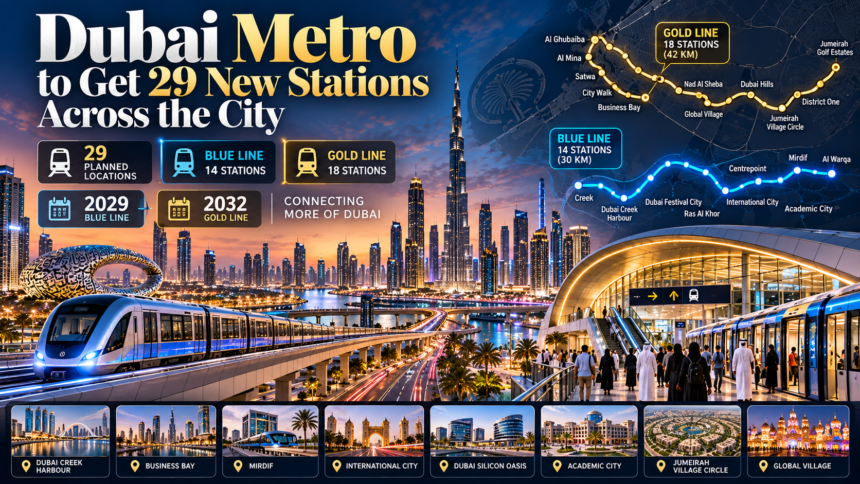
The expansion centres on two major projects: the Dubai Metro Blue Line, which is already under construction and scheduled to open in 2029, and the Dubai Metro Gold Line, approved in April 2026 and planned for 2032. Together, the projects will bring Metro services closer to fast-growing areas including Dubai Creek Harbour, Dubai Silicon Oasis, Academic City, Mirdif, City Walk, Business Bay, Meydan and Jumeirah Village Circle.
You may have seen the expansion described as bringing 29 new Metro stations or station locations across Dubai. There is an important distinction, however. RTA officially states that the Blue Line will have 14 stations, while the Gold Line will contain 18 stations, giving the two routes 32 stations in total. Some will function as connections or interchanges with existing parts of the network, which is why guides counting entirely new locations often arrive at a lower number.
Dubai Metro Expansion at a Glance
| Project | Blue Line | Gold Line |
|---|---|---|
| Route length | 30 km | 42 km |
| Stations | 14 | 18 |
| Status | Under construction | Approved, procurement underway |
| Estimated investment | More than AED20.5 billion | Around AED34 billion |
| Target opening | 9 September 2029 | 9 September 2032 |
| Main purpose | Connect eastern and north-eastern growth areas | Connect historic, central and western growth districts |
| Key connections | Red and Green Lines | Red Line, Green Line and Etihad Rail |
RTA says the Gold Line will eventually increase the Metro network to 162 kilometres and 85 stations, taking into account the Blue Line as part of the expanded system.
Dubai Metro Blue Line Will Arrive First
The first major change passengers will experience is the Blue Line.
The AED20.5 billion project will extend for 30 kilometres. Approximately 15.5 kilometres will run underground, while another 14.5 kilometres will be above ground. The route will contain 14 stations and connect with both of Dubai’s existing Metro lines.
Construction is already underway. In May 2026, Dubai launched the main tunnelling phase of the project, marking another major milestone ahead of its scheduled opening on 9 September 2029.
The Blue Line is particularly important because it serves parts of Dubai that have grown rapidly without having direct Metro access.
Which Areas Will the Blue Line Serve?
RTA says the project will serve nine major districts with a combined future population of around one million people.
The route covers or connects areas including:
- Al Jaddaf
- Dubai Festival City
- Dubai Creek Harbour
- Ras Al Khor
- International City
- Dubai Silicon Oasis
- Dubai International Academic City
- Mirdif
- Al Warqa
RTA has also highlighted improved connections towards Dubai International Airport, with journeys between some communities served by the line and the airport expected to take around 20 minutes.
This is significant because communities such as Dubai Silicon Oasis, Academic City and Mirdif currently depend much more heavily on road transport than areas along the existing Red and Green Lines.
Blue Line Will Have Two Main Routes
The Blue Line has been designed around two branches that meet at International City.
One section begins at Creek Station on the existing Green Line in Al Jaddaf. From there, it travels through Dubai Festival City and Dubai Creek Harbour before continuing through Ras Al Khor towards International City.
The route then continues towards Dubai Silicon Oasis and Dubai International Academic City.
The second section starts from Centrepoint Station on the existing Red Line, travelling towards Mirdif and Al Warqa before joining the other branch at International City.
This design gives passengers connections with both existing Metro lines rather than creating an isolated new route.
International City Will Become an Important Metro Hub
International City is expected to play a particularly important role in the Blue Line network.
The two branches of the new route will meet at an underground interchange station in the area. This should make International City a major transfer point for journeys between Academic City, Silicon Oasis, Mirdif, Al Warqa, Dubai Creek Harbour and the rest of the Metro network.
For residents, this could significantly reduce the need to rely on buses or taxis to reach the closest existing Metro stations.
International City also has a large residential population, meaning even relatively small changes in public transport accessibility could affect thousands of daily journeys.
Dubai Creek Harbour Is Getting a Landmark Metro Station
One of the most visually distinctive elements of the Blue Line will be its station at Dubai Creek Harbour.
The route will cross Dubai Creek using a new 1.3-kilometre Metro bridge, adding a new piece of rail infrastructure to the city.
Dubai Creek Harbour itself is expected to become increasingly important as new homes, commercial developments and leisure destinations are completed in the district.
Giving the area direct rail access also reduces dependence on road links as its population increases.
The station therefore serves a larger purpose than simply transporting visitors to the waterfront. It integrates an emerging urban centre directly into Dubai’s wider public transport system.
Dubai Silicon Oasis Will Finally Get Direct Metro Connectivity
Dubai Silicon Oasis is another major beneficiary of the project.
The district has developed into an important technology, residential and business centre, but reaching it by public transport often requires combining buses with the existing Metro.
The Blue Line changes that.
Direct Metro connectivity should make it easier for employees to commute into the district while providing residents with quicker access to other parts of Dubai.
RTA says the route supports the wider Dubai 2040 Urban Master Plan and its concept of a 20-minute city, where residents can reach many everyday services within a relatively short journey.
Students Could Benefit From Academic City Station
Dubai International Academic City is home to a large concentration of universities, colleges and educational institutions.
Giving the area direct Metro access could have a particularly noticeable impact on students and university employees who currently depend on cars, buses or private transport services.
The route also links Academic City more closely with Silicon Oasis and International City, creating a stronger public transport corridor across one of Dubai’s biggest education and technology clusters.
This illustrates an important shift in the Metro network. New lines are not being designed only around traditional tourism and business areas. They are increasingly connecting residential, education and employment centres.
Mirdif and Al Warqa Will Gain Better Rail Access
Mirdif and Al Warqa are among Dubai’s established residential communities but sit away from much of the existing Metro network.
The Blue Line branch from Centrepoint is intended to improve that situation.
For Mirdif residents, the development could provide another option for travelling towards International City, Silicon Oasis, Academic City and other destinations without completing the entire journey by road.
Al Warqa should similarly benefit from closer Metro connectivity.
These connections matter because expanding Metro access into established residential areas can reduce pressure on roads while making public transport a more practical everyday choice.
Blue Line Could Carry 320,000 Passengers a Day by 2040
The scale of the project becomes clearer when looking at expected passenger numbers.
RTA expects the Blue Line to serve around 200,000 passengers every day by 2030, shortly after opening. That figure is projected to increase to approximately 320,000 daily passengers by 2040.
The line will have capacity for around 56,000 passengers per hour in both directions, based on short intervals between trains.
Its wider economic benefits are estimated by RTA at more than AED56.5 billion by 2040.
Those numbers explain why the Blue Line is more than an extension of the existing system. It is being developed as a major transport corridor for future Dubai.
Dubai Metro Gold Line Will Follow in 2032
The next stage will be even larger.
In April 2026, Dubai approved the AED34 billion Gold Line, a 42-kilometre Metro project containing 18 stations. Unlike the Blue Line and much of the existing Metro network, the Gold Line is planned to run completely underground.
The route is intended to connect Dubai’s historic centre with established business districts and rapidly expanding residential communities farther west.
Tendering was scheduled during 2026, with the main contract expected to be awarded in 2027. The official inauguration is planned for 9 September 2032.
Which Areas Will the Gold Line Serve?
RTA’s official announcement identifies 15 strategic areas and major development zones along the Gold Line corridor.
The confirmed route begins around Al Ghubaiba and continues through or serves areas including:
- Mina Rashid
- City Walk
- Business Bay
- Mohammed Bin Rashid City
- Nad Al Sheba
- Mohammed bin Rashid Gardens
- Meydan
- Al Barsha South
- Jumeirah Village Circle
- Jumeirah Golf Estates
RTA has also said the line will support more than 55 development projects along its corridor.
Some media location guides have identified additional possible station areas, but final passenger-facing station names and precise locations should be treated as provisional until they are officially confirmed by RTA.
City Walk Could Become Much Easier to Reach
City Walk is one of the most interesting areas included in the official Gold Line corridor.
The neighbourhood is close to Downtown Dubai but does not currently have a Metro station directly inside the development.
That means visitors often arrive by car, taxi or through a longer walk from neighbouring Metro areas.
A Gold Line connection could change this considerably, improving access to City Walk’s restaurants, retail areas, hotels and entertainment venues.
It also illustrates how the new Metro expansion is filling gaps between Dubai’s existing rail corridors rather than simply extending lines farther into the outskirts.
Business Bay Will Become an Even Bigger Interchange
Business Bay is already one of Dubai’s busiest Metro destinations.
The Gold Line is expected to connect with the Red Line at Business Bay, giving passengers another option for transferring between central and western parts of the city.
A second major connection with the Red Line is planned at Jumeirah Golf Estates.
These interchange points could distribute passengers more efficiently across the network instead of forcing large numbers of travellers through a small number of central transfer stations.
Jumeirah Village Circle Will Finally Get Metro Access
Few Dubai communities are discussed in connection with future Metro access as often as Jumeirah Village Circle.
JVC has grown rapidly into a major residential district filled with apartment buildings, villas, hotels, restaurants and new commercial developments.
Yet residents currently depend heavily on road transport.
RTA’s Gold Line announcement officially includes Jumeirah Village Circle among the strategic locations the new route will serve.
Direct Metro connectivity could therefore be one of the biggest changes to mobility in the community since its development began.
It could also make JVC more convenient for workers, visitors and residents who do not drive.
Meydan Will Connect Metro and Etihad Rail
One of the most significant aspects of the Gold Line is that it will not operate only as an internal Dubai transport system.
RTA says the route will connect with Etihad Rail at Meydan and Jumeirah Golf Estates.
That creates the potential for passengers to move between local Dubai Metro services and the UAE’s wider passenger rail network.
In practical terms, the Metro could increasingly act as the first or final part of a much longer journey across the country.
This level of integration is likely to become increasingly important as passenger rail services expand.
Al Ghubaiba Will Connect the Gold and Green Lines
At the other side of the route, the Gold Line will connect with the Green Line at Al Ghubaiba.
Al Ghubaiba is already a major public transport area serving Metro passengers, buses and marine transport.
Connecting another Metro line there strengthens its role as a transport hub while providing a direct link between older parts of Dubai and new development districts farther south and west.
The Gold Line will therefore connect very different parts of the city: historic Dubai, Downtown and Business Bay, new residential communities and future national rail connections.
Gold Line Could Serve More Than 1.5 Million People
RTA expects communities and developments served by the Gold Line to contain more than 1.5 million people by 2040.
Passenger numbers could eventually exceed 465,000 journeys per day after 2040.
RTA also estimates that the route could remove more than 40 million road journeys annually, reducing pressure on some of Dubai’s busiest corridors.
That is particularly important for communities where population growth has increased congestion faster than public transport infrastructure has expanded.
How Big Will Dubai Metro Become?
The scale of the planned expansion is considerable.
RTA says the Metro network, including the Blue Line, spans 120 kilometres in its planning calculation. Once the Gold Line is added, that figure is expected to rise to approximately 162 kilometres.
The total number of stations is expected to reach 85.
This represents a major evolution from a Metro system originally focused largely around Sheikh Zayed Road, central Dubai and established commercial areas.
Future lines increasingly extend towards new residential communities, education districts and development corridors that did not have direct rail connections before.
Why Are People Calling It 29 New Stations?
The numbers can initially appear confusing.
The official Blue Line project contains 14 stations, while the approved Gold Line contains 18 stations. That gives 32 stations across the two routes.
However, some of those stations function as interchanges or connections with the existing Red and Green Lines. Recent location guides therefore describe the programme as bringing Metro access to around 29 new station locations across the city rather than treating every interchange as a completely new destination.
For passengers, the more useful question is therefore not simply how many stations are being built, but which communities will gain direct Metro access for the first time.
That is where the biggest difference will be felt.
What Will Change for Dubai Residents?
The most immediate change will be convenience.
Someone living in Academic City or Silicon Oasis could eventually travel directly onto the Metro network rather than first taking a taxi or bus to an existing station.
A JVC resident could gain a rail alternative to commuting entirely by road.
Passengers travelling from communities in eastern Dubai could transfer between the Blue, Red and Green Lines, while Gold Line travellers could eventually move between Dubai Metro and Etihad Rail.
More direct rail connections could also make it easier for households to rely on one car rather than multiple vehicles.
These changes may seem small individually, but across hundreds of thousands of daily journeys they can significantly reshape how a city moves.
Could the New Metro Lines Reduce Dubai Traffic?
Neither line will eliminate road congestion. Dubai’s population continues to grow, and cars will remain an important part of transport.
However, Metro expansion gives more residents a realistic alternative.
RTA says the Blue Line supports reduced congestion on the corridors it serves, while the Gold Line alone is expected to remove tens of millions of road journeys annually once mature.
The effect could be particularly noticeable where Metro stations are combined with buses, walking routes, cycling infrastructure and first- and last-mile transport.
Dubai has also approved a five-year soft-mobility plan extending improvements around 63 public transport stations and 25 residential areas through 2030.
The larger strategy is therefore not simply about constructing more tracks. It is about making stations easier to reach without a car.
When Will the New Dubai Metro Stations Open?
Passengers will have to wait several years before the entire expansion becomes operational.
The key dates currently announced are:
| Project | Planned milestone |
|---|---|
| Blue Line construction | Already underway |
| Blue Line opening | 9 September 2029 |
| Gold Line tender process | 2026 |
| Gold Line contract award | Planned for 2027 |
| Gold Line opening | 9 September 2032 |
Both launch dates have been deliberately set for 9 September, continuing Dubai Metro’s connection with 09/09. The original Dubai Metro Red Line opened on 9 September 2009.
Construction schedules for projects of this size can still evolve, so passengers should rely on future RTA announcements for final opening information.
The Dubai Metro Map of the 2030s Will Look Very Different
The most important part of Dubai’s Metro expansion is not simply the number 29, 32 or 85.
It is where the network is going.
The original Metro helped connect Dubai International Airport, Deira, Bur Dubai, Downtown Dubai, Sheikh Zayed Road, Dubai Marina and later Expo City.
The next generation moves much deeper into residential Dubai.
Academic City, Silicon Oasis, Mirdif, Al Warqa, JVC, Meydan and other developing communities are increasingly becoming part of the rail map.
At the same time, interchanges with the Red Line, Green Line and Etihad Rail will make the entire system more connected.
By the early 2030s, Dubai Metro could therefore operate less like two major lines crossing the city and more like a genuine network serving multiple urban centres.
For millions of residents and visitors, that could be one of the most important changes to everyday life in Dubai over the next decade.
Do follow us on Instagram
Read More – 15 Dubai Megaprojects That Could Transform the City Forever