

Dubai Megaprojects at a Glance
Dubai has never treated infrastructure as something that simply follows growth. Much of the city has been built on the opposite idea: create the infrastructure, destinations and connectivity first, then allow new districts and economic activity to grow around them.
- Dubai Megaprojects at a Glance
- 1. Al Maktoum International Airport Could Shift Dubai’s Centre of Gravity
- 2. Dubai Metro Gold Line Will Create a New Underground Transport Spine
- 3. Dubai Metro Blue Line Is Already Taking Shape
- 4. Dubai Loop Could Put Part of the City Underground
- 5. Dubai’s Air Taxi Network Could Add a Third Dimension to Transport
- 6. Etihad Rail Will Connect Dubai Directly With the National Passenger Network
- 7. Palm Jebel Ali Is Becoming a Real Waterfront City
- 8. Dubai Islands Could Reshape the City’s Northern Coast
- 9. Dubai Creek Harbour and Dubai Square Could Create Another Major Urban Centre
- 10. Expo City Dubai Is Becoming a Permanent City
- 11. Dubai Exhibition Centre Is Growing Into a Global Events Hub
- 12. Therme Dubai Could Redefine Urban Wellness Tourism
- 13. Dubai Walk Could Change Everyday Life More Than a Skyscraper
- 14. Jebel Ali Beach Will Combine Public Space With Conservation
- 15. Dubai Reef Is Building Infrastructure Under the Sea
- Why These Dubai Megaprojects Matter Together
- Which Projects Could Change Daily Life the Most?
- Dubai in the 2030s Could Look Very Different
That approach is becoming especially visible in 2026. Major projects are now advancing across aviation, rail, waterfront development, tourism, pedestrian mobility, culture and environmental restoration. Some are already deep into construction, while others are approved long-term programmes that will take years to fully reshape the city.
The important point is that these projects are not isolated landmarks. Many connect directly with the Dubai 2040 Urban Master Plan, the Dubai Economic Agenda D33 and the development of new urban centres in Dubai South, Expo City, Dubai Creek Harbour and other rapidly growing districts.
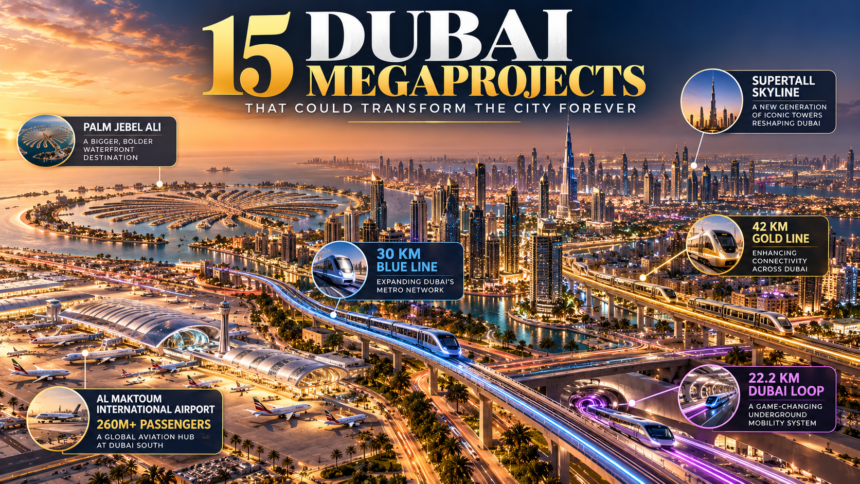
Here are 15 Dubai megaprojects worth watching as the city enters its next stage of growth.
Dubai Megaprojects at a Glance
| Megaproject | Main focus | Key milestone |
|---|---|---|
| Al Maktoum International Airport | Aviation | First major phase targeted for 2032 |
| Dubai Metro Gold Line | Public transport | Opening scheduled for 9 September 2032 |
| Dubai Metro Blue Line | Public transport | Opening targeted for 9 September 2029 |
| Dubai Loop | Underground mobility | 6.4 km pilot route planned first |
| Dubai Air Taxi Network | Future mobility | Commercial launch targeted by end of 2026 |
| Etihad Rail Passenger Network | Inter-emirate rail | Dubai station scheduled for September 2026 |
| Palm Jebel Ali | Waterfront city | First villa handovers from late 2026 |
| Dubai Islands | Coastal development | Major infrastructure and communities under construction |
| Dubai Creek Harbour and Dubai Square | Mixed-use waterfront | Dubai Square announced for roughly 2028 |
| Expo City Dubai | New urban centre | Long-term phased expansion |
| Dubai Exhibition Centre | Business and events | Expansion continues towards 2031 |
| Therme Dubai | Wellness and tourism | Completion anticipated in 2028 |
| Dubai Walk | Pedestrian mobility | Network development through 2040 |
| Jebel Ali Beach | Public waterfront | 6.6 km environmental beach project |
| Dubai Reef | Marine sustainability | 20,000 reef modules planned |
1. Al Maktoum International Airport Could Shift Dubai’s Centre of Gravity
Perhaps no project illustrates Dubai’s long-term thinking more clearly than the expansion of Al Maktoum International Airport, also known as Dubai World Central.
The AED128 billion airport development is ultimately planned to handle more than 260 million passengers and 12 million tonnes of cargo annually. The full airport master plan covers around 70 square kilometres and is expected to include five parallel runways, two passenger terminals, seven gate buildings and more than 430 aircraft stands.
This is no longer simply a future concept. Dubai confirmed in June 2026 that the airport had moved into large-scale construction. More than AED13 billion in contracts were already under execution, while preparations were underway for more than AED55 billion in additional strategic packages. The first major phase is targeted for 2032 and is expected to provide capacity for around 150 million passengers annually.
Its impact could extend far beyond aviation. Housing, hotels, logistics facilities, offices, exhibition venues and transport systems are all developing around Dubai South, potentially shifting a substantial portion of Dubai’s future economic growth southwards.
2. Dubai Metro Gold Line Will Create a New Underground Transport Spine
Approved in April 2026, the Dubai Metro Gold Line is one of the biggest additions to Dubai’s public transport system since the original Metro network opened.
The AED34 billion project will run for 42 kilometres and include 18 stations. Unlike Dubai’s existing lines, the Gold Line is planned as the city’s first fully underground metro line, reaching depths of around 40 metres. It will connect locations including Al Ghubaiba, Mina Rashid, City Walk, Business Bay, Mohammed Bin Rashid City, Meydan, Al Barsha South, Jumeirah Village Circle and Jumeirah Golf Estates.
It will also connect with the Red and Green Metro lines and integrate with Etihad Rail. The line is intended to serve more than 1.5 million people by 2040 and support dozens of major developments along its route. Tendering is planned during 2026, followed by contractor appointment in 2027, with inauguration scheduled for 9 September 2032.
For Dubai, the importance is not simply another train route. The Gold Line could encourage a more rail-oriented pattern of urban development in areas that currently depend heavily on cars.
3. Dubai Metro Blue Line Is Already Taking Shape
While the Gold Line represents the next major expansion, construction of the Dubai Metro Blue Line is already well underway.
The AED20.5 billion project stretches approximately 30 kilometres and includes 14 stations, linking communities such as Dubai Creek Harbour, Dubai Festival City, International City, Dubai Silicon Oasis, Academic City, Mirdif and Al Warqa. It will also connect the existing Red and Green lines.
By May 2026, RTA said overall construction had reached 20 percent. More than 10,000 workers were involved, and tunnelling works had begun. The project also includes a 1.3-kilometre Metro bridge across Dubai Creek, the first of its kind for the network. Opening remains scheduled for 9 September 2029.
The Blue Line is particularly important because many of the communities it serves are expected to experience significant population growth. RTA estimates the areas along the route could accommodate around one million people by 2040.
4. Dubai Loop Could Put Part of the City Underground
Dubai Loop moved significantly closer to implementation in February 2026 when RTA signed an agreement with The Boring Company to begin developing the underground passenger tunnel system.
The first phase is planned as a 6.4-kilometre pilot route with four stations connecting Dubai International Financial Centre and Dubai Mall. If expanded according to the current plan, the full network would reach approximately 22.2 kilometres with 19 stations connecting areas including Dubai World Trade Centre, the financial district and Business Bay.
The pilot project is estimated to cost around AED565 million, while the full route is estimated at approximately AED2 billion. RTA says the pilot could serve about 13,000 passengers daily, rising to approximately 30,000 daily passengers for the complete route.
Dubai Loop is therefore different from conventional mass transit. Its significance will depend on how effectively it integrates with the Metro, walking networks and other first and last-mile services.
5. Dubai’s Air Taxi Network Could Add a Third Dimension to Transport
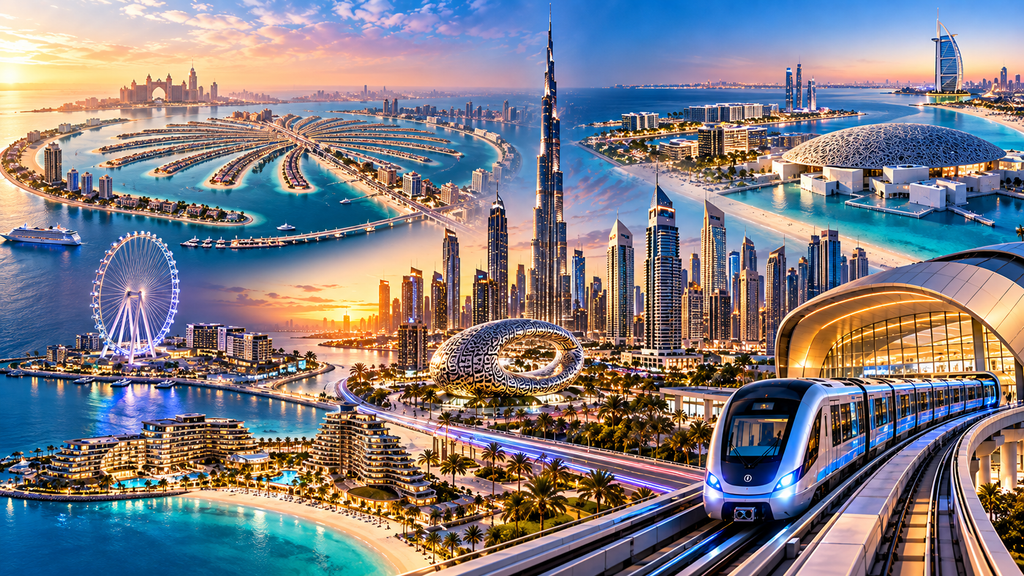
Dubai has spent years testing new mobility technologies, but electric air taxis could be among the most visible.
RTA’s initial network includes proposed vertiports near Dubai International Airport, Downtown Dubai, Dubai Marina and Palm Jumeirah. The planned aircraft can carry four passengers plus a pilot and are designed for vertical take-off and landing. RTA has previously highlighted the possibility of reducing a journey between Dubai International Airport and Palm Jumeirah from roughly 45 minutes by road to around 10 minutes by air.
As of August 2026, RTA said preparations were continuing for commercial air-taxi operations by the end of the year.
Whether air taxis eventually become widely used or remain a premium form of mobility will depend on cost, regulation, network size and demand. What makes the initiative notable is that Dubai is building physical vertiport infrastructure rather than treating flying taxis only as a demonstration technology.
6. Etihad Rail Will Connect Dubai Directly With the National Passenger Network
One of the biggest changes to travel within the UAE is arriving through Etihad Rail’s passenger service.
Passenger operations are being introduced in stages during 2026. According to Etihad Rail’s announced schedule, Dubai and Al Dhaid stations are due to join the passenger network on 30 September 2026, following the launch of initial Abu Dhabi and Fujairah connections in June. Additional stations will continue opening through 2027.
The significance for Dubai becomes even greater when combined with the future Metro Gold Line, which is planned to integrate directly with Etihad Rail at two points.
That creates the possibility of a much more integrated transport system in which residents can move from neighbourhood Metro services to national rail connections without depending entirely on highways.
7. Palm Jebel Ali Is Becoming a Real Waterfront City
Palm Jebel Ali was once known mainly as an ambitious plan on Dubai’s coastline. By 2026, construction had moved firmly into delivery.
The revived development spans seven islands and 16 fronds. Current plans provide roughly 120 kilometres of coastline and more than 90 kilometres of beachfront. In August 2026, Nakheel said more than AED13 billion in construction and infrastructure contracts had been awarded and villa construction was progressing across all 12 residential fronds.
The first villa handovers are expected to begin in phases in late 2026 and continue during 2027. Other construction packages extend further into the decade, including hundreds of villas targeted for completion in 2028.
Palm Jebel Ali matters because it adds an entirely new coastal growth corridor close to Jebel Ali, Dubai South and Al Maktoum International Airport. It could eventually function less like a stand-alone luxury island and more like a major new district of Dubai.
8. Dubai Islands Could Reshape the City’s Northern Coast
Dubai’s expansion is not limited to the south.
Dubai Islands, formerly associated with the Deira Islands project, is emerging as a major new coastal district close to Old Dubai and Dubai International Airport.
Nakheel’s updated figures describe a five-island master plan spanning about 18.6 square kilometres, with approximately 57 kilometres of coastline and 21 kilometres of beachfront. The development is designed for more than 231,000 residents across around 49,000 homes, alongside resorts, marinas, leisure attractions and retail.
Construction momentum increased in 2026, including an AED527 million infrastructure contract for Island B. New road connections and bridges are also being developed as part of the wider Al Shindagha Corridor programme.
The scale means Dubai Islands could do for the northern waterfront what newer developments have done for Dubai Marina and the city’s southern coastline.
9. Dubai Creek Harbour and Dubai Square Could Create Another Major Urban Centre
Dubai Creek Harbour has gradually developed from a collection of waterfront towers into a much larger urban district.
Emaar describes the wider destination as a major residential and commercial community beside Dubai Creek and the Ras Al Khor Wildlife Sanctuary. The district will also gain direct Metro connectivity through the Blue Line.
Another major component is Dubai Square, unveiled by Emaar in December 2025. The company describes it as the centrepiece of an AED180 billion Dubai Creek Harbour development covering more than 11 million square metres. Dubai Square itself is planned to combine retail, hospitality, dining and entertainment across approximately 2.6 million square metres, with an opening targeted roughly three years after its announcement.
If delivered at that scale, Creek Harbour could develop into a genuine second-generation counterpart to Downtown Dubai rather than simply another residential waterfront.
10. Expo City Dubai Is Becoming a Permanent City
Expo 2020 may have ended, but the site is becoming something much larger.
The Expo City Dubai master plan covers approximately 3.5 square kilometres and is designed to eventually accommodate more than 35,000 residents and 40,000 professionals. The development includes residential communities, business districts, green areas, hospitality, education and major commercial infrastructure.
The master plan is organised around several districts, including Expo Hills, Expo Fields, Expo Business and the denser Expo Downtown area. Expo City is also positioned beside three major economic assets: Al Maktoum International Airport, Jebel Ali Port and Dubai Exhibition Centre.
That location explains why Expo City could become one of Dubai’s most important future centres. Rather than everything flowing toward Downtown Dubai or Sheikh Zayed Road, a second major business and residential ecosystem is emerging farther south.
11. Dubai Exhibition Centre Is Growing Into a Global Events Hub
One of the biggest pieces of Expo City’s transformation is the expansion of Dubai Exhibition Centre.
Dubai approved an AED10 billion expansion programme designed to eventually create 180,000 square metres of indoor exhibition space across 26 halls by 2031. The long-term plan would allow the venue to host one enormous event or numerous events simultaneously.
Phase 1 has already delivered approximately 140,000 square metres of event space, significantly increasing the city’s capacity for large international exhibitions. Later phases are intended to take the facility toward the final 180,000-square-metre configuration.
The transformation also supports Dubai’s decision to move major global events toward Expo City. With the airport expansion taking place nearby, the area could eventually operate as an integrated aviation, business, exhibitions and hospitality district.
12. Therme Dubai Could Redefine Urban Wellness Tourism
Not every Dubai megaproject is about roads, airports or homes.
Therme Dubai, planned inside Zabeel Park, is an AED2 billion wellbeing resort expected to open in 2028. The 500,000-square-foot development will rise approximately 100 metres and is designed to receive up to 1.7 million visitors every year.
Plans include thermal pools, wellness and relaxation areas, waterfalls, waterslides, restaurants, therapeutic environments and what is planned to become a huge indoor botanical garden containing more than 200 plant species. The design also includes systems intended to recycle 90 percent of water used in thermal pools.
Its location is especially interesting. Rather than putting another major attraction on the city’s outskirts, Dubai is inserting a large nature and wellbeing destination into an established central park.
13. Dubai Walk Could Change Everyday Life More Than a Skyscraper
Some of the most transformative projects may be the ones that change how residents experience ordinary neighbourhoods.
The Dubai Walk Master Plan aims to create an interconnected pedestrian network exceeding 6,500 kilometres across 160 areas. This includes about 3,300 kilometres of new walkways, improvements to 2,300 kilometres of existing routes and more than 900 kilometres planned beyond 2040.
The plan also includes 110 pedestrian bridges and underpasses. Shading, landscaping, cooling systems, rest areas, sports facilities and commercial spaces are expected to make walking more practical during a larger part of the year.
One of the most striking elements is the Future Loop, part of an initial 17-kilometre programme. Plans presented by RTA include a two-kilometre structure connecting 10 destinations, with a climate-controlled level designed to support year-round walking.
For a city historically shaped around cars, this could represent a fundamental urban change.
14. Jebel Ali Beach Will Combine Public Space With Conservation
Dubai is also investing heavily in making more of its coastline publicly accessible.
The Jebel Ali Beach Development Project covers approximately 6.6 kilometres and around 330 hectares. Located within the Jebel Ali Wildlife Sanctuary, the project is being developed with an unusual emphasis on protecting turtles, mangroves and coastal ecosystems while creating recreational areas for visitors.
It forms part of a much broader programme of beach improvements across Dubai. By 2026, Dubai Municipality described an AED3 billion portfolio covering locations including Al Mamzar, Jumeirah and future work at Jebel Ali Beach through 2030.
That matters because Dubai’s future coastline is being planned as more than private hotel frontage. Public beaches, sports facilities, walking routes, ecological zones and accessible public spaces are becoming part of the broader urban strategy.
15. Dubai Reef Is Building Infrastructure Under the Sea
One of Dubai’s largest projects is almost invisible from the skyline.
Dubai Reef is a marine restoration initiative designed to deploy 20,000 purpose-built reef modules across approximately 600 square kilometres of Dubai’s waters. The project is intended to create habitats for fish and other marine species while supporting biodiversity and wider environmental goals.
Progress has already moved beyond the pilot stage. By the end of 2025, more than 68 percent of the planned modules had been fabricated and more than 47 percent had been deployed, according to Dubai’s tourism authorities.
Earlier monitoring at the proof-of-concept site also recorded increased fish populations and biomass around reef structures.
Unlike a tower or island, the project’s success will be measured through ecological improvements over many years. That makes it an important example of Dubai expanding the definition of what a megaproject can be.
Why These Dubai Megaprojects Matter Together
Looking at these developments individually can hide the bigger story.
Al Maktoum International Airport, Expo City and Dubai Exhibition Centre are strengthening a new southern urban and economic centre. Palm Jebel Ali extends that growth toward the coastline. The Gold and Blue Metro lines, Etihad Rail, Dubai Loop and future air taxis are creating new layers of connectivity between old and new districts.
At the same time, Dubai Walk, public beach projects and Dubai Reef show that the next development cycle is not focused only on creating more buildings. Greater attention is being placed on mobility, public space, environmental restoration and quality of life.
This creates a different model of expansion from the Dubai of the early 2000s. Iconic architecture remains important, but infrastructure connecting those landmarks is becoming equally significant.
Which Projects Could Change Daily Life the Most?
The answer depends on how someone experiences Dubai.
For commuters, the Blue and Gold Metro lines could be the most noticeable because they connect large residential districts directly to rail. Etihad Rail could change inter-emirate travel, while Dubai Walk could make short trips possible without automatically reaching for a car.
For Dubai’s economy, Al Maktoum International Airport and Dubai Exhibition Centre have much wider implications because both can increase the city’s capacity to move people, goods, businesses and international events.
For the shape of the city itself, Palm Jebel Ali, Dubai Islands, Creek Harbour and Expo City could create entirely new population and commercial centres.
And environmentally, Dubai Reef and the development of conservation-focused coastal areas show that future growth is increasingly being linked with ecological infrastructure.
Dubai in the 2030s Could Look Very Different
Many of these projects will take years to reach their final form, and construction schedules can change. But several important pieces are already visible.
Palm Jebel Ali villas are rising. Dubai Metro Blue Line tunnelling is underway. Al Maktoum International Airport has entered large-scale construction. Dubai Islands infrastructure is advancing. Expo City is growing beyond its Expo 2020 origins, while newer projects such as the Gold Line and Dubai Loop are moving from planning toward implementation.
What makes this development cycle particularly significant is how interconnected the projects are.
Dubai is not simply constructing another collection of landmarks. It is building airports, rail systems, pedestrian routes, business districts, coastal communities, environmental infrastructure and new mobility networks around the same long-term urban vision.
If even most of these plans reach their intended scale, the Dubai of the 2030s will not simply contain more attractions than the city of today. Its geographical centre, transportation habits, waterfront, economic districts and everyday urban experience could all look considerably different.
Do follow us on Instagram
Read More – Dubai Premier Padel P1 2026: Dates, Venue and More