



A Simple UAE Resident App Checklist
Apps every UAE resident should have can make everyday life much easier, whether you have just moved to Dubai, Abu Dhabi, Sharjah or another emirate. Government services, transport, utility payments, banking, food delivery, taxis and residency procedures have become heavily digital, so having the right apps on your phone can save repeated visits to service centres and reduce the amount of paperwork you need to carry.
- Apps Every UAE Resident Should Have: Quick Guide
- UAE PASS Should Be One of the First Apps You Set Up
- UAEICP Is Important for Residency and Identity Services
- DubaiNow Is One of the Most Useful Apps for Dubai Residents
- Use the Main Government App for Your Own Emirate
- RTA Dubai Is Essential for Dubai Drivers
- S’hail Is Useful if You Depend on Dubai Public Transport
- nol Pay Makes Managing Public Transport Easier
- DEWA Smart App Is Highly Useful for Dubai Tenants and Homeowners
- Northern Emirates Residents Should Use Their Relevant Utility App
- Keep Your Mobile Operator’s App Installed
- Your Bank’s Official App Is One of Your Most Important Daily Tools
- Careem Can Replace Several Separate Everyday Apps
- Talabat Is Useful for Food, Groceries and Everyday Deliveries
- A Reliable Maps App Is Essential for New Residents
- Keep Your Health Insurance App Ready Before You Need It
- Use an Airline App if You Travel Frequently
- Do Not Install Every App Just Because It Is Popular
- New Expats Should Install Apps in the Right Order
- Protect Yourself From Fake Government and Banking Apps
- Use Notifications Selectively
- Apps Can Help You Control Your Monthly UAE Budget
- A Simple UAE Resident App Checklist
- Which Apps Are Most Important for Dubai Residents?
- Which Apps Are Most Important for Residents Outside Dubai?
- Are All These UAE Apps Really Necessary?
The important thing is that not every resident needs exactly the same apps. A Dubai resident may depend heavily on DubaiNow, RTA Dubai and nol Pay, while someone living in Abu Dhabi will use a different combination of local government and transport services. Federal apps such as UAE PASS and UAEICP, however, can be useful regardless of which emirate you call home.
Instead of downloading dozens of apps and never opening most of them, build a small practical toolkit around your identity, residency, transport, utilities, banking and everyday needs. This guide covers the most useful apps for UAE residents in 2026, what each one does and which apps are genuinely worth keeping on your phone.
Apps Every UAE Resident Should Have: Quick Guide
A good UAE phone setup usually contains a mixture of federal government apps, emirate-specific services and private apps that simplify daily life. The most important starting point is UAE PASS because many government and utility platforms use it as a secure login method.
You should then add the apps relevant to your emirate, followed by transport, utility, banking, telecom and delivery apps. Residents who drive will naturally need more transport-related services than someone who relies entirely on Metro, buses and taxis.
| App or App Type | Main Use | Who Needs It Most |
|---|---|---|
| UAE PASS | Digital identity and government login | Almost everyone |
| UAEICP | Residency and identity services | Residents dealing with federal immigration |
| DubaiNow | Dubai government and city services | Dubai residents |
| Local government app | Emirate-specific services | Residents of that emirate |
| RTA Dubai | Driving, parking and transport services | Dubai residents |
| S’hail | Dubai journey planning | Public transport users |
| nol Pay | nol balance and travel passes | Dubai commuters |
| Utility app | Bills and consumption | Tenants and homeowners |
| Telecom app | Mobile and internet account | All residents |
| Banking app | Payments and transfers | Most adults |
| Careem | Rides and everyday services | Frequent taxi/app users |
| Talabat | Food and groceries | Delivery users |
| Maps app | Navigation | Drivers and newcomers |
| Health insurance app | Medical network and claims | Insured residents |
| Airline app | Flights and travel management | Frequent travellers |
The exact combination will change depending on your lifestyle, but most residents will find that the first eight or ten apps on this list cover the majority of everyday tasks.
UAE PASS Should Be One of the First Apps You Set Up
UAE PASS is one of the most important digital tools for anyone living in the country. It acts as the UAE’s national digital identity and is available to citizens, residents and visitors, allowing users to sign into services, digitally sign and verify documents and access digital copies of eligible documents.
Many other UAE government platforms use UAE PASS as their login method, which means setting it up early can make later processes much easier. Instead of creating separate usernames and passwords for every service, you can often authenticate yourself through one secure digital identity.
UAE PASS is particularly useful for:
- Logging into government portals
- Accessing personal government information
- Signing certain documents electronically
- Verifying identity online
- Sharing eligible digital documents
- Accessing connected utility and transport services
Registration generally uses your Emirates ID and facial verification. The UAE Government also states that users can verify their account through UAE PASS kiosks where required.
For a new resident, setting this app up soon after receiving your Emirates ID is a sensible first step because many of the other apps in this guide become easier to use once UAE PASS is active.
UAEICP Is Important for Residency and Identity Services
The Federal Authority for Identity, Citizenship, Customs and Port Security provides the UAEICP mobile application for accessing federal identity and citizenship services. The authority describes its mobile app as a way for customers to access its services quickly through smartphones.
This app is particularly relevant for residents whose visa, Emirates ID or residency transactions fall under ICP rather than an emirate-specific immigration authority. New expats should keep it available because residency-related information is one of the areas where having direct access to the official government platform is far safer than relying on screenshots or third-party advice.
Situations where UAEICP can be useful include:
- Residency-related services
- Emirates ID-related processes
- Application tracking
- Federal immigration services
- Personal service requests
The exact services available to you depend on your status and emirate. Dubai residents may encounter separate GDRFA-related processes for some immigration matters, so UAEICP should be seen as part of your government-app toolkit rather than the only immigration app you may ever need.
DubaiNow Is One of the Most Useful Apps for Dubai Residents
DubaiNow is designed as a single gateway for a large number of Dubai city services. The official platform currently says it provides access to more than 280 services from 44 government and private entities, covering areas such as bills, mobile services, driving, housing, residency, health, justice, education and travel.
That makes it particularly valuable for people who do not want separate apps for every small government transaction. Residents can use it as a central dashboard for many everyday services rather than remembering which government entity handles each one.
DubaiNow covers categories including:
- Bills
- Driving
- Housing
- Residency
- Health
- Mobile services
- Education
- Travel
- Justice
- Donations
DEWA also lists DubaiNow as an official channel for bill payment and certain move-related electricity and water services, showing how closely it is integrated into Dubai’s wider digital-government ecosystem.
If you live in Dubai, UAE PASS and DubaiNow are two apps worth setting up early rather than waiting until you urgently need a government service.
Use the Main Government App for Your Own Emirate
Residents outside Dubai should look for the official digital-services platform serving their emirate rather than assuming every Dubai app is relevant across the country. Government services in the UAE are divided between federal authorities and local emirate-level entities, so housing, transport, parking, utilities and municipal services can vary depending on where you live.
The practical approach is to keep UAE PASS and UAEICP for federal identity and residency needs, then add the local-government app used by your emirate. Abu Dhabi residents, for example, regularly use Abu Dhabi’s digital government ecosystem, while residents of Sharjah or the Northern Emirates may interact with different local authorities and utility providers.
Federal vs Local Apps
| Service Type | Usually Federal or Local? |
|---|---|
| UAE digital identity | Federal / national |
| Federal residency services | Federal |
| Local parking | Emirate-specific |
| Municipal services | Emirate-specific |
| Local utilities | Emirate-specific |
| Dubai public transport | Dubai-specific |
| Local police services | Emirate or federal system |
| Local housing services | Emirate-specific |
Keeping this distinction in mind prevents you from downloading an app that looks useful but does not actually serve your location.
RTA Dubai Is Essential for Dubai Drivers
Dubai’s Roads and Transport Authority describes the RTA Dubai app as a one-stop platform for road, traffic and transport services. Users can access parking services, renew driving licences, book vehicle-test appointments, view driving documents, recharge linked Salik accounts and locate RTA service centres.
For anyone who owns or regularly drives a car in Dubai, this is one of the most practical apps to keep installed. It reduces the need to visit physical customer centres for many routine tasks and also keeps several transport-related services inside one account.
Useful RTA Dubai features include:
- Parking services
- Parking permits
- Driving-licence renewal
- Vehicle-test appointments
- Driving-document access
- RTA transaction history
- Salik account access
- Service-centre locations
The app also supports UAE PASS sign-in, which is another reason to set up your national digital identity before configuring the rest of your UAE apps.
Drivers should still keep their actual legal documents valid and understand traffic rules, but the app makes everyday administration considerably easier.
S’hail Is Useful if You Depend on Dubai Public Transport
S’hail is RTA’s journey-planning app for moving around Dubai. It brings together information for Metro, Tram, buses, taxis and other transport options, and RTA says users can also plan intercity bus journeys and access real-time traffic information.
This makes it particularly helpful for new residents who are still learning how Dubai’s different transport systems connect. Instead of checking Metro maps, taxi apps and bus information separately, you can compare different ways of reaching the same destination.
S’hail is especially useful for:
- Metro journey planning
- Tram information
- Bus routes
- Taxi options
- Intercity bus planning
- Real-time traffic
- nol-related services
RTA has continued expanding the app in 2026 as part of its broader plan to create a more integrated mobility platform.
Someone who drives everywhere may use S’hail only occasionally, but residents who combine Metro, buses, taxis and walking can find it much more valuable.
nol Pay Makes Managing Public Transport Easier
Dubai commuters should also consider nol Pay, particularly if they use Metro, Tram and buses regularly. RTA says the app lets customers top up nol cards, check balances, buy travel passes and manage eligible family nol cards.
The app can also support virtual nol functionality on compatible devices, and RTA continues moving the wider nol system toward account-based digital ticketing. As of July 2026, RTA said 72% of that upgrade had been completed, with full project completion planned for the first quarter of 2027.
RTA Apps: Which One Do You Need?
| App | Best Use |
|---|---|
| RTA Dubai | Driving, parking and general RTA services |
| S’hail | Journey planning and mobility |
| nol Pay | nol card and travel-pass management |
You do not necessarily need to use all three every day. Drivers may rely mainly on RTA Dubai, while daily public-transport commuters may use S’hail and nol Pay much more frequently.
DEWA Smart App Is Highly Useful for Dubai Tenants and Homeowners
If you pay your own electricity and water bills in Dubai, the DEWA Smart App belongs on your phone. DEWA says the app allows customers to view and pay bills, monitor account history, receive reminders and track electricity and water consumption.
The app is also useful when moving home because DEWA provides move-in, move-out and move-to services through its digital platforms. Customers can monitor consumption, compare usage and receive efficiency recommendations through DEWA’s smart-living tools.
Useful DEWA functions include:
- View and pay bills
- Check billing history
- Track consumption
- Move in
- Move out
- Transfer service to another property
- Receive notifications
- Locate EV charging stations
For residents trying to manage summer electricity costs, the consumption information can be more useful than simply looking at the total bill each month.
Northern Emirates Residents Should Use Their Relevant Utility App
Dubai residents use DEWA, but that does not mean the same utility app applies across the UAE. Residents in parts of the Northern Emirates may receive electricity and water services through EtihadWE, while other emirates have their own local utility arrangements.
EtihadWE confirms that its mobile application allows customers to log in through UAE PASS, view accounts and pay monthly bills. Its digital channels operate around the clock for standard bill-payment services.
The important rule is to install the app that actually serves your property. Ask your landlord, building management or utility provider which company supplies electricity and water rather than assuming the service based on something you read about another emirate.
Utility App Checklist
| Where You Live | What to Check |
|---|---|
| Dubai | DEWA |
| Northern Emirates property | Check EtihadWE eligibility |
| Abu Dhabi | Check local electricity/water provider |
| Sharjah | Check local utility provider |
| District-cooled building | Cooling provider may have separate app |
You may also need a separate district-cooling account even after your electricity and water are active.
Keep Your Mobile Operator’s App Installed
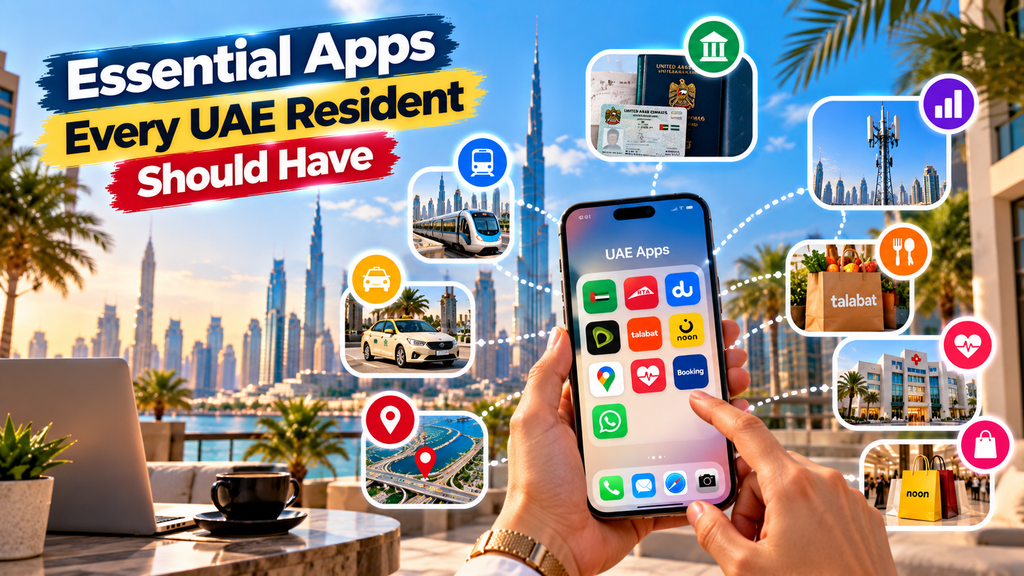
Whether your number is with e&, du or another UAE mobile service, the provider’s official app is worth keeping because it gives you a clearer view of your plan than relying on SMS notifications alone.
The app normally becomes the easiest place to track mobile-data consumption, pay postpaid bills, recharge prepaid lines, activate roaming, buy data add-ons and manage account settings. For expats, this is particularly useful when travelling because roaming packages should ideally be activated before you start using data abroad.
Use your telecom app to monitor:
- Remaining mobile data
- Minutes
- International allowances
- Roaming
- Monthly bills
- Auto-renewing add-ons
- Plan upgrades
- SIM or eSIM services
Checking the app once or twice each month can also help you spot unnecessary add-ons or discover that you are paying for much more data than you actually use.
Your Bank’s Official App Is One of Your Most Important Daily Tools
Once you open a UAE bank account, install only the bank’s official application and activate its security features. Mobile banking is used heavily in the UAE for transfers, card controls, bill payments, salary management and everyday account monitoring.
A good banking app can reduce the need to visit a branch for routine services, but security matters more than convenience. Download the app from the official app store listing, avoid links sent through random messages and never provide login codes to someone claiming to be bank support.
Useful banking-app features include:
- Local bank transfers
- International transfers
- Card freezing
- Spending alerts
- Bill payments
- Account statements
- Credit-card management
- Digital card controls
Wio, for example, operates as a UAE digital bank and says accounts can be opened digitally using Emirates ID or a UAE work visa, but residents should choose a bank based on their own needs rather than assuming one banking app is automatically best for everyone.
Whatever bank you choose, its official app should become part of your everyday UAE setup.
Careem Can Replace Several Separate Everyday Apps
Careem has expanded far beyond basic ride-hailing in the UAE. Its platform includes rides, food, groceries and Careem Pay services, making it useful for residents who prefer one app for several routine tasks.
Careem Pay currently supports bill payments, local transfers and international money transfers to more than 30 countries, while the rides section allows users to book different vehicle categories.
Depending on your location, Careem can help with:
- Taxi or ride booking
- Food delivery
- Grocery delivery
- Bill payments
- Money transfers
- Sending or requesting money
- Everyday account payments
In 2026, Careem also added features such as booking rides for friends and family directly through the app.
You do not have to use every service inside Careem, but it is one of the most useful multipurpose apps for many UAE residents.
Talabat Is Useful for Food, Groceries and Everyday Deliveries
Talabat remains another major everyday app across the UAE, particularly for food and grocery delivery. Its UAE platform currently offers restaurant delivery, groceries, flowers, health and wellness items and Talabat Mart services.
The platform lists service across major UAE cities and emirates, including Dubai, Abu Dhabi, Sharjah, Ajman, Fujairah, Ras Al Khaimah and Umm Al Quwain.
Talabat can be useful when you need:
- Restaurant delivery
- Grocery delivery
- Convenience items
- Flowers
- Selected health and wellness products
For new residents without a car, delivery apps can be especially useful during the first few weeks before you know where the nearest supermarkets and pharmacies are.
That said, frequent delivery charges and impulse ordering can increase monthly living costs, so convenience should still fit inside your budget.
A Reliable Maps App Is Essential for New Residents
Navigation is one of those things you may not think about until you move to a new UAE city and realise that knowing the neighbourhood name is not always enough to find the correct tower entrance, parking gate or villa street.
Google Maps, Apple Maps and Waze are commonly used options, and drivers may also combine them with official transport applications. The best choice depends on whether you mainly drive, walk or use public transport.
Save important locations during your first month, including:
- Home
- Workplace
- Nearest hospital
- Pharmacy
- Supermarket
- Airport
- School or nursery
- Building parking entrance
Saving locations is especially useful in large communities where the main map pin may not lead directly to your actual building entrance.
For Dubai public transport, use general maps alongside S’hail rather than relying on only one navigation source.
Keep Your Health Insurance App Ready Before You Need It
Most health insurers provide a mobile app or online account that helps customers find hospitals, clinics and pharmacies inside their network. Waiting until you are unwell to install it can make an already stressful situation harder.
Your insurer’s app may also contain your digital insurance card, policy information, approval status, claim features and network search. The exact functions vary by company, so residents should install the official app linked to their own insurance plan rather than a generic health application.
Useful information to save includes:
- Insurance card
- Policy number
- Network hospitals
- Nearby clinic
- Pharmacy network
- Customer-service number
- Claims information
If you have children, identify your nearest paediatric clinic and emergency hospital before you urgently need them.
The app may sit unused for months, but when you need healthcare quickly, having everything already logged in can save valuable time.
Use an Airline App if You Travel Frequently
Residents who travel regularly should keep the application of the airline they use most often. UAE residents commonly make frequent trips for work, holidays or visits home, and an airline app can centralise check-in, boarding passes, flight notifications and loyalty information.
The exact airline naturally depends on your routes. Someone based in Dubai may fly differently from someone in Abu Dhabi, Sharjah or Ras Al Khaimah, so there is no single airline application every resident must install.
Frequent-travel features worth using include:
- Mobile check-in
- Boarding passes
- Flight-status notifications
- Seat selection
- Loyalty accounts
- Booking management
Keeping your passport details and travel documents secure remains important even when the booking itself is managed digitally.
Do Not Install Every App Just Because It Is Popular
A useful phone setup should simplify your life rather than create another screen full of notifications.
Someone living in Abu Dhabi does not need every Dubai transport app. A resident without a car does not need to obsess over vehicle-management apps, while someone who cooks every day may barely use food-delivery services.
A better approach is to build your app list around five basic questions.
| Question | App Category You Need |
|---|---|
| How do I prove my identity? | UAE PASS |
| How do I manage residency? | UAEICP / relevant authority |
| How do I access my emirate’s services? | Local government app |
| How do I move around? | Transport and maps |
| How do I manage my home and money? | Utility, telecom and bank apps |
Add convenience apps only after those basics are covered.
New Expats Should Install Apps in the Right Order
Downloading 20 UAE apps on your first evening is unnecessary because some services depend on documents you may not yet have.
The better approach is to add applications as your residency setup progresses.
During your first few days, start with UAE PASS preparation, navigation, taxi and food-delivery apps. You can also install your telecom provider app as soon as your UAE mobile number is active.
After your Emirates ID is ready, complete UAE PASS verification and connect the government services you will actually use. Add your bank app after opening an account and your utility provider once your tenancy is active.
After settling into your home, add transport, health insurance, school, community and other lifestyle apps relevant to your daily routine.
New Resident App Setup Timeline
| Stage | Apps to Prioritise |
|---|---|
| Arrival | Maps, rides, delivery, telecom |
| Residency setup | UAE PASS, UAEICP |
| Renting home | Utility and local government apps |
| Bank account opened | Official banking app |
| Daily commute begins | RTA/S’hail/nol or local transport |
| Healthcare active | Insurance app |
| Lifestyle settled | Shopping, travel and convenience apps |
This sequence keeps the setup manageable and helps ensure each app is connected to the right verified account.
Protect Yourself From Fake Government and Banking Apps
The UAE’s heavy use of digital services also means residents should pay close attention to where applications come from.
Government, banking and utility apps may contain sensitive identity, payment and residency information. Download them only from official app-store listings or links provided by the relevant authority’s official website.
Never enter sensitive information after receiving an unexpected link claiming to be from:
- Your bank
- Police
- Immigration
- Utility provider
- Telecom provider
- Delivery company
- Government authority
If an SMS says your Emirates ID, bank account or package will be blocked unless you click immediately, open the official app yourself instead of following the link.
The same principle applies to phone calls asking for UAE PASS approval or one-time passwords. Your digital identity should be treated like your physical passport.
Use Notifications Selectively
Government and financial alerts should generally remain enabled because they can tell you about application updates, payments and account activity.
Delivery and marketing apps are different. Constant promotional notifications can make it easier to overspend and harder to notice important alerts.
A practical notification setup is:
- Keep on: bank, UAE PASS, residency, utility, transport fines and health.
- Consider limited: telecom promotions, delivery apps and shopping.
- Turn off if unnecessary: generic marketing notifications.
This keeps your phone useful without allowing every installed service to demand your attention.
Apps Can Help You Control Your Monthly UAE Budget
Many residents think of apps only as convenience tools, but they can also make budgeting easier.
Utility apps allow you to track consumption. Banking apps show spending. Telecom apps reveal data usage, while delivery apps show exactly how often you are paying for convenience instead of cooking or shopping yourself.
Once every month, check four screens:
- Bank spending summary
- Electricity and water consumption
- Mobile-plan usage
- Food and grocery delivery history
Those numbers can reveal lifestyle inflation faster than a spreadsheet because they show what you actually did, not what you planned to do.
A Simple UAE Resident App Checklist
You do not need every application mentioned in this guide. The purpose of this checklist is to make sure the important categories are covered.
| App Category | Installed? |
|---|---|
| UAE PASS | □ |
| UAEICP / relevant immigration app | □ |
| Emirate government app | □ |
| Transport app | □ |
| nol/transport-card app if relevant | □ |
| Utility app | □ |
| Telecom provider app | □ |
| Bank app | □ |
| Maps/navigation | □ |
| Health insurance app | □ |
| Ride-hailing | □ |
| Food/grocery delivery | □ |
| Airline app if needed | □ |
Someone who can tick the first ten boxes already has most of the digital tools needed for everyday UAE life.
Which Apps Are Most Important for Dubai Residents?
Dubai residents can simplify the list further by prioritising the apps they are most likely to use repeatedly.
A strong basic Dubai setup would usually include UAE PASS, the relevant immigration service, DubaiNow, RTA Dubai or S’hail, nol Pay for public-transport users, DEWA, your mobile operator, your bank, maps and a ride-hailing app.
Dubai App Starter Pack
| Priority | App |
|---|---|
| Digital identity | UAE PASS |
| Government services | DubaiNow |
| Residency | Relevant ICP/GDRFA service |
| Driving | RTA Dubai |
| Public transport | S’hail |
| nol card | nol Pay |
| Electricity and water | DEWA |
| Mobile account | Your telecom provider |
| Money | Your bank |
| Rides | Careem or preferred service |
DubaiNow’s ability to connect more than 280 services from 44 entities makes it particularly useful because it can reduce the number of separate government applications a resident needs to open regularly.
Which Apps Are Most Important for Residents Outside Dubai?
Residents elsewhere in the UAE should keep the same national foundation but replace Dubai-specific tools with the equivalent services for their emirate.
UAE PASS, UAEICP, your bank, telecom provider, maps and health-insurance applications remain relevant almost everywhere. Your local utility, transport and municipality services will then depend on where you live.
A useful non-Dubai starter setup includes:
- UAE PASS
- UAEICP
- Local government-services app
- Local utility app
- Bank app
- Mobile provider app
- Maps
- Health-insurance app
- Ride-hailing app
- Delivery app
For eligible properties in the Northern Emirates, EtihadWE’s mobile app can be used for utility-account access and bill payment, including UAE PASS login.
The main lesson is that UAE residents should build around their own emirate rather than copying a Dubai app list word for word.
Are All These UAE Apps Really Necessary?
No, and that is important.
The most essential applications are the ones connected to your legal identity, residency, money, home and transport. Convenience apps can then be added according to your lifestyle.
For most residents, UAE PASS should be at the top of the list because it functions as the national digital identity and connects with services across different sectors.
Dubai residents will get significant value from DubaiNow because of its wide range of integrated services, while RTA Dubai, S’hail and nol Pay become more important depending on how you travel.
Homeowners and tenants should keep the correct utility application available, whether that is DEWA or another provider serving their property. Residents should also have easy access to their bank, telecom provider and health insurer rather than relying on web searches every time something needs attention.
Once those essentials are covered, apps such as Careem and Talabat can make daily life easier through transport, payments, food and grocery services.
The best collection of apps every UAE resident should have is therefore not the longest list. It is the smallest set that lets you identify yourself, manage your residency, pay your bills, move around the city, control your money and access important services without unnecessary friction.
Do follow us on Instagram
Read More – How to Choose the Right Mobile Phone Plan in the UAE