How Arabic-Language AI Could Transform Daily Life in the Gulf
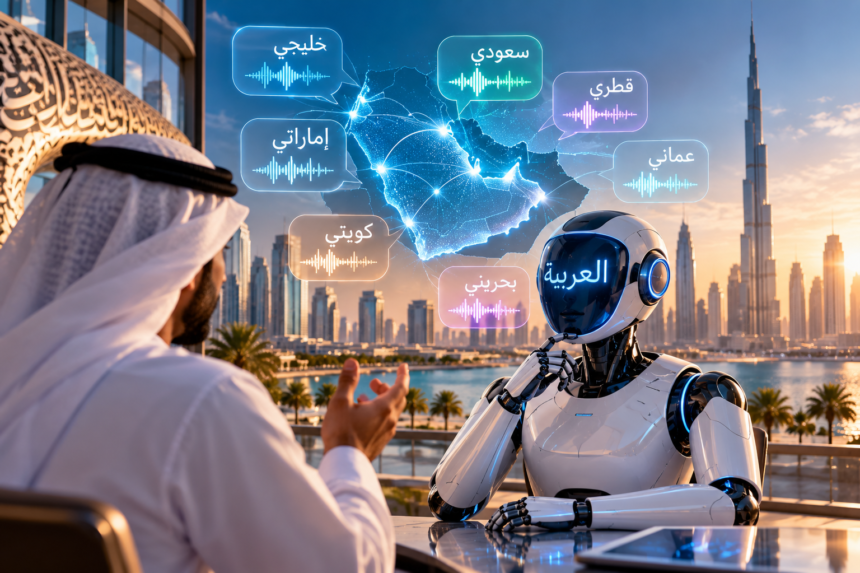
Arabic-Language AI is entering a new phase as researchers and technology companies across the Gulf develop artificial intelligence systems designed to understand how Arabic is actually spoken. From Emirati expressions and Saudi regional dialects to everyday conversations in Qatar, Bahrain, Kuwait and Oman, the challenge extends far beyond translating formal Arabic into another language.
- Arabic-Language AI: Why Gulf Dialects Are Difficult for Technology
- UAE Arabic AI Models: Jais 3, Falcon-Emirati and Falcon-H1 Arabic
- Saudi Arabia and Qatar: Building AI That Understands Regional Arabic
- 7 Breakthroughs That Could Improve Gulf Dialect Understanding
- How Arabic-Language AI Could Transform Daily Life in the Gulf
- Challenges, Cultural Accuracy and Data Privacy in Arabic AI
- The Future of Arabic-Language AI and Gulf Dialects
For years, many digital assistants and translation platforms have performed more reliably with Modern Standard Arabic than with informal regional speech. A system might recognise individual Arabic words yet struggle to understand a joke, an unfamiliar pronunciation or an expression whose meaning changes with context.
This matters because millions of people across the Gulf communicate through local dialects rather than the formal Arabic commonly used in newspapers, official documents and education.
Recent developments suggest that this gap is beginning to narrow.
On October 15, 2026, Mohamed bin Zayed University of Artificial Intelligence and Inception42 introduced Jais 3, a family of Arabic-focused AI models designed to process written and spoken Arabic across different dialects.
Earlier in October, Abu Dhabi’s Technology Innovation Institute launched Falcon-Emirati, a seven-billion-parameter model developed specifically for Emirati vocabulary, expressions and cultural context.
Saudi Arabia and Qatar are also investing in Arabic-focused artificial intelligence through initiatives such as ALLaM and Fanar.
These projects demonstrate growing regional interest in building language technology around Arabic speakers’ actual communication habits.
However, understanding Gulf dialects remains technically difficult. The differences between Saudi, Emirati, Kuwaiti and other regional varieties extend into pronunciation, sentence structure, vocabulary, humour and cultural references.
Researchers also face shortages of representative training data, especially spontaneous conversations from diverse speakers.
The question is therefore not simply whether AI can recognise Arabic words. It is whether technology can interpret their intended meaning accurately, respond naturally and work reliably in everyday situations.
This guide explores the future of Arabic-language artificial intelligence, the Gulf’s leading initiatives and seven developments that could change how people interact with technology.
Arabic-Language AI: Why Gulf Dialects Are Difficult for Technology
Arabic is spoken across a geographically and culturally diverse region, but its different forms are not identical.
Modern Standard Arabic, commonly called MSA, is widely used in formal communication, education, official writing and news reporting.
Everyday spoken Arabic, however, varies across countries and communities.
Modern Standard Arabic vs Spoken Dialects
A person may read a formal Arabic news article but communicate with family and friends using expressions rarely found in textbooks.
This difference creates a challenge for AI systems trained primarily on formal written material.
A model may generate grammatically correct Modern Standard Arabic while producing unnatural responses to a casual Gulf conversation.
Gulf Arabic Is Not One Uniform Dialect
The term Khaleeji, or Gulf Arabic, broadly describes several related regional varieties.
However, speakers in the UAE, Kuwait, Bahrain, Qatar, Oman and Saudi Arabia do not necessarily use the same expressions or pronunciation.
Saudi Arabia itself contains substantial linguistic diversity, including Najdi, Hijazi, Eastern and other regional speech varieties.
These differences matter when building accurate systems.
Why Context Matters
Consider a short expression used informally between friends.
Its meaning may depend on tone, relationship, location and the surrounding conversation.
A literal translation can miss humour, sarcasm or an implied request.
Successful Arabic AI must recognise these patterns instead of treating language as a collection of isolated words.
Formal Arabic vs Gulf Dialects
| Feature | Modern Standard Arabic | Gulf Dialects |
|---|---|---|
| Main Use | News, education and formal writing | Everyday conversation |
| Vocabulary | More standardised | Varies by region |
| Pronunciation | Formal conventions | Local variations |
| Written Spelling | Relatively standardised | Often inconsistent |
| Cultural Expressions | Formal literary references | Local idioms and humour |
| AI Training Data | Comparatively accessible | Uneven across dialects |
The main technological challenge is capturing both the shared foundations of Arabic and the differences that make local speech distinctive.
UAE Arabic AI Models: Jais 3, Falcon-Emirati and Falcon-H1 Arabic
The UAE has become an important centre for Arabic-focused AI research.
Several institutions are developing systems designed to improve language understanding, speech processing and culturally relevant digital services.
Jais 3: Arabic AI for Writing and Speech
On October 15, 2026, MBZUAI’s Institute of Foundation Models and Inception42 introduced Jais 3.
The announcement described a family of six open language models ranging from 900 million to 375 billion parameters.
The system also includes Jais Speech, designed for Arabic speech recognition across regional dialects.
Jais 3 builds on earlier developments in the Jais family, including Jais 2, released in December 2025.
Its intended applications include transcription, document creation, Arabic-language assistance and other practical workflows.
Falcon-Emirati: Understanding Local Expressions
On October 6, 2026, the Technology Innovation Institute announced Falcon-Emirati.
The model contains seven billion parameters and focuses specifically on Emirati language and cultural understanding.
According to TII’s own evaluation, the model achieved 84.83% on a native Emirati-language benchmark.
This is a reported benchmark result, not proof that it understands every Emirati conversation with that level of accuracy.
Its potential applications include customer service, subtitling, transcription and voice-enabled services.
Falcon-H1 Arabic
TII introduced Falcon-H1 Arabic in January 2026.
The model family includes three-billion, seven-billion and 34-billion-parameter versions.
Its hybrid architecture combines transformer and Mamba-based technologies, with training designed to support formal Arabic and regional dialects.
The institute reports improvements in Arabic language understanding, reasoning and cultural knowledge.
Major UAE Initiatives Compared
| AI Initiative | Institution | Main Focus |
|---|---|---|
| Jais 3 | MBZUAI and Inception42 | Arabic text, speech and practical tasks |
| Jais Speech | MBZUAI and Inception42 | Speech recognition across dialects |
| Falcon-Emirati | Technology Innovation Institute | Emirati language and cultural context |
| Falcon-H1 Arabic | Technology Innovation Institute | Broad Arabic understanding and reasoning |
| Falcon-ASR | Technology Innovation Institute | Speech transcription |
These developments indicate that UAE researchers are increasingly treating Arabic as a language requiring purpose-built technological solutions.
However, performance varies by task, and published developer benchmarks should be complemented by independent testing.
Saudi Arabia and Qatar: Building AI That Understands Regional Arabic
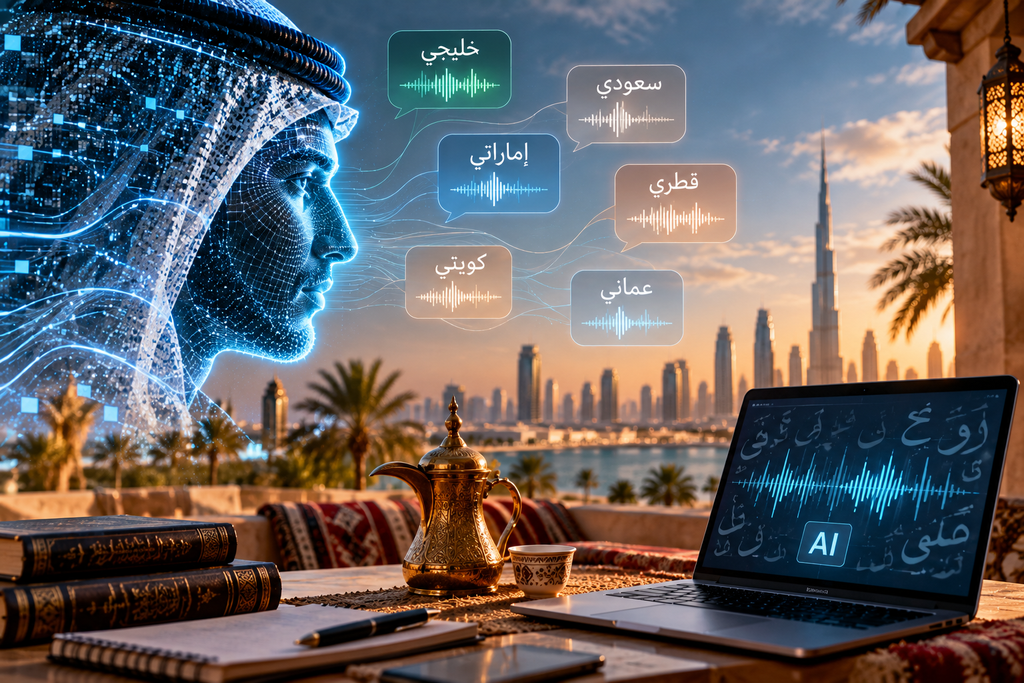
Arabic-language artificial intelligence is developing across the wider Gulf, with Saudi Arabia and Qatar pursuing their own research programmes and language models.
These initiatives aim to improve Arabic-language services while strengthening regional technical capabilities.
Saudi Arabia’s ALLaM Initiative
Saudi Arabia’s Data and Artificial Intelligence Authority, known as SDAIA, has developed ALLaM as part of the Kingdom’s efforts to expand Arabic-language AI.
The initiative focuses on generating and understanding Arabic content, including language-specific and cultural information.
Saudi Arabia has also introduced HUMAIN Chat, which reflects growing investment in locally developed generative AI.
These developments could support digital government services, education, business operations and customer communication.
However, Saudi dialect diversity presents challenges.
Speech from Riyadh, Jeddah, the Eastern Province and southern regions may contain different vocabulary, pronunciation and conversational conventions.
A model performing well on one regional variety may not perform equally well on another.
Qatar’s Fanar AI Platform
Qatar Computing Research Institute, part of Hamad Bin Khalifa University, developed Fanar as an Arabic-focused generative AI platform.
Fanar 2.0 introduced a 27-billion-parameter language model, replacing the earlier nine-billion-parameter core.
The updated platform includes capabilities for Arabic text generation, dialect understanding, speech processing, translation and other tasks.
Research published in March 2026 reported improvements in Arabic-language benchmarks, including dialect-related evaluations.
Fanar’s broader development reflects Qatar’s interest in technology that supports Arabic language and cultural knowledge.
Why Local Development Matters
Regional AI programmes can incorporate linguistic knowledge that may be less prominent in international training datasets.
They can also create opportunities for researchers, universities and developers to work with local institutions.
However, a model developed in the Gulf is not automatically more accurate than every international alternative.
Results depend on training quality, evaluation methods and the particular language task.
Regional Arabic AI Comparison
| Country | AI Initiative | Main Objective |
|---|---|---|
| UAE | Jais 3 | Arabic language and speech capabilities |
| UAE | Falcon-Emirati | Emirati dialect understanding |
| UAE | Falcon-H1 Arabic | Arabic reasoning and dialect coverage |
| Saudi Arabia | ALLaM | Arabic generative AI |
| Saudi Arabia | HUMAIN Chat | Arabic-focused digital assistance |
| Qatar | Fanar 2.0 | Arabic language, speech and cultural understanding |
The growing number of regional systems offers opportunities for more diverse Arabic-language technology, particularly when developers share research and establish reliable evaluation standards.
7 Breakthroughs That Could Improve Gulf Dialect Understanding
Developing AI capable of understanding natural Gulf conversations requires progress across several technical areas.
Some improvements are already appearing in modern systems, while others remain active research challenges.
1. Training Models on Native Arabic Data
Earlier multilingual models often relied heavily on English-language material or translated datasets.
Arabic-focused research increasingly emphasises original Arabic sources.
Native-language data can preserve expressions and sentence patterns that may disappear during translation.
However, datasets must contain diverse dialects rather than disproportionately representing formal Arabic or a few major regional varieties.
2. Improving Arabic Speech Recognition
Automatic speech recognition converts spoken language into written text.
This is essential for voice assistants, transcription tools and telephone services.
Recent research demonstrates that adapting pretrained speech models to regional Arabic can improve performance.
Yet background noise, informal conversations and unfamiliar accents continue to create difficulties.
3. Understanding Code-Switching
Gulf residents frequently switch between Arabic and English within conversations.
A speaker might use Arabic sentence structure while inserting English business or technical terminology.
AI systems need to process these mixed-language interactions without incorrectly splitting or changing their meaning.
4. Recognising Local Idioms
Regional expressions can carry meanings that are not obvious from their individual words.
For example, a phrase may convey encouragement, politeness or disagreement depending on the social context.
Training AI on culturally relevant examples can help it interpret such expressions more naturally.
5. Developing Dialect-Specific Models
A general Arabic model may provide broad coverage, while a specialised model can focus on one dialect.
Falcon-Emirati illustrates this approach.
Specialised systems may improve local language performance, although developers must test whether improvements transfer to different speakers and real-world situations.
6. Combining Speech, Text and Context
Modern AI research increasingly combines different types of information.
A system processing spoken Arabic may benefit from conversational history, written text and relevant contextual details.
Such multimodal approaches could improve interpretation, provided privacy and data security are maintained.
7. Creating Better Evaluation Benchmarks
Reliable measurement is essential.
Researchers need test datasets representing different Gulf dialects, age groups, speaking environments and communication styles.
The NADI 2026 shared task addresses several Arabic speech-processing challenges, including recognition, dialect identification, translation and spoken understanding.
Seven Developments at a Glance
| Development | Potential Benefit |
|---|---|
| Native Arabic Training | Better linguistic representation |
| Improved Speech Recognition | More accurate transcription |
| Code-Switching Support | Understanding mixed-language conversations |
| Cultural Context Training | Better interpretation of idioms |
| Dialect-Specific Models | More localised responses |
| Multimodal Processing | Richer contextual understanding |
| Standardised Benchmarks | More reliable performance comparisons |
These improvements are complementary. Accurate speech recognition alone does not guarantee that an AI system correctly understands what the speaker intends.
How Arabic-Language AI Could Transform Daily Life in the Gulf
More natural Arabic-language technology could make digital services easier to use across several industries.
The benefits may be particularly important for people who prefer speaking a familiar dialect instead of using formal written instructions.
Government Services
Digital government platforms could use conversational assistants to explain procedures or help users navigate services.
A resident might ask a question in everyday Arabic rather than searching through complicated menus.
However, systems providing official information would need access to verified regulations and appropriate human support for complex cases.
Healthcare Communication
Arabic speech recognition could help clinicians transcribe conversations or prepare administrative summaries.
Dialect-aware systems may also support communication between patients and healthcare providers.
Nevertheless, medical interpretation requires exceptionally careful evaluation.
Misunderstanding symptoms, medications or instructions could create serious risks. AI-generated clinical information should be reviewed by qualified professionals.
Education and Learning
Arabic-language AI may support interactive learning, reading assistance and personalised educational explanations.
Students could ask questions in familiar language while receiving responses appropriate to their level.
These systems may also help explain differences between spoken dialects and Modern Standard Arabic.
Teachers would still need to verify accuracy and guide learning.
Media, Journalism and Content Production
Newsrooms, broadcasters and digital publishers increasingly use transcription, translation and subtitling tools.
Accurate Gulf dialect recognition could reduce the time required to prepare interviews, podcasts and video captions.
This is particularly relevant when speakers use regional expressions or switch between Arabic and English.
Human editors remain essential for checking names, quotations, nuance and factual accuracy.
Customer Service and Business
Companies may use dialect-aware AI to improve customer support.
A system that understands how customers naturally describe problems could make interactions more convenient.
However, businesses must ensure customers can reach human representatives when automated responses are inaccurate or insufficient.
Potential Industry Applications
| Sector | Possible Application |
|---|---|
| Government | Conversational digital services |
| Healthcare | Assisted documentation |
| Education | Arabic learning tools |
| Journalism | Transcription and subtitles |
| Banking | Customer assistance |
| Tourism | Regional-language information |
| Retail | Personalised customer support |
The commercial value will depend on reliability, accessibility, user trust and whether the technology solves genuine communication problems.
Challenges, Cultural Accuracy and Data Privacy in Arabic AI
Despite rapid progress, important limitations remain.
Research published in March 2026 reviewing 82 studies on Arabic and Saudi dialect speech recognition identified persistent problems involving limited datasets, uneven dialect representation and inconsistent evaluation methods.
These challenges help explain why performance in demonstrations may not always match everyday use.
Limited Dialect Training Data
Formal Arabic text is widely available through news, books and official sources.
Informal spoken dialects are harder to collect systematically.
Some regional varieties have limited publicly available recordings or consistently annotated transcripts.
As a result, models can perform differently across dialect communities.
Differences Between Written and Spoken Arabic
Everyday Arabic is often written informally, especially in messages and social media posts.
The same expression may have multiple spellings.
Speech adds other difficulties, including pronunciation, speed and background sounds.
An AI system trained mainly on written messages may therefore struggle with spontaneous voice recordings.
Cultural Misinterpretation
Language reflects relationships, humour and social expectations.
A grammatically correct translation may still miss the intention behind an expression.
AI can also produce responses that sound culturally appropriate while containing factual errors.
For sensitive topics, human verification remains necessary.
Privacy and Consent
Speech datasets may contain personal conversations, voices and identifiable information.
Developers should collect and process this material through appropriate consent, security and data-governance procedures.
Businesses deploying voice assistants should also explain how recordings are stored and used.
Evaluating Performance Fairly
One benchmark score cannot describe every aspect of Arabic understanding.
A model that answers written multiple-choice questions effectively might still struggle to transcribe a noisy telephone conversation.
Similarly, accurate transcription does not necessarily mean accurate interpretation.
Important Testing Questions
- Does the model understand speakers from different Gulf countries?
- Can it handle informal pronunciation?
- Does it recognise Arabic-English code-switching?
- Can it interpret expressions without inventing meanings?
- Does it perform reliably with background noise?
- Does it protect sensitive user information?
- Can users correct mistakes or reach human support?
Transparent evaluation will be important for establishing trust in Arabic-language AI.
The Future of Arabic-Language AI and Gulf Dialects
The development of Jais 3, Falcon-Emirati, Falcon-H1 Arabic, ALLaM and Fanar demonstrates that Arabic-focused artificial intelligence is progressing beyond experimental research.
However, achieving natural and reliable conversations across Gulf dialects will require continued improvement.
More Inclusive Regional Coverage
Future systems may place greater emphasis on dialects that currently receive limited attention.
Better representation of Omani, Bahraini, Qatari, Kuwaiti and different Saudi varieties could improve accessibility.
Collaboration with local speakers and linguists will be important for collecting representative data.
Voice-First Digital Services
Speech-enabled services may become more useful as transcription and language understanding improve.
Residents could increasingly interact with technology through ordinary conversation rather than formal commands.
However, voice interfaces must remain accessible to users who prefer typing or need alternative communication methods.
Smaller, More Efficient Models
Large AI models can require substantial computing resources.
Research into smaller specialised models may allow some applications to operate with lower infrastructure requirements.
The success of these systems will depend on balancing efficiency with accuracy and reliability.
Preserving Linguistic Heritage
Arabic dialects contain expressions, oral traditions and cultural references that may not be extensively documented.
Responsible language technology could help preserve aspects of this heritage.
However, AI-generated material should not replace authentic recordings, scholarly research or community participation.
Frequently Asked Questions
Can AI understand Gulf Arabic today?
Yes, some modern systems can understand and generate Gulf Arabic to varying degrees. Accuracy depends on the dialect, task and quality of the input.
Is Gulf Arabic different from Modern Standard Arabic?
Yes. Gulf Arabic includes regional vocabulary, pronunciation and conversational structures that differ from formal Modern Standard Arabic.
Which UAE AI models support Arabic dialects?
Jais 3, Falcon-H1 Arabic and Falcon-Emirati are examples of UAE-developed systems designed to support Arabic language and dialect understanding.
What is Falcon-Emirati?
Falcon-Emirati is a seven-billion-parameter AI model introduced by Abu Dhabi’s Technology Innovation Institute in October 2026, focusing on Emirati language and culture.
Does Saudi Arabia have an Arabic AI model?
Yes. Saudi Arabia has developed Arabic-focused initiatives including ALLaM and HUMAIN Chat.
What is Qatar’s Fanar AI?
Fanar is an Arabic-focused generative AI platform developed by Qatar Computing Research Institute, with capabilities involving text, speech and cultural understanding.
Why do AI systems struggle with Arabic dialects?
Major challenges include limited training data, different pronunciations, informal spelling, code-switching and the importance of cultural context.
Will AI eventually understand every Gulf dialect perfectly?
Further improvements are possible, but perfect understanding cannot be guaranteed. Reliable performance requires ongoing testing across diverse speakers and situations.
Final Thoughts on the Future of Arabic-Language AI
Arabic-language artificial intelligence is becoming an important area of technological development across the Gulf.
The latest models demonstrate progress in language generation, speech processing and understanding regional expressions.
The UAE’s Jais and Falcon initiatives, Saudi Arabia’s ALLaM development and Qatar’s Fanar platform show that regional institutions are investing in technology designed around Arabic speakers.
However, understanding Gulf dialects requires more than recognising vocabulary.
Successful systems must interpret pronunciation, context, cultural references and the differences between regional speech varieties.
Progress will depend on more representative datasets, reliable benchmarks, privacy protections and meaningful participation from Arabic-speaking communities.
Ultimately, Arabic-Language AI has the potential to make technology more accessible and culturally relevant across the UAE and wider GCC.
Its most important achievement may not be producing perfectly formal Arabic, but allowing people to communicate naturally with digital systems in the language and dialect they use every day.
Editorial Note: This article reflects research and technology announcements available through October 27, 2026. Model capabilities and benchmark results vary by evaluation method and should not be treated as guarantees of real-world accuracy.
Do follow us on Instagram
Read More – Data Centre Water Usage: The Hidden Cost of the AI Boom in the Gulf