UAE and Saudi Arabia Indoor Farming Projects
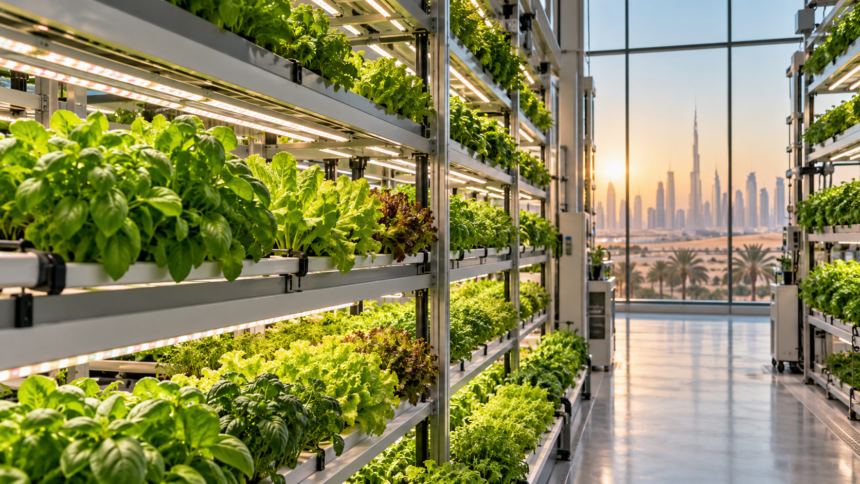
Imagine walking into a farm in Dubai where rows of fresh lettuce grow under carefully controlled lighting, without traditional agricultural soil or exposure to the harsh outdoor summer heat. Instead of relying on rainfall, the plants receive precisely measured nutrients through a water-based system, while sensors monitor temperature, humidity and growing conditions throughout the day.
- What Is Indoor Farming in the Gulf and How Does It Work?
- Why Gulf Countries Are Investing in Vertical Farming and Food Security
- 7 Benefits of Indoor Farming for Gulf Food Production
- UAE and Saudi Arabia Indoor Farming Projects: Real Examples
- The Economics of Indoor Farming: Costs, Profits and Business Opportunities
- Energy, Water and Sustainability: The Challenges Facing Indoor Agriculture
- The Future of Indoor Farming in the Gulf and Frequently Asked Questions
This is no longer simply a futuristic concept. Indoor farms are operating in parts of the Gulf, introducing a different approach to producing fresh food in one of the world’s most water-constrained regions.
For countries such as the United Arab Emirates, Saudi Arabia, Qatar and Kuwait, agriculture has always involved difficult environmental conditions. Limited rainfall, high temperatures, water scarcity and restricted arable land make conventional farming challenging for many crops.
At the same time, cities continue to grow, creating demand for fresh vegetables, herbs and other food products throughout the year.
These conditions are encouraging interest in Indoor Farming in the Gulf, an agricultural approach that uses controlled environments, advanced irrigation and technology to produce crops with less dependence on outdoor weather.
Unlike conventional agriculture, indoor farms can regulate important growing conditions. Some use stacked cultivation systems to maximise available space, while others rely on hydroponic greenhouses or smaller urban facilities.
The UAE provides a significant example through Bustanica, a large indoor vertical farm near Al Maktoum International Airport in Dubai. The facility was developed to produce more than one million kilograms of leafy greens annually while using substantially less water than conventional cultivation methods.
Saudi Arabia has also explored urban farming through projects that place growing systems directly inside supermarkets, alongside wider investment in agricultural technology.
These developments reflect a broader effort to strengthen food security and reduce vulnerabilities associated with international supply chains.
However, indoor farming is not a complete replacement for conventional agriculture or food imports. Operating costs, electricity consumption, crop selection and consumer demand create significant limitations.
The real opportunity lies in identifying which foods can be produced efficiently, which technologies are commercially practical and how indoor agriculture can complement the Gulf’s existing food supply systems.
What Is Indoor Farming in the Gulf and How Does It Work?
Indoor farming involves cultivating crops within enclosed or substantially controlled environments where growers can manage factors affecting plant development.
These systems may operate inside warehouses, purpose-built buildings, greenhouses or specially designed containers.
The broader concept is often described as controlled-environment agriculture, or CEA, because the objective is to reduce dependence on unpredictable outdoor conditions.
How Indoor Farming Differs From Traditional Agriculture
Conventional field farming depends heavily on outdoor soil, sunlight, local weather and irrigation.
Indoor growing systems can replace or supplement some of these elements through artificial lighting, nutrient delivery, climate control and automated equipment.
Growers can adjust conditions to suit particular crops, potentially improving consistency and allowing more predictable harvest schedules.
However, the additional equipment introduces expenses that ordinary outdoor farms may not face.
The Three Main Growing Methods
Hydroponics involves growing plants with their roots receiving nutrients through a water-based solution rather than conventional agricultural soil. Water can be collected, treated and recirculated, reducing losses in suitable systems.
Aeroponics typically suspends plant roots and delivers nutrients through a fine spray or mist. This can use water efficiently, but equipment reliability and maintenance are essential because plant roots depend on regular nutrient delivery.
Aquaponics combines aquatic animal production with plant cultivation. Water containing nutrients from the aquatic system supports plant growth after appropriate biological treatment, creating an interconnected system that requires careful management.
Indoor Farming Systems Compared
| Farming Method | How It Works | Main Consideration |
|---|---|---|
| Hydroponics | Roots receive nutrient-rich water | Water and nutrient management |
| Aeroponics | Nutrients are delivered through mist | Equipment reliability |
| Aquaponics | Fish production and plant cultivation are connected | Biological system balance |
| Vertical Farming | Crops grow on stacked levels | Lighting and cooling costs |
| Controlled Greenhouses | Growing conditions are partly regulated | Climate and energy requirements |
Vertical farming describes how growing space is arranged, while hydroponics and aeroponics describe how plants receive nutrients. A single vertical farm may use either method.
Understanding these differences is important because technologies have different costs, environmental impacts and commercial applications.
Why Gulf Countries Are Investing in Vertical Farming and Food Security
Food security is a central reason for expanding agricultural technology across the GCC.
Countries need reliable access to nutritious food, but domestic production is constrained by water availability, climate and land conditions.
Indoor farming provides one potential method of increasing local output for selected crops.
The UAE’s National Food Security Strategy 2051
The UAE’s National Food Security Strategy 2051 aims to strengthen the country’s food system through sustainable production, diversified imports and improved supply-chain resilience.
It identifies 18 principal food categories and includes initiatives supporting agricultural technology and local production.
The strategy does not suggest that the UAE should grow all its food domestically. Instead, it recognises the importance of combining different supply sources with technological development.
This distinction matters because some products can be imported more economically and sustainably than they can be produced in highly energy-intensive indoor facilities.
Saudi Arabia’s Agricultural Technology Ambitions
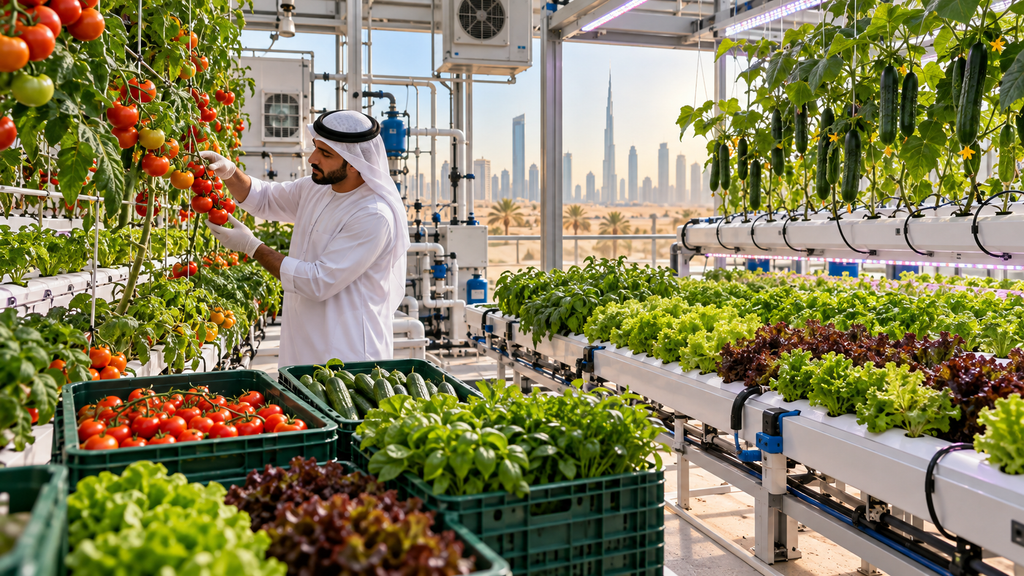
Saudi Arabia has invested in hydroponics, greenhouses and other agricultural technologies as part of its wider food-security efforts.
In February 2023, the Public Investment Fund announced a joint venture agreement with AeroFarms to develop indoor vertical farms in Saudi Arabia and the wider Middle East and North Africa region.
The announcement included plans for a facility with annual production capacity of up to 1.1 million kilograms.
This represents a planned capacity associated with the investment announcement, not automatically verified production from a completed operating facility.
Why Food Imports Still Matter
International agricultural trade allows Gulf countries to access food products that may be difficult or costly to grow locally.
However, reliance on foreign suppliers can expose importers to transportation disruptions, changes in international prices and logistical difficulties.
Producing suitable fresh crops domestically can provide an additional source of supply.
The objective is therefore greater resilience rather than complete food independence.
Food Security Priorities Compared
| Priority | Role of Indoor Farming | Remaining Challenge |
|---|---|---|
| Local Food Production | Additional fresh vegetable supply | Limited crop suitability |
| Water Conservation | Recirculating irrigation | Water treatment and losses |
| Supply-Chain Resilience | Shorter routes for selected products | Dependence on imported equipment |
| Agricultural Innovation | Research and technical employment | Specialist expertise |
| Freshness | Potentially shorter delivery times | Distribution efficiency |
| Food Affordability | Potential supply diversification | High operating costs |
The value of indoor agriculture depends on whether it improves the wider food system without creating unsustainable costs elsewhere.
7 Benefits of Indoor Farming for Gulf Food Production
The potential advantages of indoor farming are particularly relevant to hot and water-scarce environments.
However, the benefits vary considerably between growing methods, crops and facility designs.
1. Reduced Water Consumption
Recirculating irrigation systems can deliver water directly to plant roots and recover unused nutrient solution.
Bustanica reports using approximately 95% less water than comparable conventional cultivation.
This is a facility-specific claim and should not be treated as a guaranteed saving for every indoor farm.
2. Production During Hot Weather
Controlled environments can maintain suitable growing conditions even when outdoor temperatures become challenging.
This may allow certain vegetables and herbs to be produced throughout more of the year.
The advantage depends on reliable cooling and electricity.
3. Efficient Use of Growing Space
Stacked growing systems allow multiple cultivation levels within a single building.
This can increase production per unit of land for suitable crops, particularly leafy vegetables.
However, more cultivation levels generally require additional lighting and equipment.
4. More Predictable Harvests
Controlled temperature, lighting and irrigation can reduce certain weather-related variations.
Growers may be able to plan production around expected retailer or restaurant demand.
Equipment failures, disease and operational mistakes can still disrupt harvests.
5. Reduced Exposure to Some Agricultural Pests
Enclosed environments may reduce exposure to outdoor insects and other pests.
Some facilities can operate without routine pesticide applications.
Nevertheless, indoor growing systems are not automatically free from plant diseases or contamination risks.
6. Shorter Distribution Routes
Farms located near cities may deliver vegetables to supermarkets and restaurants more quickly than distant overseas suppliers.
This can support freshness and reduce some transportation requirements.
However, local production does not necessarily have a lower total carbon footprint when electricity use is high.
7. New Agricultural Careers
Indoor farming creates demand for technicians, agronomists, engineers, software specialists and production managers.
The sector combines agricultural knowledge with automation and data analysis.
Training is essential because running a controlled environment requires more than traditional planting skills.
Seven Potential Advantages
| Benefit | Potential Value | Important Limitation |
|---|---|---|
| Water Efficiency | Reduced irrigation demand | Depends on system performance |
| Climate Control | More stable growing conditions | Electricity requirements |
| Space Efficiency | Greater output per land area | Infrastructure costs |
| Consistent Production | Planned harvest cycles | Mechanical reliability |
| Pest Management | Reduced exposure to some pests | Biosecurity remains necessary |
| Local Supply | Shorter delivery routes | Energy footprint |
| Skilled Employment | New technical roles | Workforce training |
These advantages explain the growing interest in controlled-environment agriculture, but financial and environmental assessments remain necessary for each project.
UAE and Saudi Arabia Indoor Farming Projects: Real Examples
The UAE and Saudi Arabia have introduced projects showing how indoor agriculture can operate at different scales.
Some facilities serve supermarkets and food-service companies, while others explore smaller growing systems located close to consumers.
Bustanica: Large-Scale Vertical Farming in Dubai
Bustanica opened in July 2022 through a venture involving Emirates Flight Catering and Crop One.
The facility is located near Dubai World Central and covers approximately 330,000 square feet across three floors.
Its designed annual production capacity exceeds one million kilograms of leafy greens, including lettuce, spinach, kale and herbs.
The company says its hydroponic production uses approximately 15 litres of water per kilogram of produce, compared with its conventional farming benchmark of 317 litres.
Actual water consumption and environmental comparisons depend on the crops, production methods and measurement boundaries used.
In February 2024, Emirates Flight Catering acquired full ownership of Bustanica, making the business wholly UAE-owned.
Its produce has been distributed through major retail chains and Emirates’ catering operations, demonstrating a connection between commercial agriculture and established food buyers.
Saudi Arabia’s Supermarket-Based Farming
In April 2024, Saudi Arabia’s Ministry of Environment, Water and Agriculture announced an urban vertical farming project inside Danube supermarkets in Riyadh.
The concept involved compact growing units producing crops such as lettuce, parsley, coriander and broccoli.
The announcement described ambitions to expand the model across retail locations.
These were forward-looking plans, and the originally proposed number of future installations should not be interpreted as a confirmed total of operational farms.
The project illustrates an alternative to large agricultural warehouses: producing certain vegetables close to the point of sale.
The Saudi PIF and AeroFarms Partnership
Saudi Arabia’s Public Investment Fund announced an agreement with AeroFarms in February 2023 to explore large-scale indoor vertical farming.
The venture was intended to support local food production and agricultural technology development.
However, announced facilities, projected output and completed operations are different measures. Commercial success must be evaluated using verified operating results rather than planned capacity alone.
Indoor Farming Across the Wider GCC
Research focused on Kuwait has also examined whether controlled-environment agriculture could improve the availability of selected vegetables.
A study published in Sustainability in 2021 assessed the potential for indoor and vertical farming to contribute to food self-sufficiency while recognising the challenges associated with water, energy and infrastructure.
For Qatar, Bahrain and Oman, the broader principles are similar, but agricultural policies, available land and electricity costs differ.
A method that performs well in one Gulf market may require significant adaptation elsewhere.
Regional Initiatives Compared
| Project or Initiative | Country | Main Focus |
|---|---|---|
| Bustanica | UAE | Commercial-scale leafy greens |
| UAE Food Security Strategy 2051 | UAE | Local production and supply resilience |
| Danube In-Store Farming Project | Saudi Arabia | Supermarket-based vegetable growing |
| PIF–AeroFarms Partnership | Saudi Arabia | Planned large-scale vertical farming |
| Indoor Agriculture Research | Kuwait | Crop suitability and food security |
The projects show different approaches to local production, from national food strategies to individual retail experiments.
The Economics of Indoor Farming: Costs, Profits and Business Opportunities
Indoor farming can create opportunities for agricultural entrepreneurs, investors and food businesses, but commercial viability is one of the industry’s biggest challenges.
A facility may use less water or produce more crops per square metre while still struggling to cover electricity, equipment and labour expenses.
Why Indoor Farms Can Be Expensive
Many fully enclosed vertical farms require artificial lighting for plant growth.
Cooling and humidity control are also important, particularly in Gulf climates.
Other costs may include nutrient solutions, water treatment, pumps, packaging, refrigeration and technical maintenance.
Facilities with expensive automation also need sufficient sales volumes to justify their initial investment.
Which Crops Make Commercial Sense?
Leafy greens, herbs and microgreens are commonly grown indoors because they have relatively short production cycles and can command higher prices in some markets.
Tomatoes, cucumbers and strawberries can also be produced in controlled environments, although they may be more suitable for greenhouse systems depending on the climate and business model.
Staple crops such as wheat and rice generally present much greater difficulties for fully enclosed vertical farms because of their growing requirements and the value of the harvest relative to production costs.
Crop Suitability Comparison
| Crop Category | Indoor Farming Potential | Commercial Consideration |
|---|---|---|
| Lettuce and Leafy Greens | Strong technical suitability | Retail pricing |
| Culinary Herbs | Suitable for many systems | Consistent buyers |
| Microgreens | Short growing cycles | Limited market size |
| Strawberries | Possible in controlled environments | Complex growing requirements |
| Tomatoes | Suitable for some greenhouse systems | Yield and energy costs |
| Wheat and Rice | Generally unattractive for vertical farms | Low commodity value relative to costs |
Illustrative Indoor Farm Financial Model
Consider a hypothetical UAE indoor farm selling 8,000 kilograms of vegetables monthly at an average realised wholesale price of AED 14 per kilogram.
| Monthly Revenue or Expense | Illustrative Amount |
|---|---|
| Vegetable Sales | AED 112,000 |
| Electricity and Cooling | AED 24,000 |
| Employees and Specialists | AED 28,000 |
| Seeds and Nutrients | AED 9,000 |
| Packaging and Distribution | AED 13,000 |
| Rent and Maintenance | AED 21,000 |
| Administration and Other Expenses | AED 8,000 |
| Operating Surplus Before Other Costs | AED 9,000 |
These numbers are hypothetical and do not represent actual market prices, production costs or reported earnings of a Gulf farming business.
They also exclude depreciation, financing, taxes and major equipment replacement. An expensive capital investment could turn an apparent operating surplus into an overall financial loss.
The Importance of Reliable Buyers
Restaurants, supermarkets, catering companies and food distributors may offer opportunities for recurring supply agreements.
However, buyers typically expect consistent quality, dependable delivery and commercially acceptable prices.
Businesses should assess demand before investing in large production facilities.
The most sophisticated growing technology will not create a sustainable company if the produce cannot be sold profitably.
Energy, Water and Sustainability: The Challenges Facing Indoor Agriculture
Indoor farming is often described as sustainable because it can use less water and require less agricultural land.
These advantages are meaningful, but they do not automatically establish that indoor production has a lower overall environmental impact than field farming.
A proper assessment must examine the full system.
The Electricity Challenge
Artificial lighting and cooling can consume substantial electricity.
When that electricity is generated from fossil fuels, the emissions associated with indoor farming may be significant.
Research has shown that the carbon footprint of vertical farming can exceed conventional alternatives under certain operating conditions.
Performance depends on the crop, lighting efficiency, electricity mix, facility design and the production system being compared.
Water Savings Are Not the Entire Story
Hydroponic systems can reduce irrigation losses by recycling water.
This is especially valuable where freshwater is scarce.
However, water may also be used indirectly through electricity production, equipment manufacturing and other stages of the supply chain.
A meaningful environmental comparison should therefore consider both direct water use and wider resource consumption.
Renewable Energy Integration
Solar electricity could support indoor agricultural facilities across the Gulf.
However, farms need suitable lighting and climate conditions even when solar electricity is unavailable.
Grid connections, storage and operational planning remain important.
Greenhouses that use natural sunlight may offer a different balance between energy demand and environmental control than fully enclosed vertical farms.
Food Safety and Operational Reliability
Controlled environments can reduce some external contamination risks, but they still require rigorous hygiene.
Recirculated nutrient solutions must be managed carefully because contamination can spread through interconnected systems.
Equipment failures can also affect crops quickly, especially when plants depend on automated pumps and environmental controls.
Environmental Trade-Offs Compared
| Sustainability Factor | Potential Advantage | Potential Drawback |
|---|---|---|
| Water Use | Efficient recirculation | Treatment and energy requirements |
| Land Use | High production density | High construction intensity |
| Pesticides | Reduced need in suitable systems | Biosecurity still necessary |
| Transport | Close to consumers | Not always lower lifecycle emissions |
| Electricity | Can use cleaner power | High demand for lighting and cooling |
| Crop Losses | More controlled conditions | Technical failures can affect entire systems |
Why Lifecycle Assessment Matters
A lifecycle assessment evaluates environmental impacts across production, operations, transportation and other relevant stages.
This approach helps distinguish a genuinely efficient farm from one that simply uses less water while consuming substantially more electricity.
For Gulf policymakers and investors, sustainability claims should be based on measurable performance rather than promotional language.
The Future of Indoor Farming in the Gulf and Frequently Asked Questions
Indoor farming is likely to remain an important part of the Gulf’s agricultural innovation strategy.
However, its future may involve a mixture of advanced greenhouses, hydroponic facilities, urban growing systems and carefully selected fully enclosed vertical farms.
The strongest business models will depend on matching crops and production technologies to actual market requirements.
Smarter Greenhouses and Hybrid Farming
One potential direction involves combining natural sunlight with automated irrigation, climate control and selective supplementary lighting.
Such systems may reduce dependence on artificial lighting compared with fully enclosed farms.
However, greenhouse cooling can still require significant energy during Gulf summers.
Artificial Intelligence in Agriculture
Sensors and data analysis can help farmers monitor temperature, humidity, nutrient levels and crop development.
AI systems may support adjustments to growing conditions and identify equipment problems earlier.
These tools can improve operational decision-making, but their usefulness depends on accurate data, suitable algorithms and agricultural expertise.
A More Balanced Approach to Food Security
The future of Gulf food production is unlikely to depend on a single agricultural method.
Instead, indoor farming can complement conventional agriculture, imports, food storage and supply-chain diversification.
Producing more local leafy greens may improve resilience, but it cannot replace the region’s need for major quantities of grain, animal feed and other staple foods.
Practical Indoor Farming Investment Checklist
- Identify crops with dependable local demand.
- Compare vertical farming with greenhouse alternatives.
- Evaluate electricity and cooling requirements.
- Calculate water consumption per kilogram of produce.
- Secure reliable equipment and technical support.
- Confirm agricultural and food-safety requirements.
- Develop distribution and retail partnerships.
- Include equipment replacement in financial planning.
- Measure environmental performance across the full lifecycle.
- Start with realistic production and sales targets.
Frequently Asked Questions
What is indoor farming?
Indoor farming involves growing crops inside controlled environments where factors such as temperature, lighting, water and nutrients can be managed.
Why is indoor farming important in the Gulf?
The region faces water scarcity, high temperatures and limited suitable agricultural land. Indoor farming can help produce selected fresh crops under controlled conditions.
Which Gulf country has a major vertical farm?
The UAE has Bustanica, a large commercial vertical farm in Dubai designed to produce more than one million kilograms of leafy greens annually.
Does indoor farming use less water?
Many recirculating systems use substantially less irrigation water than conventional cultivation, although actual savings depend on technology and crop selection.
Is vertical farming profitable?
Some operations can be commercially viable, but profitability depends on electricity, labour, capital costs, crop prices and customer demand.
Can Saudi Arabia grow more food indoors?
Yes. Saudi Arabia has introduced urban farming initiatives and agricultural technology investment programmes, although scalability and economic performance vary by project.
Can indoor farms grow all types of food?
No. Leafy greens and herbs are often suitable, while staple grains and other low-value crops can be difficult to produce economically in fully enclosed vertical farms.
Is indoor farming always more sustainable?
Not necessarily. Water and land savings must be considered alongside electricity consumption, materials, equipment and other environmental impacts.
Will indoor farming replace food imports in the GCC?
It is unlikely to replace imports entirely. Its more realistic role is to strengthen domestic production of selected crops and diversify food supply.
Final Thoughts on Indoor Farming in the Gulf
The rise of indoor farming reflects an important shift in how Gulf countries are approaching agriculture and food security.
Instead of relying exclusively on outdoor growing conditions, producers are exploring ways to manage the environments in which crops develop.
Major initiatives in the UAE and Saudi Arabia demonstrate that controlled-environment agriculture is moving beyond experimentation and becoming part of the region’s broader food-production strategy.
However, technical success does not automatically guarantee commercial profitability or environmental sustainability.
The industry must overcome challenges involving electricity costs, cooling requirements, equipment investment and the limited range of crops that can be produced economically.
For governments, the opportunity is to develop a more resilient food system while protecting scarce water resources.
For entrepreneurs, it lies in choosing suitable technologies, securing dependable customers and building businesses capable of competing on quality and cost.
For consumers, locally grown vegetables can provide an additional choice alongside imported produce.
Ultimately, Indoor Farming in the Gulf is unlikely to transform the region into a completely self-sufficient agricultural economy.
Its greatest contribution may instead be helping Gulf countries produce more of the right foods locally, using technologies that are financially practical, resource-efficient and suited to the environment.
The future of farming in the region will depend not simply on how high crops can be stacked, but on how intelligently the entire food system can be developed.
Do follow us on Instagram
Read More – Oman’s Frankincense Industry: Can an Ancient Product Find New Global Markets?